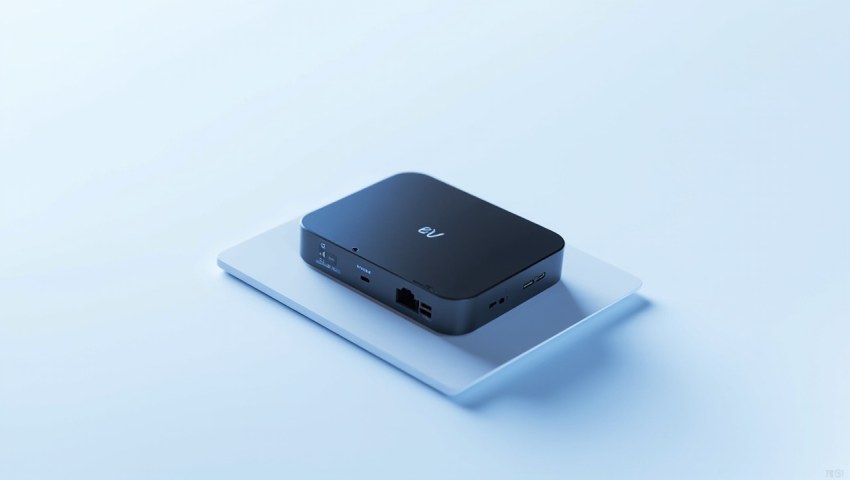
What the answer hinges on
android tv box what-is describes an Android-based television receiver whose processor, operating system, media pipeline, interfaces and software integration determine its commercial role. The decisive distinction is not a marketing label: it is the platform specification. For a 4K IPTV program, verify Android TV qualification, the exact Amlogic SoC, AOSP release, memory configuration, Widevine and PlayReady status, HDMI and Ethernet variants, then require a production-evidence package. Hardware capability without software, licensing or operator middleware is not a deployable product.
A procurement team should treat “Android TV box” as a family, not a single specification. It can mean an operator set-top box, a white-label OTT receiver, a cloud-gaming endpoint or a retail Android TV device. Each category carries different update, DRM, certification and launch constraints. The term “AOSP Android” also requires care: AOSP identifies the upstream software foundation, while Google Android TV certification, GMS licensing and operator middleware are separate commercial and compliance questions.
For the broader glossary and model index, use the Android TV box glossary and index. This page concentrates on the android tv box what-is angle: how DataMax models map to the requirements that should appear in an RFQ. The short answer is that chipset names establish the compute and codec envelope, but a release-ready device requires the OS build, protected-content path, connectivity, interfaces, test evidence and update method to match the application.
Decision rule
Do not approve a quotation from a model name alone. Freeze the SoC, OS, RAM/ROM, video formats, DRM, port configuration and certification scope before commercial comparison.
For example, a 100M Ethernet and 1G Ethernet are not interchangeable commercial lines because the latter can change the network component, verification method and site acceptance boundary. Similarly, Widevine L1 listed as optional must become an included or excluded statement before the purchase order is released. The buyer’s first task is therefore to convert loose vocabulary into testable requirements.
The most useful opening question for a supplier is not “What Android TV box do you have?” It is: “Which exact model, SoC, AOSP release, memory option, DRM configuration, output mode and destination-market qualification will be delivered under this quotation?” That answer creates a traceable baseline for sample evaluation, pilot acceptance and production inspection.
Where the terminology comes from
The platform has 5 linked layers. Each can make an otherwise similar quotation operationally different.
-
System-on-chip and CPU layer. The SoC names the integrated processing platform. Its CPU configuration provides the application baseline, while video-engine capabilities determine supported streams and frame rates. DataMax uses Amlogic S905Y4, S905Y5, S905X5 and S905X5M across the range in this comparison. Those names must be quoted exactly; substituting a visually similar chip identifier creates an engineering-review failure.
-
Operating-system layer. “AOSP Android 11” or “AOSP Android 14” identifies the software baseline, but it does not by itself establish Google Android TV device certification, GMS approval or a particular operator middleware release. AOSP is the upstream source; product differentiation comes from firmware, drivers, middleware, security policy, update service and validation scope.
-
Media layer. Codec labels describe permitted bitstream handling. AV1, VP9, H.265/HEVC, H.264 and H.266/VVC are separate decode obligations. Syntax levels and frame rates matter: “4K” alone is not an adequate commercial line. HDCP protects the output path, while Widevine L1 and PlayReady govern access to protected streaming content under their respective licensing and conformance regimes.
-
Connectivity layer. HDMI 2.0b output, USB 2.0, USB 3.0, TF, S/PDIF, analogue AV, RJ45 and Wi-Fi 6 describe physical interfaces or network paths. An “RJ45 100M” line and a “1G optional” line produce different BOM and network-test obligations. Wi-Fi 6 2x2 and Bluetooth 5.4 likewise require chipset, antenna and regulatory validation rather than a badge alone.
-
Lifecycle layer. Android TV hardware becomes commercially relevant through a controlled release: image locking, middleware integration, certification, pilot deployment, OTA procedures and production inspection. A factory can manufacture the same board and still produce materially different products through firmware configuration, licensed components, test depth and update obligations.
| Layer | Terms to specify | RFQ consequence |
|---|---|---|
| Compute | SoC, CPU, RAM/ROM | Fix silicon and memory configuration |
| Software | AOSP release, Android TV qualification, GMS scope, middleware | Separate upstream code from commercial software approval |
| Media | Codec, profile, level, resolution, frame rate, DRM, HDCP | Define playback and protected-content acceptance tests |
| Interfaces | HDMI, USB, Ethernet, AV, Wi-Fi, Bluetooth, storage | Lock connector and network configuration |
| Lifecycle | OTA, regression, certification, traceability | Require evidence and change control |
The terminology therefore describes both hardware and a controlled implementation. Asking what android tv box what-is means is incomplete without asking which layer the quotation changes.
A useful glossary distinguishes capability from entitlement. “Amlogic S905X5” identifies the processing platform, while “AV1 4K@120” identifies one decode capability. “Widevine L1” identifies a protected-content implementation requirement, while a service launch may additionally depend on the application, account model, device identity and commercial licence. “HDMI 2.0b out” identifies the output boundary, but it does not state the display mode, refresh rate, HDCP configuration or attached adaptor.
The same distinction applies to operating-system labels. AOSP Android 14 provides a source baseline and a target version, while an operator release may add launcher policy, device management, provisioning, broadcast components, recovery behaviour and service interfaces. A buyer evaluating two Android TV products should compare those layers on separate lines rather than allowing the version number to conceal meaningful differences.
Five production SKUs compared
Although the heading basis refers to 5 models, 4 DataMax production SKUs are supported by the supplied product facts: DM21P, DM21S, DM21T and DM22Q. No fifth product specification is inferred.
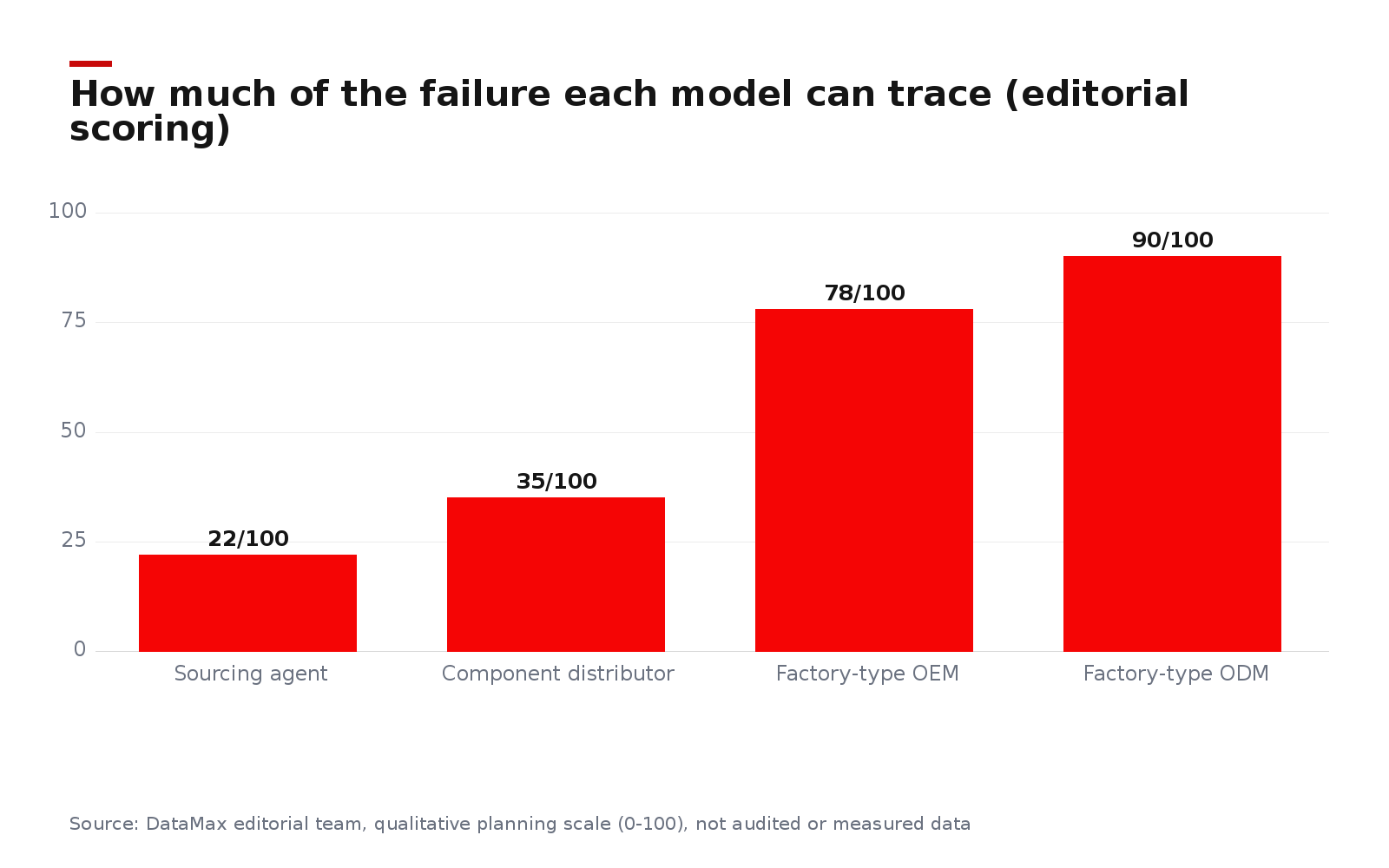
The same figures, in searchable form:
| Business route | Editorial score |
|---|---|
| Sourcing agent | 22/100 |
| Component distributor | 35/100 |
| Factory-type OEM | 78/100 |
| Factory-type ODM | 90/100 |
The chart ranks sourcing responsibility, not measured defect performance. An ODM route may offer a broader traceability chain than an agent-led purchase, but only a documented process proves that capability.
| Model | Position | SoC and CPU | Software | Memory | Decode | DRM and output | Key interfaces |
|---|---|---|---|---|---|---|---|
| DM21P | 4K IPTV / operator middleware set-top box | Amlogic S905Y4, quad Cortex-A35 | AOSP Android 11 | 2GB / 8GB; 4GB; 16/32/64GB optional | AV1 [email protected]; VP9/H.265 4K@60; H.264 4K@30 | Widevine L1 / PlayReady / HDCP 2.2 optional; HDMI 2.0b out x1 | USB2.0 x2, TF, S/PDIF, 3.5mm AV, RJ45 100M, Wi-Fi6 2x2 + BT5.4, DC 5V/2A |
| DM21S | 4K Android TV box for IPTV/OTT white-label | Amlogic S905Y5, quad Cortex-A55 | AOSP Android 14 | 2GB / 16GB; 2/4/8GB; 16/32/64GB optional | AV1 / H.265 [email protected] 4K@60 | Widevine L1 / PlayReady optional; Dolby Vision/DTS; HDMI 2.0b out | S/PDIF, AV, USB2.0 x2, TF, RJ45 100M, 1G optional, Wi-Fi6 2x2 + BT5.4 |
| DM21T | Premium UHD / cloud-gaming box | Amlogic S905X5, quad Cortex-A510 (ARMv9) | AOSP Android 14 | 4GB / 64GB family options | H.266/VVC [email protected] 4K@120; AV1/VP9/H.265 4K@120; AVS3 4K@120; H.264 4K@60; inline AI-SR | Widevine L1 / PlayReady optional; HDMI 2.0b out, no HDMI input | USB2.0 x1 + USB3.0 x1, TF, S/PDIF, AV, RJ45 100M, 1G opt, Wi-Fi6 + BT5.4 |
| DM22Q | Gaming-oriented Android TV box | Amlogic S905X5M, quad Cortex-A55 up to 2.5GHz | AOSP Android 14 | 4GB / 64GB; 2/4/8GB; 16/32/64GB optional | AV1/H.265 L5.1 4K@60; inline AI-SR; no NPU TOPS stated | Widevine L1 / PlayReady optional; Dolby Vision/DTS; HDMI 2.0b out | USB2.0 x2, TF, S/PDIF, AV, RJ45 100M, 1G opt, Wi-Fi6 2x2 + BT5.4 |
The practical differences are concentrated in the RFQ. DM21P addresses an operator middleware path on AOSP Android 11. DM21S serves an IPTV/OTT white-label requirement on AOSP Android 14. DM21T carries the most demanding 4K@120 decode list in the supplied facts and has no HDMI input. DM22Q targets gaming at 4K@60 with the S905X5M platform. None of these facts authorizes an 8K output claim; the production datasheet remains the controlling document.
Three comparison questions separate these platforms quickly. The first is operating-system baseline: AOSP Android 11 on DM21P versus AOSP Android 14 on DM21S, DM21T and DM22Q. The second is decode envelope: DM21T reaches the listed 4K@120 paths, while DM22Q reaches 4K@60 for its listed AV1 and H.265 formats. The third is interface composition: DM21T has one USB2.0 and one USB3.0, whereas the other listed models use two USB2.0 ports; DM21T also explicitly has no HDMI input.
Memory also requires exact selection. DM21P is presented as 2GB/8GB with 4GB and 16/32/64GB options; DM21S as 2GB/16GB with 2/4/8GB and 16/32/64GB options; DM21T as 4GB/64GB family options; and DM22Q as 4GB/64GB with 2/4/8GB and 16/32/64GB options. These are approved configuration points, not permission to infer availability for an unstated destination or volume.
The optional DRM entries should be treated as commercial decision gates. If a paid IPTV application requires Widevine L1, state that the quoted configuration must include it. If PlayReady is required, identify whether that licence is part of the device programme. HDCP 2.2 appears as optional for DM21P and should not appear in a DM21P acceptance statement unless the selected build confirms it.
The operator, the integrator and the venue
The same “TV box” description can support 3 deployment models, but each has a different acceptance boundary.
An operator needs a controlled firmware line, middleware integration, device identity, network management, conditional access or platform DRM dependencies, and an update path that fits operator deployment. The relevant question is not merely whether the box launches Android; it is whether the middleware image, provisioning flow and service entitlement chain remain stable across the accepted production lot.
An AV or IT integrator needs the physical interface list to match the room. HDMI output, optical audio, analogue AV, Ethernet speed, USB generation, storage and wireless options become site-level dependencies. A 100M Ethernet variant and an optional 1G variant can affect network design, while USB 3.0 on DM21T may suit a particular peripheral but cannot be assumed if the quotation names the base configuration.
A venue operator may add digital-signage duties, remote management, physical security, operating-hour recovery and support escalation. Those requirements sit beyond the supplied product facts. Confirm against the production datasheet and a project-specific acceptance schedule rather than inferring them from the SoC or Android version.
| Situation | Primary requirement | Model direction | RFQ evidence |
|---|---|---|---|
| Operator IPTV | Middleware set-top-box integration | DM21P | Image, provisioning and operator acceptance schedule |
| IPTV/OTT white label | Android 14 product identity and branding | DM21S | Boot logo, build identity, update and regional compliance scope |
| Premium UHD or cloud gaming | High-frame-rate 4K decode; no HDMI input requirement | DM21T | Format-by-format 4K@120 playback test and interface schedule |
| Gaming-oriented deployment | 4K@60 media path and gaming software baseline | DM22Q | GPU/display integration, thermal and sustained-load evidence where required |
An extreme macro image of a television mainboard makes the distinction concrete: the black package is only one component in a larger memory, PCB, power and interface system.

Thus, android tv box what-is ultimately becomes a deployment question. The commercial model narrows the possible route; the software release, middleware, certification and acceptance evidence complete it.
For an operator IPTV programme, DM21P is the clearest starting direction because its stated fit is a 4K IPTV operator middleware set-top box. The buyer should still define the provisioning sequence, entitlement path, operator image ownership and update mechanism. For an integrator designing a branded IPTV/OTT product, DM21S is the relevant direction because its stated fit includes white-label use; boot assets, packaging, UI policy and Android TV qualification must then be assigned to named parties.
A premium UHD or cloud-gaming requirement may point to DM21T, provided the project can use the listed 4K@120 decode paths and does not require HDMI input. The no-input condition is important for signal-routing diagrams and comparison with capture cards. A gaming-oriented deployment may point to DM22Q, whose stated fit and S905X5M platform provide a distinct procurement route from the premium UHD model.
The venue case exposes requirements that are not defined by the supplied facts. Digital-signage scheduling, remote fleet management, kiosk behaviour, peripheral integration and physical-security arrangements require project-specific confirmation. A broad label such as “commercial Android TV” cannot resolve them. The RFQ should identify each site dependency, its owner and the acceptance evidence before model selection is finalised.
A decision path for the RFQ
Turn the request into a sequence that prevents an attractive board from becoming an ambiguous order.
- Define the role Write one sentence naming the operator, white-label, premium UHD/cloud-gaming or gaming-oriented use. Attach the target market and required service operator.
- Freeze the platform Specify the exact DataMax model, SoC, AOSP release, RAM/ROM option and whether the product requires Google Android TV qualification or GMS.
- Define media acceptance List codec, profile, level, resolution, frame rate, HDR or audio requirement, DRM, HDCP and output version. Replace “supports 4K” with testable format lines.
- Lock the interfaces Specify HDMI quantity and input/output status, Ethernet 100M versus 1G, USB generation and count, optical and analogue audio, storage, Wi-Fi and Bluetooth.
- Attach lifecycle scope Define provisioning, OTA, middleware, localization, packaging, support escalation and the evidence required from production.
- Compare like-for-like Align every quoted line to the same model, memory option, interface option, certification scope and acceptance quantity before evaluating commercial terms.
A pasteable RFQ opening can read: “RFQ for a DataMax DM21P, Amlogic S905Y4, AOSP Android 11, 2GB/8GB configuration, operator IPTV middleware set-top-box deployment. State Widevine L1, PlayReady and HDCP 2.2 availability for the quoted configuration; HDMI 2.0b output x1; USB 2.0 x2; RJ45 100M; and target-market certification scope.”
Then add acceptance evidence: serial traceability, AOI records, aging result, RF/EMC documentation applicable to the destination market, firmware identification and packaging approval. “Optional” features need an explicit yes/no decision. For example, “RJ45 1G optional” becomes “RJ45 1G included” or “RJ45 100M included” in the purchase specification. That removes an avoidable interpretation gap.
The media line should be equally precise. A DM21T request for 4K@120 should identify the accepted codec, profile and level rather than relying on one aggregate label. Its supplied list includes H.266/VVC [email protected], AV1, VP9, H.265 and AVS3 at 4K@120, plus H.264 at 4K@60. A DM22Q request should state AV1 and H.265 L5.1 at 4K@60. These lines prevent the pilot from testing one format while the commercial specification implies a broader capability.
The interface schedule should separately identify signal output, signal input, network speed and peripheral generation. A DM21T line should note HDMI 2.0b output, no HDMI input, USB2.0 x1 and USB3.0 x1. A DM21P line should identify HDMI 2.0b out x1, USB2.0 x2 and RJ45 100M. Such explicit lines are more valuable than a shared summary saying merely “HDMI, USB and Ethernet.”
The lifecycle section should identify the firmware owner, middleware integrator, OTA service, certification owner, packaging approver and escalation route. The RFQ should state whether the buyer supplies branding assets and app identifiers, whether the factory maintains a golden build, and which changes require written approval. This turns vague terms such as “support” into accountable deliverables without presuming any unlisted DataMax capability.
The traps in this category
Most quote divergence comes from ambiguous words, not unknown technologies. The first trap is treating platform family names as complete specifications.
Field trap
A request for an “8K Amlogic Android TV box” can resolve to a 4K production platform. For DM21T, the supplied datasheet caps output and decode at 4K, including 4K@120 paths; for DM22Q, the maximum is 4K@60. Quoting 8K output creates a hardware mismatch, unrealistic acceptance criteria and avoidable rework.
The second trap is treating AOSP, Android TV and GMS as synonyms. AOSP Android 14 identifies a baseline. Android TV qualification is a device-programme question. GMS is a Google licensing and compliance question. Dolby Vision, DTS, Widevine L1 and PlayReady likewise carry separate conditions, and “optional” in the product facts must be resolved before purchase order release.
Interface shorthand creates another gap. “Wi-Fi 6” does not state spatial configuration on every model; “RJ45” does not state speed; and “USB” does not identify generation or port count. The RFQ should reproduce the exact configuration from the accepted production datasheet.
Field trap
Accepting “Wi-Fi 6, Ethernet and USB” in a summary sheet can produce a unit that misses a required antenna path, Ethernet speed or peripheral-generation target. Cost appears later as certification rework, site substitution and failed pilot acceptance.
Memory terminology is another source of drift. A listed “2GB / 8GB” is a configuration point; parenthetical options show a family range, not a default entitlement. The purchase order must state the selected RAM and ROM. Likewise, decode capability and display output are separate checks: a format may decode at a specified level while the selected output path or product configuration does not support the intended presentation mode.
A fourth failure mode is confusing codec support with application entitlement. A device can decode a stream yet still fail a protected-service workflow because the DRM configuration, service integration or device registration is incomplete. Acceptance should therefore identify the content path, display mode and expected result rather than asking only whether a codec name appears in the specification.
A fifth failure mode is comparing different physical revisions under one model name. A factory may offer alternative Ethernet, USB or memory configurations, but the quotation must identify the selected build. The buyer should obtain the production datasheet, configuration sheet and build identifier for the sample, then require the same identifiers in the production lot.
Finally, avoid treating a unit price comparison as a platform comparison. Align SoC, memory, OS, certification, middleware, test evidence and delivery configuration. Otherwise, lower-cost quotations may simply omit the protected-content, certification or connectivity obligations that the operating program requires.
How the factory controls the variable
Factory control begins before board population and continues through the delivery record. DataMax can support a video factory audit or a request for SMT/AOI/aging evidence through its factory quality and manufacturing resources.
The evidence chain should connect the approved BOM to the production lot:
- Incoming control. Verify the exact Amlogic SoC, memory components and other critical parts against the approved configuration. Capture supplier and lot traceability where the production process supports it.
- SMT and AOI. Record solder-paste, placement, soldering and automated optical inspection results for the PCB assembly. A pass is meaningful only when tied to a board revision, work instruction and inspection setup.
- Boot and firmware verification. Confirm the AOSP release, build identifier, branding, middleware image, boot animation and required services. Check that the fitted memory matches the ordered configuration.
- Aging and load testing. Exercise the unit through the approved stress and soak procedure. Retain the result against serial or lot identity; the aging plan and duration must come from the production specification rather than an improvised field rule.
- Dark-room and display validation. Perform the approved visual inspection and screen checks under dark-room conditions, including dead pixels, image uniformity, audio, HDMI output and applicable remote-control functions.
- Network and RF verification. Validate Ethernet speed, Wi-Fi, Bluetooth and applicable radio functions according to the accepted configuration and destination-market compliance plan.
- Audit and release. Review certificates, labelling, packaging, serial records and the non-conformance disposition. Freeze the production datasheet and golden sample before shipment approval.
Evidence package
Request the approved configuration, BOM revision, firmware build, board revision, SMT/AOI records, aging result, dark-room report, destination-market certification list, serial traceability and packaging approval. A factory photograph without a controlled record is not a substitute for a report.
The process also protects software variables. Change control should identify who may alter the image, boot logo, middleware, certificate state, memory configuration or interface assembly. An engineering sample that passes in a lab is not equivalent to a production line whose repeatability is demonstrated by linked evidence.
For android tv box what-is decisions, this chain converts terminology into an inspectable product definition. The buyer can then challenge a claimed Android TV box with serial-level data rather than a feature brochure.
The evidence should be tied to the actual model. A DM21P record should resolve its exact AOSP Android 11 build, 2GB/8GB base configuration and selected optional protected-content items. A DM21S record should identify AOSP Android 14 and resolve the 1G Ethernet option. A DM21T record should distinguish USB 3.0 from USB 2.0 and preserve the no-HDMI-input configuration. A DM22Q record should identify the S905X5M platform and the selected memory and DRM lines.
Inspections should also distinguish functional failure from configuration drift. If the wrong Ethernet speed is fitted, that is not corrected merely because the unit boots. If the wrong memory configuration is fitted, a boot test alone may not reveal the commercial deviation. If the expected Widevine L1 configuration is absent, protected-content acceptance can fail despite normal playback. The inspection plan therefore needs both configuration inspection and functional evidence.
For the buyer, the most efficient review is a document index tied to the order. One folder should hold the approved specification, one the factory process evidence, one the software and middleware release record, and one the destination-market compliance and packaging files. Each document should carry the same model, configuration and revision identifiers. Exceptions should be recorded with a disposition before shipment approval.
Two routes, one bill of differences
The practical choice is between an entry configuration and a commitment configuration. Both can use the listed DataMax platforms; the distinction is the depth of product freeze, integration and evidence committed before production.
| Decision line | Entry configuration | Commitment configuration |
|---|---|---|
| Model direction | DM21P or DM21S for an operator or white-label pilot | DM21T or DM22Q where the supplied decode and gaming-oriented requirements justify the platform |
| Software | AOSP baseline with agreed branding and middleware | Frozen AOSP build, middleware release, certification path and OTA process |
| Memory | Selected RAM/ROM stated on the order | Selected RAM/ROM plus BOM, configuration audit and serialized traceability |
| DRM and protected content | Availability identified per quoted configuration | Licensing scope, device conformance and application-level acceptance defined |
| Interfaces | Base port list fixed; optional 1G Ethernet resolved | Every output, input, speed, generation and peripheral requirement frozen |
| Factory evidence | Basic production and pre-shipment inspection | Linked SMT/AOI, aging, dark-room, RF and audit package by configuration |
A sourcing-agent route scores 22/100 on the editorial traceability scale shown earlier. A component distributor scores 35/100, a factory-type OEM 78/100 and a factory-type ODM 90/100. These are qualitative planning scores, not audited measurements, and the appropriate route depends on where design ownership, firmware control, component accountability and production evidence actually sit.
The entry route minimizes initial configuration work but leaves integration questions open. The commitment route consumes more definition effort before production, then reduces ambiguity during certification, pilot deployment and lifecycle management. It is normally the better fit for operator middleware, protected streaming and multi-site AV deployments.
The bill of differences is larger than the memory choice. Entry configurations can leave middleware integration, certification ownership, option resolution and evidence depth as subsequent tasks. A commitment configuration moves those decisions ahead of production and connects them to the order, firmware build and release record. The commercial comparison should therefore include the engineering and documentation workload that each route places on the operator, integrator or brand team.
For example, an IPTV white-label project can begin with DM21S for a controlled pilot, but a multi-site programme may need the 2GB/16GB configuration, selected Widevine and PlayReady availability, resolved 1G Ethernet, frozen branding and a repeatable middleware release. A cloud-gaming project can use DM21T only if the listed 4K@120 formats and absence of HDMI input fit the design. A gaming-oriented deployment can use DM22Q only after the application and sustained-load acceptance match the stated platform direction.
Ask the engineering team to review the final SKU list, target-market certificates and middleware/DRM checklist before approval. Procurement can request samples through sample ordering and route a production-specific audit request through the inquiry form. For the closing definition of android tv box what-is, email [email protected] with the frozen SKU list, target-market certification requirements, middleware/DRM checklist, interface schedule and requested factory-evidence package.
The final approval record should make the chosen route visible. State whether the order uses the entry or commitment tier, identify the exact DataMax model and options, attach the accepted production datasheet, and name the factory evidence required with the shipment. That closes the commercial gap between a feature description and an inspectable television receiver.
Further reading
- Best Android TV Box: Glossary and Index of Selection Terms
- H.265 HEVC Android TV box guide
- Widevine L1 certification guide
- Dolby Atmos Android TV box guide
- TV box vendor selection checklist
- DataMax DM21P specifications and fit
- DataMax DM21S specifications and fit
FAQ
What makes an Amlogic Android TV box commercially deployable?
A deployable unit combines an exact SoC and memory configuration with a controlled AOSP build, required Android TV certification, applicable GMS scope, operator middleware where needed, licensed DRM support, defined interfaces and production traceability. The chip establishes capability, but software conformance, certification and field acceptance establish deployability. A quotation that omits any of those elements remains a technical description rather than a purchase-ready specification.
Is AOSP Android 14 the same as Google Android TV?
No. AOSP Android 14 identifies the upstream software baseline. Google Android TV device qualification is a separate programme covering product, software and compatibility requirements. GMS is another licensing and compliance scope. Confirm whether the quotation includes Android TV certification, GMS approval or both, and identify the responsible party for each application and test stage.
Should a buyer request the optional 1G Ethernet configuration?
Request it only when the deployment path needs it. The listed DataMax configurations state RJ45 100M with 1G optional on DM21S, DM21T and DM22Q, while DM21P lists RJ45 100M. A network design, hub and operating model can make the difference operationally irrelevant, so resolve the option explicitly in the RFQ rather than leaving “optional” in the purchase order.
Why is “4K Android TV box” insufficient for acceptance?
It omits codec, profile, level, frame rate, output and DRM. The supplied models differ across AV1, VP9, H.265, H.264, H.266/VVC and AVS3 paths, with maximum frame rates that vary by model. Specify each required format and verify it through the exact firmware build, display mode and protected-content workflow used in production.
Which DataMax model fits a gaming-oriented requirement?
DM22Q is identified as the gaming-oriented Android TV box and uses the Amlogic S905X5M with quad Cortex-A55 up to 2.5GHz, AOSP Android 14 and 4GB/64GB as the listed configuration. Its supplied decode line reaches 4K@60 for AV1 and H.265. A project may prefer DM21T for its higher-frame-rate decode envelope, so confirm the application, formats, output mode and sustained-load acceptance.
What factory evidence should accompany the quotation?
Request the approved BOM and board revision, firmware build, SMT and AOI records, aging result, dark-room inspection, network/RF test records, destination-market certification list, serial traceability and packaging approval. Evidence must match the quoted model and options. DataMax can support a video factory audit or a topic-specific request for SMT/AOI/aging documentation through the factory-quality resources.
Can one DataMax model cover operator IPTV and white-label OTT?
The supplied facts identify DM21P for 4K IPTV and operator middleware and DM21S for a 4K Android TV box for IPTV/OTT white-label use. Their SoCs, CPU configurations and AOSP releases differ, as do the listed decode and optional feature sets. A procurement team should select from the stated fit rather than treating them as interchangeable; branding, middleware, DRM and interface requirements must then be frozen for the selected model.
How should a buyer resolve optional ports and protected-content features?
Convert every optional item into an explicit included-or-excluded decision. The RFQ should name the required RAM/ROM, Ethernet speed, Widevine L1, PlayReady, HDCP 2.2 and other applicable options for the exact model. Obtain the production datasheet and build record before approving samples. If a feature is neither required nor confirmed, exclude it from the purchase specification and the acceptance schedule.