AV-over-IP & Multi-Screen Distribution
Encode, decode and route 4K/8K AV across the LAN — hospitality TV, control rooms and venue signage without a matrix switch closet.

Compute Where It Is Needed
OEM/ODM ARM edge gateways and AV-over-IP engines on Rockchip RK3588 and Amlogic platforms — 4K playout, edge AI, IoT aggregation and optional 4G/5G, built for unattended 24/7 deployment in our own Shenzhen factory.
Stop sending every frame and sensor reading to the cloud. Decode, decide and distribute locally, then sync only what matters — with a fixed BOM, remote fleet management and long-lifetime supply.
The Architecture Decision
Most fleets end up hybrid. Use this fork to see which workloads belong on-premises and which still belong in the data centre.
Latency, uptime and bandwidth are decided on your premises, not in a far-away data centre.
Heavy analytics, fleet-wide ML training and storage-heavy workloads still belong in the cloud — edge boxes complement rather than replace it.
Deployment Use Cases
The same proven hardware family is fielded across media, vision, networking and self-service — choose the workload, we size the build.
Encode, decode and route 4K/8K AV across the LAN — hospitality TV, control rooms and venue signage without a matrix switch closet.
Store and render content on-device, schedule offline, and fall back gracefully when the network is busy or down.
Run NPU-accelerated inference for camera analytics, people counting and inspection without sending every frame upstream.
Aggregate Modbus, serial, GPIO and sensor traffic, normalise it locally, and forward only what the cloud needs.
Combine media playout with dual-Ethernet, optional 4G/5G cellular and Wi-Fi for a single multi-WAN edge appliance.
Locked-down always-on compute for kiosks, vending, POS and interactive displays with remote provisioning and OTA.
The unattended-site lesson
The most expensive edge project is the one that starts with a thirty-dollar streaming dongle. The hardware looks identical on a bench — same HDMI port, same Android menu — but the duty profile could not be more different. A consumer device is designed for a few evening hours a day in ventilated living rooms; an edge node runs flat-out, behind a panel, in a metal kiosk, for years, with nobody watching it.
The failure modes are predictable and repeat across every commercial vertical: heat, unrecoverable hangs, unmanageable firmware, drifting bills of materials and missing industrial interfaces. Each one turns a hardware saving into a truck-roll cost many times larger. The digital signage programme documents the same pattern from the screen side, and the quality system shows how burn-in aging and lot traceability keep these units out of field-failure reports.
The discipline extends to the chip choice. Amlogic and Rockchip platforms serve different workload tiers — the Amlogic and Rockchip guides explain the families, and the sizing table further down this page maps common workloads to the right tier.
Consumer dongles cool by convection around an intermittent viewer. Bolt one behind a 24/7 display and it throttles, freezes or dies — unattended hardware needs a metal chassis sized for constant load.
When a consumer player hangs at 2 a.m., nobody reboots it until a site visit. Industrial builds recover themselves and report the event to the fleet console.
A one-off firmware image with no OTA channel or configuration API cannot run a thousand-site fleet. Every node has to be provisionable and patchable remotely from day one.
White-box dongles swap memory, power components or even SoCs without notice. A fixed, named BOM with change control is what keeps a qualified deployment identical in year three.
HDMI out and two USB ports do not connect to Modbus, RS-485, GPIO or dual-LAN networks. Sensors and controllers need industrial interfaces on the build sheet from the start.
Cheap SD cards and bundled adapters dominate field-failure logs in signage fleets. Wide-temperature, duty-rated components and burn-in aging are the unglamorous difference uptime is made of.
The Line-Up
Flagship AV-over-IP hardware engine
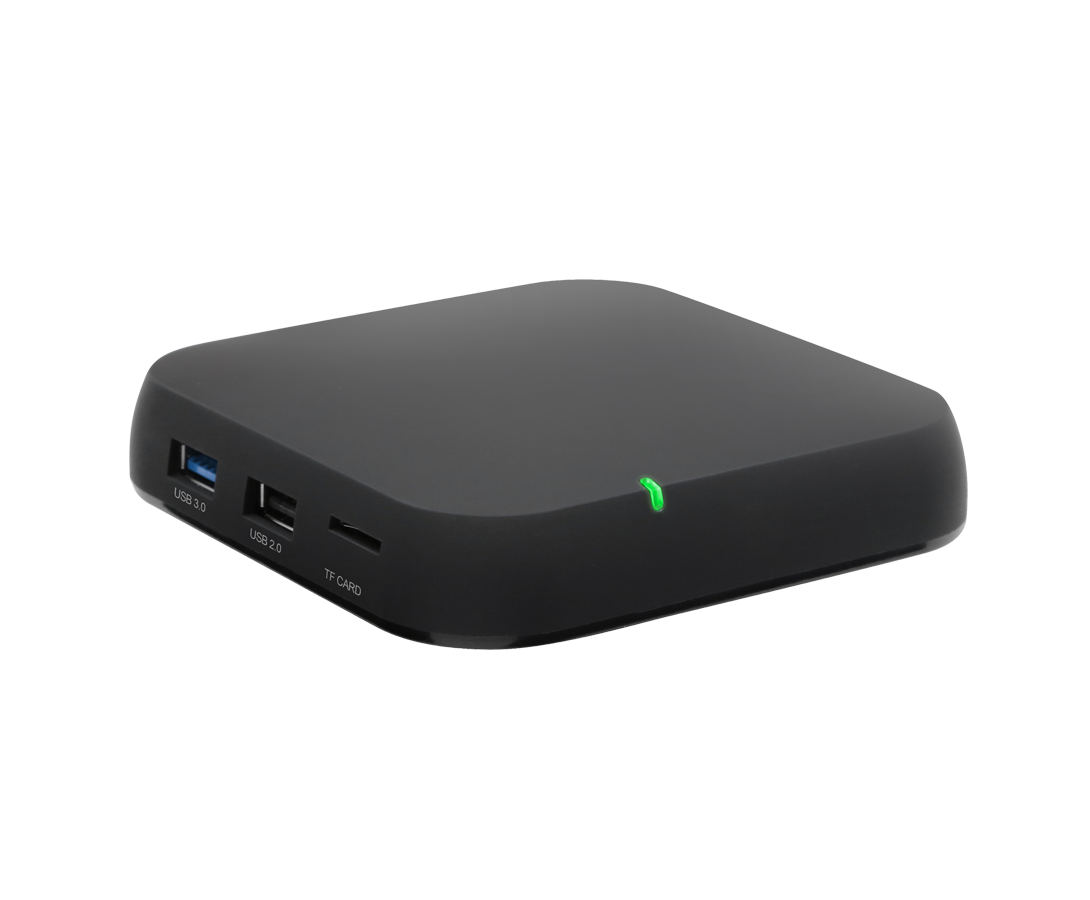
Connected 4K edge player
Efficient next-gen codec edge box
The Edge Software & Hardware Stack
An edge box is only operational once OS, remote management and I/O integration are handled. DataMax owns the hardware and bring-up and integrates cleanly with the management layer you already run.
AOSP / Android, Linux and Debian-based builds on proven Amlogic and Rockchip BSPs, so your software team picks the platform it already develops for.
Headless fleet operation with unattended provisioning, remote reboot, config push and per-device grouping across thousands of sites.
Dual Ethernet, Wi-Fi, Bluetooth and optional 4G/5G cellular give every deployment a reliable primary and fallback path.
HDMI, USB, serial UART and GPIO options connect the box to screens, sensors, controllers and industrial equipment.
Metal chassis thermal design, wide-temperature components and watchdog auto-recovery keep unattended units up around the clock.
Sizing by Workload
Over-specifying wastes budget per node; under-specifying creates the thermal and throughput failures above. These are starting tiers — engineering confirms the exact model against your application and stream counts.
| Workload | Critical requirements | Typical platform tier |
|---|---|---|
| 4K signage & media playout | 4K decode, LAN playout, scheduled offline content, low heat at constant duty | Efficient always-on tier (S905X5-class platforms) |
| AV-over-IP / multi-screen distribution | Multiple concurrent 4K streams, high codec throughput, multi-display output | Performance tier (RK3588-class AV-over-IP engines) |
| Edge AI & computer vision | NPU inference headroom, camera inputs, local event processing before upload | NPU performance tier, sized per model and frame rate |
| Industrial IoT gateway | UART / RS-232/485, GPIO, Modbus traffic, dual LAN, low steady power | Efficient tier with industrial I/O mapping |
| Sites without wired broadband | SIM data path, antenna design, 4G-LTE or 5G fallback and remote management | Connected tier (cellular-equipped builds) |
Not sure which tier your application lands in? The build-sheet step of the OEM/ODM process sizes it from your real workload, and the custom development engagement covers boards that need interfaces no standard SKU exposes.
From Workload to Field Fleet
Tell us the application, codec resolution, I/O, network and target operating conditions — we size the right SoC tier.
You receive a fixed BOM, interface map and a pre-production sample validated against your actual workload.
Housing, branding, firmware image, launcher, remote management and certifications are tailored to your deployment.
Run a pilot fleet, then scale to volume with lot traceability, OTA support and long component-lifetime supply.
Edge Buying Questions
It is a small, ruggedised ARM computer installed on-site — next to the screen, camera or machine — that processes, plays out or forwards data locally instead of sending everything to a remote cloud. DataMax edge boxes run Android or Linux and combine media playout, gateway and local-compute functions in one appliance.
A streaming player is built for consumer video apps. An edge box is built for unattended 24/7 operation: it adds industrial I/O, optional cellular, remote fleet management, watchdog recovery and thermal/long-lifetime design for commercial and industrial workloads.
We ship AOSP/Android and Linux/Debian-based images on Amlogic and Rockchip platforms. The exact OS and BSP depend on the model and your software requirements; OEM firmware can be pre-loaded with your launcher and apps.
Yes. Models such as the DM35R include a SIM slot with 4G-LTE or 5G data options, which is ideal for sites without reliable wired broadband — outdoor signage, kiosks, vehicles and temporary venues.
Logo and packaging customisation starts at a low MOQ, while new industrial design (housing/tooling) is project-based. Standard platforms can usually be branded and configured quickly; contact us with your quantity and target market for an exact build sheet.
Every unit uses a metal thermal chassis, wide-duty components and watchdog auto-recovery, and runs through burn-in aging and functional testing before shipment. Lot traceability and OTA support keep deployed fleets maintainable.
Yes. Beyond HDMI and USB, builds can expose UART/RS-232/RS-485 and GPIO for industrial sensors and controllers. Interface mapping is confirmed during the build-sheet and sample stage.
Use the inquiry form and tell us the workload, resolution, I/O, connectivity and quantity. We reply within 24 hours with the recommended platform, a datasheet and pricing options tailored to your project.
Usually yes. Most fleet teams already standardise on an MDM or RMM console, and the edge box is built to be managed: unattended provisioning, remote reboot, configuration push, grouping and signed OTA are exposed for your platform to drive rather than replaced by a lock-in portal. During scoping we confirm the protocol and agent your console requires on the chosen OS image, validate it on a sample, and keep that integration on the SKU-named firmware branch for the life of the deployment.
Linux and Debian-based builds ship on proven Amlogic or Rockchip board-support packages with the kernel, bootloader and driver baseline documented for the exact model. OEM engagements define the support window up front: how long the BSP branch is maintained, how security patches and kernel fixes are delivered, what source or headers are provided under the applicable licences, and how component end-of-life is handled with a migration path. Because edge fleets run for years, that lifecycle schedule is agreed before the purchase order — the same fixed-BOM discipline explained on the manufacturer page.
Start Your Edge Project
Send your application, resolution, I/O, connectivity and quantity. Our engineering team replies within 24 hours with a recommended platform, datasheet and OEM build options.
Subscribe to our newsletter and be the first to know about new products, OEM/ODM tips, exclusive offers, and factory updates.