
Before the terminology: choose the support model first
If the device is a fixed operator deployment with controlled middleware, ask for a named BSP branch and kernel maintenance window. If the product is sold under multiple brands, ask instead how every customer image is identified, tracked, and updated. The direct answer to android tv box BSP and kernel support questions is not simply “newest Android”: the buyer must identify the exact board, chipset, OS baseline, kernel branch, binary provenance, patch ownership, and update commitment before comparing quotations.
Most readers sit on the operator or integrator side of this fork. A fixed deployment favors release discipline and repeatable images; a white-label program favors source access, image isolation, variant control, and migration support. These are different procurement outcomes even when both boxes run AOSP Android.
The term “BSP” normally describes the board support package: device-specific drivers, boot configuration, hardware abstraction, media integration, peripherals, power management, and build support. “Kernel” is one layer inside that package. An updated Linux kernel may improve security or driver compatibility without changing the Android release. Conversely, an Android security patch can be backported while leaving the kernel branch unchanged. A quotation that combines those into one sentence has not established a support scope.
Ask the supplier to identify the exact kernel version, Android security patch level, build fingerprint, bootloader policy, firmware image owner, patch source, escalation route, and regression-test evidence. Also obtain the update and rollback procedure, the supported peripheral matrix, and the end-of-life record. The broader selection context is available in the canonical Android TV box for ISPs guide.
A second fork concerns requirements. If 4K IPTV playback, DRM, and operator middleware are the primary workload, codec capability and certification are central. If gaming, high-frame-rate video, or aggressive graphics performance drives the sale, thermal behaviour and sustained performance need separate validation. The same phrase “BSP support” can therefore describe two materially different contracts.
The correct RFQ response is a named software baseline, not a promise that the supplier “supports the kernel.” A buyer should be able to trace one production unit from its hardware revision to bootloader image, kernel configuration, device tree, AOSP tree, binary build, security patch, test result, and update record. Without that chain, a nominally inexpensive quotation carries integration and release risk.
Where quotations quietly diverge
BSP support quotations commonly diverge at the boundary between upstream work, downstream adaptation, and customer-owned middleware. One supplier may price Android kernel development; another may price only integration of an existing image; a third may treat middleware certification, DRM integration, operator provisioning, and field updates as separate services. The product names can match while the scope does not.
Field trap
A quotation saying “Linux kernel support included” is incomplete unless it identifies the kernel branch, supported kernel configuration, device tree, board revision, build system, and defect responsibility. Getting this wrong can turn a firmware defect into a full fleet revalidation cycle.
Another divergence is the meaning of “custom BSP.” This may mean a device tree, one peripheral driver, a boot-logo change, and a rebuilt kernel. It can also mean a maintained platform with versioned release notes, qualification records, and a defined path for Android upgrades. A change-request process operating on the latest upstream kernel is not equivalent to a controlled production branch with documented regressions.
Field trap
“Free Android upgrade” may describe source adaptation without a signed image, recovery plan, OTA orchestration, or operator acceptance test. Require the deliverable and release criteria, not the marketing verb.
DRM is another frequent source of hidden separation. Hardware support for Widevine, PlayReady, or HDCP is not the same as a licensed, provisioned, certified production image. The buyer must establish which party owns the device identity, provisioning credentials, license-server relationship, key delivery path, and certification evidence. A production release may also depend on the application’s declared codec and DRM requirements.
Codec support produces a parallel ambiguity. A hardware decoder can support a format while the selected chip, board, thermal design, driver, and firmware revision still determine reliable playback. Specify the relevant profile and level, output frame rate, container, operating system, and test conditions. Do not infer one model’s decode capability from another in the same family.
Version language needs careful treatment. “Android 14” identifies an OS generation, not a security patch level or kernel release. “Latest” has no procurement meaning because it changes without notice. The baseline should be a dated build with immutable image identifiers and a reproducible source revision.
Bootloader security and update control can also be quoted ambiguously. Verify secure-boot assumptions, rollback protection, image signing, partition layout, recovery behavior, and whether factory tooling is supplied. In operator deployments, a failed update must not create an unrecoverable unit or strand devices between firmware generations.
Finally, lifecycle language may conceal a commercial gap. A stated support period does not establish the release branch, patch scope, spare-unit period, last-time-buy mechanism, or end-of-life notice. Those must appear as separate contractual fields. A lower quotation can still be commercially appropriate for a short campaign, provided the buyer explicitly accepts the shorter operational horizon and updates the risk register accordingly.
Questions to put in the supplier review
Turn BSP assurance into an evidence request. The RFQ should require artifacts that can be traced to a production board revision, not screenshots of a development portal. The sequence below applies to an android tv box program carrying operator middleware, branded applications, or significant field volume.
- Freeze the hardware identity Record the SKU, PCB revision, SoC marking, RAM and storage configuration, board identifier, and intended regional configuration. Require the supplier to state which BSP and kernel branch applies to each combination.
- Request the software manifest Obtain the Android release, security patch level, kernel version, bootloader version, build fingerprint, source or binary deliverables, toolchain version, and signing method.
- Inspect the change-control record Review how a kernel or driver change enters the branch, who approves it, what regression suite runs, and how the build is promoted from engineering to production.
- Validate production evidence Ask for SMT, AOI, aging, dark-room, or audit records linked to the relevant production lot, together with the factory role responsible for each test.
- Run the acceptance sequence Test boot, recovery, OTA, rollback, DRM, middleware, codec, network, peripheral, and thermal behaviour on units built from the proposed production process.
- Document lifecycle ownership Name the firmware branch, patch route, escalation channel, release cadence, end-of-life notice process, and the party responsible for security response.
Evidence request: ask for the current build manifest, kernel configuration and device-tree revision, bootloader and rollback procedure, OTA test report, supported peripheral matrix, production test plan, and lifecycle/EOL statement. Require each artifact to identify the applicable board and firmware revision.
SMT and AOI records matter because software validation cannot compensate for hardware variation. Ask whether the review detects assembly defects relevant to exposed SoC, memory, power, RF, and connector populations. Aging evidence should document duration, environmental conditions, load, and failure criteria. Dark-room evidence should state which defects it is intended to reveal; it is not a substitute for RF, thermal, or software regression testing.
For a factory audit, focus on traceability rather than a tour. Follow one serial number or lot code from component issue through board assembly, firmware flashing, test disposition, and shipment release. Determine whether test logs are machine-readable, retained, and linked to the board revision and firmware build. A buyer seeking broader manufacturing assurance can request a video factory audit with the SMT, AOI, aging, and firmware-release records placed in scope.
Software evidence needs equivalent rigor. Request the procedures used for kernel patches, driver changes, Android framework changes, middleware integration, and third-party application updates. Establish whether a failed OTA returns to the prior signed image, whether recovery is accessible without network access, and how a bad image is quarantined.
The audit should also test the escalation process. Present a representative defect, such as an intermittent USB peripheral or HDMI handshake, and trace how it moves from field report to reproduction, root-cause analysis, patch, regression, and release. A named branch without traceable execution is only a label.
The comparison buyers actually make
Most comparisons divide into an entry position and a commitment position. The entry position buys a functioning image, basic integration, and supplier assistance. The commitment position buys named releases, controlled updates, evidence, migration planning, and lifecycle responsibilities. The difference is not a longer feature list; it is control over what happens after shipment.
| Criterion | Entry position | Commitment position |
|---|---|---|
| Baseline identity | Generic OS and approximate kernel description | Dated build manifest tied to board revision |
| Change scope | Best-effort fixes on request | Defined defect, patch, regression, and release workflow |
| Updates | Manual image delivery | Signed OTA, staged rollout, rollback, and reporting |
| Customer changes | Ad hoc customization | Versioned branch and customer-specific overlay |
| DRM and middleware | Integration assistance | Owner, test matrix, and acceptance responsibility defined |
| Production evidence | Basic inspection summary | Traceable build, test, and release records |
| Lifecycle | Support period stated without operational detail | EOL notice, patch route, and spares plan documented |
The entry position can suit a short promotional programme, a controlled proof of concept, or a device with a simple application. The buyer accepts greater dependence on the supplier and should limit the number of bespoke changes. The commitment position fits operator-scale or long-life deployments where image consistency, release notes, audit evidence, and predictable recovery affect operational workload.
A useful side-by-side test asks both parties to describe the same four events: a kernel security issue, a middleware incompatibility, a failed OTA, and an end-of-life revision. Clear contracts produce an intake route, reproduction environment, target release, rollback behaviour, and approval party for each event. Vague contracts use the same word—“support”—for all four.
The commitment tier may also separate development access from production authority. The supplier can own BSP source and branch maintenance while the operator owns middleware, provisioning, DRM configuration, and storefront policy. Shared ownership reduces ambiguity only if interfaces are frozen: partitions, build signing, device identity, APIs, update channels, and telemetry.
Cost evaluation should follow the control boundary. Compare engineering effort, qualification cycles, fleet update risk, support calls, branch duplication, certification work, and transition effort, not just the quoted development scope. A larger commitment may reduce recurring integration effort; an entry position may create hidden costs when each customer image diverges.
Lifecycle coverage

The same figures, in searchable form:
| Contract position | Editorial score |
|---|---|
| Undocumented | 20/100 |
| Warranty period only | 45/100 |
| Named firmware branch | 70/100 |
| EOL notice plus spares window | 92/100 |
The ordering is a planning aid, not measured performance. “Named firmware branch” lacks the operational detail that “EOL notice plus spares window” should define. Neither score substitutes for written obligations covering patch scope, last-time buy, field support, and production continuity.
Definitions a buyer cannot outsource
BSP is the integration layer between an SoC reference design and a deployable product. It commonly contains the bootloader integration, kernel source or binary, device tree, board drivers, media stack configuration, peripheral enablement, power and thermal controls, Android HAL integration, and build definitions. The exact boundary varies by supplier and project. The RFQ must define the boundary rather than rely on a generic acronym.
The Linux kernel manages hardware abstraction beneath Android. For an android tv box, relevant components may include display and HDMI drivers, Ethernet, Wi-Fi, Bluetooth, USB, audio, storage, thermal sensors, and power management. Android’s framework and applications sit above the kernel. A BSP can therefore contain unchanged vendor code, customer modifications, and board-specific adaptations at the same time.
Use the Android build fingerprint and source revision to identify a release. Request the Android security patch level separately. Both are required because the framework patch date does not reveal the complete patch state of the Linux kernel or vendor drivers. A security review should examine the actual component versions, not infer them from the application label.
Kernel configuration is part of the technical baseline. Request the configuration file, enabled modules, disabled subsystems, toolchain, compiler version, and any downstream patch series. Device-tree revisions identify board-level enablement. The bootloader determines initial chain of trust and recovery. Together they provide a more defensible release identity than a chipset name.
“Source access” also requires definition. It can mean a tarball, a Git repository, release tags, build scripts, toolchain downloads, proprietary binary blobs, documentation, and permission to modify the branch. Ask which artifacts are included, under which licence, and whether the customer can reproduce a bit-identical build. Record the signing infrastructure separately.
Update architecture determines operational risk. An OTA system needs an update server or control plane, authenticated manifests, image signing, device identity, download handling, installation policy, health reporting, staged deployment, failure thresholds, and rollback. A side-loaded image is a valid method for initial deployment but is not equivalent to fleet update control.
DRM flows involve several parties. The application requests protected playback; the CDM communicates with the applicable license service; the device presents the necessary device identity and keys; and the display path must satisfy content-protection requirements. Widevine L1, PlayReady, and HDCP are separate capabilities. Confirm production provisioning and certification status for the exact image and market.
Media capability likewise spans layers. Codec names describe standards, while profile, level, pixel format, bit depth, frame rate, output path, memory bandwidth, and thermal limits determine the working envelope. For example, AV1 Main profile at a stated level is not identical to unrestricted 4K playback across every application and output mode.
The buyer's task is to create an interface agreement. Define the board revision, kernel, bootloader, Android baseline, device tree, media configuration, signing method, update control, test coverage, ownership, and lifecycle terms. That agreement lets DataMax or another supplier respond with an implementable baseline rather than a reusable phrase.
Real DataMax platforms, field by field
The following table states only the supplied DataMax product facts. Platform fit should be confirmed against the production datasheet for the exact configuration, software image, region, and accessories.
| Model | Fit | SoC and OS | Memory | Decode | DRM | Ports |
|---|---|---|---|---|---|---|
| DM21P | 4K IPTV / operator middleware set-top box | Amlogic S905Y4, quad Cortex-A35; AOSP Android 11 | 2GB / 8GB; 4GB; 16/32/64GB optional | AV1 [email protected]; VP9/H.265 4K@60; H.264 4K@30 | Widevine L1 / PlayReady / HDCP 2.2 optional | HDMI 2.0b out x1; USB2.0 x2; TF; S/PDIF; 3.5mm AV; RJ45 100M; Wi-Fi6 2x2 + BT5.4; DC 5V/2A |
| DM21S | 4K Android TV box for IPTV/OTT white-label | Amlogic S905Y5, quad Cortex-A55; AOSP Android 14 | 2GB / 16GB; 2/4/8GB; 16/32/64GB optional | AV1 / H.265 [email protected] 4K@60 | Widevine L1 / PlayReady optional; Dolby Vision/DTS | HDMI 2.0b out; S/PDIF; AV; USB2.0 x2; TF; RJ45 100M; 1G optional; Wi-Fi6 2x2 + BT5.4 |
| DM21T | Premium UHD / cloud-gaming box | Amlogic S905X5, quad Cortex-A510 (ARMv9); AOSP Android 14 | 4GB / 64GB family options | H.266/VVC [email protected] 4K@120; AV1/VP9/H.265 4K@120; AVS3 4K@120; H.264 4K@60; inline AI-SR | Widevine L1 / PlayReady optional | HDMI 2.0b out, no HDMI in; USB2.0 x1 + USB3.0 x1; TF; S/PDIF; AV; RJ45 100M; 1G optional; Wi-Fi6 + BT5.4 |
| DM22Q | Gaming-oriented Android TV box | Amlogic S905X5M, quad Cortex-A55 up to 2.5GHz; AOSP Android 14 | 4GB / 64GB; 2/4/8GB; 16/32/64GB optional | AV1/H.265 L5.1 4K@60; inline AI-SR | Widevine L1 / PlayReady optional; Dolby Vision/DTS | HDMI 2.0b out; USB2.0 x2; TF; S/PDIF; AV; RJ45 100M; 1G optional; Wi-Fi6 2x2 + BT5.4 |
DM21P is the operator-oriented baseline in the supplied facts: AOSP Android 11, an Amlogic S905Y4 with quad Cortex-A35, and optional Widevine L1, PlayReady, and HDCP 2.2. A project requiring a later AOSP generation should not treat its OS label as interchangeable with the Android 14 models.
DM21S is positioned for IPTV or OTT white-label programmes and uses the Amlogic S905Y5 with quad Cortex-A55. Its supplied memory baseline is 2GB / 16GB, with other stated RAM and storage options. Dolby Vision and DTS appear in the DRM-related facts, but the RFQ should separate optional display and audio implementation requirements from the mandatory baseline.
DM21T is the high-frame-rate direction: the Amlogic S905X5 with quad Cortex-A510 (ARMv9) supports H.266/VVC [email protected] 4K@120, AV1/VP9/H.265 4K@120, AVS3 4K@120, and H.264 4K@60 in the supplied facts. It also includes inline AI-SR and has no HDMI in according to the product facts. Output is capped at 4K in the provided datasheet, so no 8K output claim belongs in the specification.
DM22Q uses the Amlogic S905X5M with quad Cortex-A55 up to 2.5GHz. The supplied decode facts list AV1/H.265 L5.1 4K@60 and inline AI-SR; no NPU TOPS figure is stated, so none should be inferred. Its datasheet maximum is 4K@60, despite any live marketing name.
For each platform, DataMax can act as the OEM/ODM discussion point, but the BSP deliverable remains an evidence-backed engineering choice. Request the production image identifier, kernel version, security patch level, bootloader version, build fingerprint, update method, and exact board configuration. Confirm all lifecycle and support terms against the production datasheet and contract.
Buyer situations, ranked by what they punish
Different deployment scenarios expose different weaknesses. A mistake in an operator rollout affects provisioning, middleware compatibility, and fleet updates. An integrator mistake appears in peripheral behaviour and installation time. A venue or signage deployment may fail because remote recovery, idle operation, or app compatibility is insufficient. The matrix below maps each situation to its decisive requirement and DataMax model direction.
| Situation | Primary requirement | Model direction |
|---|---|---|
| Operator IPTV deployment | • Stable middleware image • Optional DRM path • Controlled update and recovery • 100M Ethernet as listed | DM21P for the stated operator fit; DM21S for an Android 14 white-label direction |
| IPTV/OTT white-label programme | • Brand isolation • 4K@60 media baseline • Optional 1G Ethernet • Peripheral integration | DM21S |
| Premium UHD or cloud gaming | • 4K@120 decode routes • Higher-memory configuration • USB3.0 on DM21T • No HDMI-in dependency | DM21T |
| Gaming-oriented retail channel | • 4K@60 decode baseline • 4GB / 64GB supplied baseline • Dolby Vision/DTS options • Release-specific kernel validation | DM22Q |
| AV integrator with USB peripherals | • USB and AV validation • HDMI handshake testing • Stable recovery path • Explicit optional-port configuration | DM21S or DM22Q, subject to peripheral matrix |
| Venue digital-signage fleet | • Signed image control • Remote update and rollback • Android application compatibility • Hardware revision traceability | Platform selected through application, network, and lifecycle testing |
For an operator, the punishment is fleet-wide inconsistency. The same build should be tied to the same hardware revision, and updates need deterministic rollback. DRM, middleware, and provisioning responsibilities should be explicit because an image can pass generic boot tests and still fail service integration.
For an integrator, the punishment is the final site installation. A box may decode 4K yet fail with a declared USB controller, audio route, HDMI handshake, or Ethernet switch. The purchasing package should therefore include a supported peripheral matrix and an agreed compatibility-test list.
For a venue deployment, the punishment is an unattended recovery failure. The selected android tv box must support a controlled application update, resilient storage, remote observability, and a recovery path appropriate to the installation. These operational requirements may outweigh a processor-generation preference.
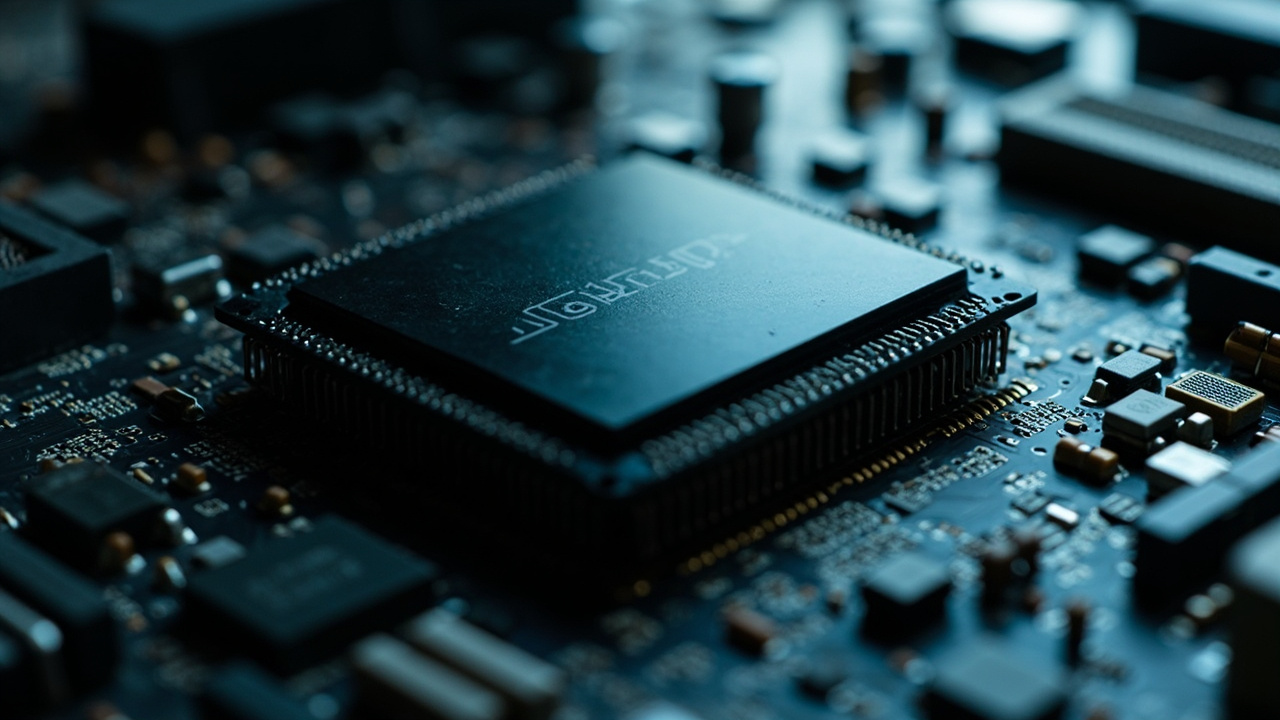
The photograph represents the hardware side of the decision: the SoC package sits within a larger board, but BSP quality depends on memory, power, connectivity, firmware, and validation around it. A processor model alone cannot establish stability.
The ranking principle is straightforward: select the scenario that can punish the programme most severely, make its requirement contractual, and then choose among platforms. Confirm production suitability against the production datasheet; do not infer thermal limits, storage endurance, operating temperature, or unlisted connectivity.
A decision path for the RFQ
Convert the conversation into a sequence of gates. Each gate removes a source of ambiguity before price comparison. The result should be a specification schedule that the supplier can quote and the buyer can test.
operator, OTT, gaming, or signage
board and model locked
Android, kernel, bootloader
OTA, rollback, evidence
patch and EOL duties
- State the workload Name resolution, frame rate, codec profiles, DRM, middleware, application distribution, networking, peripherals, and service window.
- Lock the model and board Record the exact DataMax SKU, memory configuration, port options, SoC, OS, and regional hardware variant. Confirm against the production datasheet.
- Define the software baseline Specify the Android release, security patch level, kernel version, device-tree revision, bootloader, build fingerprint, toolchain, and signing method.
- Assign operating ownership Identify who owns the BSP, middleware, DRM provisioning, application, OTA control, device identity, certification, and field escalation.
- Attach acceptance evidence Require production-unit tests, recovery and rollback results, peripheral compatibility, DRM flow, media profiles, thermal behaviour, and traceability records.
- Write lifecycle duties Add branch naming, patch route, release cadence, notice period, EOL communication, spare strategy, and last-time-buy mechanics.
Pasteable RFQ lines should be unambiguous. Use this structure:
- “Deliver the production BSP identified by board revision, Android baseline, security patch level, kernel version, device-tree revision, and bootloader version.”
- “Provide reproducible build instructions, signing responsibility, signed production images, update packages, and documented rollback procedure.”
- “Deliver a supported peripheral and codec matrix with the agreed profile, level, resolution, frame rate, and operating-mode limits.”
- “State DRM implementation, device provisioning, licence-server dependency, certification evidence, and party responsibility.”
- “Provide SMT, AOI, aging, dark-room, software test, and release-traceability evidence for the proposed production process.”
- “Define named-branch maintenance, defect severity, escalation, release cadence, end-of-life notice, and spare continuity.”
Before accepting a quotation, compare responses line by line. A supplier that cannot answer the baseline fields may still build a box, but the buyer then owns integration ambiguity. DataMax can support that review as an OEM/ODM partner; confirm the production configuration and all contractual support terms against the current production datasheet.
For additional engineering evidence, request a video factory audit or a supplier package containing SMT, AOI, aging, dark-room, firmware-build, and OTA-regression records specific to the proposed android tv box. For a structured commercial review, email [email protected] with the SKU list, target-market certificate requirements, middleware and DRM checklist, target release baseline, and required lifecycle terms.
Further reading
- Guide android tv box for isps
- Google TV devices
- AV1 Android TV box guide
- AOSP vs Google TV guide
- HDR10+ Android TV box guide
- DataMax DM21P specifications and fit
- DataMax DM21S specifications and fit
FAQ
Is BSP support the same as kernel support?
No. BSP support normally covers a wider device-specific integration package: bootloader, kernel, device tree, drivers, HALs, media integration, peripherals, and build support. Kernel support covers only the Linux layer. Require a supplier to identify the kernel version, branch, configuration, patches, and defect responsibility within the wider BSP.
Does “Android 14” tell a buyer which kernel is installed?
No. Android 14 identifies the OS generation, while the kernel version, security patch level, bootloader, device tree, and vendor patches establish the actual software baseline. Ask for immutable build identifiers and dated release documentation. Do not infer kernel currency from the Android label.
Should every operator receive the same android tv box image?
The image should be controlled, but not necessarily identical across unrelated programmes. Shared hardware can use a common validated core while customer-specific overlays hold middleware, branding, provisioning, or applications. Define which layers vary, who approves changes, and how a custom layer is tested and updated.
What evidence proves that a BSP can be maintained?
Look for a named branch, reproducible build instructions, source or binary deliverables, change records, regression results, signed update packages, rollback tests, and production traceability. A successful demonstration proves one build works; the evidence set shows whether future releases can be produced and controlled.
When should a buyer require a commitment-level BSP contract?
Require it when field volume, customer-specific software, DRM, middleware, or multi-year operation makes an uncontrolled update costly. Short campaigns can use an entry position if the buyer accepts the reduced release evidence, support scope, and lifecycle horizon. The contractual wording must match the deployment risk.


