

The myth that a spare-parts quote proves manufacturing depth
A printed component list, a factory photograph, or a quotation for replacement parts does not prove that a supplier can manufacture a stable android tv box manufacturer programme. The wrong belief is that “spare-parts availability” equals production capability. In reality, the relevant evidence is a controlled chain from component sourcing through SMT, inspection, aging, dark-room testing, firmware loading, and shipment authorization.
For repeat-volume hardware, treat the supplier as an extension of your product operations. Verify who owns the line, who buys the components, what can be substituted, how deviations are recorded, and which inspection records travel with the shipment. A genuine factory can provide those links; a trader or sourcing intermediary may coordinate them but should not be presented as the manufacturer.
DataMax is positioned here as an OEM/ODM manufacturing partner, so the evaluation below separates supplier roles, maps evidence to buyer scenarios, and compares 4 production platforms. The key distinction is simple: a spare-parts request is useful only when it proves process control behind the part. A responsible android tv box manufacturer should be able to identify the exact production baseline, not merely offer a visually similar replacement.
Decision rule: approve a supplier only after the quotation, component provenance, inspection route, firmware baseline, and shipment-release authority agree with one another. A low quotation without matching evidence is a sourcing anomaly, not a manufacturing advantage.
The practical test is a 30-minute documentary review. Ask the supplier to display one production lot’s approved BOM, one board revision, one inspection report, one aging log, and one release record. The records should share the same model, configuration, date, and production identifier. If the seller changes the model during the review, or presents generic documents that cannot be tied to the offered units, accountability remains with the trader rather than the factory.
This matters because service stock is not isolated from the original programme. A replacement board can affect boot time, network registration, remote behavior, decoding, DRM configuration, and operator middleware. The buyer is therefore validating a production system, not purchasing miscellaneous electronic parts.
The evidence trail from SMT to shipment
Factory verification starts before the first board is populated. Ask for the approved manufacturer list, authorised distributors, board revision, schematic and PCB release, BOM version, component markings, and substitution policy. The correct record identifies who sourced each constrained component and links it to the lot used in the build. For details on how these roles are commonly separated, see the android tv box manufacturer guide.
- Establish the material baseline Record PCB revision, schematic release, BOM revision, supplier part numbers, approved alternatives, firmware baseline, and the date each change became effective.
- Verify line control Review stencil, solder-paste, reflow-profile, placement, AOI or SPI, and programming records. The supplier should explain who owns each control point and how non-conforming boards are segregated.
- Test complete assemblies Require a documented functional test covering power, boot, Ethernet, Wi-Fi, Bluetooth, USB, HDMI, audio, storage, remote input, and declared decode paths. A dark-room test belongs to this stage, not to a separate “quality statement”.
- Age the product Require burn-in duration, ambient conditions, duty cycle, failure criteria, retest method, and disposition records. “Aged” without parameters is not acceptance evidence.
- Release the shipment Match the packing list, serial or lot identifiers, firmware load report, inspection summary, carton marks, and release authorization against the actual order.
The material baseline should be revision-controlled, not merely acknowledged in an email. For example, a replacement mainboard may use the same outward-facing HDMI, USB, and RJ45 connectors while changing an Ethernet component, power regulator, Wi-Fi module, memory configuration, or boot image. Require the supplier to show how the electrical schematic, BOM, PCB release, and firmware baseline are linked. If an alternate component is proposed, the record should identify the engineering rationale, validation performed, and buyer approval.
SMT evidence must connect the physical process to that baseline. Request the stencil identifier, solder-paste control record, placement program revision, reflow profile, and AOI or SPI result. For a documented line, these records should show the board and lot being processed. A high-level inspection report without machine data, line identity, or configuration can only demonstrate that inspection occurred somewhere, not that the delivered lot received the stated control.
Functional testing should be a released test instruction, not a free-form checklist assembled after a failure. The procedure should state power, boot, network association, DHCP, DNS, storage, USB, HDMI, audio, Bluetooth, remote input, declared codec playback, factory reset, and update operation where applicable. Include the expected result, instrument or fixture used, sample coverage, failure code, retest rule, and final disposition. DRM and HDCP claims require their own configuration and evidence rather than inference from successful video playback.
Audit pack to request: BOM and approved-vendor list; PCB revision; SMT placement and SPI or AOI report; reflow profile; firmware load record; functional and dark-room checklist; burn-in or aging log; non-conforming-material report; carton and packing list. Ask for samples, not only descriptions.
Aging and dark-room testing should have measurable parameters. An aging procedure identifies duration, ambient condition, load pattern, power interruptions, failure criteria, retest method, and quarantine route. A dark-room procedure identifies the test pattern, ambient illumination, display connection, inspection position, sample coverage, and rejection threshold. Without those fields, both terms remain unverified labels. The records should identify the serial or lot range and release decision so that a future RMA can be reconciled with the original test population.
A useful cross-check is to quote one spare-part requirement and walk backward. “Replacement mainboard with the same Ethernet, HDMI, USB, power, and firmware interfaces” should resolve to a board revision, component list, firmware image, test record, and approved source. If the answer remains at “we can supply it”, the evidence trail is incomplete. Repeat the exercise with one specific SoC or operator middleware configuration; a capable android tv box manufacturer should recognize the exact production line rather than answer with a catalogue substitute.
Options placed side by side
Four supplier roles can supply parts, but they carry different accountability for manufacturing outcomes. A general trader may be useful for catalogue procurement, while an OEM/ODM factory can connect engineering changes, production evidence, and shipment release. Do not confuse access to a factory with contractual ownership of the process.
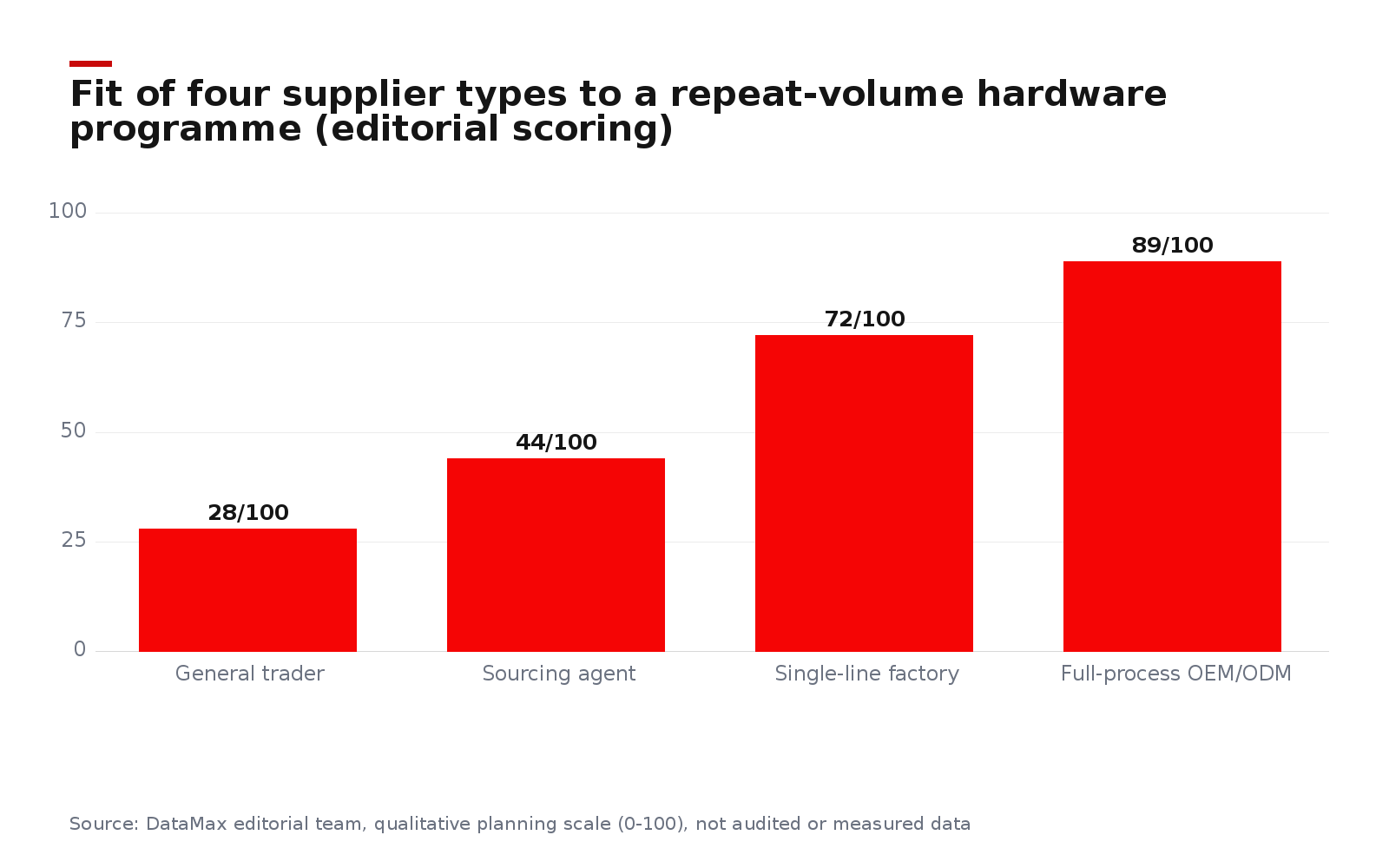
The same figures, in searchable form:
| Supplier type | Editorial score | Accountability focus |
|---|---|---|
| General trader | 28 | Part availability and transaction |
| Sourcing agent | 44 | Supplier coordination and commercial handling |
| Single-line factory | 72 | Defined production line and inspection |
| Full-process OEM/ODM | 89 | Product definition, sourcing, build, test, and release |
The scores are an editorial qualitative planning scale, not measured data. They should not be converted into audit findings. Their purpose is to expose the procurement trade-off: more manufacturing accountability usually means a deeper diligence process.
The entry tier is appropriate when the requirement is narrow, documented, and non-recurring. A general trader can satisfy a consumable or catalogue part when the buyer specifies the manufacturer, authorized sourcing route, condition, traceability, packaging, and incoming-inspection criteria. A sourcing agent becomes useful when the programme spans multiple factories or markets and the buyer needs commercial orchestration. The buyer must still name the production site and retain authority over the BOM and acceptance gate.
A single-line factory fits a repeat build of one platform when it can demonstrate control of that line. Its accountability may be strong for the product it already builds but narrow elsewhere. A full-process OEM/ODM carries more coordination work because it can connect product definition, component sourcing, hardware engineering, firmware loading, production, inspection, and shipment authorization. That model requires clearer specifications because more variables fall within its responsibility.
| Criterion | General trader | Sourcing agent | Single-line factory | Full-process OEM/ODM |
|---|---|---|---|---|
| Manufacturing authority | May not hold it | Usually coordinates it | Usually holds it for the defined line | End-to-end responsibility can be contracted |
| BOM and board-revision visibility | Part-level only | Variable by factory | Expected | Expected and controlled |
| Substitution governance | Commercial recommendation | Negotiated with factory | Factory process | Defined change-control process |
| Build and test evidence | May be unavailable | Obtained on request | Available for the line | Available across programme stages |
| Best procurement use | Documented catalogue items | Multi-supplier coordination | Repeat builds of one platform | Operator, integrator, and branded programmes |
Commercial responsibility should be attached to each evidence layer. Name the party that selects the manufacturer, the party that authorizes a substitution, the party that performs incoming inspection, and the party that can reject a lot. Then define who pays for re-testing, rework, freight, and expedited replacement after a discrepancy. Without that allocation, each party can report that the failure belongs elsewhere.
For a buyer evaluating an android tv box manufacturer, the selection is not simply direct versus indirect. It is whether the contracting structure provides one accountable chain from the approved component to the released unit. An intermediary can perform that function if the agreement makes the factory, records, approval rights, and failure remedy explicit.
Definitions a buyer cannot outsource
A spare part is not simply “the same-looking board”. It is an item governed by the same part number, revision, electrical specification, firmware compatibility, labelling, inspection method, and substitution rules as the assembly used in the original programme. Specify whether the need is RMA replacement, field service stock, production-line replenishment, or a deliberately revised revision.
“Approved vendor” means the manufacturer or franchised route through which the buyer permits the component to be sourced. The audit must identify whether the supplier is the original manufacturer, an authorised distributor, a trader, or a subcontractor. Ask for lot, date code, packaging, and traceability evidence. A genuine label reduces counterfeit risk but does not alone prove correct assembly.
“Same revision” must be tied to the PCB layout, schematic, BOM, and firmware baseline. An assembly can look identical while using a different Ethernet PHY, regulator, Wi-Fi module, memory configuration, or boot image. Conversely, a replacement can be electrically equivalent yet unacceptable if its labelling, firmware, or regulatory documents do not match the released product.
For connected products, “works” also needs a defined test boundary. Confirm boot, network association, DHCP, DNS, firmware update, HDCP output where required, Widevine or PlayReady behaviour where licensed, and operator middleware or middleware interface expectations. Protocol names such as TR-069, Android Management API, and OTA protocols apply only when the released architecture includes them; they must not be inferred from a generic Android device.
“Dark room” means controlled visual inspection of the display output under defined conditions. Require the procedure: fault patterns observed, ambient illumination, test pattern, sample coverage, and rejection rule. “Aging” means a controlled operating interval with defined load, environment, interruption behaviour, and retest rule. Without these parameters, either phrase is only a marketing label.
Certification also needs an exact scope. A report for one model, radio configuration, market, or component revision does not automatically cover another. Require the certificate or declaration identity, applicant, model coverage, target market, laboratory or issuing body, valid status, and the production part numbers it references. For Android TV products, distinguish Android CDD, CTS, GMS, and EDLA requirements when the released product actually targets those programs; do not treat them as interchangeable labels.
“Operator-ready” must be decomposed into interfaces and procedures. The android tv box manufacturer should identify the middleware image, provisioning model, identity flow, device-management dependency, boot behavior, upgrade path, operator applications, and regional network assumptions. “OTT-ready” may instead mean a white-label launcher, a particular streaming application set, remote-control behavior, and a specific firmware baseline. These definitions should be attached to the model and revision rather than left in a sales description.
An RMA replacement also has a return path. Specify whether the defective unit must be returned, how the serial or lot is linked to the original shipment, whether the replacement is new or reworked, how the old unit is dispositioned, and how no-charge replacement is authorized. A field-service stock programme may require serialized labeling and traceability; a production-line replenishment may rely on carton and lot controls. The evidence package follows the actual use case.
Finally, “equivalent” is not an acceptance criterion until the buyer defines equivalence. The comparison may cover interface, dimensions, electrical limits, radio configuration, firmware, labels, certifications, accessories, and packaging. A field engineer should be able to determine whether the replacement can be installed without modifying the original deployment process. Where any dimension or option is not confirmed against the production datasheet, the release must remain blocked.
Five production SKUs compared
The platform count is 4, despite the section basis referring to five SKUs. No fifth DataMax model is supplied, so no additional product or chipset is invented. The available production facts are compared verbatim below; confirm unresolved options against the production datasheet.
| Model | SoC and OS | RAM / storage | Decode | DRM | Ports and connectivity |
|---|---|---|---|---|---|
| DM21P | Amlogic S905Y4, quad Cortex-A35; AOSP Android 11 | 2GB / 8GB; 4GB; 16/32/64GB optional | AV1 [email protected]; VP9/H.265 4K@60; H.264 4K@30 | Widevine L1 / PlayReady / HDCP 2.2 optional | HDMI 2.0b out x1; USB2.0 x2; TF; S/PDIF; 3.5mm AV; RJ45 100M; Wi-Fi6 2x2 + BT5.4; DC 5V/2A |
| DM21S | Amlogic S905Y5, quad Cortex-A55; AOSP Android 14 | 2GB / 16GB; 2/4/8GB; 16/32/64GB optional | AV1 / H.265 [email protected] 4K@60 | Widevine L1 / PlayReady optional; Dolby Vision/DTS | HDMI 2.0b out; S/PDIF; AV; USB2.0 x2; TF; RJ45 100M; 1G optional; Wi-Fi6 2x2 + BT5.4 |
| DM21T | Amlogic S905X5, quad Cortex-A510 (ARMv9); AOSP Android 14 | 4GB / 64GB; family options | H.266/VVC [email protected] 4K@120; AV1/VP9/H.265 4K@120; AVS3 4K@120; H.264 4K@60; inline AI-SR | Widevine L1 / PlayReady optional | HDMI 2.0b out; no HDMI in; USB2.0 x1; USB3.0 x1; TF; S/PDIF; AV; RJ45 100M; 1G opt; Wi-Fi6 + BT5.4 |
| DM22Q | Amlogic S905X5M, quad Cortex-A55 up to 2.5GHz; AOSP Android 14 | 4GB / 64GB; 2/4/8GB; 16/32/64GB optional | AV1/H.265 L5.1 4K@60; inline AI-SR; no NPU TOPS stated | Widevine L1 / PlayReady optional; Dolby Vision/DTS | HDMI 2.0b out; USB2.0 x2; TF; S/PDIF; AV; RJ45 100M; 1G opt; Wi-Fi6 2x2 + BT5.4 |
Specification trap
DM21T and DM22Q must not be described as delivering 8K output. Their supplied datasheet limits are 4K. Keep the stated codec profiles and refresh rates intact when drafting an RFQ.
The DM21P direction is an operator-oriented 4K IPTV set-top box with AOSP Android 11. The DM21S fits a 4K Android TV box for IPTV/OTT white-label work on AOSP Android 14. DM21T addresses premium UHD and cloud-gaming requirements with higher stated decode capabilities, while DM22Q targets gaming-oriented Android TV use. These are fit directions, not guarantees that every certification, middleware, or interface is already approved.
For any replacement line, lock the exact model and configuration in the purchase specification. “DM21S” alone does not define storage, Ethernet speed, Dolby Vision/DTS, or the DRM configuration. That is why the DataMax production datasheet must govern, alongside the approved BOM and golden sample. Likewise, a DM21T replacement cannot inherit DM21S firmware simply because both use AOSP Android 14. The board revision, hardware population, and image compatibility must be established.
The comparison also prevents a common catalogue substitution. DM21P has a stated RJ45 100M configuration and 2GB / 8GB base memory, with specified storage options. DM21S and DM22Q have stated 4GB / 64GB configurations with optional storage ranges, and both list 1G as an option for Ethernet. DM21T is stated at 4GB / 64GB with family options. These are procurement distinctions, not proof that any unconfirmed option is available in every order.
For service continuity, record the distinguishing interfaces beside each model: DM21P includes two USB2.0 ports, TF, S/PDIF, 3.5mm AV, and DC 5V/2A; DM21S includes two USB2.0 ports, TF, S/PDIF, AV, and RJ45 100M with 1G optional; DM21T includes one USB2.0 port, one USB3.0 port, TF, S/PDIF, AV, RJ45 100M, and 1G opt, with no HDMI in; DM22Q includes two USB2.0 ports, TF, S/PDIF, AV, RJ45 100M, and 1G opt.
A spare-part request should therefore carry the full model configuration, supported interface set, and released firmware baseline. If the buyer is evaluating platforms rather than ordering an existing spare, use the AOSP versus Google Android TV guide to decide which software approach fits the programme before the BOM is frozen.
The operator, the integrator and the venue
A field photograph can create authority, but it cannot establish process control. An engineering review should put the actual prototype, PCB revision, inspection report, and firmware baseline together on the table. The scene below represents the evidence review that a procurement team should request.

The people in the room may represent different buying situations. An operator needs controlled operator middleware, identity, device management, and serviceability. An integrator may prioritize HDMI, USB, network, audio, installation method, and site integration. A venue or signage operator may need a stable configuration and repeat replenishment rather than an expansive feature set.
| Situation | Primary requirement | Evidence to request | Model direction |
|---|---|---|---|
| Pay-TV or IPTV operator | 4K operator middleware set-top box | Middleware image, provisioning procedure, identity flow, boot and update records | DM21P |
| IPTV or OTT white-label programme | 4K Android TV platform | BOM freeze, firmware baseline, DRM configuration, AOI and aging evidence | DM21S |
| Premium UHD or cloud-gaming project | Higher stated decode capability | Codec test vectors, thermal evidence, 4K@120 validation, port configuration | DM21T |
| Gaming-oriented retail or distribution project | Gaming-oriented Android TV box | Controller path, performance configuration, firmware baseline, inspection records | DM22Q |
For an operator, certification status and production consistency are one gate: a supplier cannot substitute a security component without revalidating the release. An integrator’s field failure often traces to an unrecorded board revision. A venue’s total operating risk comes from unit-to-unit variation and replenishment delays, not merely from the initial sample passing.
The operator review should include the middleware engineer, not only the purchasing manager. Trace boot from power-on, application startup, network registration, identity, entitlement or content path, remote input, settings, and upgrade. Tie each step to the released image and identify which failures return a unit to service. The manufacturer’s evidence package should show how these steps were exercised before release.
The integrator review is interface-led. Compare the physical connectors, supported resolutions and refresh rates, network speed, audio path, storage, remote requirements, and installation accessories against the original product. For a replacement board, ask for a dimensional check and a port-compatibility check against the golden unit. These are separate from electrical equivalence and must be recorded in the acceptance sheet.
A venue or digital-signage programme adds fleet consistency to the evaluation. The buyer should define whether units must share the same model, storage, network interface, firmware image, and configuration at every site. Ask for the serialisation method, carton mark, loading record, and replacement procedure. A single passing pilot cannot establish that a large installed base can be replenished consistently.
| Role | Primary concern | Best documentary evidence | Acceptance owner |
|---|---|---|---|
| Operator | Middleware, identity, updates, fleet service | Boot trace, provisioning record, middleware image hash, update test | Operator platform team |
| Integrator | Physical and logical interface compatibility | Port map, golden-unit comparison, codec test, network and audio test | Solutions engineering |
| Venue or signage operator | Configuration consistency and replenishment | Serial or lot control, carton list, loading report, approved substitution rule | Operations and procurement |
The role of DataMax in this evaluation is to expose which platform and process evidence fit the buyer’s deployment. For a broader selection method, the 4K 60fps Android TV box guide helps separate a 4K@60 requirement from higher refresh-rate claims. A project that wants direct factory accountability can review the custom-development route, while certification requirements should be mapped through the certifications page rather than inferred from a supplier’s capabilities statement.
How to choose, step by step
Start with the use case, not the supplier category. Write the operator, integrator, or venue requirement as measurable lines: exact DataMax model, SoC, OS, memory, ports, decode profile, DRM option, and the required test evidence. Then identify which part of the supply chain controls each line.
- Name the exact product State the model, storage, Ethernet configuration, DRM options, operating system, and accessory or remote requirements. For example: “DM21P, 2GB / 8GB, RJ45 100M, Widevine L1 / PlayReady, HDCP 2.2 optional.”
- Define the controlled part Add PCB revision, schematic and BOM release, firmware baseline, approved component sources, labelling, packaging, and whether substitutions are prohibited or require written approval.
- Specify the evidence package Require SPI or AOI report, reflow record, programming log, functional checklist, dark-room procedure and results, aging parameters and disposition, and final packing list.
- Define the acceptance gate State who signs the golden sample, the serialisation method, defect thresholds, sample quantity, test coverage, and the disposition rule for failed units.
- Freeze change control Require written approval for component, firmware, tooling, process, site, and sub-supplier changes. Add the revision date and named signatories to the order.
A procurement-ready RFQ should ask for “DM21S, AOSP Android 14, 2GB / 16GB, RJ45 100M, HDMI 2.0b out, USB2.0 x2, Wi-Fi6 2x2 + BT5.4, Widevine L1 / PlayReady optional; provide BOM revision, SPI or AOI report, firmware load report, functional test, dark-room test, aging log, and packing list.” Options that remain unconfirmed must be marked “confirm against the production datasheet”.
Expand the RFQ with commercial and logistics fields that otherwise become disputed after award. State the destination market, delivery point, packaging standard, carton mark, serial or lot convention, approved inspection party, documentary-report timing, and the permitted window for substitutions. For RMA stock, identify the replacement trigger, unit disposition, return procedure, and whether the replacement unit must match a newly frozen or previously released revision.
The sample request should test the uncertainty rather than merely demonstrate the hardware. If the concern is Ethernet consistency, request units that expose the relevant path. If the concern is thermal behavior during decode, state the operating condition and observation period. If the concern is operator middleware, request the exact image and provisioning procedure. A representative sample becomes useful only when the buyer records what it proves and what it leaves unresolved.
RFQ decision record: list every open configuration as a question with a named owner and required evidence. Do not convert “optional”, “similar”, “equivalent”, or “latest” into an approved configuration. A signed datasheet reference, golden unit, and change-control clause close the gap.
The first message sent through the RFQ contact form should contain the exact model, target configuration, required quantity for planning, destination market, certification scope, firmware or middleware requirement, and the evidence package expected. Alternatively, an evaluation-sample request can establish a golden sample before the production specification is frozen. A sample alone is not acceptance; it becomes the reference only after the buyer signs its configuration.
The selection record should preserve rejected options and the reason. For example, state that DM21P was selected for operator middleware, AOSP Android 11, and the stated interface set; or that DM21S was selected for a 4K IPTV/OTT white-label direction on AOSP Android 14. If the project instead requires the stated 4K@120 decode capabilities, use DM21T as the direction. For a gaming-oriented Android TV requirement, use DM22Q as the direction. These choices remain subject to the production datasheet and release evidence.
What goes wrong after the PO
The most common post-PO failure is not an outright counterfeit label. It is an uncontrolled substitution that changes the electrical or software behavior of an otherwise familiar part. The buyer receives a board that boots, but the Ethernet performance, thermal behavior, remote path, DRM path, or update process differs from the approved reference.
Field trap 1
A quotation may identify a processor family but omit the board revision, memory configuration, network component, DRM option, or firmware branch. The cost is a shipment that cannot be assembled into the same service process as the original run. Require the missing fields before approval.
A second failure is evidence collected after the problem. The supplier may send a generic factory-quality deck, an unrelated inspection report, or an “aging completed” statement without parameters. Neither proves the delivered lot was tested. Require records that identify the lot, date, line, configuration, and release decision.
Field trap 2
Do not approve a part on appearance or catalogue similarity. A mismatched board revision or firmware baseline can create RMA inventory that cannot be used in the live programme. Use the golden sample and the change-control clause to control that exposure.
Commercial divergence becomes visible after the PO when responsibility is vague. Confirm whether quoted parts are new, factory-sourced, approved-distributor-sourced, pulled, or repaired; define who owns freight, customs, test failures, firmware work, and expedited replacement. A supplier that changes origin or component status without written notice has broken the evidence chain even if the unit passes a basic boot test.
One recurring failure is configuration drift across purchase orders. A first run specifies 2GB / 16GB, while the replenishment quotation abbreviates the model name and leaves storage open. Another order changes the Ethernet option without revising the test plan. The firmware team may still load the approved image, while the hardware team interprets an optional DRAM or network component differently. The release becomes internally inconsistent even though every individual document exists.
Another failure is an incomplete audit trail after a field defect. The serial or carton mark may not identify the production lot, and the test report may list only a date range. Without a link from the returned unit to its component batch, firmware image, and inspection disposition, the buyer cannot separate a systemic lot issue from an isolated installation issue. Require traceability before shipment, not after the first RMA cluster.
Certification scope can also drift. A report that covers a related model or an earlier market revision may be attached to the wrong purchase order. The purchasing team may accept the document because it appears official, while the compliance owner has not checked the applicant, model, target market, or validity. The correction is to attach the exact report to the exact released configuration and re-review any changed component or firmware baseline.
The final control is acceptance against the signed package. Check model, memory, ports, operating system, decode limits, DRM options, packaging, labels, firmware, and lot-linked test records. DataMax’s factory-quality material provides a useful starting point, while unresolved production details must still be checked against the production datasheet and signed purchase specification. For procurement teams ready to document the requirement, the DataMax contact route can receive the RFQ and evidence matrix.
Further reading
- Guide android tv box manufacturer
- Android TV boxes
- Rockchip Android TV boxes
- Edge computing boxes
- 4K 60fps Android TV box guide
- DataMax DM21P specifications and fit
- DataMax DM21S specifications and fit
FAQ
Can a trading company be a valid spare-parts supplier?
Yes, for catalogue items with traceable sourcing, but it should not be described as the factory. Ask which original manufacturer or authorised distributor supplies the item, whether new production parts are guaranteed, and how substitutions and traceability are documented. For repeat-volume builds, contractual responsibility must remain clear.
What proof shows that a supplier controls SMT and inspection?
Request line-linked evidence: the PCB and BOM revisions, stencil and placement control, reflow profile, SPI or AOI report, programming log, functional test, dark-room test, aging log, and shipment-release record. The records must identify the configuration and production lot rather than merely demonstrate that a factory performs similar work.
Is a golden sample enough to approve spare parts?
No. A golden sample defines the expected reference, but it does not prove that each future lot matches. Combine it with a frozen BOM, board revision, firmware baseline, approved-vendor rules, inspection evidence, and written change control. Then verify that production units correspond to that signed baseline.
How should optional Ethernet and storage configurations be ordered?
State the exact configuration in the RFQ and purchase specification. For DM21S and DM21T, the supplied facts list 1G as optional; DM21P specifies RJ45 100M. Confirm storage against the production datasheet and approve the selected configuration through the golden-sample process.
What should be checked before approving an eight-kilobyte firmware file?
Firmware integrity and product compatibility are more important than file size. Match the firmware to the exact model, board revision, hardware configuration, and release baseline; verify the supplier’s programming record and boot the unit from the intended image. Approve only through the controlled release process.
What information should the first RFQ message contain?
Include the exact model, memory, ports, operating system, decode and DRM requirements, destination market, certification scope, middleware or firmware requirement, planning quantity, and requested evidence package. Send that package to DataMax and request confirmation against the production datasheet.


