
What the answer hinges on
Before approving an android tv box for a Nigerian cable operator, confirm eight items against the production configuration: video output and decode coverage, operator middleware, Google licensing status where required, DRM path, Ethernet performance, storage headroom, power/thermal behavior and the evidence available for pilot-to-shipment scale-up. The direct answer is that the operator’s billing, entitlement, channel lineup and network-management architecture determine the software scope; the chipset only becomes the differentiator after that software and certification envelope is defined.
Verification must be field-specific. A broadcast or IPTV feed should pass through the intended middleware, HDMI path and television profile, with subtitles, parental controls and channel navigation exercised. DRM must be demonstrated on the exact operator and content combination. Connectivity should be tested with the expected access network, including Wi-Fi6 fallback where wired Ethernet is unavailable. Factory evidence should include SMT inspection, aging, dark-room display checks and audit records for the production revision.
The selection is not a generic hardware comparison. For example, a purchase order that requests only “4K Android TV box with Wi-Fi” may omit the operator application, entitlement flow, device provisioning method, update authority and target display profile. Such a quotation can be technically accurate at the component level while remaining unsuitable for subscriber activation. The buyer should require each line to identify whether it describes hardware capability, supplied software, operator responsibility or a contractual acceptance condition.
This page addresses only the Nigerian cable-operator deployment angle. For the general platform decision, use the canonical Android TV box for ISPs guide; operator-grade software architecture is covered separately from hardware selection.
| Confirmation | Evidence required | Acceptance basis |
|---|---|---|
| Video profile | Test capture at the selected resolution and frame rate | Matches the agreed channel and display profile |
| Middleware | Operator build on the production OS image | Login, EPG, entitlement and playback pass |
| Licensing | Certification status for the quoted SKU | Matches the required commercial model |
| DRM | Licence and playback test using target content | Service and display path operate together |
| Connectivity | Wired and wireless site tests | Stable access to the operator platform |
| Factory control | Revision-linked inspection and aging records | Traceable from assembly through shipment |
| Recovery | Interrupted network, entitlement and reboot tests | Returns to service without re-provisioning |
| Update ownership | Named rollout, signing and support process | Failure recovery remains operable after shipment |
Entry tier versus commitment tier
The practical divide is not simply “basic” versus “premium” hardware. It is a low-change white-label terminal versus an engagement requiring deeper firmware, launcher, middleware and hardware coordination. A logo-only skin has a narrow responsibility. A joint hardware/software ODM engagement requires DataMax and the operator to define more interfaces, verification gates and change controls.
The lead-in score below uses the supplied editorial engagement scores; the value suffix is /100 and the source context remains qualitative planning data, not laboratory measurement.
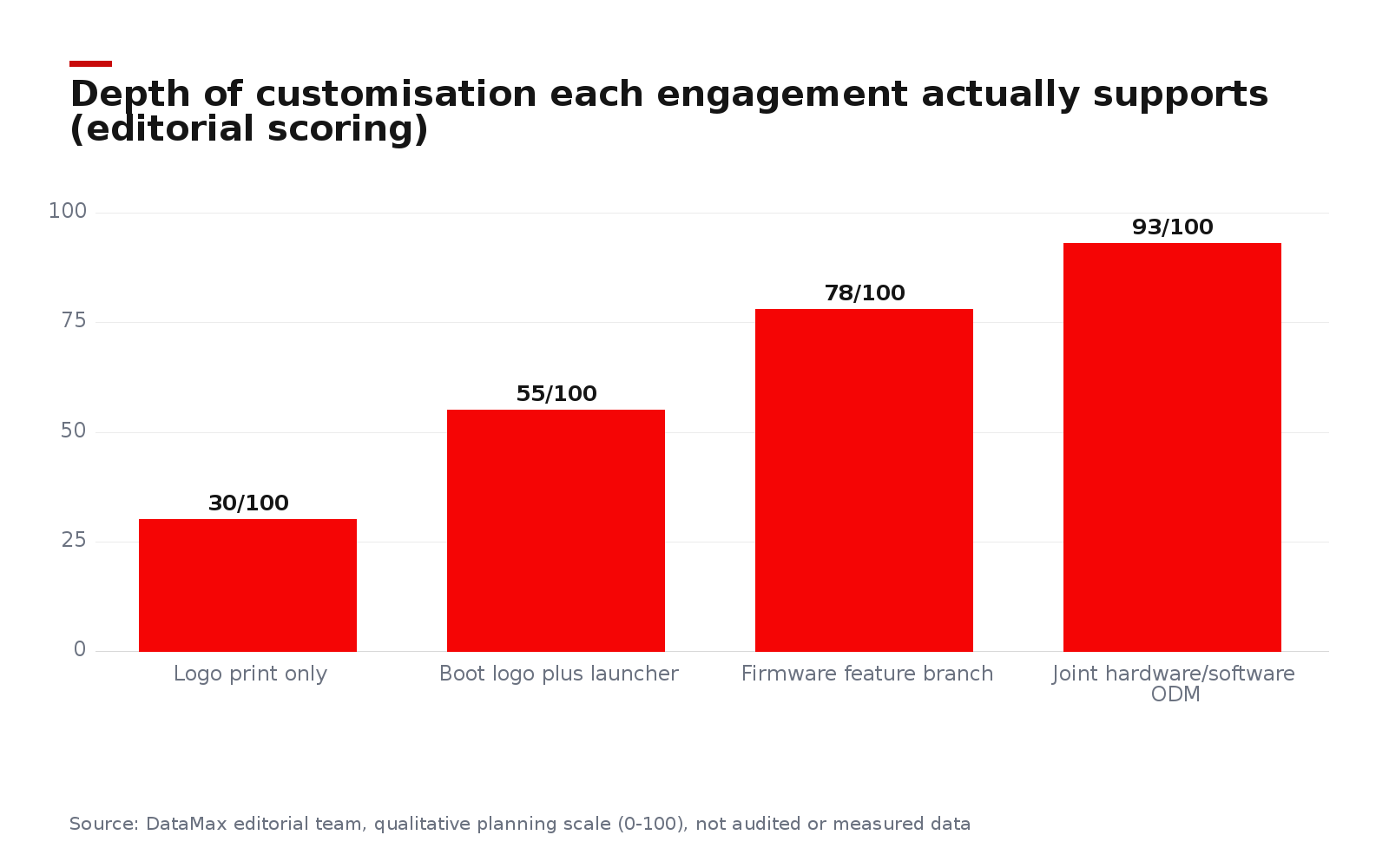
The same figures, in searchable form:
| Engagement option | Editorial score |
|---|---|
| Logo print only | 30 |
| Boot logo plus launcher | 55 |
| Firmware feature branch | 78 |
| Joint hardware/software ODM | 93 |
| Dimension | Entry tier | Commitment tier |
|---|---|---|
| Operator identity | Brand assets and launcher treatment | Brand treatment plus agreed feature differentiation |
| Software control | Defined image with standard update procedure | Operator-specific branch or coordinated image ownership |
| Middleware interface | Known launcher and device interface | Documented API, entitlement and update interfaces |
| Hardware scope | Off-the-shelf port and radio configuration | Controlled SKU changes subject to engineering review |
| Acceptance | Golden sample and batch conformity checks | Stage-gated pilot, revision traceability and change control |
| Best fit | Straightforward branded terminal program | Operator product with recurring software and device differentiation |
| Remote support | Standard documented support route | Named escalation, change window and issue ownership |
| Certification ownership | Quoted SKU status supplied as defined | Responsibility and evidence plan agreed before sample |
| Release control | Configuration-based shipment release | Operator sign-off and revision-specific release gate |
| Change impact | Mostly packaging or launcher updates | Application, image, middleware and hardware interface impacts |
For a cable operator, the entry tier can be sufficient when the operator middleware is already integrated, branding is limited and procurement values standardized delivery. The commitment tier becomes relevant when the operator requires a maintained firmware branch, custom launcher behavior, device identity integration or controlled hardware variation. The quotation must identify which tier it prices; otherwise, two responses may appear comparable while covering fundamentally different engineering scope.
A practical procurement example is a distributed TV service with a fixed launcher, regional branding and no operator-specific hardware variation. A logo-only or controlled-launcher scope may meet the requirement, provided the middleware has already been integrated and the standard update process covers the production revision. A second service with a dedicated parental-control workflow, operator diagnostics screen, custom entitlement flow and installation-state reporting needs a software branch or coordinated ODM scope. The commercial comparison must include engineering hours, validation cycles, image maintenance and change governance because those items determine the ongoing burden.
The mechanism behind the spec
An operator terminal combines 4 independent layers: the SoC and display pipeline, the AOSP-based software image, the commercial device or middleware layer, and the operator service platform. Each layer has a separate failure boundary. A decoder can support a codec without proving that the operator’s entitlement server delivers the correct licence. A bootable image can omit the required network-management component. A fast Ethernet port can still yield poor channel behaviour if the access network or platform is the constraint.
For broadcast-in-IP delivery, the access path may use multicast, unicast or a hybrid design. The terminal must be validated against the actual transport, authentication, entitlement, channel-change and time-shift functions. Remote management may rely on operator middleware, TR-069-style management or another agreed control plane; the RFQ should name the required protocol and update mechanism rather than request “remote management” generically.
DRM requires separate acceptance. Widevine L1, PlayReady and HDCP 2.2 describe different parts of the protected-content path, but the operator must confirm the service compatibility and licensing arrangement. A DRM-enabled bill of materials does not establish that the target application, operator agreement and display path will negotiate successfully. Test content and accounts therefore belong in the qualification plan.
The output specification must also separate decode from display capability. AV1, VP9, H.265 and H.264 support are not interchangeable descriptions of resolution, profile and frame rate. HDMI 2.0b output is present on the relevant models, but cable and IPTV distribution in Nigeria can involve television panels, splitters, receivers and hospitality displays with different supported modes. The pilot should use the actual display chain.
For an android tv box intended for operator use, the production image is part of the product. It should have a fixed identity, documented update route, removable-data policy, network defaults, secure boot or platform integrity expectations, operator application version, middleware version and settings baseline. A quotation that identifies only RAM, storage and codec support is incomplete for procurement.
Subscriber activation exposes the interaction between these layers. The device must obtain a trusted identity, exchange that identity with the operator platform, receive or derive entitlements, present the correct channel lineup and preserve the relevant state across restart or network interruption. An installer may then need to diagnose a failed claim without exposing subscriber data or leaving an unactivated unit in the dispatch stock.
The RFQ should state which party owns the trust boundary: operator middleware, customer premises equipment, conditional-access or entitlement server, content delivery path, application and device. For example, a test can pass because a lab entitlement server permits the unit, while a field failure results from a changed device-registration procedure. The operator must therefore identify its registration sequence, token lifetime and account-recovery rule as acceptance inputs.
A second boundary concerns update behavior. The terminal may receive an operator build, an application update and a system update through different paths. The release plan should identify signing authority, package source, rollout control, rollback behavior and responsibility after a failed update. These are operational controls rather than decorative software features, because an update interruption can strand otherwise healthy units.
Which DataMax models actually sit here
The DataMax range covers several distinct operator positions. Select by platform responsibility and certification requirement, then confirm any omitted production detail against the datasheet. The listed fields below are reproduced from the supplied product facts without extrapolation.
| Model | Fit | SoC and OS | Memory | Decode and DRM | Ports and connectivity |
|---|---|---|---|---|---|
| DM21P | 4K IPTV / operator middleware set-top box | Amlogic S905Y4, quad Cortex-A35; AOSP Android 11 | 2GB / 8GB; 4GB; 16/32/64GB optional | AV1 [email protected]; VP9/H.265 4K@60; H.264 4K@30; Widevine L1 / PlayReady / HDCP 2.2 optional | HDMI 2.0b out x1; USB2.0 x2; TF; S/PDIF; 3.5mm AV; RJ45 100M; Wi-Fi6 2x2 + BT5.4; DC 5V/2A |
| DM21RTD | Operators/retail requiring a Google-certified non-Google-TV (AOSP+GMS) SKU | Realtek RTD1325; GMS-certified AOSP | Confirm against the production datasheet | AV1 capable; other DRM details confirm against the production datasheet | Ports and connectivity confirm against the production datasheet |
| DM21S | 4K Android TV box for IPTV/OTT white-label | Amlogic S905Y5, quad Cortex-A55; AOSP Android 14 | 2GB / 16GB; 2/4/8GB; 16/32/64GB optional | AV1 / H.265 [email protected] 4K@60; Widevine L1 / PlayReady optional; Dolby Vision/DTS | HDMI 2.0b out; S/PDIF; AV; USB2.0 x2; TF; RJ45 100M with 1G optional; Wi-Fi6 2x2 + BT5.4 |
| DM21T | Premium UHD / cloud-gaming box | Amlogic S905X5, quad Cortex-A510 (ARMv9); AOSP Android 14 | 4GB / 64GB; family options | H.266/VVC [email protected] 4K@120; AV1/VP9/H.265 4K@120; AVS3 4K@120; H.264 4K@60; inline AI-SR; Widevine L1 / PlayReady optional | HDMI 2.0b out with no HDMI in; USB2.0 x1 + USB3.0 x1; TF; S/PDIF; AV; RJ45 100M with 1G opt; Wi-Fi6 + BT5.4 |
DM21P is the direct operator-middleware option when AOSP Android 11 and the listed 100M Ethernet are acceptable. Its optional memory and DRM configurations must be frozen as part of the order. DM21RTD serves the different requirement of a Google-certified non-Google-TV SKU; its exact memory, ports and DRM terms require production-datasheet confirmation.
DM21S is the current-generation white-label choice when AOSP Android 14, 4K@60 and an optional 1G Ethernet configuration fit the program. DM21T addresses higher video-format or refresh-rate requirements and offers USB3.0, but its position as a premium UHD or cloud-gaming box does not replace the operator middleware and rights work required for a Nigerian cable deployment.
No model should be described as an 8K output product because the supplied production facts cap output and decoding at 4K. For broader selection guidance, compare the operator-tier Android TV box and the AOSP versus Google Android TV distinctions. To request comparable production quotations, send the required OS, middleware, DRM, memory, connectivity and regional configuration through the inquiry form.
The ordering table prevents a misleading substitution. For example, replacing DM21S with DM21T adds no basis for assuming better operator readiness: the higher-frame-rate formats and USB3.0 do not replace middleware integration, device claiming, entitlement testing or a maintained operator image. Likewise, replacing DM21P with a newer OS model can create integration work if the operator middleware has only been qualified against AOSP Android 11.
A configuration-level example illustrates why the optional fields matter. A DM21P quote with 2GB / 8GB and Widevine L1 / PlayReady / HDCP 2.2 optional does not establish the delivered memory or DRM combination. The RFQ should identify the populated configuration. For DM21S, “RJ45 100M with 1G optional” likewise requires a decision between the standard and optional network configuration. These are not cosmetic variations because they affect device qualification, ordering and production traceability.
Where this matters in a deployment
The deployment context changes the acceptance path. A cable operator may manage subscriber authentication and entitlement directly, while an integrator may connect a terminal into a larger building or hospitality network. In both cases, the device remains part of a managed service rather than a discretionary consumer appliance.
| Situation | Primary requirement | Model direction | Field verification |
|---|---|---|---|
| • Nigerian cable operator with existing IPTV middleware | • Stable operator integration and 4K IPTV baseline | • DM21P as the direct middleware-oriented platform | • Login, entitlement, EPG, channel change and recovery test |
| • Operator or retail program requiring GMS-certified AOSP | • Google-certified non-Google-TV configuration | • DM21RTD subject to production-datasheet confirmation | • Certification record and application installation test |
| • White-label IPTV/OTT service on Android 14 | • Current OS, 4K@60 and optional 1G Ethernet | • DM21S | • Operator build, 4K output and access-network soak test |
| • Premium video or cloud-gaming offer | • Higher codec/frame-rate support and USB3.0 | • DM21T where the service profile justifies it | • Display-mode matrix and sustained playback test |
| • Installer-led residential or building deployment | • Simple identification, stable LAN connection and repeatable setup | • Select by confirmed operator image rather than retail branding alone | • First-boot, DHCP/DNS, app login and recovery checks |
| • AV integrator integrating displays and control systems | • HDMI compatibility, EDID behavior and control permissions | • Use the confirmed HDMI and audio configuration for the selected model | • Test with the actual display, splitter or control-room chain |
| • Operator bundling a branded TV service | • Repeated activation without visible consumer configuration | • Select a model after the operator image and device-claim sequence are frozen | • Unboxed activation, account association and replacement-unit test |
| • Hospitality or commercial venue | • Central control, consistent display behavior and simple recovery | • Select against the venue network and display chain | • Multi-display test, control permission check and restart recovery |
| • Distributor-managed regional rollout | • Packaging, serial identity and dispatch consistency | • Choose a stable configured SKU rather than ungoverned mix | • Random warehouse audit and label-to-device reconciliation |
An operator may want a branded launcher but no hardware changes; the commitment tier then concerns software and QA rather than a new PCB. Conversely, a distributor may require regional packaging, labels and a repeatable serial-number process but no operator-specific feature branch. Those work items should not be described as equivalent to a joint ODM program.
For residential access over Nigeria’s fixed, fibre or related access networks, Ethernet behavior should be evaluated at the cabinet or premises level rather than inferred from the port label. Wi-Fi6 can serve as a fallback, but it should not silently become the primary acceptance route if the operator expects wired delivery. For installer-led programs, the first-boot sequence, device-claim process and recovery after a failed entitlement exchange determine field labour.
The physical setting also affects acceptance. A TV shop may evaluate the box beside multiple television models, while a central installation team may work from a controlled bench. The photograph below represents the engineering-style validation environment that a volume program should reproduce before field rollout.
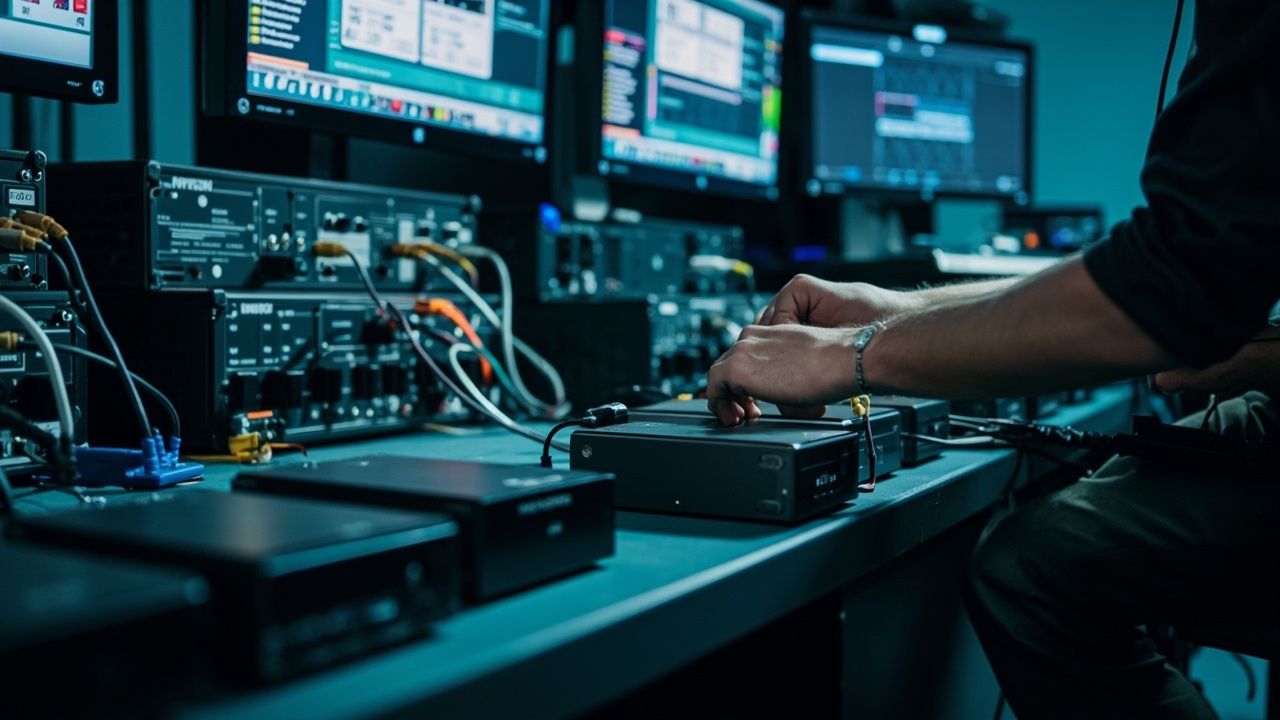
A practical scene is therefore a sequence, not a single playback demo: device identity, network attachment, account and entitlement, channel access, display output, restart recovery and remote observability. Each stage needs an owner and a pass criterion. This deployment structure applies whether the android tv box is sold through a cable operator, an integrator or a venue technology partner.
Installer workflows expose issues that laboratory playback may conceal. A unit may activate correctly when it is already connected to a known network, but the actual installation may begin with an absent DHCP response, weak Wi-Fi, an unfamiliar television mode or an expired operator credential. The acceptance script should reproduce that order rather than assume the installer has already solved connectivity.
For a managed estate, the remote diagnostics view becomes part of the operational requirement. The operator needs enough information to distinguish a device that is offline, a device whose entitlement exchange failed, a device blocked by the network and a device running the wrong approved image. This diagnostic requirement should be mapped to the middleware or management platform rather than inferred from the SoC.
The selection sequence that removes rework
Convert the operator’s service definition into an RFQ with pass/fail lines. The sequence below prevents a codec-led selection from creating middleware, certification or network rework later.
and service SLA
baseline
configuration
factory evidence
and change control
- Define the operator workflow State whether the box serves live IPTV, OTT, hybrid cable, cloud gaming or a defined combination. List authentication, entitlement, EPG, parental control, channel-change, recording, time-shift and recovery functions that are mandatory. State channel counts, expected concurrency and household access pattern without treating them as measured platform capacity.
- Freeze software and commercial requirements Specify the exact OS line, operator middleware, launcher expectations, application versions, update mechanism and management protocol. Identify whether Google certification is contractual and whether Widevine L1, PlayReady or HDCP 2.2 is required. Name the content service used for acceptance testing.
- Write hardware lines against the workflow Select the model family, RAM/ROM configuration, Ethernet option, Wi-Fi configuration, HDMI and USB requirements, audio path and power supply. For DM21T, state only the supported 4K modes; do not request or approve an 8K output claim.
- Build the qualification environment Use representative channels, entitlements, television models, access network and account types. Include install, upgrade, logout, credential reset, network interruption, service interruption and reboot paths. Record expected and actual results against the same revision.
- Freeze the golden sample Identify the sample’s hardware revision, OS image, middleware build, bootloader and firmware, application set and configuration. A physical sample without an image manifest is not a reproducible acceptance reference.
- Place the production evidence request Request SMT and AOI records, aging results, dark-room display checks, firmware-consistency evidence and audit documentation for the production revision. Each record must identify the lot and date where applicable.
Pasteable RFQ wording should be specific: “Device shall boot the agreed operator AOSP image; authenticate through the named middleware; retrieve the assigned entitlement; render the specified channel profile through HDMI; recover following service and network interruption; and pass the frozen golden-sample test.” Add codec profiles, DRM, certification, memory, Ethernet and update requirements as separate lines.
Send the first RFQ message with the deployment country, operator workflow, target model family, required OS and middleware, video/DRM profile, connectivity, expected volume planning basis and any branding or packaging requirements. The sample request page can support qualification units; production claims should remain subject to the approved configuration and evidence review.
A second procurement example shows why the order of decisions matters. If the operator first selects a codec profile and then asks the manufacturer to source any terminal that supports it, the resulting quotation may lack the operator launcher, device-claim procedure, entitlement API or approved update mechanism. Defining the service workflow first lets the RFQ state whether decoding is the actual constraint and whether the target terminal is part of IPTV, OTT or another managed service.
The qualification environment should have a named configuration register. At minimum, record the operator account type, content package, display model, access connection, Ethernet population, image identifier and expected recovery result. If the operator uses different television modes in separate districts, those modes belong in the acceptance matrix rather than being reduced to a generic “HDMI works” statement.
The golden sample also needs a change-control rule. Once the sample is approved, any modification to bootloader, firmware, middleware, launcher, application manifest, memory configuration or populated network interface should trigger a documented review. The rule should state whether the change requires a new sample, a focused regression test or a revised factory release. This prevents the accepted laboratory device from diverging silently from shipment hardware.
Failure modes that reach the field
Most field failures originate from an undefined boundary, not from an isolated hardware defect. A quotation may describe “operator-ready” while leaving middleware, device provisioning and update ownership ambiguous. Another may quote one production revision but ship another. These mismatches appear after deployment, when correcting them requires recalls, installer visits or content-service interruption.
Field trap
A codec or DRM line without a named service test can pass laboratory inspection yet fail in the operator environment. The cost is not limited to the replacement device: it includes subscriber calls, repeat installation visits, entitlement debugging and a fragmented evidence trail. Require the target content service, display profile and licensed-device configuration in the acceptance record.
The second common trap is confusing model-family capability with the ordered configuration. DM21S lists RJ45 100M with 1G optional; DM21T lists RJ45 100M with 1G opt. “Ethernet” in a quotation does not state which configuration is populated. Likewise, optional DRM on DM21P, DM21S and DM21T must be frozen rather than assumed, while DM21RTD’s GMS-certified AOSP position does not establish the complete memory, port or DRM bill.
Field trap
Do not let “4K” or “8K” language bypass profile-level sign-off. The supplied DM21T facts cap output and decode at 4K, with listed high-frame-rate codec support and inline AI-SR. The RFQ should name the actual output mode, codec, profile and display chain. An unqualified resolution claim creates mismatches among sales sheets, firmware configuration and customer expectations.
| Gap | What must be fixed | Consequence if omitted |
|---|---|---|
| OS and image unnamed | OS line and exact operator image | Middleware, app or update incompatibility |
| DRM treated as a generic feature | Named service, content and licence test | Black playback or failed entitlement |
| Wi-Fi accepted as the primary path | Wired and wireless deployment criteria | Inconsistent household service quality |
| Optional memory or Ethernet unstated | Order-level configuration code | Sample-to-batch mismatch |
| No revision traceability | Lot-linked evidence and golden-sample identity | Failure cannot be isolated to hardware or software |
| Update ownership absent | Update channel, signing and recovery process | Service interruption after rollout |
| Display chain omitted | Resolution, refresh, codec and television-profile matrix | Mode negotiation or playback failures |
| Device claim not assigned | Registration sequence, token rules and recovery owner | Activation cannot be completed at installation |
| Return or replacement flow undefined | Fault code, evidence collection and swap procedure | Repeated technician visits and weak root-cause data |
| Regional packaging omitted | Labels, serial identity and dispatch configuration | Wrong regional stock enters the installation channel |
Other failures appear at recovery boundaries: a failed first-boot claim, an interrupted update, a lost entitlement token or a device that cannot reconnect after WAN failure. These paths must be exercised independently of normal playback. The android tv box should therefore be accepted as an operational product with telemetry, support and update responsibilities, not only as a media renderer.
Power and thermal behavior can also become a field issue when the laboratory bench and customer premises differ. A test setup with generous ventilation may mask a connector or enclosure stress not reproduced in the deployed configuration. The RFQ should identify the supplied power path, required accessories and the environment used for sustained playback. For DM21P, the listed DC 5V/2A supply is a production fact that should appear in the order line rather than be replaced by a generic “power adapter” description.
A separate failure class is weak serial and software correlation. If the external label, internal device identifier and loaded image cannot be reconciled, a distributor may dispatch a unit whose hardware revision or operator configuration differs from the sample. The factory release should preserve that chain, and the operator should define how its installed base reports a unit identifier when an installation cannot be completed.
The evidence trail from SMT to shipment
Factory control becomes useful only when each stage leaves linked evidence. The sequence should connect the approved production revision to assembly, inspection, aging, display verification and shipment release. DataMax can provide the relevant SMT, AOI, aging and audit trail for the selected configuration; request evidence tied to the device family, configuration and production lot.
- Configuration release Freeze the hardware revision, SoC, memory configuration, OS image, middleware build, launcher, bootloader/firmware and application manifest. The production team signs the same configuration represented by the golden sample.
- SMT and AOI control Capture line records for placement and inspection activities. The device identifier must connect the line result to the ordered configuration and production lot; a general factory pass report is insufficient for a mixed-SKU program.
- In-process functional checks Verify the essential device interfaces and boot path. The check list should reflect the actual connector population and network configuration, including Ethernet, HDMI, USB, audio and wireless functions where they are part of the ordered SKU.
- Aging and dark-room verification Run the defined aging load and screen checks on the production revision. The aging profile, duration, sample coverage, failure criteria and disposition process must be stated in the applicable production evidence; do not infer a universal cycle from a generic label.
- Final operator-image verification Flash or load the approved image, apply the configuration manifest and verify boot, network, display, DRM where ordered, operator application and update path. Record software and hardware identifiers together.
- Shipment release and retention Release only against the signed configuration and completed inspection record. Retain samples, test logs, failure dispositions and traceability records under the agreed quality plan so that a field complaint can be reconstructed without assuming a cause.
The evidence package should connect 6 records: the approved configuration, the golden-sample identity, SMT/AOI results, aging results, dark-room display checks and the final operator-image verification. A ship date without revision-level records does not close the variable.
A practical data-control example is a mixed order containing DM21P and DM21S configurations with different memory, Ethernet and DRM selections. The line must prevent a completed unit from one order configuration from being relabelled as another. The inspection record needs to link the physical unit identifier, ordered configuration, image result and release decision. The operator’s receiving team should be able to reconcile a sample from the delivered population against that same chain.
Dark-room verification should use the acceptance criteria tied to the production revision. The check must relate to the display assembly and its configured output mode rather than to a generic screen label. If the operator requires a particular television profile, the final verification environment should include that profile or an agreed equivalent whose limits are documented. This prevents a display defect from being confused with an unsupported mode in the selected HDMI chain.
The evidence request should state what the operator needs to audit, not merely ask whether the factory has inspection. A video factory audit can cover line identification, inspection stations, image-loading controls, sample segregation, nonconforming-unit disposition and record retrieval. Requesting an actual trace from one unit to its line results demonstrates whether the process works in practice rather than only in a procedure document.
For a Nigerian cable-operator program, request a video factory audit or SMT/AOI/aging evidence specific to the selected android tv box configuration through DataMax factory quality. During the technical discussion, ask how the factory separates mixed configurations, how failed units are dispositioned and how the approved image is tied to each production lot. See the manufacturer page for the broader DataMax engagement model.
Further reading
- Guide android tv box for isps
- Edge computing boxes
- 4K 60fps Android TV box guide
- Rockchip Android TV box guide
- Dolby Vision Android TV box guide
- DataMax DM21P specifications and fit
- DataMax DM21RTD specifications and fit
FAQ
Is an AOSP Android device suitable for a Nigerian cable operator?
AOSP Android can suit an operator when the middleware, entitlement flow, updates, network management and branding are defined and tested as one product. For Google-dependent applications or retail requirements, the GMS-certified DM21RTD direction may be more appropriate. The decision should follow the operator workflow rather than the operating-system label alone.
Which model should be selected for a basic IPTV deployment?
DM21P is positioned for a 4K IPTV or operator-middleware set-top box and includes RJ45 100M, Wi-Fi6 2x2, HDMI 2.0b output and optional DRM configurations. DM21S offers AOSP Android 14 and 4K@60 for white-label IPTV/OTT. The final choice depends on the required OS, middleware, Ethernet option, DRM and storage configuration.
Does Widevine L1 automatically make a box operator-ready?
No. Widevine L1 addresses one part of protected-content delivery, but playback still depends on the licensed service, entitlement, application, hardware path and display. PlayReady and HDCP 2.2 are separate capabilities. Require a playback test using the operator’s actual content account and target television chain before approval.
Can DM21T support 8K output?
The supplied production facts cap DM21T output and decoding at 4K. They list H.266/VVC [email protected] 4K@120, AV1/VP9/H.265 4K@120, AVS3 4K@120 and H.264 4K@60, plus inline AI-SR. The RFQ should specify the actual supported mode and validate it against the target display.
What evidence should accompany a volume quotation?
Request a golden-sample identity, frozen production configuration, SMT/AOI records, aging results, dark-room display checks, operator-image verification and shipment-release traceability. Records should identify the applicable revision and lot where possible. A generic statement that the product passed inspection does not demonstrate configuration control.
Who owns software updates after shipment?
The RFQ must assign ownership for image delivery, signing, rollout policy, failure recovery, operator middleware versions and long-term support. Confirm whether updates are controlled by the operator, distributor, DataMax or a documented combination. The selected model and operating-system line do not, by themselves, settle that responsibility.
How should a buyer verify Ethernet performance?
Start with the populated configuration because DM21S and DM21T list RJ45 100M with 1G optional, while DM21P lists RJ45 100M. Then test the device through the actual access network, operator platform and target service, including channel access and interruption recovery. A nominal port-speed check does not establish the subscriber experience.
What should the first RFQ message contain?
Include the deployment country, operator workflow, target model family, required OS and middleware, video and DRM profile, connectivity, expected volume planning basis, branding or packaging needs and the evidence required. Use the inquiry form or the sample request page so that the technical response and qualification units address the same frozen configuration.


