

The procurement answer in one screen
A widespread belief is that “Android TV box” names a finished product with one fixed specification sheet. That is wrong for commercial procurement. android tv box what-is is a set of engineering and contractual conditions covering the hardware configuration, operating-system baseline, licensed middleware, connectivity, codecs, DRM, interfaces, test evidence, and change control.
The decisive question is not “Is this an Android TV box?” It is “Which configuration is frozen, who owns each layer, and what evidence proves production units match it?” A quotation may describe an existing platform, a configured variant, or a customer-controlled design. Each creates a different risk boundary. A retail label such as “4K Android TV box” does not freeze RAM/ROM, AOSP version, decoder limits, DRM licensing, Ethernet speed, port count, or test coverage.
Treat the terms as a specification system. Separate platform capability from licensed capability, sample performance from production acceptance, and hardware revision from software image. The same factory can produce materially different outcomes under the same product name. Define the platform, identify the production route, freeze the revision, attach test evidence, and subject every downstream change to written approval. DataMax platforms can then be mapped against operator, integrator, and gaming requirements without confusing SKU names with acceptance criteria. The Android TV box glossary and index covers the wider terminology.
A buyer can interrogate a quotation without becoming an SoC specialist. It should answer nine linked questions: Which operating-system baseline ships? Which licensed layer is present? Which hardware revision is used? Which media formats and frame rates are accepted? Which interfaces are populated? Which DRM and codec paths are enabled? Which factory tests apply? How are deviations recorded? Which changes require buyer approval? If an answer is “as standard,” “optional,” or “same as sample,” the baseline is not frozen.
Several common statements are scope labels rather than acceptance criteria. “Android 14” identifies an operating-system family but not the complete image. “4K” identifies a resolution class but not a codec path. “DRM optional” identifies commercial uncertainty rather than a usable service. “Aging tested” identifies a process stage but not duration, load, or rejection criteria. Read the production terms against the purchase order, approved sample, production datasheet, and release records. The buying decision should remain anchored to android tv box what-is as a configuration-and-evidence problem, not a product-name exercise.
How the factory controls the variable
Factory control is an evidence chain, not a claim that units “passed quality inspection.” The chain begins with the approved bill of materials and ends with a serial-number-linked production record. Each stage must answer what was checked, against which revision, under which limit, and what evidence was retained.
- Lock inputs Record approved part numbers, substitutions, alternates, firmware baseline, labels, packaging, and approved golden samples before release.
- Build under SMT control Verify stencil, placement, reflow profile, first-article inspection, and approved component-feed status.
- Inspect assemblies Use AOI for detected solder defects, supplemented by visual inspection and functional checks where board density requires it.
- Run powered tests Check boot, storage, interfaces, network, audio/video paths, remote control, update functions, and operator middleware.
- Age the units Apply the agreed burn-in or soak procedure, then repeat functional tests after thermal and runtime exposure.
- Audit the dark room Evaluate display output, synchronization, image integrity, and repeatability under the agreed test environment.
- Release evidence Bind inspection results, firmware versions, serial ranges, deviations, and corrective actions to the shipment release.
Evidence package Request the inspection plan, sampling rule, AOI coverage, functional test matrix, aging duration, dark-room procedure, firmware release record, approved sample, serial-number traceability, and nonconformance disposition. These are acceptance artifacts to define in the purchase specification; DataMax can provide an audit or supporting records for review.
Separate process capability from product acceptance. AOI can detect assembly anomalies visible to its inspection method, but it does not prove boot reliability, thermal stability, Wi-Fi performance, DRM function, or middleware integration. Aging exposes time-dependent failures, but its value depends on load, duration, temperature, and recovery criteria. A dark-room test can reveal frame, color, and synchronization defects, but it cannot substitute for codec conformance or content-path testing.
Each control answers a different failure question. SMT control addresses component placement and solder-joint consistency. AOI addresses visible board-level anomalies within the inspection coverage. First-article inspection establishes that the line, recipe, and material set produce an approved reference unit. Functional testing proves that powered interfaces and software paths respond under defined stimuli. Aging targets failures emerging after sustained operation. Dark-room testing addresses image and synchronization behavior. Traceability connects each result to the released configuration.
The production release is a controlled baseline. “Same model” is insufficient: ask for the PCB revision, SoC marking, RAM/ROM combination, Android build, firmware image hash, remote-control mapping, accessory list, packaging revision, and authorized alternate list. A change to a controlled item should produce an engineering-change notice with reason, affected units, validation evidence, and approval authority. A factory audit or a request for DataMax-specific SMT, AOI, and aging evidence can be raised through the factory-quality review channel.
Consider a networked IPTV box. Its production record should identify the RJ45 variant, Wi-Fi6 2x2 antenna configuration, Bluetooth 5.4 function, HDMI output path, operator middleware version, remote-control mapping, and boot image. If Ethernet changes from the approved 100M configuration to another approved variant, determine whether the substitution changes board layout, firmware, certification, or only internal sourcing. “Same Ethernet” answers none of those questions.
Playback qualification requires the same discipline. The inspection matrix can establish that the decoder boots, decodes an agreed file, emits a defined signal, and survives the specified test cycle. It does not establish that a service license, certificate, account, middleware entitlement, and content authorization are present. Record those as separate acceptance items. This is why android tv box what-is includes both process evidence and commercial licensing conditions rather than one pass/fail certificate.
Two routes, one bill of differences
Two common sourcing routes look similar on a quotation but allocate risk differently. The platform-selection route starts with a proven model and limits variation through configuration selection and inspection. The custom-commitment route starts with a customer-controlled specification and freezes it through a longer approval and validation process. The second route is not automatically superior; it buys control at the expense of additional engineering, documentation, and change governance.
| Decision field | Platform-selection route | Custom-commitment route |
|---|---|---|
| Starting point | Approved DataMax platform and existing bill of materials | Customer-specified hardware, software, interface, and packaging baseline |
| Primary buyer value | Lower schedule and validation burden | Greater control of differentiation and interfaces |
| Change control | Selection of supported variants only | Written approval for hardware, firmware, middleware, and packaging changes |
| Validation focus | Configuration matching, functional tests, sample-to-batch consistency | New requirements, integration, regression, and pilot-production evidence |
| Commercial exposure | Feature constraints inherited from the platform | Engineering effort, tooling, validation, and change costs exposed earlier |
| Production evidence | Platform inspection records plus order-specific results | Order-specific build record covering the full frozen configuration |
The quotation should identify its route and state what remains “optional,” what is selected at order placement, and what triggers revalidation. A supported Ethernet configuration may be listed as optional on a platform. That does not say whether the quoted unit includes it, whether it is production-approved, or whether changing it requires firmware qualification. Optional DRM needs commercial licensing detail; optional codec capabilities need chip, firmware, and licensed-content conditions.
Treat optionality as an open line, not a completed feature. Each option needs a part number, availability rule, unit-price treatment, test method, approval owner, and effect on the delivery baseline. The custom-development process can convert custom requirements into an engineering scope, while the sample request can establish whether the selected platform matches the intended use.
| Control point | Platform-selection route | Custom-commitment route |
|---|---|---|
| Approved sample | Existing model reference plus ordered configuration | New golden sample representing the customer specification |
| Component alternates | Only items on the platform’s authorized list | Any alternate requires impact review and buyer approval |
| Software baseline | Published platform image plus selected applications | Customer-controlled image, middleware, launcher, and update design |
| Regression scope | Existing regression plus configuration-specific checks | Full requirement set affected by each change |
| Pilot build | Configuration-match and first-article review | Dedicated pilot validation before volume release |
| Ownership of evidence | Factory retains platform records; buyer approves order configuration | Factory retains build evidence; buyer and supplier jointly approve baseline |
A white-label programme requiring a logo, carton, operator middleware, and one Ethernet variant can be mistaken for a fully custom platform even when the board remains standard. State “customization scope” item by item: mechanical branding, packaging artwork, boot image, launcher, middleware, remote-control mapping, preloaded applications, update channel, and hardware options. This prevents cosmetic customization from hiding an engineering assumption.
A selection route also requires a configuration hierarchy. The order should reference a model-level platform, a configuration code, an image or middleware version, and a packaging revision. Four documents with similar names do not provide four independent controls; they should point to one controlled baseline. A custom-commitment route adds explicit sign-off gates, but both routes need serial-linked evidence and written change authority. This distinction is central to android tv box what-is: the product family may remain stable while the controlled commercial configuration changes.
How the requirement actually works
Production terminology becomes precise once the system boundary is visible. Hardware describes the physical device; AOSP describes the software foundation; middleware supplies operator or application functions; codecs decode media; DRM governs protected-content licensing; and the production release binds these layers to a particular revision.
“Android TV” can be ambiguous. A platform labelled AOSP Android TV may not include Google services, the Google TV launcher, Play Store access, Google Cast, or Google account integration. Those require separate commercial and technical conditions. The AOSP versus Google Android TV guide separates the operating-system baseline from the licensed product layer.
“4K” is equally insufficient. Decompose it into output format, pixel format, chroma sampling, color space, HDR behavior, refresh rate, and codec path. One codec may be stated at 4K@60 while another is stated at 4K@120. “Supports 4K” does not mean every codec, input path, color format, or output mode reaches the same resolution and frame rate. The 4K 60 fps decision guide distinguishes frame-rate requirements from a general resolution label.
DRM and content protection require parallel checks. A platform may expose Widevine L1 and PlayReady, while the shipped production image, licensing service, certificates, agreements, and playback implementation determine operational availability. HDCP must be considered across the output device, display path, sink, and content. AV1 capability depends on decoder hardware, firmware, container support, and the selected application path. The AV1 Android TV guide provides that distinction.
A codec label does not specify output behavior by itself. AV1, H.265, or H.266 decoding can coexist with HDMI output constrained to HDMI 2.0b. The application profile, decoder level, color pipeline, tone mapping, and display mode form the user-facing path. Procurement language should cite codec, profile or level where relevant, maximum format, frame rate, output interface, and exact acceptance test—not marketing shorthand.
The same layering applies to Wi-Fi, Bluetooth, Ethernet, USB, audio, and update functions. A named radio generation establishes one part of the path. Operational performance still depends on antenna layout, router compatibility, enclosure, regulatory configuration, driver, firmware, and interference conditions. A port label establishes a physical interface, but accepted function may depend on the connected accessory, negotiated mode, power behavior, or host-side system.
Therefore, android tv box what-is must be answered through relationships, not isolated labels. Decoder capability relates to the SoC, image, output interface, display mode, and content profile. DRM relates to device class, certificates, licensing arrangements, application implementation, and output protection. Factory terms relate to the released revision, inspection coverage, sampling rule, and acceptance threshold. Procurement needs each relationship to remain unchanged from sample through shipment.
Managed deployments add another boundary. Android Management API can govern certain enrollment, policy, application, and update workflows, but it does not define the underlying hardware. TR-069 can support remote management for specified network equipment and functions, but it does not replace a device-management requirement. RDK belongs to a separate architecture for certain operator set-top boxes. Identify the required architecture instead of assuming every android tv box what-is category supports the same management plane.
A precise requirement uses four verbs: decode, output, protect, and manage. “Decode” identifies codec and format. “Output” identifies interface, mode, and rate. “Protect” identifies DRM and content-protection conditions. “Manage” identifies enrollment, updates, middleware, and ownership. If a term cannot be expressed through those verbs, it remains a marketing label requiring an acceptance method.
Which DataMax models actually sit here
DataMax models occupy different production-term positions: operator middleware, white-label IPTV/OTT, premium cloud-gaming, and gaming-oriented configurations. The table below uses only the supplied production facts. Any unresolved option or update must be confirmed against the production datasheet.
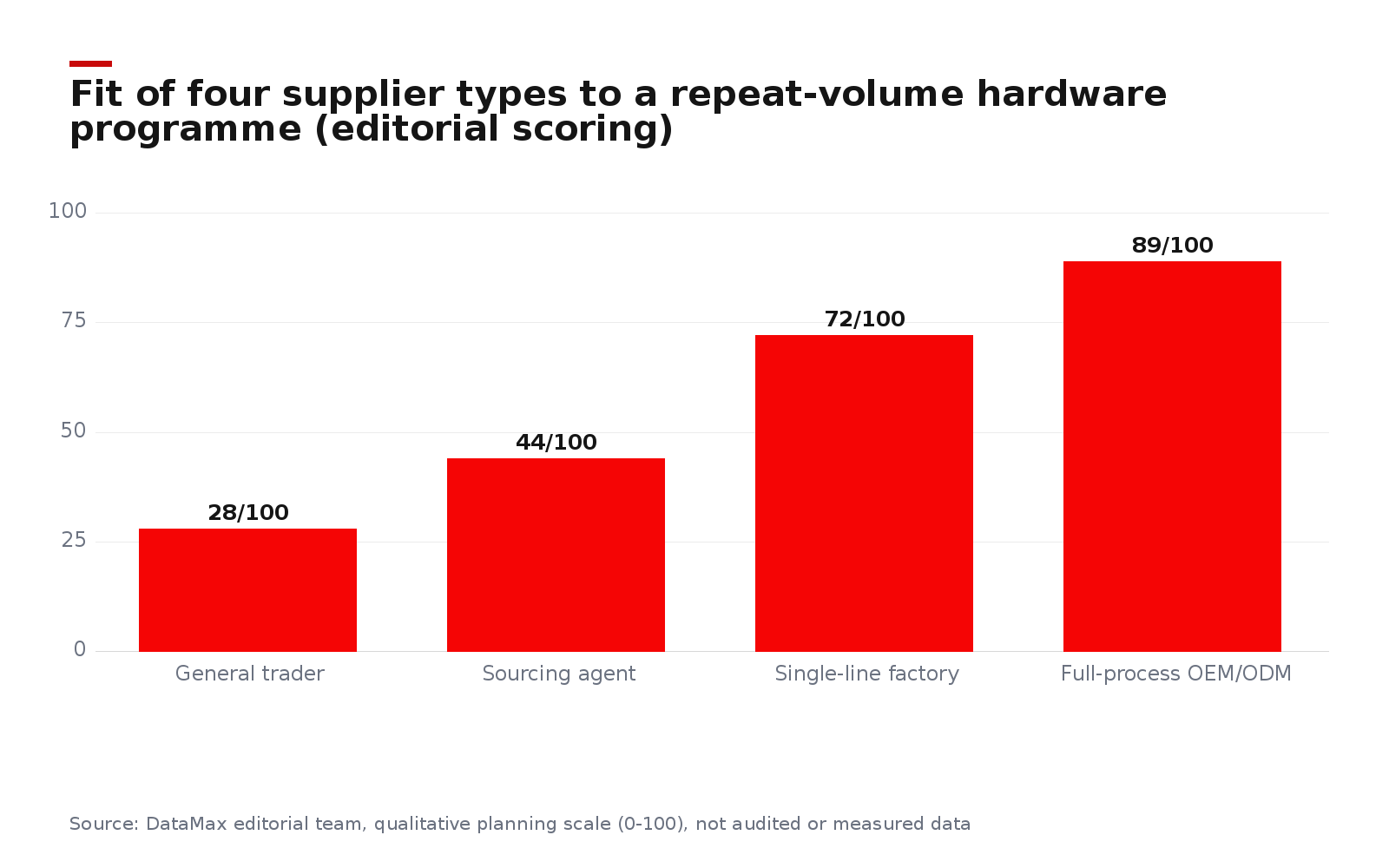
The same figures, in searchable form:
| Supplier type | Editorial score |
|---|---|
| General trader | 28 |
| Sourcing agent | 44 |
| Single-line factory | 72 |
| Full-process OEM/ODM | 89 |
Source: DataMax editorial team, qualitative planning scale (0-100), not audited or measured data. The score uses a /100 suffix and ranks supplier types for a repeat-volume hardware programme; it is not a measurement.
| Model | SoC and OS | RAM/ROM | Decode and DRM | Ports and connectivity |
|---|---|---|---|---|
| DM21P | Amlogic S905Y4, quad Cortex-A35; AOSP Android 11 | 2GB / 8GB; 4GB; 16/32/64GB optional | AV1 [email protected], VP9/H.265 4K@60, H.264 4K@30; Widevine L1 / PlayReady / HDCP 2.2 optional | HDMI 2.0b out x1, USB2.0 x2, TF, S/PDIF, 3.5mm AV, RJ45 100M, Wi-Fi6 2x2 + BT5.4, DC 5V/2A |
| DM21S | Amlogic S905Y5, quad Cortex-A55; AOSP Android 14 | 2GB / 16GB; 2/4/8GB; 16/32/64GB optional | AV1 / H.265 [email protected] 4K@60; Widevine L1 / PlayReady optional; Dolby Vision/DTS | HDMI 2.0b out, S/PDIF, AV, USB2.0 x2, TF, RJ45 100M; 1G optional; Wi-Fi6 2x2 + BT5.4 |
| DM21T | Amlogic S905X5, quad Cortex-A510 (ARMv9); AOSP Android 14 | 4GB / 64GB; family options | H.266/VVC [email protected] 4K@120, AV1/VP9/H.265 4K@120, AVS3 4K@120, H.264 4K@60; inline AI-SR; Widevine L1 / PlayReady optional | HDMI 2.0b out; no HDMI in; USB2.0 x1 + USB3.0 x1, TF, S/PDIF, AV, RJ45 100M; 1G opt; Wi-Fi6 + BT5.4 |
| DM22Q | Amlogic S905X5M, quad Cortex-A55 up to 2.5GHz; AOSP Android 14 | 4GB / 64GB; 2/4/8GB; 16/32/64GB optional | AV1/H.265 L5.1 4K@60; inline AI-SR; Widevine L1 / PlayReady optional; Dolby Vision/DTS | HDMI 2.0b out, USB2.0 x2, TF, S/PDIF, AV, RJ45 100M; 1G opt; Wi-Fi6 2x2 + BT5.4 |
The distinction appears in platform intent, not the model name alone. DM21P is positioned for 4K IPTV and operator middleware set-top boxes. DM21S addresses 4K Android TV use for IPTV/OTT white-label programmes. DM21T targets premium UHD and cloud-gaming use, while its decode list includes 4K@120 paths and inline AI-SR. DM22Q targets gaming-oriented Android TV use with a 4K@60 decode statement and optional Dolby Vision/DTS. Confirm any nonstandard configuration against the production datasheet before placing it in an RFQ.
DM21P’s supplied RAM/ROM statement includes 2GB / 8GB, 4GB, and optional 16GB, 32GB, or 64GB storage. Its connectivity line includes HDMI 2.0b output x1, two USB2.0 ports, TF, S/PDIF, 3.5mm AV, RJ45 100M, Wi-Fi6 2x2 with BT5.4, and DC 5V/2A. DM21S’s supplied baseline is 2GB / 16GB, with 2GB, 4GB, or 8GB RAM and 16GB, 32GB, or 64GB storage options. Its RJ45 100M configuration has 1G listed as optional. Do not normalize these baselines during quotation.
DM21T carries the strongest supplied high-frame-rate decode statements, including H.266/VVC [email protected] 4K@120 and AV1/VP9/H.265 4K@120. Its interface boundary includes HDMI 2.0b output, no HDMI input, one USB2.0 port, one USB3.0 port, TF, S/PDIF, AV, RJ45 100M with 1G optional, and Wi-Fi6 with BT5.4. A buyer needing a 4K@120 path should verify the complete content-to-display chain rather than infer that every function operates at that rate.
DM22Q lists Amlogic S905X5M with quad Cortex-A55 up to 2.5GHz, AOSP Android 14, and AV1/H.265 L5.1 4K@60 with inline AI-SR. Its interface set includes two USB2.0 ports, TF, S/PDIF, AV, RJ45 100M with 1G optional, and Wi-Fi6 2x2 with BT5.4. The product facts do not state an NPU TOPS figure, so an RFQ should not create one from the AI-SR label.
The editorial supplier chart is a route-selection aid, not a product ranking. A full-process OEM/ODM receives 89/100 because the editorial view assigns more weight to direct coordination across engineering, SMT, validation, and production release. A single-line factory receives 72/100, a sourcing agent 44/100, and a general trader 28/100. These are qualitative planning judgments, not measured performance, and they do not replace an audit of the named production site. This supplier-type framing reinforces android tv box what-is as a route-selection question as well as a specification question.
Deployment scenarios and the spec each needs
Deployment context determines which term must be frozen. An operator may prioritize middleware integration, network access, update control, and repeatable fleet imaging. An integrator may prioritize HDMI and USB connectivity, device management, and enclosure interfaces. A venue or gaming use case may prioritize decode capability, output mode, latency-related validation, and sustained performance. These requirements cannot be inferred from the word “box.”
| Situation | Controlling requirement | Model direction | Quotation control |
|---|---|---|---|
| Pay-TV/IPTV operator | Middleware image, 4K decode, operator-controlled deployment, Ethernet and update behaviour | DM21P for 4K IPTV/operator middleware; DM21S where AOSP Android 14 and white-label flexibility are preferred | Freeze image version, middleware version, network interface, update method, and acceptance suite |
| OTT or distributor white-label programme | 4K Android TV baseline, storage options, AV output, and application certification path | DM21S | State exact RAM/ROM, AOSP baseline, codec profile, DRM availability, and packaging artwork revision |
| Premium UHD or cloud-gaming deployment | High-frame-rate decode, output interface limits, storage, and workload stability | DM21T | Specify the required codec, format, frame rate, output path, and sustained-run test |
| Gaming-oriented Android TV deployment | 4K@60 media path, Ethernet option, wireless configuration, optional Dolby Vision/DTS | DM22Q | Freeze Ethernet speed, wireless antenna configuration, codec path, and optional licensed feature status |
| Commercial AV installation | HDMI, USB, audio, control, thermal stability, and repeatability | Compare DM21P, DM21S, and DM22Q by port and acceptance requirements | Use a model-to-I/O matrix; do not accept “AV-ready” as an acceptance criterion |
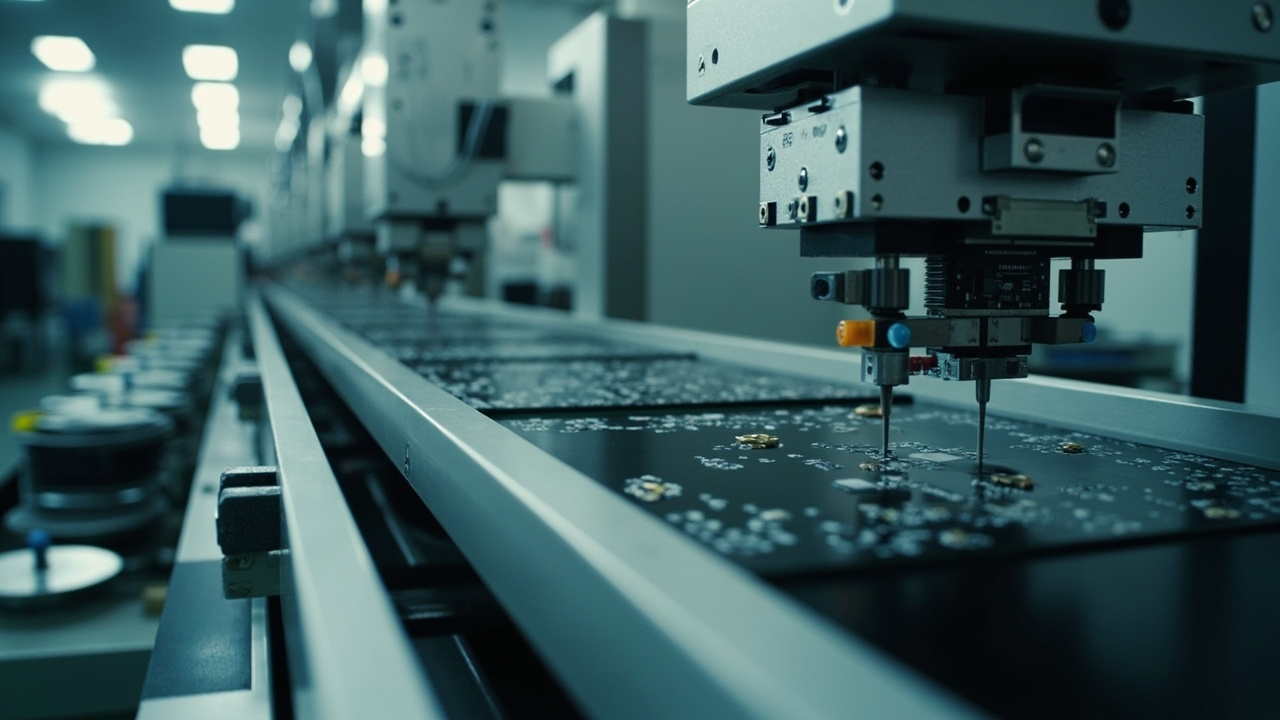
In a modern electronics factory, the controlled variable starts at SMT: component placement and solder quality are linked to the approved process recipe. The production line therefore belongs in the deployment discussion, not merely the commercial description. Operators require traceability from the line to the deployed fleet, while integrators require the device to survive the specified signal chain. A venue deployment combining 4K sources, multichannel audio, and long operating periods should specify signal-path acceptance rather than infer it from port labels.
For operator programmes, the operator-tier Android TV box solution helps translate deployment intent into an RFQ. DataMax can then evaluate the scenarios against current production facts; specifications not listed here remain subject to confirmation against the production datasheet.
A pay-TV operator should link the hardware baseline to middleware and fleet operations. The production record must identify the operator image, middleware version, RJ45 configuration, and update mechanism exercised. An OTT distributor needs configuration codes for branding, packaging artwork, application entitlements, and the selected memory baseline. A mismatched carton without an artwork revision still creates inventory and returns ambiguity.
A commercial AV integrator should map each signal rather than count ports. HDMI 2.0b output, S/PDIF, AV, USB, and TF answer different connection questions. The acceptance plan should identify source format, display mode, audio path, cable, and repeatability requirement. A venue deployment also needs thermal and runtime conditions because a brief bench demonstration does not establish stable behavior during a long operating period.
Gaming and premium-UHD scenarios add a sharper media-path requirement. DM21T can be considered where the supplied decode list includes the required 4K@120 path; DM22Q can be considered where 4K@60 and the stated gaming orientation align. Neither selection is complete without the application, output display, input command path, network conditions, and sustained-run procedure. These variables determine whether the device is merely decoding a clip or operating within the intended service.
The deployment matrix is a routing tool. It identifies which model direction deserves technical review, then sends the buyer into configuration and evidence work. It does not substitute for a datasheet, sample, or pilot. Each scene has different failure exposure, so each needs a different acceptance test rather than a shared label such as “4K ready.” In practical terms, android tv box what-is changes with the deployment: operator control, integrator signal paths, and gaming media limits do not inherit one common requirement set.
Turning the question into a spec line
Convert each vague production term into an observable requirement. “Android TV box” should become an OS baseline plus product-layer entitlement; “4K” should become codec, format, and frame rate; “optional DRM” should become named technologies, license status, and evidence; “100M” should become the selected Ethernet configuration; and “quality checked” should become a sampling plan and functional matrix.
content, network, control
codec, output, ports
hardware and OS
revision and evidence
serial-linked records
- Name the operating baseline Write: “AOSP Android [version]; licensed services and launcher: [state or excluded].”
- Define the media path Write: “HDMI 2.0b output; [codec] [profile/level where applicable] at [format] and [frame rate]; test source and acceptance method [reference].”
- Freeze the hardware configuration Write: “SoC [exact designation]; RAM/ROM [exact combination]; Ethernet [speed]; USB [count and generation]; other interfaces [exact list].”
- Resolve optional features Write: “Widevine L1 / PlayReady / Dolby Vision / DTS / HDCP: included or excluded; licence and test evidence required.”
- Attach production evidence Write: “SMT, AOI, functional test, aging, and dark-room records shall be retained against the production revision and serial range.”
- Control changes Write: “No SoC, memory, PCB, firmware, middleware, accessory, label, or packaging substitution without written approval.”
A practical RFQ line should be internally testable. “Premium performance” fails that test. “H.265 4K@60 through HDMI 2.0b with the agreed test clip and display path, accepted after the defined functional procedure” can be sampled and repeated. The same discipline applies to storage endurance, Wi-Fi operation, Bluetooth function, boot behavior, and update delivery; each needs a defined stimulus and pass condition rather than a product adjective.
Specify who provides the application, middleware, certificates, test content, display equipment, and network simulation. This prevents environmental gaps from becoming factory failures. DataMax engineering and procurement can review these lines against the selected model, while the manufacturer overview provides a starting point for a production discussion.
A paste-ready hardware line for an operator-facing DM21P direction identifies Amlogic S905Y4, quad Cortex-A35, AOSP Android 11, RAM/ROM, RJ45 100M, Wi-Fi6 2x2, BT5.4, the listed HDMI and USB configuration, and the selected operator image. It does not use “same as sample” for the SoC or memory. A gaming-oriented line can identify the chosen DM22Q baseline, Amlogic S905X5M, AOSP Android 14, selected RAM/ROM, 4K@60 AV1/H.265 path, Ethernet selection, and status of optional Dolby Vision/DTS.
A paste-ready DRM line distinguishes capability from operational authorization: “Widevine L1 device-level integration as listed for the selected platform; commercial licensing, certificates, service availability, and playback verification shall be confirmed for the deployed programme.” If HDCP 2.2 is required, include the output path and acceptance procedure rather than relying on the feature list. If Dolby Vision or DTS is not contracted, state “excluded” so it cannot appear later as an assumed feature.
Production evidence should also be paste-ready: “Inspection plan revision [reference]; AOI coverage [reference]; functional-test matrix [reference]; aging duration, load, and temperature [reference]; dark-room procedure [reference]; sampling and disposition rule [reference].” A generic request for a “quality report” is weaker because it leaves the measurement method and release identity open.
The final step is change governance. Name the technical approver, commercial approver, notice period, affected serial range, validation requirement, and effective revision. Require the production release to identify accepted deviations. This turns android tv box what-is from a naming exercise into an auditable production instruction suitable for an RFQ, purchase specification, and factory audit checklist. The H.265/HEVC Android TV guide can help make the media-path line equally specific.
Where quotations quietly diverge
Most commercial divergence occurs in words that sound precise but leave ownership or acceptance undefined. “Same BOM,” “Google certified,” “supports DRM,” “factory tested,” “4K,” “customized,” and “optional” require expansion before signature. The cost is not merely a missed feature; it is rework, delayed certification, or a batch that cannot be accepted against the intended operating scenario.
Field trap
A quotation that says “Android TV box” but does not identify AOSP Android 11 versus AOSP Android 14 leaves the software baseline unresolved. If the buyer later requires a different OS baseline, boot image, middleware release, certification path, or regression cycle, the quoted configuration may not remain valid.
Field trap
“4K” can conceal a difference in codec, profile, frame rate, output path, or display mode. A decoder limit of 4K@60 is not interchangeable with 4K@120, and neither statement establishes HDMI capture, HDR, color, or synchronization behavior. The acceptance source and complete signal chain must be written into the specification.
Other divergences hide in commercial substitutions. A quote may assume a qualified alternate for a memory or connectivity component without identifying it. A “custom” label may cover only the logo and carton rather than the PCB, Android image, middleware, remote-control mapping, or accessories. A warranty clause may define repair but not the golden-sample baseline used for disputed functionality. In each case, add the affected item to the approved configuration list.
A first divergence appears when the order sheet uses a product name while the factory record uses a revision code. The buyer believes the second model is covered by the first name, but the factory intends only the baseline documented in its release. Add the PCB revision, image version, memory combination, port configuration, and authorized alternatives, then require an engineering-change notice for any departure.
A second divergence appears when optional licensed features appear in the commercial summary but not the technical acceptance matrix. A buyer may assume Dolby Vision, DTS, HDCP 2.2, Widevine L1, or PlayReady are active simply because they are named. The quote must say whether each is included, optional, excluded, or dependent on external licensing, and which test demonstrates the selected state.
A third divergence concerns sampling. The quotation may cite “100% testing,” while the inspection plan defines 100% coverage for one station and sample-based release for another. Ask which units or tests are covered, which measurement limits apply, what constitutes failure, and how a nonconforming unit is segregated. “Tested” has no procurement value until scope and disposition are written.
Before release, compare the quotation, approved sample, production datasheet, and test evidence line by line. Reconcile every SKU, option, revision, and quantity description. Request an audit or video review of relevant SMT, AOI, aging, and dark-room controls through DataMax contact. A quotation becomes commercially meaningful only when its words trace to a released configuration and an acceptance record.
The final divergence is contractual rather than technical. The order may allow substitutions, while the deployment plan forbids them without approval. Remedy this with a controlled-substitution clause listing permitted parties, advance notice, impact assessment, validation evidence, and the signatory. This prevents a commercial convenience from becoming an unreviewed hardware or software variation. It also gives the factory a clear release mechanism rather than forcing informal decisions at the line.
Further reading
- Best Android TV Box: Glossary and Index of Selection Terms
- AOSP Android TV boxes
- H.265 HEVC Android TV box guide
- Widevine L1 certification guide
- Dolby Atmos Android TV box guide
- DataMax DM21P specifications and fit
- DataMax DM21S specifications and fit
FAQ
What does “Android TV box” mean in a supplier quotation?
It is a category description unless the quotation also identifies the operating-system baseline, licensed services, hardware configuration, media path, interfaces, and production revision. Require an approved configuration list rather than inferring the delivered unit from the product name. The model, configuration code, image, and packaging revision should point to one controlled baseline.
Does AOSP Android mean the box has Google services?
No. AOSP describes the software foundation. Google applications, Google Play services, Google TV launcher, casting functions, and account integration are separate product and licensing layers. Each must be identified as included, excluded, or subject to confirmation in the quotation and acceptance matrix.
Is “supports 4K” an adequate specification?
No. The RFQ should identify codec, profile or level where relevant, pixel format, frame rate, output interface, display path, and acceptance source. A 4K@60 decoder path and a 4K@120 decoder path create different system and test requirements even when both receive an abbreviated “4K” label.
When should an optional feature become mandatory in the order?
When deployment requires it, name the exact feature, configuration, license conditions, and acceptance evidence. Leave nothing at “optional” after contract release. Every selected option needs an approved part number, test method, and change-control rule tied to the released configuration.
What evidence proves production units match the approved sample?
Request a serial-number-linked package covering the build revision, SMT and AOI records, functional test results, aging procedure and outcome, dark-room results, firmware version, and nonconformance disposition. Agree the sampling method and acceptance criteria before production rather than accepting a generic quality report.
Can DataMax support a customized operator programme?
Yes, subject to the confirmed scope and current production facts. Use the inquiry process to request model fit, engineering review, a sample plan, and factory evidence relevant to the intended deployment. Specifications absent from the current product facts must be confirmed against the production datasheet.


