

What the answer hinges on
A procurement RFQ lands with two quotations describing the same enclosure, display output, radio and application processor. The firmware team then asks whether the operating-system image, decoder configuration, DRM build and middleware binary must be frozen before the first production order. The answer is yes: freeze a controlled, versioned configuration before the committed build, not a generic “latest” label.
android tv box production becomes controllable when the commercial sample, hardware revision, Android build, middleware, supplier lot and operator acceptance evidence are treated as one configuration. Every physical unit must trace to an approved bill of materials, bootloader and Android baseline, middleware and DRM manifest, test matrix and golden sample. This page addresses the specific freeze point after purchase-order approval; the broader selection context appears in Android TV boxes for ISPs.
The baseline should cover board revision, SoC, memory selection, AOSP version, bootloader, kernel, device tree, vendor blobs, middleware, service packages, DRM level, CA system, update policy, factory test limits and approved accessories. The factory verifies identity, image hash, network functions, storage, interfaces, decoding and secured playback against that record. The operator separately verifies entitlement workflows, middleware integration, content licensing and fleet enrollment.
The freeze is a linked control set: configuration baseline, reference unit, test matrix, release record and change process. Missing any one element allows a consistently assembled batch to contain incompatible operational assumptions. Assign a configuration code, name its owner, identify the superseding document and map each unit to it.
Responsibility boundaries also need definition. The factory can establish assembly conformity, boot validity and installed-image identity. The operator owns entitlement, middleware behavior, account enrollment and fleet release management. A valid factory image does not prove an operator workflow, while an operator-approved application does not prove that every shipped unit contains the same hardware and software.
The operator, the integrator and the venue
The same hardware can satisfy one buyer and fail another because it enters different operational chains. An operator prioritizes identity, middleware, entitlement handling, staged updates and reproducible firmware. An AV integrator prioritizes HDMI behavior, EDID, control protocols, mounting, peripherals and recovery after site power changes. A venue operator adds centralized management, kiosk restrictions, shared-account controls and installation consistency.
| Situation | Controlling requirement | Model direction |
|---|---|---|
| IPTV operator deployment | Middleware compatibility, controlled OTA path, firmware identity and operator-grade interfaces | DM21P for 4K IPTV and operator middleware |
| White-label OTT package | Android 14 baseline, branding control, 4K decode and configurable storage/network options | DM21S for 4K IPTV/OTT white-label |
| Premium cloud-gaming package | Higher decode ceiling, USB bandwidth, 4K/120 workload and controlled display path | DM21T for premium UHD and cloud-gaming use |
| Gaming-oriented retail channel | Android 14, 4K/60 baseline, gaming positioning and broad connectivity | DM22Q for gaming-oriented use |
| AV installation or venue pilot | EDID behavior, HDMI/control testing, recovery process, labeling and batch traceability | Select only after interface and update requirements are frozen |
| Hospitality-room deployment | Remote identity, account isolation, site recovery and repeatable installation | Freeze the complete site package before a multi-site release |
| Digital-signage rollout | Persistent display behavior, update ownership, storage endurance and fleet monitoring | Freeze the recovery path and application configuration |
| Secondary-brand operator program | Separate configuration code, OEM identity, update ownership and inventory | Use a distinct release manifest for the same hardware model |
The manufacturing scene exposes variation before it becomes an audit finding. Component reels, placement equipment and board conveyors show whether a model is assembled repeatedly or depends on hand selection and undocumented substitutions.

For a venue rollout, the decision unit is the site package rather than the box alone: one approved hardware revision, firmware hash, remote-control profile, OTA channel, mount, label sequence and power-recovery procedure. If HDMI-CEC behavior matters, the factory test must exercise that behavior rather than merely detect an electrical signal. If entitlement-bound DRM matters, the manifest must identify the intended Widevine or PlayReady configuration without implying that every licensed deployment uses the same keys.
A hospitality deployment exposes a second failure mode. One room may use a different remote profile, account pattern or local recovery procedure while the main board remains unchanged. The release record should therefore include remote identity, account model, network policy, site labels and restart testing. Unit-level software consistency alone does not create site-level consistency.
Digital signage adds an update-layer distinction. A factory-installed image may contain an application that is later replaced remotely. The release record must identify which layer changed, who authorizes the update and how the endpoint returns to the approved configuration. An application update that leaves the reported Android build unchanged can still alter runtime behavior.
DataMax model direction narrows the starting point, not the final configuration. Confirm middleware version, network assumptions, branding method and acceptance procedure against the production datasheet. Branding may reside in the OS image, application layer, packaging or provisioning service; each location needs its own owner and change rule.
How to choose, step by step
Translate the commercial question into gates. Each gate must produce an artifact attached to the purchase order, release order or pilot record. The objective is to prevent “same model” from concealing different hardware and software.
- Define the use case Record content path, operator middleware, commercial model, venue profile, display mode, network connection, peripherals and update ownership. State whether the device is operator middleware, IPTV/OTT white-label, cloud-gaming or gaming-oriented.
- Freeze the hardware baseline Assign a board revision and configuration ID. List SoC, RAM/ROM, ports, radio options, display output, power supply, remote, packaging and approved substitutions. Do not accept “same as sample” without the revision under test.
- Freeze the software manifest Record AOSP version, bootloader, kernel, build number or hash, device tree, vendor blobs, firmware, middleware, service packages, DRM declarations, CA integration and update policy.
- Create the golden sample Define a serialized reference unit. Photograph the enclosure and board, archive hashes and configuration files, and define evidence that distinguishes conforming units from look-alikes.
- Translate features into tests Convert claims such as 4K, Wi-Fi6, HDCP or Widevine into acceptance items. For an android tv box, each capability should map to media, instrumentation, an interface procedure or a manifest field.
- Run the pilot and release Execute factory and application tests on a controlled pilot batch, close deviations and authorize production only after named reviewers sign the release record.
- Control changes Require an impact list for every change. A new memory supplier, Wi-Fi module, security patch, middleware branch or enclosure revision can invalidate prior evidence.
A pasteable RFQ line is: “Each shipment shall be identified by hardware revision, Android baseline, build identifier, middleware branch, DRM manifest and configuration code recorded against the serial number.” Add: “Any substitution requires prior written approval and a documented impact assessment.” These lines convert an abstract freeze request into a delivery condition.
Information requirements should also be staged. At quotation, request the proposed configuration code and unresolved deviations. At sample stage, request the exact board and build identifiers attached to the delivered unit. At pilot stage, request the test plan, raw exceptions and signed acceptance record. At shipment stage, request lot traceability and advance notice for approved changes.
Do not compress these gates if procurement, software and compliance use separate approval paths. The cost of an omitted field appears as a mismatch among the purchase order, shipped unit and update server.
Attach a configuration code to every quotation. It should reference a human-readable record, not merely a generated identifier. A line may cite platform, board revision, memory option, network option, operating-system baseline and accessory set. Each optional item must state whether it is selected, unselected or subject to factory confirmation. “Optional” without status is unresolved specification.
Pilot sign-off should contain pass/fail results and open-risk ownership. A noncritical observation that cannot close before release needs an owner, permitted workaround and expiry point. A blanket exception permits uncontrolled divergence without evidence that the variation is acceptable in service.
What goes wrong after the PO
The largest divergence is usually a version mismatch that makes a batch unusable for its intended fleet workflow. Quotation A may mean AOSP Android 11 while quotation B means AOSP Android 14. Both can look correct until middleware support and device certification are tested.
Field trap
A quotation saying “latest Android” is not a version freeze. Insert the exact AOSP release, build identifier, bootloader baseline, security-patch status, middleware branch and DRM manifest. “Latest” can move between sample approval and volume production.
Field trap
HDMI capability is often copied as a marketing label. Freeze output format, maximum resolution, refresh-rate requirement, HDCP configuration, EDID behavior and test media. A model whose datasheet caps output and decoding at 4K must not be accepted under an 8K requirement.
Other failures include RJ45 100M becoming 1G without electrical and thermal recheck, a production unit booting an engineering image, boot failures appearing only after low-storage testing, and middleware being installed differently across regional batches. These indicate missing acceptance criteria rather than isolated workmanship defects.
Memory can drift without changing the visible model name. If one quotation specifies a base option and another permits a larger option, application versions, cache policies and storage assumptions can differ across the fleet. Compare each storage selection separately, with selected value, factory ordering code and test expectations recorded.
Remote and accessory changes create a lower-visibility split. A revised remote may use a different key map, radio behavior or pairing sequence while the board remains unchanged. Include remote model, firmware, pairing procedure and command map in the configuration record. Packaging and labels are not interchangeable unless expressly permitted.
Update ownership creates another divergence. The factory may provide the initial image while the operator maintains fleet updates. Define who signs the first production image, which keys are embedded, whether updates are staged and how rollback works. Without that division, an OTA channel can replace a tested build after shipment.
Normalize quotations before comparison. Request one line for hardware revision, storage, connectivity, operating system, middleware, DRM, ports and accessories. Record exceptions against a specific line. A supplier unable to populate those fields has not offered a frozen configuration, regardless of enclosure drawing completeness.
The remediation path matters. Quarantine rejected batches and preserve serial identity. Do not relabel failed units as another memory or connectivity configuration. Replacement requires a new configuration ID, repeat of affected tests and a revised release record. This prevents corrective work from creating an untracked second product under the same model name.
Avoid temporary engineering images. If a unit cannot boot the approved production build, replacing only its bootloader, device tree or application layer can leave an uncontrolled hybrid. Restore the complete approved image set, verify the build identifier against the manifest and repeat affected tests. A shortcut repair may restore video while leaving radio calibration, security configuration or update enrollment outside the release boundary.
How the factory controls the variable
The factory controls the freeze through a traceable chain from components to released image. The evidence must answer three questions: what was fitted, what software ran, and which results authorized shipment.
- Incoming identification Verify approved part numbers and supplier documentation against the frozen BOM. Record substitutions before assembly. SMT feeder control, moisture-sensitive handling and component traceability support this step, but the audit trail matters more than the equipment list.
- SMT and AOI verification Inspect placement, polarity, soldering and component presence under the approved process. Tie inspection records to work order and board revision. AOI does not replace functional testing of RF, interfaces or boot media.
- Assembly and programming Program bootloader, device tree, vendor blobs and calibration data under controlled credentials. Record the image identifier written to each unit. Separate manufacturing access from secure release keys.
- Aging and functional test Exercise power cycling, boot, storage, Ethernet, wireless functions, ports, audio/video output and remote interfaces under specified loads. Record exceptions by serial number rather than replacing a failed result with an aggregate pass rate.
- Dark-room and image verification Where screen output or video alignment is in scope, inspect representative images under controlled viewing conditions. Validate agreed output format and display behavior rather than accepting resolution labels.
- Application and DRM check Load the released build, verify middleware path, confirm device identity and test the licensed content workflow where available. Archive build and configuration evidence for the batch.
- Audit and release Compare the lot against the golden sample and approved configuration. Close deviations, label the batch and retain the evidence package for change control.
For an engineering audit, request the configuration record, golden-sample report, line traceability, firmware-hash procedure and pilot acceptance results for this android tv box program. A generic factory-quality presentation does not establish that the shipped image matches the approved build.
Use board revision as the first routing key. A work order for one revision must not automatically accept components intended for another. At programming, the station should read or apply the configuration code and write the corresponding boot and application artifacts. The output record should contain serial number, board revision, image identifier and programming-station identity. A chain that can be reconstructed months later is operational rather than documentary.
Aging requires defined stimuli, not merely duration. State power-cycle count, active Ethernet and wireless traffic, ports exercised, storage condition and failure symptoms. A unit that completes the interval but intermittently misses a boot attempt remains an exception. Elapsed time alone is not stability evidence.
The dark-room check must match the commercial claim. A 4K/60 requirement needs agreed media and display behavior; a 4K/120 workload needs a compatible source and capture method. The record should identify decoded format, output interface and observed result. A device-tree declaration is not proof of actual output.
Software release control continues after the manufacturing line. The factory must know which image is authorized; the operator must know which image is enrolled. A build-hash procedure connects both systems. An update record should identify source image, target configuration and rollback image. Generic model identifiers prevent the operator from excluding an unintended build during staged rollout.
The golden sample also needs status control. A sample may remain useful for diagnosis but become invalid as a release reference after a patch. Maintain revision history, designate the current golden sample and withdraw superseded samples. Otherwise, two teams can approve different images under one project name.
DataMax can support a video factory audit or a request for SMT, AOI and aging evidence specific to the frozen configuration through the factory-quality capability and manufacturer overview. The evidence request should identify the exact SKU, board revision and release record rather than rely on a general factory presentation.
Two routes, one bill of differences
A requirements-only route treats the initial RFQ as the control document. It is faster to price, but uncertainty remains in board revision, software branch, accessories and test depth. A commitment route freezes hardware and software before release, then controls substitutions and changes through a pilot batch. It consumes more review effort but reduces uncertainty at manufacturing entry.
| Control item | Requirements-only route | Commitment route |
|---|---|---|
| Hardware definition | Descriptive component list | Revisioned BOM and approved substitutions |
| Software definition | General Android and middleware statement | Build, bootloader, kernel, middleware and DRM manifest |
| Reference unit | Sales or evaluation sample | Serialized golden sample with archived evidence |
| Test basis | General functional checklist | Traceable pilot results and release criteria |
| Change control | PO amendment when noticed | Impact assessment and approval before implementation |
| Operational risk | Late discovery of incompatibility | Earlier correction with controlled release boundaries |
| Storage selection | Category or range subject to factory selection | Selected configuration linked to ordering code |
| Network option | Interface family without selected speed | Approved Ethernet option and test limits |
| DRM selection | Family named without build status | Declared configuration, manifest and content workflow |
| Accessories | General remote, power and packaging description | Exact models, firmware and pairing procedure |
| Operator enrollment | Deployment guide supplied after shipment | Enrollment, update ownership and recovery assigned |
| Release evidence | Factory functional summary | Unit-, lot- and configuration-linked acceptance package |
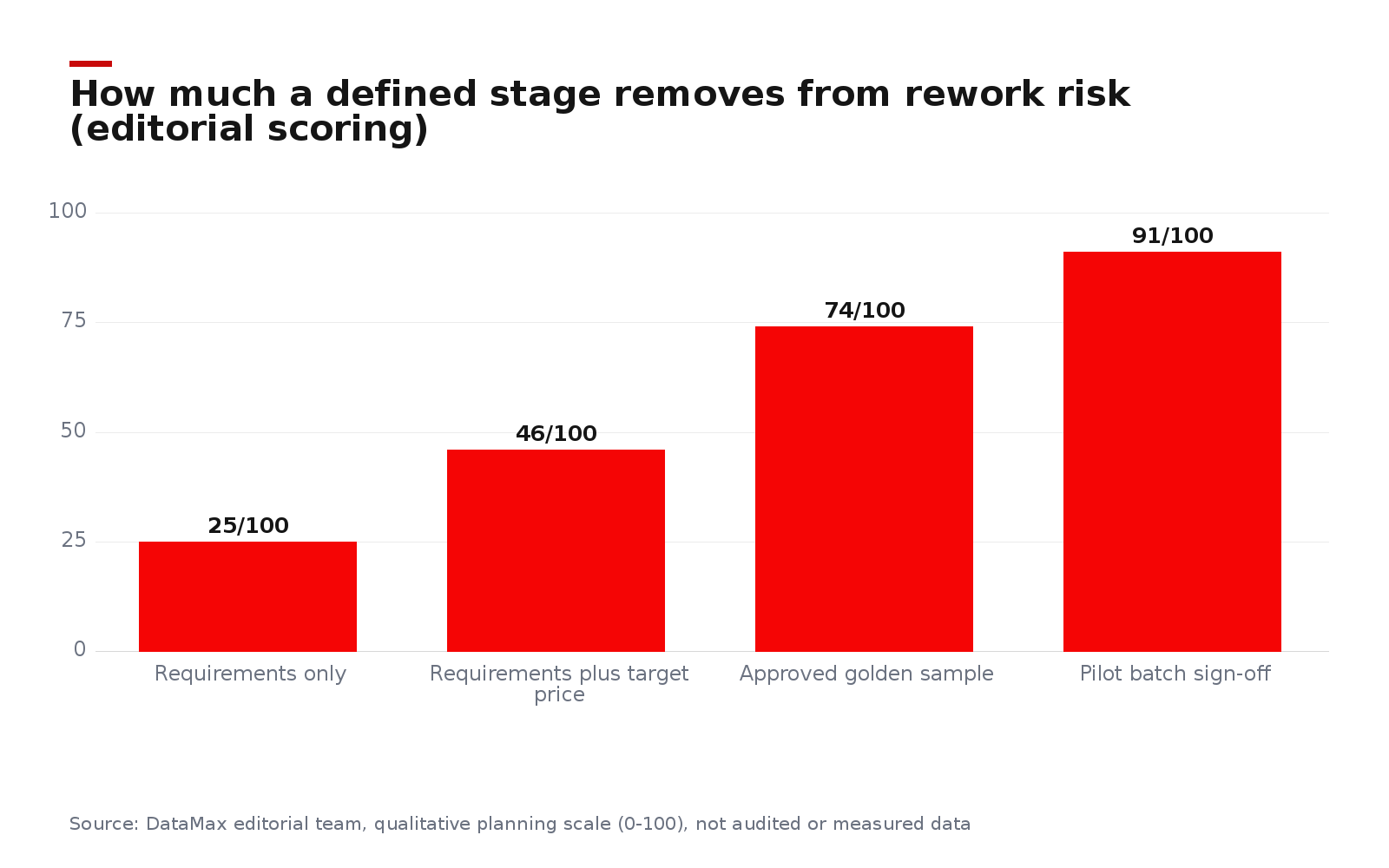
The same figures, in searchable form:
| Stage | Editorial score |
|---|---|
| Requirements only | 25/100 |
| Requirements plus target price | 46/100 |
| Approved golden sample | 74/100 |
| Pilot batch sign-off | 91/100 |
Source: DataMax editorial team, qualitative planning scale (0-100), not audited or measured data.
The chart uses an editorial qualitative planning scale, not measured production data. It ranks control stages rather than predicting defect rates. Requirements plus target price narrow the discussion, while the approved golden sample and pilot sign-off establish progressively stronger evidence.
The bill of differences also changes supplier communication. Requirements-only buyers often request final pricing before deeper engineering work. Commitment-tier buyers fund the sample configuration, test tooling, application validation and pilot release earlier. The objective is to define evidence preventing an android tv box from arriving under an unverified version, not to demand every internal factory file.
A middle route works when the supplier cannot customize the OS. Freeze the available DataMax platform more tightly, compensate through network configuration, fleet policy and operator middleware controls, and document excluded customizations. Unstated exclusions are the failure point.
Choose the route according to the cost of uncontrolled change. A managed fleet may require staged updates across thousands of endpoints. A fixed signage appliance can use a smaller evidence package, but its installed image still needs a defined recovery path. Control depth should follow deployment risk.
Assign signers by discipline. Procurement can approve the commercial configuration, engineering the build, compliance the certificates and the operator enrollment and content workflows. One combined signature can conceal unexamined work. A route that identifies the owner and artifact for each approval is easier to audit after a field issue.
How the requirement actually works
A version freeze is a configuration-management mechanism. It establishes one authoritative baseline and a controlled amendment path. The baseline combines hardware and software into a unit suitable for the deployment.
For an android tv box built on AOSP, the image may include the bootloader, kernel, device tree, vendor blobs, AOSP framework, hardware abstraction layers, middleware, applications, certificates and configuration data. Two images can show the same Android release while differing in kernel revision, security patch, device tree, radio firmware, boot configuration or vendor blob. Release identity therefore needs more than a marketing label.
Widevine L1 or PlayReady declarations require a release manifest. The factory can record the declared DRM configuration, while the operator needs the appropriate licensing and account workflow. HDCP 2.2 optional wording is not equivalent to universal HDCP 2.2 behavior in every unit. Optional means the buyer must select and verify the production configuration.
The update path completes the architecture. The factory may provision a signed initial image, while an operator-side server controls staged rollout. Device identity, enrollment, target-group selection, failure reporting and rollback need named owners. If recovery replaces primary flash with an unsigned build, both the update chain and release record have failed.
- Hardware revision and configuration code
- Android, bootloader, kernel and device-tree identifiers
- Middleware, applications, certificates and DRM manifest
- Golden sample and configuration archive
- Build-to-unit traceability
- Factory, application and pilot acceptance records
- Impact assessment and affected-item list
- Regression plan and named approval
- Revised release status
This mechanism limits commercial ambiguity. “Android TV box,” “IPTV box” and “OTT box” are categories, not production equivalence. Procurement language should distinguish AOSP Android from a Google-certified Android TV environment where certification matters, and identify middleware ownership. See AOSP versus Google Android TV and operator-tier Android TV box requirements for the related distinctions.
Identifiers should be nested rather than duplicated. The commercial model identifies the product family. The configuration code identifies the board, memory, connectivity and accessory set. The release record identifies software artifacts and accepted deviations. The serial links the physical device to the release, and fleet inventory links enrollment state to the approved configuration. No layer substitutes for another.
Change assessment should follow dependency direction. A component substitution can affect board revision, calibration data, firmware and test limits. A middleware update can affect application behavior, identity, entitlement workflows and operator acceptance. A security patch can require a new image hash while the visible Android release remains unchanged. The affected-item list must identify upstream and downstream artifacts.
The approved change record should define the disposition of existing units. Categories include replacement, in-field update, no impact, pilot-only release and acceptance of variance. A component change that does not alter the configuration still needs a recorded decision; otherwise, the factory may treat it as routine procurement while operator documentation retains the old revision.
Distributed deployments need release naming and inventory reporting based on the same keys. A descriptive label without a configuration code may support people but not automated filtering. The update server should select by configuration code, build identity and enrollment state. This supports staged rollout to a small validation group before the broader eligible population.
Preserve the distinction between test evidence and contractual capability. A factory test can show that an interface emits a signal; it cannot establish broad content compatibility. A pilot can validate a licensed workflow under specific accounts and servers; it cannot replace fleet monitoring. The version freeze records what was tested and the assumptions that applied.
The platform shortlist with datasheet values
Use the shortlist to identify the starting hardware direction, then confirm the production configuration against the current datasheet. The values below reproduce the supplied product facts and do not imply unlisted certifications, throughput, storage options or firmware features.
| Field | DM21P | DM21S | DM21T | DM22Q |
|---|---|---|---|---|
| Fit | 4K IPTV / operator middleware set-top box | 4K Android TV box for IPTV/OTT white-label | Premium UHD / cloud-gaming box | Gaming-oriented Android TV box |
| SoC | Amlogic S905Y4, quad Cortex-A35 | Amlogic S905Y5, quad Cortex-A55 | Amlogic S905X5, quad Cortex-A510 (ARMv9) | Amlogic S905X5M, quad Cortex-A55 up to 2.5GHz |
| OS | AOSP Android 11 | AOSP Android 14 | AOSP Android 14 | AOSP Android 14 |
| RAM/ROM | 2GB / 8GB (4GB; 16/32/64GB optional) | 2GB / 16GB (2/4/8GB; 16/32/64GB optional) | 4GB / 64GB (family options) | 4GB / 64GB (2/4/8GB; 16/32/64GB optional) |
| Decode | AV1 [email protected], VP9/H.265 4K@60, H.264 4K@30 | AV1 / H.265 [email protected] 4K@60 | H.266/VVC [email protected] 4K@120, AV1/VP9/H.265 4K@120, AVS3 4K@120, H.264 4K@60; inline AI-SR | AV1/H.265 L5.1 4K@60; inline AI-SR |
| DRM | Widevine L1 / PlayReady / HDCP 2.2 optional | Widevine L1 / PlayReady optional; Dolby Vision/DTS | Widevine L1 / PlayReady optional | Widevine L1 / PlayReady optional; Dolby Vision/DTS |
| Ports | HDMI 2.0b out x1, USB2.0 x2, TF, S/PDIF, 3.5mm AV, RJ45 100M, Wi-Fi6 2x2 + BT5.4, DC 5V/2A | HDMI 2.0b out, S/PDIF, AV, USB2.0 x2, TF, RJ45 100M (1G optional), Wi-Fi6 2x2 + BT5.4 | HDMI 2.0b out (no HDMI in), USB2.0 x1 + USB3.0 x1, TF, S/PDIF, AV, RJ45 100M (1G opt), Wi-Fi6 + BT5.4 | HDMI 2.0b out, USB2.0 x2, TF, S/PDIF, AV, RJ45 100M (1G opt), Wi-Fi6 2x2 + BT5.4 |
The DM21P is the direct starting point for operator middleware and IPTV requirements aligned with its listed fit. The DM21S offers the newer listed AOSP baseline for white-label work. The DM21T has the highest listed decode ceiling, including 4K/120 formats and inline AI-SR, plus USB3.0 and no HDMI input. The DM22Q targets gaming-oriented deployments with a listed 4K/60 decode baseline.
Check all four against the production datasheet for ordered memory, wired-network and DRM configurations. For android tv box production, model selection is one input to the freeze. The release record still needs the precise build, middleware, certificates, accessories and test evidence.
Software age is the first comparison. DM21P lists AOSP Android 11, while DM21S, DM21T and DM22Q list AOSP Android 14. That difference can matter when middleware, applications or certification evidence assumes a platform baseline. It should trigger compatibility review rather than an automatic ranking.
Decode is the second filter. DM21P lists AV1 [email protected], VP9/H.265 4K@60 and H.264 4K@30. DM21S lists AV1 and H.265 [email protected] 4K@60. DM21T lists the 4K/120 decode set and inline AI-SR. DM22Q lists AV1/H.265 L5.1 4K@60 and inline AI-SR. Match output, source format and refresh rate to the exact datasheet field.
Interface selection should follow installation. DM21P lists two USB2.0 ports, RJ45 100M, HDMI 2.0b output, 3.5mm AV and DC 5V/2A. DM21S, DM21T and DM22Q list RJ45 100M with a 1G option, which must be selected and confirmed. DM21T uniquely lists USB3.0 alongside USB2.0 and explicitly states no HDMI input.
DRM wording also requires exact treatment. HDCP 2.2 is listed as optional on DM21P. Dolby Vision and DTS appear as optional on DM21S and DM22Q. Establish the selected production configuration and applicable test evidence; a catalog listing does not identify which option is fitted.
The final comparison is operational. DM21P’s fit matches operator middleware. DM21S matches 4K IPTV/OTT white-label. DM21T fits premium UHD or cloud-gaming work where its decode ceiling and USB3.0 are relevant. DM22Q fits gaming-oriented requirements where 4K/60 is sufficient. Confirm every selected value against the production datasheet before entering it into the purchase order.
Further reading
- Guide android tv box for isps
- Allwinner Android TV boxes
- AOSP Android TV boxes
- H.265 HEVC Android TV box guide
- Widevine L1 certification guide
- DataMax DM21P specifications and fit
- DataMax DM21S specifications and fit
FAQ
When should the version freeze happen?
Freeze the approved configuration before the committed production build, not after the first shipment. The baseline should identify hardware revision, AOSP release, build, middleware, DRM manifest and accessories. A later freeze documents existing variation rather than preventing it, leaving operators to reconcile units that share a model name but not a controlled release.
Can firmware changes occur after the purchase order?
Yes, but they require controlled impact assessment. Identify affected hardware, software, security, middleware and test procedures, followed by regression results and named approval. An urgent security patch may use an expedited route, but it cannot bypass configuration ownership, build identity and release records.
Is AOSP Android the same as a Google-certified Android TV product?
No. AOSP identifies an open-source software baseline, while Google Android TV certification involves separate program requirements and an approved product configuration. A buyer requiring certified commercial Android TV should state that requirement in the RFQ and validate the actual model and release; AOSP alone does not establish certification.
What should a golden sample contain?
It should contain the approved hardware and release configuration, not merely a display unit. Archive its board revision, serial identity, build and bootloader identifiers, middleware and DRM manifest, configuration files, approved remote and accessories, and acceptance results. This creates the comparison basis for incoming inspection and pilot sign-off.
How does an operator prevent mixed versions across a fleet?
Define enrollment identity, build enrollment, target groups and update ownership before deployment. Use the golden sample as the reference implementation, keep every fleet image traceable to a release record, and test upgrade, recovery and rollback. A device that loses its enrolled identity during recovery needs an explicit recovery path rather than an unrestricted reinstall path.
What should be attached to a production audit request?
Request the approved configuration record, golden-sample evidence, SMT and AOI records, aging procedure, firmware-writing and hash procedure, pilot acceptance results and change-control process for the specific model. The audit should show how these artifacts connect to the shipped lot, not merely list factory equipment or present generic quality slides.
For a controlled RFQ, send the version-freeze requirements and request the configuration ID, revision history, sample evidence and pilot acceptance plan. To close the review, email [email protected] with the SKU list, target-market certificate list, golden-sample manifest, middleware/DRM checklist and proposed pilot test results; any value not present in the current production datasheet should be confirmed before it becomes contractual.


