

The procurement answer in one screen
A useful android tv box review is not a score assembled from headline specifications; it is an evidence chain showing what the hardware can decode, which software image was tested, how protected playback behaves, and which factory controls can reproduce the result. The direct answer is to buy against a frozen configuration, not a model name. A quotation can name the right SoC while leaving memory configuration, HDMI revision, Ethernet speed, DRM status, firmware baseline, and test evidence unclosed.
Start with four gates. First, match the platform to the workload: operator middleware and managed IPTV require stability and lifecycle control, while OTT white-label work benefits from a newer AOSP baseline. Second, record measurable media limits, including codec, profile, level and frame rate; do not accept “4K” without the output mode. Third, separate advertised integration from fitted options: Ethernet speed and DRM capabilities can vary by production configuration. Fourth, require evidence from the supplier’s actual process, including SMT inspection, aging, dark-room validation and firmware audit trails.
The shortlist below follows that logic. The DM21P aligns with 4K IPTV and operator middleware set-top-box deployments. The DM21S serves 4K IPTV/OTT white-label programs. The DM21T targets premium UHD and cloud-gaming use cases, while the DM22Q is oriented toward gaming.
Do not convert a review into an approval without a configuration sheet. The model, memory option, port set, optional features and production datasheet must remain linked to the same order line. For broader selection criteria, see our canonical guide to choosing an Android TV box for ISP deployments. The production datasheet remains the controlling reference for any specification omitted from a quotation.
A useful review also identifies what the supplier can demonstrate, not merely what the product family can theoretically support. If the quotation does not identify the AOSP build, middleware version, RAM/ROM combination, DRM implementation and Ethernet option, the review has not reached order-ready status. A buyer may have four candidate platforms and still have no valid basis for approval.
How the requirement actually works
A procurement-grade android tv box review begins by separating three layers: silicon capability, firmware implementation and service obligations. These layers often appear together in sales material, but they create different risks. Codec support describes what the media pipeline can process; the HDMI and display path determine whether that content can actually reach the panel; DRM, middleware and licensing determine whether protected content is permitted to play.
For video, specify the complete path rather than a generic resolution. A suitable line records codec, profile, level, resolution, frame rate, pixel format where relevant, colour treatment and HDMI output mode. AV1 Main Profile Level 5.1 is different from AV1 at an unspecified level. H.265 Main 10 at 4K60 is different from H.266/VVC Main 10 at 4K120. The operating system does not create these capabilities by itself.
The platform architecture also matters. AOSP Android 11, AOSP Android 14 and any later production baseline are distinct starting points. Android Management, provisioning, update policy, application signing, device-owner enrollment and operator middleware interfaces must be evaluated separately from AOSP version. Widevine L1, PlayReady and HDCP 2.2 also belong in the same checklist: a review should identify what is stated, what is optional and what evidence demonstrates a protected-content path.
Connectivity must be treated as an application requirement. RJ45 100M is adequate for a specific delivery design, while 1G is optional on certain models. Wi-Fi 6 2x2 and Bluetooth 5.4 describe radio capability, not guaranteed throughput or coexistence performance. USB, S/PDIF, analogue AV and TF availability can determine whether a box replaces a legacy installation or only supports a new television.
Lifecycle evidence completes the mechanism. A model becomes deployable only after the supplier can show how the exact firmware, application package, hardware revision and regional configuration are frozen, tested and reproduced. A good review asks whether “pass” means a single engineering sample or a defined production process. For Android-specific software considerations, the companion analysis of AOSP versus Google Android TV helps separate an operating-system baseline from a branded distribution decision.
The operating-system statement also needs boundary conditions. AOSP Android 14 identifies a platform baseline, not a complete Google-certified Android TV distribution. Buyers must not infer Google Play, mobile services, cast integration, device-owner enrollment, update channels or security patch commitments from the AOSP label alone. Where the service layer matters, the RFQ should name the intended Google service dependency, signing model and update channel, then require the supplier to state which parts are included.
Media review has a similar boundary. A decode claim establishes processing capability only if the source bitstream, container, profile and output mode are in scope. For example, a 4K120 decode line does not establish that every television, cable, HDMI sink and application path can carry 4K120. The acceptance test must use the intended source, the fitted output and the actual display endpoint.
DRM evidence must connect the key server, device identity, security level and playback resolution. A label such as “Widevine L1 / PlayReady optional” describes a potential configuration, not a verified service. The review should identify the optional item as selected, confirm the production image, and report the protected-content test used for that exact hardware revision.
The platform shortlist with datasheet values
The following comparison contains only values present in the supplied DataMax product facts. Options remain explicitly optional where the source marks them as such. Confirm every order against the production datasheet.
| Model | SoC | OS | RAM / ROM | Decode | DRM | Interfaces |
|---|---|---|---|---|---|---|
| DM21P 4K IPTV / operator middleware set-top box | Amlogic S905Y4, quad Cortex-A35 | AOSP Android 11 | 2GB / 8GB 4GB; 16/32/64GB optional | AV1 [email protected]; VP9/H.265 4K@60; H.264 4K@30 | Widevine L1 / PlayReady / HDCP 2.2 optional | HDMI 2.0b out x1; USB2.0 x2; TF; S/PDIF; 3.5mm AV; RJ45 100M; Wi-Fi6 2x2 + BT5.4; DC 5V/2A |
| DM21S 4K Android TV box for IPTV/OTT white-label | Amlogic S905Y5, quad Cortex-A55 | AOSP Android 14 | 2GB / 16GB 2/4/8GB; 16/32/64GB optional | AV1 / H.265 [email protected] 4K@60 | Widevine L1 / PlayReady optional; Dolby Vision/DTS | HDMI 2.0b out; S/PDIF; AV; USB2.0 x2; TF; RJ45 100M (1G optional); Wi-Fi6 2x2 + BT5.4 |
| DM21T Premium UHD / cloud-gaming box | Amlogic S905X5, quad Cortex-A510 (ARMv9) | AOSP Android 14 | 4GB / 64GB family options | H.266/VVC [email protected] 4K@120; AV1/VP9/H.265 4K@120; AVS3 4K@120; H.264 4K@60; inline AI-SR | Widevine L1 / PlayReady optional | HDMI 2.0b out (no HDMI in); USB2.0 x1 + USB3.0 x0; TF; S/PDIF; AV; RJ45 100M (1G opt); Wi-Fi6 + BT5.4 |
| DM22Q Gaming-oriented Android TV box | Amlogic S905X5M, quad Cortex-A55 up to 2.5GHz | AOSP Android 14 | 4GB / 64GB 2/4/8GB; 16/32/64GB optional | AV1/H.265 L5.1 4K@60; inline AI-SR No NPU TOPS stated | Widevine L1 / PlayReady optional; Dolby Vision/DTS | HDMI 2.0b out; USB2.0 x2; TF; S/PDIF; AV; RJ45 100M (1G opt); Wi-Fi6 2x2 + BT5.4 |
One editorial check is useful before treating these as interchangeable. The review process is compared by the degree of failure traceability a partner type is expected to provide, using a qualitative planning scale.
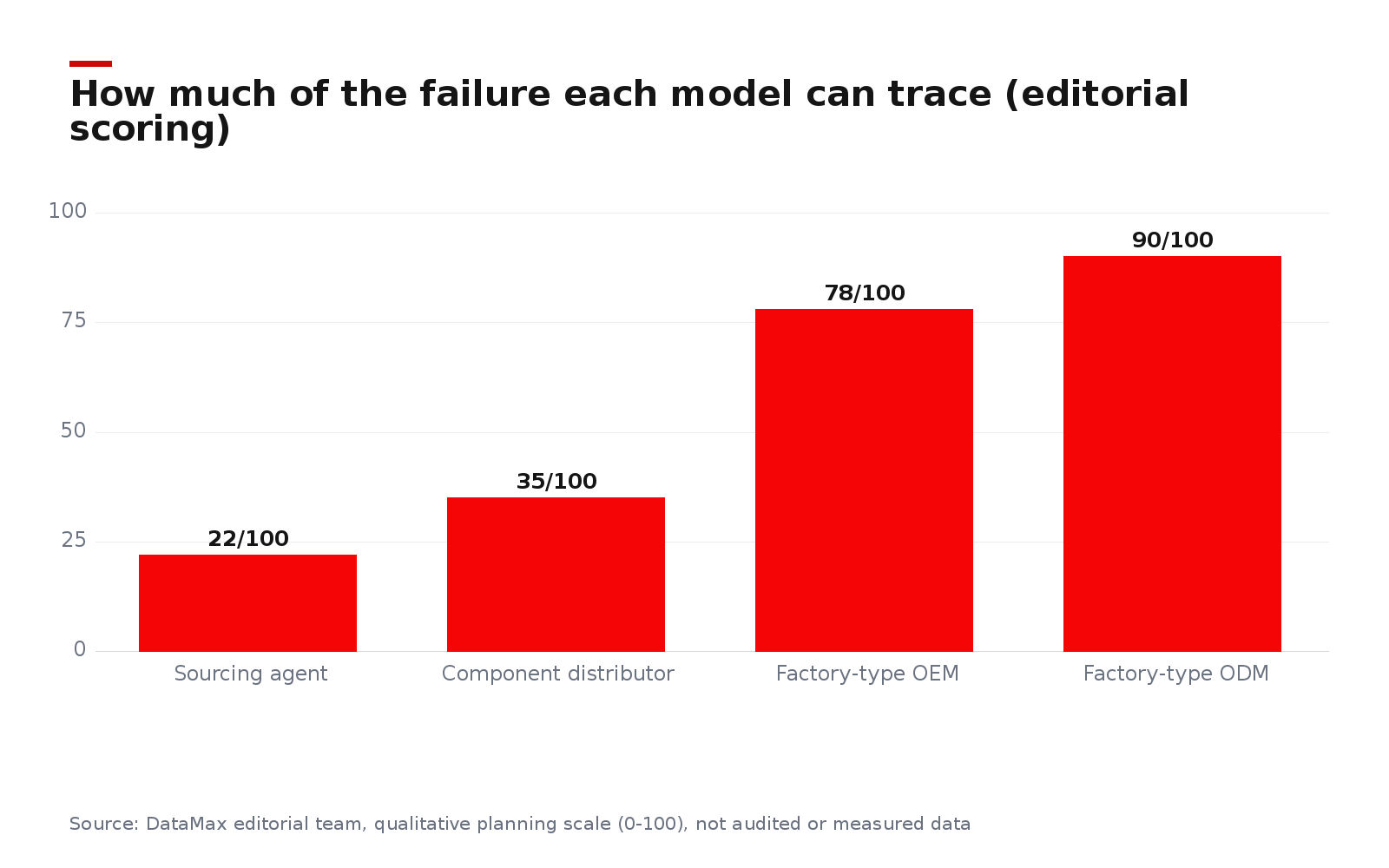
The same figures, in searchable form:
| Partner model | Editorial score |
|---|---|
| Sourcing agent | 22/100 |
| Component distributor | 35/100 |
| Factory-type OEM | 78/100 |
| Factory-type ODM | 90/100 |
The chart ranks expected traceability, not product quality. It reinforces the need to inspect evidence for the actual production site rather than infer control from the commercial label.
The table should be read row by row rather than as a winner-takes-all ranking. A buyer with managed IPTV may prioritize the DM21P’s operator-middleware fit and AOSP Android 11 baseline. A white-label programme may choose the DM21S’s AOSP Android 14 baseline and 2GB/16GB starting configuration. Premium UHD or cloud-gaming requirements point toward the DM21T’s stated 4K120 decode formats, while gaming-oriented work points toward the DM22Q’s stated 4GB/64GB baseline.
The table is not a substitute for the order configuration. “2GB / 16GB” and “2/4/8GB; 16/32/64GB optional” are not interchangeable commercial commitments. Likewise, “1G optional” identifies an available selection but not a standard build. The buyer should record the selected RAM, ROM and Ethernet variant in the purchase order, BOM, work instruction and inspection record.
Where this matters in a deployment
The operational context determines which review findings matter. An operator may prioritize predictable firmware, middleware compatibility and recovery procedures. An AV integrator may care more about HDMI behaviour, audio output, remote-control integration and physical mounting. A venue team may need a sealed, repeatable configuration with network access managed by the operator rather than exposed consumer settings.
The scene below illustrates the intended concealment of a compact operator box behind a wall-mounted television in a modern hotel room at dusk, with a clean bedside desk and warm ambient lighting.
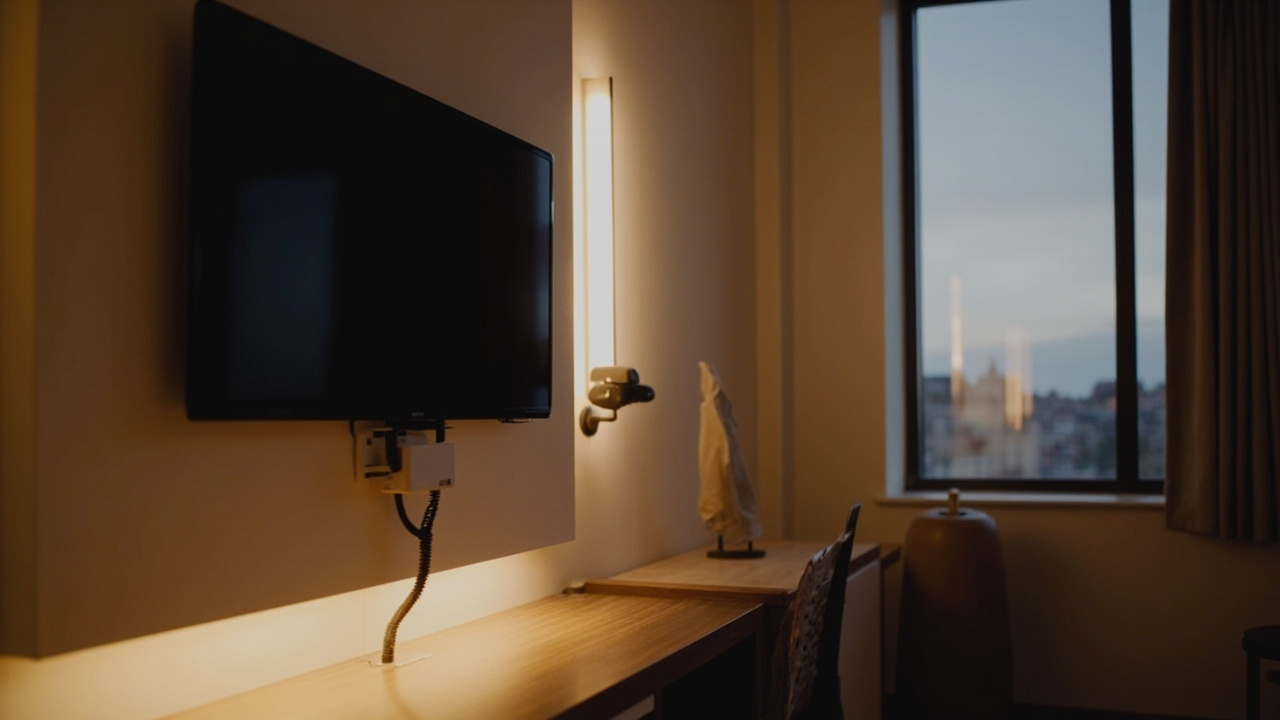
For a hospitality deployment, the review should test remote IR, Wi-Fi provisioning, Ethernet fallback, application launch after power loss, firmware update recovery and HDMI reconnection. The photograph is illustrative; it does not establish the dimensions, finish, thermal performance or installation method of any DataMax product.
| Situation | Primary requirement | Model direction | Evidence to request |
|---|---|---|---|
| IPTV operator programme | Operator middleware stability and managed lifecycle | DM21P | Middleware build matrix, recovery test and configuration baseline |
| IPTV/OTT white-label programme | Current AOSP baseline and brand-level integration | DM21S | Signed image, application package, regional settings and update path |
| Premium UHD or cloud-gaming | High-frame-rate decode path and higher memory configuration | DM21T | 4K120 format support list, thermal run and output-mode evidence |
| Gaming-oriented deployment | AV1/H.265 playback, 4GB/64GB configuration and game-service integration | DM22Q | Game-service test, storage endurance and sustained-performance record |
| Hospitality room programme | Remote control, power recovery, concealed installation and site replacement | Confirm platform after remote and recovery tests | IR matrix, power-cycle log, fault-replacement record |
| Managed retail digital-signage deployment | Repeatable image, controlled updates and centralized recovery | Confirm platform after Android Management workflow test | Enrollment record, update policy and device-owner recovery log |
| AV installation with legacy audio | Required analogue or digital audio output | Confirm fitted AV or S/PDIF before model release | Port inspection, output test and physical BOM |
For an operator, the strongest review question is “Can this exact image boot, provision and recover after interruption?” For an integrator, it is “Which physical outputs are fitted, and what happens when the television negotiates a new HDMI mode?” For a venue deployment, it is “Who can replace the unit without changing its configuration?” These questions expose differences that a generic specification sheet conceals.
A hotel programme can expose update and replacement risks that are invisible during a demonstration. If a failed unit is replaced from stock, the replacement must carry the same firmware, middleware entitlement, regional settings and network identity. Require a reset or re-enrollment procedure and test whether that procedure can be completed without exposing operator-controlled settings to the guest.
A managed retail site introduces a different failure boundary. The box may need to boot into a controlled application, recover from an interrupted update and retain a known identity after network changes. The review should document Android Management enrollment, device-owner behavior and the update channel if those services are part of the intended deployment.
For an integrator, port selection must be verified physically. The shortlist includes HDMI 2.0b output, USB, TF, S/PDIF and AV on several models, while the DM21P explicitly lists 3.5mm AV and DC 5V/2A. The DM21T explicitly has no HDMI input. These distinctions determine whether the proposed box is a primary source, a companion product or a suitable replacement for existing equipment.
Turning the question into a spec line
Convert the title question into an RFQ sequence before requesting samples. The objective is a line that can be compared across quotations without interpretation.
- Define the job Record operator middleware, IPTV/OTT white-label, premium UHD, cloud-gaming or gaming-oriented use. Name the panel resolution, refresh target and output standard rather than using “4K TV box”.
- Freeze the model State the exact DataMax model and request the production datasheet. Do not allow a quotation to substitute a similar model or chipset.
- Freeze memory and interfaces Write RAM/ROM, Ethernet speed, HDMI output count, USB count and required analogue or digital audio outputs as fitted options.
- State the media path Include codec, profile, level, frame rate and any display-format restriction. Distinguish decode support from output capability.
- State the protection path Identify Widevine, PlayReady, HDCP and Dolby Vision/DTS requirements, including which features are optional and therefore need explicit selection.
- Define the software baseline Specify the AOSP version, middleware version, application signing, regional configuration and update/recovery method.
- Attach the evidence set Require production-line records, aging results and a traceable sample-to-shipment configuration record for the quoted configuration.
A pasteable RFQ line looks like this:
Supply the DM21S configuration with AOSP Android 14, 2GB/16GB, HDMI 2.0b out, USB2.0 x2, S/PDIF, AV, TF, RJ45 100M and Wi-Fi6 2x2 + BT5.4 for the approved IPTV/OTT white-label programme. State AV1 / H.265 [email protected] 4K@60 decode support and any optional Widevine L1 / PlayReady / Dolby Vision/DTS implementation. Quote the production datasheet, exact firmware baseline and test evidence.
When requesting samples through sample ordering, the first message should identify the model, exact RAM/ROM and port configuration, intended workload, required codec and DRM profile, target operating system, quantity under review and the evidence package required. This reduces the risk of receiving a configuration that demonstrates a different market segment.
Turn “latest processor” into an exact SoC line. For example, an operator requirement may read “Amlogic S905Y4, quad Cortex-A35, AOSP Android 11, 2GB/8GB”; a white-label requirement may read “Amlogic S905Y5, quad Cortex-A55, AOSP Android 14, 2GB/16GB”. The processor name alone is not enough because the RAM/ROM, OS baseline and output options remain separate order decisions.
Turn “modern connectivity” into fixed interface lines. “RJ45 100M” and “RJ45 100M (1G optional)” represent different procurement commitments. A venue with a specific network design may need a defined Ethernet speed, while an integrator may need two USB2.0 ports rather than the DM21T’s USB2.0 x1 + USB3.0 x1 arrangement. Include the USB generation and count because peripheral loading behaviour may depend on both.
Turn “HD-ready” or “4K ready” into a format matrix. The RFQ should state whether the acceptance suite includes AV1 [email protected], VP9, H.265 Main 10, H.264, and the intended frame rate. It should also require the source file characteristics and the end-to-end display path. This prevents a processor-level decode claim from becoming an unsupported site-level output promise.
Finally, attach acceptance ownership. Name who checks codec playback, who verifies protected content, who signs the middleware image, who reviews factory records and who authorizes a model substitution. Without assigned gates, an apparently complete RFQ still leaves the critical review decisions unowned.
Where quotations quietly diverge
Most divergence occurs between a feature named in a quotation and a feature fitted, licensed, enabled or tested in the delivered configuration. A model identifier may also absorb several memory, networking and protection variants. The buyer must therefore request one frozen ordering code and one matching production datasheet.
Field trap
A quotation saying “Widevine L1 / PlayReady optional” has not defined the delivered SKU. If DRM is operationally required, specify the option, licence status, supported resolution and evidence required. An optional feature omitted from the build can break protected playback after the hardware has already passed general review.
Field trap
“4K” or “8K” marketing language is not an output specification. For the listed DM21T and DM22Q platforms, use only the stated decode limits: 4K120 for the DM21T formats listed and 4K@60 for the DM22Q. Confirm display, source and panel constraints separately; the HDMI 2.0b output must also be part of the end-to-end test.
Other divergence points include the Ethernet option. RJ45 100M appears as the baseline across the shortlist, while 1G is optional on the DM21S, DM21T and DM22Q. A sample carrying 1G does not prove that the production order will. Likewise, “family options” must never be copied into an RFQ without a selected RAM/ROM value.
Software language can also conceal operational differences. AOSP Android 14 does not establish the middleware, update channel, device-owner workflow or Google-certified feature set. Likewise, “Dolby Vision/DTS” must be tied to the exact platform and selected configuration. Confirm against the production datasheet, then request a sample matching the intended build.
The cost of these omissions appears late: after tooling, shipment, certification review or installation. Correct them at RFQ stage by converting every optional phrase into either “included and evidenced” or “excluded from this order”.
A second divergence appears in component substitutions. The exact SoC and memory values should appear on the order line. A processor replacement can change codec claims, power behaviour, Android image requirements and thermal design, while a memory substitution can affect application storage, update partitions and recovery procedures. If change is unavoidable, route it through a documented review of the affected test cases rather than accepting it as a routine procurement substitution.
A third divergence is the interpretation of “sample passed.” The sample may be an engineering unit running a developer image, while production units use a signed image and a finalized bill of materials. Require the sample’s serial number, board revision, firmware hash and configuration to be visible in the test record. If those fields are missing, a passed sample remains an informal demonstration.
A fourth divergence concerns delivered documentation. A quotation may cite a datasheet for the family rather than the ordered option, and a certification folder may mix reports for different SoCs or OS baselines. The buyer should index each document by model, hardware revision, firmware baseline, laboratory and configuration. A document that cannot be mapped to the proposed SKU should not close the review item.
Questions to put in the supplier review
Supplier review should follow the physical production path. The purpose is to determine how a variation becomes visible before shipment, not to collect disconnected quality images.
- SMT inspection Ask which board revisions are in production, which parameters are inspected, and how inspection records are linked to the finished unit.
- AOI review Request examples of defect classes covered by automated optical inspection and the escalation path for failures that require manual verification.
- Assembly and firmware loading Confirm the station that applies the approved image, writes the configuration and records the device identity.
- Functional test Ask whether HDMI, Ethernet, USB, audio, Wi-Fi, Bluetooth, storage and configured DRM paths are tested as defined combinations.
- Burn-in or aging Request the duration, workload, sample coverage, failure criteria and retained result for the exact board revision.
- Dark-room validation Ask which visual, audio, network and application checks occur without ordinary ambient interference.
- Audit trail and shipment release Require the linkage between test result, hardware configuration, firmware version, serial record and shipment batch.
Evidence standard: a screenshot proves that a report existed; it does not prove that the report belongs to the ordered unit. Request lot identifiers, board revision, firmware hash, test date, pass/fail disposition and traceability from station record to shipment container. Any missing field remains an open item, not an implied pass.
The factory review should also test configuration control. Ask how optional Ethernet, memory and DRM variants are represented in the bill of materials and work instructions. A capable line uses one ordering code across the purchase order, production order, test record and final packing list.
For this topic, the review should focus on the exact candidate rather than general factory capability. For the DM21P, request the operator middleware image, recovery procedure and evidence for the selected 2GB/8GB baseline. For the DM21S, request the AOSP Android 14 image, optional-feature decision and protected-content path. For the DM21T and DM22Q, request sustained media playback and gaming or application test records against their selected configurations.
SMT evidence should answer what the process can detect, while AOI evidence should answer what it detects automatically and what moves to manual verification. The two are complementary: automated inspection does not replace functional testing, and a functional pass does not prove that solder defects were controlled at assembly. Request the actual record structure rather than a statement that the process is “100% inspected”.
Aging evidence must identify the workload. A box that idles during aging does not test the thermal and network conditions created by continuous media playback, Wi-Fi use or an operator application. Ask for test duration, sample coverage, failure criteria and the procedure applied to a failed unit. For the DM21T, any 4K120 acceptance run should identify the source formats, output mode and ambient conditions used during the test.
Dark-room validation should be tied to the intended deliverable. The objective is repeatable inspection without ordinary ambient interference, not a generic screen photograph. Ask whether audio, network, application launch, indicator states and remote-control functions are covered. The evidence should retain the device identifier and test recipe so engineering can reproduce a failure.
DataMax’s manufacturing and quality controls can be reviewed through the factory-quality page, or a video factory audit can be requested. The invitation should identify this topic specifically and ask for SMT/AOI, aging, dark-room and configuration-traceability evidence for the proposed model. For related compliance review, the certifications page provides a natural reference point, while individual claims must remain tied to the production configuration.
The comparison buyers actually make
Buyers rarely compare products in isolation. They compare a baseline operating cost against the cost of adding capability later. The relevant differences are not visual styling; they are software baseline, decode envelope, memory configuration, port flexibility, DRM positioning and process traceability.
| Decision dimension | DM21P | DM21S | DM21T | DM22Q |
|---|---|---|---|---|
| Position | 4K IPTV / operator middleware set-top box | 4K Android TV box for IPTV/OTT white-label | Premium UHD / cloud-gaming box | Gaming-oriented Android TV box |
| SoC and CPU | Amlogic S905Y4, quad Cortex-A35 | Amlogic S905Y5, quad Cortex-A55 | Amlogic S905X5, quad Cortex-A510 (ARMv9) | Amlogic S905X5M, quad Cortex-A55 up to 2.5GHz |
| OS | AOSP Android 11 | AOSP Android 14 | AOSP Android 14 | AOSP Android 14 |
| Stated RAM / ROM | 2GB / 8GB; other memory options stated | 2GB / 16GB; other memory options stated | 4GB / 64GB; family options | 4GB / 64GB; other memory options stated |
| Decode distinction | AV1 [email protected]; VP9/H.265 4K@60; H.264 4K@30 | AV1 / H.265 [email protected] 4K@60 | Includes H.266/VVC [email protected] 4K@120 and listed formats at 4K120 | AV1/H.265 L5.1 4K@60; inline AI-SR |
| Interface distinction | HDMI 2.0b out x1; USB2.0 x2; 3.5mm AV; DC 5V/2A | HDMI 2.0b out; USB2.0 x2; RJ45 100M (1G optional) | HDMI 2.0b out with no HDMI in; USB2.0 x1 + USB3.0 x1 | HDMI 2.0b out; USB2.0 x2; RJ45 100M (1G opt) |
| DRM wording | Widevine L1 / PlayReady / HDCP 2.2 optional | Widevine L1 / PlayReady optional; Dolby Vision/DTS | Widevine L1 / PlayReady optional | Widevine L1 / PlayReady optional; Dolby Vision/DTS |
The decision sequence is straightforward. Choose DM21P when the programme is explicitly positioned around operator middleware and its AOSP Android 11 baseline is accepted. Choose DM21S where an AOSP Android 14 baseline and white-label fit are central. Choose DM21T when the stated 4K120 decode formats, USB3.0 and premium UHD/cloud-gaming direction justify the platform. Choose DM22Q for the gaming-oriented requirement set, 4GB/64GB baseline and Dolby Vision/DTS wording.
The cost of choosing on the wrong axis appears after installation. An operator that selects for headline decode capability but cannot maintain a controlled firmware baseline may face larger deployment and recovery costs. A gaming programme that selects for processing but omits the required USB, Ethernet or DRM options may have to alter the physical or service design. Compare the bill of differences, including evidence, software and interface commitments, rather than ranking the boxes by processor generation alone.
A second comparison is entry tier against commitment tier. The entry decision is often a managed IPTV programme using the DM21P direction, with 2GB/8GB and RJ45 100M as the stated baseline. The commitment decision may be a white-label programme using DM21S, a premium UHD programme using DM21T, or a gaming programme using DM22Q. “Commitment tier” here means a broader configuration and evidence obligation, not a higher price claim.
Before releasing an order, have engineering, operations and procurement approve the same evidence pack. Include the production datasheet, selected configuration, media test matrix, DRM implementation, firmware baseline and traceability record. A supplier-review request should begin with the model, exact configuration, workload and evidence list. That discipline makes an android tv box comparison repeatable across factories and protects the programme from decisions based on headline labels.
Further reading
- Guide android tv box for isps
- Android TV boxes
- Rockchip Android TV boxes
- Edge computing boxes
- 4K 60fps Android TV box guide
- DataMax DM21P specifications and fit
- DataMax DM21S specifications and fit
FAQ
What should a buyer verify before accepting an Android TV box review?
Verify the exact model, RAM/ROM, port configuration, AOSP baseline, codec profile and frame-rate limits, DRM options, Ethernet speed and firmware identity. A review is reliable only when its tested configuration matches the proposed production order. Require the production datasheet and sample-to-shipment traceability record before approval.
Is a newer Android version automatically the better choice?
No. A newer AOSP baseline may improve integration options, but it does not determine middleware stability, application compatibility, update control, DRM licensing or hardware capability. Compare the complete software and service design. For the stated shortlist, DM21P uses AOSP Android 11, while DM21S, DM21T and DM22Q use AOSP Android 14.
How should optional DRM and Ethernet features be written in an RFQ?
Replace vague optional language with an explicit selection and evidence condition. State whether Widevine L1, PlayReady, HDCP 2.2, Dolby Vision, DTS and 1G Ethernet are included in the ordered configuration. Request the production datasheet and matching test record, because an engineering sample may not represent the shipping build.
What evidence proves that a supplier controls manufacturing quality?
Ask for SMT and AOI records, firmware-loading traceability, functional test results, aging or burn-in results, dark-room validation and shipment-release records. The evidence should identify the board revision, firmware, configuration and date. For a live process review, request an audit focused on this model rather than a general factory presentation.
Does “4K” mean the same thing for every model?
No. The supported limit depends on codec, profile, level, frame rate, source material and the output path. The supplied facts distinguish 4K60, 4K120 and H.264 4K@30 capabilities. Buyers should require a format matrix and end-to-end HDMI test instead of treating “4K” as a sufficient performance claim.
Can one sample approve a production order?
A sample can validate fit and identify integration issues, but it should not replace configuration and process controls. Approval should cover the production datasheet, frozen firmware and middleware, selected options, applicable test matrix, manufacturing traceability and change-control obligations. Any subsequent substitution should trigger review against the same evidence standard.


