

Before the terminology: the decision
An RFQ lands with 3 model names, 4 memory configurations, 3 DRM statements and a request for samples. The purchasing team wants “the cheapest 4K box,” while engineering must answer whether the device will boot operator middleware, negotiate a DRM licence, sustain the required network load and pass regional compliance.
The short answer is that an android tv box manufacturer should be selected as a manufacturing and verification partner, not as a catalogue of generic boxes. The decisive evidence is a platform-to-workload match, a locked bill of materials, a repeatable software image, and production records covering SMT, AOI, burn-in and shipment. This article extends the canonical topic, what an Android TV box manufacturer is and what it is not, from the engineer’s procurement perspective.
A quotation becomes useful only after 5 questions are answered: What exact SKU is quoted? Which Android release and middleware image are supported? Which DRM, HDCP and decoder obligations apply to the target service? What production and compliance evidence accompanies the configuration? What changes when RAM, storage, connectivity or regional certification changes?
For operators, device management and licence-service integration often matter more than a newer operating system. For hotel, hospitality and signage projects, thermal behaviour, remote-control support, recovery mechanisms and installation ergonomics can dominate. For premium entertainment, decode capability and output constraints must be specified without accepting marketing labels that exceed the datasheet.
A further decision is whether the programme is catalogue procurement or product creation. A catalogue SKU requires confirmation of the standard enclosure, image, accessories and packaging. A white-label programme requires control over the launcher, wallpaper, boot sequence, remote key map, application set, update agent and update domain. Those are different engineering contracts even when the underlying board is identical.
For a volume programme, the buying team should nominate 1 technical owner, 1 supply-chain owner and 1 acceptance-test owner. Their decisions must use the same configuration revision. Otherwise, a sample approved by engineering can diverge from the order accepted by procurement.
DataMax positions itself as an ODM and OEM manufacturer for Android TV/OTT boxes, so the relevant discussion is configuration control and evidence—not a generic brand claim. Request a model-linked sample and a video factory audit before assigning a production commitment. A responsible android tv box manufacturer should expose unresolved assumptions before the purchase order, not after the first production lot.
Deployment scenarios and the spec each needs
The first engineering task is to describe the deployment as a service system, not as a television product. Each role changes the workload, failure recovery and evidence requirement.
| Situation | Primary requirement | Model direction |
|---|---|---|
| Pay-TV or IPTV operator | Stable AOSP software, operator middleware, 100M Ethernet baseline, DRM and device-management integration | Evaluate DM21P for 4K IPTV and operator middleware, or DM21S for an Android 14 IPTV/OTT white-label path |
| OTT or streaming brand | 4K playback, AOSP Android 14, Widevine L1, optional PlayReady, branded image and controlled configuration | Evaluate DM21S or DM22Q against playback and interface requirements |
| Hotel or hospitality integrator | Compact enclosure, reliable network attachment, simple provisioning, AV and HDMI connectivity | Use DM21P or DM21S as a starting point, then validate thermal and recovery behaviour |
| Premium UHD or cloud-gaming programme | Higher decode headroom, 4K/120-capable media path, USB 3.0, storage and sustained performance | Evaluate DM21T; do not infer output capability beyond its datasheet |
| Gaming-oriented retail or edge project | Android 14, 4K/60 media support, 4GB/64GB base configuration, AV and optical-audio outputs | Evaluate DM22Q with a controlled image and workload test |

The pictured scenario is a compact operator box hidden behind a wall-mounted television in a modern hotel room at dusk. Its practical requirements include stable HDMI output, remote operation, recovery after power interruption and a network path that survives guest-network procedures. Wall placement also changes thermal and signal assumptions; a bench-top RFQ does not validate those conditions.
A hospitality deployment adds a field-recovery constraint. The operator may need to restore a lost remote pairing, replace a failed unit and recover service without a site visit. Specify whether configuration is stored locally, can be exported, or is restored from a central service. Also define whether the unit starts into the operator experience after power restoration. Those questions affect the image, update design and accessory supply chain.
A venue digital-signage programme adds another constraint: the device may run unattended for long periods with a fixed content playlist and remote update path. Specify whether updates arrive through an operator application, Android Management API, Android Recovery or another controlled mechanism. Confirm that the chosen image, middleware and update policy are supported as one configuration.
For an operator tender, divide the acceptance test into 4 layers: hardware continuity, image stability, service entitlement, and network performance. “4K” alone does not define any of them. An engineer should be able to point to a test case, expected result and responsible owner for each layer.
A useful test sheet records source codec, resolution, frame rate, HDR type, audio format, HDMI mode, playback duration, reboot count and network state for every protected-media case. A single ten-minute playback proves much less than a 24-hour service run. The buyer can then distinguish a product limitation from an unstable environment.
The deployment matrix narrows the candidate set, but it does not approve it. Every selected platform still needs a controlled image, a target-market compliance scope and a service acceptance protocol. The operator-tier Android TV box solution provides a useful starting point for defining those obligations.
Turning the question into a spec line
A procurement query becomes executable only when every ambiguous noun has a measurable field. The sequence below turns a general request for an android tv box manufacturer into RFQ lines that engineering, operations and finance can review.
- Name the platform State the approved model and exact base SKU. Do not write “4K box equivalent”; require the SoC, RAM, storage, OS build, ports and output mode in the quotation.
- Define the service boundary Identify the operator middleware, launcher, application, update method, network profile and account or DRM dependency. Include the target market and required Android framework level.
- Fix media obligations List required codecs, maximum frame rate, HDR format, audio format and HDMI output mode. Treat decoder support and output capability as separate fields.
- Define protection State Widevine security level, PlayReady requirement, HDCP version and whether hardware-backed or software-backed paths are acceptable. “DRM supported” is not an acceptance criterion.
- Connect the environment Specify Ethernet speed, Wi-Fi standard, USB topology, audio outputs, remote-control method and physical installation constraints.
- Attach the evidence Name required production records: SMT inspection, AOI results, burn-in or aging, image loading, functional test, packaging traceability and applicable certification files.
- Freeze changes Attach the model revision, firmware build, boot logo, package label and accessory list. State the engineering change-control path for substitutions.
A pasteable RFQ line should resemble this structure:
Quote [model and base SKU] for [target market and deployment], using [RAM/storage], [AOSP Android version], [SoC], [Ethernet/Wi-Fi], [decoder profile], [DRM and HDCP requirement], [middleware/image ownership] and [specified ports]. The quotation must identify lead time against a written configuration, excluded accessories, recurring software charges, certification scope and all proposed substitutions. Supply sample evidence and production inspection records against this same configuration.
This process exposes commercial divergence before samples are built. A quoted SKU may include a different storage tier, power adapter, Wi-Fi module, remote or operator image than the sample. Require the quotation to state those boundaries line by line rather than using “equivalent” in a long table.
Turn performance statements into testable thresholds. Replace “stable playback” with a defined media file, duration, frame-rate tolerance and restart result. Replace “fast Ethernet” with RJ45 speed, negotiated link mode and sustained transfer expectation. Replace “reliable Wi-Fi” with the required band, regulatory domain and minimum association rate. The android tv box manufacturer must know which condition triggers rejection.
Add a configuration-parts table to the RFQ. Its rows should cover mainboard or SoC, RAM, storage, Wi-Fi module, Ethernet speed option, remote, power adapter, enclosure, HDMI cable and packaging artwork. Each row needs a part number, approval status and change-notification commitment. This prevents a 1G Ethernet option or newer storage tier from entering production as an uncontrolled substitution.
The acceptance gate should also name who owns each result. Hardware engineering signs the interface and media matrix; software engineering signs the image and recovery tests; operations signs traceability; compliance supplies market-scope evidence. An android tv box manufacturer cannot resolve missing application requirements merely by providing a generic board.
Where quotations quietly diverge
Quotations often diverge because each supplier models the programme differently. One prices a bare board; another includes the enclosure, adapter, remote and branded image. One treats RAM and storage as standard; another quotes them as engineering changes. The unit price can appear identical while the delivered scope is not comparable.
Field trap
A 4K decoder claim does not automatically specify 4K output. If the buyer needs a particular frame rate, HDR mode or refresh combination, the quotation and validation plan must state whether it is decode-only, pass-through or output-supported. The wrong interpretation can produce a sample that passes media testing but fails the deployment specification.
Field trap
A “Google-certified” request and an AOSP Android TV requirement are not interchangeable. Certification, framework services, Widevine security level and PlayReady support depend on the exact image, service agreements and target market. Request the actual approval scope; do not infer it from a generic “Android TV” label.
Other common discrepancies concern Ethernet: a 100M RJ45 baseline and an optional 1G configuration have different interfaces, thermal and validation implications. They also concern storage: a larger flash tier needs a boot test, update-cycle test and endurance expectation appropriate to the application. Memory options affect image size, update procedures and operational headroom, not just multitasking.
Remote-control support needs a component-level specification. Identify the protocol, frequency band, key map and pairing process. For TV-box deployments where the operator supplies the viewing experience, confirm whether the device boots directly into that environment and how a lost pairing is recovered.
Compliance is another quoted variable. Confirm the production datasheet for the exact market and certification status. Do not let a project plan assume that a generic platform’s regulatory files cover a modified radio, power supply, enclosure or target country. The compliance evidence route should identify the exact product and market scope rather than relying on a family-level claim.
A less visible divergence is the bootloader and partition contract. One quotation may include a preinstalled application and locked update domain; another may deliver an unlocked build suitable for the operator’s own signing process. State who creates the update package, who signs it, how rollback works and which recovery mode remains available to field service.
Packaging is another source of late change. A remote-control supplier can change its IR code table without a board revision. A power-adapter change can alter electrical compliance scope. A carton redesign can change the product label and serial format. Require configuration-control records for these indirect changes, not only for the mainboard.
The most expensive ambiguity is usually discovered after the first production batch. An RFQ should state permitted substitutions, notification periods, golden-sample approval, bootloader and partition treatment, serial-number format, packaging revision and defect-analysis responsibility. These clauses convert “same as sample” into a controlled baseline.
A disciplined android tv box manufacturer should record deviations against a released configuration. Deviations may be accepted for a documented pilot, but they should not silently migrate into the production baseline. Ask for the exception list at every stage: sample approval, pilot build and production release.
The evidence trail from SMT to shipment
Production control is a chain of evidence. The factory’s ability to present a clean data trail matters more than a photographed line, because a line view does not show which serial numbers passed which inspection gate.
- Incoming control Match electronic components and mechanical parts against the approved BOM. Record lot traceability where the quality plan requires it.
- SMT and AOI Capture line records for placement and automated optical inspection. Review exceptions, accepted deviations and repair operations against the released build.
- Assembly and firmware loading Verify board revision, image version, boot logo, serial identity and configured RAM/storage tier before enclosure assembly.
- Aging and burn-in Run the device under the agreed workload and duration. Record thermal, reboot, network and media checks according to the agreed test plan.
- Dark-room and functional validation Check display output, audio paths, interfaces, remote functions and image behaviour under controlled conditions.
- Audit and release Reconcile the packed quantity with the production record, retain the final test result and approve the shipment configuration.
- Traceability after shipment Preserve the production lot, hardware revision, software build and non-conformance disposition so field issues can be scoped to a batch.
Request evidence in a structure that maps each record to a product, revision and serial or lot range. For a new supplier, a factory quality evidence review can be combined with a request for an SMT, AOI and aging video audit. The review should establish what was checked, which criterion was applied, how failures were dispositioned and whether the reviewed process matches the proposed production line.
A sampling rule should state what happens after a failure. For example, the agreed policy may quarantine the affected station output, record the serial range and require retest of units handled since the last passing check. The buyer does not need to prescribe every inspection interval, but the android tv box manufacturer must document the reaction plan and its evidence.
Image loading needs its own checkpoint. Before the unit enters its enclosure, production software should verify the image version, bootloader and partition versions, serial mapping, launcher configuration and selected memory tier. A checksum prevents an earlier build from entering the line, while a golden image prevents engineering samples from becoming the accidental production standard.
Functional testing should exercise the physical interfaces named in the purchase order. For a device with HDMI, USB, TF, S/PDIF, AV and Ethernet, each selected path needs a defined result. Optional interfaces should be tested when supplied, not omitted from the record simply because they are optional in the base catalogue.
Thermal validation must match the installation. A wall-mounted hospitality enclosure, a ventilated retail shelf and a rack-adjacent player create different airflow conditions. Record ambient conditions, test duration and media load. The relevant factory-quality evidence should show the same assembly or an explicitly stated equivalent.
Acceptance samples also require controls. Pre-register the image checksum, boot logo and serial number so an unapproved substitute is visible. Run a standard test sequence covering cold start, restart after abrupt power removal, Ethernet link negotiation, Wi-Fi association, HDMI output, USB enumeration, audio output, remote input and application installation.
A supplier may have strong facilities yet lack the specific evidence needed for the programme. Conversely, a compact factory can present a coherent traceability process if the quality plan is explicit. Judge the control system applied to the quoted configuration, not the scale of the building.
For custom development, review bootloader, partition layout, update agent, recovery mechanism and production-test fixtures as source-controlled items. The custom development route should define who owns source artefacts, signing keys, test images and the manufacturing release. Without versioned handover, “factory support” is not a repeatable engineering process.
Options placed side by side
The platform choice should follow the workload, not a generic performance tier. DataMax’s four cited platforms illustrate that distinction: two use 2GB base RAM, while two use 4GB. Optional memory tiers exist on most platforms, so the configured quantity must appear as a discrete line in the purchase order.
| Model | Base RAM | Base storage | Software level | Primary fit |
|---|---|---|---|---|
| DM21P | 2GB | 8GB | AOSP Android 11 | 4K IPTV and operator middleware set-top box |
| DM21S | 2GB | 16GB | AOSP Android 14 | 4K IPTV/OTT white-label |
| DM21T | 4GB | 64GB | AOSP Android 14 | Premium UHD and cloud-gaming box |
| DM22Q | 4GB | 64GB | AOSP Android 14 | Gaming-oriented Android TV box |
This ranking is qualitative, not a benchmark. DM21P is positioned specifically for 4K IPTV and operator middleware; DM21S for 4K Android TV IPTV/OTT white-label use; DM21T for premium UHD and cloud gaming; and DM22Q for gaming-oriented Android TV. A project with an operator-specific image and long-running service profile may prefer the platform explicitly designed for that role even when another model has more base memory.
For the 3 Android 14 models, the comparison moves to decoder families, interface mix and use case. The DM21S and DM22Q share Widevine L1, optional PlayReady and optional Dolby Vision/DTS, but their processor and output profiles differ. The DM21T adds higher 4K frame-rate decode capabilities and USB 3.0, while its datasheet explicitly excludes HDMI input.
The practical comparison table below prevents a feature-count decision from replacing workload validation. Each row marks a different procurement consequence, not a universal performance ranking.
| Decision point | DM21P | DM21S | DM21T | DM22Q |
|---|---|---|---|---|
| Android baseline | AOSP Android 11 | AOSP Android 14 | AOSP Android 14 | AOSP Android 14 |
| Ethernet baseline | RJ45 100M | RJ45 100M; 1G optional | RJ45 100M; 1G optional | RJ45 100M; 1G optional |
| USB mix | USB2.0 x2 | USB2.0 x2 | USB2.0 x1 + USB3.0 x1 | USB2.0 x2 |
| HDMI input | Not stated in cited facts | Not stated in cited facts | No HDMI in | Not stated in cited facts |
| Wi-Fi description | Wi-Fi6 2x2 + BT5.4 | Wi-Fi6 2x2 + BT5.4 | Wi-Fi6 + BT5.4 | Wi-Fi6 2x2 + BT5.4 |
Do not treat memory as a proxy for video quality. Validate the actual media path, output mode and service application. Conversely, do not accept a lower-cost platform when its 2GB baseline cannot meet the selected image’s memory profile after production middleware is installed. The correct question is whether the configured SKU passes the release test.
For the optional tiers, make the PO legible. A line should identify the model, RAM, storage, Ethernet choice, remote, power supply, image and packaging revision. A footnote that says “memory may vary” transfers configuration risk back to the factory. The sample-order route is most useful when the sample carries the same written configuration proposed for production.
Definitions a buyer cannot outsource
AOSP is the Android Open Source Project baseline. An AOSP build provides an operating-system foundation, while Google Mobile Services, Google Play, Widevine provisioning, application distribution and update mechanisms can involve separate services and agreements. An operator must define which of those layers the device actually needs.
Widevine L1 indicates a hardware-backed content-protection path; L3 is generally a software-backed path. PlayReady is a separate DRM system. HDCP protects content over interfaces such as HDMI. Consequently, “DRM” is not one checkbox: specify the service, security level, output topology, licence acquisition mechanism and test assets.
Android TV is the television-oriented form factor and UX framework. AOSP Android 14 alone does not prove that every Google Android TV service, certification or store requirement has been met. For procurement, distinguish operating-system version, device form factor, certified image and service integration.
Decoder support and display output are separate capabilities. A SoC may decode a codec and frame rate that the output path cannot transmit. Validation must therefore state the source format, decoder result, HDMI mode, display mode and permitted drift. The 4K/60 Android TV box guide provides a useful media-test structure, while project-specific output constraints remain mandatory.
The AOSP-versus-Google distinction affects provisioning and lifecycle management. The AOSP and Google Android TV comparison helps frame application distribution, service access and update ownership. Android Management API can manage policy and device state, but it does not remove the need to test launcher behaviour, application permissions and operator middleware.
IPTV multicast also requires a specific network path. A box with Ethernet is not automatically ready for operator IPTV; validate IGMP, multicast routing, stream recovery and the operator’s middleware against the target network.
Codec naming is not a sufficient test matrix. A source carrying AV1 can exercise a different hardware path from H.265, while H.264 can reveal different compatibility constraints. The test record should identify profile and level where relevant, the output frame rate and the display mode. For AV1, H.265 and broader codec context, the AV1 guide and H.265 guide provide focused references.
HDR and audio are separate commercial decisions. A platform may list Dolby Vision/DTS support, but the buyer must confirm the exact configuration, licences or service dependencies, and output path. The Dolby Atmos guide and DTS:X guide can structure those questions. Do not infer an optional feature from a product family.
The android tv box manufacturer also cannot define the operator’s service entitlement. The buyer owns channel lineup, account state, content licence, middleware and network architecture. The manufacturer owns the device implementation and its declared configuration. A clean procurement boundary prevents either party from accepting responsibility for an undefined layer.
For recovery, define the observable state after interruption. Is the last channel restored, the launcher presented, or a login screen requested? Does a failed update roll back automatically, and is the mechanism accessible through the declared hardware? These criteria belong in the acceptance test, not in a general promise of “OTA support.”
Real DataMax platforms, field by field
The table below reproduces the cited production facts without extrapolating missing fields. “Optional” remains optional until it is written into the quotation and purchase order.
| Field | DM21P | DM21S | DM21T | DM22Q |
|---|---|---|---|---|
| SoC | Amlogic S905Y4, quad Cortex-A35 | Amlogic S905Y5, quad Cortex-A55 | Amlogic S905X5, quad Cortex-A510 (ARMv9) | Amlogic S905X5M, quad Cortex-A55 up to 2.5GHz |
| OS | AOSP Android 11 | AOSP Android 14 | AOSP Android 14 | AOSP Android 14 |
| RAM / ROM | 2GB / 8GB; 4GB; 16/32/64GB optional | 2GB / 16GB; 2/4/8GB; 16/32/64GB optional | 4GB / 64GB family options | 4GB / 64GB; 2/4/8GB; 16/32/64GB optional |
| Decode | AV1 [email protected]; VP9/H.265 4K@60; H.264 4K@30 | AV1 / H.265 [email protected] 4K@60 | H.266/VVC [email protected] 4K@120; AV1/VP9/H.265 4K@120; AVS3 4K@120; H.264 4K@60; inline AI-SR | AV1/H.265 L5.1 4K@60; inline AI-SR |
| DRM | Widevine L1 / PlayReady / HDCP 2.2 optional | Widevine L1 / PlayReady optional; Dolby Vision/DTS | Widevine L1 / PlayReady optional | Widevine L1 / PlayReady optional; Dolby Vision/DTS |
| Key ports | HDMI 2.0b out x1; USB2.0 x2; TF; S/PDIF; 3.5mm AV; RJ45 100M; Wi-Fi6 2x2 + BT5.4; DC 5V/2A | HDMI 2.0b out; S/PDIF; AV; USB2.0 x2; TF; RJ45 100M (1G optional); Wi-Fi6 2x2 + BT5.4 | HDMI 2.0b out, no HDMI in; USB2.0 x1 + USB3.0 x1; TF; S/PDIF; AV; RJ45 100M (1G optional); Wi-Fi6 + BT5.4 | HDMI 2.0b out; USB2.0 x2; TF; S/PDIF; AV; RJ45 100M (1G opt); Wi-Fi6 2x2 + BT5.4 |
The base RAM values are 2 for DM21P, 2 for DM21S, 4 for DM21T and 4 for DM22Q.
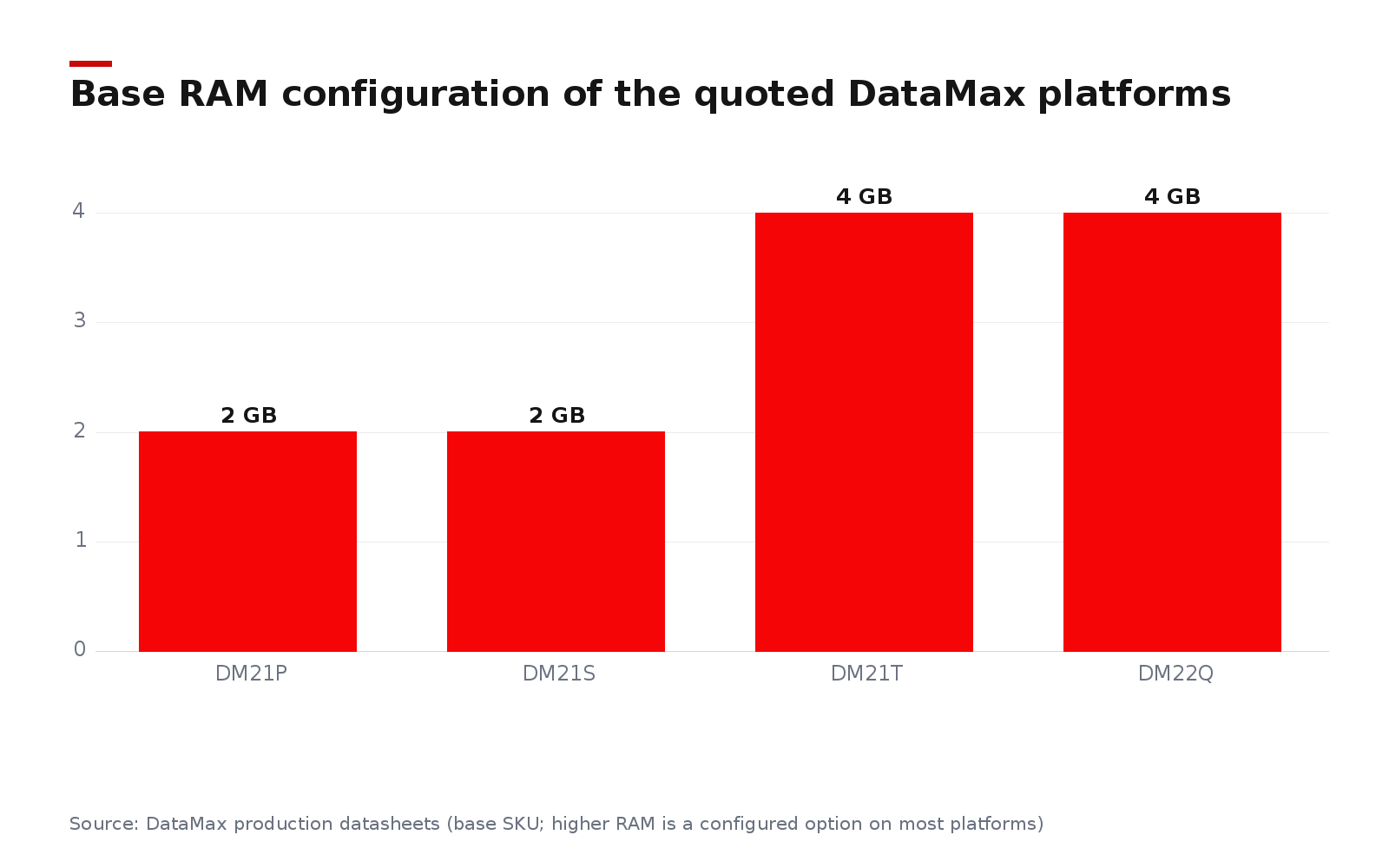
The same figures, in searchable form:
| Model | Base RAM | Source context |
|---|---|---|
| DM21P | 2GB | DataMax production datasheets; base SKU, with optional RAM tiers where cited |
| DM21S | 2GB | DataMax production datasheets; base SKU, with optional RAM tiers where cited |
| DM21T | 4GB | DataMax production datasheets; base SKU; family options |
| DM22Q | 4GB | DataMax production datasheets; base SKU, with optional RAM tiers where cited |
The DM21P is the only cited platform with AOSP Android 11 and the only one whose listed power input is DC 5V/2A. The DM21S, DM21T and DM22Q use AOSP Android 14. Do not infer dimensions, enclosure material, regulatory approvals, cooling, Android certification or accessory contents from these fields; confirm against the production datasheet.
Output claims require particular discipline. DM21T’s listed decoder capabilities cap at 4K/120 formats, with HDMI 2.0b output and no HDMI input. DM22Q’s maximum listed media rate is 4K@60. Any supplier reference using a higher output label should be reconciled with the production datasheet before acceptance.
The field differences guide the first sample order. DM21P supports operator middleware and exposes 3.5mm AV plus a stated DC 5V/2A input. DM21S and DM22Q list Dolby Vision/DTS and a 1G Ethernet option. DM21T introduces USB 3.0 and higher listed decode rates but removes HDMI input. These are selection inputs, not automatic approvals.
The android tv box manufacturer should confirm whether every cited field belongs to the same orderable SKU. Storage options, Ethernet options and protected-content options must be fixed rather than implied. A model-name match alone does not establish configuration equivalence.
For a next step, the DataMax inquiry team can prepare an RFQ against a specific model, target market and middleware scope. Email [email protected] with the proposed SKU list, target-market certificate requirements, middleware and DRM checklist, and the required factory evidence package. Ask for a video factory audit or an SMT/AOI/aging evidence review specific to the quoted configuration through the manufacturer capability route.
Further reading
- Android TV Box Manufacturer: What It Is and What It Is Not
- Allwinner Android TV boxes
- AOSP Android TV boxes
- H.265 HEVC Android TV box guide
- Widevine L1 certification guide
- DataMax DM21P specifications and fit
- DataMax DM21S specifications and fit
FAQ
What makes an Android TV box manufacturer suitable for an operator programme?
The decisive factors are configuration control, software-image ownership, DRM integration, update recovery and production traceability. The supplier should identify the exact platform, OS build, middleware, memory configuration and ports in the quotation. It should also provide a repeatable path from SMT and AOI through aging, functional testing and shipment, with serial or lot traceability against the released configuration.
Should a buyer select the platform with more base RAM by default?
No. Base RAM is one constraint, not a complete selection rule. Validate the target image, operator middleware, application workload, media path, update method and thermal behaviour. DM21P and DM21S start at 2GB, while DM21T and DM22Q start at 4GB, but the deployed workload determines the acceptable configuration. Any optional tier must be fixed line by line in the purchase order.
Does support for 4K decoding guarantee 4K output?
No. Decode capability, output capability and the display mode are separate requirements. An RFQ should identify the codec, frame rate, resolution, HDMI output mode, audio format and acceptable result for every protected-media case. This prevents a decoder-only capability from being mistaken for a complete end-to-end 4K playback guarantee.
Which factory evidence should accompany samples and production?
Request records or a video audit covering SMT, AOI, firmware loading, aging or burn-in, dark-room checks, functional testing and final traceability. The records must identify the hardware revision and software build. For custom images, include the approved golden sample, boot and partition versions, serial-number format, update procedure and recovery test.
How should DRM requirements be written in an RFQ?
Specify Widevine security level, PlayReady requirement, HDCP version and the licence-service dependencies. A statement such as “DRM supported” is insufficient because image provisioning, hardware backing, application integration and HDMI protection can differ. Test the exact target combination and define who provides the licence infrastructure and protected content.
Can an AOSP Android 14 box be treated as a certified Google Android TV device?
No. AOSP Android 14 describes the operating-system baseline, while Google services, application distribution, framework integration and device certification require separate definition. State the required service stack and approval scope in the RFQ. Do not infer Google TV functionality or certification from the Android version alone; confirm against the production datasheet.


