

Before the terminology: the decision
A warranty on an android tv box is not a test result. It is a contractual allocation of failure risk across the supplier, buyer, logistics chain, and end user. Before signature, define what evidence will show that the ordered configuration was built, tested, and released. A marketing statement such as “12-month warranty” does not answer that question.
The precise decision is whether the purchase order, the approved golden sample, the factory test record, and the signed acceptance document describe the same hardware, software image, accessories, packaging, and delivery batch. For a volume program, signature should be conditional on that traceable match. A verbal assurance without a lot identifier, serial range, configuration revision, and test record creates an avoidable acceptance dispute.
The evidence hierarchy is straightforward: a verified golden sample establishes fit; a pilot lot exposes repeatability; factory records connect serial numbers to inspections; and contractual clauses define remedies when a defect escapes the plant. Keep those roles separate. A passing sample does not prove a production run, and a production record does not prove that a customer-facing feature works after operator middleware, network provisioning, and retail packaging.
For android tv box sourcing, ask for a pre-signature acceptance pack covering identity, electrical performance, software, connectivity, decode, DRM, update method, accessories, and packaging. The supplier should state which items are measured, which are sampled, and which are visual. Do not treat “QC passed” as a sufficient release criterion. If the requirement is operator middleware, high-volume IPTV, or a branded retail channel, use the Android TV box for ISPs guide to align the platform selection before defining the evidence pack.
The signature decision should be recorded as one of three states: accepted, accepted with documented deviation, or rejected pending correction. Require the responsible engineering, procurement, and logistics representatives to select the state. A signature that acknowledges a deviation without naming the affected serial range, workaround, retest requirement, and closure owner is not a controlled acceptance. This simple decision rule keeps warranty language separate from production evidence while preserving both contractual and operational traceability.
How to choose, step by step
Turn warranty acceptance into a sequence of procurement decisions. Each step needs an owner, an artifact, and a rejection rule; otherwise the factory can satisfy the process without satisfying the program.
- Freeze the ordered configuration Record the SoC, operating-system baseline, RAM/ROM combination, DRM option, port set, decode profile, firmware revision, packaging, accessories, labels, and cable set. Name every option because “same model” may conceal multiple production variants.
- Approve a golden sample Test the exact configuration against the agreed use case: operator middleware, live network service, HDCP-protected playback, decoding, storage, USB, Ethernet, Wi-Fi, remote-control behavior, OTA installation, recovery, and packaging. Store the sample as a physical and software reference.
- Run a representative pilot Include the production line, intended firmware branch, representative network conditions, and the planned packaging process. Record serial ranges and retain units for failure analysis.
- Define release evidence Specify the production test stations, sampling rules, defect codes, rework records, and approval authority. The acceptance pack must reconcile packed units, serials, test results, and the shipment record.
- Write conditional signature Make final acceptance contingent on document review and the agreed pilot results. State the remedy for missing evidence, unexplained serial gaps, or configuration drift.
A pasteable RFQ line should read: “Quote the exact model and configuration; include an approved golden-sample test matrix, pilot-lot procedure, serial-number traceability plan, factory test records, packaging verification, AOI/SMT/aging evidence where applicable, and the proposed acceptance document before shipment approval.” The RFQ should also identify whether a factory quality review is requested and which documents the buyer may audit.
Use the product field as the first gate. If the order requests Android 11 with a specified memory configuration, an Android 14 proposal is not equivalent. If the program needs 1G Ethernet, a quoted 100M RJ45 configuration needs an explicit option. If protected 4K playback matters, Widevine and PlayReady entries do not by themselves prove every HDCP, operator entitlement, or playback workflow.
Turn each requirement into a line with a test method. For example, require “RJ45 link negotiated at the ordered rate,” not merely “Ethernet works.” Require “the specified codec profile and frame rate decoded on the production image,” not merely “video playback passed.” Require “serial, test result, and carton label reconcile without unexplained gaps,” not merely “packing checked.” These formulations make the supplier response auditable and give the acceptance team a reason to withhold signature.
The final step is governance. Assign one buyer representative to accept the evidence pack, one engineering representative to approve technical deviations, and one logistics representative to reconcile serials. A valid sequence connects requirements to tests and then to contractual disposition; it does not merely collect photographs of a test bench. If the program needs a sample first, use the sample-order route and request that its report identify the exact production configuration.
What goes wrong after the PO
The usual failure is not a sudden hardware collapse. It is ambiguity between what the buyer believed it purchased, what the factory built, and what the acceptance document proves. That ambiguity surfaces after the purchase order, when returning or replacing a mixed population is more operationally disruptive than preventing configuration drift.
Field trap
The quotation names the model family but omits the memory option, Ethernet speed, DRM option, or firmware branch. A later shipment may be technically functional but not contract-equivalent; the cost is not only the hardware delta but requalification, repackaging, software migration, and delayed deployment.
Common failure modes cluster around five points:
- Identity drift. The sample uses one memory combination while the shipment uses another. Without a configuration code and serial-level record, the buyer cannot prove what changed.
- Test-method substitution. The factory reports “pass” for HDMI, network, decode, or Wi-Fi without stating the stimulus, fixture, software version, or measured criterion.
- Sampling ambiguity. “100% tested” may describe a visual inspection while functional testing is sampled. The acceptance document must identify each test scope.
- Software drift. The Android baseline, device tree, middleware, bootloader, certificates, and OTA configuration differ between sample and batch. A hardware match alone cannot close this gap.
- Document disconnection. Test records cannot be reconciled to packed units, carton labels, advance-shipping notices, or the serial range received.
Field trap
A supplier may attach a generic “QC passed” statement to the shipment. It contains no lot, no serial range, and no defect disposition. Treat it as supporting evidence only, not a signature basis, until the factory explains the record owner, test station, revision, and traceability chain.
A sixth failure is unapproved engineering change. A component, firmware branch, enclosure, antenna, power supply, remote-control protocol, or packaging supplier may change without a visible model-number change. The commercial risk is cumulative: each change can invalidate a test result even if no individual change appears significant. Require advance-notice rules, engineering-change notices, impact analysis, and a reapproval trigger. The rule should distinguish administrative metadata changes from changes capable of affecting boot, RF, thermal behavior, media output, storage, external interfaces, or protected playback.
Another failure is defective remediation. A repaired unit may re-enter production with a replaced board, but its serial can remain in the shipped population without a repair trail. Require the original failure code, replacement action, retest result, operator, date, and quarantine status. For firmware defects, require affected build identifiers and the update or replacement population. A warranty process that only counts final shipment records cannot reveal whether an escaping defect was reworked or concealed.
The commercial remedy must match the defect class. Replacement of an isolated defective unit is different from rework of a production lot, correction of a firmware defect, or compensation for field deployment disruption. Put reporting windows, root-cause evidence, corrective-action records, retest scope, and escalation ownership into the acceptance and warranty clauses before release. Do not rely on a generic defect definition copied from another device program.
Verification you can ask for on paper
Factory verification is a chain of evidence from board assembly to packed shipment. Ask the supplier to identify where each control occurs, what is recorded, and which failures stop the line. A photograph proves that an activity can occur; a controlled record proves that a defined unit passed a defined revision of a defined test.
- Incoming-material and board evidence Identify component traceability, approved-vendor controls, SMT setup records, stencil and paste information, and component-substitution approvals. These records answer whether the production build matches the released BOM.
- Optical and solder inspection Request the AOI program version, defect threshold, station identification, and sampling or coverage rule for SMT and assembled boards. The buyer should know how detected defects are isolated, reworked, and retested.
- Functional test evidence Map every test to the product requirement: power, boot, RAM/ROM identity, HDMI output, AV1/H.265/H.264 decode, Ethernet, Wi-Fi, Bluetooth, USB, TF, audio, remote input, reset, and recovery. Include pass criteria and fixture calibration where relevant.
- Software and security evidence Request the build identifier, firmware checksum, update result, device enrollment, middleware version, and license configuration relevant to the deployment. A boot test does not prove protected content playback.
- Stress and aging evidence Define burn-in duration, workload, temperature conditions, and sample coverage. Require zero-tolerance decisions for thermal, reboot, network, or storage failures rather than accepting unexplained intermittent defects.
- Final-pack reconciliation Compare unit serials, test dispositions, labels, manuals, accessories, carton marks, and shipping documents. Require quarantine status for failed or unresolved units.
Ask for a redacted evidence index first: one row per control, with document owner, factory stage, unit or lot scope, revision, pass criterion, defect code, disposition, and approval authority. A small index is more useful than an unstructured folder because it reveals whether the evidence can be traced to the shipment.
The index should use revision dates and document identifiers that can be checked during an audit. For example, link each functional test to the firmware build, hardware configuration, fixture version, and station used. Link each AOI control to the board revision and defect classification. Link aging results to the sampled serial list and environmental condition. This does not require every raw record in the first review; it establishes which controlled record supports each release claim.
Sampling rules need plain language. Identify whether a control covers every unit, every board, every lot, or a selected sample. State the selection method, coverage, exclusions, and action taken after a failure. If a critical test fails, require affected-product containment and a documented retest population. If a noncritical test is sampled, require a rule that prevents the unqualified remainder from shipping.
The evidence request should be proportional to the program. A trial shipment may need configuration photographs, serial capture, and a functional matrix. A recurring-volume program needs traceable manufacturing records, change control, pilot-gate governance, and an agreed audit right. The buyer should define whether inspection is by the supplier, a third party, or the buyer’s personnel. DataMax’s certification route and compliance route can be referenced in the RFQ where documentary scope must be separated from factory acceptance evidence.
For software-enabled playback, the test matrix should name the service, stream format, resolution, frame rate, output path, and protection state where applicable. AV1, H.265, and H.264 are codec capabilities, not proof of a specific operator channel. Widevine, PlayReady, and HDCP also serve different layers. The purchase order should identify the required combination, while the acceptance evidence should show the corresponding test case.
Two routes, one bill of differences
A basic purchase and a commitment-tier program differ mainly in evidence density, not in the phrase “warranty.” The basic route accepts routine inspection and limited documentation. The commitment route ties release to a golden sample, a pilot gate, serial-level records, change control, and contractual remedies.
| Decision field | Basic inspection route | Commitment-tier route |
|---|---|---|
| Configuration control | Model family and selected options listed in the order | Configuration code, BOM revision, golden sample, and deviation approval |
| Test evidence | Summary QC statement and final functional result | Test matrix, station records, defect codes, serials, and lot reconciliation |
| Software | Boot and basic UI verification | Build identity, middleware, OTA, recovery, security, and playback validation |
| Release decision | Shipment inspection before dispatch | Conditional signature after pilot and evidence-pack review |
| Failure remedy | Case-by-case replacement under stated terms | Defined triage, containment, corrective action, retest, and escalation |
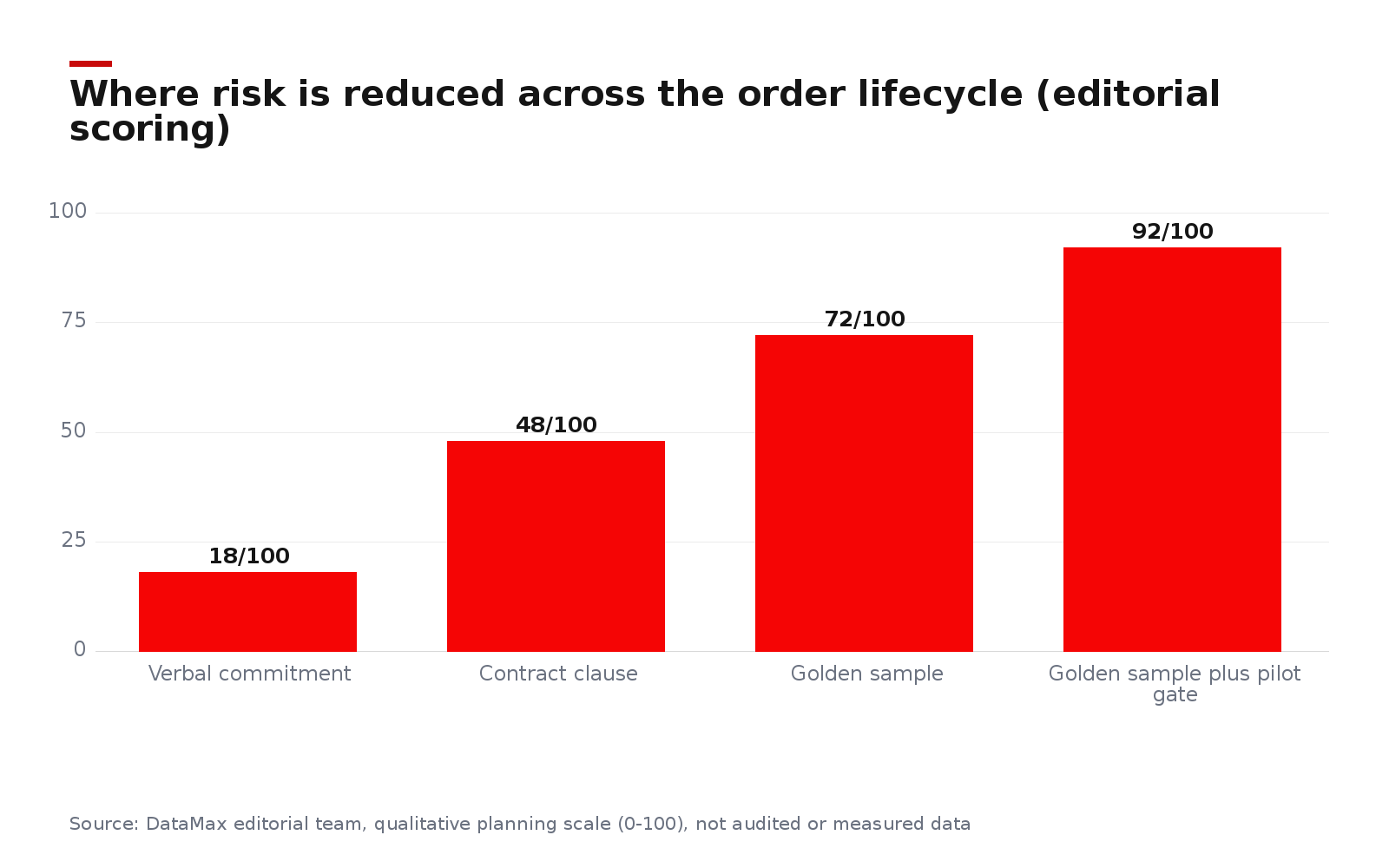
The same figures, in searchable form:
| Control option | Editorial score | Source context |
|---|---|---|
| Verbal commitment | 18/100 | DataMax editorial team, qualitative planning scale, not audited or measured data |
| Contract clause | 48/100 | DataMax editorial team, qualitative planning scale, not audited or measured data |
| Golden sample | 72/100 | DataMax editorial team, qualitative planning scale, not audited or measured data |
| Golden sample plus pilot gate | 92/100 | DataMax editorial team, qualitative planning scale, not audited or measured data |
The commercial difference should be priced through program work, not hidden inside unit terms. A commitment route may require more engineering time, travel, sample inventory, review cycles, and factory audit preparation. In return, the buyer obtains a defensible release decision. If the forecast, operator integration schedule, or deployment scale cannot justify those controls, the basic route may be adequate, provided its limitations are explicit.
The chart scores are editorial planning values, not audited performance measurements. Their operational value is the sequence: a verbal commitment identifies intent but leaves configuration and test scope weak; a contract clause creates obligations; a golden sample identifies the accepted configuration; and a pilot gate tests repeatability before volume release. The buyer should not convert 92/100 into a probability of defect-free delivery. Use the ranking to decide how much evidence the program risk warrants.
A useful contract attaches three schedules: the product configuration, the acceptance matrix, and the evidence index. Each schedule should have a revision and an approval record. The warranty clause then references these documents rather than restating incomplete technical assumptions. Add a fourth schedule for change control when customization, middleware, branding, or firmware updates exceed the standard configuration.
How the requirement actually works
The underlying mechanism is configuration control plus test traceability. A requirement becomes enforceable when it is written as an observable condition, assigned to a test, linked to a production revision, and associated with a disposition for nonconformance.
Start with identity. The production datasheet and purchase order must define the hardware and software baseline. The physical sample then becomes the approved reference. For every configuration option, record its exact designation rather than a general product label. The order should also define firmware release ownership: whether DataMax supplies an AOSP image, the operator supplies middleware, and which party controls bootloader, certificates, device enrollment, applications, and update policy.
Hardware + software revision
Approved identity and behavior
Repeatability and exceptions
Serial-linked evidence
Testing then follows the product architecture. AOSP Android provides the platform baseline, while operator middleware, content applications, provisioning, and management can add separate layers. The buyer should test the integrated system because successful boot at the factory does not demonstrate successful IPTV provisioning, entitlement, protected playback, or OTA recovery.
Media acceptance requires precise naming. AV1 identifies a codec family, not every profile or operating point. H.265, also called HEVC, must be tested at the resolution and frame rate in the deployment. HDMI 2.0b describes an output interface; its presence does not itself guarantee a 4K60 output path. Widevine L1 and PlayReady relate to DRM implementations, while HDCP protects the output path. Each requires its own test evidence.
Connectivity acceptance should name the interface, radio combination, and usage scenario. RJ45 100M and 1G are different capacity commitments. Wi-Fi6 2x2 and Bluetooth 5.4 describe wireless capabilities, but deployment quality still depends on antenna implementation, enclosure, interference, router behavior, and operator configuration. The factory evidence should show that the intended configuration—not merely the chipset—passed.
Storage and update behavior require separate acceptance cases. A boot test does not prove that the correct RAM/ROM configuration is reported, that the recovery partition is valid, or that an update completes without service interruption. For operator middleware, test enrollment, authorization failure handling, app launch, restart persistence, and recovery after an interrupted update. For a white-label program, test packaging labels, first-boot branding, application versions, remote-control behavior, and the upgrade path that will remain valid through the agreed lifecycle.
Finally, define the governance model. The factory owns build conformance and recorded test results; the buyer owns program acceptance and witnessed validation; the operator or brand owner may define middleware and service behavior. Each owner signs only the part they can verify. That separation makes the warranty clause operationally meaningful and limits disputes caused by asking one report to prove unrelated responsibilities.
The platform shortlist with datasheet values
The evidence requirement must follow the selected platform; it cannot be transferred from one model to another. Use the datasheet to define the exact configuration, then ask DataMax to map that configuration to the proposed test matrix and acceptance artifacts. The values below reproduce the supplied product facts; unlisted options remain subject to confirmation against the production datasheet.
| Model and fit | SoC and OS | Memory | Media and DRM | Interfaces |
|---|---|---|---|---|
| DM21P 4K IPTV / operator middleware set-top box | Amlogic S905Y4, quad Cortex-A35 AOSP Android 11 | 2GB / 8GB 4GB; 16/32/64GB optional | AV1 [email protected]; VP9/H.265 4K@60; H.264 4K@30 Widevine L1 / PlayReady / HDCP 2.2 optional | HDMI 2.0b out x1; USB2.0 x2; TF; S/PDIF; 3.5mm AV; RJ45 100M; Wi-Fi6 2x2 + BT5.4; DC 5V/2A |
| DM21S 4K Android TV box for IPTV/OTT white-label | Amlogic S905Y5, quad Cortex-A55 AOSP Android 14 | 2GB / 16GB 2/4/8GB; 16/32/64GB optional | AV1 / H.265 [email protected] 4K@60 Widevine L1 / PlayReady optional; Dolby Vision/DTS | HDMI 2.0b out; S/PDIF; AV; USB2.0 x2; TF; RJ45 100M (1G optional); Wi-Fi6 2x2 + BT5.4 |
| DM21T Premium UHD / cloud-gaming box | Amlogic S905X5, quad Cortex-A510 (ARMv9) AOSP Android 14 | 4GB / 64GB family options | H.266/VVC [email protected] 4K@120; AV1/VP9/H.265 4K@120; AVS3 4K@120; H.264 4K@60; inline AI-SR Widevine L1 / PlayReady optional | HDMI 2.0b out (no HDMI in); USB2.0 x1 + USB3.0 x1; TF; S/PDIF; AV; RJ45 100M (1G opt); Wi-Fi6 + BT5.4 |
| DM22Q Gaming-oriented Android TV box | Amlogic S905X5M, quad Cortex-A55 up to 2.5GHz AOSP Android 14 | 4GB / 64GB 2/4/8GB; 16/32/64GB optional | AV1/H.265 L5.1 4K@60; inline AI-SR (no NPU TOPS stated) Widevine L1 / PlayReady optional; Dolby Vision/DTS | HDMI 2.0b out; USB2.0 x2; TF; S/PDIF; AV; RJ45 100M (1G opt); Wi-Fi6 2x2 + BT5.4 |
The DM21P offers the clearest operator-set-top positioning in this shortlist, so its acceptance matrix should cover the middleware integration, network service, protected playback, and Android 11 build. The DM21S aligns with a white-label IPTV/OTT program on AOSP Android 14; its evidence should distinguish base-platform validation from operator application integration. The optional 1G Ethernet must appear as a selected configuration rather than an implied capability.
The DM21T targets premium UHD and cloud-gaming workloads, with higher listed decode formats and frame rates. Its matrix must include the applicable codec/frame-rate combinations, USB3.0, Wi-Fi6, and the absence of HDMI input. The supplied facts cap output and decode at 4K despite marketing references elsewhere; the acceptance criterion must use the production datasheet.
The DM22Q is gaming-oriented and supports inline AI-SR, but no NPU TOPS figure is stated. Do not convert the feature into an unverified performance metric. Test the documented workloads and include Dolby Vision/DTS only when selected for the shipped configuration.
Across all four models, ask DataMax to identify the serial format, test-record retention process, available evidence package, and sample lead time. The relevant guide can help define the next decision: compare AOSP and Google Android TV platforms or assess 4K 60fps Android TV box requirements before locking the acceptance matrix.
Turn each shortlist item into a conditional recommendation rather than an unconditional selection. For DM21P, make Android 11 compatibility with the operator middleware a first-pass gate. For DM21S, make the selected memory, Ethernet option, and application stack explicit before approving the golden sample. For DM21T, bind acceptance to the listed 4K decode modes and the intended gaming workload, with no output claim beyond the supplied datasheet. For DM22Q, bind the AI-SR test to the defined workload and leave any absent performance metric open for confirmation.
The RFQ should ask DataMax to map each selected platform to one evidence schedule. For DM21P, include operator middleware, RJ45 100M, and the selected playback requirement. For DM21S, include Android 14, the ordered RAM/ROM combination, and either RJ45 100M or the optional 1G configuration. For DM21T, include the listed media modes, USB3.0, and the absence of HDMI input. For DM22Q, include the selected codecs, gaming workload, AI-SR behavior, and any chosen Dolby Vision/DTS configuration. This prevents a generic android tv box test report from being attached to a more demanding platform.
Where this matters in a deployment
A quality-control station becomes commercially meaningful when its output is linked to a shipment decision. The photograph should show an inspector placing a small black device into a test jig, with illuminated indicators and burn-in units behind it; the evidence pack should then connect that station to a test method, serial list, defect code, and release signature.

| Situation | Primary requirement | Evidence emphasis | Model direction |
|---|---|---|---|
| • IPTV operator middleware | • Stable set-top platform and controlled provisioning | • Middleware image, network service, playback, recovery, and batch identity | • DM21P or DM21S, subject to the selected configuration |
| • White-label OTT retail | • Android 14 baseline and repeatable branding | • Golden sample, packaging revision, application install, DRM, and serial reconciliation | • DM21S |
| • Premium UHD or cloud-gaming | • Higher listed codec and frame-rate paths | • Datasheet-aligned media matrix, USB3.0, thermal/aging evidence, and performance workload | • DM21T |
| • Gaming-focused distribution | • Android 14 platform with documented AI-SR capability | • Game workload, storage endurance, thermal behavior, and configuration identity | • DM22Q |
| • AV integrator project | • Display, audio, and control integration | • HDMI output path, AV, S/PDIF, remote control, EDID behavior, and site-level test | • Select against the installation I/O list |
| • Digital-signage operator | • Repeatable image and remote fleet management | • OTA, enrollment, recovery, application version, and post-deployment monitoring | • Select against the management architecture |
For an operator, the critical scene is often a firmware or provisioning change rather than a visible hardware fault. The evidence pack must therefore include build identity and recovery testing, not only electrical results. For an integrator, acceptance happens near the display and sound system; HDMI, audio, remote, and EDID behavior belong in the site checklist. For a venue deployment, temperature, network stability, and device restart behavior determine whether a unit remains operational after installation.
Separate factory acceptance from site acceptance in the matrix. The factory can prove configuration identity, functional test results, and lot reconciliation. The operator can prove middleware enrollment, entitlement, channel access, and live service behavior. The integrator can prove display compatibility, audio routing, control behavior, and the physical installation. The venue operator can prove restart, network stability, remote-management operation, and recovery under its operating conditions. One signature should not imply that every party has verified work outside its control.
A practical deployment record contains three columns: test stage, accountable party, and evidence reference. For example, “protected playback, factory test station 4, serial list and result file” differs from “service playback, operator laboratory, service identifier and build.” A later field failure can then be localized to hardware, platform, service, or installation. That localization reduces unnecessary lot-wide returns and prevents an android tv box warranty dispute from becoming a search for the first plausible document.
The deployment owner should translate these situations into a final matrix before shipment. Record which tests occur at the factory, which occur in the pilot environment, and which must be repeated after installation. A factory pass cannot replace the site test, just as a site test cannot prove production consistency.
To prepare an RFQ, send the exact model direction, configuration fields, expected volume, operator middleware status, required media services, evidence list, and pilot/acceptance timing. The first message should contain the platform, required RAM/ROM and connectivity options, codec/DRM needs, test matrix, serial-traceability requirement, and requested document format. Use the inquiry form for this package, or the sample-order route when the immediate decision is golden-sample approval. DataMax can then map the request to a production datasheet and a test-evidence proposal without filling absent specifications by inference.
Further reading
- Guide android tv box for isps
- Widevine L1 certification guide
- Dolby Atmos Android TV box guide
- TV box vendor selection checklist
- AOSP vs GMS solution notes
- DataMax DM21P specifications and fit
- DataMax DM21S specifications and fit
FAQ
Does a warranty certificate prove that an Android TV box was factory tested?
No. A warranty certificate defines commercial coverage or service terms. Factory-test proof requires a named test scope, production revision, unit or lot identifier, pass criterion, defect disposition, and linkage to the shipped serial range. Keep warranty documentation separate from manufacturing evidence so a missing test record is not mistaken for an excluded warranty claim.
What should a buyer inspect before signing the first shipment?
Inspect the approved golden sample, exact configuration, serial range, test matrix, defect and rework records, packaging, and shipment reconciliation. Confirm that the production build, software branch, and accessories match the purchase order. Sign conditionally if the evidence pack contains unresolved deviations, unexplained serial gaps, or test results that do not cover the required service workflow.
How many units should be tested during a pilot lot?
The pilot size depends on line configuration, forecast variability, required confidence, and defect risk; no universal count covers every program. Define coverage by station and test type, preserve failed units, and require retest evidence after corrective action. The pilot must exercise the intended production line and firmware branch rather than only laboratory prototypes.
Is an Android 11 model unsuitable for a new Android TV box program?
No automatic rejection follows from the OS version. The decision depends on middleware compatibility, operator requirements, security update ownership, application support, and lifecycle plans. If the program specifically requires Android 14, that baseline becomes a contractual configuration field. For the broader platform discussion, see the Android TV box for ISPs guide.
What evidence proves protected 4K playback?
The test matrix must name the DRM implementation, protected-content service, codec, resolution, frame rate, and output path, then record a successful result for the shipped configuration. Widevine L1, PlayReady, and HDCP are distinct elements. A boot test, codec demonstration, or unlicensed stream does not close the protected-playback requirement.
When should a buyer request a factory audit?
Request an audit when production volume, deployment risk, integration complexity, or customization justifies direct verification of the process. At minimum, define document access, line observation, test-station review, serial traceability, change control, and nonconformance handling in advance. For a program definition, start with DataMax’s factory-quality route and identify the evidence required at each manufacturing stage.


