

Bluetooth 5.4 is a radio generation, not a complete product specification
A widespread belief in Android set-top-box procurement is that “Bluetooth 5” tells a buyer which device to choose. It does not. android tv box what-is is an incomplete query by design, so the useful answer begins with the missing variables: Bluetooth version, radio band, antenna design, codec support, host connection, pairing policy, regulatory certification, and the validation evidence attached to the production unit.
Bluetooth 5.4 is therefore an adjective, not a platform decision. A box carrying that label may still fail to pair with the deployed controller, lose a connection in a metal installation cabinet, or expose an unsuitable Bluetooth profile. For an operator or AV integrator, the relevant question is not whether the quotation says “BT5.4”; it is whether the production model supports the intended controller ecosystem, operates in the intended RF environment, and has evidence from repeatable factory testing.
The correct procurement frame is a 4-part chain: requirement, implementation, verification, and deployment control. The requirement defines the user action and latency target. The implementation determines the chipset, antenna path, firmware, and host software. Verification covers RF behavior, pairing, stability, and interoperability. Deployment control preserves that result across firmware revisions, production lots, and regional SKUs.
This distinction matters because DataMax models listed as Wi-Fi6 plus BT5.4 include DM21P, DM21S, DM21T, and DM22Q. That Bluetooth designation is only one line in their production specifications. It does not establish supported accessories, paired-device counts, radio certification scope, or controller-level certification. Those details require the applicable production datasheet and test report.
This page interprets the Bluetooth angle. It does not replace the broader Android TV Box glossary and index, which should remain the canonical taxonomy.
A useful RFQ treats Bluetooth as a testable system rather than a feature checkbox. The buyer identifies the controller or accessory, names the required user action, defines the environmental constraint, requests evidence from the exact production configuration, and reserves rejection rights for failed acceptance criteria. That discipline protects the program from a label that describes only the radio generation.
The evidence trail from SMT to shipment
Bluetooth claims become credible only when the factory can connect the radio claim to the finished assembly. The evidence trail starts at SMT, where the Bluetooth-capable SoC and supporting components are placed, then passes through AOI inspection for assembly defects, functional testing, aging, RF verification, and final audit. A logo printed on a carton does not close any of those loops.
- Incoming identity and BOM lock Match the fitted wireless module, SoC, antenna components, and firmware branch against the approved revision.
- SMT and AOI evidence Retain placement, solder, and inspection records for the radio path and antenna-feed components, including any approved substitutions.
- Operating-system integration Verify the Bluetooth driver, host framework, permissions, and intended profile against the locked AOSP build.
- RF and functional checks Exercise the relevant band, output behavior, pairing path, reconnection, and accessory interaction under controlled conditions.
- Aging and dark-room testing Repeat functional checks after thermal stress, with screens and network activity included according to the agreed test recipe.
- Final audit and shipment evidence Link the approved sample, test record, firmware identifier, and shipping configuration so a returned unit can be traced.
Evidence minimum: a quotation should identify the exact production model, firmware baseline, radio configuration, intended accessory list, test methods, acceptance criteria, and document owner. If it contains only “BT5.4 supported,” it is not yet a testable RFQ.
The dark room is not automatically a Bluetooth certification chamber. It can expose unwanted emissions, interference, thermal instability, or receiver sensitivity problems, but the chamber, equipment, limits, and procedures must match the applicable regulatory and product requirements. Likewise, AOI detects specified assembly conditions; it does not prove that an antenna is correctly tuned.
For repeat-volume programs, traceability should link work order, PCB revision, fitted module, software image, serial identifier, operator, and test result. The practical question for procurement is whether a failure can be assigned to a lot and process step rather than reduced to “Bluetooth is unreliable.”
That chain matters because each handoff can conceal a different defect. An incorrect module can produce an unsupported radio configuration; a poor solder joint can make an otherwise compliant design intermittent; a driver mismatch can prevent pairing even though the radio passes a conducted or radiated check; an enclosure revision can alter antenna performance after the housing has already been tooled. A procurement record should therefore identify which process owns each risk rather than asking one broad “quality team” to certify the complete result.
A practical evidence packet for a repeat-volume program can contain six linked records. The BOM identifies the SoC, wireless implementation, antenna parts, and approved alternatives. The AOI report identifies inspected PCB assemblies and exceptions. The software manifest records the image identifier, Bluetooth driver, and firmware revision. The RF record states equipment, configuration, limits, and results for the relevant procedures. The functional record documents pairing, reconnection, accessory behavior, and coexistence. The shipment record links the accepted configuration to serial or lot identifiers.
None of these records replaces another. A successful functional test does not replace regulatory documentation; an AOI pass does not replace an RF test; and a certification report does not prove that the intended remote behaves correctly in the finished product. Buyers should reject records that show only a pass/fail stamp without identifying the tested revision. They should also define who owns corrective action when a failed sample, lot hold, or engineering change occurs.
For a laboratory bench showing the intended production workflow, the accompanying image depicts the controlled test context rather than evidence of a particular certification result. The actual acceptance procedure must match the product, target market, and applicable regulatory framework. Validate the method against the production datasheet and agreed test plan rather than assuming that one generic chamber procedure covers every Bluetooth function.
Options placed side by side
The procurement mistake is treating supplier type as a substitute for an engineering specification. Four supplier types can all be viable, but they expose different control points.
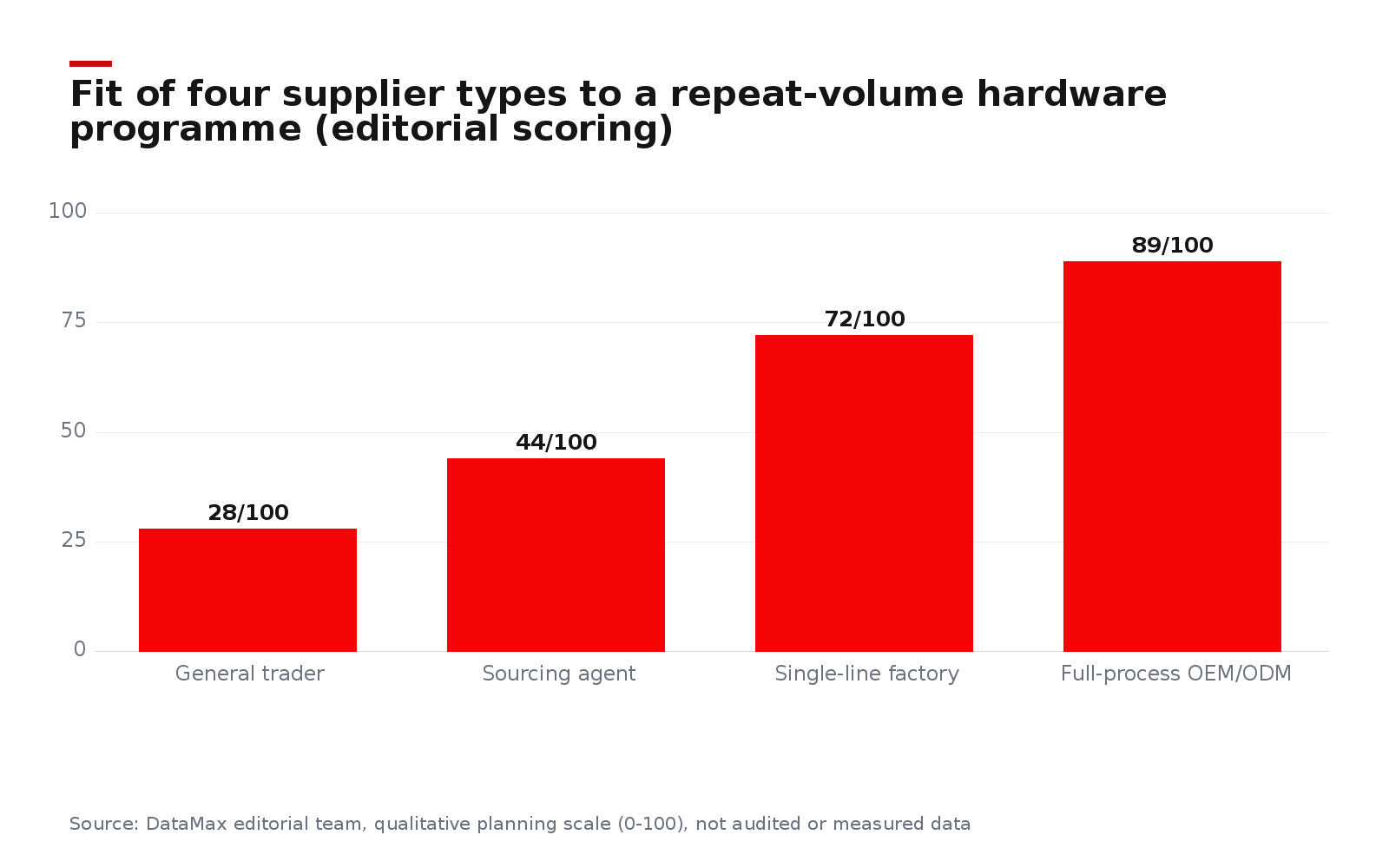
The same figures, in searchable form:
| Supplier type | Editorial score |
|---|---|
| General trader | 28 |
| Sourcing agent | 44 |
| Single-line factory | 72 |
| Full-process OEM/ODM | 89 |
| Option | Design control | Manufacture control | Bluetooth evidence | Best use |
|---|---|---|---|---|
| General trader | Often limited | Variable | Document-dependent | Catalog sourcing |
| Sourcing agent | Coordination-led | Factory-dependent | Must be assigned | Multi-supplier assembly |
| Single-line factory | Defined within its line | Strong within process | Process evidence available | Repeat product family |
| Full-process OEM/ODM | End-to-end ownership | End-to-end ownership | Can be tied to the production record | Integrated programme |
Entry-tier sourcing can be adequate for a fixed, low-complexity accessory program if the buyer writes precise acceptance tests and retains authority over the approved configuration. A commitment-tier program needs change control, revision traceability, and a named owner for radio-firmware exceptions.
The economic distinction is not a catalogue label. It is who absorbs the cost of an antenna substitution, driver regression, failed audit, or mismatched controller. That responsibility must be written into the purchase order and acceptance procedure.
The choice also depends on where the design is frozen. A catalogue transaction may suit a standard product, a fixed enclosure, and one approved remote. An integrated programme usually has a branded shell, custom middleware, regional packaging, operator provisioning, and more than one accessory ecosystem. That added variation increases the number of interfaces that must remain under change control: mechanical parts, firmware images, pairing policy, regulatory files, packaging labels, and field-support instructions.
For android tv box what-is analysis, supplier fit should therefore be scored against programme complexity rather than assumed from factory size. A buyer can ask each candidate to map responsibility for five items: approved radio configuration, antenna implementation, host-driver integration, test-record ownership, and engineering-change approval. If two candidates give different answers, the quotation should reveal that difference rather than hide it behind a shared “BT5.4” line.
DataMax is positioned as an OEM/ODM manufacturer for programme-level integration, but buyers should still validate the proposed production route. A factory audit, evidence sample, and supplier questionnaire are appropriate controls for any vendor. The editorial score is a planning aid, not a substitute for a process audit or a sample report.
Definitions a buyer cannot outsource
“Bluetooth 5.4” describes a Bluetooth Core Specification generation. It should not be expanded into unsupported claims about range, throughput, power, pairing count, or compatibility. Bluetooth LE and Bluetooth Classic remain distinct functional classes; a product can support one without delivering the other. Profiles define application behavior, while the host operating system controls permissions and service integration.
The 2.4 GHz ISM band is shared with Wi-Fi and other radio systems. A set-top box combining Wi-Fi6 and BT5.4 therefore has a coexistence problem: Wi-Fi, Bluetooth, the antenna structure, chassis, USB 3.x interference sources, and cable routing can affect both radios. The label “2x2” describes the stated Wi-Fi antenna configuration, not Bluetooth antenna diversity.
A buyer should distinguish 4 specifications that are often collapsed into one quotation line:
- Radio generation: the stated Bluetooth version, here BT5.4 on all four listed models.
- Functional support: the Bluetooth mode, profiles, and accessory classes required by the application.
- Host integration: AOSP build, driver, firmware, permissions, and application behavior.
- Evidence: pairing, reconnection, coexistence, environmental, and regulatory records for the production configuration.
“Pairing” also needs definition. A successful first-time scan is only one event. Re-pairing after forgetting the accessory, recovery after reboot, simultaneous accessory behavior, disconnect handling, and behavior during Wi-Fi traffic must be specified separately. These are software and RF requirements, not interchangeable features.
“Range” is not a production acceptance criterion by itself. Specify the test geometry, attenuation, distance, obstruction, orientation, traffic condition, and success criterion. Otherwise, two factories can both claim a passing range test and ship products that behave differently.
The word “low energy” needs similar discipline. Bluetooth LE is a radio architecture intended for power-constrained devices, but the resulting battery life of a remote or peripheral also depends on its controller, reporting interval, transmission behavior, power policy, and the selected features. A set-top-box quotation does not, by itself, prove the battery runtime of a third-party accessory. If the accessory is supplied as part of the programme, its power and endurance requirements belong in the same system specification.
“Latency” can refer to several different intervals. A buyer might mean discovery time, pairing time, button-to-action response, reconnection after sleep, or stable sustained control. A passing pairing test says little about a 100-millisecond or 250-millisecond input-response target, depending on the application. Define the event clock, measurement point, number of repetitions, permitted percentile, and behavior under concurrent network traffic.
The same separation applies to “maximum connected devices.” If the number applies to the Bluetooth specification, controller implementation, operating-system stack, application, or accessory combination, each may impose a different practical limit. A android tv box what-is glossary should treat that figure as conditional until the production datasheet identifies the exact meaning and the RFQ identifies the required accessory set.
For a wider foundation, compare AOSP versus Google Android TV before assuming that every Android TV platform includes the same application, certification, and accessory framework.
Five production SKUs compared
The available production facts define four DataMax models, not five. A fifth row must not be fabricated. The model comparison below therefore uses the four supplied SKUs and identifies the missing fifth-platform entry explicitly.
| Model | SoC and OS | RAM / ROM | Decode and DRM | Connectivity and ports |
|---|---|---|---|---|
| DM21P | Amlogic S905Y4, quad Cortex-A35; AOSP Android 11 | 2GB / 8GB; 4GB; 16/32/64GB optional | AV1 [email protected]; VP9/H.265 4K@60; H.264 4K@30; Widevine L1 / PlayReady; HDCP 2.2 optional | HDMI 2.0b out x1; USB2.0 x2; TF; S/PDIF; 3.5mm AV; RJ45 100M; Wi-Fi6 2x2 + BT5.4; DC 5V/2A |
| DM21S | Amlogic S905Y5, quad Cortex-A55; AOSP Android 14 | 2GB / 16GB; 2/4/8GB; 16/32/64GB optional | AV1 / H.265 [email protected] 4K@60; Widevine L1 / PlayReady optional; Dolby Vision/DTS | HDMI 2.0b out; S/PDIF; AV; USB2.0 x2; TF; RJ45 100M; 1G optional; Wi-Fi6 2x2 + BT5.4 |
| DM21T | Amlogic S905X5, quad Cortex-A510 (ARMv9); AOSP Android 14 | 4GB / 64GB; family options | H.266/VVC [email protected] 4K@120; AV1/VP9/H.265 4K@120; AVS3 4K@120; H.264 4K@60; inline AI-SR; Widevine L1 / PlayReady optional | HDMI 2.0b out; no HDMI in; USB2.0 x1; USB3.0 x1; TF; S/PDIF; AV; RJ45 100M; 1G optional; Wi-Fi6 + BT5.4 |
| DM22Q | Amlogic S905X5M, quad Cortex-A55 up to 2.5GHz; AOSP Android 14 | 4GB / 64GB; 2/4/8GB; 16/32/64GB optional | AV1/H.265 L5.1 4K@60; inline AI-SR; no NPU TOPS stated; Widevine L1 / PlayReady optional; Dolby Vision/DTS | HDMI 2.0b out; USB2.0 x2; TF; S/PDIF; AV; RJ45 100M; 1G optional; Wi-Fi6 2x2 + BT5.4 |
| Fifth platform | Not supplied | Not supplied | Not supplied | Confirm against the production datasheet |
All four supplied models list BT5.4, so Bluetooth does not distinguish them. Their differentiation comes from processor generation, Android release, memory, video handling, ports, and intended fit. DM21P is positioned for 4K IPTV and operator middleware. DM21S is positioned for IPTV/OTT white-label use. DM21T targets premium UHD and cloud gaming. DM22Q is gaming-oriented.
The absence of a supplied fifth model is not a product claim. It is a disclosure gap. For any procurement sheet requiring 5 SKUs, the missing platform must be confirmed against the production datasheet rather than inferred from the four listed devices.
Bluetooth accessory support, pairing behavior, radio certification details, and profile lists are also absent from the supplied facts. Confirm them for each model before treating BT5.4 as a deployment commitment.
The table also prevents an adjacent video error. DM21T lists H.266/VVC [email protected] 4K@120 and several 4K@120 decode paths, while DM22Q lists AV1/H.265 L5.1 4K@60. Neither supplied fact supports an 8K output claim, so an RFQ must not convert a marketing shorthand into a technical acceptance line. Bluetooth selection and video selection should remain separate gates even when both are printed on the same device sheet.
For android tv box what-is procurement, the model table is a shortlist filter rather than a final acceptance document. A buyer can select the intended processor, OS, memory, decode, and port family from the supplied facts, but must obtain project-specific radio evidence. A single table cell combining “Wi-Fi6 2x2 + BT5.4” cannot answer whether a Bluetooth controller works with the selected remote.
The operator, the integrator and the venue
An operator, an integrator, and a venue owner appear to buy the same “Android TV box with Bluetooth 5.4,” yet their acceptance priorities differ. The operator must protect service operations and device identity. The integrator must make the controller, display, network, and room automation work together. The venue cares about installation consistency, recovery behavior, and supportability across rooms.
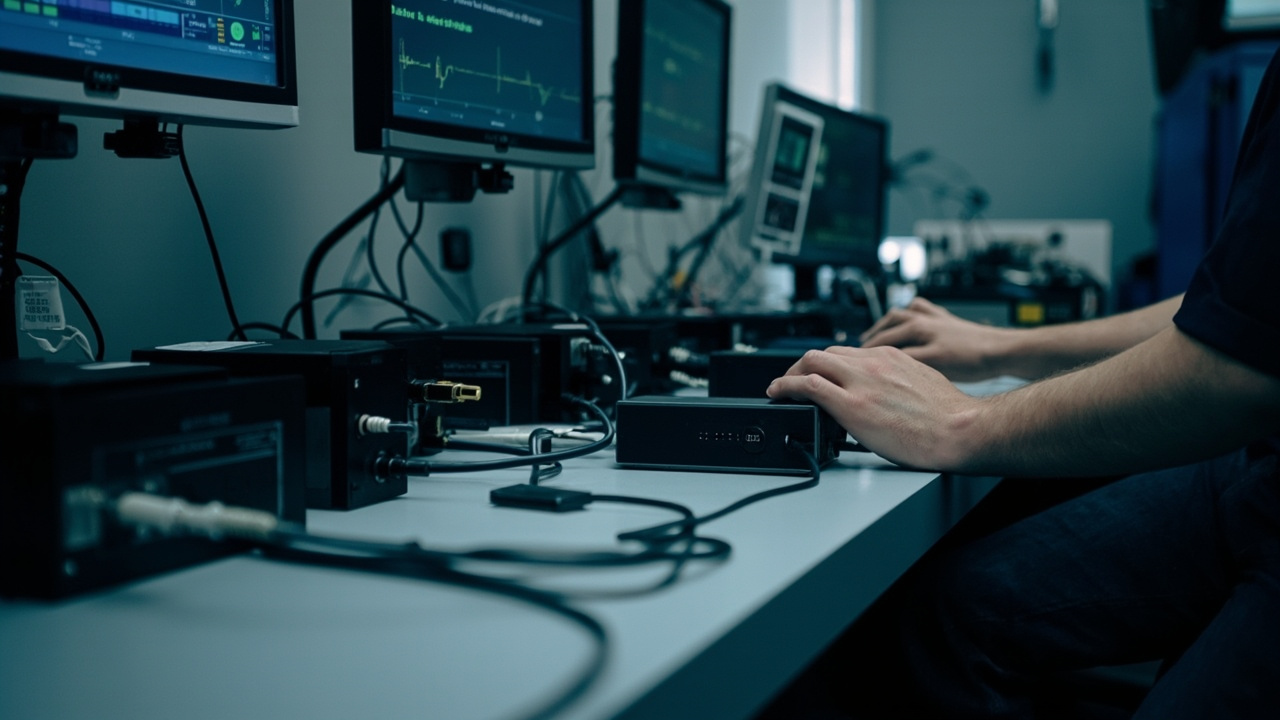
The scene illustrates the intended verification environment: multiple set-top boxes connected to test displays and networks while engineers inspect radio behavior under controlled conditions. It does not imply a measured certification result; validate the actual protocol against the applicable standard and production configuration.
| Situation | Primary requirement | Model direction | Evidence to request |
|---|---|---|---|
| IPTV operator deployment | Stable provisioning, middleware integration, and device-level traceability | DM21P or a model confirmed for the target middleware | OS image, hardware revision, provisioning results, serial-to-lot trace |
| IPTV/OTT white-label program | Flexible branding, controlled configuration, and repeatable builds | DM21S direction | Build manifest, peripheral test, firmware regression report |
| Premium UHD or cloud-gaming venue | Higher video capability and connectivity around sustained use | DM21T direction | Decode/output verification, thermal test, interface stress test |
| Gaming-focused installation | Controller responsiveness and stable accessory interaction | DM22Q direction | Controller compatibility matrix, reconnect test, RF coexistence report |
A hotel operator may deploy rooms across multiple buildings, making recovery after power loss a service-level issue. A sports venue may place receivers near high-load RF equipment, making coexistence and interference mapping more significant than peak Bluetooth speed. A residential IPTV operator may need to associate remotes centrally and disable unauthorized re-pairing, making identity and permission policy central.
The venue matrix also exposes a logistics issue. Staging a device with one remote, then shipping the same model with another, creates two configurations even if both remotes claim Bluetooth support. Each approved accessory combination needs its own version, pairing procedure, and field test.
Operator programmes need a fleet-level view. A unit that pairs correctly in the workshop can still create a service incident if it loses the assigned controller after a network event, accepts an unintended controller, or receives an image whose permissions differ from the operator build. The acceptance record should therefore include device identity, assigned accessory, software image, and recovery result rather than a generic connectivity check.
Integrators face an interface map. The set-top box may coexist with a television, room-control system, display matrix, soundbar, keyboard, or handheld controller. Each interface has a different expected response and power behavior. A venue test should use the actual signal path, cables, television menu settings, automation sequence, and furnished room position. A laboratory bench without those conditions may hide an application-level conflict even when the radio is stable.
Venue owners should separate factory acceptance from installation qualification. The factory can prove that a defined configuration passes its recipe. The site must still verify that the device works in each room type, especially where walls, metal furniture, television brackets, and neighboring equipment differ. A rolling sample plan across installed rooms can identify variation without turning every installation into a full engineering test.
The same disciplined approach supports android tv box what-is decisions: map the actor, define the environment, and request evidence from that exact combination. Before selecting a video platform, use the 4K 60 fps Android TV box guide to align frame-rate requirements with the display, source, decoder, and output path. That video decision remains separate from Bluetooth acceptance.
How to choose, step by step
Start with the user action, not the chipset. If the requirement is “support Bluetooth 5.4,” it is not ready for quotation. Translate it into controller type, pairing count, profile, latency, reconnection behavior, coexistence environment, and required evidence. “Any Bluetooth accessory” introduces uncontrolled variables that cannot be tested consistently.
- State the deployment Record operator, room type, display, network, audio, remote, and expected service duration.
- Freeze accessories Name the approved controller, firmware baseline, pairing procedure, and fallback method.
- Select the platform family Compare the supplied model facts, then confirm Bluetooth profiles, certification, and supported accessories against the production datasheet.
- Define RF acceptance Specify coexistence traffic, obstruction, reconnect, reboot, and multi-accessory criteria.
- Lock evidence and traceability Name the test method, acceptance limit, sample quantity, record owner, and lot linkage.
- Approve samples Run the complete user flow on the exact hardware, firmware, remote, display, network, and room configuration.
- Release production Freeze the bill of materials, software image, approved suppliers, test recipe, and change process.
The RFQ should contain this exact first-message structure:
Provide the proposed DataMax model and production BOM revision; confirm the stated Bluetooth version, radio modes, profiles, approved accessories, pairing and reconnection behavior, host-driver integration, coexistence test method, RF acceptance criteria, regulatory documentation, sample lead time, test-report format, and change-control process. Identify every item that remains subject to datasheet confirmation.
Send that request through the DataMax inquiry channel. For sample-based validation, request samples with the exact controller, display, network, and room conditions. A sample without the target accessory cannot validate the requirement.
The selection record should also contain negative decisions: no profile support, no regional certification, failed coexistence result, or untraceable firmware should stop release. This prevents “BT5.4” from becoming a checkbox that conceals an unresolved engineering dependency.
A buyer can convert the selection sequence into concrete RFQ lines. “Bluetooth version” should require the exact generation and supported modes. “Accessory” should name the controller model and firmware. “Pairing” should define first pairing, re-pairing, reboot recovery, power-interruption recovery, and unauthorized re-pairing behavior. “Coexistence” should identify Wi-Fi traffic, nearby radio conditions, duration, and pass criteria. “Evidence” should require revision identifiers, equipment, method, result, and report ownership.
Those lines can be pasted into the technical schedule without asserting an unavailable DataMax specification. For each model, confirm against the production datasheet whether a specified profile, accessory, radio certification, antenna detail, or pairing limit is available. The RFQ should state that unknown entries remain open rather than allowing the supplier to copy “BT5.4” into every field.
Sample approval should follow a written test script. The script names the operator or integrator, test location, controller, accessory count, firmware, network condition, display, room geometry, repetitions, and expected result at each step. It should preserve failed results for diagnosis and should not be replaced by a general “works normally” statement. This is particularly important for a android tv box what-is programme where the radio label is precise but the user experience is undefined.
Release is a configuration decision. The buyer signs the model, hardware revision, bill of materials, image, controller, accessory list, test recipe, and regulatory package together. A later substitution is not automatically a minor administrative event if it touches the antenna, enclosure, driver, wireless module, or accessory firmware. It requires an impact review against the original acceptance evidence.
What goes wrong after the PO
The most expensive quotation error is accepting a shorthand specification. “BT5.4” may describe a radio generation while omitting the profiles, modes, accessories, certification, or validation that make the feature usable. The discrepancy often appears only after the buyer has committed to firmware, packaging, and field identity.
Field trap
A quotation for “Bluetooth 5.4, 2x2” may compress two different antenna claims. In the supplied DataMax facts, “Wi-Fi6 2x2 + BT5.4” states the Wi-Fi configuration and the Bluetooth generation. It does not prove a 2x2 Bluetooth radio. Buying against that implied claim can trigger antenna redesign, certification review, and accessory retesting after tooling or branding has advanced.
A second failure is firmware drift. A controller passes at approval, but an unrelated OS update changes permissions, pairing state handling, or power-policy behavior. Without a locked image and regression list, the factory cannot determine whether a field failure is RF, driver, application, accessory, or user error.
Field trap
Do not convert a successful first pairing into a blanket acceptance test. A recoverable production design must also be tested after accessory reset, device reboot, power interruption, network reassociation, and the defined number of concurrent accessories. Each event needs a named expected result and failure owner.
Other divergences appear in substitution. A processor, wireless module, antenna, enclosure, USB controller, or firmware branch may look equivalent in a spreadsheet while changing RF behavior or regulatory scope. Engineering change notices must identify affected tests and whether prior approvals remain valid.
The post-PO control is straightforward: freeze the configuration, retain traceability, test the intended accessory, review changes before implementation, and quarantine failed material against its actual source. DataMax factory-quality documentation can provide the appropriate evidence route for the selected program.
Three commercial failures commonly follow a technical ambiguity. First, a supplier may treat an unsupported accessory as a customer-supplied defect even though compatibility was not written into the acceptance criteria. Second, a supplier may replace an approved wireless component without demonstrating equivalence in the final enclosure. Third, a buyer may reject a correctly built unit because the quoted chipset wording was read as a performance guarantee rather than a product identifier. A signed configuration sheet resolves these disputes before they become shipment delays or field returns.
Regional requirements also belong in the post-PO file. A Bluetooth implementation may be sold in different markets, and the applicable radio and product-compliance scope must be confirmed for the intended destination. Do not assume that one test record covers every country or every accessory combination. The release package should identify the exact market, model, hardware revision, and regulatory documentation considered at approval.
Field failure analysis needs the same identity chain as factory testing. Capture the serial identifier, hardware revision, image version, accessory version, pairing history, network state, and installation conditions. Compare the failed unit with the approved lot and configuration. Without those fields, a return may be classified only as “Bluetooth problem,” masking an enclosure, firmware, controller, or RF-environment cause.
For a technical baseline, review DataMax’s factory-quality process and compliance information. Neither substitutes for project-specific Bluetooth acceptance criteria. The final shipment is acceptable only when its radio, firmware, accessory, and documentation record correspond to the same approved revision.
Further reading
- Best Android TV Box: Glossary and Index of Selection Terms
- HDR10+ Android TV box guide
- DTS:X Android TV box guide
- DRM compliance solutions
- Telecom solutions
- DataMax DM21P specifications and fit
- DataMax DM21S specifications and fit
FAQ
Does Bluetooth 5.4 automatically improve remote-control range?
No. Bluetooth 5.4 identifies a specification generation, but usable range depends on the radio implementation, antenna, chassis, power, interference, orientation, and controller design. Specify a controlled range test with defined geometry and obstacles rather than relying on the version label. Confirm the deployed antenna and production configuration against the datasheet.
Is every Bluetooth 5.4 Android TV box compatible with every remote?
No. Compatibility depends on supported Bluetooth modes, profiles, host drivers, pairing procedures, and accessory firmware. The four supplied DataMax models list BT5.4, but their detailed accessory and profile support is not included in the product facts. Confirm the exact controller against the production datasheet and approve it in a representative sample.
Can the same firmware image ship to operator and consumer versions?
Not automatically. Branding, middleware, preinstalled applications, provisioning, permissions, update channels, and regional configuration can change image dependencies. If the hardware remains the same, maintain separate build manifests and regression evidence. Any firmware change affecting Bluetooth must be evaluated for pairing, reconnection, coexistence, and accessory behavior.
What should a buyer request before approving mass production?
Request the locked model and BOM revision, radio profile list, approved accessories, pairing procedure, test methods, acceptance criteria, sample report, firmware manifest, regulatory documentation, and lot traceability. Also require change-notice handling for the wireless module, antenna, enclosure, and Bluetooth driver. “BT5.4 supported” alone is not a sufficient acceptance statement.
Does Wi-Fi6 2x2 mean Bluetooth also has a 2x2 antenna?
No. In the supplied specifications, “Wi-Fi6 2x2” describes the Wi-Fi arrangement, while BT5.4 separately states the Bluetooth generation. Do not infer Bluetooth antenna diversity from that notation. Request the relevant antenna and radio implementation details against the production datasheet, then verify the intended accessory in the finished enclosure.
What is the best Bluetooth feature test for a hotel-room deployment?
Test the complete room flow: first pairing, deployment handoff, reboot, power interruption, network reassociation, remote reset, and recovery of the assigned accessory. Include the specified room controller, display, network, and furniture arrangement. The test should have fixed pass criteria and be repeated on production-representative hardware before release.




