

What the answer hinges on
The widespread belief is that BSP support means a factory will repair an operating-system defect after shipment. That is incomplete. For procurement, BSP support is an engineering obligation spanning bootloader, kernel, device drivers, Android framework integration, firmware release branches, manufacturing test, security updates, and end-of-life handling. The relevant android tv box contract should identify who owns each layer, what evidence demonstrates the current release, and how long each software branch remains available.
A shortlist therefore depends on 4 contractual questions: Is the BSP shared across multiple product models or maintained only for the buyer? Which Android, decoder, DRM, and connectivity configurations have been tested together? What release and security processes protect a deployed fleet? What happens at end of life, including firmware, bootloader, drivers, and spare parts?
The answer should not be a generic statement such as “long-term BSP support.” It should be a named support boundary. A buyer can still use the general android tv box for ISPs guide to understand device selection, but platform-fit, lifecycle, and contractual evidence should be reviewed separately.
The core procurement risk is configuration ambiguity. “Android 14,” “Wi-Fi 6,” and “Widevine L1” can each describe several implementation levels. A supplier must identify the exact production configuration and the test evidence attached to it. For a first supplier conversation, send the required SoC, OS, RAM/ROM, decoder, DRM, connectivity, and lifecycle information in one message through the RFQ inquiry channel.
Questions to put in the supplier review
The buyer should treat the factory’s process as a traceable claim, not a checklist slogan. A credible response links each delivered unit to the applicable board revision, BSP baseline, firmware image, manufacturing test record, and release approval. The review should establish not only who performs the work, but also how the buyer can retrieve that evidence later.
- Define the product identity Require a board revision, model code, SoC, Android baseline, memory configuration, and intended region to be written into the quotation and release record.
- Trace board production Ask how SMT programming, component traceability, first-article inspection, rework control, and AOI exceptions are recorded for that revision.
- Verify the software baseline Request the firmware build identity, bootloader and kernel versions, device-tree configuration, driver set, and approvals applicable to the shipping configuration.
- Exercise the device Define aging, cold boot, repeated reboot, network recovery, suspend/resume, HDCP, decoding, and output-test coverage, including dark-room checks where display output is relevant.
- Audit the release chain Confirm who approves a firmware change, how regressions are triaged, and what record links a deployed image to the tested hardware.
- Plan end of life Set notice, final firmware, bootloader, driver, security-patch, bootloader-unlock, and spare-part obligations in the agreement.
Procurement evidence packet: request the board revision list, firmware release manifest, factory test procedure, audit record, incident/escalation process, and end-of-life plan. Accept only evidence tied to the proposed production configuration; a generic “factory quality” presentation is not a substitute.
A practical RFQ line reads: “Supplier shall identify the production board revision and firmware build for each shipped unit, maintain test evidence for the agreed decoder, DRM, network, boot, and aging procedures, and provide the named support owner and escalation path.” Another line should require production and engineering change notifications before hardware, bootloader, or driver substitution.
The review should separate 2 evidence categories. Manufacturing evidence explains whether units were assembled and tested consistently. BSP evidence explains whether the operating system boots, initializes devices, passes security requirements, and can be reproduced after a patch. DataMax can document factory capability through its factory quality resources, while buyers must still verify the exact production model against the approved baseline.
For an operator purchasing an android tv box, request the evidence packet in a format that can be archived with the purchase order. At minimum, include the board and image identifiers, the test revision, the responsible factory contact, and the date of the most recent release approval. Ask whether the supplier can reproduce a defect from a reported symptom, serial number, software version, and network configuration. If the answer depends on a shared customer portal, confirm access rights and export procedures before approval.
The manufacturing sequence also deserves specific evidence. SMT programming records should identify the programmer and program version used for the board revision. AOI exceptions should show disposition, replacement part, and reinspection result. A production-line audit should connect station identifiers and test limits to the shipped configuration. These records help distinguish a software defect from an assembly or component-substitution issue.
Aging needs acceptance criteria rather than a general assurance. Define the workload, duration, temperature condition, power state, reboot count, and permitted failure rate. Dark-room checks should be tied to HDMI output, display detection, synchronization, and the agreed video mode. If the product includes conditional access, tuner, remote control, or operator middleware, identify the exact accessory and firmware combination tested.
The review should also ask what happens when the proposed configuration is not the supplier’s most common build. A nonstandard memory option, regional tuner, branded launcher, operator middleware, or required interface can create a branch that is not covered by the standard regression list. Require a written statement showing whether the requested combination is supported, newly qualified, or excluded from the quoted branch.
The comparison buyers actually make
Procurement teams commonly compare an entry commercial arrangement against a deeper firmware-maintenance commitment. The useful comparison is not “cheap” versus “expensive”; it is the difference between a named deliverable and an undefined promise. The buyer should compare the operational evidence behind each position, not merely the wording of a support statement.
| Support position | Contractual deliverable | Buyer evidence | Operational consequence |
|---|---|---|---|
| Undocumented | General after-sales assistance | No named baseline or owner | Release provenance and defect responsibility remain unclear |
| Warranty period only | Hardware or defect remediation for a stated interval | RMA records and escalation contacts | Software-branch and end-of-life exposure continues |
| Named firmware branch | Defined BSP and firmware line for specified hardware | Release manifest, build identity, change log | Regressions can be reproduced and routed |
| EOL notice plus spares window | Advance notice, final release, and parts obligation | Written notice procedure and parts schedule | Field replacement planning can continue without an open-ended dependency |
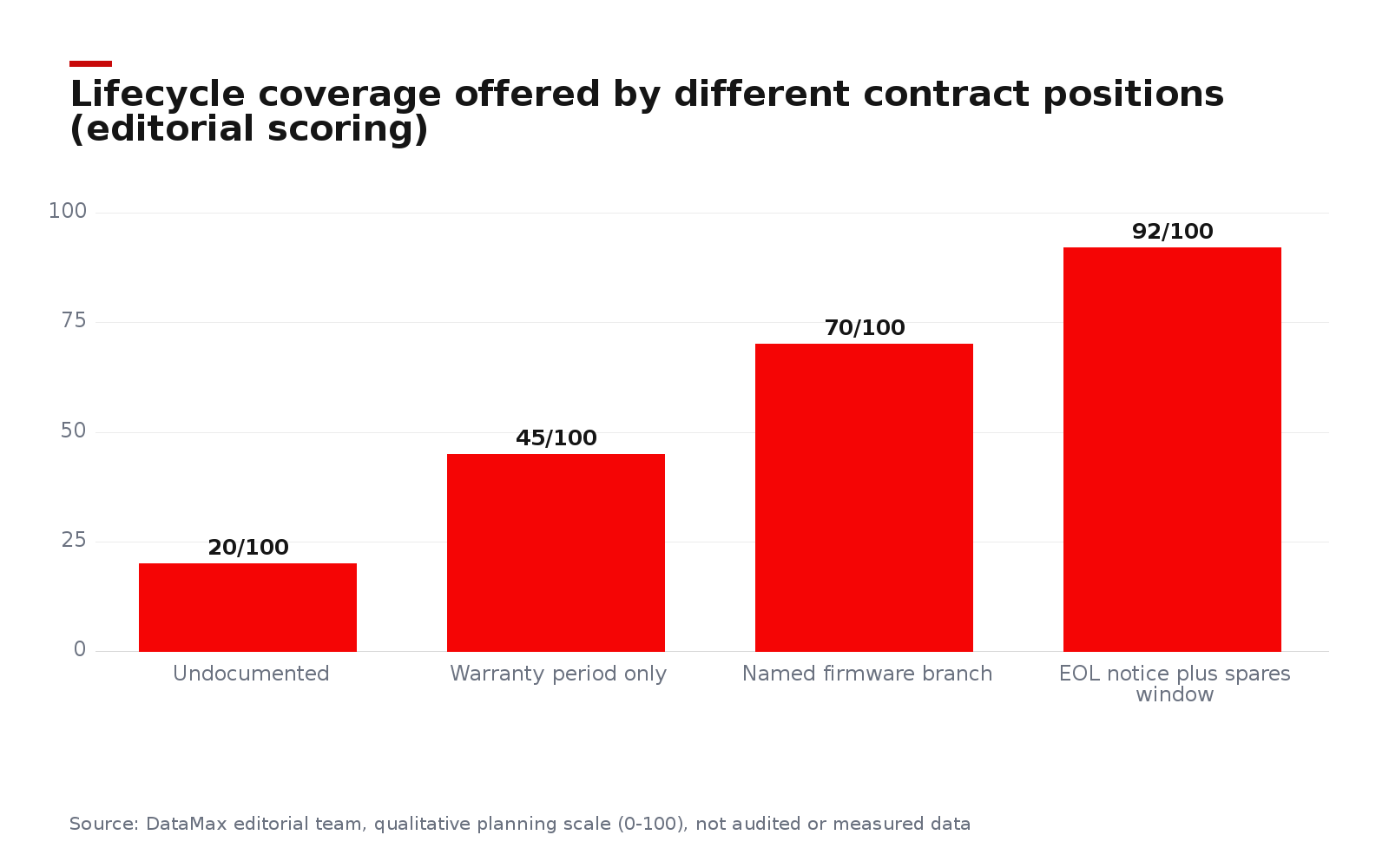
The same figures, in searchable form:
| Contract position | Editorial score |
|---|---|
| Undocumented | 20 |
| Warranty period only | 45 |
| Named firmware branch | 70 |
| EOL notice plus spares window | 92 |
The numerical comparison must not be mistaken for an industry benchmark. It illustrates the procurement logic: explicit release lineage and end-of-life obligations provide more planning control than a warranty label. Every quotation should also identify whether support is shared across the supplier’s fleet or created for the buyer. That distinction affects response routing, patch isolation, test reproducibility, and whether a firmware update can be reused after a hardware revision.
A second comparison is between a shared branch and a customer-specific branch. A shared branch may receive broader regression coverage because several products use it, but it can also carry features or assumptions unrelated to one buyer. A customer-specific branch can provide tighter alignment with middleware, branding, or regional requirements, while making the OEM responsible for more integration and regression management. Ask which changes occur upstream, which are local, and who signs off on a merge.
The third comparison concerns firmware continuity after a component or board change. A supplier may support the android tv box family by silently adapting a branch to a new wireless module, tuner, or storage component. That can simplify procurement, but it may also invalidate existing certifications, test records, and operator middleware. The quotation should say whether such changes require notice, requalification, a new board revision, or a new image identity.
The final comparison is incident-response ownership. Hardware-only support sends failures to an RMA queue. Full BSP support should provide a path for logs, crash analysis, boot loops, upgrade failures, and driver regressions. Ask whether the supplier can distinguish a hardware failure from a software failure using the same unit data collected at the factory and in the field. A clear answer reduces disputes during a fleet rollout.
Where the terminology comes from
BSP means board support package. In an Android device, it is the collection that adapts a specific board to the Android platform: bootloader configuration, kernel and device tree, board-specific drivers, boot services, hardware abstraction integration, and the build process that produces the image. The Android framework and applications sit above this layer. A weakness beneath the framework can therefore appear as an application crash, a missing feature, or a failed boot.
The responsibility stack should be assigned explicitly:
- Platform and BSP owner Bootloader, kernel, device tree, core drivers, build integration, and release notes
- Device and middleware owner Tuner, Wi-Fi, Bluetooth, Ethernet, HDMI, storage, remote control, middleware integration, and conditional-access interfaces
- Application owner Operator portal, playback, catalogue, account, entitlement, and device-management workflows
- Manufacturing owner SMT programming, inspection, end-of-line testing, firmware loading, traceability, and approved test limits
AOSP means the Android Open Source Project. An AOSP-based product gives the buyer a defined upstream code base, but it does not by itself establish production readiness, security-patch cadence, certification status, or long-term branch policy. Similarly, Widevine L1 describes a Widevine security level; the quoted configuration still needs to show whether the stated DRM implementation is optional in the exact orderable model.
Decoder claims require the same discipline. AV1, H.265 and other codec strings are useful only when tied to a specific SoC, firmware branch, output mode, and test protocol. For design decisions, the AV1 android tv box guide helps distinguish codec capability from deployment readiness.
The right contract line names the supported configuration and deliverables: “Support applies to model, board revision, SoC, Android baseline, RAM/ROM configuration, firmware branch, and approved accessory or tuner configuration.” It should identify the provider, response path, defect severity definitions, release cadence, security responsibility, and what happens when the supplier discontinues the underlying chipset or Android branch.
The architecture also explains why “one firmware for every unit” is not a useful requirement. A fleet may contain several board revisions, storage capacities, wireless modules, remote-control implementations, and middleware versions. Some differences can share a binary image, while others require separate device-tree configurations, drivers, or build targets. Procurement should request a compatibility matrix showing which image applies to which hardware combination.
BSP scope is not the same as application scope. The platform owner may maintain the kernel and drivers, while a separate party supplies a launcher, operator application, entitlement client, or device-management agent. The interface between those parties must be versioned. A framework API change can break an application even when the BSP remains stable, so the release manifest should identify minimum middleware and application versions.
Security responsibility must also be separated by layer. Android patches, Linux kernel patches, bootloader fixes, vendor-driver fixes, application security, and key-management operations can have different owners and different disclosure paths. The contract should identify who tracks advisories, who validates a patch, who authorizes deployment, and who communicates risk to the fleet operator. A generic statement about “security updates” leaves those 4 decisions unresolved.
Real DataMax platforms, field by field
The platform comparison must stay within the supplied production facts. Four DataMax models illustrate different fit directions, but their availability and exact ordering configurations require confirmation against the production datasheet.
| Model | SoC and OS | RAM / ROM | Decode and DRM | Interfaces |
|---|---|---|---|---|
| DM21P | Amlogic S905Y4, quad Cortex-A35; AOSP Android 11 | 2GB / 8GB; 4GB; 16/32/64GB optional | AV1 [email protected]; VP9/H.265 4K@60; H.264 4K@30; Widevine L1 / PlayReady / HDCP 2.2 optional | HDMI 2.0b out x1; USB2.0 x2; TF; S/PDIF; 3.5mm AV; RJ45 100M; Wi-Fi6 2x2 + BT5.4; DC 5V/5V/2A |
| DM21S | Amlogic S905Y5, quad Cortex-A55; AOSP Android 14 | 2GB / 16GB; 2/4/8GB; 16/32/64GB optional | AV1 / H.265 [email protected] 4K@60; Widevine L1 / PlayReady optional; Dolby Vision/DTS | HDMI 2.0b out; S/PDIF; AV; USB2.0 x2; TF; RJ45 100M; 1G optional; Wi-Fi6 2x2 + BT5.4 |
| DM21T | Amlogic S905X5, quad Cortex-A510 (ARMv9); AOSP Android 14 | 4GB / 64GB; family options | H.266/VVC [email protected] 4K@120; AV1/VP9/H.265 4K@120; AVS3 4K@120; H.264 4K@60; inline AI-SR; Widevine L1 / PlayReady optional | HDMI 2.0b out, no HDMI in; USB2.0 x1 + USB3.0 x1; TF; S/PDIF; AV; RJ45 100M; 1G opt; Wi-Fi6 + BT5.4 |
| DM22Q | Amlogic S905X5M, quad Cortex-A55 up to 2.5GHz; AOSP Android 14 | 4GB / 64GB; 2/4/8GB; 16/32/64GB optional | AV1/H.265 L5.1 4K@60; inline AI-SR; no NPU TOPS stated; Widevine L1 / PlayReady optional; Dolby Vision/DTS | HDMI 2.0b out; USB2.0 x2; TF; S/PDIF; AV; RJ45 100M; 1G opt; Wi-Fi6 2x2 + BT5.4 |
DM21P is positioned for 4K IPTV and operator middleware. DM21S is positioned for 4K IPTV/OTT white-label work. DM21T targets premium UHD and cloud-gaming applications, while DM22Q is gaming-oriented. These fit descriptions are product facts, not complete statements of tuner, certification, or production availability.
The table also exposes why an RFQ cannot use the word “android tv box” as the platform specification. The four models differ in Android generation, CPU architecture, codec profile, interface set, memory options, and DRM positioning. A quote for the generic category leaves too many variables unresolved. Name the model and the exact configuration, then add the BSP branch, board revision, and support deliverables. For a broader operator-tier android tv box assessment, use the guide to separate operator requirements from consumer feature labels.
For DM21P, the stated operating system is AOSP Android 11, so a buyer planning Android 14 must not treat the family naming as evidence of platform parity. Its stated interfaces include RJ45 100M and Wi-Fi6 2x2 + BT5.4. Optional Widevine L1, PlayReady, and HDCP 2.2 arrangements need confirmation against the production datasheet and the exact orderable configuration.
For DM21S, the supplied baseline is AOSP Android 14 with AV1 / H.265 [email protected] 4K@60 and optional DRM arrangements. The listed RJ45 100M configuration has 1G optional. A procurement line should therefore distinguish base interface requirements from validated options rather than placing an optional speed in the unconditional specification.
For DM21T, the supplied facts identify Amlogic S905X5, quad Cortex-A510 (ARMv9), AOSP Android 14, and 4GB / 64GB within the family options. Its codec list includes 4K@120 modes and inline AI-SR, but that capability does not replace a display-mode test. The HDMI entry explicitly states no HDMI input, which matters for capture, passthrough, or return-path workflows. Confirm all other assumptions against the production datasheet.
For DM22Q, the supplied facts identify Amlogic S905X5M, quad Cortex-A55 up to 2.5GHz, AOSP Android 14, and 4GB / 64GB in the stated configuration family. AV1/H.265 L5.1 4K@60 and inline AI-SR are listed, while no NPU TOPS figure is stated. Procurement should ask for the workload, display mode, duration, and thermal boundary used to validate the performance claim rather than infer a processing metric.
Buyer situations, ranked by what they punish
Different deployments expose different weaknesses. Operator procurement punishes unclear middleware ownership and slow recovery from mass-field defects. Integrators punish missing interfaces and configuration drift between samples and production. Gaming-oriented buyers punish sustained thermal or input-response problems and codec claims that do not survive the actual display path.
A modern SMT line illustrates the upstream evidence behind every device: pick-and-place, board identity, component placement, and process control occur before Android or middleware validation.

| Situation | Requirement that deserves priority | Model direction | Evidence to request |
|---|---|---|---|
| • IPTV operator fleet | • Middleware integration, recovery, and named firmware branch | • DM21P or DM21S direction | • Production image, middleware test matrix, rollback plan |
| • OTT white-label launch | • Stable Android baseline, branding control, and configuration traceability | • DM21S direction | • Firmware ownership matrix and provisioning process |
| • AV integration project | • HDMI, AV, S/PDIF, Ethernet, and accessory compatibility | • Confirm against selected model’s datasheet | • Interface drawing and tested accessory list |
| • Premium UHD or cloud gaming | • Codec, refresh-path, and performance validation | • DM21T direction | • Display-mode matrix and workload test report |
| • Gaming-oriented retail program | • Sustained performance and 4K output verification | • DM22Q direction | • Thermal run, frame-path, and I/O test evidence |
The ranking is operational rather than market-based. A 4K operator deployment may punish a weak recovery process more severely than a missing high-end codec. An integrator may reject the platform if a required port is treated as “optional” without a validated alternative. A gaming program must distinguish decoder capability from sustained output behavior; the supplied product facts identify codec and inline AI-SR support, but any NPU TOPS claim remains unsupported for DM22Q.
For an IPTV operator, the first failure scenario is a boot-loop or failed network recovery across many units. The second is an update that installs successfully but leaves the middleware unable to authenticate. The third is a tuner or conditional-access integration that passes a laboratory sample but behaves differently after a board revision. Procurement should request the production image, middleware test matrix, recovery procedure, and rollback plan as a single evidence set.
For an OTT white-label buyer, configuration drift is the primary risk. A sample may have a branded launcher, a selected storage option, a regional network module, and a debug image that will not be used in production. The contractual baseline should enumerate the launcher build, provisioning process, preloaded applications, update method, and any factory-reset behavior. A named firmware branch matters because the buyer must be able to reproduce and re-flash the approved image.
For an AV integrator, the device is only 1 part of the signal path. A declared HDMI output does not establish compatibility with a specific display, receiver, control system, audio extractor, or capture device. The acceptance record should identify the connected equipment, resolution, refresh mode, audio route, and recovery behavior. Any requested interface not present in the selected model must be treated as a new qualification item.
For a premium UHD or cloud-gaming deployment, sustained behavior matters more than catalogue wording. The test should record source format, decoder mode, output resolution, refresh rate, workload duration, thermal state, and input response. The DataMax model direction can shortlist a platform, but the acceptance evidence must be produced on the exact display and accessory configuration.
Venue projects add configuration-management problems. Digital signage, hospitality, and commercial display deployments may replace units while preserving the same customer-facing image. Procurement should request the approved image hash, bootloader behavior, configuration export, and recovery method. If the device will be maintained by several teams, the escalation route and document repository must identify a single source of truth.
The same procurement question therefore needs scenario-specific acceptance criteria. For an operator, boot-loop and network-recovery tests should be part of qualification. For an integrator, every connected accessory and signal path should appear in the approved configuration. For a gaming application, test duration, display mode, thermal state, input path, and content type need to be recorded. “4K” without a mode definition is not an acceptance criterion.
A decision path for the RFQ
Start with the deployment constraint rather than a preferred chipset. Lock the operating scenario, output requirements, middleware, connectivity, tuner or accessory needs, and expected fleet scale. Then select a DataMax direction using the product facts, and ask the supplier to fill the unresolved BSP and lifecycle fields in writing.
acceptance criteria
configuration lock
evidence review
and pilot gates
A pasteable specification block should contain 7 fields:
| Field | Required wording |
|---|---|
| Model and configuration | State model, board revision, SoC, Android baseline, RAM/ROM, tuner/accessory configuration, and destination region. |
| BSP baseline | State bootloader, kernel, device tree, build identity, driver scope, and firmware branch. |
| Acceptance tests | State boot, reboot, recovery, network, interface, decoder, DRM, aging, dark-room, and scenario-specific criteria. |
| Ownership | Name the supplier, OEM, middleware, app, security, and manufacturing owners. |
| Release control | Define notification, approval, regression, documentation, and deployment procedure. |
| Lifecycle | Define notice, final firmware, security, bootloader, driver, parts, and last-time-buy obligations. |
| Escalation | Define severity, response route, reproducer package, and release decision process. |
The qualification sequence should move from paper to hardware: commercial and technical clarification, sample evaluation, production-equivalent build, engineering validation, limited pilot, then release approval. Each stage needs a written exit condition. A sample is not proof of the production image; a production image is not proof of fleet recovery.
For the first RFQ message, send the target model, exact required memory configuration, deployment scenario, output and codec requirements, DRM requirement, interfaces, quantity planning parameters, target market, and required lifecycle deliverables. Do not send only a category name and ask for a recommendation. Use the sample request route only after the model and acceptance matrix are written, because uncontrolled samples can generate incompatible conclusions.
The RFQ should use conditional clauses where configuration is unresolved. For example: “RJ45 100M is the base requirement; any 1G configuration is acceptable only if it appears in the quotation, test matrix, and production datasheet.” A second clause should state that optional DRM arrangements apply only when explicitly listed for the ordered model. These clauses prevent the quotation from merging base and optional capabilities into an implied standard.
Sample qualification should compare identity before testing performance. Record model, board revision, memory configuration, peripherals, firmware build, bootloader, kernel, and installed accessories. Then execute the agreed test matrix. If any identity field differs from the RFQ, record the result as a configuration mismatch rather than a product failure.
Production-equivalent review should verify that the pilot unit represents the intended assembly, image, and test process. Check whether the factory has changed the board, component, memory, tuner, wireless module, or middleware since the sample was approved. A production pilot should also exercise recovery from an interrupted update and restoration of the approved image. The exit condition is evidence that the fleet can be reproduced and corrected, not only that a display lights up.
The AOSP distinction remains relevant to approval. The AOSP versus Google Android TV guide helps decide which software ownership model matches the program before contractual support language is drafted.
The traps in this category
The first trap is accepting the platform name as the specification. A catalogue entry can combine a generic chipset, optional RAM, optional Ethernet speed, optional DRM, and one Android baseline without defining the shippable combination. When a quotation says “the android tv box includes Widevine L1,” ask whether that applies to the proposed model, board, firmware image, and production quantity.
Field trap
Marketing labels can overstate output capability. Require the exact maximum output and decode modes from the approved datasheet and test report. For DM21T and DM22Q, the supplied facts cap the relevant output/decode at 4K; do not convert an “8K” marketing label into an 8K claim.
The second trap is treating BSP support as permission to skip release governance. A factory may rebuild the image successfully while leaving bootloader behavior, key handling, system-partition compatibility, or recovery path undefined. The resulting fleet can fragment even when the visible launcher appears identical. Every image must have a unique build identity, and every board revision must map to an approved binary set.
Quotations also diverge around boundaries. One supplier may include application integration, another may provide only the BSP; one may supply generic reference software while another owns operator middleware; one may maintain a shared branch while another forks one for the customer. These are commercial scope differences, not interchangeable descriptions.
Field trap
A “spare-parts window” without a named firmware and bootloader commitment can leave the fleet physically supported but operationally stranded. Require one integrated exit plan covering notices, final images, security responsibility, bootloader availability, drivers, and repair parts.
A third trap is accepting test language that cannot be audited. “Aging tested” must identify duration, load, and failure criteria; “HDCP verified” must identify the source, display, and sink behavior; “stable Wi-Fi” must specify the network environment. Procurement should convert every assurance into a record, threshold, or repeatable procedure. The failure cost is not merely a rejected sample: it is delayed certification, field inconsistency, and a dispute over whether the delivered behavior matched the agreed baseline.
A fourth trap is treating firmware support as unlimited customization. If the supplier agrees to maintain a customer-specific image, clarify whether every launcher change, middleware upgrade, regional service, or accessibility requirement enters the same regression process. Otherwise, minor requests can consume engineering capacity and delay security or defect fixes. State which changes are standard, which are chargeable engineering, and which are excluded from the branch.
A fifth trap is failing to define notice channels. A contract may promise end-of-life communication, but the buyer will miss it if it is sent only to a former engineer’s mailbox. Require defined recipients, a backup recipient, and delivery evidence. Likewise, incident escalation should survive staff turnover by naming a role, a response channel, and an escalation contact rather than relying on an individual relationship.
A sixth trap is confusing a reference platform with a maintained product. A supplier may possess source code, a build system, and a demonstration image without operating a controlled release branch for the buyer’s exact configuration. Verify the relationship between the quoted BSP and the shipped image. A source archive does not by itself provide tested drivers, bootloader compatibility, manufacturing procedures, or end-of-life assets.
Close by assigning a document owner for the support matrix, release manifest, test evidence, and end-of-life plan. DataMax platform questions can be sent through the engineering contact, while compliance and production claims should be reviewed through certification information and compliance resources. The buying decision is mature when support can be reproduced, traced, transferred, and ended in an orderly way.
Further reading
- Guide android tv box for isps
- Android TV boxes
- Rockchip Android TV boxes
- Edge computing boxes
- 4K 60fps Android TV box guide
- DataMax DM21P specifications and fit
- DataMax DM21S specifications and fit
FAQ
What is BSP support for an android tv box?
BSP support covers the hardware-specific software layer beneath Android, including bootloader integration, kernel and device tree, drivers, board configuration, build processes, and production firmware. Commercial scope may also include middleware or application work, but the contract must name those owners separately. Procurement should identify the supported board revision and firmware branch rather than relying on the category name.
Who should own Android security updates?
The allocation depends on the operating model, but the agreement must still name an accountable party for Android security patches, bootloader fixes, vendor-driver issues, and release communication. A supplier may produce the BSP while the OEM owns the final image and sign-off. Whatever the split, each fix needs an owner, test target, approval route, and field-deployment procedure.
How many firmware versions should a fleet retain?
The appropriate count depends on update risk, fleet size, rollback requirements, and storage constraints. Procurement should require a named supported branch, a tested migration path, and a rollback procedure rather than an arbitrary version count. The EOL clause should define the final release and bootloader availability so operations teams know when maintenance ends.
Can one BSP support several TV box models?
Yes, when the supplier explicitly identifies the shared code base, model-specific branches, hardware dependencies, and regression scope. A shared BSP can reduce duplicated engineering, but board revisions and tuner or accessory combinations still require their own validation. The quotation should state which models and revisions each release covers.
What evidence should accompany a sample?
The sample review should identify the exact model, board revision, memory configuration, firmware build, bootloader and kernel version, and installed accessories. Request the test matrix, known limitations, recovery procedure, and change history. Approval should require production-equivalent firmware rather than a demonstration image whose configuration differs from the proposed shipment.
When should procurement involve the supplier’s BSP team?
Involve the BSP team before the commercial platform is locked, then again during sample qualification and production approval. It should validate bootloader, driver, middleware, thermal, network, codec, and update assumptions against the actual deployment. Waiting until final user acceptance shifts technical discovery into a schedule where alternative hardware, firmware, or deployment paths are limited.


