
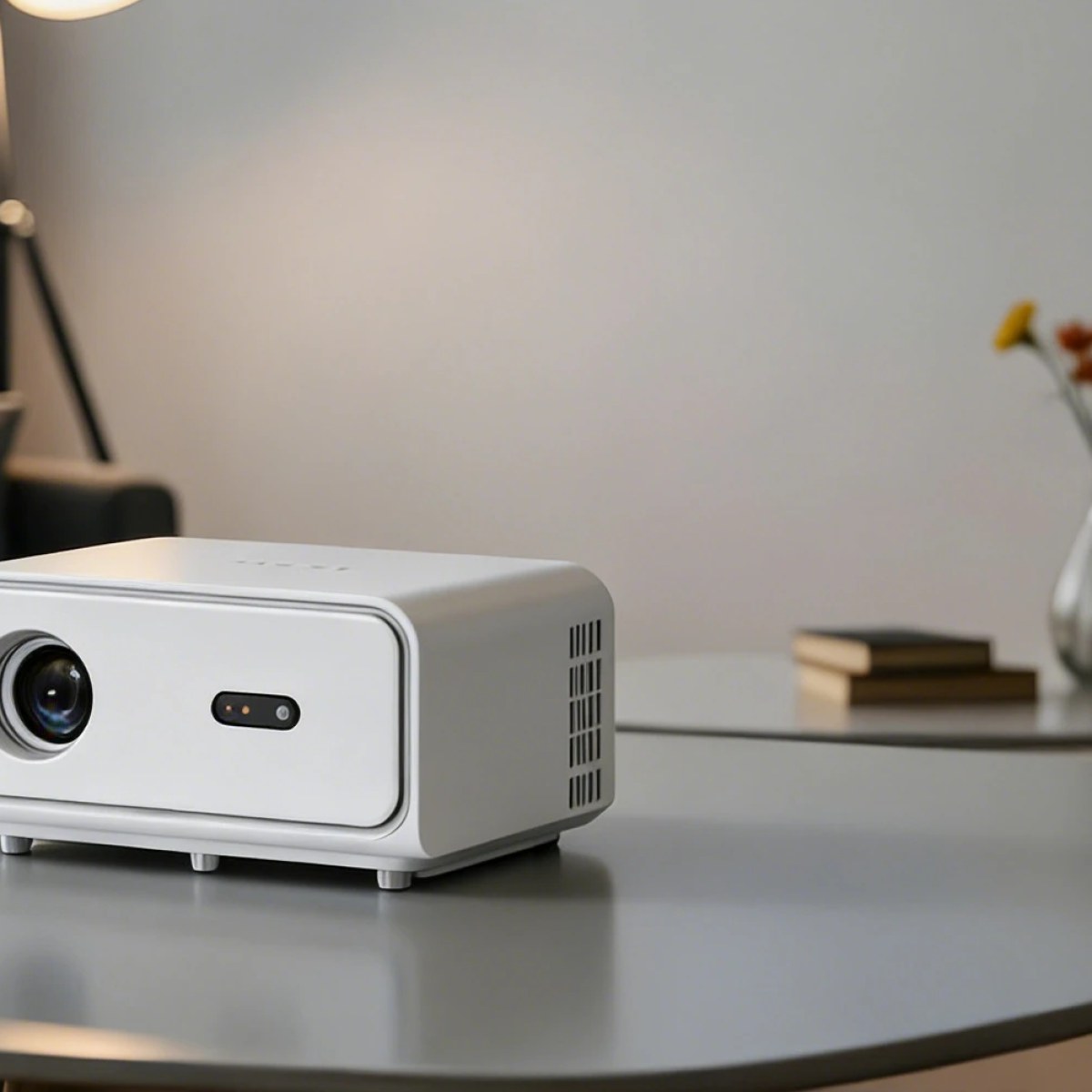
Commercial decision context
A household buying guide treats outdoor use as a temporary connection between a compact projector, a phone and a dark evening. An installed commercial project must instead survive ambient light, non-controlled temperatures, dust ingress, condensation risk, public operation, electrical variation, maintenance access and fleet-level software support. The procurement unit is therefore a system: projection engine, screen or wall, enclosure, power, network, audio, control platform, mounting hardware, spares and acceptance procedure.
The governing question is not whether a DLP projector can be taken outside. It is whether a specified unit can deliver a measurable presentation target for the required hours, ambient illuminance and environmental duty cycle. A 450-ANSI-lumen unit and a 1000-ANSI-lumen unit are not interchangeable on a sunlit commercial surface; a 10000mAh battery also does not define usable runtime because brightness mode, wireless activity, audio volume and thermal conditions remain unspecified.
- Design duty cycle: define whether the unit is portable between events, intermittently installed, or operated continuously from a fixed weather-protected enclosure.
- Environment: record direct sun, indirect daylight, dust, rain exposure, humidity, temperature range, altitude and wind exposure by site survey.
- Content security: determine whether playback is commercial AV, operator-controlled Android, Google TV, casting-only, or externally sourced through HDMI.
- Service model: compare module replacement, on-site repair, depot repair, spare stock, firmware recovery and mean-time-to-repair commitments.
- Measurement basis: require the production datasheet, test report and firmware build to identify ANSI lumens, resolution and platform configuration.
- Outdoor enclosure rule: a product marketed as “outdoor” must still be evaluated against ingress, condensation, UV exposure, cable strain, surge and field-service requirements.
| Consumer assumption | Commercial engineering requirement | Procurement evidence |
|---|---|---|
| Outdoors means darkness | Quantified ambient illuminance at the screen plane across operating hours | Site lux survey, orientation study and commissioning target |
| Short demonstrations | Defined daily hours, weekly frequency and service interval | Duty-cycle worksheet and maintenance plan |
| App casting is sufficient | DRM, tenancy, network and content-delivery policy | Platform security and integration test report |
| Splash resistance is acceptable | Ingress and condensation strategy for each deployment class | Enclosure IP declaration, test method and site procedure |
| Consumer warranty is adequate | Fleet RMA, spare modules and end-user support escalation | Warranty matrix, depot process and SLA |
For related optical sizing, see the projector brightness selection guide. For commercial programme governance, use the projector OEM/ODM process reference.
ANSI lumens, resolution and optical fundamentals
ANSI lumens quantify projector light output under a defined test procedure rather than a vendor’s arbitrary brightness label. Procurement acceptance should request the applicable test method, measurement configuration, sample size and production-lot tolerance. Do not compare a listed ANSI value with LED lumens, image “boost” modes or source-lumen claims without a common test basis.
Two useful first-order equations are:
- Screen area: A = W × H, with W and H expressed in the same units.
- Throw distance: D = R × W, where R is the stated projection ratio and D is lens-to-screen distance.
- Target average illuminance: E = F / A, where F is ANSI lumens and A is image area; this omits ambient light, screen gain, uniformity and aging losses.
- Maintained output: Fm = F0 × retention, with retention validated from the production light-source specification rather than assumed indefinitely.
- Required source lumens: F_req ≈ (Etarget × A) / (G × U × R), where G is screen gain, U is an application utilization factor and R is retained-output factor. Validate the application factors empirically because the formula is not an ANSI substitute.
Native resolution describes the signal matrix generated or accepted by the product; “4K” in a commercial title does not establish a native 3840×2160 DMD. A title listing “4K” must therefore be supported by the production datasheet. Contrast should be reported with its measurement mode because sequential or ANSI contrast methods produce different values. Throw ratio governs layout flexibility, while digital keystone correction changes pixels and effective output rather than adding optical brightness.
| Metric | Engineering interpretation | Acceptance focus |
|---|---|---|
| ANSI lumens | Normalized light output under a stated procedure | Report test method, mode and production tolerance |
| Native resolution | Physical or declared display matrix; not necessarily input capability | Confirm actual panel/DMD and HDMI operating modes |
| Contrast ratio | Ratio between specified black and white levels | Require measurement mode and whether dynamic modes are active |
| Throw ratio | Lens-distance relationship to image width | Validate at the selected image width and focus position |
| Keystone | Digital geometry correction that resamples the image | Check usable pixels, focus and distortion after correction |
| Light-source life | Elapsed time to a specified lumen-retention point | State brightness mode, ambient temperature and end-of-life threshold |

Real DataMax model comparison
The supplied DataMax records support a procurement comparison, but several records are incomplete or internally inconsistent. The table distinguishes specified facts from unconfirmed items. No product gap is filled by inference; “confirm against production datasheet” is mandatory wherever the record is partial or contradictory.
| Model / record | Platform | Brightness and optical data | Connectivity and I/O | Mechanical / power | Data-quality status |
|---|---|---|---|---|---|
| GP8 | Amlogic T972; Android 9; 2GB RAM; 32GB ROM; Bluetooth remote | Title says 400 ANSI lumens; structured record says 450 ANSI lumens; 1920×1080 native; 1200:1 contrast; 0.23-inch DMD; throw ratio 0.24:1; 15-116cm; 30-200 inches; LED; auto focus and auto keystone | Wi-Fi 6 dual-band; Bluetooth 5.0; AirPlay, Miracast and EShare; 1×HDMI input; 2×USB 2.0; 3.5mm audio | 94×71×190mm; 0.88kg; 89W; 30dB; front projection; 4Ω 5W dual-driver speaker | Confirm against production datasheet: 400 versus 450 ANSI lumens and title “4K” versus 1920×1080 native |
| Portable 1080P Android 13 | Android 13; detailed CPU, RAM, storage and wireless versions not supplied | Title states 1080P and 400 ANSI; 3D, throw ratio, contrast, DMD, light-source life and image size not supplied | Wi-Fi, Bluetooth, HDMI, USB and mirroring details not supplied | Dimensions, weight, power consumption, battery and noise not supplied | Confirm every unlisted specification against the production datasheet |
| Portable 1080P Android 13 | Android 13; detailed CPU, RAM, storage and wireless versions not supplied | Title states 1080P and 230 ANSI; focus, keystone, contrast, throw ratio, DMD, light-source life and image size not supplied | Wi-Fi and Bluetooth 5.2 stated; HDMI, USB, audio and mirroring details not supplied | Dimensions, weight, power consumption, battery and noise not supplied | Confirm every unlisted specification against the production datasheet |
| 4K Smart DLP Outdoor | Android 9; CPU, RAM, storage, DRM and update method not supplied | Title states 4K and outdoor; 10000mAh battery; native resolution and ANSI brightness not supplied | Title indicates dual-band Wi-Fi, Bluetooth 5.0 and wireless mirroring; port details not supplied | Battery stated; dimensions, weight, charging time, noise and ingress rating not supplied | Confirm against production datasheet: 4K implementation, brightness, ingress protection, battery runtime and operating environment |
| GP96-GTV | Allwinner H137 plus XuanTie C906 RISC-V CPU; Google TV 11 or 14; Google TV dongle S805X2 or RTD1332; 1GB DDR4; 8GB eMMC | 1000 ANSI lumens; 1920×1080 native; 1600:1 contrast; 1.2:1 ratio; 1.26-3.5m; 80-120 inches; auto focus, auto keystone, auto screen alignment and obstacle avoidance | 2.4/5GHz Wi-Fi; Bluetooth 5.0; 1×HDMI; 1×USB; mini-jack audio; 1 infrared receiver; stated 2KP60, HDR10, HDR10+ and HLG | 256×203×140mm; 2.95kg; 130W; 32dB; front/rear/hanging projection; ABS; dust-free design | Confirm against production datasheet: exact Google TV version and dongle variant; “4.45-inch LCD display” conflicts with a DLP projector context; “LED 10,000-10,500 lumens” requires test-basis clarification |


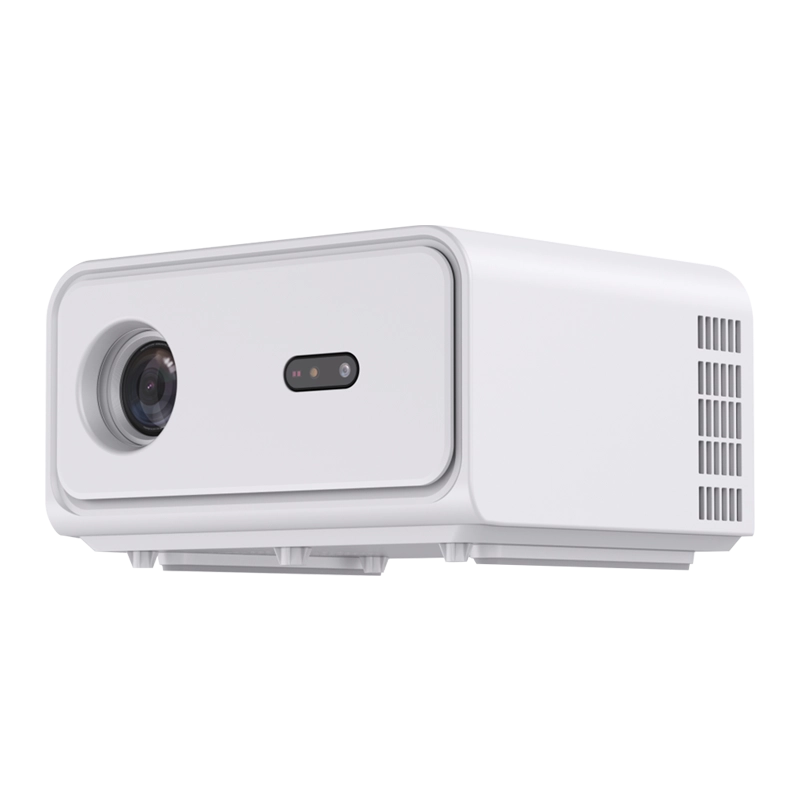
Quantitative selection method and worked example
Begin with a target image size, measured screen-plane illuminance and permitted operating mode. The following worked example is illustrative engineering analysis, not a DataMax performance claim. Assume an 80-inch 16:9 image, width W = 1.771m and height H = 0.996m. The area A is approximately 1.764m². A low-gain matte screen with G = 1.0 is assumed. An application utilization factor U = 0.70 accounts conservatively for alignment, uniformity and operating mode; this factor must be validated on an actual sample.
If Etarget = 120lx on the screen before accounting for ambient light, required maintained source lumens are F_req ≈ 120 × 1.764 ÷ 0.70 = 302.4 lumens. If ambient light already contributes 70lx and the desired total is 220lx, the projector must contribute approximately 150lx, giving F_req ≈ 378 lumens. A listed 400- or 450-ANSI-lumen unit could therefore be dimensionally plausible for this illustrative application, but only an on-site photometric test confirms compliance. The 1000-ANSI-lumen GP96-GTV provides more installation margin for a larger image or brighter environment, subject to actual screen gain and measurement.
For GP8 at a stated 0.24:1 throw ratio, an 80-inch width requires D = 0.24 × 1.771 = 0.425m, nominally within the stated 15-116cm projection-distance range. This geometry calculation does not resolve the product’s UST image-size range or installation clearances; confirm the production optical diagram. For GP96-GTV at 1.2:1, the same width gives D = 2.125m, within the stated 1.26-3.5m range and compatible with an 80-inch target. Exact placement must use the lens offset, wall bracket and screen plane rather than a bare throw-distance result.
| Selection variable | Illustrative value | Formula or check | Decision consequence |
|---|---|---|---|
| Image width | 1.771m for 80-inch 16:9 | 16:9 diagonal × 16 ÷ √337 | Sets area and throw distance |
| Image area | 1.764m² | W × H | Sets source-lumen requirement |
| Target projector contribution | 150lx after 70lx ambient contribution | Etotal − Eambient | Prevents double-counting daylight |
| Utilization factor | 0.70 illustrative | Validate by uniformity and mode testing | Adds margin for real installation |
| Required maintained output | 378lm illustrative | 150 × 1.764 ÷ 0.70 | Compare with specified and retained output |
| GP8 nominal distance | 0.425m at 0.24:1 | R × W | Requires UST placement validation |
| GP96-GTV nominal distance | 2.125m at 1.2:1 | R × W | Fits illustrative 1.26-3.5m record range |
| Profile | Typical environment | Initial candidate | Required verification |
|---|---|---|---|
| Controlled indoor / UST | Near screen, low ambient light, 30-120 inch use | GP8 | 400 versus 450 ANSI discrepancy; brightness mode; geometry; acoustics |
| General portable Android | Protected meeting or event space | Android 13 230 or 400 ANSI records | Full datasheet, cooling, runtime and input lag |
| Protected outdoor temporary | Dusk event, occasional rain exposure avoidance | Outdoor-labelled record or higher-output fixed unit | Ingress, condensation, battery runtime, sunset horizon |
| High ambient | Daylit terrace, retail or hospitality | GP96-GTV | 1000 ANSI measurement basis, screen gain and thermal duty |
Deployment profiles by environment
Hotel and hospitality
Conditions: Guest-room or suite installation requires low noise, controlled IR interference, simple recovery and discrete power. GP8 is specified at 30dB and offers a Bluetooth remote; this is a candidate, not proof of suitability. A fixed 80-120 inch installation may align more closely with the GP96-GTV record, while UST furniture placement may favor GP8.
- Architecture: IR&Bluetooth remote, HDMI source, screen or wall, local power and room-management integration.
- Risks: guest network isolation, copyrighted streaming restrictions, inconsistent furniture geometry and unauthorized app changes.
- Management: lock configuration through supported device policy; the production mechanism for Android policy control must be confirmed.
Corporate workplace
Conditions: Conference and training rooms need deterministic HDMI or network input, predictable geometry and fleet visibility. The GP96-GTV record includes 1×HDMI, 2.4/5GHz Wi-Fi, Bluetooth 5.0 and stated 2KP60 output; exact HDMI modes and Google TV variant need confirmation. Architecture: fixed ceiling or wall mounting, wired HDMI preferred for presentation reliability, controlled LAN for management and external room-control interface if required. Risks: unverified input latency, single HDMI port, app licensing and insecure casting. Management: require MDM/OTA procedures, admin credentials, recovery image and log-export requirements.
Education
Conditions: Classrooms prioritize lamp-free LED operation, low maintenance and repeatable geometry. GP8’s 30dB specification and UST ratio support consideration in compact teaching spaces, but classroom use requires a documented ingress, impact and warranty policy. Architecture: ceiling mount, screen, wired source, VLANed management and captive-portal authentication. Risks: student access to settings, unauthorized casting and insufficient brightness with blinds open. Management: restrict discovery, define device enrollment, separate user and administrator networks and schedule firmware validation.

Retail and signage
Conditions: Retail projection may be used on promotional walls, displays or event zones where daylight and opening hours dominate. The GP96-GTV record’s 1000 ANSI lumens and stated dust-free design make it a candidate for evaluation, not a proof of retail suitability. Architecture: fixed mounting, external media player, scheduled playback, wired network and remote monitoring. Risks: color consistency, burn-in or visual fatigue from static content, overheating and unauthorized reboot. Management: use signed media, application allowlisting, kiosk mode where supported, NTP time synchronization and heartbeat monitoring.
High-ambient and exposed sites
Conditions: Daylit terraces, temporary event sites and semi-outdoor hospitality spaces require the highest brightness margin among the supplied records. No supplied DataMax specification establishes outdoor ingress protection, full sunlight capability or unrestricted weather exposure. Architecture: use a weather-rated enclosure, drip loop, filtered ventilation, sunshade, stable power and a high-gain or carefully selected screen. Risks: condensation, solar heat gain, dust blockage, corrosion, surge and screen washout. Management: prohibit direct rain unless the production datasheet provides an ingress rating; inspect seals, heater/dehumidification strategy and thermal logs after each event.
Platform, connectivity and control integration
Google TV and AOSP are distribution and management classes, not interchangeable procurement labels. The GP96-GTV record states Google TV 11 or 14 on a dongle platform and identifies two possible dongle CPUs, so the delivered firmware, EDLA/GMS status, Widevine security level, HDCP path and licensing terms must be confirmed against the production datasheet and shipment configuration. The other records state Android 9 or Android 13, but do not establish GMS, Widevine, HDCP or app-signing status. For DRM decisions, see the Widevine L1 versus L3 business-impact reference.
| Integration layer | Required decision | Evidence or test |
|---|---|---|
| Application distribution | Google TV certified path, AOSP private build or external player | Build identity, signing policy, GMS/EDLA declaration if claimed |
| DRM and protected content | Widevine security level, HDCP version and display topology | License flow, output-protection log and content playback test |
| OTA and MDM | Signed updates, staged rollout, rollback and remote inventory | Package signature, recovery procedure and audit report |
| Network | Dual-band Wi-Fi, Ethernet through approved accessory or USB adapter | RF coexistence, captive portal, VLAN and bandwidth test |
| Room control | PMS, CEC, API or relay integration | Command map, state feedback, startup and power-off timing |
| Audio | Internal speaker, 3.5mm output or networked audio | Level, latency, mute, EDID and lip-sync test |
| Mechanical | Bracket load, focus clearance, cable strain and service access | Drawing, torque specification and installed fit check |
| Thermal and acoustics | 30dB GP8 and 32dB GP96-GTV are declared values requiring method confirmation | Installed noise measurement at listener position |
For AV integration, HDMI CEC can simplify control but should not be the sole production control path unless the required projector, source and display behavior is verified. PMS or building-management integration should use a documented command interface or certified IP-control protocol; the supplied records do not specify PMS APIs, CEC support, RS-232, Ethernet or trigger interfaces. Confirm against the production datasheet.
Compliance, environmental evidence and optical-engine protection
Outdoor suitability is an evidence package, not a product adjective. Procurement should require declarations and test reports matched to the exact model, electrical rating, firmware, region and supply lot. For commercial programs, applicable obligations may include electrical safety, EMC, radio, RoHS/REACH where required, battery transport where a battery is fitted, and local building or accessibility rules. The exact certification list and issuing laboratory must be confirmed against the production datasheet.
- Electrical: request applicable safety and EMC reports, AC input range, fuse or protection details, earthing method and shutdown behavior.
- Radio: request country-specific radio approvals and declared Wi-Fi/Bluetooth bands; the records state Wi-Fi and Bluetooth versions but not every regional approval.
- Battery: for any 10000mAh model, request cell chemistry, cycles, UN 38.3 or applicable transport evidence, charger rating, thermal protection and replacement policy; these are not supplied.
- Optical engine: “dust-free design” is a product claim for GP96-GTV. Require the seal architecture, particle test, service interval and evidence that cleaning does not void warranty.
- Ingress: do not equate a dust-free optical engine with IP-rated outdoor enclosure protection; confirm enclosure and connector ingress separately.
- Condensation: require dew-point limits, warm-up procedure, heater strategy or a rule prohibiting cold storage and immediate power-on.
- Environmental longevity: ask for lumen-retention curves, LED driver thermal limits and replacement criteria rather than relying on a single “10,000-hour” statement.
Lifecycle, lumen depreciation and TCO structure
Total cost of ownership should be modeled over a project-defined period rather than inferred from a vendor headline. Use a spreadsheet or lifecycle model with separate acquisition, installation, energy, content, connectivity, maintenance, spares, logistics and end-of-life categories. Energy calculation is E_kWh = rated power in kW × scheduled hours × load factor × site count. At the supplied 89W GP8 value, continuous operation consumes 0.089kWh per hour; at the supplied 130W GP96-GTV value, continuous operation consumes 0.130kWh per hour. These values are working-consumption records, not guaranteed site input power.
Lumen depreciation is a maintenance variable. Define F0 as initial measured output, Rt as retained output at the service interval and Faccept as the minimum acceptable output. If the end-of-life threshold is 70% of initial output, a 1000-ANSI-lumen unit reaches 700 lumens at that threshold; this is an illustrative calculation, not a DataMax warranty or life claim. Obtain the actual retention curve and define whether replacement is based on hours, calendar age, brightness, failure rate or image uniformity.
| TCO category | Engineering quantity | Control measure |
|---|---|---|
| Acquisition and logistics | Unit count, cartons, spares and inbound/outbound freight | Use production carton dimensions and weights; validate packing changes |
| Installation | Mount, screen, cable, enclosure, labor and commissioning hours | Separate fixed installed and temporary event costs |
| Energy | 89W GP8 or 130W GP96-GTV stated working consumption | Measure at site and include duty cycle |
| Operations | Software licenses, network service, monitoring and content delivery | Separate operator cost from hardware support |
| Maintenance | Cleaning, filter or optical service, calibration and RMA | Use measured interval, not generic lamp-life language |
| Risk reserve | Failure, water exposure, theft and emergency replacement | Set spare ratio from field data and service response target |
| End of life | Recovery, disposal and data-wipe requirements | Define secure Android account and storage wiping |
The supplied GP8 carton data is 530×480×240mm for 10 units with 18.8kg gross weight; GP96-GTV is 540×360×335mm for 3 units with 12kg gross weight. These figures are useful for warehouse and freight planning but must be reconfirmed against the production packing specification before shipment approval.
OEM/ODM commercial process and customization
A projector programme should separate standard catalogue products from custom engineering. A hardware revision that changes the optical engine, power supply, Android board, thermal path, label or mounting geometry can alter certification, optical output and spare-part continuity. Define the configuration baseline by model number, hardware revision, firmware version, regional plug, label, package and approved supplier.
- Define the URS: specify environment, image target, input set, platform, DRM, management, acoustic, ingress and service requirements with measurable acceptance limits.
- Audit the supplier: review manufacturing controls, optical-engine process, test equipment, traceability, change notification and sub-tier suppliers.
- Sample and validate: evaluate engineering samples separately from production-equivalent units; record photometric, thermal, acoustic, network and platform results.
- Lock the build: identify approved BOM, SoC, memory, display, power, firmware, packaging and labels; resolve GP8 brightness and GP96 platform conflicts in writing.
- Production control: apply AQL sampling only after the defect classes and critical characteristics are defined; safety, display defects, missing accessories and firmware identity should not be treated as cosmetic.
- PCN and ECN: require advance notification and written approval for component, firmware, optics, packaging or regulatory changes.
- Spare planning: define the spare ratio using failure history, deployment count, service time and substitution test; do not assume field interchangeability.
- Warranty: define depot or advance replacement, return authorization, evidence retention, turnaround target and exclusions for outdoor exposure.
Customization scope can include industrial design, enclosure, brackets, logo, packaging, regional power, language, preinstalled apps, network configuration, MDM enrollment, remote controls and a custom Android or Google TV image. It should not include unsupported claims such as waterproofing, sunlight suitability or battery runtime unless the supplier provides corresponding test evidence.

Weighted RFP scoring and ordered decision tree
| RFP criterion | Weight | Scoring evidence | Minimum gate |
|---|---|---|---|
| Optical performance | 25% | ANSI test report, resolution proof, uniformity, focus, geometry | Pass specified target at installation dimensions |
| Outdoor/environment fit | 15% | Ingress, temperature, dust, condensation, UV and power evidence | Do not award outdoor suitability without applicable evidence |
| Platform and security | 15% | OS build, GMS/EDLA if claimed, DRM, HDCP, signing and OTA | Pass content and update requirement |
| Mechanical and acoustic | 10% | Drawing, weight, mount, noise method, thermal test | Pass installed clearance and noise limit |
| Connectivity and integration | 10% | HDMI modes, network, Wi-Fi coexistence, PMS/API/CEC evidence | Pass approved source and control test |
| Reliability and service | 15% | MTBF evidence, RMA, spares, lead time and PCN process | Approved service plan |
| Commercial governance | 10% | Production control, AQL, traceability, packaging and change control | Signed quality agreement |
Scores should use a 0-5 technical scale before weighting, with explicit evidence. A high score cannot compensate for a failed safety, content-security or environmental gate.
- Is the installation electrically and mechanically permitted? If no, reject before comparing brightness.
- Is the environment outside the confirmed product duty? If yes, specify an enclosure and environmental-control design or select a qualified product.
- Does the production optical record meet the target image size and illuminance? If no, calculate the next geometry or output class.
- Is the content platform acceptable? If Google TV certification or DRM is mandatory, reject unverified AOSP-only records.
- Does the control integration work with the source, display and network? If no, require an external control system or revise architecture.
- Can the supplier support the fleet? If PCN, spare, OTA and warranty evidence is incomplete, do not release a volume order.
A candidate comparison should not confuse product tiers. The GP8 is a compact UST Android 9 unit with a stated 0.24:1 ratio; GP96-GTV is a 1000-ANSI-lumen Google TV unit with a stated 1.2:1 ratio and dust-free-design claim. The three other records have incomplete structured specifications. This makes optical and platform fit a qualification exercise, not a simple brightness ranking.
Site acceptance and commissioning tests
| Test | Procedure | Record / pass criterion |
|---|---|---|
| Visual photometric | Measure illuminance at center and four edge/corner points after stabilization | Report target, uniformity and measurement equipment |
| Image geometry | Set image to approved size; compare projection to screen or wall markings | No unacceptable crop, skew or keystone beyond approved drawing |
| Focus and stability | Operate for 15 minutes; repeat focus after thermal stabilization | Sharpness retained; no unacceptable drift or shutdown |
| Source compatibility | Test approved HDMI resolutions, refresh rates and audio path | No handshake, EDID or lip-sync defect |
| Network and casting | Join controlled WLAN; test discovery policy, bandwidth and roaming | Only approved sources or users can connect |
| DRM/platform | Play representative protected content; verify account and license behavior | Required DRM, output protection and playback complete |
| Thermal and acoustic | Record temperature and sound at listener position during rated duty | Within declared operating and project noise limits |
| Outdoor enclosure | Inspect seals, drip loops, cable entries, ventilation and condensation controls | No unsafe water, heat or cable condition |
| Management and recovery | Apply approved policy, OTA package, reboot and factory recovery | Fleet state and rollback path verified |
| Packaging and serials | Reconcile model, hardware revision, firmware, accessories and carton records | 100% traceability for released units |
- Record ambient illuminance before image power-on and again during the approved operating period.
- Measure at the final screen plane, not at the lens or on an unapproved sample surface.
- Use the production-equivalent unit, approved firmware and the same brightness mode proposed for deployment.
- Photograph cable routing, mounting, seals and serial labels as installation evidence.
- Retain test files with the device serial number, site ID and software revision.
Troubleshooting procedure
| Symptom | Likely boundary | Ordered response |
|---|---|---|
| Image is dim | Ambient light, wrong brightness mode, aged output, gain or screen | Measure lux; verify mode; compare retained-output threshold; repeat on the approved screen |
| Image is soft after warm-up | Focus, keystone resampling, vibration or thermal drift | Wait 15 minutes; refocus; disable unnecessary correction; inspect mount rigidity |
| Keystone does not fit | Wrong throw model, lens offset or screen geometry | Recalculate D = R × W; check lens offset and bracket; do not solve all errors digitally |
| Protected video is black | Widevine, HDCP, output topology, account or cable path | Verify account; test supported source; inspect HDMI/display path; review license and output-protection logs |
| Casting intermittently fails | 2.4/5GHz coexistence, RF policy, multicast discovery or app version | Move access point; isolate SSIDs; test approved device; review app permissions and firewall |
| Unit shuts down outdoors | Temperature, solar gain, blocked ventilation, voltage or condensation | Log temperature and power; remove sun load; restore clearance; inspect enclosure and desiccation policy |
| Fans or speaker are objectionable | Listener-position acoustics or specified mode difference | Measure at seat; verify brightness mode; compare 30dB/32dB declarations with measured method |
| Cannot enroll or update | MDM agent, signing key, network policy or wrong firmware branch | Capture build identity; test DNS/NTP; verify certificate and signature; attempt approved rollback |
| Image disappears after power restoration | Input, CEC/PMS state, auto-start policy or electrical sequence | Separate power from signal control; reissue start command; test CEC/PMS state feedback |
| Weather exposure concern | Unspecified ingress rating or connector sealing | Stop operation if water ingress is suspected; isolate power; inspect service path and consult production support |
Expert FAQ
Can any DLP projector be used outdoors?
No. Outdoor suitability depends on measured ambient light, temperature, dust, moisture, power and enclosure design. The supplied GP96-GTV record states a dust-free design, but dust-free optics do not establish IP-rated weather protection. Confirm against the production datasheet.
Is 400 ANSI lumens sufficient for an outdoor evening event?
It can be sufficient after a lux survey and a photometric test. At dusk, contribution depends on sunset timing, screen material, image size and direct-versus-indirect sun. A 450-ANSI-lumen listing and 400-ANSI title exist for GP8, so confirm the actual production rating before sizing.
Does 10,000mAh mean 10,000 hours or all-day runtime?
No. Battery capacity is measured in milliampere-hours and requires voltage, load, efficiency, brightness mode and thermal conditions to calculate runtime. The outdoor-labelled model record does not provide those operating details; confirm against the production datasheet.
Can a GP8 be installed at a table or ceiling?
The record states front projection and a 0.24:1 throw ratio, which indicates an ultra-short-throw installation geometry, but it does not provide a complete mounting drawing. Confirm lens offset, bracket points, ventilation clearance and service access before ceiling installation.
Is Google TV required for commercial streaming?
Not universally. AOSP or an external media player can serve some commercial projects, while Google TV is relevant when the programme requires a certified TV experience or specific service integration. Confirm GMS/EDLA, Widevine level, HDCP and firmware configuration for the exact GP96-GTV build.
Does “dust-free design” mean the projector can operate in rain?
No. Dust-free optical construction addresses particles reaching the optical engine; it does not automatically seal power, HDMI, USB, audio or ventilation paths against water. Require an enclosure or IP evidence appropriate to the site.
Can keystone correction replace proper projector placement?
No. Keystone corrects geometry digitally and can reduce effective resolution, increase processing and create image-quality trade-offs. Calculate throw distance and mounting geometry first, then use correction only for measured residual deviation within the approved quality limit.
What evidence should a buyer request before volume approval?
Request the production datasheet, photometric report, platform and DRM declaration, radio and safety evidence applicable to the region, environmental limits, thermal and noise method, firmware/OTA procedure, AQL plan, PCN process, spare-part list and warranty workflow. A catalogue image or title alone is insufficient.
Engineering consultation
For a multi-site outdoor projector programme, send the integrator the exact screen dimensions, measured ambient lux, weather exposure, image content, control protocol, environmental range and required fleet count. A DataMax engineering consultation or RFQ can then map those constraints to a documented model, production revision and acceptance plan without substituting unverified assumptions for field data.


