

The short answer first
| Buyer question | Evidence required | Commercial effect |
|---|---|---|
| What hardware and OS are supplied? | Ordered-SKU datasheet, BOM baseline, software build identifier | Prevents catalogue claims from being mistaken for contractual configuration |
| Which DRM and protected-content requirements apply? | SKU-specific security and licence-service evidence | Determines deployment readiness, not merely codec support |
| Can production remain traceable? | SMT, AOI, aging, audit and change-control records | Links certification to the units actually delivered |
A complete android tv box certification pack must connect three layers: the ordered hardware configuration, the software image and its protected-content implementation, and the production evidence that ties both to delivered units. A model name or catalogue page is insufficient. For an operator programme, the procurement baseline should identify the exact android tv box SKU, Android version, memory configuration, codec profile, DRM status, connectivity and any required operator middleware.
The same principle applies to an integrator or streaming deployment. Widevine L1 appearing in a product summary does not prove that a particular production image has the required device-integrity, key-management and licence behaviour. Likewise, a decoder capability does not establish that the service is approved for 4K, Dolby Vision, HDR or another protected profile. The support matrix must therefore distinguish capability, conformity evidence and application-level service approval.
For the broader selection method, see the canonical android tv box for ISPs guide. This article focuses on the narrower evidence set that should accompany a purchase order. DataMax can provide an SKU-specific certification review; certificates and DRM/security provisions must be confirmed against the ordered configuration, not inferred from a catalogue page.
A practical procurement rule is to make every certification claim traceable through five identifiers: model, option code, hardware revision, software build identifier and production date. If any one is absent, the buyer cannot determine whether the document applies to the delivered android tv box. This rule exposes configuration drift before pilot approval and gives the supplier a precise basis for revalidation after a component, firmware or manufacturing change.
The platform shortlist with datasheet values
The shortlist below records only supplied DataMax product facts. Optional configurations remain marked as optional, and production selections require confirmation against the production datasheet.
| Model and fit | Platform | Memory | Media and DRM | Interfaces |
|---|---|---|---|---|
| DM21P 4K IPTV / operator middleware set-top box | Amlogic S905Y4 quad Cortex-A35 AOSP Android 11 | 2GB / 8GB 4GB; 16/32/64GB optional | AV1 [email protected]; VP9/H.265 4K@60; H.264 4K@30 Widevine L1 / PlayReady / HDCP 2.2 optional | HDMI 2.0b out x1; USB2.0 x2; TF; S/PDIF; 3.5mm AV; RJ45 100M; Wi-Fi6 2x2 + BT5.4; DC 5V/2A |
| DM21S 4K Android TV box for IPTV/OTT white-label | Amlogic S905Y5 quad Cortex-A55 AOSP Android 14 | 2GB / 16GB 2/4/8GB; 16/32/64GB optional | AV1 / H.265 [email protected] 4K@60 Widevine L1 / PlayReady optional; Dolby Vision/DTS | HDMI 2.0b out; S/PDIF; AV; USB2.0 x2; TF; RJ45 100M (1G optional); Wi-Fi6 2x2 + BT5.4 |
| DM21T Premium UHD / cloud-gaming box | Amlogic S905X5 quad Cortex-A510 (ARMv9) AOSP Android 14 | 4GB / 64GB family options | H.266/VVC [email protected] 4K@120; AV1/VP9/H.265 4K@120; AVS3 4K@120; H.264 4K@60; inline AI-SR Widevine L1 / PlayReady optional | HDMI 2.0b out (no HDMI in); USB2.0 x1 + USB3.0 x1; TF; S/PDIF; AV; RJ45 100M (1G opt); Wi-Fi6 + BT5.4 |
| DM22Q Gaming-oriented Android TV box | Amlogic S905X5M quad Cortex-A55 up to 2.5GHz AOSP Android 14 | 4GB / 64GB 2/4/8GB; 16/32/64GB optional | AV1/H.265 L5.1 4K@60; inline AI-SR (no NPU TOPS stated) Widevine L1 / PlayReady optional; Dolby Vision/DTS | HDMI 2.0b out; USB2.0 x2; TF; S/PDIF; AV; RJ45 100M (1G opt); Wi-Fi6 2x2 + BT5.4 |
The main selection distinction is not simply “newer” versus “older”. DM21P provides AOSP Android 11 on Amlogic S905Y4, while the other three listed platforms provide AOSP Android 14 on different SoCs. Android 14 alone does not establish operator middleware compatibility, Widevine conformance or a particular application certification. The RFQ must identify the exact software baseline, boot image, middleware version and test account used for the programme.
Codec and DRM fields also require separate treatment. DM21T records H.266/VVC [email protected] 4K@120 and several 4K@120 decode paths, but HDMI 2.0b remains its stated output. Neither a decode capability nor a marketing resolution label should be converted into an unsupported output claim; confirm the production datasheet and validation report for the ordered SKU.
For the RFQ, the supplier should be asked to complete one row per configurable item rather than return a generic product sheet. For example: “DM21S, 2GB RAM, 16GB storage, RJ45 1G optional selected, Widevine L1 selected, PlayReady selected, AOSP Android 14 image identifier ______.” A blank becomes an open configuration, while a checked option with a named build creates a reviewable baseline.
The platform matrix should also record what is absent from the supplied facts. Cellular options are not stated for these models. RF and radio compliance evidence, however required by the destination programme, must therefore be confirmed separately rather than inferred from Wi-Fi6 or Bluetooth 5.4. The same discipline applies to regulatory test reports, country-specific power behaviour and production quantities.
Evidence strength by document type
A useful certification-pack review ranks evidence by specificity. The following editorial scale is a planning aid, not a measured certification score.
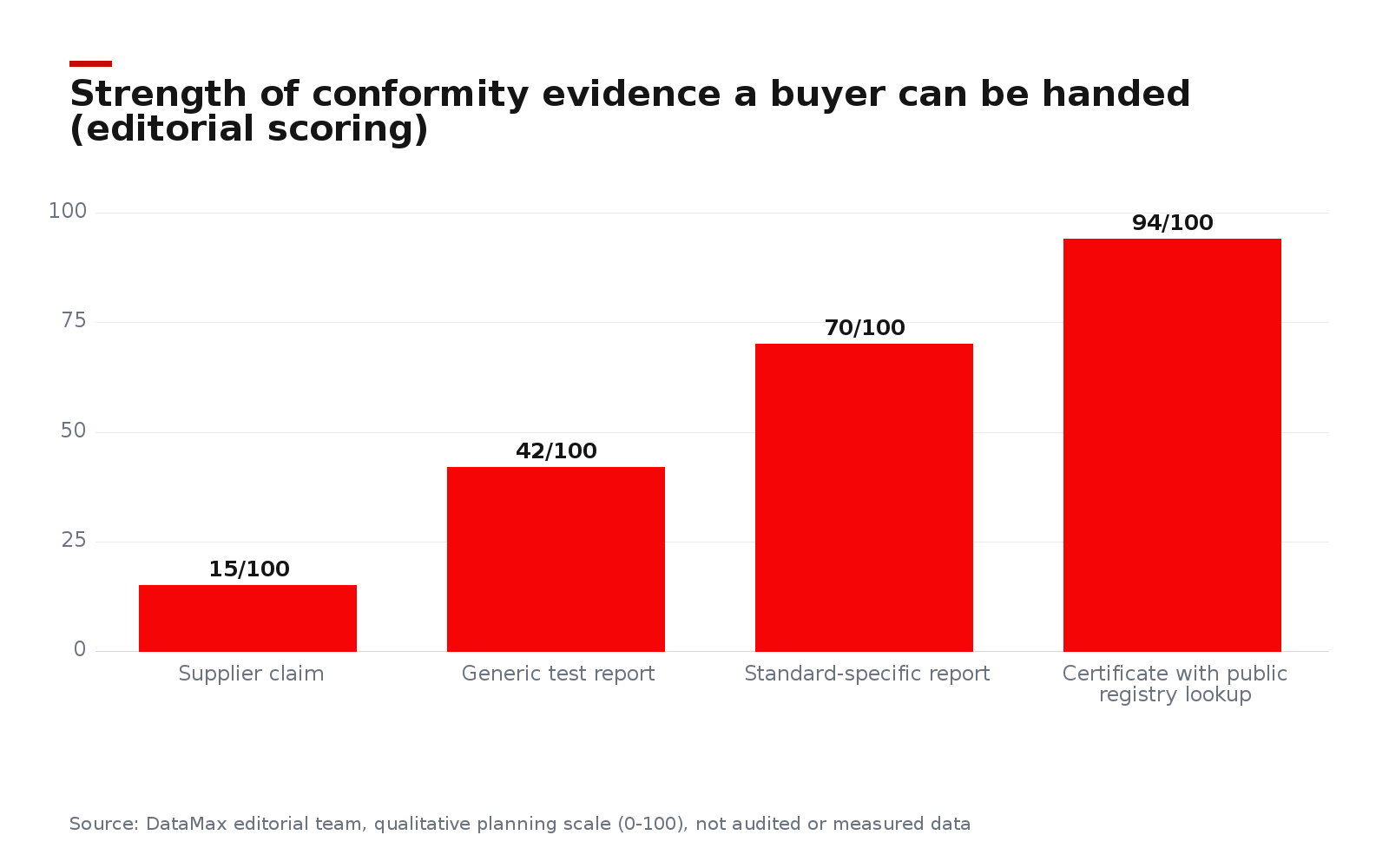
The same figures, in searchable form:
| Evidence option | Editorial score | Source context |
|---|---|---|
| Supplier claim | 15/100 | DataMax editorial team, qualitative planning scale (0-100), not audited or measured data |
| Generic test report | 42/100 | DataMax editorial team, qualitative planning scale (0-100), not audited or measured data |
| Standard-specific report | 70/100 | DataMax editorial team, qualitative planning scale (0-100), not audited or measured data |
| Certificate with public registry lookup | 94/100 | DataMax editorial team, qualitative planning scale (0-100), not audited or measured data |
The scores are editorial planning values, not audited data, pass rates or certification outcomes. A certificate with a public registry lookup receives the highest planning score because the buyer can independently test whether the record exists and whether its named subject matches the programme. A standard-specific report receives a stronger score because its method and scope are explicit. A generic report may still be useful context, but it leaves more identity and configuration gaps. A supplier claim should initiate review, not close it.
Document control should attach to every score. Record the document title, issuer, report number, issue date, tested sample, firmware identifier, applicable standard and access date for any registry lookup. A PDF with a certificate title but no inspectable subject data cannot deliver the traceability value implied by the score.
How the requirement actually works
Certification operates at several layers, and each document answers a different question. A hardware report establishes that a sample met a specified test condition. A standard-specific report links that result to a defined standard, device configuration and date. A certificate may identify an applicant or product, but it must still be checked against the registry, validity status and legal holder where public lookup is available.
For an operator deployment, Widevine L1 is a protected-content DRM level, not a quality label for the whole device. The service request path involves a device identity, device-integrity conditions, a licence request, policy evaluation, response handling and secure key output. Therefore, a buyer should request the implementation and validation evidence for the ordered android tv box configuration, not accept the words “Widevine L1” in isolation.
HDCP 2.2 is also path-specific. For the DM21P, HDCP 2.2 is optional. The contract should identify whether the licensed service requires HDCP 2.2, how the protected output path is implemented, and which display and sink equipment were used during validation. Copy protection, output interfaces and application-level restrictions must be assessed together.
Android compatibility has a separate chain. AOSP Android 11 or AOSP Android 14 identifies the base platform in the supplied facts. Operator middleware, Google services, application binaries, launcher, device provisioning, update mechanisms and certification status can vary around that base. The evidence pack should name the build identifier and list installed components rather than describing the unit only by operating-system version.
Codec support follows a similar pattern. AV1, H.265 and H.264 entries describe decode capability, while a service requirement may also specify profile, level, resolution, frame rate, HDR handling, protected playback and bitrate behaviour. For example, the supplied DM21T decode list reaches 4K@120 for selected codecs, but its stated HDMI output is 2.0b. The supported service profile must therefore be validated at the output boundary.
The architecture behind a sound evidence matrix has five columns. The first defines the requirement, such as protected 4K playback at a named resolution. The second identifies the object under test by model, option code and hardware revision. The third identifies the software state through image, firmware and application versions. The fourth points to the applicable report, certificate or registry record. The fifth states the disposition: accepted, accepted with condition, rejected or pending revalidation.
This structure prevents a subtle but expensive substitution. A supplier may replace a component or update the image while preserving the commercial model number. The operator still sees an android tv box with the same ordering code, yet the evidence package no longer describes the delivered unit. A change-control field should capture every such event, including who approved it, which serial ranges were affected and whether service certification must be repeated.
Certification bodies and service operators can also use different names for the same product class. A report may identify the SoC, hardware revision and image without using the retail model name; a certificate may use a legal-company name rather than the operator’s working SKU. Reconciliation must be performed across all identifiers, with the buyer preserving the evidence that links them. A verbal assurance is not an adequate substitute for that cross-reference.
- Define the service requirement Record codec, resolution, frame rate, HDR, DRM, output protection and operator middleware requirements.
- Freeze the device configuration Identify model, SoC, Android version, memory option, firmware build and accessory or network configuration.
- Match the evidence Link each requirement to a test report, certificate, registry entry or production-control record.
- Approve deviations Record every exception, its owner, resolution date and effect on deployment.
Two routes, one bill of differences
| Dimension | Entry route | Commitment route |
|---|---|---|
| Hardware selection | Use a catalogue-equivalent model as an evaluation sample | Freeze the production SKU, options and firmware before the purchase order |
| DRM scope | Confirm the advertised protected-content implementation | Review SKU-specific Widevine, PlayReady, HDCP, Dolby Vision or DTS evidence and runtime behaviour |
| Certificate control | Receive a copy and identify its issuer, scope and dates | Verify public registry data where available and reconcile the legal holder, model and shipment coverage |
| Production evidence | Request representative line and test records | Define a sampling plan, change notification and audit trail tied to production lots |
| Commercial effect | Supports technical evaluation; does not lock all delivery conditions | Reduces configuration drift, but requires more document control and supplier oversight |
The entry route is appropriate for a pilot, laboratory evaluation or short deployment. The supplier provides the closest matching configuration, available reports and factory evidence. The buyer still owns the final compatibility judgement because applications, networks, displays and protected-service requirements remain deployment variables.
The commitment route is appropriate for an operator rollout, white-label programme or managed AV estate. Here, the purchase order should reference an evidence baseline as carefully as it references RAM and storage. A document schedule can list each certificate, standard-specific report, software build and production-control requirement. Any approved substitute must be assessed for exact scope rather than similarity of title.
The bill of differences also includes effort. The entry route may need one configuration comparison, one document folder and one pilot batch. The commitment route adds revision control, incoming inspection, approved-image checks, serial traceability, change notification and periodic sampling. That extra governance has a cost, but it replaces uncertainty that usually appears later as retesting, blocked deployment or field substitution.
For a 200-unit trial, the entry route can be sufficient if the buyer intends no commercial release and accepts the sample as the reference device. For a multi-site operator programme, the commitment route should begin before the first production order. The trigger is not simply unit volume: regulated content, operator middleware, payment services, custom launchers or managed updates raise the required evidence depth even at a modest unit count.
The AV1 decision illustrates why the routes differ. The certification pack should identify AV1 decode capability for the selected SKU, but the buyer must also establish the service-side requirements and test environment. Netflix reports that 88% of large-screen devices submitted for certification during 2021-2025 supported AV1; the population was submitted devices, not all devices shipped.

The same figures, in searchable form:
| Certification outcome | Share | Source context |
|---|---|---|
| Supported AV1 | 88% | Netflix Technology Blog, Dec 2025; large-screen devices submitted for Netflix certification during 2021-2025 |
| No AV1 support | 12% | Netflix Technology Blog, Dec 2025; submitted-device population, not all devices shipped |
Source: Netflix Technology Blog, AV1 — Now Powering 30% of Netflix Streaming
That evidence informs codec planning, but it does not transfer a service approval from one submitted device to another. The correct conclusion is to validate the exact ordered configuration through the relevant certification process.
Deployment scenarios and the spec each needs
| Situation | Primary requirement | Model direction | Evidence to request |
|---|---|---|---|
| IPTV operator middleware rollout | Stable 4K baseline, operator image and controlled software change | DM21P for the specified AOSP Android 11 operator fit; DM21S for a AOSP Android 14 white-label direction | Middleware version, build identifier, DRM implementation, update procedure and pilot report |
| OTT white-label launch | Application compatibility, identity, payments, account restoration and current Android baseline | DM21S | Application test matrix, Widevine and PlayReady evidence where required, launcher and provisioning configuration |
| Premium cloud-gaming venue | Low-latency service integration, high-bandwidth decode paths and sustained thermal performance | DM21T | Codec and service qualification, output-path validation, thermal aging records and update controls |
| Gaming-oriented room system | 4K@60 decode path, controller and network integration | DM22Q | Android 14 image record, AV1/H.265 test evidence, thermal records and peripheral compatibility list |
| Managed AV integrator | Simple deployment, consistent firmware and supportable replacement procedure | DM21S or DM22Q according to performance and interface needs | Golden-image hash, serial and lot traceability, remote-management scope and rollback procedure |
An IPTV operator should place the software baseline ahead of promotional feature lists. The selected box must run the operator middleware, maintain provisioning state, support the required upgrade path and preserve the certificate scope after updates. DM21P is the supplied fit for an operator middleware set-top box, while its AOSP Android 11 baseline must be reconciled with the operator’s application and device-management requirements.
A white-label OTT programme adds commercial-brand responsibilities: launcher, applications, remote control, store policy, account data, payment integration and support processes. DM21S supplies a 4K android tv box fit for IPTV/OTT white-label use, but the production image—not the model name—must identify those choices. Optional DRAM, Ethernet and protected-content provisions also need explicit ordering.
Cloud gaming and premium UHD deployments require careful separation of decode, output and service qualification. DM21T lists H.266/VVC [email protected] 4K@120, AV1/VP9/H.265 4K@120 and H.264 4K@60, with inline AI-SR. Its HDMI 2.0b output and absence of HDMI input must be accepted as constraints in the system design.
For venue operators, the RFQ should add thermal conditions, physical mounting, network quality, remote-control behaviour and recovery procedures. Certification proves a controlled capability; it does not guarantee uninterrupted service in a congested hotel network or a hot display cabinet.
The photograph below shows the type of engineering bench required for connected-device validation: each box should be tied to a named test configuration, network path, display, software build and result record.

A practical laboratory procedure prevents the bench from becoming another uncontrolled sample. Assign an asset label to the device under test, capture its serial number and hardware revision, install the approved image, record display and network identifiers, and retain the resulting logs. For protected playback, retain both the successful service result and the failure signature. This allows the operator to distinguish a codec limitation, a display-path limitation, a DRM-policy rejection and a network failure.
Site acceptance should then repeat the same method under the real network and display. For example, a hotel can test a DM21P with its production middleware against the live multicast or unicast source, the room display and the guest-network policy. The support matrix is valid only when the laboratory evidence and site evidence point to the same ordered configuration.
What goes wrong after the PO
Field trap
A certificate or catalogue claim is written for a configuration that differs from the shipped SKU. The buyer may approve a sample, then receive a device with another memory option, Android build, firmware, connector set or optional DRM provision. Control the document by model, option code, build identifier and effective production date.
The first common failure is treating evidence as a binary yes/no. “Widevine L1” may be present on the catalogue page, but the evidence file can cover a different device, an earlier firmware, a limited test lab or a legal holder that does not match the programme. The remedy is a traceability matrix rather than a copied certificate folder.
The second failure is confusing decoder capability with service approval. AV1 [email protected] on DM21P, or AV1/H.265 L5.1 4K@60 on DM22Q, establishes the supplied decode capability. It does not establish Netflix approval, an application licence flow, a particular profile policy or a display’s handling of the resulting signal.
Field trap
Protected-output requirements are negotiated after the unit is selected. HDCP 2.2, Dolby Vision, DTS, PlayReady and Widevine can have different scope and test conditions. A quotation that simply lists their names remains incomplete until the buyer maps each requirement to the ordered configuration and evidence.
Quotations also diverge on optional items. DM21P records HDCP 2.2 as optional; DM21S and DM22Q list 1G Ethernet as optional; all four models contain multiple memory alternatives. The contract should identify the selected values, while any production substitution requires review. Do not let “equivalent” mean a changed SoC, Android baseline or protected-content implementation.
Factory evidence can create another blind spot. A generic report from an unrelated model, a test performed on a hand-built engineering sample, or a certificate whose registry entry cannot be matched to the order offers limited procurement assurance. Each document needs an owner, issue date, scope, sample description and revision status.
The commercial cost appears through delayed pilot approval, certification retesting, blocked device approval, distributor claims disputes and field substitution. The operational cost appears when OTA updates alter the approved baseline, a SoC or memory allocation changes, or a factory line uses a different image. These are configuration-control failures, not cosmetic paperwork issues.
A third failure is approval by filename. Folder names such as “DRM”, “certificate” or “final report” communicate no scope. The reviewer must open each document, identify the tested product, record its revision and compare it with the purchase order. A generic report may be retained as supporting context, but it should never occupy the same acceptance field as a standard-specific report whose subject and configuration have been reconciled.
A fourth failure is missing the software side of the change notice. A hardware substitution from one approved memory option to another can alter resource availability without changing the enclosure or model label. Likewise, an OTA update may preserve codec support while altering device-integrity conditions, licence handling or middleware compatibility. The change rule should cover component substitutions, memory allocation, firmware, Android baseline, protected-content modules, launcher, middleware, factory line and test method.
A fifth failure is confusing a zero-defect sample with a repeatable process. A pilot unit can pass every functional test even if the line has no documented AOI coverage, no golden-image check or no lot-level release gate. The buyer should ask how many units were tested, against which standard, from which lots and with what disposition of failures. A record that cannot answer those questions cannot support a scaled rollout.
How to choose, step by step
- Start with the deployment profile Define operator, white-label OTT, cloud-gaming, managed-AV or gaming-room use, including display, network, controller and service assumptions.
- Set the mandatory media contract Specify resolution, frame rate, codec, profile, level, HDR, DRM and protected-output behaviour without relying on shorthand such as “4K certified”.
- Select the platform direction Compare the supplied DM21P, DM21S, DM21T and DM22Q datasheets, then confirm the production datasheet for the exact ordered SKU.
- Freeze software and hardware options Record Android version, memory, Ethernet option, image identifier, middleware, launcher and accessory configuration.
- Build the evidence matrix Map every requirement to a certificate, standard-specific report, registry lookup, test result or factory-control record.
- Approve a pilot and production rule Define pass criteria, sample sizes, permitted changes, notification timing and the conditions for revalidation.
The resulting RFQ should contain copy-ready lines. For example: “Provide the exact certificate and test-report scope for the ordered model and option code; state Android version and image identifier; identify Widevine, PlayReady and HDCP provisions by SKU; include protected-output test conditions; provide SMT, AOI and aging evidence for the production process; define notification for SoC, memory, firmware or certificate changes; permit a video factory audit.”
The model-selection stage should remain evidence-led. If the requirement is a 4K IPTV operator middleware set-top box, DM21P is the stated fit. For a 4K android tv box for IPTV/OTT white-label work, DM21S is the stated fit. DM21T addresses premium UHD/cloud-gaming requirements, and DM22Q addresses gaming-oriented android tv box requirements. Each direction still requires a programme-specific evidence review.
Do not add unsupported requirements to the RFQ, and do not let the supplier fill omissions with assumptions. Where the product facts do not state a capability, request the production datasheet and test evidence rather than inferring it. That discipline prevents a catalogue feature from becoming a contractual promise that the ordered configuration cannot support.
The RFQ should separate mandatory acceptance criteria from requested supporting information. Mandatory criteria include the ordered SoC, Android version, selected memory, required codec path, required DRM provision and any mandated protected-output level. Supporting information includes the test method, factory-control records, document index and audit access. This separation prevents a detailed but noncontractual evidence folder from being mistaken for an acceptance commitment.
Scoring should penalize unresolved configuration drift more heavily than an imperfectly formatted report. A missing registry lookup may be retrievable during review; an undisclosed firmware or component change can invalidate the approved baseline entirely. The supplier response should therefore close every blank field with a dated source, a named document or a clear statement that confirmation remains pending.
Pilot acceptance should use the same build proposed for production, or the RFQ must explain why a different build is acceptable. The test sample, serial number, hardware revision, option code and image identifier should be retained with the results. If the supplier later changes any of these fields, the pilot can be reassessed against the production unit without starting the entire evidence review again.
Questions to put in the supplier review
A factory review should follow the physical and digital production route. The purpose is not to collect generic factory photographs; it is to establish that the reviewed line, software process and test data correspond to the ordered product.
- SMT evidence Review the placement and route records for the ordered board revision, identify inspection points and connect non-conformance records to the relevant lot.
- AOI evidence Check which assemblies are inspected, how results are dispositioned and whether the inspection coverage matches the production configuration.
- Assembly and flash evidence Confirm the process used to load the approved image, how configuration options are selected and how wrong-image loading is prevented.
- Aging and burn-in evidence Review sample selection, environmental conditions, runtime duration, failure codes and the relationship between failed units and serial or lot records.
- Audit trail Trace one recent shipment from component issue through SMT, AOI, assembly, firmware loading, test, packing and release.
Evidence package: ordered model and option code; hardware revision; Android and firmware identifiers; approved certificates and reports; public registry result where applicable; test report index; SMT and AOI summary; aging procedure and results; lot traceability; deviation log; and change-notification procedure.
The supplier review should ask several precise questions. Which document proves the test sample used the same SoC and memory option as the order? Which fields determine whether a certificate applies? Which process prevents an engineering image from entering production? What event triggers revalidation after a firmware or component change? How are failed units quarantined? Can a buyer trace a serial number to its board revision and release record? Are protocol, RF and safety claims supported by standard-specific reports rather than generic summaries?
For DRM and security, request a separate response. The supplier should identify the ordered SKU’s Widevine L1 and PlayReady status, any HDCP 2.2 provision, and the relevant Dolby Vision or DTS arrangement where listed. It should provide the test context without treating one catalogue page as proof for every variant. DataMax’s certification resources and compliance materials can support this review, with certificates and DRM/security provisions confirmed per ordered SKU rather than per catalogue page.
Factory approval should be evidence-led. DataMax invites buyers to request SMT, AOI and aging evidence specific to the programme, or to propose a video factory audit through the manufacturer review. That closes the gap between a model-level specification and the evidence attached to production units.
The review should close with an action log, not an informal assurance. Each item needs an owner, requested evidence, due date and impact on approval. A missing registry result can remain an open action if the production configuration is otherwise fixed. An unknown Android image or an optional DRM provision remains a critical blocker because the buyer cannot determine whether the ordered android tv box implements the required service path.
A release gate should then state what the factory must retain and for how long under the programme’s agreed retention rule. The minimum set is the approved configuration record, material and board revision, firmware identifier, test result, serial or lot link and release decision. This internal evidence set complements the external certification pack: one proves conformity, while the other proves that conforming units were the units shipped.
Further reading
- Guide android tv box for isps
- AV1 Android TV box guide
- AOSP vs Google TV guide
- HDR10+ Android TV box guide
- DTS:X Android TV box guide
- DataMax DM21P specifications and fit
- DataMax DM21S specifications and fit
FAQ
Which certification documents should accompany an Android TV box purchase order?
Attach an ordered-SKU datasheet, software build identifier, relevant certificates, standard-specific test reports, protected-content documentation and production-traceability records. The document schedule should state scope, revision, issue date and whether public registry verification is possible. A catalogue page alone does not establish that a shipped configuration matches the approved evidence.
Is Widevine L1 enough to approve an operator deployment?
No. Widevine L1 addresses a protected-content DRM level, but the deployment can also depend on device integrity, licence-server policy, Android build, operator middleware, applications and output protection. Review the implementation and validation evidence for the ordered SKU. Confirm certificate scope and expiry, then test the actual application and service path.
How should a buyer compare an IPTV box and a gaming-oriented box?
Compare the deployment requirement first. An IPTV programme may prioritise middleware stability, provisioning and lifecycle control. A gaming-oriented box may prioritise 4K@60 decode capability, controller integration, networking and sustained performance. Use the supplied DataMax fit only as a starting point, then freeze the exact configuration and validate it against the service.
Why does the evidence matrix need a production date?
Certificates and reports have defined scopes, while hardware revisions, firmware images and factory processes can change over time. A production date helps the buyer determine which evidence governed a shipment. The supplier should also identify changes that require notification and revalidation, especially changes to SoC, memory option, Android image or protected-content implementation.
Can a generic test report replace a standard-specific report?
A generic report may provide useful context, but it is weaker because it may omit the standard, device configuration, laboratory conditions and result limits. A standard-specific report links results to a defined method and scope. A certificate with a public registry lookup offers another traceability layer, subject to confirming that its subject matches the ordered product.
When should a video factory audit be requested?
Request a video factory audit when production evidence is incomplete, change control is unclear, or the programme has a high field-unit volume. The review should cover SMT, AOI, image loading, aging, test disposition, lot traceability and release records. A walkthrough becomes more useful when it traces a recent shipment rather than showing unrelated production stations.


