The short answer first
A streaming stick matters commercially only when its quoted configuration, production route, and verification evidence remain traceable after the purchase order. For the DataMax D03E, the strongest sourcing case is a factory-type ODM engagement with a fixed bill of materials, defined test gates, and configuration records tied to the delivered units. A sourcing-agent quotation can be faster to obtain, but its weaker traceability leaves more gaps between the requested SKU and the hardware that reaches the field.
The D03E fits a cost-down white-label 4K use case rather than every operator distribution model. Its documented configuration is Allwinner H313, quad Cortex-A53, AOSP Android 10, and 2GB/16GB, with 4GB/32GB optional. Video capability is H.265 4K@60, while Widevine L1 and HDCP 2.2 are optional and Dolby pass-through is listed. Connectivity is Wi-Fi6 2T2R with no RJ45. The mechanical and interface set is HDMI 2.0b output, USB2.0 x1, TF, an IR extender, and Type-C 5V/1.5A, with dimensions of 94x31x12mm.
The practical decision is therefore whether the application can tolerate those boundaries. A D03E procurement should proceed when compact 4K playback, wireless connectivity, and a white-label configuration are acceptable, and when optional DRM features are explicitly ordered rather than assumed. A buyer that needs wired Ethernet, a current cellular option, or a different decode profile should compare another platform instead of trying to close gaps through quotation language.
Evidence quality determines whether that product claim becomes operational reality. Before approval, request the exact memory option, Android release, SoC, decode profile, DRM wording, port list, power requirement, accessories, firmware level, test method, and production-line responsibility. The production specification and compliance context are covered in DataMax D03E for broadcast operations spec check; this article focuses narrowly on the sourcing model, the paper trail, and the procurement decision.
A useful rule is simple: approve a streaming stick by its ordered configuration, not by its model name. A sample proves one assembled unit; an RFQ line, frozen BOM, test record, and serial-linked shipment record prove that the production route can reproduce that unit. That distinction becomes material when a buyer moves from a pilot to multiple markets, changes private-label packaging, or asks a distributor to explain why a field unit differs from the approved sample.
Definitions a buyer cannot outsource
The term streaming stick describes an HDMI-connected compact playback device, not a fixed hardware category with identical obligations. Android device certification, DRM licensing, protected-content path behavior, operator middleware integration, and production evidence are separate workstreams. A supplier can supply hardware without owning the operator account, application integration, storefront certification, or territory-specific regulatory work. Conversely, a factory can assemble and test the unit without automatically proving the end application will pass every content gate.
The architecture should be treated as a chain. Application and middleware consume resources on the stated SoC and RAM/ROM configuration; the display path terminates at HDMI 2.0b; protected content depends on the ordered DRM and HDCP configuration; network behavior depends on Wi-Fi6 2T2R because the D03E has no RJ45; and remote operation depends on the IR extender. Each arrow needs an owner and a verification method. A product name at the start of the chain does not transfer responsibility to the buyer.
DRM wording also needs precision. “Widevine L1” describes a Widevine security level claim, while “HDCP 2.2 optional” describes a protected-output option. Their presence on a quotation must be tied to the selected production configuration and relevant test evidence. Dolby pass-through should be treated as another ordered feature, not inferred from the SoC or from a successful ordinary video playback test. Market-specific obligations remain separate and must be confirmed against the production datasheet and target-market requirements.
The same discipline applies to decode specifications. H.265 4K@60 is the stated D03E capability; it does not create an obligation to support every codec, resolution, color format, or frame rate used in a service catalogue. For an operator, the RFQ should name the mandatory test corpus: codec profile, container, resolution, frame rate, audio format, subtitle handling, and whether the service uses live, linear playback, or stored content. For a venue integrator, the practical test may instead focus on looping, restart behavior, IR input, and recovery after power cycling.
Finally, distinguish a product specification from a manufacturing-control specification. The product specification says what the unit is intended to contain and do. The manufacturing-control specification says how the supplier proves that each delivered unit matches it. Without SMT records, inspection results, aging records, firmware-burning records, and lot traceability, the two can drift even when the initial sample appears correct. The sourcing model affects how readily that evidence can be obtained.
| Term | Procurement meaning | Evidence to request |
|---|---|---|
| Hardware specification | Named SoC, RAM/ROM, OS, decode, interfaces, and dimensions | Approved configuration sheet and sample inspection |
| DRM configuration | Widevine L1 and HDCP 2.2 are optional on the D03E; Dolby pass-through is listed | Order line and configuration-specific verification record |
| Application integration | Middleware, launcher, account, update, and playback behavior | Application build identifier and acceptance-test log |
| Production qualification | Controls preventing build drift between quotation and shipment | Line records, inspection data, and audit trail |
| Target-market compliance | Certification, radio, and content obligations for the destination | Market-specific document list and responsible party |
For a buyer, this separation determines who accepts a failed streaming stick shipment. Hardware failure may belong to manufacturing; playback failure may belong to the application image; entitlement failure may belong to the content service; certification failure may belong to the target-market program. The RFQ should identify each owner before the first sample, otherwise the factory may receive an ambiguous corrective-action request that cannot be closed.
Real DataMax platforms, field by field
The right platform comparison starts with deployment constraints, not nominal product category. A compact HDMI device without RJ45, a cellular dongle, and two set-top boxes with Ethernet solve different installation problems. The table below records only the supplied production facts and links each model to its corresponding product page.
| Model | SoC and OS | RAM/ROM | Video and DRM | Interfaces and dimensions | Intended fit |
|---|---|---|---|---|---|
| D03E | Allwinner H313, quad Cortex-A53; AOSP Android 10 | 2GB / 16GB; 4GB/32GB optional | H.265 4K@60; Widevine L1 / HDCP 2.2 optional; Dolby pass-through | HDMI 2.0b out; USB2.0 x1; TF; IR extender; Type-C 5V/1.5A; no RJ45; Wi-Fi6 2T2R; 94x31x12mm | Cost-down white-label 4K stick |
| DM33H | Allwinner H618, quad Cortex-A53; AOSP Android 14 | 2GB / 16GB; 4GB/32GB optional | H.265 up to 8K@24 source; H.264/VP9/AVS2 4K@30; H.265 Main10 4K@60; no Widevine row on datasheet | HDMI 2.0b out; 2x Type-C, one 5V/2A power and one data; SIM x1, 4G Quectel EG915N and 5G optional; Wi-Fi6 2T2R; no RJ45; 70x70x17mm | Cellular 4G/5G TV dongle for RV, hospitality, and no-Wi-Fi signage |
| DM21P | Amlogic S905Y4, quad Cortex-A35; AOSP Android 11 | 2GB / 8GB; 4GB; 16/32/64GB optional | AV1 [email protected]; VP9/H.265 4K@60; H.264 4K@30; Widevine L1 / PlayReady / HDCP 2.2 optional | HDMI 2.0b out x1; USB2.0 x2; TF; S/PDIF; 3.5mm AV; RJ45 100M; Wi-Fi6 2x2 + BT5.4; DC 5V/2A | 4K IPTV / operator middleware set-top box |
| DM21S | Amlogic S905Y5, quad Cortex-A55; AOSP Android 14 | 2GB / 16GB; 2/4/8GB; 16/32/64GB optional | AV1 / H.265 [email protected] 4K@60; Widevine L1 / PlayReady optional; Dolby Vision/DTS | HDMI 2.0b out; S/PDIF; AV; USB2.0 x2; TF; RJ45 100M with 1G optional; Wi-Fi6 2x2 + BT5.4 | 4K Android TV box for IPTV/OTT white-label |
The editorial audit comparison below ranks how readily each sourcing arrangement can support failure tracing. It is a planning aid, not measured performance or an audited certification result.

The same figures, in searchable form:
| Sourcing route | Editorial score (/100) |
|---|---|
| Sourcing agent | 22 |
| Component distributor | 35 |
| Factory-type OEM | 78 |
| Factory-type ODM | 90 |
The product fit is equally important. A D03E is not a wired IPTV box, so its lack of RJ45 is a deployment boundary rather than a missing accessory. The DM33H introduces cellular choice but has no Widevine row on its datasheet. The DM21P and DM21S provide RJ45 and broader fixed-function paths, while their optional DRM and memory choices still require explicit order lines. No model should be selected merely because it carries a similar HDMI form factor.
The same comparison discipline applies to a streaming stick proposal that combines several CROSS fields. D03E and DM33H are both compact HDMI devices, but their deployment roles differ; DM21P and DM21S are box-format platforms with wired connectivity. A procurement spreadsheet should therefore preserve the model, configuration, and application role in separate columns. Collapsing them into one row creates false equivalence, particularly where the RFQ is later used to request a golden sample or a production evidence pack.
Buyer situations, ranked by what they punish
The highest-consequence situations are those where a seemingly small configuration difference becomes visible across a deployed estate. For a pay-TV or OTT operator, the main risk is a content or account gate: the unit may decode ordinary video but fail the required DRM, middleware, account, or protected-output path. For an AV integrator, the risk is physical integration: the remote-control chain, power source, HDMI connection, and network path may not match the room design. For a distributor, the risk is SKU drift between the sample, the purchase order, and the cartons delivered to customers.
| Situation | What the deployment punishes | Requirement to make decisive | Model direction |
|---|---|---|---|
| Pay-TV/IPTV operator rollout | • Middleware mismatch • DRM or protected-output failure • Unrepeatable firmware | • Certified application path • Explicit DRM order line • Lot-level firmware traceability | • DM21P for wired operator middleware • DM21S for newer Android and white-label OTT |
| Hospitality or RV deployment | • Unreliable Wi-Fi dependence • Power or interface mismatch • No cellular path | • Cellular availability • Exact power requirement • Controlled service recovery | • DM33H where 4G/5G dongle use is required |
| AV integration room | • IR addressing failure • HDMI or power incompatibility • Unstable network hand-off | • IR extender in package • HDMI 2.0b and Type-C 5V/1.5A validation • Wired-network need resolved | • D03E for compact wireless white-label installs • DM21P or DM21S when RJ45 is required |
| Digital-signage player | • Continuous playback variation • Incorrect content decode • Untraceable fleet issue | • Codec corpus • Aging and reboot evidence • Hardware and software serial linkage | • D03E for qualified 4K stick projects • DM21P for fixed wired installations |
| Brand owner private label | • Cosmetic changes without control • Optional feature omission • Inconsistent packaging | • Golden sample • Configuration lock • Packaging and accessory BOM | • D03E for a defined cost-down 4K proposition • DM21S for a fixed-box IPTV/OTT proposition |
The penalties differ by situation. An operator may lose service entitlement or fail a content-security review. An integrator may face truck-roll and installation rework. A distributor may discover configuration inconsistency only after regional stock has been allocated. A brand owner may lose the private-label experience because accessories or packaging differ from the approved sample. These are different consequences, so the RFQ should rank the gates rather than append every certificate in a generic checklist.
A practical procurement example shows why order-level precision matters. A hotel operator can choose the DM33H when cellular is the selected access path, then specify the memory tier, cellular option, power arrangement, and application image together. The D03E remains relevant for a different installation requiring Wi-Fi6 2T2R and an IR extender. Calling both products “4K sticks” would hide the difference in connectivity and make the RFQ impossible to compare.
For another procurement example, an integrator quoting 250 rooms should tie one approved golden unit to the line inspection record and packaging configuration. The next-line fields should include SoC, RAM/ROM, OS, firmware, DRM configuration, IR extender, power rating, HDMI output, network type, and serial-number method. The resulting document supports both installation planning and later failure analysis.
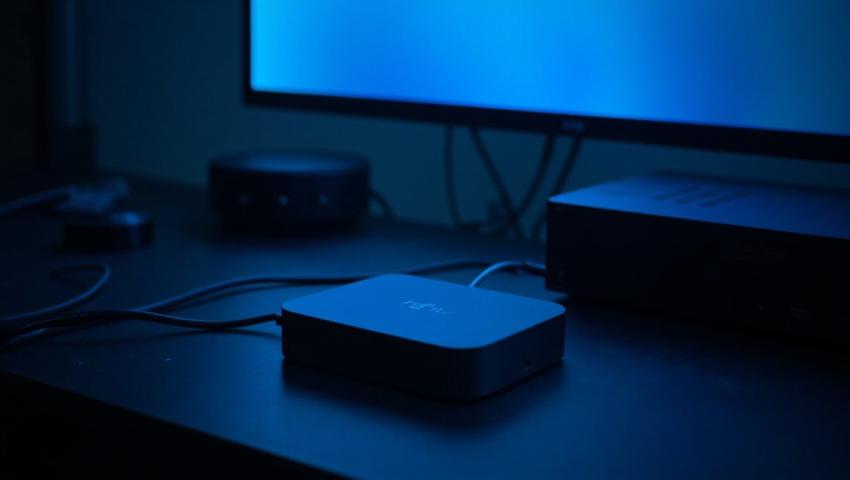
The procurement desk scene that follows illustrates the practical task: reconciling quotations before an SKU reaches an approval meeting.

A final situation-specific distinction is ownership of recovery. A venue operator may own the recovery path through a managed network and remote-management system, while a distributor may need the factory to expose a unit-level test record. For a streaming stick order, the RFQ should state who receives the first field failure, who reproduces it, and who is authorized to approve a firmware correction. Leaving that sequence unassigned creates delays even when the hardware configuration is correct.
How to choose, step by step
A sound selection process turns the application into testable specification lines before comparing supplier routes. Start with the output and content path, then the network, then the physical installation, and only afterward compare commercial supply arrangements. Reversing that sequence encourages a supplier to optimize around a form factor before the deployment constraints are known.
- Define the minimum service path State required codecs, resolution, frame rate, audio, subtitles, DRM, protected-output requirement, account or middleware behavior, and live-versus-stored playback. Convert each item into an acceptance test rather than a marketing word.
- Map physical and network constraints Record HDMI, power, IR, USB, TF, Ethernet, Wi-Fi, and cellular requirements. Identify whether external accessories such as an IR extender are mandatory, optional, or prohibited.
- Select the platform family Use D03E for the qualified cost-down white-label 4K stick use case; use DM33H when the cellular dongle path is essential; use DM21P for a wired operator middleware box; use DM21S for an Android TV IPTV/OTT box.
- Lock the orderable configuration Name RAM/ROM, OS, SoC, optional DRM, decode profile, interfaces, dimensions, accessories, packaging, and target market. “D03E” alone is not an adequate BOM line.
- Assign the sourcing responsibility Decide who controls the firmware, who buys key components, who owns line testing, and who retains manufacturing and configuration records. Compare factory-type ODM, factory-type OEM, component distributor, and sourcing-agent routes on evidence access.
- Approve a golden sample and test protocol Freeze the hardware, software, accessories, packaging, labels, and test corpus. Require the production unit to match the approved sample against documented acceptance criteria.
- Attach the shipment evidence Define the inspection report, aging result, test log, packaging record, serial linkage, and non-conformance process that accompany delivery.
The resulting RFQ should contain lines that can be accepted or rejected. For the D03E, a defensible base line is: “Allwinner H313, quad Cortex-A53, AOSP Android 10, 2GB/16GB, H.265 4K@60, HDMI 2.0b output, USB2.0 x1, TF, IR extender, Type-C 5V/1.5A, Wi-Fi6 2T2R, no RJ45, 94x31x12mm.” An additional line must state whether 4GB/32GB and Widevine L1/HDCP 2.2 are ordered. Dolby pass-through should also be explicitly accepted or excluded.
A second RFQ block should cover the production conditions: “Manufacture against the approved golden sample and frozen BOM; retain SMT, AOI, firmware-burning, aging, functional-test, and packaging records; identify each unit and lot; report deviations before shipment.” That language is more useful than “factory quality certificate,” because it identifies the actual control points and the required record.
The buyer should also split responsibility for software. The hardware supplier can burn an approved image, but the application owner supplies the final build identifier, credentials, middleware, and content-service configuration. If the application changes during production, a new approval gate is needed. Otherwise the hardware remains traceable while the software explanation becomes weaker.
A further step is to write pass and fail criteria for the physical streaming stick sample. Instead of “device works,” require HDMI output at the accepted resolution, IR input through the supplied extender, network association and reconnection, playback from the defined corpus, power-cycle behavior, and access to the approved storage configuration. Each failed condition should identify whether it blocks approval, requires a documented exception, or identifies a different product model.
What goes wrong after the PO
The most expensive failures are configuration gaps that survive sample approval. A sample can pass because it contains the required feature while the production order omits an optional DRM line, uses a different memory tier, or arrives without the IR extender. The purchaser then discovers that the approved sample is not the repeatable product.
Field trap 1
“Optional” is not an order line. A D03E quotation that says “Widevine L1 / HDCP 2.2 optional” without identifying the selected configuration leaves the buyer unable to determine whether the protected-content path was built. Attach an explicit accepted-option field to the purchase order and verify it against the production configuration record.
Connectivity assumptions create the second trap. The D03E has Wi-Fi6 2T2R and no RJ45, so a project that silently substitutes Wi-Fi for the planned operator network may add installation work or create service inconsistency. Likewise, Type-C 5V/1.5A is a stated requirement and should be tied to the actual power source, not inferred from a similar-looking USB-C connector on another unit.
Field trap 2
Do not accept a network line that merely says “wireless.” Record Wi-Fi6 2T2R and the absence of RJ45 for the D03E, require the intended SSID and authentication method in the acceptance plan, and obtain a recovery test after reconnection. A vendor portal can describe a streaming stick, but it cannot remove the installation consequence of an absent Ethernet port.
Other common post-PO failures lack clear ownership. Firmware may be replaced after the sample is approved. The application image may differ between facilities. The IR accessory may be packed while the internal IR path remains untested. Labels may show one SKU while the device tree reports another. The production lot may contain mixed memory configurations because the packing record captures only the carton. Each gap breaks the chain between field failure and production cause.
Software and service failures need separate escalation. A DRM failure may originate in licensing, account entitlement, protected-output configuration, display capability, or the complete media path. A playback failure may originate in the content corpus rather than the decoder. A restart failure may involve power, thermal behavior, storage state, or application logic. The request for corrective action should include the exact image, serial number, test media, network condition, reproduction steps, and logs; “device defective” is not an actionable diagnosis.
Packaging divergence can conceal a working unit but still damage the deployment. A missing IR extender, an incorrect power adapter, a missing remote-control component, or an incorrect HDMI cable affects the customer experience even if the electronics pass. Photograph the approved package, define the packing list, and define the inspection method for both carton and unit labels.
A corrective-action clause should specify quarantine, root-cause analysis, affected-lot identification, and re-inspection. It should also state how the buyer learns about substitutions. Any proposed SoC, OS, memory, decoder, DRM, interface, or dimensional change needs written approval against the production datasheet; a similar product name is not authorization to ship a different product.
Another post-PO defect is the change that appears harmless in a sample but alters fleet behavior. A different power adapter, Wi-Fi module behavior, remote-control accessory, packaging label, or application launcher can create support cases even when the streaming stick still produces a picture. Require a list of controlled substitutions, attach the revised golden-sample comparison, and state the field behavior expected to remain unchanged before approval.
Verification you can ask for on paper
Verification evidence should follow the physical production sequence. SMT records show what was placed and when; AOI records show that placement was inspected; firmware-burning records connect the image to the board; aging exposes early failures under sustained operation; functional testing checks the required behavior; final inspection confirms configuration, accessories, labels, and packaging. Each record should carry a common unit, serial, lot, or board identifier.
- Incoming and board traceability Request the lot or batch references for the SoC, memory, wireless module, and other controlled components. Confirm that the build matches the approved BOM and that substitutions were not made without approval.
- SMT and AOI evidence Ask for the line record, inspection criteria, equipment result, and exception disposition. The document should show the inspected production lot and the corrective action for any detected defect.
- Firmware and configuration record Request the image identifier, flashing record, application build, configuration flags, and unit serial linkage. For the D03E, the record must expose the selected RAM/ROM and DRM configuration instead of relying on catalogue defaults.
- Aging and reboot evidence Define the aging duration, workload, power condition, and restart cycles in the purchase specification. Review the record for interrupted tests, resets, and units removed from the lot.
- Dark-room and functional verification Require tests appropriate to the ordered functions: HDMI output, decode corpus, network association, IR path, power, storage visibility, and protected-content behavior where applicable. The acceptance sheet should identify failed or excluded cases.
- Final audit and shipment release Request packing-list reconciliation, accessory count, label image, carton record, and release signature. Retain a serial-number method that lets the buyer trace a returned unit back to its test result and lot.
Evidence rule: accept records, not impressions. A statement such as “100% tested” is not sufficient without the test scope, sample or population definition, result, date, configuration reference, responsible line, and exception handling. The same rule applies to a streaming stick claim: the evidence must identify which configuration was tested.
An audit request should ask to observe the actual sequence rather than receive a presentation folder. Review component reconciliation at SMT, AOI result disposition, image flashing, aging racks, functional-test fixtures, exception handling, final packing, and traceability between the board, unit, and carton. Record any point where identification is manual and can break the chain.
DataMax can support this review through its factory-quality process. A buyer may request a video factory audit or SMT/AOI/aging evidence for the selected platform. The request should identify the exact SKU, required evidence types, destination market, and inspection stage. A generic factory profile is insufficient for a procurement decision involving DRM options, memory configurations, or custom packaging.
For a D03E project, a targeted evidence pack would include the approved golden-sample record, BOM and option sheet, SMT/AOI report, firmware and configuration log, aging result, functional-test matrix, IR-accessory packing record, and final audit trace. For another CROSS model, use the same control structure but substitute the relevant configuration fields. The method remains the same; the product data must be taken from that model’s production datasheet.
A paper review should also test document reconciliation. Compare the model and memory tier on the purchase order with the configuration log, compare the image identifier with the firmware-burning record, and compare the packing list with the final-audit sheet. If those three records disagree, the streaming stick shipment should remain on hold until the affected lot is identified. A sample photo or supplier declaration cannot substitute for cross-document consistency.
The evidence pack should also define retention access. The buyer needs to know which party holds the original record, how a serial number retrieves the test result, and how an unlinked unit is treated. These controls allow a distributor or operator to escalate one field failure without requiring the entire shipment to be recalled.
Entry tier versus commitment tier
The D03E is an entry-tier hardware proposition within the CROSS comparison, but its sourcing path can still involve a serious commitment. The product facts describe a cost-down white-label 4K stick; they do not provide a general product ranking or a universal performance scale. The commitment tier should therefore be defined by governance depth: how much of the BOM, software, test corpus, evidence, and change control the buyer requires the factory to own.
| Decision area | Entry tier: compact commercial route | Commitment tier: controlled factory route |
|---|---|---|
| Configuration control | Uses the catalogue option as the baseline | Freezes RAM/ROM, OS, DRM, accessories, packaging, and firmware before release |
| Evidence | Receives a sample inspection and basic shipment check | Receives SMT, AOI, burning, aging, functional, packing, and traceability records |
| Change control | Commercial notification for material deviations | Written approval required before any controlled configuration change |
| Failure analysis | Investigates one returned unit or one shipment | Links the returned serial to lot, image, inspection, and packaging records |
| Application ownership | Buyer accepts a greater share of integration and recovery work | Factory and buyer agree on build ownership and escalation interfaces |
| Best-fit product | D03E for the qualified cost-down white-label 4K use case | D03E with frozen BOM and evidence, or DM21P/DM21S where the deployment requires their wired and operator-oriented configurations |
The entry tier is appropriate for controlled trials, lower deployment complexity, or buyers able to absorb configuration and evidence gaps. Its discipline still matters: lock the D03E memory option, state whether optional Widevine L1/HDCP 2.2 is included, and record the package contents. Lower governance cannot excuse an ambiguous purchase order.
The commitment tier becomes appropriate when content licensing, managed distribution, private-label packaging, or fleet-level failure analysis makes configuration drift expensive. Here the factory’s evidence trail is part of the deliverable. The buyer should require a golden sample, explicit BOM, controlled firmware, inspection records, aging evidence, and serial-level traceability before shipment authorization.
The sourcing-route chart is best read in this context. Factory-type ODM receives the highest editorial traceability score because the model is most naturally aligned with coordinated product definition and production control. Factory-type OEM follows because the factory controls production execution, while a component distributor or sourcing agent may sit farther from the complete product decision chain. The scores are qualitative planning guidance, not audited measurements.
For procurement, the final choice is not simply “ODM versus agent.” It is whether the selected route can expose the evidence needed for the product. Ask each route the same seven questions: Who freezes the BOM? Who owns the firmware image? Who controls component substitutions? Who performs SMT and AOI? Who defines aging? Who links serial to test record? Who authorizes shipment? If the answers remain unclear, the commitment tier is not operational yet.
Teams can request a quote through DataMax inquiry. To keep the comparison decision-grade, email [email protected] with the SKU list, target-market certificate list, middleware and DRM checklist, approved golden-sample details, and requested SMT/AOI/aging evidence pack.
A controlled approach does not require every pilot to use the commitment tier. It requires the tier to match the consequence of failure. A small internal demonstration can use the entry route with a recorded configuration and accepted sample. A managed service or multi-site private-label program needs the frozen BOM, serialized evidence, and written change gate. In both cases, the RFQ should identify the streaming stick model, configuration, evidence package, and responsible signatory so that approval cannot rely on an ambiguous model name.
Further reading
- DataMax D03E for Broadcast Operations: Confidence Monitor
- Android TV boxes
- Rockchip Android TV boxes
- Edge computing boxes
- 4K 60fps Android TV box guide
- DataMax D03E specifications and fit
- DataMax DM33H specifications and fit
FAQ
Is the DataMax D03E an operator set-top box?
Not by the documented product positioning. The D03E is a cost-down white-label 4K stick with Wi-Fi6 2T2R and no RJ45. Operators needing a wired middleware set-top-box direction should also evaluate DM21P, while DM21S serves the Android TV IPTV/OTT white-label use case.
Which D03E configuration should be named in the purchase order?
Name the exact RAM/ROM, OS, decode profile, optional DRM choice, interfaces, accessories, and packaging. The base documented memory configuration is 2GB/16GB, with 4GB/32GB optional. Widevine L1 and HDCP 2.2 are also optional, so the purchase order must record whether they are selected.
Can the D03E be deployed without Wi-Fi?
The documented D03E port list has no RJ45 and lists Wi-Fi6 2T2R. A deployment requiring deterministic wired connectivity should therefore choose another platform or validate a separate network architecture. The accepted testing plan should cover association, authentication, reconnection, and recovery from network interruption.
What evidence should accompany a D03E production shipment?
Request the approved golden-sample record, frozen BOM, SMT and AOI results, firmware-burning record, aging evidence, functional-test matrix, final inspection, accessory reconciliation, and serial-to-lot traceability. The evidence must identify the selected D03E configuration so optional DRM and memory differences cannot be hidden.
How much does the sourcing route affect traceability?
It affects how readily the buyer can obtain and follow the production evidence trail. The editorial chart scores factory-type ODM at 90/100 and factory-type OEM at 78/100, compared with 35/100 for a component distributor and 22/100 for a sourcing agent. These are qualitative planning scores, not audited measurements.
Can DataMax support a pre-production audit?
Yes. Buyers can request a video factory audit covering the proposed manufacturing and evidence process. Send the target SKU, BOM options, required certification list, middleware and DRM checklist, and the specific SMT, AOI, aging, and configuration records required for approval.