Before the terminology: the procurement decision
| Question | Primary decision | Best-fit DataMax direction |
|---|---|---|
| What must the device do? | Operator middleware, OTT playback, signage, cellular backhaul, or premium UHD | DM21P, DM21S, DM21T, or DM35R respectively |
| What must be contracted? | DRM, Android release, connectivity, port configuration, and lifecycle documentation | Define the commercial evidence before supplier nomination |
| Where can rework occur? | Software integration, certification, operator acceptance, and field replacement | Require traceability and an agreed evidence package |
| Which variable is hardest to change? | Cellular hardware, firmware branch, DRM configuration, and port topology | Resolve each option before the production revision is frozen |
The decision is not “which Android TV box is best”; it is which platform can pass the operator, integrator, or venue deployment without unpriced software and certification work. An android tv box may be judged on different controls: Widevine and PlayReady for commercial content, H.264 compatibility for operator middleware, fanless cellular operation for signage, or H.266/VVC decoding for a premium UHD program. Each choice creates a different acceptance risk.
DataMax supplies several production SKUs across IPTV, OTT, signage and premium UHD. The DM35R is not a generic substitute for the DM21P, DM21S, or DM21T. Their operating systems, memory configurations, media pipelines, connectivity and DRM positions differ. Buyers should select against the acceptance test and service contract, then ask for an exact SKU configuration.
The lifecycle commitment matters as much as the bill of materials. A quotation that identifies the device but omits firmware ownership, Android release, spares policy or end-of-life notice leaves a variable that later becomes an engineering change. A second example is the option field: “1G opt” is not equivalent to a delivered RJ45 1G interface. The purchase order must state whether the option is included, excluded, or unavailable. For broader architecture context, see the guide to android tv box selection for ISP and operator programs.
Five production SKUs compared
The table below uses the supplied production facts verbatim; optional configurations remain optional and must be confirmed against the production datasheet. DM35R is the fifth model in the comparison because it is the cellular signage direction, not an entry-tier IPTV set-top box. It is included because “box” describes the physical category, while the deployment constraints determine the correct model.
| Model | Fit | SoC and OS | RAM / ROM | Decode | DRM | Ports and connectivity |
|---|---|---|---|---|---|---|
| DM35R | Fanless cellular 4K box / signage player | Rockchip RK3566, quad Cortex-A55; AOSP Android 13 | 4GB / 32GB; 2/4/8GB; 16/32/64GB optional | H.265/H.264/VP9 4K@60 decode; 1080P@60 encode; 8M ISP | none stated | HDMI 2.0b out; USB2.0 x2; TF; SIM x1 (5G/4G LTE); RJ45 100M (1G opt); Wi-Fi6; BT5.2; DC5V/2A |
| DM21P | 4K IPTV / operator middleware set-top box | Amlogic S905Y4, quad Cortex-A35; AOSP Android 11 | 2GB / 8GB; 4GB; 16/32/64GB optional | AV1 [email protected]; VP9/H.265 4K@60; H.264 4K@30 | Widevine L1 / PlayReady / HDCP 2.2 optional | HDMI 2.0b out x1; USB2.0 x2; TF; S/PDIF; 3.5mm AV; RJ45 100M; Wi-Fi6 2x2 + BT5.4; DC 5V/2A |
| DM21S | 4K Android TV box for IPTV/OTT white-label | Amlogic S905Y5, quad Cortex-A55; AOSP Android 14 | 2GB / 16GB; 2/4/8GB; 16/32/64GB optional | AV1 / H.265 [email protected] 4K@60 | Widevine L1 / PlayReady optional; Dolby Vision/DTS | HDMI 2.0b out; S/PDIF; AV; USB2.0 x2; TF; RJ45 100M (1G optional); Wi-Fi6 2x2 + BT5.4 |
| DM21T | Premium UHD / cloud-gaming box | Amlogic S905X5, quad Cortex-A510 (ARMv9); AOSP Android 14 | 4GB / 64GB; family options | H.266/VVC [email protected] 4K@120; AV1/VP9/H.265 4K@120; AVS3 4K@120; H.264 4K@60; inline AI-SR | Widevine L1 / PlayReady optional | HDMI 2.0b out (no HDMI in); USB2.0 x1 + USB3.0 x1; TF; S/PDIF; AV; RJ45 100M (1G opt); Wi-Fi6 + BT5.4 |
Lifecycle visibility should be treated as a procurement variable, not inferred from a model name. The editorial comparison below ranks the completeness of the contract position; it is not a measured DataMax performance claim.
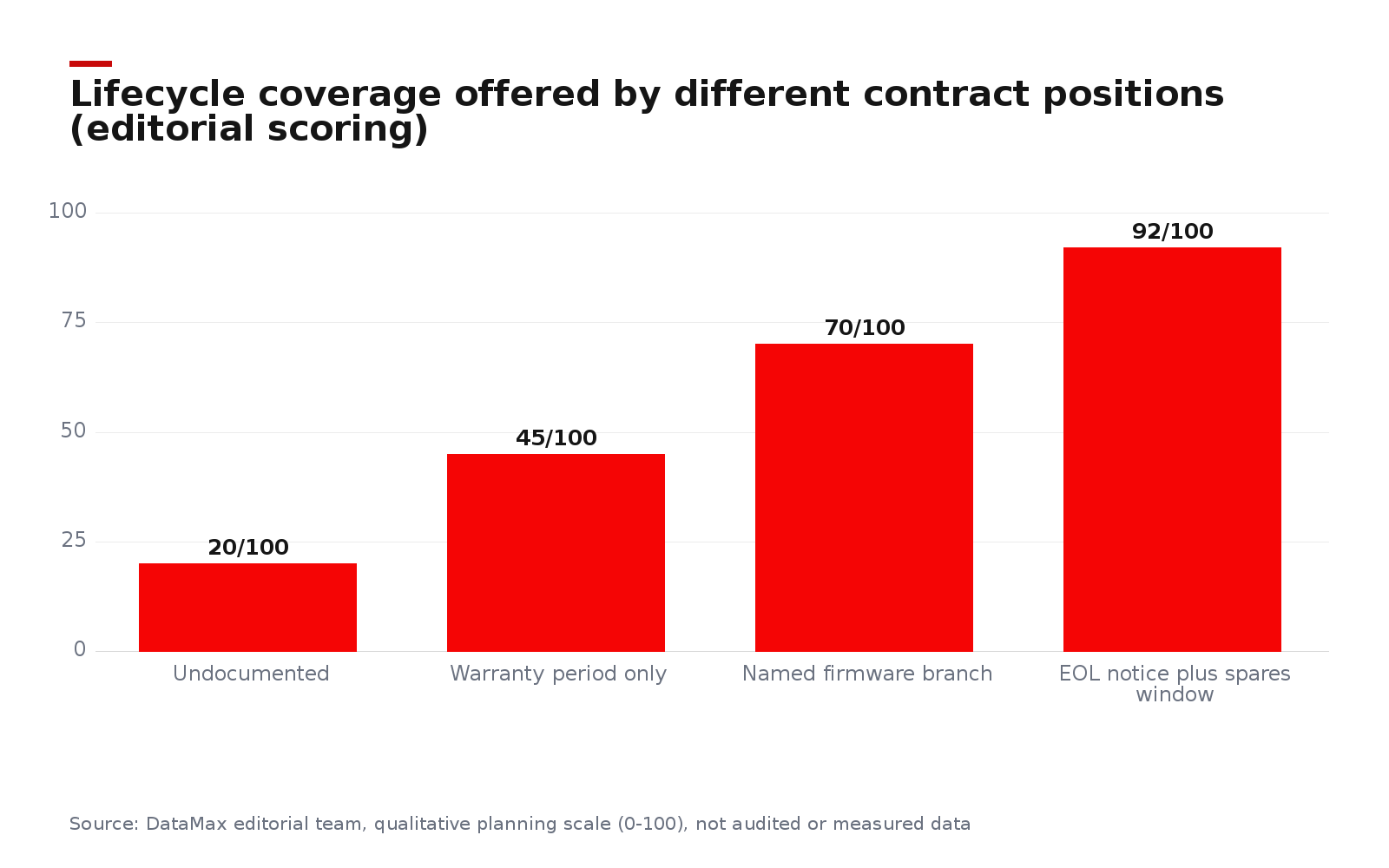
The same figures, in searchable form:
| Contract position | Editorial score |
|---|---|
| Undocumented | 20/100 |
| Warranty period only | 45/100 |
| Named firmware branch | 70/100 |
| EOL notice plus spares window | 92/100 |
Source: DataMax editorial team, qualitative planning scale (0-100), not audited or measured data.
The chart contrasts contract completeness, not device capability. A “Named firmware branch” provides an upgrade anchor; an “EOL notice plus spares window” provides time to migrate installations. Neither statement substitutes for an operator security and device-management policy. For example, an operator that changes middleware after a 4K@60 catalogue launch may need a defined update route, while a signage customer replacing equipment may care more about the spare-part identity and notification period. A buyer should ask which document proves each position and attach that document to the commercial schedule.
Where the terminology comes from
“Android TV box” covers several product classes whose names can obscure different acceptance requirements. A set-top box is normally deployed by an operator, broadcaster or managed-service provider and may require operator middleware, conditional access integration, DRM licence handling, infrared remote control, channel zapping and remote-management functions. An OTT box is sold under a consumer-facing or white-label service, so storefront integration, account sign-in, playback policy and branding may dominate.
A signage player is deployed as an appliance in a venue, retail environment or information system. Its acceptance test may center on scheduled playback, USB or network content ingestion, display compatibility, autonomous recovery and long-duration operation. A cellular 4K box adds SIM provisioning, network coverage, data-control policy and antenna integration to the device bill of materials. An android tv box can therefore belong to several physical categories while failing a very different project gate. A DM35R may boot correctly in a workshop and still fail a venue gate if it cannot recover after a network interruption or if the playback schedule is not retained.
The operating system label also requires precision. AOSP Android 11, 13 or 14 identifies the stated platform generation, but it does not by itself establish a Google TV build, GMS certification, EDLA certification, Widevine conformance, operator middleware approval or production update policy. Likewise, HDMI 2.0b describes an interface version, not the complete output contract: resolution, refresh rate, chroma format, HDR behaviour and HDCP policy need separate confirmation. For a 4K programme, “4K” should be decomposed into the actual delivery file, decode path, output timing and display acceptance criteria rather than left as one word in the RFQ.
DRM names need the same discipline. “Widevine L1 / PlayReady optional” means the feature is an order-level configuration or project decision, not that every delivered unit contains it. “HDCP 2.2 optional” on the DM21P must be reconciled with the commercial stream format and display chain. The production datasheet and quotation must identify the selected configuration, while any device-security and certification requirement remains subject to the programme’s own compliance review. A protected-content acceptance sheet should identify the service, licence level, output path, display requirement and evidence that the delivered configuration has been checked.
Network qualification is another architectural boundary. RJ45 100M, a 1G optional configuration, Wi-Fi6 and a SIM slot describe available interfaces; they do not state throughput, cellular band plan, carrier approval, antenna selection or VPN behaviour. A buyer comparing an android tv box should separate physical connectivity from validated service readiness. That distinction affects commercial wording: “Ethernet fitted” is a build fact, while “carrier-ready cellular service” requires a module, band, SIM, antenna and network acceptance statement.
The comparison buyers actually make
Buyers rarely need an abstract ranking; they need to allocate spend to the variables that can delay deployment. The table below separates platform selection from contract selection. Hardware differentiation is visible in the supplied platform data, while certification, middleware and lifecycle evidence must be added to the RFQ rather than assumed from the SKU.
| Decision area | Entry direction | Commitment direction | Procurement consequence |
|---|---|---|---|
| OS baseline | DM21P: AOSP Android 11 | DM21S or DM21T: AOSP Android 14 | Validate operator middleware, security patch process and application compatibility against the named release |
| Media profile | DM21P: AV1, VP9, H.265 and H.264 paths | DM21T: H.266/VVC main10 and 4K@120 decode paths | Select from the delivery pipeline, not from headline “4K” wording |
| DRM | DM21P or DM21S: optional Widevine L1 / PlayReady | DM21P: HDCP 2.2 optional | Name security level, display/output policy and evidence required in the order |
| Connectivity | RJ45 100M standard on the listed IPTV models | DM35R: SIM x1 (5G/4G LTE); RJ45 100M (1G opt) | Price carrier and antenna qualification separately from hardware |
| USB strategy | DM21P, DM21S and DM35R: USB2.0 x2 | DM21T: USB2.0 x1 + USB3.0 x1 | Check peripheral bandwidth if storage, camera or local media is involved |
| Lifecycle | Model and firmware branch identified | EOL notice plus spares window agreed | Write migration and replacement ownership into the agreement |
| Memory position | DM21P: 2GB / 8GB; DM21S: 2GB / 16GB | DM35R: 4GB / 32GB; DM21T: 4GB / 64GB | Confirm application working set, cache policy and storage endurance against the deployment |
| Evidence | Product description only | Order-specific factory, certification and lifecycle evidence | Reject substitutions between the quotation, golden sample and production revision |
The economically important comparison is between a low-commitment hardware order and a deployment-ready programme. Choosing an android tv box only by SoC or RAM can leave middleware ports, licensing, operator certification, remote-management integration, spare stock and end-of-life handling outside the quoted scope. Those costs surface later as integration engineering, certification delays and duplicate SKUs.
A defensible entry tier defines the hardware and asks the software team to price every external dependency. A commitment tier bundles specific media, DRM, connectivity and lifecycle obligations into the acceptance schedule. The difference is not necessarily a larger device; it is a clearer allocation of responsibility. For example, a DM21P entry quotation might identify AOSP Android 11, 2GB / 8GB and the standard port set, while leaving the DRM option open. A production commitment must identify which optional DRM configuration, Ethernet speed and memory variant apply.
Operators typically weight DRM, middleware, remote management and device continuity. Integrators serving hospitality and commercial AV often weight display outputs, AV interfaces, mounting and stable configuration. Gaming-oriented programmes may weight input latency, media decode and storage bandwidth, although no latency measurement is supplied here. Venue signage operators may weight cellular resilience, unattended recovery and service access.
For external comparison criteria, use the certifications reference and require the supplier to state which certificates apply to the exact order. Do not convert a platform capability into a certification claim without documentary evidence. A useful quotation schedule can use “included,” “excluded,” “optional,” and “pending confirmation” as four mutually exclusive states, with the corresponding evidence attached for each included item.
Buyer situations, ranked by what they punish
The fastest way to narrow the field is to identify the failure that a buyer refuses to absorb. A missed middleware release blocks the operator launch; an uncertified DRM path blocks commercial content; an unverified cellular link causes field outages; and an ambiguous lifecycle statement creates a second sourcing event after installation. These penalties are not equivalent in every programme, so the matrix ranks them by what each situation punishes most.
| Situation | What it punishes | Controlling requirement | Model direction |
|---|---|---|---|
| IPTV or operator middleware rollout | Middleware incompatibility and unlicensed-content failure | Exact OS release, H.264 path, optional DRM selection, operator acceptance | Start with DM21P; move to DM21S when the programme requires AOSP Android 14 |
| OTT white-label service | Account, storefront and playback integration drift | AOSP Android 14 baseline, application compatibility, optional Widevine L1 / PlayReady | DM21S |
| Premium UHD or cloud-gaming deployment | Unsupported decode path or inadequate media throughput | Named 4K@120 codec requirements, USB bandwidth, display integration | DM21T |
| Cellular venue or signage deployment | Carrier, SIM, antenna and unattended-recovery gaps | SIM x1 (5G/4G LTE), fanless fit, scheduled playback, remote recovery | DM35R |
| Fibre or managed-IP installation | Ethernet interface assumptions and remote-management gaps | RJ45 100M or the specified 1G optional configuration, VPN and provisioning design | DM21P, DM21S or DM21T according to media and OS needs |
| Retail or hospitality AV installation | Output mismatch and avoidable integration work | HDMI output, AV path, mounted form, application and update behaviour | DM21S or DM21T after display and media validation |
| Fleet refresh with no managed-IP service | Dependency on a network that is not available | SIM provisioning, carrier coverage, antenna responsibility and recovery policy | DM35R, subject to cellular acceptance |
An operator programme can punish a missing H.264@30 path even when its consumer catalogue emphasizes AV1. The DM21P supplies H.264 4K@30 and is therefore the more direct starting point for an operator middleware box; that does not itself prove middleware certification. The DM21S offers AOSP Android 14 and a broader white-label posture, but its listed decode profile should be checked against the service catalogue. If the operator requires a legacy H.264 stream, the RFQ should name that stream and require a decode test with the actual delivery asset.
A signage deployment often fails outside the media pipeline. The DM35R combines AOSP Android 13, a fanless cellular fit, SIM x1 (5G/4G LTE), H.265/H.264/VP9 4K@60 decode and 1080P@60 encode. Its DRM is “none stated,” so it should not be selected for a programme that assumes protected commercial streaming without a separately verified solution. A venue rollout should also define recovery behavior after a power cycle, the source of the playback schedule, and who controls the SIM and data subscription.
The visual ranking below is editorial, not measured performance. It reflects how sharply the listed situations punish each platform choice.

Failure modes that reach the field
The first field trap is configuration ambiguity. A model can be quoted without its memory variant, Ethernet speed, DRM option, cellular module, Android release or firmware branch. The resulting unit may pass a visual inspection yet fail a burn-in list or operator application build. A quotation line must identify the exact production configuration; optional does not mean included. A practical control is to place the approved golden-sample label, quotation revision and purchase-order configuration on the same release checklist.
Field trap
Do not infer Widevine L1, PlayReady, HDCP 2.2 or Dolby Vision/DTS from the model name. On the DM21P and DM21S they are optional in the supplied facts; on DM35R, DRM is “none stated.” Record the selected licence level, output policy and supporting evidence in the purchase order.
The second trap is confusing decode capability with delivered output. The DM21T lists H.266/VVC [email protected] 4K@120, AV1/VP9/H.265 4K@120, AVS3 4K@120 and H.264 4K@60 decode, while its port list states HDMI 2.0b out and no HDMI input. The procurement file must therefore separate codec support from display timing, source capture, input latency and mode availability. “8K” is not used here because the supplied facts cap output/decode at 4K.
Connectivity ambiguity causes a different failure. The DM35R’s “SIM x1 (5G/4G LTE)” does not identify a module, band plan, antenna system, carrier approval or data-management policy. The 100M Ethernet baseline and optional 1G variants across the range likewise need an explicit order line. A deployment that depends on carrier failover must include radio qualification, SIM provisioning, signal survey and recovery policy in the acceptance plan.
Storage and update failures begin with the wrong reference image. A production android tv box may be described generically while the operator requires a signed image, an update server, partition layout, regional settings and remote-management parameters. A model-level specification cannot prove that those artefacts are ready. Ask for image provenance, update mechanism, rollback procedure and responsibility for version drift.
Finally, lifecycle quotations often diverge. One supplier may include a named firmware branch, another only a warranty period, and another an EOL notice plus a spares window. These are materially different commercial positions, as the lifecycle comparison shows. Define the required notification period, last-time-buy route, spare-part identity, security-patch responsibility and field-migration plan in the agreement rather than in an email side note.
Other failure modes sit in the test method. A short boot test proves less than an extended playback test; a successful 100M Ethernet attachment does not prove the intended managed-IP service; and an installed SIM does not prove coverage inside a venue. Write test assets, duration, network conditions and pass criteria into the purchase order so that a laboratory result can be compared with the deployment outcome.
The selection sequence that removes rework
A controlled selection sequence prevents the buyer from treating software, certification and logistics as post-order add-ons. Start with the service and acceptance evidence, map those requirements to an exact platform, and only then ask DataMax to quote the production configuration. The sequence below is suitable for an RFQ covering an android tv box programme.
- Freeze the deployment outcome Record the venue or subscriber scale, content source, display mode, network path, management model and who accepts the unit. Define whether the device is an operator set-top box, OTT terminal, signage player or premium UHD platform.
- Write the acceptance profile Name required codecs, output resolution and refresh rate, H.264 fallback, DRM level, HDCP policy, Ethernet speed, Wi-Fi and cellular requirements, USB topology, remote-control needs and application compatibility. Attach the operator security or device-management requirement.
- Map profile to model Use DM21P for 4K IPTV/operator middleware, DM21S for IPTV/OTT white-label on AOSP Android 14, DM21T for premium UHD/cloud-gaming decode requirements, and DM35R for fanless cellular 4K signage. Treat the direction as a starting point, not a substitute for validation.
- Resolve every optional item State the selected RAM/ROM, 1G Ethernet where required, Widevine L1, PlayReady, HDCP 2.2, Dolby Vision/DTS and other project options. Require the production datasheet and quotation to agree on each line.
- Attach the evidence package Request configuration records, certification evidence relevant to the order, firmware and update documentation, factory test records, packaging definition and serial/lot traceability. Assign a named approver for each document.
- Contract the lifecycle Define the named firmware branch, update responsibility, EOL notice, spares window, last-time-buy treatment, security-patch process and the remedy for an interrupted programme.
- Run the pre-production gate Apply the written acceptance profile to engineering samples and then production units. Record deviations as configuration changes; do not silently substitute components or software branches.
The resulting RFQ can be pasted into a supplier form:
Quote an exact production android tv box SKU against the attached acceptance profile. State model, SoC, AOSP release, RAM/ROM, selected codec outputs, DRM/security level, display and USB topology, Ethernet speed, Wi-Fi/Bluetooth, cellular module and antenna responsibilities, power input, firmware branch, update mechanism, certification evidence, factory test scope, serial traceability, EOL notice and spares window. Mark every unavailable or excluded item explicitly.
For a first RFQ, send the deployment outcome, content profile, target quantity schedule, delivery region, certification attachments and required response date. The engineering inquiry channel is the appropriate route when the acceptance profile is not yet stable; sample-order contact is appropriate when a written configuration must be inspected before programme nomination. The first message should contain the selected model direction, exact OS release, required memory, codec and DRM obligations, network and port requirements, and the documents the supplier must return. That structure turns the initial quote into a traceable baseline rather than a catalogue response.
A second stage should compare the quotation with the approved sample and the production datasheet. Every difference needs an owner and disposition. If the sample uses 4GB / 32GB but the purchase order says 2GB / 16GB, the discrepancy is a commercial and test issue, not a clerical difference. If the operator adds a DRM requirement after nomination, the change should trigger a compatibility review and revised evidence package.
How the factory controls the variable
Factory control begins with a frozen build specification. The BOM, SoC selection, memory configuration, module versions and firmware branch should be identified under one production revision. A change to any of these elements needs an impact review because the factory test plan, certification evidence and customer acceptance profile may depend on them. The procurement file should preserve the approved revision rather than reference a generic catalogue page.
The production path then moves through assembly inspection, software loading and verification. Surface-mount assembly is inspected with AOI, followed by checks for missing or misplaced components. Board bring-up verifies power rails, interfaces and boot behaviour. The factory should retain machine results against the board or serial identifier so that a field issue can be traced to a process step rather than treated as an isolated device complaint. For the DM35R, that traceability should also connect the SIM path, power input and specified network interfaces to the tested record.
Media and connectivity testing must use the acceptance profile for the ordered model. An android tv box can boot while its decode path, DRM configuration, Ethernet interface or cellular module fails later. Validation evidence should distinguish functional tests, extended playback, network attachment and burn-in. The DM35R’s 1080P@60 encode capability, for example, should not be confused with 4K encode support; only the stated function belongs in the test plan.
Aging and dark-room procedures provide separate controls. Aging exposes units to sustained operation so that thermal, power and component-stress defects can surface before shipment. Dark-room or controlled-environment testing checks display-related behaviour and visible image quality where the programme requires it. Neither procedure replaces functional certification, but both can expose faults before packaging.
DataMax factory capability should be requested as an evidence set: production revision, AOI records, test coverage, burn-in conditions, dark-room procedure, final inspection criteria and serial/lot traceability. Review the factory quality controls and compliance material, then require the actual order-specific records rather than assuming a general capability applies to every shipment.
The commercial close should mirror the technical sequence: approved samples become the golden configuration; the production order references that revision; deviation requires written approval; and the acceptance report becomes part of the release file. For complex operator or custom requirements, assess whether custom development is necessary and define its interface with standard product support. This prevents the android tv box quotation from becoming a collection of assumptions that the factory cannot preserve at volume.
A release file should permit an auditor to answer four questions without a verbal explanation: which revision was built, which test procedure ran, which unit passed, and which shipment contained it. A model-level “4K” label cannot answer those questions. The record should identify the relevant operating system, memory configuration, decode profile, selected DRM state, port topology and firmware branch. Any failed or reworked unit should remain linked to its original result and disposition, preventing a repaired unit from appearing as an untouched production record.
Further reading
- Guide android tv box for isps
- Procurement glossary
- Amlogic Android TV boxes
- Google TV devices
- AV1 Android TV box guide
- DataMax DM35R specifications and fit
- DataMax DM21P specifications and fit
FAQ
Is the DataMax DM35R an operator set-top box?
The DM35R is positioned as a fanless cellular 4K box and signage player, not an IPTV operator terminal. It has AOSP Android 13, a Rockchip RK3566 with quad Cortex-A55, SIM x1 for 5G/4G LTE, and H.265/H.264/VP9 4K@60 decode. For operator middleware with optional Widevine L1, PlayReady and HDCP 2.2, start with the DM21P.
Which model uses AOSP Android 14?
Both the DM21S and DM21T use AOSP Android 14. The DM21S is aimed at IPTV/OTT white-label deployments and lists AV1 / H.265 [email protected] 4K@60 decode. The DM21T targets premium UHD/cloud-gaming use and lists H.266/VVC [email protected] 4K@120 plus other 4K@120 decode paths.
Does every DataMax Android TV box include Widevine L1?
No. Widevine L1 is optional on the DM21P, DM21S and DM21T, while the DM35R facts state no DRM. A procurement specification must identify the selected DRM configuration and the evidence required for the exact order. Do not infer a security level from the model name or a general catalogue statement.
Which model supports a cellular 5G/4G LTE connection?
The supplied DM35R configuration includes SIM x1 (5G/4G LTE), RJ45 100M with 1G optional, Wi-Fi6 and BT5.2. Its cellular module, supported bands, carrier approval and antenna arrangement are not stated in the supplied facts. Confirm those items against the production datasheet and acceptance profile before nomination.
What should be included in a DM35R RFQ?
Include the exact RAM/ROM configuration, AOSP Android 13 firmware branch, decode and encode scope, HDMI and USB topology, selected Ethernet speed, cellular module and band plan, SIM provisioning, antenna responsibility, power input, test evidence, certification scope, traceability, EOL notice and spares window. Send the deployment outcome and acceptance profile through the inquiry channel.
Is the DM21T an 8K platform?
The supplied facts support up to 4K@120 decode for its listed codecs and HDMI 2.0b output. They do not support an 8K claim. For any UHD programme, specify the required resolution, refresh rate, chroma mode, HDR policy, input path and display timing, then validate them on the production configuration.
How should a buyer compare the DM21P with the DM21S?
Compare the acceptance profile rather than only the SoC. DM21P uses AOSP Android 11 and lists H.264 4K@30, AV1 [email protected], VP9/H.265 4K@60, optional Widevine L1 / PlayReady and optional HDCP 2.2. DM21S uses AOSP Android 14 and lists AV1 / H.265 [email protected] 4K@60, optional Widevine L1 / PlayReady and Dolby Vision/DTS. Middleware, content and certification evidence remain separate selection gates.
Does a 4K label guarantee a 4K display mode?
No. The supplied decode and HDMI 2.0b statements do not define every resolution, refresh rate, chroma format or HDR policy. The RFQ should name the required output mode and validate it using the production configuration, content asset and target display chain. This is particularly important where the purchase order combines optional DRAM, 4K video and an external display.