What the answer hinges on
Before accepting an android tv box programme, sign-off should depend on five controlled items: the frozen requirement sheet, the approved golden sample, measurable incoming-inspection results, traceable production evidence, and a controlled change process. Each must answer a different question. The requirement sheet defines what was ordered; the golden sample defines the approved implementation; inspection confirms that a delivery resembles that sample; production records show that the sample was reproduced; and change control prevents an undocumented substitution from entering the chain.
For the DataMax DM35R, the practical acceptance authority is not a photograph or a catalogue. It is the combination of the written specification, the labelled master sample, inspection records, and revision history. Any discrepancy remains open until DataMax supplies evidence and both parties agree on the governing revision. The DM35R’s production description—Rockchip RK3566, quad Cortex-A55, AOSP Android 13, and 4GB/32GB—must therefore be checked against the actual unit rather than inferred from a family name.
The central rule is simple: acceptance is an evidence decision, not a subjective inspection. For broader platform selection, see the canonical guide to android tv box use for IPTV programmes. This page narrows that topic to incoming acceptance and golden-sample control.
A quotation, an evaluation unit and an approved golden sample perform different functions. The quotation states commercial terms; the evaluation unit supports feasibility testing; the golden sample becomes the adjudicated reference for production. Before approval, require a named unit, hardware revision, operating-system build, firmware build, application build, selected connectivity, labelling, accessories and test results. Do not allow a generic model family to stand in for that configuration.
The sign-off sequence should therefore run in this order: freeze requirements, approve one labelled master and one customer-retained reference, define the inspection plan, produce a pilot lot, and release only after exceptions are closed. Each step produces evidence for the next step. A bootable sample without a revision record cannot support a repeatable acceptance decision, while a passing pilot without traceable production evidence cannot support volume release.
Send the first RFQ message with the target model, frozen hardware and software revision, intended monthly deployment, required inspection evidence, and the requested sample quantity. DataMax can review those fields against the sample request process before commercial approval.
Entry tier versus commitment tier
Entry-tier acceptance asks whether a unit works and broadly matches the quotation. Commitment-tier acceptance asks whether it is repeatable enough to support a volume deployment. The difference is not rhetorical: it changes the sampling method, evidence set, laboratory conditions, and disposition of failures. A passing sample inspection without production traceability may be adequate for evaluation, but it cannot establish that a subsequent lot is equivalent.
| Control point | Entry tier | Commitment tier | Decision consequence |
|---|---|---|---|
| Requirement baseline | Quoted features and visual comparison | Frozen specification with revision identifiers | Defines what constitutes a conforming unit |
| Reference unit | Evaluation sample | Labelled and approved golden sample | Creates the comparison authority |
| Incoming inspection | Basic power, boot, interface and output checks | Structured AQL sampling plus critical-item testing | Controls lot acceptance or rejection |
| Production evidence | Model identification | SMT, AOI, aging, dark-room and audit records | Connects the sample to serial production |
| Change control | Informal notification | Written approval before material or software changes | Prevents silent configuration drift |
| Exception control | Repair and retest at operator discretion | Named disposition, owner and closure evidence | Prevents unresolved deviations entering stock |
| Release decision | Unit can be used for evaluation | Lot passes agreed plan and evidence chain | Separates demonstration from deployment |
The editorial scoring below ranks the strength of a defined stage, not measured defect performance. The figures are planning aids for buyers choosing how much evidence to demand before committing to scale.
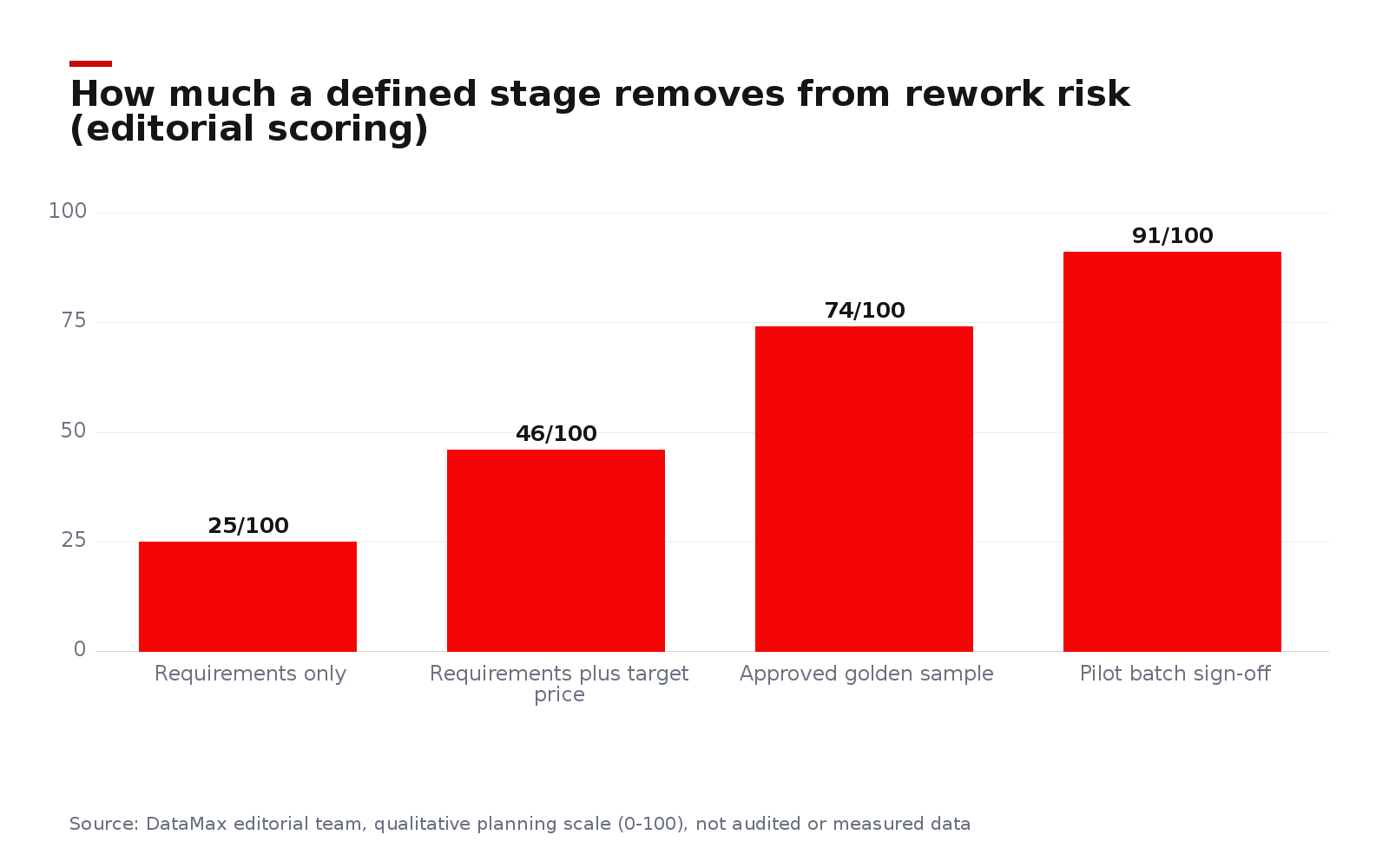
The same figures, in searchable form:
| Stage | Editorial score | Source context |
|---|---|---|
| Requirements only | 25/100 | DataMax editorial team, qualitative planning scale (0-100), not audited or measured data |
| Requirements plus target price | 46/100 | DataMax editorial team, qualitative planning scale (0-100), not audited or measured data |
| Approved golden sample | 74/100 | DataMax editorial team, qualitative planning scale (0-100), not audited or measured data |
| Pilot batch sign-off | 91/100 | DataMax editorial team, qualitative planning scale (0-100), not audited or measured data |
The practical sequence is therefore requirements, commercial alignment, approved golden sample, then pilot batch sign-off. Skipping from a quotation directly to volume acceptance collapses two separate risks: choosing the wrong implementation and failing to reproduce it consistently.
A practical example shows why the tiers differ. During vendor evaluation, an operator may boot a DM35R, confirm HDMI output and connect it to a laboratory network. That establishes feasibility, but it does not verify that a delivery contains the same 4GB/32GB configuration, cellular option, labelling and software build. Before commitment, the buyer should require a pilot lot, structured sampling, critical-item testing and records that connect each accepted lot to the factory process.
The tier should also be written into the purchase record. Avoid vague language such as “sample approved” or “supplier quality accepted”. State the tier, the exact revision, the lot scope, the evidence schedule and who may authorize an exception. This prevents an evaluation success from being reused later as though it were volume authorization.
The mechanism behind the spec
A golden sample works through configuration control. It is a physically identifiable reference whose hardware revision, firmware build, application build, accessories, labelling and packaging are recorded. During incoming acceptance, inspectors compare each sampled unit against that reference and the frozen requirement sheet. A photograph is not enough because it cannot prove software identity, boot behaviour, port population or accessory equivalence.
The requirement baseline should distinguish commercial configuration from product-family capability. For the DM35R, the supplied facts list Rockchip RK3566 with quad Cortex-A55, AOSP Android 13, and 4GB/32GB as the described configuration; optional RAM/ROM ranges include 2GB/4GB/8GB and 16GB/32GB/64GB. The selected production configuration must be stated explicitly rather than covered by a catalogue-level family statement.
Inspection then applies three forms of equivalence: identity, functional and documentary. Identity requires the correct model, processor, memory configuration, operating-system build, connectivity options and labelled ports. Functional checks cover boot, user interface, display output, storage, network, remote-control functions, applicable cell connection, and customer middleware. Documentary checks connect the sample to SMT, AOI, aging, dark-room and audit records.
For android tv box products requiring protected content, the DRM position must be explicit. The DM35R product facts state that DRM is not specified; Widevine or PlayReady capability must therefore be confirmed against the production datasheet and demonstrated on the golden sample rather than inferred. The same discipline applies to regulatory targets: request the certification package relevant to the destination market instead of accepting a family-level claim.
Configuration control also governs substitutions that are not visible in a photograph. Component landing changes, memory revision, radio module, enclosure artwork, power supply, remote-control variant and firmware image can all leave the outside appearance unchanged. Each element needs a status in the specification: mandatory, selected option, prohibited substitution, or pending confirmation. A pending item cannot be silently treated as approved when a pilot lot begins.
The sample record should also state what the golden sample does not prove. It does not replace network certification, electrical safety, regulatory testing, content-security validation, or a defined sampling plan. It establishes the implementation against which those activities are assessed. For example, the DM35R’s listed SIM x1 and RJ45 100M with 1G optional make cellular population and Ethernet speed explicit inspection fields; the golden sample shows which option was selected.
- Governing baseline Approved requirement and revision index
- Identity layer Model, hardware, memory, OS, connectivity and label
- Behaviour layer Boot, output, network, middleware and recovery
- Evidence layer Inspection, exception and production records
- Freeze the specification Assign a revision to the model, hardware options, operating system, middleware, performance profile, labelling, accessories and regulatory scope.
- Approve the golden sample Record unit identity, firmware and application identifiers, approved appearance, port layout, boot sequence and test results.
- Define inspection instructions Map critical, major and minor characteristics, define the sampling plan, environmental conditions and failure disposition.
- Link units to evidence Preserve serial or lot references connecting incoming samples to production, test and exception records.
Which DataMax models actually sit here
Model fit changes the inspection emphasis. An IPTV box, signage player, white-label TV device and cloud-gaming box share acceptance mechanics, but their failure consequences differ. The following table contains only the supplied product facts; absent capabilities remain unstated rather than inferred.
| Model | Processor and OS | Memory | Decode and DRM | Interfaces |
|---|---|---|---|---|
| DM35R | Rockchip RK3566, quad Cortex-A55; AOSP Android 13 | 4GB/32GB; 2/4/8GB and 16/32/64GB optional | H.265/H.264/VP9 4K@60 decode, 1080P@60 encode, 8M ISP; DRM not stated | HDMI 2.0b out; USB2.0 x2; TF; SIM x1 (5G/4G LTE); RJ45 100M, 1G opt; Wi-Fi6; BT5.2; DC5V/2A |
| DM21P | Amlogic S905Y4, quad Cortex-A35; AOSP Android 11 | 2GB/8GB; 4GB; 16/32/64GB optional | AV1 [email protected]; VP9/H.265 4K@60; H.264 4K@30; Widevine L1 / PlayReady / HDCP 2.2 optional | HDMI 2.0b out x1; USB2.0 x2; TF; S/PDIF; 3.5mm AV; RJ45 100M; Wi-Fi6 2x2 + BT5.2; DC 5V/2A |
| DM21S | Amlogic S905Y5, quad Cortex-A55; AOSP Android 14 | 2GB/16GB; 2/4/8GB and 16/32/64GB optional | AV1/H.265 [email protected] 4K@60; Widevine L1 / PlayReady optional; Dolby Vision/DTS | HDMI 2.0b out; S/PDIF; AV; USB2.0 x2; TF; RJ45 100M, 1G optional; Wi-Fi6 2x2 + BT5.4 |
| DM21T | Amlogic S905X5, quad Cortex-A510 (ARMv9); AOSP Android 14 | 4GB/64GB; family options | H.266/VVC [email protected] 4K@120; AV1/VP9/H.265 4K@120; AVS3 4K@120; H.264 4K@60; inline AI-SR; Widevine L1 / PlayReady optional | HDMI 2.0b out, no HDMI in; USB2.0 x1 + USB3.0 x1; TF; S/PDIF; AV; RJ45 100M, 1G opt; Wi-Fi6 + BT5.4 |
The DM35R is the fanless cellular 4K box/signage-player fit. Its SIM x1 option and 100M Ethernet with 1G optional make network-path and cellular-configuration checks relevant. By contrast, the DM21P is positioned for IPTV/operator middleware, the DM21S for IPTV/OTT white-label use, and the DM21T for premium UHD/cloud-gaming use. Each fit changes which acceptance test receives priority, but none changes the need for a controlled reference.
For an android tv box procurement, the product table should also state which features are contractual, optional or unconfirmed. The DM35R’s DRM is not stated; the DM21P’s Widevine L1, PlayReady and HDCP 2.2 are optional; the DM21S and DM21T list Widevine L1 and PlayReady as optional. “Optional” must not appear in an acceptance instruction without defining the selected option.
The model comparison also defines which checks cannot be transferred from one candidate to another. The DM21P and DM21S use different processors and operating-system branches, so their boot images and firmware baselines cannot be substituted for DM35R acceptance. The DM21T lists USB3.0, while the DM35R lists USB2.0 x2; an accessory or cable assumption based on one model must not be applied to another. The golden sample must identify the exact candidate under review.
Do not broaden a supplied fact into a commercial promise. For example, the DM35R’s listed 8M ISP is an imaging fact, not proof of a specific camera configuration. Likewise, “inline AI-SR” on DM21T belongs to that model’s supplied decode description and does not establish equivalent processing on another model. Acceptance lines should quote the selected model’s stated feature, attach the test method, and leave unsupported claims pending confirmation.
A complete model-and-option matrix should be attached to the golden-sample sheet. It should mark the base configuration, every paid or selected option, every excluded feature, the display and network assumptions, the regulatory market, and the accessories included in the shipment. For the DM35R, the cellular radio population, Ethernet speed, memory configuration and power supply are explicit fields rather than broad family references.
Where this matters in a deployment
The deployment situation determines the sample depth and failure tolerance. An operator running live IPTV needs deterministic boot, network stability, middleware integration and remote-management behaviour. A signage integrator may prioritize continuous playback, display output, mounting provisions and recovery after power interruption. An AV integrator may focus on HDMI compatibility, audio routing, control accessories and installation resilience. None should rely solely on a generic functional pass.
| Situation | Primary requirement | Golden-sample direction | Field consequence if omitted |
|---|---|---|---|
| IPTV operator deployment | Network, middleware, boot and recovery checks | DM21P or DM21S | Mass activation or service calls become the first integration test |
| White-label retail programme | Brand assets, packaging, accessories and UI identity | DM21S | Packaging or firmware drift becomes visible after distribution |
| Cellular signage deployment | SIM configuration, network recovery and fanless operation | DM35R | Intermittent connectivity may be misdiagnosed as an application fault |
| Premium UHD use | 4K@120 display path, thermal behaviour and format coverage | DM21T | Format assumptions may exceed the selected output path |
| Integrated AV installation | HDMI, audio, network and control-system interoperability | Model selected from the interface matrix | Site-level integration absorbs factory variance |
| Remote-site edge deployment | Power recovery, connectivity loss handling and update rollback | Selected by interface and recovery requirements | Site visits replace controlled recovery testing |
| Managed-content programme | DRM confirmation, licence workflow and protected playback | Model with confirmed production option | Content failure appears only after platform integration |
| Distributed retail channel | Packaging, serial identity, labelling and accessory completeness | Exact branded configuration | Channel returns arise from packaging and configuration mismatch |
A procurement desk should compare quotations on the same inspection sheet. Ask for one photograph set covering the labelled unit, top and bottom, port panel, packaging, accessories and boot screen. The documents should contain only the model and revision identifiers required for acceptance; unrelated customer information should not enter the sample record.

The scene matters because quotations commonly collapse several decisions into one line: “4K box,” “operator grade,” or “same as approved sample.” Those terms do not specify whether the 4K path is 60 or 120, whether DRM is required, whether Ethernet is 100M or 1G optional, or whether cellular hardware is populated. For an android tv box programme, each phrase should expand into an observable requirement with a test method and acceptance record.
This is also where the distinction between a quotation sample and a golden sample becomes operational. A quotation sample is useful for evaluation. A golden sample is approved under a controlled revision and becomes the reference used to adjudicate subsequent lots. The buyer should not label the former “golden” merely because it arrived first.
The deployment matrix changes the sampling priorities, not the need for identity control. An IPTV operator may test Ethernet recovery and middleware activation; a signage programme may test playback after power restoration; a retail programme may inspect branding and packaging; an AV integrator may test the chosen display and audio path. Each activity should name its stimulus, observation, acceptance criterion, duration where relevant, and responsible party.
A site pilot can provide additional evidence, but its result must remain separate from factory acceptance. A successful deployment in one environment proves suitability for that configuration and environment. It does not establish that the next shipment contains the same build or that the production process is stable. Capture site results as supplementary validation while retaining the formal sample, inspection and evidence chain.
The selection sequence that removes rework
Start from the deployment constraint, not the model name. Record display and decode requirements, application environment, network architecture, connectivity, protected-content needs, regulatory scope, physical accessories and the intended lifecycle. Then map those fields to a candidate and identify every optional feature. For the DM35R, the candidate can include a SIM x1 cellular configuration and 1G Ethernet option, but each must appear as a selected line in the frozen specification.
Next, request a controlled sample package. It should identify the DM35R or other selected model, hardware revision, AOSP version, firmware build, application build, memory configuration, connectivity population and relevant certification status. The master sample and customer-retained sample should be labelled so that later units can be compared against the same revision.
Before pilot production, convert the agreement into inspection instructions. For the DM35R, direct checks can cover HDMI 2.0b output, two USB2.0 ports, TF slot, SIM slot where populated, Ethernet, Wi-Fi6, BT5.2 and the stated DC5V/2A supply. These are acceptance checkpoints, not substitutes for broader functional and regulatory testing.
RFQ instruction: “Send the first message with target model, approved configuration, deployment profile, golden-sample revision fields, inspection evidence required and requested sample quantity. Include the application and display assumptions so DataMax can identify mismatches before sample preparation.”
Finally, define disposition in advance: accept, reject, use-as-allowed, or rework. Each result needs an owner and record. Without that rule, a failed or limited unit can accidentally enter the golden-sample set, weakening the authority of every later comparison. The RFQ checklist provides a broader structure for capturing adjacent commercial and technical fields.
Pasteable RFQ lines should be exact enough to become inspection criteria. A useful block reads: “DM35R, selected configuration: Rockchip RK3566, quad Cortex-A55, AOSP Android 13, [RAM]/[ROM], HDMI 2.0b output, USB2.0 x2, TF, [SIM x1 cellular populated / not populated], [RJ45 100M / 1G opt], Wi-Fi6, BT5.2, DC5V/2A, [customer middleware build], [label revision], [destination market].” Brackets identify decisions that must be closed rather than values the supplier may silently select.
The sample package should state which records accompany it. Request a configuration sheet, photographs of each labelled face and port panel, boot and user-interface views, a declared build list, the accessories included, applicable certification documents and the inspection result. If a field is absent, mark it “not stated” and obtain confirmation against the production datasheet. This converts missing data into a visible task rather than an assumption.
Pilot production is the next control point. Select a lot under the frozen configuration, perform the agreed sampling plan and retain all exceptions. Compare pilot units with the labelled golden sample in appearance, port population, boot path and configuration. A mismatch should trigger a written disposition before the design moves toward volume. The pilot may expose label artwork, accessory or firmware issues that a single evaluation unit never reveals.
Failure modes that reach the field
The first field trap is configuration drift. A catalogue may describe a family, while the quotation, sample and production batch select different memory, Ethernet, cellular or DRM options. On the DM35R, the stated 4GB/32GB configuration and optional memory ranges are easy to confuse; inspect the label and device identity rather than infer configuration from the family name. A changed SoC, Bluetooth version or operating-system branch is equally serious because it can alter the qualification baseline.
Field trap
A visually identical unit may carry a different hardware or software revision. If the quotation says “DRM ready” while the DM35R facts do not state DRM, do not release the batch for protected-content testing until the production datasheet and demonstrated golden-sample behaviour resolve the requirement.
The second trap is accepting one good unit as proof of lot conformity. Sample handling and calibration errors can conceal defects that appear across production. Conversely, inspecting only cosmetic defects misses boot, network, thermal, display and software regressions. A golden sample therefore defines appearance and configuration, while the inspection plan defines functional sampling and evidence requirements.
Field trap
A dark-room image can confirm uniformity only if camera position, exposure, screen content and test conditions are recorded. A single photograph without those controls is not a repeatable acceptance method and cannot establish consistency across a lot.
Other recurring failures are administrative. An unsigned golden-sample sheet leaves the revision ambiguous. A mismatch in power accessories can cause field failures attributed to the unit. An approved middleware image may be overwritten during flashing. A certification report may refer to another variant or destination market. Each risk is reduced by naming the controlling document and requiring an exception process.
A specific software failure occurs when the factory flashing image differs from the image approved by the buyer. The hardware, labels and ports may remain correct, but the application, boot sequence, network settings or UI branding can differ. Prevent it by recording firmware and application build identifiers on the golden-sample sheet, checking them during final audit and retaining the deployed image hash where available. Any re-flash must be logged against the affected serial or lot.
An accessory mismatch can have the same visual effect. A changed remote-control variant, power adapter, mounting accessory or cable may not affect the unit photograph but can break deployment. Treat accessories as separate controlled items: identify the part, revision and quantity; compare them with the approved bundle; and record a shortage or substitution through the same exception process used for the hardware.
Network assumptions create another field trap. RJ45 100M with 1G optional means the approved configuration must identify the selected Ethernet implementation. A sample tested on one path cannot be assumed equivalent to a shipment with another option. For cellular deployments, the SIM x1 option must likewise be explicit, and the acceptance plan should distinguish hardware population from successful activation in the intended network environment.
Display and decode claims require equally literal treatment. A feature described as 4K@60 does not by itself define the source format, display mode, refresh rate and output configuration used in acceptance. Record the actual test input and expected observation. Do not turn listed capability into a broader unsupported claim; any additional mode or output target must be confirmed against the production datasheet and demonstrated on the selected sample.
Quotation divergence should be logged as a structured discrepancy, not averaged into a compromise. Classify it as product identity, hardware option, software revision, accessory, labelling, certification or evidence gap. The owner should state whether the quotation, sample or specification changes. This preserves the audit trail and prevents a verbal clarification from becoming the real production baseline.
The evidence trail from SMT to shipment
Factory control begins before final assembly. The production record should connect component and board revisions to the SMT line, inspection results to identifiable hardware, and the approved configuration to the finished unit. DataMax’s evidence package should show what was checked, the lot or serial reference, the result, and the disposition of exceptions. This is the evidence chain needed for an android tv box acceptance file.
- SMT identity Record the board and component revision against the approved build; verify that substitutions require controlled approval.
- AOI control Retain solder-joint inspection results, equipment or process identification, coverage and the disposition of detected abnormalities.
- Assembly and firmware Link serial or lot identity to the flashed firmware, application build, configuration and accessory set.
- Aging and dark-room Retain burn-in or aging results under stated conditions, plus display uniformity evidence with controlled capture settings.
- Final audit Compare the finished unit with the labelled golden sample and the frozen inspection instruction.
- Shipment release Record the accepted lot, exceptions, corrective action and shipment identifier.
The evidence must remain readable. A photograph without a serial reference, a test result without the unit identifier, or a firmware file without a build hash cannot establish equivalence. DataMax should provide the documents in a format that the buyer can archive and retrieve during a later dispute or supplier audit.
For higher-confidence release, request a video factory audit or a targeted evidence pack through DataMax factory quality or the manufacturer page. The request should name SMT, AOI, aging, dark-room and final-audit evidence relevant to the selected model, plus the trace path from a finished unit back to its production records. This keeps the review tied to the exact acceptance programme rather than a generic factory presentation.
Evidence index: model and revision matrix; SMT line record; AOI report; firmware and application build identifiers; aging log; dark-room record; final inspection report; golden-sample approval sheet; shipment release note. Every artifact should include its lot or serial linkage.
The trace path should be demonstrable with a sample record rather than described only as a capability. Ask DataMax to show how one approved configuration connects to the material preparation record, SMT board revision, AOI result, assembly record, firmware flash, aging log, dark-room record, final-audit entry and shipment release. Any gap becomes an owner-assigned corrective action before release. This is particularly important when an android tv box order includes cellular, operator middleware or customer branding.
The evidence index should also carry document status. Mark each artifact “controlled”, “supplied for approval”, “missing” or “superseded”. State its revision, date, applicable model and lot scope. If a report covers several variants, identify the rows that apply to the ordered device. This prevents an unrelated factory record from being accepted merely because it carries a similar model name.
The final release rule should require three simultaneous outcomes: the sampled lot passes the agreed inspection plan, the evidence chain is complete, and no unresolved change affects the frozen specification. One sample approval does not replace this rule. For an android tv box programme with managed content, cellular connectivity or operator middleware, that distinction between demonstration and controlled reproduction is the difference between an attractive sample and a deployable product.
Further reading
- Guide android tv box for isps
- AV1 Android TV box guide
- AOSP vs Google TV guide
- HDR10+ Android TV box guide
- DTS:X Android TV box guide
- DataMax DM35R specifications and fit
- DataMax DM21P specifications and fit
FAQ
What is the purpose of a golden sample in an Android TV box acceptance process?
A golden sample provides a labelled physical and software reference for later inspections. For an android tv box programme, it should identify the approved model, hardware options, operating-system build, firmware, application version, accessories and appearance. Inspectors compare sampled units against both this reference and the frozen specification. The sample does not replace functional testing or lot sampling; it defines what “equivalent to the approved unit” means.
When should a quotation sample become the golden sample?
Only after the specification is frozen, the sample configuration is identified, functional tests pass and the buyer formally approves the revision. An early evaluation unit can become the golden sample, but only after defects and option differences are resolved. For the DM35R, confirm the production configuration rather than relying on family-level catalogue wording. A signed approval record must accompany the labelled master and customer-retained samples.
Which DM35R features require the most attention during incoming acceptance?
Prioritize identity and configuration, especially Rockchip RK3566, quad Cortex-A55, AOSP Android 13, the selected memory option, and whether cellular and Ethernet options are populated. Verify HDMI 2.0b output, USB2.0 x2, TF, SIM x1 where fitted, RJ45, Wi-Fi6, BT5.2 and DC5V/2A supply. DRM is not stated in the supplied facts, so protected-content requirements must be confirmed against the production datasheet and golden sample.
What factory evidence should accompany a volume shipment?
Request an evidence index covering SMT identity, AOI results, firmware and application build identifiers, aging, dark-room records, final audit and shipment release. Every record should connect to the unit or lot. Also request the golden-sample approval sheet and exception disposition. A video factory audit can add confidence, but the buyer still needs documentary traceability between the approved reference and the released product.
Can one approved sample authorize a production batch?
No. One approved sample establishes a reference, not the conformity of a batch. A pilot lot should be inspected under the frozen plan, with defects and critical characteristics sampled according to the agreed method. Unresolved changes must be closed before release. The approval chain should connect specification, golden sample, inspection results, factory evidence and shipment disposition.
When should procurement send an RFQ for samples?
Send the request once the deployment profile and candidate model are known, but before a quotation becomes the governing specification. Include the target model, selected options, intended use, display and application assumptions, regulatory scope, requested evidence, sample quantity and required revision fields. DataMax can then use the inquiry process to identify mismatches before sample preparation.