Commercial decision context
“HD LCD projector” and “LED projector” are not mutually exclusive technical classifications. A commercial projector can use an LCD imaging panel with an LED light source, while another can use a DLP imager with LEDs. The original comparison that treats lamp-based LCD against LED-DLP is therefore inadequate for procurement. Specify the imaging engine, light source, rated output, optical geometry and operating environment independently.
Consumer buying guides usually isolate screen size, headline resolution and purchase price. Installed projects require the reverse sequence: define ambient light, image area, mounting envelope, duty cycle, content security, control protocol, service access and fleet management. A 400-ANSI-lumen unit can be unsuitable for a daylight-intensive lobby but appropriate for a controlled meeting room; a 1,000-ANSI-lumen unit still fails when its stated image size, throw distance and screen gain are ignored.
- Design duty: establish whether the unit is for office presentation, classroom instruction, hospitality entertainment, retail signage or a high-ambient public area.
- Image target: define diagonal, pixel density, screen gain, aspect ratio and acceptable viewing geometry.
- Environmental load: record maintained illuminance on the screen, ambient spectrum, temperature, altitude and dust conditions.
- Service model: specify access frequency, replacement stock, maximum downtime and remote-management expectations.
- Commercial evidence: require traceable test reports rather than unsupported “HD,” “4K,” “sealed” or brightness claims.
DataMax models shown below provide commercial reference points rather than a complete portfolio. Four supplied records include enough data for comparison, but several use ambiguous labels. In particular, “4K,” native resolution, LED output notation and platform descriptions must be confirmed against the production datasheet before contractual use.
Optical and measurement fundamentals
Brightness, image size and mounting geometry interact. For a projection screen of width W and height H, area is A = W × H. If the measured on-screen illuminance is E lux and screen gain is G, the useful lumens required on the screen are L = E × A / G. This first-order method should be checked against the projector manufacturer’s ANSI lumens test method and measured with a calibrated photometer.
ANSI lumens are specified using a standardized method involving multiple points across the image; the method removes several ambiguities found in lamp lumens or LED-lumen marketing. A manufacturer claiming “LED 10,000 lumens” without ANSI qualification cannot be compared directly with a rated ANSI figure. Likewise, a product advertised as “4K” may have a 1080p native panel or use pixel shifting; native resolution and input resolution must be recorded separately.
| Parameter | Procurement definition | Verification method |
|---|---|---|
| ANSI brightness | Projector output under the applicable ANSI test procedure | Production sample, calibrated measurement, dated report and serial-number mapping |
| Native resolution | Physical active-pixel matrix generated by the imaging engine | Test-pattern inspection through the lens, not the HDMI input label |
| Input resolution | Maximum source format accepted by the scaler | EDID, scaler specification and 60 Hz signal test |
| Contrast ratio | ANSI or stated native method; full-on/off and FOFO values are not interchangeable | Require the measurement method and room conditions |
| Throw ratio | Projection distance divided by image width | Confirm fixed, zoom, focus and keystone state |
| Uniformity | Variation in illuminance across target points | Minimum, maximum and average readings on a fixed screen |
Throw-distance geometry should use the manufacturer’s dimensional diagram, not an approximate range alone. For a throw ratio of TR and desired image width W, nominal projection distance is D = TR × W. The GP8’s stated 0.24:1 ratio, for example, places the lens much closer to the screen than the GP96-GTV’s 1.2:1 specification. That changes mounting brackets, cable reach, audience sightlines and installation time.
Keystone correction changes geometry through scaling or image processing. It consumes available pixels and can affect brightness, sharpness and alignment; it does not correct an unsuitable throw ratio. Focus must be evaluated at the delivery temperature, and UST systems need special attention to ceiling texture, projector tilt, screen flatness and shadow from presenters.
Architecture, light source and lifecycle trade-offs
A traditional LCD projector illuminates three transmissive LCD panels with a lamp, often combining red, green and blue light through dichroic optics. It generally offers a mature optical path and high native pixel density, but lamp intensity declines, color shifts with temperature and aging, and replacement cycles interrupt operation. Organic panel defects, dust accumulation and cooling requirements must also be managed.
An LED projector can use either LCD or DLP as the imager. LED illumination avoids scheduled lamp replacement and supports instant-on cycling, but it does not eliminate brightness depreciation. Multi-LED engines also add thermal-management requirements, and a sealed optical path can make internal heat dissipation more demanding. DLP has different sensitivities: pixel-pitch and optical-fill characteristics, panel or chip thermal behavior, and the potential effects of dust or vibration require model-specific qualification.
| Optical decision | LCD-imaging projector | DLP-imaging projector | Procurement consequence |
|---|---|---|---|
| Light source | LED or lamp | LED, laser or lamp depending on model | Confirm the actual light engine; “LED projector” alone is insufficient |
| Maintenance driver | Lamp replacement if lamp-based; filter and panel aging still require review | LED source typically removes lamp replacement | Compare labor and access cost over the deployment life |
| Pixel behavior | Fixed RGB pixel structure | Micromirror array | Test native sharpness and panel-pixel artifacts for the target content |
| Thermal and optical design | Panel, lamp, polarizer and heat-sink tolerances | Chip, heat-sink, color-wheel or phosphor subsystem where applicable | Require altitude derating, temperature and acoustic evidence |
| Sealed architecture | Possible, but ingress protection must be proven | Possible, but thermal path and dust strategy must be proven | Do not infer sealing from “dust-free” marketing alone |
Light-source life is a population statistic under stated operating conditions, not a guarantee for every unit. For fleet planning, obtain rated and minimum useful-life curves, lamp or LED replacement criteria, and a warranty definition. Typical commercial planning uses three states: rated life, minimum useful light output, and end-of-life failure. Any assumed 10,000-hour or 20,000-hour figure must be validated against the exact engine and test regime.
DataMax model comparison from supplied specifications
The following table includes all four supplied DataMax product records. It does not fill missing fields by inference. The GP8 contains an explicit contradiction: the title says “400 ANSI Lumens,” while the detailed display specification says “450 ANSI lumens.” “4K,” “0.23-inch DMD,” “1920×1080P WVGA” and “LED” also require clarification of the production specification.
| Model / supplied record | Optical and image specifications | Platform and connectivity | Mechanical, acoustic and electrical | Procurement flag |
|---|---|---|---|---|
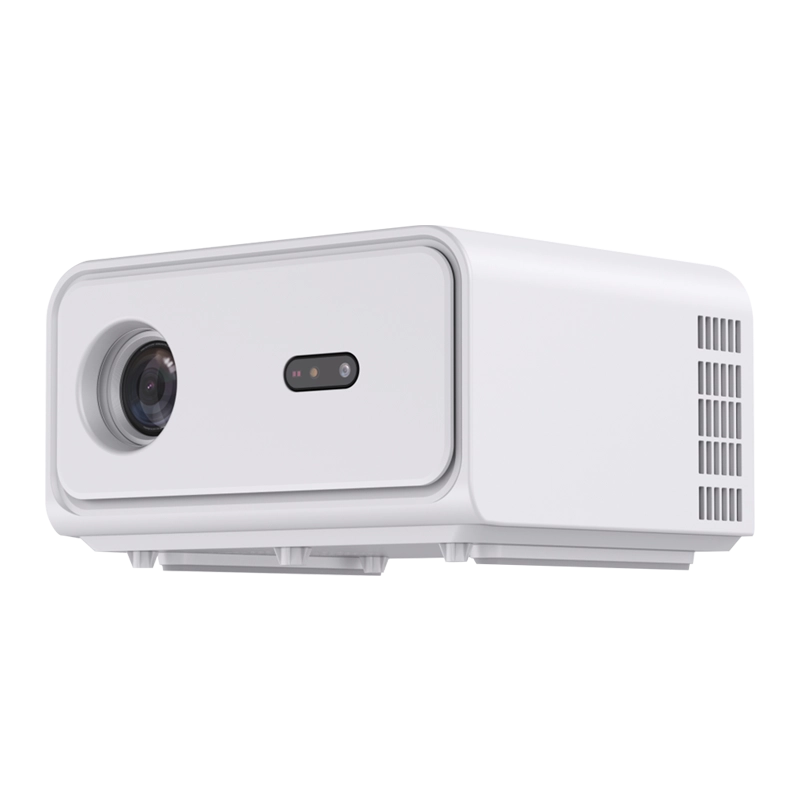
| GP8 UST projector | 450 ANSI lumens in detailed spec; 400 in title 1920×1080 native; 16:9 0.24:1 projection ratio 15–116 cm stated distance 30–200 inch image 1,200:1 contrast LED light source | Android 9.0 Amlogic T972 2GB RAM, 32GB ROM Wi-Fi 6 dual band, Bluetooth 5.0 AirPlay, Miracast, EShare 1×HDMI, 2×USB 2.0, 3.5 mm output | 94×71×190 mm 0.88 kg 89 W working consumption 30 dB noise Auto focus, auto keystone Front projection | Confirm 400 versus 450 ANSI lumens; confirm “4K,” 0.23-inch DMD and native-resolution wording against production datasheet |
| Mini HD Built-in battery model | 300 ANSI lumens in product title No detailed optical record supplied | No platform or I/O detail supplied | Built-in battery indicated by model title No dimensions, runtime, charging, noise or power data supplied | Confirm light source, native resolution, throw ratio, battery runtime, ingress protection and all I/O against production datasheet |
| DM-P5 1080p Netflix LCD model | 1080p stated in model title LED or lamp light source not stated in supplied record | “Official Netflix” and ChatGPT remote indicated CTS-certified Android referenced in supplied image path | No detailed dimensions, brightness, noise, power or I/O supplied | Confirm light source, ANSI brightness, Android version, Netflix certification, DRM level, content rights and mechanical data |
| 1080P LCD Auto-focus/keystone model | 1080p and LCD stated in product title ANSI brightness not supplied | Android 13 stated No CPU, RAM, storage, HDMI, USB, network or DRM detail supplied | Auto-focus and auto-keystone stated No dimensions, power, noise or light-source life supplied | Confirm whether this is distinct from DM-P5 and GP8; obtain full production datasheet before shortlisting |
| GP96-GTV High-brightness Google TV model | 1,000 ANSI lumens 1920×1080 native; 16:9/4:3 1.2:1 projection ratio 1.26–3.5 m stated distance 80–120 inch image 1,600:1 contrast 4.45-inch LCD display LED source | Google TV 11 or 14 Allwinner H137 plus XuanTie C906 stated Google TV dongle: S805X2 or RTD1332, 1GB DDR4, 8GB eMMC 2.4/5 GHz Wi-Fi, Bluetooth 5.0 HDR10, HDR10+, HLG; AV1, H.265, VP9, H.264 decode | 256×203×140 mm 2.95 kg 130 W working consumption 32 dB noise Auto focus, keystone, screen alignment, obstacle avoidance Front/rear/ceiling projection | “LED (10,000–10,500 Lumens)” conflicts with or may describe a different quantity than 1,000 ANSI lumens: confirm both against production datasheet. Also confirm final Google TV version, CPU population, Netflix status and dust-free claim |


Quantitative selection and worked sizing example
Start with measured screen illuminance rather than a generic “bright-room” label. Assume a hotel lobby meeting zone has a 2.4 m by 1.35 m screen, a 1.0 gain screen and a maintained target of 120 lux. The required lumens on screen are:
L = E × A ÷ G = 120 × (2.4 × 1.35) ÷ 1.0 = 388.8 lumens.
This is the theoretical output for the stated maintained screen luminance, not a project guarantee. Apply the projector’s measured ANSI output and an installation factor F that accounts for mounting, surface condition and optical loss. With F = 0.80, required rated output is 388.8 ÷ 0.80 = 486 lumens. The GP8’s title figure of 400 ANSI lumens fails this simplified check; its detailed 450 ANSI-lumen figure also fails. A unit rated above 486 lumens is required under this example, subject to photometric validation.
| Step | Worked value | Decision rule |
|---|---|---|
| 1. Screen dimensions | 2.4 m × 1.35 m | Derive from usable wall or display area |
| 2. Screen area | 3.24 m² | A = W × H |
| 3. Maintained target | 120 lux | Measure under final daytime operating condition |
| 4. Gain | 1.0 | Use the actual screen’s specified gain |
| 5. Required on-screen lumens | 388.8 lumens | E × A ÷ G |
| 6. Installation factor | 0.80 | Validate using sample geometry and surface condition |
| 7. Minimum rated ANSI output | 486 ANSI lumens | Round upward; do not compare with non-ANSI lumens |
| 8. Geometry | 1.2:1 model gives 2.88 m nominal distance for 2.4 m width | D = TR × W; verify focus, lens shift and physical installation range |
| Deployment condition | Image-area indicator | Initial brightness gate | Geometry and control priorities |
|---|---|---|---|
| Controlled meeting room | 80–100 inch diagonal | Calculate from 50–100 lux maintained target; validate rather than copy home guidance | Fixed throw, ceiling mount, IR/network control, focus lock and source auto-recovery |
| Training classroom | 100–120 inch diagonal | Account for 150–250 lux maintained screen target and ceiling reflections | Daylight management, blackout blinds, 16:9 or 16:10 depending on seating, camera-ready audio |
| Hospitality room | 80–120 inch diagonal | Set target from room-lighting scenes and guest experience, not maximum output | Google TV or AOSP policy, PMS/IP-control integration, service access and audio routing |
| Retail display | Typically 100–200 inch, illustrative | Measure peak and maintained ambient light; use a higher target than office use | Long duty, thermal margin, scheduled media playback, remote recovery and tamper resistance |
| High-ambient lobby | 120–200 inch, illustrative | Calculate separately for each daylight band and surface condition | Ceiling/wall mounting, obstruction control, dust strategy, high usage and residual-image review |
The example is illustrative, not a universal brightness recommendation. Validate it through a photometric sample at the actual throw distance, with the final screen, lens setting, content, ambient lights and mounting attitude. Compare the ANSI-lumen selection method with the project’s measured illuminance.
Deployment profiles by operating environment
Hotel and hospitality
Guest-room and hospitality-lounge deployments require scene control, simple recovery and centralized device policy. The GP96-GTV platform can address a Google TV-class experience, but Android 11 versus 14, device certification, DRM and content authorization must be confirmed for the shipped configuration. PMS integration should use the hotel’s supported IP-control method and documented command set rather than simulated remote-control codes.
- Conditions: scheduled evening operation or controllable blackout; 80–120 inch screens are common starting points.
- Architecture: Google TV for managed guest applications or AOSP for controlled integration; separate AV network and IoT management plane.
- Mounting: ceiling or rear installation where room geometry allows; keep service access and ventilation paths clear.
- Risks: unlicensed streaming, account drift, guest-access friction, PMS command mismatch and nighttime noise.
Corporate meeting and collaboration
Corporate rooms prioritize repeatability over streaming flexibility. A fixed installation should lock focus and geometry, expose only required inputs and restore a known source state after a meeting. HDMI, USB-C, wireless presentation and wired network should be treated as separate paths, with USB-C requiring an explicit specification rather than assumption from a USB-A port.
- Conditions: 80–100 inch screen, controlled lighting and frequent daily use.
- Architecture: room controller or AV processor, encrypted Wi-Fi where supported, wired video path and device-management policy.
- Risks: EDID conflicts, source auto-detection failure, unsecured casting and firmware drift across rooms.
Education and training
Classrooms often run 6–10 hours per day, so thermal endurance, filter access, acoustic limits and repair turnaround matter more than short-term color calibration. A 16:9 model suits common 16:9 lecterns; 4:3 support can assist specialist rooms. Daylight from windows should be measured at the worst hour and curtain states.
- Conditions: 100–120 inch display, variable daylight and frequent source changes.
- Architecture: ceiling mount, cable concealment, explicit classroom AV network and central policy.
- Risks: fan noise, teacher-zone shadow, vandalism, filter blockage and unsupported content formats.
Retail and digital signage
Retail display is an extended-duty embedded-computing problem. Use scheduled playback or signage software, suppress consumer notifications, and define behavior after network loss. Long image retention on static or high-luminance content requires content review, not only a projector specification.
- Conditions: 12–18 hour daily operation is a reasonable planning scenario; actual hours must be measured.
- Architecture: AOSP or managed signage platform, NTP/time synchronization, watchdog reboot, health telemetry and local media fallback.
- Risks: heat buildup, image persistence, accidental menu access, expired certificates and unplugged storage.
High-ambient public area
High-ambient locations prioritize contrast, surface selection and thermal margin. Brighter ambient light may not reveal every lamp as “washed out,” but it compresses perceived contrast and raises the minimum output required. A short-throw model reduces the image plane distance but adds risk from ceiling texture, lens alignment and UST airflow restrictions.
- Conditions: measured daylight of 250 lux or more at the screen, plus reflections from glass or polished flooring.
- Architecture: engineered ceiling suspension, anti-vibration mount, obstacle avoidance validated in the final room and remote monitoring.
- Risks: UST shadow, screen bow, ceiling marks, overheating and brightness overdrive reducing useful life.
Platform and integration architecture
Google TV and AOSP are operating-system distribution choices, not interchangeable DRM or management certifications. Google TV provides a certified consumer experience when the exact build is approved; AOSP provides greater source-level control but does not automatically provide Google Play, Widevine security level, Netflix certification or Google system updates. Specify the build, bootloader policy, signing model, update channel and application entitlements.
| Layer | Google TV path | AOSP path | Acceptance evidence |
|---|---|---|---|
| Application distribution | Approved Google TV build and compatible Google Play service | Operator-managed APK delivery or approved store | Build fingerprint, app compatibility list and install/recovery procedure |
| DRM | Widevine or other required DRM with explicit security level; Netflix certification if required | Must be integrated and provisioned; cannot be inferred from chipset | License-flow test, certificate provisioning, device-specific key attestation |
| OTA | Manufacturer update channel with staged deployment and rollback | Operator update mechanism or factory image policy | Signed package, upgrade interruption test, rollback and recovery test |
| MDM | Android Management API or operator console | Device owner, EMM or bespoke agent | Enrollment, policy application, telemetry, lock and remote diagnostic evidence |
| Network | Dual-band Wi-Fi; wired network preferred where available | Same | DHCP, DNS, NTP, certificate, captive portal and firewall test |
For protected content, compare Widevine L1 with L3 through the business implications of Widevine security levels. The DRM level is a production property of the complete device, software and provisioning path, not a chipset feature. HDCP requirements for external displays or receivers must likewise be tested end to end.
| Integration domain | Control options to specify | Verification |
|---|---|---|
| Hospitality PMS | Power, input, volume, mute, preset and status feedback | Command latency, retries, power-state reconciliation and unsupported-command reporting |
| Room control | IR, RS-232, network API or discovery protocol | Full command matrix, startup state and 24-hour soak test |
| Audio | Internal speaker, 3.5 mm output, HDMI ARC/EDID or external amplifier | Channel routing, mute isolation, lip-sync and volume-limit checks |
| Video | HDMI input, aspect-ratio behavior, EDID override, screensaver and blanking | 1080p60, 4K input if supported, hot-plug and source auto-detection |
| Fleet management | OTA groups, rollout rings, health telemetry, remote reboot and diagnostics | Canary update, failure quarantine, recovery after network partition |
| Mechanical | Mount points, cable bend radius, fan clearance, lens protection and service access | Installed drawing, pull-and-plumb survey and thermal soak |
Acoustic and thermal design are part of integration. The GP8 is specified at 30 dB and 89 W; GP96-GTV at 32 dB and 130 W. Those figures require the measurement condition and operating mode. A projector beneath a ceiling may be acoustically masked by HVAC noise but still thermally constrained. Confirm intake and exhaust clearance, ceiling cavity temperature, altitude derating and service removal path.
Compliance, sealed optics and evidence requirements
Evidence must match the exact production model, electrical configuration, firmware and market. A report for a similar model, engineering sample or different radio configuration is not sufficient. Request test reports and declarations with model numbers, standards, ports, ratings, issue dates and laboratory accreditation where relevant.
- Electrical safety: applicable IEC 62368-1 or the destination-market equivalent, with plug, power supply and fuse configuration stated.
- EMC: applicable CISPR 32/35 and IEC 61000-4 series expectations, with ports and modes identified.
- Radio: destination-market approval for Wi-Fi 6, 2.4/5 GHz, Bluetooth and any cellular/SIM function; a generic test report is insufficient.
- Environmental: operating and storage temperature, humidity, altitude, drop, vibration and thermal-cycle evidence.
- Material and packaging: applicable RoHS, REACH and WEEE documentation for each market.
- Platform: GMS/EDLA or Google TV certification, Android CDD/CTS evidence and Netflix certification only where the product claim requires it.
- Optical safety: applicable laser or lamp classification and labeling evidence for the exact light engine.
The GP96-GTV description uses “dust-free design.” This wording alone does not prove that the optical engine is sealed or that the device has an ingress-protection rating. Require a definition of dust-free, the seal architecture, airflow paths, particulate test method, filter service interval and result. If no standardized IP rating exists, document the commercial claim and test condition rather than converting it into an unsupported IP number.
| Evidence package | Required detail | Acceptance gate |
|---|---|---|
| Product safety | Exact model, mains input, standard, certificate and laboratory ID | Valid report and production BOM match |
| EMC and radio | Every enabled radio, band, antenna and configuration | No unresolved critical findings |
| Optical and photometric | ANSI method, sample serial numbers, input mode and ambient conditions | Production sample reproduces rated output |
| Sealed-optics claim | Seal definition, particulate test, duration and serviceability | No ingress affecting image or thermal performance |
| Software and content | Build ID, certificate status, DRM level and app versions | License playback and OTA rollback succeed |
| Environmental | Temperature, humidity, altitude and acoustic conditions | Operates at declared limits without derating breach |
Lifecycle, lumen depreciation and total cost of ownership
Total cost of ownership should be calculated over the same service interval for every candidate. Use the formula TCO = acquisition + installation + content + energy + maintenance + downtime + end-of-life disposition. Because no product prices are provided here, each commercial term remains an RFQ input rather than an assumed figure.
For energy, estimate E = rated watts × operating hours ÷ 1,000 kWh, then apply the site tariff and carbon factor. For example, a 130 W device operating 10 hours per day for 365 days consumes 474.5 kWh annually. A 89 W unit under the same schedule consumes 324.9 kWh. These are illustrative operating calculations, not lifetime energy guarantees.
| TCO component | Cost driver | Control measure | Evidence for buyer |
|---|---|---|---|
| Acquisition | Unit, configuration, freight, tax and volume commitments | Compare like-for-like warranties and certified versions | Itemized quote without undisclosed bundles |
| Installation | Mount, cabling, screen, labor and controls | Use site drawing and standardized installation kit | Bill of materials and labor hours |
| Energy | Watts, hours, tariff and standby behavior | Scheduled shutdown, occupancy and brightness management | Measured power and annual operating profile |
| Maintenance | Lamp, filters, cleaning, calibration and firmware support | Stock parts by site criticality | Service price list and RMA turnaround |
| Downtime | Failure rate, diagnosis time and alternate unit | Fleet pool, spare ratio and remote recovery | MTBF evidence and replacement workflow |
| Depreciation | Lumen depreciation, panel aging and use intensity | Preventive replacement based on measured output | Useful-life curve and maintenance trigger |
| End of life | Data destruction, recycling and certification | Secure erase, asset record and take-back program | WEEE and data-handling procedure |
Output depreciation should be modeled rather than reduced to the source lifetime. A practical schedule has 100% relative output at commissioning, an intermediate threshold based on the manufacturer’s useful-light curve, and an end-of-life trigger based on image uniformity, color tolerance and maintenance cost. Require the test method, ambient temperature and drive-current condition. Operating the projector continuously at maximum output usually accelerates depreciation relative to an eco mode that reduces power and extends service life.
OEM/ODM commercial process and customization scope
A commercial projector program should be managed as a product configuration and quality-control process, not a logo-and-packaging exercise. Define the optical engine, light-source binning, panel or DLP supplier strategy, platform, certifications, mounts, packaging and approved accessories before pilot approval. The OEM/ODM process reference provides the broader manufacturing framework.
- Requirements freeze: record specification, approved components, certifications, user documentation and golden-sample configuration.
- Design for manufacture: review component alternation, end-of-line test access, thermal margins and packaging drop protection.
- Prototype validation: test brightness, focus, color, noise, interfaces, thermal behavior, OTA and remote-control functions.
- Qualification build: use production-intent tooling and suppliers; collect deviations and failure analysis.
- Golden sample: identify one approved reference unit, firmware build and accessory set for all inspections.
- Pilot run: validate line yield, test coverage, serialization and traceability.
- Production release: close all critical deviations and obtain signed conformity.
- Change control: process PCNs for LEDs, LCD/DLP components, power supplies, Wi-Fi modules, optics, firmware and packaging.
| Customization area | Feasible scope | Approval risk |
|---|---|---|
| Mechanical | Enclosure finish, logo, mount interface, packaging and accessory configuration | Tooling change can affect heat, vibration, EMC and appearance tolerances |
| Optical | Lens or throw option, focus behavior and screen-alignment feature | May alter regulatory, thermal and calibration requirements |
| Software | AOSP build, boot logo, preinstalled apps, OTA agent and regional settings | Certification, DRM, updater signing and update rollback are affected |
| Connectivity | Wi-Fi/Bluetooth antenna, wired interface and remote-control protocol | Radio approval and RF performance can change |
| Accessories | Remote, mount, power cord, HDMI/USB cables and case | Regional safety, packaging and usability must be verified |
| Brand and service | Asset labels, serial scheme, warranty workflow and spare parts | Traceability must remain intact through repair and refurbishment |
Quality acceptance should use ANSI/ASQ Z1.4 or the agreed equivalent, with defect classes and AQL levels defined per inspection stage. The AQL number is not a substitute for zero tolerance on critical safety or functional defects. Propose 100% functional checks for power, light output, focus, keystone, interfaces, speaker output, serial number and remote control, with sampling for appearance, labeling and packaging.
PCN control requires advance notice, affected serial or lot range, change description, risk assessment, qualification evidence, validation sample and effective date. The buyer must decide whether each PCN requires lab retest, certificate extension or production-sample comparison. Unilateral component substitution is not acceptable where it affects optics, radio, safety, firmware or the certified platform.
Spares planning should reflect the deployment population and failure criticality: typically 2–3% onsite spares for noncritical rooms and 5% plus a loaner pool for critical hospitality or commercial sites are illustrative starting points, not DataMax commitments. Warranty scope must distinguish optics, light source, panel or DLP module, board, power supply, remote, mount, labor, freight and software support. Read the DRM hardware/security comparison when defining protected-content warranty terms.
Weighted RFP scoring and procurement instruments
A two-stage RFP reduces the risk of selecting on headline specifications. Stage 1 is pass/fail for mandatory compliance, platform certification, native resolution, minimum brightness, throw geometry, warranty and delivery evidence. Stage 2 scores weighted objectives among technically compliant models. Suggested weights below are procurement-ready templates and must be adjusted to the site.
| Criterion | Weight | Evidence required | Scoring anchor |
|---|---|---|---|
| Optical performance and uniformity | 20% | ANSI report plus production-sample measurement | 5: exceeds target with margin; 3: meets target; 1: conditional; 0: fails |
| Image geometry and installation fit | 15% | Throw-range drawing, focus and alignment test | 5: exact fit with service allowance; 3: workable adaptation; 1: material redesign |
| Platform, DRM and content certification | 15% | Build ID, license flow, certification and app matrix | 5: complete approved stack; 3: limited scope; 1: conditional |
| Reliability, thermal and acoustic | 15% | Ambient-light test, burn-in, noise and altitude data | 5: validated margin; 3: meets minimum; 1: unproven |
| Remote management and OTA | 10% | Live enrollment, staged update and rollback demonstration | 5: complete fleet workflow; 3: partial; 1: manual only |
| Compliance and documentation | 10% | Exact-model reports, declarations and certificates | 5: complete and current; 3: minor gap with plan; 1: major gap |
| Service, spares and warranty | 10% | RMA process, lead time, loaner and spares schedule | 5: fleet-ready SLA; 3: conventional; 1: uncommitted |
| OEM/ODM quality and PCN control | 5% | Golden sample, AQL plan, traceability and PCN workflow | 5: controlled and transparent; 3: defined; 1: weak |
| Total | 100% | Award only after mandatory criteria pass | |
- Is the application content protected, and does it require a certified Widevine level or Netflix approval?
- Does measured ambient light require more than the selected model can provide after installation loss?
- Can the stated throw range physically fit the room without keystone or unacceptable image reduction?
- Will the exact production build support the required apps, control protocol and OTA policy?
- Does the exact model hold current safety, EMC, radio and platform evidence?
- Can the vendor demonstrate fleet enrollment, staged OTA, rollback, spares and warranty execution?

Site acceptance and commissioning
Acceptance should use a repeatable site protocol rather than visual judgment alone. Record ambient lux, image coordinates, unit serial number, firmware build, installation orientation, screen gain, source resolution and test files for each accepted unit.
| Acceptance test | Procedure | Pass criterion |
|---|---|---|
| Ambient condition | Measure at screen center and four edge regions under final lighting | Within the approved photometric design and stated operating scenario |
| Brightness | Compare calibrated photometer reading with rated ANSI output and installation factor | Meets contractual tolerance for the production sample |
| Focus and resolution | Display focus chart and pixel-grid source through the lens | Sharp at all four corners; no unacceptable scaling artifacts |
| Geometry | Display grid and edge markers with final screen and mount | Within signed tolerance; no dependence on uncorrected keystone |
| Color and uniformity | Display gray, white and color patches; record multiple points | Meets agreed color and uniformity limits |
| Connectivity | Exercise each HDMI, USB, network, audio and control interface | All advertised functions pass at 1080p60 and applicable higher formats |
| Sound | Test internal speaker and external output through the room audio chain | No unacceptable noise, clipping, echo or channel mismatch |
| Thermal and acoustic | Run for the contracted soak period at final ceiling temperature | No thermal throttle, shutdown or noise-limit breach |
| Platform and DRM | Sign in, play protected content, change source and recover after network loss | License succeeds and recovery completes within the agreed time |
| OTA and recovery | Deploy staged package, interrupt it, then restore a signed image | Rollback and device recovery are successful |
| Documentation | Archive serial, build, certificates, settings and as-built drawing | Asset record is complete and retrievable |
Burn-in should match the duty profile: a 24-hour office qualification is not equivalent to a 90-day retail program. At minimum, use an agreed 8–24-hour representative soak for pilot units and monitor for restarts, image drift, fan anomalies, thermal throttling, network disconnects and memory pressure.
Troubleshooting matrix
Troubleshooting should separate installation, optical, platform and service faults. Do not replace a unit until remote logs and basic checks identify whether the fault is content, control, network, environment or hardware.
| Symptom | Likely checks | Corrective action | Escalation evidence |
|---|---|---|---|
| Image dimmer than site calculation | Ambient lux, lamp/LED mode, screen gain, dust and runtime | Restore brightness mode, clean approved surfaces and recalculate output | Before/after photometer readings and runtime log |
| Keystone changes or corners blur | Mount stability, focus, geometry setting and 4K/1080p input | Lock installation, disable unnecessary correction and refocus | Geometry photos, source format and OSD configuration |
| Content app will not start | Network, certificate, DRM entitlement, app version and storage | Correct connectivity, update approved build or clear app state | Build ID, logcat or vendor diagnostic export |
| Protected stream fails | License server, Widevine level, device provisioning and time | Re-provision within policy; correct network or platform configuration | License transaction and provisioning status |
| No network after restart | DHCP lease, Wi-Fi roaming, captive portal and Ethernet | Restore configuration and update approved connectivity profile | Network logs and router lease data |
| Remote-control command ignored | Mode, pairing, IR blocking and PMS command set | Correct mode, pair again and use supported command | Command/response trace and control-system version |
| Fan noise or thermal shutdown | Ceiling clearance, intake blockage, room temperature and altitude | Clear airflow, correct mounting and derate if necessary | Temperature log, altitude and inspection photos |
| USB device not recognized | USB version, power, file format and media service | Use compliant media or service the media service | USB descriptor and media logs |
| OTA fails or device bricks | Power loss, package signature, storage and rollback partition | Recover via approved image and correct update process | Package hash, updater log and recovery result |
- Capture the unit serial number, firmware build and installation ID before changing configuration.
- Reproduce the fault with a known source and a second cable or network path where applicable.
- Export vendor diagnostics before reboot, factory reset or module replacement.
- Record recovery time and prevent recurrence through a firmware, configuration or site-environment correction.
Fleet rollout, inventory and service governance
A 1,000-unit deployment and a 10-unit deployment require different controls, but both need traceable configuration. Assign a site, room, asset tag, serial number, firmware build, certificate identity and installation record to each unit. Prevent staging errors by validating the startup screen, serial mapping and management enrollment before shipment.
- Pilot: deploy 2–5% of the fleet or all distinct room types, whichever is greater, to expose template and network issues.
- Canary OTA: update a small ring, validate playback and recovery, then expand in controlled stages.
- Configuration baseline: control image settings, system time, power behavior, update policy and network certificates.
- Spare stock: hold onsite units and a central repair pool according to measured failure rate and service response.
- Incident records: link failures to room type, runtime, ambient condition, firmware and network events.
For the supplied GP8, Android 9.0 and 2GB/32GB may constrain long-term application support for enterprise fleet work. The GP96-GTV offers Google TV 11 or 14, but the exact version must be identified per shipment. No battery capacity or runtime is supplied for the Mini HD, so it cannot be assigned to outage-critical or mobile duty without a capacity test, charge-time record and thermal validation.

Expert FAQs
Does “LED projector” mean it uses DLP?
No. LED identifies the light source; DLP, LCD and other technologies identify the imaging method. A projector can combine LED illumination with an LCD panel, as suggested by the GP96-GTV’s 4.45-inch LCD display specification. The procurement specification must name both.
Is an LED projector always brighter than an LCD projector?
No. Brightness depends on the light engine, panel or chip size, lens transmission, thermal mode and manufacturer’s test method. Compare ANSI lumens from the same measurement standard, then apply the screen gain and installation factor. A 1,000-ANSI-lumen model and a 400-ANSI-lumen model cannot be ranked by architecture alone.
Does native 1920×1080 mean the projector accepts 4K input?
No. Native resolution describes the image the projector physically generates; input resolution describes what its scaler can receive. A 4K input may be downscaled to 1080p. Require separate native-resolution and maximum-input-resolution fields, including frame rate and chroma format.
How much brightness is required for a commercial room?
Calculate required on-screen lumens as E × A ÷ G, then divide by a validated installation factor. For the worked lobby example, 120 lux over 3.24 m² with gain 1.0 and factor 0.80 requires at least 486 ANSI lumens. This is an illustrative first-order result, not a universal rule.
Can a UST projector replace a conventional throw projector?
Not automatically. The GP8’s stated 0.24:1 ratio changes the installation geometry and may help a shallow room, but ceiling texture, alignment, screen flatness, presenter shadows, audio placement and cable routing still require review. Confirm lens-center offset, permitted tilt, airflow clearance and focus at operating temperature.
Does “dust-free design” provide ingress protection?
Not necessarily. A sealed optical path can reduce contamination risk, while the overall enclosure may remain open for airflow and may have no standardized IP rating. Ask for the seal definition, particulate test, service procedure and thermal evidence. The GP96-GTV claim must be confirmed against the production datasheet.
Is Google TV sufficient for managed commercial deployment?
No. Google TV addresses the certified platform and application experience, but management still requires enrollment, policy, monitoring, OTA staging, rollback and content licensing. AOSP can be equally controllable when it includes the required applications, DRM, device owner or EMM functions and update mechanism.
Which DataMax model is suitable for a high-ambient lobby?
The supplied data are insufficient for a final selection. The GP96-GTV has the highest stated ANSI rating at 1,000 lumens and may be the starting candidate, but its effective output must be calculated, its “10,000–10,500 lumens” notation clarified, and its installation geometry, thermal margin and platform configuration verified. Other models lack enough brightness and optical data for direct comparison.
Engineering consultation and RFQ
For a controlled, evidence-led RFQ, provide the room drawings, measured screen illuminance, target image size, screen gain, content applications, DRM requirements, mounting constraints, operating hours, network policy and preferred management platform. An engineering review can then produce a photometric sizing check, integration matrix, acceptance protocol and DataMax configuration request; all model-level claims should remain subject to the production datasheet, test reports and a golden-sample approval.