
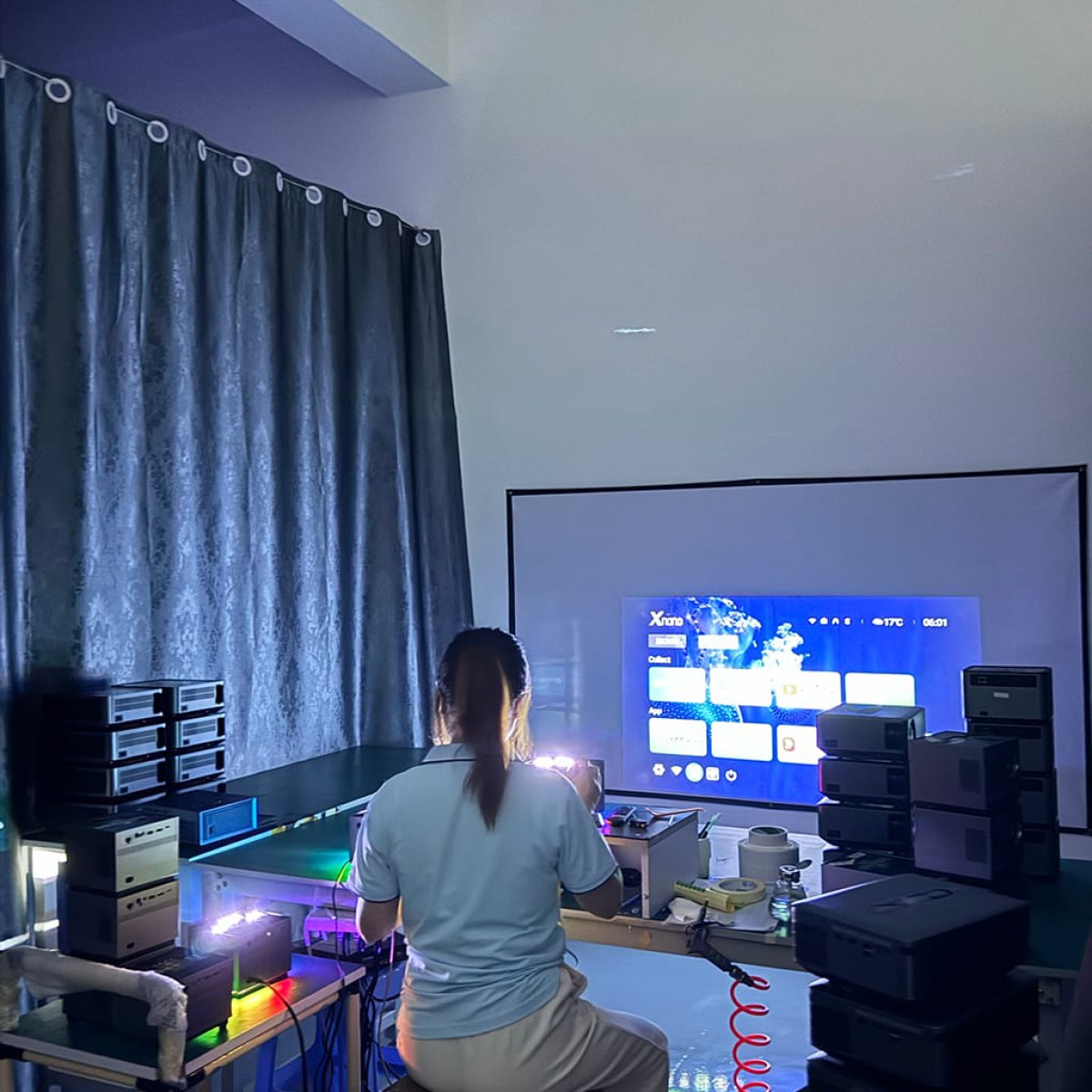
Commercial decision context
Home-projector buying guides rarely address the variables that determine an installed fleet outcome: measured image performance, mount rigidity, thermal design, network control, service access, environmental protection, certification evidence, and component continuity. A 300 or 400 ANSI-lumen device that passes a temporary demonstration may still fail after 8,000 operating hours because ambient light, intake recirculation, input instability, or unsupported recovery procedures were not included in the qualification plan.
For commercial buyers, “DLP versus LCD” is therefore an optical architecture decision inside a broader systems decision. The useful comparison is not whether one technology is universally better. It is which architecture, model, firmware baseline, screen, room, service process, and operating profile produce a repeatable result at the specified screen size.
- Installed image: calculate lumens, contrast, ambient-light allowance, and screen gain for each room rather than ranking devices by headline lumens.
- Fleet integration: validate Android behavior, HDCP paths, DRM, OTA recovery, remote control, network discovery, and room-system integration.
- Environmental fit: confirm dust exposure, temperature range, ceiling or tabletop mounting, ventilation clearance, noise criteria, and service access.
- Lifecycle: model depreciation, cleaning, lamp or LED replacement, software support, spare-unit strategy, and failure handling over the stated deployment period.
- Commercial control: require traceable specifications, golden samples, serialized acceptance, PCN notification, warranty repair terms, and production-datasheet confirmation for unresolved data.
Consumer concepts such as cinematic contrast, plug-and-play portability, or a large image from a small enclosure have limited procurement value without controlled measurements. The same nominal architecture can behave differently when the optical path is short, the screen gain is high, the ambient light is uncontrolled, or the ceiling structure amplifies fan noise.
Optical and measurement fundamentals
ANSI lumens measure light output under the ANSI/InfoLuma standard method: a set of nine equal-area measurement points distributed across the projected image, with luminance measured at the center and four corners using specified averaging. The result is a more useful procurement datum than arbitrary “LED brightness” claims, but it does not describe color, contrast, uniformity, ambient performance, or usable resolution. Procurement should request the test report, tested color mode, source setting, measurement instrument, operating duration, and ambient conditions.
For planning, the initial illuminance requirement can be expressed as:
Escreen = Lprojector × Ascreen × Gscreen ÷ (π × D²)
where Lprojector is measured projector luminance, Ascreen is screen area, Gscreen is screen gain, and D is throw distance in the same units used for screen dimensions. The equation estimates useful screen illuminance before ambient subtraction; it is not a substitute for photometric testing in the finished room. A practical design target should be verified against the application’s required legibility, contrast, and content type.
| Parameter | Procurement interpretation | Required evidence or control |
|---|---|---|
| ANSI lumens | Total flux measured under ANSI/InfoLuma conditions; it is not screen illuminance. | Photometric report and stabilized output mode. |
| Native resolution | Addressable input matrix; it does not guarantee equivalent spatial detail at every screen size. | Native panel or DMD resolution, aspect ratio, and input-resolution test. |
| Contrast | Usually specified under defined operating conditions; “FOFO” and ambient conditions differ. | Method, enabled picture modes, color temperature, and brightness setting. |
| Throw ratio | Image width divided by lens-to-screen distance. | Range, lens shift, focus behavior, and installed distance calculation. |
| Keystone and focus | Digital geometry correction can reduce usable resolution and introduce scaling artifacts. | Keystone range, usable focus plane, and end-to-end test pattern. |
| Light-source life | Manufacturer life is conditional on brightness, color, temperature, and operating mode. | LED or lamp lifetime, depreciation curve, warranty exclusions, and spare policy. |
A 16:9 screen 100 inches wide has an image width of 2.54 m and height of 1.43 m. At a 0.24:1 throw ratio, the ideal lens-to-screen distance is approximately 0.61 m before any specified lens offset or tolerance. For the DataMax GP8, the supplied range of 15–116 cm and 30–200-inch image limits should be checked against the room because the fixed geometry cannot be evaluated from the ratio alone.
DLP architectures typically use a micromirror imaging element, while LCD architectures use transmissive liquid-crystal panels. Neither label alone establishes suitability: thermal design, optical path, panel or DMD resolution, color processing, sealed construction, and firmware determine the installed result. DLP may simplify compact optical packaging, while LCD implementations may provide different cost and scaling behavior. These are architectural tendencies, not product guarantees.
DataMax model comparison
The supplied DataMax product record is incomplete for four models. Only GP8 has a detailed specification set. The other models are included with explicit data gaps rather than inferred specifications. Model names and product descriptions below are not substitutes for a production datasheet.
| DataMax model | Architecture and platform | Output and optical data | Connectivity and integration | Physical, lifecycle and data status |
|---|---|---|---|---|
| GP8 | DLP indicated by “0.23-inch DMD”; Android 9.0; Amlogic T972; 2 GB RAM; 32 GB ROM | Title says 400 ANSI lumens, but specification says 450 ANSI lumens: confirm against production datasheet. 1920×1080 native resolution; 16:9; 1200:1 contrast; LED source; 0.24:1 projection ratio; 30–200-inch image; 15–116 cm distance. | Wi-Fi 6 dual band; Bluetooth 5.0; AirPlay, Miracast, and EShare mirroring; 1× HDMI input; 2× USB 2.0; 1× 3.5 mm stereo output; BT remote listed, while packing list states IR remote: confirm against production datasheet. | 94×71×190 mm; 0.88 kg; 89 W working consumption; 30 dB; auto focus; auto keystone; front projection; 3D supported; AC 100–240 V, 50/60 Hz with DC 19 V 4.7 A adapter. No stated light-source lifetime: confirm. |
| Mini HD Projector 300 ANSI Lumens with Built-in Battery | Architecture, Android version, SoC, RAM, ROM, and Google licensing status not supplied. | 300 ANSI lumens and built-in battery stated. Native resolution, contrast, throw ratio, light source, focus, keystone, and image size: confirm against production datasheet. | HDMI, USB, Wi-Fi, Bluetooth, AV output, screen mirroring, and CMS interfaces: confirm against production datasheet. | Battery capacity, runtime, charging, dimensions, weight, noise, power, temperature, and warranty: confirm against production datasheet. |
| DM-P5 1080P Official Netflix LCD Projector with ChatGPT Remote | LCD; Android version, SoC, RAM, ROM, Netflix certification level, and GMS/EDLA status: confirm against production datasheet. | 1080P stated; ANSI lumens, contrast, throw ratio, light-source life, focus, keystone, refresh rate, and input latency: confirm against production datasheet. | Wi-Fi, Bluetooth, HDMI, USB, AV, optical audio, remote-control method, and DRM service support: confirm against production datasheet. | Dimensions, weight, noise, power, operating temperature, sealed optical engine, and certifications: confirm against production datasheet. |
| 1080P LCD Projector with Auto-Focus and Keystone, Android 13 | LCD; Android 13; SoC, RAM, ROM, GMS/EDLA, Netflix, and Widevine security level: confirm against production datasheet. | 1080P, auto focus, and auto keystone stated. ANSI lumens, contrast, throw ratio, light source, image size, and refresh rate: confirm against production datasheet. | Wi-Fi, Bluetooth, HDMI, USB, AV, LAN, screen mirroring, CMS, and CEC behavior: confirm against production datasheet. | Dimensions, weight, noise, power, thermal limits, and optical-engine sealing: confirm against production datasheet. |
| 4K Smart DLP Outdoor Projector with 10000mAh Battery, Android 9 | DLP; Android 9. “4K” is in the product name, but native output resolution and input support are not supplied: confirm against production datasheet. | 10,000 mAh battery stated. ANSI lumens, native resolution, contrast, throw ratio, image size, focus, keystone, and light-source life: confirm against production datasheet. | Product-path text states dual-band Wi-Fi, Bluetooth 5.0, and wireless mirroring; exact protocols and ports: confirm against production datasheet. | Outdoor rating, ingress protection, operating temperature, dimensions, weight, noise, charging time, and runtime: confirm against production datasheet. |
The GP8’s “400 ANSI lumens” title and “450 ANSI lumens” specification are a direct contradiction. Procurement should require one controlled datasheet revision and a matching golden sample, rather than averaging or selecting the more favorable number.


Quantitative selection method and worked example
Start with the application constraint, not the display technology. For each site, record image width and height, screen gain, ambient illuminance on the screen, minimum acceptable luminance, color standard, content type, viewing angle, mounting height, throw-distance envelope, maximum acoustic level, maintenance access, network architecture, and required operating period.
- Define usable image size: calculate diagonal from width and height, then compare with the projector’s stated image range and the target audience’s visual-angle requirement.
- Calculate room illuminance: measure or conservatively estimate daylight and controlled-lighting contributions at screen center and corners.
- Select target projector luminance: use the illuminance equation, add installation losses and maintenance depreciation, then compare with ANSI output under the specified mode.
- Validate geometry: compare projection distance, throw ratio, focus range, lens shift, keystone limits, and physical obstructions.
- Validate the signal chain: test protected content, EDID, HDMI handshake, network authentication, mirrored sessions, and room-control commands.
- Run an environmental soak: operate at the intended mounting orientation, temperature, network load, and input source for the agreed qualification period.
Worked example: a hotel guest-room installation uses a 100-inch, 16:9 screen with width 2.54 m, height 1.43 m and assumed gain 1.0. Target screen illuminance is 120 lux before subtracting 20 lux of ambient light, so the planning requirement is 140 lux. For a 0.24:1 throw ratio, lens-to-screen distance is approximately 0.61 m. The projection-distance equation with screen gain is:
Lprojector = Etarget × π × D² ÷ (Ascreen × Gscreen)
Using 0.61 m consistently, screen area is approximately 3.63 m², yielding:
L = 140 × π × 0.61² ÷ (3.63 × 1.0) ≈ 45.2 cd/m²
The screen area in lumens is approximately 45.2 × 3.63 ≈ 164 lumens before additional optical, alignment, dust, and aging allowances. If the installation applies a 30% engineering margin for geometry, surface condition, temperature and long-term depreciation, the procurement target becomes approximately 235 lumens of ANSI-measured output. This simplified result shows why a 300 or 400 ANSI-lumen portable unit may be optically adequate for this example, while color, black level, uniformity, room reflections, HDCP, and acoustic constraints still determine acceptance.
| Scenario | Assumed screen | Ambient light | Target plane | Selection implication |
|---|---|---|---|---|
| Dark hotel room | 80–100 inch, gain 1.0 | 5–20 lux | 80–120 lux content plane | Compact DLP can be considered where contrast and integration are stronger criteria. |
| Corporate boardroom | 100–120 inch, gain 1.1–1.3 | 50–150 lux | 150–250 lux | Prioritize controlled light, color uniformity and correction capability. |
| Classroom | 100–120 inch, gain 1.0 | 100–250 lux | 180–300 lux | Text legibility, ingress protection and service access dominate. |
| Retail activation | 60–100 inch, gain 1.0–1.2 | 100–300 lux | 180–300 lux | Use local dimming, content design and measured ambient conditions. |
| High-ambient atrium | 120–200 inch, gain 1.2–1.5 | 250–600 lux | 300–600 lux | Do not approve from lumens alone; require a full-room photometric simulation and sample. |
The target ranges above are illustrative planning values, not universal standards. Validate them through content trials, daylight cycles, observer review and the final screen substrate.
Deployment profiles by operating environment
Hotel and hospitality
Conditions: controlled or darkable rooms, 60–100-inch screens, in-room content, multi-language interfaces, PMS billing and a requirement for fast recovery after staff or guest use. Mounting: ceiling or cabinet placement should preserve the 0.24:1 geometry only where physically feasible; otherwise select a model whose lens-to-image range fits the room. Connectivity and management: isolated VLAN, DHCP reservation, captive-portal workflow, IR or network room control, and a documented PMS/CEC interface. Risks: guest network isolation, content licensing, accidental configuration changes, excessive wall reflections, and remote diagnostics exposing personal data.
Corporate meeting and training
Conditions: mixed Windows and Android sources, 100–120-inch displays, video conferencing and intermittent wired inputs. Mounting: rigid ceiling mount with cable routing that separates power and signal where practical. Connectivity and management: centralized configuration, dual network paths where justified, EDID locking, HDMI-CEC policy, room reservation integration and telemetry for device health. Risks: source handshake failures, firmware drift, occupied-room change control, and security features that block required streaming applications.
Education
Conditions: 100–120-inch classroom screens, daily use, mixed content sources and high replacement pressure on AV staff. Mounting: ceiling installation with tamper-resistant fasteners and accessible filters or dust provisions. Connectivity and management: scheduled OTA windows, classroom VLAN segmentation, asset labels, remote diagnostics and centralized application policy. Risks: dust, student tampering, Wi-Fi coverage, headphone or classroom audio integration, and unreported image drift.
Retail and digital signage
Conditions: long operating hours, repeated content loops, high ambient light and limited service access. Mounting: tamper-resistant ceiling or storefront mounting with protected power and network routes. Connectivity and management: unattended boot, health checks, central media publishing, remote restart, log export and version pinning. Risks: screen burn-in from static creative, high-temperature operation, accidental shutdown and advertising-content compliance.
High-ambient environment
Conditions: 250–600 lux at the image plane, possibly daylight contamination and glossy screen reflections. Mounting: orient to minimize reflections and avoid direct solar exposure. Connectivity and management: use scheduled display control rather than a continuously bright operating mode if the platform permits. Risks: insufficient ANSI output, low contrast, color shift, thermal derating and screen glare. A sealed engine does not solve ambient-light loss.
Platform and integration architecture
| Layer | Google TV / certified Android profile | AOSP / general Android profile | Procurement verification |
|---|---|---|---|
| Application distribution | Managed catalog and platform policy can simplify branded deployments. | Applications depend on APK sourcing, signing, compatibility and update control. | Test installation, update, removal, storage behavior and recovery. |
| DRM and protected content | Certified services still require valid Widevine and service authorization. | Widevine support and security level depend on the device build and OEM implementation. | Require L1/L3 evidence, license server behavior and 1080p or higher output tests. See Widevine L1 versus L3. |
| OTA and MDM | Google-managed update paths may coexist with OEM update policy. | OEM-controlled OTA, MDM enrollment or side-loading may be required. | Define update ownership, staging, rollback, signed image policy and recovery after interrupted updates. |
| Network | Wi-Fi and Ethernet support must be confirmed per configuration. | Network features can vary by board and firmware. | Test DHCP, DNS, NTP, captive portals, multicast behavior, roaming and proxy environments. |
| Room control | Applications can integrate through supported APIs, IR, serial or network bridges. | Integration depends on OEM APIs and exposed interfaces. | Use a written PMS/CEC/audio control matrix and API stability commitment. |
Android 9 or Android 13 identifies an operating-system generation, not current Google GMS/EDLA compliance, Netflix approval, Widevine level, CTS/VTS status or cybersecurity support. The DM-P5 product description references “CTS-certified Android OS,” but the precise CTS/VTS report, scope and device model must be supplied. The 4K DLP model’s “4K” name also does not prove native 3840×2160 output.
| Integration domain | Minimum engineering package | Key risk |
|---|---|---|
| Signal and audio | EDID profile, 1080p/4p60 test vectors, CEC map, 3.5 mm or optical output behavior, lip-sync test. | Protected-source blackouts or audio path failures. |
| Mechanical | Drawing, mounting-hole coordinates, mass, center of gravity, lens clearance, anti-vibration check. | Image shift, focus change or dropped installation after vibration. |
| Thermal | Inlet and outlet clearance, ambient-temperature range, airflow map, stable-output test and derating policy. | Noise increase, brightness reduction or shutdown over time. |
| Acoustic | Measured dBA at operator, guest and adjacent-room positions under normal and maximum modes. | Hospitality complaints and meeting interference despite a nominal 30 dB label. |
| Remote support | Device identity, diagnostics command set, log retention, secure credential rotation and recovery procedure. | Uncontrolled access or inability to restore field state. |
For installation architecture, separate four domains: content from the publishing or streaming platform, device control from the CMS or MDM, room control from the PMS or building controller, and power/network from the infrastructure. This separation limits failure domains: a content outage should not force a lighting reset, and a device update should not interrupt unrelated building systems.
Compliance, certification and optical-engine evidence
Certification claims should be tied to the exact model, SoC, firmware baseline, radio configuration, power supply and destination market. For Android devices, request the current Google GMS or EDLA approval scope where applicable, the Android Compatibility Definition Document and CTS/VTS evidence where claimed, plus the build security patch status and Google Play status. “Official Netflix” should be supported by the relevant Netflix partner-device documentation, not only packaging or a product-page phrase.
- Radio and EMC: require test reports or declarations appropriate to the sale region, including applicable FCC, CE/RED or national radio-equipment requirements.
- Electrical safety: obtain CB/IEC 62368-1 or the applicable national equivalent report for the final adapter and product configuration.
- Environmental and packaging: request RoHS, REACH declarations where applicable, WEEE or recycling arrangements, and packaging material documentation.
- Optical serviceability: distinguish a sealed dust-resistant light engine from a merely enclosed chassis. Request the optical-engine seal design, dust test, filter configuration and replacement policy.
- Battery models: request UN 38.3, IEC 62133-2 or applicable transport and safety evidence, cell traceability, charging protection and end-of-life handling.
- Version control: map each certificate and test report to the production model number, hardware revision and firmware release.
The supplied DataMax records do not contain complete certification schedules. Confirm against the production datasheet and compliance folder for every model before shipment. GP8’s 89 W working consumption and supplied AC input range identify its electrical platform, but do not prove safety, EMC or energy compliance for a destination market.
Lifecycle, lumen depreciation and TCO structure
Total cost of ownership should be calculated from deployed quantity, not unit acquisition cost. No prices are used here; the model defines the cost categories that should be populated with the buyer’s approved rates.
| TCO element | Calculation basis | Control or evidence |
|---|---|---|
| Capital equipment | Projector quantity × approved unit cost, plus mounts, screens, adapters and control hardware. | Bill of materials and serialized asset register. |
| Installation labor | Site survey × technician hours × labor rate. | Signed installation pack and as-built drawings. |
| Maintenance | Annual cleanings × labor rate + replacement parts + local logistics. | Task list, travel policy and failure history. |
| Software operations | CMS/MDM licenses, cellular plans, cloud resources and support hours. | Entitlement record and renewal schedule. |
| Energy | Average watts × operating hours ÷ 1,000 × energy rate. | Measured operating watts at the selected brightness mode. |
| Downtime | Failed units × site criticality × replacement and service delay. | Spares ratio, RMA time and workaround plan. |
| End of life | Decommissioning, recycling and data-erasure cost. | Asset-disposal policy and certificate template. |
For lifecycle planning, the useful question is not “LED life versus lamp life” alone. Compare depreciation to the buyer’s minimum usable luminance, operating hours per year, color shift limits, temperature effects, dust loading, and whether replacement requires a new lamp, light engine, projector or merely filter cleaning. A nominal 25,000-hour LED claim does not mean 25,000 hours of acceptable output. Require a depreciation curve or a contractual usable-output criterion.
A simple energy calculation is annual kWh = average watts × operating hours ÷ 1,000. At 89 W and 8,000 hours per year, GP8 consumes 712 kWh annually before peripheral loads and power-supply losses. A pilot should measure actual watts because brightness controls, video modes and environmental conditions can change consumption.
- Define minimum acceptable lumen output, contrast and color at end of the planning period.
- Obtain manufacturer depreciation and environmental-derating data for the selected model and mode.
- Measure the installed unit’s stabilized output after 2 hours at representative ambient and operating temperature.
- Recalculate annual energy use from measured operating power and scheduled operating hours.
- Budget field cleaning, filter or light-engine service, spare units and replacement logistics.
- Review the fleet at 25%, 50% and 75% of the planned deployment interval rather than waiting for end of life.
OEM/ODM commercial process and sourcing controls
A commercial projector program should proceed through requirement freeze, engineering validation, pilot approval, production qualification and lifecycle control. The supplier’s product-page description is an initial identifier, not the controlling specification. Each approved build needs a revisioned product datasheet, bill of materials, firmware baseline, test protocol and sample identity.
| Stage | Supplier deliverable | Buyer gate |
|---|---|---|
| Requirement definition | Site-use matrix, target output, connectivity, environmental and compliance requirements. | No technical feasibility is assumed from an existing model. |
| Customization scope | Industrial design, enclosure, optics, PCB, firmware, packaging, accessories and private-label options. | Change-control impact and NRE are documented separately. |
| Engineering sample | Pre-production unit, golden image, wiring diagram, test report and deviation list. | Critical dimensions and functions are measured, not inferred. |
| Pilot | Representative units installed at named sites with logged results. | Safety, image, network, thermal and operational gates pass. |
| Production qualification | AQL plan, serialized test records, traceability and golden sample. | Approved sample and production data match. |
| Lifecycle | PCN process, EOL notice, firmware support, spares and RMA process. | Change impact is reviewed before implementation. |
Define AQL by defect class rather than using one blanket value. Critical defects may include electrical safety violations, boot failure, missing input, incorrect lens or output declaration, thermal shutdown and unauthorized radio/software behavior. Major defects may include image nonuniformity outside specification, focus instability, incorrect port function and abnormal noise. Minor defects include cosmetic deviations that do not affect function. Sampling should reference a recognized standard such as ANSI/ASQ Z1.4, ISO 2859-1 or ISO 9001 controls, with the defect class and acceptance number stated in the purchase order.
- PCN control: require advance notice for optical, panel, DMD, SoC, RAM, storage, power, wireless module, firmware, packaging and supplier changes.
- Configuration control: bind the device serial number, PCB revision, firmware hash, accessory set and approved test report.
- Spares: hold projection modules, remotes, power adapters, mounting hardware and a fleet-defined percentage of complete units, based on measured failure rate and lead time.
- Warranty: define coverage for LED or lamp depreciation, ingress, accidental damage, firmware regression, battery capacity decline and out-of-warranty repair.
- End of life: require last-time-buy notice, firmware support period, key-part availability and asset data handling.
Before comparing quotations, normalize each offer to the same screen class, mounting kit, power adapter, warranty, AQL, certification package, spare allocation, firmware policy and delivery scope. See the DataMax OEM/ODM process for the broader sourcing framework.
Weighted RFP scoring and ordered decision tree
A 100-point RFP prevents optical specifications from obscuring fleet risks. The weights below are a starting framework for installed commercial deployments and must be adjusted to the application.
| Criterion | Weight | Objective evidence | Scoring rule |
|---|---|---|---|
| Optical and image performance | 20 | ANSI report, uniformity, contrast method, resolution, focus and correction tests | 5: verified best; 3: meets requirement; 1: conditional; 0: unverified or fails. |
| Platform and content security | 15 | GMS/EDLA, Widevine, Netflix and DRM evidence | Binary compliance and verified playback. |
| Integration and remote management | 15 | API, OTA, MDM, CMS, PMS/CEC and network test | Score each required workflow. |
| Reliability and thermal design | 15 | 500-hour soak, temperature test, dust and vibration evidence | No unexplained reset, shutdown or material output shift. |
| Mechanical and acoustic fit | 10 | Drawing, mass, dimensions, dBA and mounting validation | Pass/fail site constraints before scored margin. |
| Compliance and documentation | 10 | Model-specific reports, declarations and traceability | All mandatory evidence present and valid. |
| Lifecycle and support | 10 | Depreciation data, PCN, spares, EOL and warranty | Score committed support duration and spare availability. |
| Commercial compliance | 5 | Scope normalization, AQL and acceptance criteria | Offer completeness and clarity. |
- Exclude noncompliant candidates: remove any model without mandatory safety, EMC, radio and destination-market evidence.
- Apply hard site gates: reject units that cannot meet minimum lumen output, image size, throw distance, mount geometry, noise, temperature or connectivity requirements.
- Verify content path: reject units that fail required DRM, streaming, EDID, CEC or audio tests.
- Score remaining candidates: apply the weighted table, with optical, integration and reliability evidence treated separately.
- Run a controlled pilot: compare image uniformity, thermal stability, remote recovery and operator workflow at representative sites.
- Select by lifecycle fit: prefer the candidate with the best supported operating outcome and documented change control, not merely the highest headline lumens.
Site acceptance and factory testing
| Test | Procedure | Acceptance criterion | Record |
|---|---|---|---|
| Identity and configuration | Verify model, serial number, hardware revision, firmware, region and accessories against the approved BOM. | 100% match; no unapproved substitutions. | Serialized test record and photograph. |
| Optical output | Operate for at least 2 hours; record ANSI-lumen method output and stabilized setting on the final screen or calibrated test surface. | Meets the specified lumen floor and stated test method. | Photometer report, mode and ambient log. |
| Image geometry | Display grid, focus wedges, text and edge tiles at the installed distance. | Within approved focus, keystone and uniformity tolerances. | Test images and measured position. |
| Signal and DRM | Test each required source resolution, refresh rate, EDID handshake, protected playback and protected-output path. | No handshake failure, unsupported mode, or DRM downgrade. | Source list and playback results. |
| Network and control | Exercise DHCP, DNS, captive portal, CMS, MDM, OTA, restart, log retrieval and PMS/CEC commands. | All required workflows complete within agreed time limits. | Network, API and command logs. |
| Thermal and acoustic | Run at maximum intended operating mode for at least 4 hours; record output, temperature and dBA at defined positions. | No shutdown; output, temperature and noise remain within specification. | Time-series graph and acoustic readings. |
| Mechanical | Apply the approved mount and cable strain relief; perform controlled vibration and access checks. | No movement, lens shift, disconnection or inaccessible service part. | Installation checklist. |
| Recovery | Simulate power interruption during normal operation and during an approved OTA process. | Documented recovery path; no unrecoverable service state. | Recovery timeline and logs. |
Production sampling may use AQL, while every deployed unit still needs identity, boot, output, I/O and configuration verification appropriate to risk. High-cost integration failures should be moved to 100% test even when visual defects use sampling.
Troubleshooting matrix
| Symptom | Likely checks | Procedure | Escalation criterion |
|---|---|---|---|
| No image after HDMI input | EDID, source resolution, cable, handshake, input selection | Test at 1080p60, swap known-good cable, inspect EDID, power-cycle in the documented sequence. | Escallate if all supported formats fail or handshake logs show a hardware fault. |
| Protected content is black | DRM license, Widevine level, time synchronization, account entitlement | Verify network access and NTP, compare output path with a reference display, capture platform DRM logs. | Escalate if the certified build or license request fails. |
| Image is dim or unstable | Brightness mode, thermal state, ambient light, intake blockage | Record temperature and output over 60 minutes, clear permitted air paths, compare with a golden unit. | Escalate on output decline beyond the agreed curve or repeated shutdown. |
| Keystone cannot converge | Throw distance, projection angle, lens shift, digital correction limit | Measure lens-to-screen distance and angle; reduce correction until geometry is geometrically valid. | Escalate if the required geometry is outside the model envelope. |
| Device is missing from CMS | Network, DHCP, discovery, identity, MDM enrollment | Check link, DNS, time, enrollment and discovery logs; re-enroll under the approved procedure. | Escalate after verified connectivity with failed enrollment. |
| OTA fails or leaves device offline | Power stability, storage, firmware signature, network policy | Do not interrupt recovery; capture logs, verify power, storage and approved firmware endpoint, then execute signed recovery. | Escalate if the golden unit fails or the rollback path is unavailable. |
| Fan noise is unacceptable | Operating mode, intake, room acoustics, adjacent-room path | Measure dBA at the defined positions, compare normal and eco modes, inspect permitted ventilation paths. | Escalate if the measured level exceeds the site criterion after mode optimization. |
| Remote control is intermittent | Remote type, pairing, battery, line-of-sight and RF interference | Test the supplied BT or IR remote, confirm the packing-list discrepancy is resolved, pair and retest. | Escalate if the approved control method is absent from production. |
Implementation and fleet rollout roadmap
A controlled rollout reduces the risk of applying one nominal specification across materially different sites. The pilot should validate both the product and the operating process, including who performs image alignment, who owns content licensing, and who restores failed devices.
- Week 1–2: freeze requirements, resolve GP8 brightness and remote-control contradictions, and issue the controlled RFP.
- Week 3–5: conduct document review, sample inspection, room survey and photometric calculations.
- Week 6–8: execute image, DRM, network, thermal, acoustic and recovery tests.
- Week 9–12: deploy the pilot at representative sites and collect operator feedback plus machine logs.
- Week 13: approve the production golden sample, AQL plan, serial test record, packaging and spares.
- Week 14 onward: stage shipments by site, execute serialized acceptance, and retain firmware and hardware traceability.
The roadmap assumes a 14-week validation cycle; complex certification or custom mechanical work can extend it. Procurement should not use schedule pressure to waive the controlled sample, site acceptance or compliance-document gates.
Expert FAQ
Is DLP always better than LCD for commercial projection?
No. DLP and LCD are optical architectures, not acceptance categories. A DLP unit fails if its ANSI output, geometry, thermal design, software support or protected-content path does not meet the site requirement. Conversely, an LCD unit can be suitable where controlled brightness, text presentation, service access and installed cost dominate. Select from measured results at the actual screen size.
Does “4K” mean the projector has a 3840×2160 native panel?
No. “4K” may describe input acceptance, output capability, upscaling or marketing terminology. The DataMax 4K Smart DLP Outdoor Projector record does not state native resolution, so confirm the native imaging element and output matrix against the production datasheet. Verify 3840×2160 input through a protected 4K source and record the actual pixel structure on the screen.
Which DataMax projector is confirmed at 300 ANSI lumens?
The supplied record identifies the Mini HD Projector 300 ANSI Lumens with Built-in Battery as a 300-ANSI-lumen product. Because its optical, platform, battery and environmental details are absent, it should not be selected solely by brightness. Obtain a controlled datasheet and a golden sample before deployment.
Is the GP8 rated at 400 or 450 ANSI lumens?
The supplied title states 400 ANSI lumens and the detailed specification states 450 ANSI lumens. This contradiction must be confirmed against the production datasheet. The approved value should match the photometric report, product label, sales configuration and golden sample used for acceptance.
Does Widevine L1 matter for a commercial Android projector?
Yes when protected HD or UHD streaming is required. Widevine L1 permits protected output paths that differ from L3 constraints, but device certification, display path and license authorization must all be correct. Request the security-level declaration and perform protected-content testing on every approved HDMI and display route. Additional guidance appears in the Widevine L1 versus L3 guide.
Can a 0.24:1 UST projector replace a conventional room projector?
Not without geometry and environmental validation. The 0.24:1 ratio can support a very short lens-to-screen distance, but screen gain, wall tolerance, lens offset, focus, keystone, mount structure and room reflections still affect image quality. For GP8, compare the stated 15–116 cm distance and 30–200-inch range with the as-built position.
Does a 30 dB noise specification make a projector suitable for a hotel room?
Not by itself. The measurement distance, operating mode, room volume, structure-borne vibration and adjacent-room transmission are missing. GP8 is stated at 30 dB, but installed acceptance should measure sound pressure at the bed, desk and adjacent-room positions after thermal stabilization.
What evidence should a procurement team request before a fleet order?
Request the controlled datasheet, model-specific compliance reports, ANSI photometric evidence, native-resolution and input matrix, platform certification, DRM evidence, OTA/MDM documentation, API or room-control specification, mechanical drawing, thermal and acoustic reports, AQL plan, PCN process, warranty terms, spare-part commitment and a production golden sample. Field results without serialized production traceability are insufficient.
Engineering consultation
For a DLP or LCD fleet decision, provide site drawings, screen dimensions, measured ambient light, content requirements, mount constraints, network topology and target deployment period to an AV systems engineer for a specification-led comparison, pilot test plan and RFQ package. This article provides the engineering framework; model-level commitments should be issued only after confirmation against the current production datasheet and controlled sample.




