

Before the terminology: the decision
The wrong belief is that a broadcast demo is mainly a matter of connecting a display to an Android box and playing a high-resolution video. The correct frame is narrower: a signage player is an engineered endpoint whose decode path, display interface, thermal behavior, network behavior, and supply evidence must remain stable when the same sequence is repeated across many units.
For procurement, a convincing demo proves one configuration, not a volume programme. The useful evidence separates four questions: what hardware was used, which software build was installed, how the unit was tested, and whether the quotation identifies a frozen SKU. For the wider distinction between commodity playback hardware and a commercial display endpoint, see commercial display player: what it is and what it is not.
A controlled signage player evaluation should therefore include a timed content run, output verification at the declared resolution and refresh rate, repeated power cycling, network reconnection, thermal observation, and an audit trail tied to the production specification. A photograph of a studio can support the presentation; it cannot replace those records.
This article focuses on broadcast-demo framing for a repeat-volume hardware programme. It does not treat broadcast video, television distribution, and digital signage as interchangeable. Broadcast content may be supplied as files, streams, or captured playback, but the endpoint still needs explicit decode, output, and operating assumptions.
Decision rule: accept a demo as procurement evidence only when the model, SoC, OS, memory option, panel configuration, resolution, decode format, refresh rate, interfaces, and test method are recorded against the same SKU.
The practical decision is therefore binary. If the purpose is a one-room presentation with controlled content, an engineering sample can establish feasibility when its exact configuration is recorded. If the purpose is a repeatable programme across rooms, sites, or customer locations, the buyer needs a production-equivalence process: a frozen SKU, lot-linked inspection, controlled firmware, release authorization, and a documented response to deviation. A signage player selected through visual appeal alone creates rework at installation, because the buyer has not established which source format, output mode, network path, power input, or service process will be repeated.
This framing also changes what to measure. A short playback test proves only that a media file opened. The stronger test asks whether the same unit survives a reboot, a network interruption, the intended operating duration, and the actual display timing. It records the configuration rather than relying on “Android box,” “4K,” or “broadcast ready” as procurement-grade descriptions.
Verification you can ask for on paper
Factory control should be treated as a chain of evidence, not a montage of generic statements. The chain begins with incoming-material inspection, continues through SMT and AOI, then board-level and assembly checks, aging, dark-room display verification, final functional testing, packing, and shipment release. Each stage needs a record that can be connected to the production lot.
The buyer does not need unrestricted access to every internal tool. The RFQ should require a concise evidence package containing the inspection record, test criteria, sample units or lot identifiers, failure disposition, firmware version, and the approved configuration. This makes the signage player claim auditable without exposing sensitive factory information.
- Define the frozen SKU Record the exact model, SoC, Android baseline, RAM/ROM combination, panel or output configuration, decode requirements, ports, power input, and dimensional constraints before requesting samples.
- Inspect production consistency Ask how SMT and AOI results are linked to the board or serial record, what happens after a detected defect, and who authorizes the corrective action.
- Run an aging cycle Request the load profile, duration, ambient conditions, restart policy, and criteria for units that fail during the cycle.
- Verify in a dark room Confirm the expected display output, interface behavior, touchscreen operation where applicable, and recorded pass criteria rather than relying on visual impressions alone.
- Audit the release Tie firmware build, test results, approved BOM, packaging label, and shipment authorization to the production order.
Paper-test question: “Show how an AOI result, aging result, dark-room result, and final functional-test result can be traced to one production lot without replacing the identity of the tested unit.”
For a repeat programme, sample inspection should have an explicit disposition rule. A successful engineering sample establishes usability, but it does not establish process capability. The production-order review should identify which stages are sampled, which are recorded unit by unit, and which deviations require written approval. It should also state whether the firmware image, player configuration, and signage content are released as versioned artifacts.
A factory-quality review is useful only when its evidence is mapped to the quotation. “AOI tested” is insufficient unless the reader can identify what was inspected, what data was captured, and how exceptions were resolved. The same rule applies to “burn-in tested,” “100 percent tested,” and similar statements.
A practical evidence index can use one row per control point rather than a generic certification attachment. Row one identifies incoming inspection and component substitution status. Row two records SMT line, stencil or placement result, and AOI disposition. Row three identifies assembly and firmware-flash status. Row four captures aging conditions and restart behavior. Row five records dark-room display, touch, interface, and network checks. Row six identifies final functional-test evidence, packaging label, and release authorization. Every row should reference the same SKU, lot, and document revision where applicable.
The buyer should also ask what happens when an inspection record is missing. A robust process defines quarantine, investigation, repair authorization, retest, and release. It should identify whether the retested item retains its original traceability or receives a documented new status. Without that rule, an absent record can be interpreted as a pass even when the physical state is unknown.
The dark-room check deserves exact acceptance language for a signage player. For a panel SKU, the record should identify model, panel option, native resolution, orientation, backlight setting, expected image, and observed defect criteria. For an output-only endpoint, it should identify the source codec and resolution, output mode, connected reference display, network condition, and playback duration. The test is not satisfied by a photograph; it is satisfied when the same procedure and result can be located for the production lot.
Entry tier versus commitment tier
The entry tier is adequate for a bounded demonstration or a defined pilot. The commitment tier is appropriate when the deployment repeats at volume or when a failure creates operational and commercial exposure. The difference is not merely unit cost. It is the depth of configuration control, evidence, change management, and support that sits behind the hardware.
| Decision area | Entry tier | Commitment tier |
|---|---|---|
| Configuration control | Model-level sample with baseline datasheet | SKU-level freeze across BOM, OS, firmware and peripherals |
| Factory evidence | Selected inspection or test records | Lot-linked inspection, aging, dark-room and release trail |
| Demo content | Representative local playback test | Timed repeat run with decode, output, reconnect and thermal checks |
| Change control | Advisory notice of substitutions | Approved ECN process with versioned rollout and rollback plan |
| Failure handling | Case-by-case replacement | Disposition, root-cause, containment and corrective-action workflow |
| Supply planning | Approximate lead-time view | SKU, BOM, forecast and component-availability review |
| Acceptance responsibility | Buyer signs the sample result | Buyer and factory sign matching acceptance criteria |
| Software release | Working build installed on the sample | Versioned image, recovery method, and deployment record |
| Content validation | One representative asset set | Approved source matrix with duration and restart behavior |
| Serial traceability | Basic sample and package identification | Unit, lot, firmware, test, and release linkage |
| Deviation handling | Informal consultation before shipment | Written approval, impact review, and affected-unit record |
| Field replacement | Replace from an ad hoc stock | Controlled spare and equivalent-SKU procedure |
The entry tier can support a broadcast demonstration where the event has a defined end date, controlled content, and a single engineering team accepting the configuration. It should still identify the exact signage player rather than use “Android player” as a model description. The risk lies in a quotation that appears complete during the demo but permits memory, OS, display, power, or connectivity changes during production.
The commitment tier adds controls that matter when the same content is replayed across rooms or sites. Those controls can include staged firmware rollout, approved image restoration, serial traceability, spare-unit planning, and a written deviation process. The buyer should not request unnecessary paperwork for a one-off pilot; it should request traceable controls when repetition, installation time, or failure exposure makes the endpoint part of a service-level commitment.
The tiers should also be separated by acceptance authority. An entry-tier purchase may be accepted by one engineering reviewer against a test note. A commitment-tier release should name the criteria, the authorized approver, the evidence owner, and the rule for a failed or incomplete check. That avoids a late argument over whether a visible defect, missed restart, or unlogged deviation blocks release.
The chart ranks supplier types for planning, not product performance. A full-process OEM/ODM may provide stronger visibility into SMT, assembly, firmware, and release controls, while a general trader may offer a simpler route for a bounded purchase. The buyer still has to map the selected supplier’s actual process to the quoted configuration. Editorial fit cannot substitute for inspection rights, sample evidence, or written change control.
The mechanism behind the spec
A display path begins with encoded media and ends at pixels. The decoder capability, operating-system media stack, graphics pipeline, output mode, panel timing, and scaling behavior all participate. Consequently, a demo saying “4K” does not establish whether a particular file format is decoded in 4K, whether the output is 4K, whether the panel is 4K, or whether all three conditions are true simultaneously.
For a procurement signage player, state each layer separately. Codec support identifies what the SoC can decode. The output specification identifies the interface mode, such as HDMI out. The display specification identifies native resolution, orientation, and panel type. The test specification identifies the source format, output resolution, and refresh rate actually exercised.
H.265/H.264/VP9 4K@60 decode, for example, is a media capability statement rather than proof of a 4K panel. Conversely, a native 1920x1080 panel does not prevent the endpoint from decoding a 4K source and scaling it, but the intended operating mode must be agreed. Android compatibility alone is also insufficient: a signage player may run AOSP Android while requiring a specific kiosk application, device-owner enrollment, network policy, storage behavior, and recovery mechanism.
Network behavior is another mechanism. RJ45 100M, RJ45 1000M with optional PoE, Wi-Fi, and Bluetooth describe different paths; they do not describe identical deployment behavior. A product used behind an IPTV or multicast workflow may require a defined network route, address scheme, remote-management policy, and interface separation. The 4K 60 fps Android TV box guide helps separate decode and output claims, while the AOSP versus Google Android TV guide clarifies the operating-system distinction.
For display products, DRM and output-protection claims require documentary support. “Widevine L1” is meaningful only if it applies to the specified SKU and is supported by the intended service. The same applies to HDCP. Certification marks, operator approvals, and hospital software claims must be attached to the quotation rather than inferred from a generic portfolio.
The mechanism behind an Android deployment adds software ownership and lifecycle questions. AOSP Android identifies the platform baseline but does not by itself state whether the device is managed with Android Management API, how applications are published, whether the bootloader is locked, whether system updates are staged, or how an operator restores a known image. A production signage player should therefore be described with an application-distribution method, update policy, kiosk behavior, remote-support path, and recovery trigger.
Content delivery introduces a second set of boundaries. Local-file playback emphasizes removable or internal storage, directory structure, file permissions, and boot-time launch. Stream playback emphasizes network stability, transport behavior, buffering, authentication, and recovery after interruption. Multicast or operator-managed IPTV workflows may add addressing, entitlement, and service integration. The buyer should name the source path rather than describe all of them as “network content.”
The display-output contract should also separate physical interfaces from logical modes. HDMI in on DS43H provides a signal path into the integrated panel assembly; it is not the same as HDMI out from DP810U, DP104R, or DP02L. LVDS in is likewise an input path. The acceptance test must identify which endpoint originates the image, which device receives it, the cable or adapter used, the negotiated output mode, and the panel’s native timing.
A broadcast-style source may use a frame rate, color format, or aspect ratio that looks correct in a thumbnail but exposes pipeline limitations. The test set should include the production codec, container, resolution, refresh rate, audio configuration, start and end transition, and loop boundary. For H.265 or VP9 material, the source profile and bit depth may need explicit confirmation. For a signage player assigned to a 4K source but a 1080p panel, the agreed scaling and output mode must appear in the RFQ and test record.
The platform shortlist with datasheet values
The shortlist below uses only the supplied DataMax product facts. It is a platform direction, not a universal ranking. Confirm every production value against the production datasheet and purchase order because catalogue and hero content may differ from the authoritative product configuration.
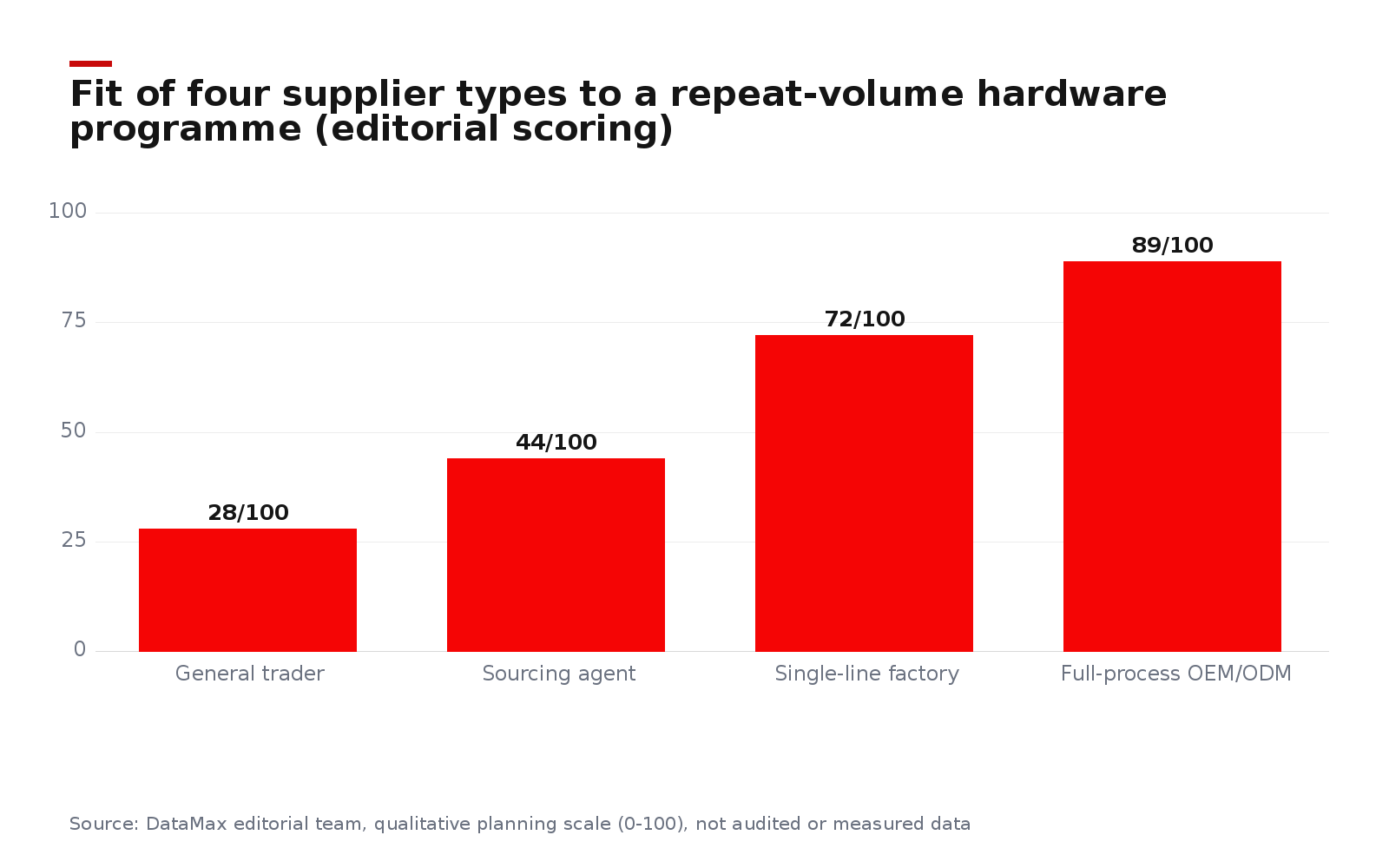
The same figures, in searchable form:
| Supplier type | Editorial score |
|---|---|
| General trader | 28/100 |
| Sourcing agent | 44/100 |
| Single-line factory | 72/100 |
| Full-process OEM/ODM | 89/100 |
Source: DataMax editorial team, qualitative planning scale (0-100), not audited or measured data.
| Model | SoC and graphics | OS | RAM/ROM | Decode | Display and ports | Primary fit |
|---|---|---|---|---|---|---|
| DS43H | Hisilicon Hi3751 quad 32-bit A53, Mali-450 | AOSP Android 9 (datasheet) | 1GB / 8GB (PDP) | 1080P@60 + VP9 10-bit (no 4K/AV1) | 43" TFT LED 1920x1080, 300 cd/sqm, 1500:1, 6ms, 89deg, backlight 50,000h, 0-50C; HDMI in, LVDS in, USB2.0 x4, RJ45 100M (1G opt), DC12V/2A, 989x578.5x60.3mm | Hospitality/hospital/restaurant wall signage |
| DP810U | Rockchip RK3562 quad A53 up to 1.2GHz, Mali-G52 1-Core-1EE | AOSP Android 11 (datasheet) | 2GB / 16GB (4GB optional) | H.265 4K@60, H.264/VP9 1080P@60 | 8"/10.1" capacitive touch, 1280x800 | 1920x1200, 1x3W; HDMI out, USB2.0 x2, TF x2 (up to 128GB), 3.5mm, RJ45 100M, DC12V/2A, Wi-Fi + BT5.0 | Bank/government/hotel desktop self-service kiosk |
| DP104R | Rockchip RK3566 quad A55, Mali-G52 1-Core-2EE | AOSP Android 11 or above | 2GB / 16GB (4GB optional) | H.265/H.264/VP9 4K@60 decode, 1080P encode, 8M ISP | 10.1" IPS capacitive touch, portrait 800x1280 | 1200x1920 (9:16), 5MP cam optional; HDMI out, USB2.0 x2, TF x2, 3.5mm, RJ45 100M, DC12V/2A, Wi-Fi + BT5.0 | Retail/hospitality portrait L-shape desk sign |
| DP02L | Rockchip RK3399 dual A72 + quad A53, Mali-T860 MP4 | AOSP Android 11 | 4GB / 32GB (8GB/64GB optional) | H.265 10-bit 4K@60, H.264 4K@30, Widevine L1/HDCP2.2 optional | 21.5" capacitive touch 1920x1080, 16:9 or 16:10, 16h/7d, 8MP camera, 2x3W + mic, 2x headset; USB2.0 x1 + USB3.0 x2, RJ45 1000M (PoE optional), Wi-Fi + BT5.0, DC12V/2A | Hospital bedside infotainment/care terminal |
Several cautions apply to this table. DS43H is identified as AOSP Android 9 by the datasheet; do not substitute a conflicting Android version. Its power option must be confirmed against the production datasheet. DP810U’s stated Bluetooth version and TF-slot count must not be replaced by conflicting hero-page values. DP104R must remain framed as portrait in the supplied facts. DP02L’s optional Widevine L1/HDCP2.2 status requires documentary confirmation for the ordered configuration.
Read the shortlist by deployment role. DS43H is a 43-inch wall-signage display with HDMI and LVDS inputs, so it belongs where the panel assembly itself is the endpoint. DP810U and DP104R provide HDMI output and touch-oriented form factors for kiosks and desk signs. DP02L is the bedside infotainment and care-terminal direction, with 1000M Ethernet, optional PoE, camera, audio, and headset integration. The model choice should therefore follow the display architecture, not simply the highest decode statement.
The memory options also require a written order line. A quoted 2GB / 16GB with 4GB optional, or 4GB / 32GB with 8GB/64GB optional, does not authorize the factory to treat every optional combination as an approved SKU. The buyer should name one RAM/ROM combination, the display size and resolution where applicable, and whether the optional camera or PoE feature is included. Confirm against the production datasheet.
The table deliberately preserves optional qualifiers. Widevine L1 and HDCP2.2 on DP02L are optional, not universal. The 1G Ethernet option on DS43H, 5MP camera option on DP104R, and PoE option on DP02L likewise require configuration confirmation. For a repeatable signage player programme, the quotation, test record, and packaging label should resolve those options consistently.
Where this matters in a deployment
The correct model direction follows the deployment surface, not the broadcast demo alone. A wall-mounted hospitality display, a desktop self-service kiosk, a portrait desk sign, and a bedside care terminal impose different constraints on mounting, interaction, output, networking, and operating hours. The following matrix maps those situations to procurement requirements and the relevant DataMax platform direction.
| Situation | Requirement | Model direction | RFQ evidence |
|---|---|---|---|
| Hospitality or hospital wall signage | Wall-format display, 1080p playback, integrated inputs and stable supply configuration | DS43H | Panel specification, input path, production SKU and dark-room record |
| Bank, government or hotel kiosk | Compact capacitive touch, desktop enclosure, 4K decode and controllable local media | DP810U | Touch test, media run, interface inventory and AOSP Android 11 build identity |
| Retail or hospitality desk sign | Portrait touch panel, 9:16 output and optional camera integration | DP104R | Portrait mode test, camera option status, output timing and orientation recovery |
| Hospital bedside infotainment | Extended-use terminal, Ethernet, optional PoE, protected media and peripheral integration | DP02L | Runtime profile, network test, optional DRM evidence and peripheral test |
| Operator-managed room endpoint | Managed application deployment, controlled identity and a documented update path | Confirm AOSP platform fit against the operator workflow | Enrollment method, application publication, remote-support policy and update procedure |
| Multi-site retail campaign | Identical content behavior, recovery and configuration across repeated installations | Confirm against the required touch and orientation | Frozen SKU, image version, field test and approved spare-unit process |
| Exhibitor or hospitality suite | Timed demo loop, controlled content and rapid fault recovery | Use the installation-specific display platform | Loop-duration result, reboot count, recovery time and local-content fallback |
| Clinical bedside information point | Continuous interface, headset and camera integration, network attachment | DP02L | Peripheral test, runtime record, network test and applicable software evidence |
An operator evaluating an IPTV or multicast service may need the endpoint to sit behind a defined IPTV workflow rather than merely play local files. The operator-tier Android TV box solution is relevant for comparing endpoint responsibilities, while the retail digital signage guide helps structure a site rollout.
For an AV or IT integrator, the demo should occur in the intended installation architecture: correct power, cabling, display timing, network path, content source, and recovery procedure. A bench-top playback can hide signal-conversion, cable, thermal, or network issues. For a venue operator, the operational question shifts to content recovery, unattended startup, replacement turnaround, and fleet visibility.
A factory quality-control station can provide the right scene for this verification: an inspector places a small black device into a test jig with illuminated indicators, with burn-in units on shelves behind it. The point is not decorative realism; it is the controlled transition from hardware inspection to recorded test evidence.

For an operator, the most consequential failure may occur before content appears. Address assignment, authentication, entitlement, DNS, multicast route, or application launch can stop the service even though local playback works. The acceptance test should include the real network path, the expected source, and the recovery sequence. It should also state whether the endpoint depends on Wi-Fi or wired Ethernet for the production use case.
For an integrator, installation variability often dominates the laboratory result. The reference display, scaling setting, cable, adapter, power rail, and ambient condition can differ across rooms. The procurement file should identify which parts are supplied and which are installer-controlled. A repeatable signage player demo therefore includes the installation checklist, not only a media playlist.
For a venue owner, uptime and service access matter. Ask how a failed unit is identified, replaced, imaged, and returned to service. The process should preserve the same SKU and application state, whether the replacement comes from spare stock or a later production lot. The hardware choice should be compatible with that operational model, while any DRM, operator approval, or hospital-software claim remains tied to documentary evidence.
The selection sequence that removes rework
Start with the output contract, not the model name. Define what the signage player must display, where it must be installed, how content arrives, which network interface is mandatory, how it is operated, and which optional features require evidence. Only then map those requirements to a platform and request a frozen quotation.
- Write the operating line Specify source type, codec, resolution, refresh rate, output interface, panel orientation, network path, power input, operating environment, and daily runtime.
- Freeze the commercial line Quote the exact model, SoC, OS baseline, RAM/ROM, storage, display option, camera option, connectivity, power option, and included accessories.
- Define the test line State the content set, loop duration, restart count, network interruption method, thermal observation, acceptance criteria, and evidence retained.
- Freeze the release line Identify firmware image, player build, signage content version, approved BOM, test record, serial or lot linkage, and change-approval process.
- Approve production equivalence Require confirmation that the sampled unit matches the ordered SKU and that no component or software change occurs without written approval.
The first message to DataMax should contain the deployment site, installation format, source media, codec and resolution target, panel or output resolution, refresh rate, network method, power requirement, expected operating duration, required model, and the evidence package requested. Use the inquiry page and paste those lines directly. If the immediate objective is a sample validation, order samples and identify the exact acceptance sequence rather than requesting a generic display unit.
The same discipline applies to DataMax’s engineering role. Confirm manufacturing scope, certification scope, and compliance documentation against the selected SKU. If customization is required, use custom development to define the boundary between standard hardware, firmware, application work, and customer-supplied services.
A paste-ready operating line might read: “Unattended portrait desk-sign deployment; local H.265/H.264/VP9 source; 4K@60 decode target; HDMI out; 1200x1920 native panel; Wi-Fi plus RJ45 100M; DC12V/2A; 14-hour daily duty cycle.” The line must then be completed with the actual model, exact RAM/ROM, orientation behavior, storage, application, and evidence requirement. The buyer should not copy a target that the display cannot natively render without confirming the intended scaling path.
The commercial line should prevent ambiguity between a family and an orderable configuration. Name the model, SoC, OS baseline, RAM/ROM, panel size and resolution, orientation, camera or PoE status, network interfaces, power input, dimensions, and accessories. For integrated displays, identify whether the test content enters through HDMI in or is generated by an internal player. For output products, identify the reference display and output mode used in acceptance testing.
The test line should be written so that two parties would reach the same result. Define the file names, codecs, resolutions, refresh rates, audio state, loop duration, restart count, interruption point, observation interval, and pass criteria. State whether a screenshot is supplementary or required, but do not substitute a screenshot for a recorded result. The evidence line should identify which records are per unit and which are sampled per lot.
The release line closes the loop between demonstration and production. It should identify the firmware image, player application, signage content, approved BOM, hardware revision, test record, lot identifier, packaging label, and deviation process. The approval step should state that the sampled unit and the ordered production unit are equivalent unless a written change is approved. A staged rollout can reduce risk when the programme has multiple sites: first verify the frozen image, then extend the same acceptance sequence to later lots.
For decoding decisions, use the H.265 Android TV box guide to structure codec questions and the hotel meeting-room signage guide to identify display and installation requirements before the RFQ is issued.
Failure modes that reach the field
The most damaging mismatch is an unresolved specification conflict. A page may claim one Android version while the datasheet states another; a hero image may show landscape while the production specification is portrait; an optional DRM statement may be read as a universal certification. These conflicts turn a successful demo into a procurement dispute at release.
Field trap
A brochure image can conceal the production orientation. If the approved requirement is portrait 9:16, the sample, firmware layout, output timing, mounting method and recovery procedure must all be verified in portrait mode.
Decode capability can also be overstated. A statement of 4K@60 may refer to decoding, while the connected display remains 1080p. The procurement file must record the source codec, decoded resolution, output mode and panel mode separately. Otherwise, a signage player may pass a visual demo but fail an automated or operator-level acceptance test.
Thermal, network, and power behavior can remain invisible during a short presentation. Run the content long enough to represent the intended duty cycle, restart the unit repeatedly, reconnect the specified interface, and verify that no stale screen, application crash, storage issue, or recovery delay remains outside the agreed tolerance. A signage player that requires manual recovery at every boot is unsuitable for unattended deployment unless that behavior is explicitly accepted.
Field trap
Do not combine a display SKU, power option, optional module, and certification claim from different catalogue entries. The cost is not only replacement inventory; it can include firmware rework, failed installation, unavailable service parts, and rejected certification evidence.
The final field risk is evidence drift. A factory test proves a unit, but the release file must prove that the shipped unit belongs to the same controlled configuration. Require versioned firmware, approved BOM, manufacturing records, test disposition, and deviation approval. Where a fact is absent from the production datasheet, confirm against the production datasheet rather than filling the gap from a hero image or a comparable model.
Other failures arrive through system boundaries. A media file may be unsupported despite a successful test with a different container or profile. Storage may fill because cached content, logs, and updates were not bounded. A touch display may lose calibration after a power interruption. Ethernet may negotiate a lower rate than the installation requires. A camera or peripheral may be represented as optional in one document and included by implication in another quotation. Each condition needs an owner and an acceptance rule.
The recovery model must also be realistic. State whether a failed application relaunches automatically, whether the device restores the last content, whether an operator can replace the unit without opening the enclosure, and what evidence is needed to return a spare to service. “Works after reboot” is a diagnosis, not a field procedure. The procurement file should define acceptable recovery time and the trigger for escalation.
Do not confuse certification scope with product capability. A badge, operator approval, DRM option, or hospital-software statement must apply to the exact ordered configuration and intended service. If the evidence is absent, the buyer should treat the capability as unconfirmed. That discipline protects the signage player selection from relying on portfolio-level claims that cannot be transferred to the production SKU.
For broader factory capability, review factory quality and contact DataMax with the frozen RFQ lines. The correct final decision is not that the demo looked convincing; it is that the signage player can be built, tested, released, and replaced against the same documented specification.
Further reading
- Commercial Display Player: What It Is and What It Is Not
- H.265 HEVC Android TV box guide
- Widevine L1 certification guide
- Dolby Atmos Android TV box guide
- TV box vendor selection checklist
- 43-inch hospital digital signage
- Compact kiosk display
FAQ
What makes a signage player demo procurement-grade?
A demo becomes procurement-grade when the tested model and configuration match the proposed order. Record the SoC, OS, RAM/ROM, display mode, decode target, output interface, network method, power input, firmware build, and test procedure. A timed playback and power-cycle record add evidence, but they do not replace configuration control.
Does 4K@60 decode prove a 4K display output?
No. Decode, output, and native panel resolution are separate stages. A device may decode a 4K@60 source, output a lower resolution, or drive a higher-resolution panel through a separately specified interface. The RFQ should list source format, decoded resolution, output mode, and panel resolution independently.
Should an Android signage player use AOSP or Google Android TV?
The choice depends on device ownership, application distribution, service integration, and operator requirements. AOSP Android may provide a controlled platform baseline, while Google Android TV may align with a managed television ecosystem. Compare OS baseline, update method, app deployment, remote management, and certification requirements; use the AOSP versus Google Android TV guide to structure that comparison.
What factory evidence should accompany a repeat-volume order?
Request the approved BOM, SMT and AOI records, aging criteria, dark-room results, final functional-test records, firmware identity, failure disposition, and production-lot linkage. State whether each record applies per unit or per lot. The evidence must support the exact ordered SKU rather than a broader product family.
Which DataMax model fits a portrait desk-sign deployment?
The supplied facts identify DP104R for retail and hospitality portrait L-shape desk signs. Its stated display options are 10.1-inch IPS capacitive touch in portrait 800x1280 or 1200x1920, 9:16. Confirm the production datasheet, including any camera and connectivity options, before ordering.
How should a buyer request samples for broadcast-demo framing?
The first request should identify the model, exact SKU, source codec, target output, panel resolution, refresh rate, network interface, power requirement, runtime, and required factory evidence. The acceptance sequence should include repeated playback, restart, reconnect, and the relevant display check. Use order samples and attach those lines to avoid receiving a generic configuration.
What should happen when a production change is proposed?
Pause release of the affected configuration and identify the model, component, firmware, application, documentation, and test implications. The supplier should provide the proposed change, rationale, effect on the frozen SKU, revised verification evidence, and effective lot. No change should reach the field solely through a catalogue update or informal approval.
How can a buyer verify unattended restart behavior?
Require a scripted sequence that removes power, restores it, starts the installed content, reconnects the required network, and confirms that the approved image appears without manual intervention. Repeat the sequence under the specified operating conditions and retain the result against the exact SKU. Define the accepted recovery delay and the action required when that limit is exceeded.


