

Before the terminology: the procurement decision
“DRM L1,” “DRM L3,” “HDCP 2.2,” and “PlayReady” are not interchangeable labels. They describe different trust boundaries, output constraints, licence flows, and implementation obligations. A supplier’s statement that a device is “DRM ready” therefore establishes almost nothing for an operator’s service contract.
The direct answer for an android tv box procurement is straightforward: specify the required DRM implementation by provider, security level, device certificate status, resolution, output path, and service profile rather than accepting a single checkbox. Widevine L1 keeps content processing, cryptography, and control inside a Trusted Execution Environment; Widevine L3 provides no TEE, placing protection in the host operating system, while a hardware cryptography engine can improve performance without creating L1 security. These definitions come from Google’s Widevine DRM architecture documentation and must be matched to the exact service level required by the streaming operation.
Commercial playback also requires a separate output path. Widevine or PlayReady can protect the software flow to the application, but HDCP governs the protected AV path toward a display. A set-top box may therefore combine Widevine L1 and HDCP 2.2, while a different product uses Widevine L3 with an optional HDCP configuration. The quotation must separate application DRM, device provisioning, display output, middleware integration, and commercial launch approval.
For a paper shortlist, require the following lines before comparing hardware: named DRM provider and level; certified device or product-line status; secure-boot and key-provisioning architecture; maximum protected resolution and frame rate; supported output and copy-protection version; Android CDD or CTS route if required; per-unit identity mechanism; licence-server responsibility; and evidence required for acceptance. DataMax can then map those lines to a platform, but final production capability must be confirmed against the production datasheet.
How to choose, step by step
Start with the content contract rather than the box. Identify each application, playback engine, DRM provider, licence server, catalogue tier, and commercial launch window. If one tier needs Widevine L1 and another is an internal preview service using L3, model them as separate certification tracks. Combining requirements into one line—“Android TV, 4K, DRM, 100M Ethernet”—creates more ambiguity than it removes.
- Define the protected stream Record codec, resolution, frame rate, dynamic range requirement, and whether the same service must run on operator middleware, Android TV apps, or an OTT white-label build.
- Name the DRM obligation Write “Widevine L1,” “Widevine L3,” “PlayReady,” or an approved combination explicitly. Avoid the unqualified term “DRM” in the RFQ.
- Fix the trust boundary For L1, ask where the TEE boundary sits and how the implementation is enabled. For L3, ask how host-OS protection and hardware crypto acceleration are configured.
- Define the output path State HDMI version, HDCP requirement, whether external display enforcement is tested, and the expected result for unsupported displays or sources.
- Define device identity Require a documented provisioning route for device certificates, key delivery, serial-number mapping, revocation, and replacement handling.
- Define operational acceptance Specify the test catalogue, duration, network conditions, error-log collection, and who signs the launch report.
A pasteable RFQ line is: “Supply one proposed platform and its production configuration stating Widevine provider and security level, PlayReady status if required, certified-device status, protected codec/resolution/frame-rate ceiling, HDMI and HDCP configuration, certificate provisioning method, Android AOSP version, operator middleware integration, and the acceptance-test evidence package.”
Procurement rule: A chipset name, codec capability, and DRM label together do not prove that one production SKU passes a commercial stream. The supplier must connect those fields to the exact firmware, certificates, display path, and acceptance procedure.
The broader selection method for an android TV box for ISPs helps separate operator middleware, white-label OTT, and entertainment performance requirements before the DRM comparison begins. For example, an IPTV operator using a managed middleware image should name its image identifier, application package, licence-server topology, and update policy in the RFQ. An OTT buyer should instead identify the target app build, store or side-loading model, account entitlement mechanism, and whether multiple DRM providers share one playback engine. A cloud-gaming operator may need a low-latency path that differs from the DRM decision, so the media pipeline and networking criteria should be recorded separately rather than hidden under a codec line.
The selection sequence should also distinguish a pilot from a scaled fleet. A pilot may accept one hardware revision, one firmware image, and one display model. Fleet deployment adds serial-number traceability, spare-unit provisioning, certificate replacement, regression testing, end-of-life planning, and coordinated dispatch. Those obligations belong in the RFQ because they affect the supplier’s operating process and the programme schedule. A android tv box cannot be shortlisted responsibly by display specification alone: the protected stream must remain tied to the same application, firmware, identity, and output configuration that will ship.
The broader selection method for an android TV box for ISPs helps separate operator middleware, white-label OTT, and entertainment performance requirements before the DRM comparison begins.
What goes wrong after the PO
The most common post-PO failure is semantic: procurement accepts “L1” from a sales response, while operations discovers that the certified build, firmware, certificate batch, or service application was not the configuration evaluated. Another failure is output blindness. A hardware DRM implementation may pass application-level tests while the chosen TV path, adapter, display, or scaling mode prevents the expected protected presentation.
Field trap
A “PlayReady” entry without a profile, hardware requirement, app support statement, and licence-flow test cannot be treated as equivalent to PlayReady Device certification for the deployment. Confirm the applicable Microsoft profile and production device requirements against the production datasheet.
Field trap
Do not infer 8K output from a marketing label. The supplied DataMax DM21T and DM22Q facts cap relevant output and decode at 4K, so an 8K claim creates an avoidable acceptance dispute. Confirm against the production datasheet.
Other divergence points appear between quotation and shipment. A quoted RAM and ROM configuration may not include the operator image, middleware partition, secure storage, root keys, bootloader state, or update partitions. A model may include optional RJ45 at 1G, but the quoted SKU may contain 100M. “Optional” DRM may mean a different production BOM or a different certification status. These details need explicit SKU treatment rather than a generic product-family reference.
Firmware replacement can also invalidate a device’s position in a certified fleet. A patch may alter the media path, Widevine module, CDM, device attestation, certificate handling, or display negotiation. A controlled upgrade therefore needs a regression script, an approved image identifier, and a rollback rule. Without those controls, the original evidence applies only to an earlier build.
Commercial uncertainty often sits outside the physical box. The licence server may require device identity, app identity, account entitlement, concurrent-stream rules, heartbeat behavior, and regional policy. The hardware supplier may own only part of that chain. Name the responsible party for certificates, security provisioning, licence operation, blacklist or revocation behavior, and first-line diagnostics.
The contractual remedy should attach to observable outcomes: exact approved model, exact firmware baseline, protected stream matrix, failed-playback rate, display-path behavior, and defect-replacement workflow. Do not rely on “DRM compliant” as the acceptance criterion.
A second failure appears when the buyer treats a successful laboratory stream as proof that every subscriber television will work. Retail displays, integrated operators, capture cards, splitters, and long HDMI runs can introduce behaviour that is absent from the reference bench. The acceptance plan should include the actual display models and adapters used by the operator, or at minimum define a controlled display matrix. It should also specify whether black frames, reduced resolution, failed playback, or a visible copy-protection message are acceptable outcomes. Without those definitions, a display-path failure can become an endless debate between the hardware supplier, application team, and installer.
A third failure is certificate provisioning treated as an invisible factory task. If serial numbers, certificates, licences, and firmware baselines are not linked, the operator cannot reliably replace a failed unit, revoke a compromised unit, or reconstruct what was tested. During a pilot, that may remain a manual spreadsheet operation. During a regional rollout, the same process becomes an operational control with provisioning yield, exception handling, and audit evidence. The RFQ should therefore identify whether provisioning occurs at manufacturing, in the operator warehouse, or during installation, and it should define the responsible party for failed provisioning.
Do not confuse a firmware update with a certified-product change. A bootloader revision, Android security patch, Widevine module, CDM, application package, display driver, or middleware release can each alter the tested chain. Freeze the commercial baseline during acceptance, attach an identifier to that baseline, and define which changes require a targeted regression test versus a full stream-matrix rerun. The cost of an uncontrolled branch is not limited to engineering time; it includes repeated field triage, replacement stock, and uncertainty over which subscribers experienced the issue.
Verification you can ask for on paper
Factory control begins at the bill of materials, where the exact SoC, memory configuration, secure-storage components, interfaces, and production peripherals are frozen. The factory should preserve a trace from component lot and line serial to the finished-unit record. For DRM specifically, that record needs the software image, device-certificate status, provisioning result, and display configuration attached to the unit or its batch.
- Incoming and SMT control Review approved-component records, production BOM alignment, programming logs, and traceability between the programmed identity and the serial number.
- Automated optical inspection Use AOI evidence to inspect assembly defects around the processor, memory, interfaces, power path, and other board features. AOI does not certify DRM, so keep board inspection and security testing as separate records.
- Software and provisioning control Record image version, bootloader state, root-key handling, certificate issuance, provisioning outcome, and failed-unit disposition.
- Aging and functional test Exercise power, boot, storage, HDMI, network, decode, and application paths. Include a protected-content matrix where the commercial licence environment is available.
- Dark-room or controlled-display verification Check whether the intended output path presents protected content as required and whether unsupported displays fail or degrade in the documented manner.
- Audit trail and release Link test records to serial numbers, firmware baseline, certificate identifiers, inspection status, and the release decision.
Evidence request: Ask for a sample evidence index showing the record type, owner, retention period, serial or batch linkage, and approval gate. Request a redacted sample rather than only a process description. Production fields remain subject to confirmation against the production datasheet.
Third-party certification should be separated from internal testing. A certificate or listing establishes a specific relationship between a device identity, software, provider, and authorized use. It does not automatically validate an operator’s middleware, application entitlement, display setup, or catalogue. The acceptance package should therefore align provider evidence with the operator’s own stream matrix.
DataMax factory capabilities can be discussed through the factory quality page, while the final acceptance protocol must reflect the chosen model, production configuration, and deployment environment.
The evidence index should include the document owner and the point at which a record can block release. For example, a missing image checksum, an invalid provisioning result, or an unresolved AOI defect should have a defined disposition. A protected-stream test should identify the application version, content tier, codec, resolution, frame rate, DRM provider, DRM level, display type, HDMI mode, network condition, and result. That level of detail lets the operator distinguish a content-policy rejection from a media-pipeline failure, an output-protection failure, or a network timeout.
Sampling should be defined rather than implied. The buyer can request full functional testing for every unit, automatic testing with audit sampling, or a controlled sample for specific checks. Each method has a different cost and detection profile. For identity-bound DRM, a small sample cannot prove that every unit was provisioned correctly; if the certificate is attached to the individual unit, traceability and provisioning records become central. For a common firmware and device identity, sampling may be viable, but the sampling rule still needs statistical criteria, defect response, and retest authority.
A factory test report should also distinguish “pass,” “pass with limitation,” and “not tested.” For example, an HDMI functional test may pass while a protected external-display scenario remains untested. Labeling prevents a general assembly result from being interpreted as DRM launch approval. The signed release record should then state exactly what was accepted, which optional configuration was fitted, and which application, firmware, and display matrix supported the result.
Two routes, one bill of differences
Two procurement routes often produce the same visible playback result but carry different evidence and lifecycle burdens. Route A treats DRM as a device procurement line and verifies a defined production configuration during hardware acceptance. Route B treats DRM as a managed service commitment linking certification, fleet identity, firmware maintenance, certificates, and application integration through the programme lifecycle.
| Decision field | Route A: configuration acceptance | Route B: managed lifecycle commitment |
|---|---|---|
| Security boundary | Exact provider and level recorded per SKU | Exact provider and level governed across approved models |
| Device identity | Provisioning record linked to production serial | Provisioning, rotation, revocation, and replacement governed |
| Acceptance | Protected stream and display-path matrix | Matrix plus fleet regression and release governance |
| Software changes | Approved image and retest rule | Branch policy, regression cadence, and rollback ownership |
| Commercial dependency | Supplier evidence plus operator test | Named ownership across provider, middleware, and licence service |
| Commercial exposure | Unit acceptance and defect remedy | Programme-wide change, support, and end-of-life coordination |
The route choice should follow the deployment. A controlled pilot with one operator image may begin with Route A, but a scaled fleet with recurring firmware branches, regional content tiers, and multiple display environments needs the lifecycle controls in Route B. The visible device cost is only one line in that difference; certification work, protected-content testing, certificate handling, and release governance determine the operating burden.
The lifecycle chart below uses an editorial qualitative planning scale. It is not measured performance and must not be used as a substitute for a contractual support statement.
Before committing, ask the supplier to define the firmware branch, security-update responsibility, certificate-service dependency, end-of-life notice mechanism, and spares window in the agreement. The numbers above are planning aids; the contractual statements determine procurement exposure.
Route A is often suitable for a closed demonstration, a small hospitality trial, or a single application controlled by one software team. It can answer whether a specific model and build can decode and display an agreed content set. Its limitation is that acceptance can expire as soon as the image, application, certificate, display environment, or licence policy changes. The buyer must therefore define how long the accepted configuration remains valid and what event triggers retesting.
Route B is suited to multi-site service, operator middleware, and fleets that require replacement continuity. Its additional work must be mapped to named artefacts: a supported model list, an approved firmware branch, a compatibility matrix, a certificate lifecycle procedure, a security-patch cadence, an incident route, and an end-of-life process. Without those artefacts, “managed” remains a marketing description rather than an operational commitment.
The bill of differences also affects spare units. Under Route A, a replacement may be accepted only after a basic functional check because the original configuration is simple and frozen. Under Route B, a spare must enter the same identity, provisioning, firmware, and regression process as the deployed fleet. The operational buyer should ask whether a spare can be shipped quickly without bypassing the controls that make it a valid substitute.
How the requirement actually works
Widevine L1 and L3 differ at the device trust boundary. Google’s architecture overview defines L1 as performing all content processing, cryptography, and control within the TEE. L3 has no TEE on the device; protection is implemented in the host OS, and a hardware crypto engine improves performance only, not security. That distinction affects the threat model, implementation effort, and what an operator should request as evidence.
Source: Google, Widevine DRM Architecture Overview
The protected flow is more than application decryption. A CDM obtains licence material according to the provider’s policy; the app supplies entitlement and device context; the device performs the required security operations; and the media pipeline presents protected output. During playback, policy decisions may depend on output protection, resolution, screen state, and other conditions defined by the service. The exact sequence and available reports depend on the selected provider, API, device implementation, and application.
- Application request The player identifies the requested stream and supplies service-specific entitlement data.
- CDM and device context The client module interacts with the protected environment or host-OS implementation defined by the security level.
- Licence exchange The licence server evaluates entitlement, account policy, device identity, and output-related conditions.
- Protected rendering The media pipeline processes the protected stream within the selected security boundary.
- Display enforcement The AV path negotiates the display and applies the required copy-protection mechanism such as HDCP.
HDCP operates on the display output path and is not another name for Widevine. A supplier can offer Widevine L1 plus an optional HDCP configuration, but the buyer still needs the exact production option, supported display behavior, and test result. PlayReady is a separate DRM ecosystem with its own device, profile, and application requirements.
AOSP is the software baseline in the listed DataMax models, not proof of an operator certification programme. Android CDD and CTS support may be relevant to a deployment and operator application, but the applicable route and test status must be established for the exact product and release. Confirm against the production datasheet rather than deriving it from an AOSP version.
L1 and L3 are security classifications, not content-quality tiers. An L3 implementation does not automatically mean lower picture quality, and an L1 implementation does not guarantee unrestricted resolution, frame rate, dynamic range, or output compatibility. Those properties depend on the codec path, hardware decoder, protected rendering implementation, display negotiation, and service policy. A procurement should keep two matrices separate: one for the DRM security boundary and another for media capability.
The application also controls parts of the chain. It identifies the requested asset, selects the relevant CDM, supplies token or entitlement data, handles licence-server errors, and presents user-facing recovery behavior. A device can have the required security level yet still fail because the application requests the wrong protection configuration, omits a device binding step, or cannot recover after a licence timeout. Acceptance should therefore use the production application rather than a generic test player whenever the commercial service is available.
Device identity is another architectural dependency. The chosen model must show how per-unit or per-product credentials are generated, stored, associated with the serial number, renewed, and revoked. Where provisioning is performed in a factory, the process needs reconciliation after programming and assembly. Where provisioning occurs in the operator’s depot, the process needs an audit trail and an exception path for units that fail. The RFQ should identify the owner, timing, and evidence for each step.
Finally, content policy can change without a hardware change. A licence server may impose account, region, concurrency, output, or content-tier rules. The correct buyer response is not to infer those rules from the DRM level, but to document them and test the relevant failure behavior. This separates a legitimate refusal by the service from a defective decoder, certificate, middleware, or display configuration.
The platform shortlist with datasheet values
The four supplied platforms differ in operating system, processing tier, output-related capability, and stated DRM options. Every value below comes directly from the provided product facts. Optional entries require SKU confirmation against the production datasheet.
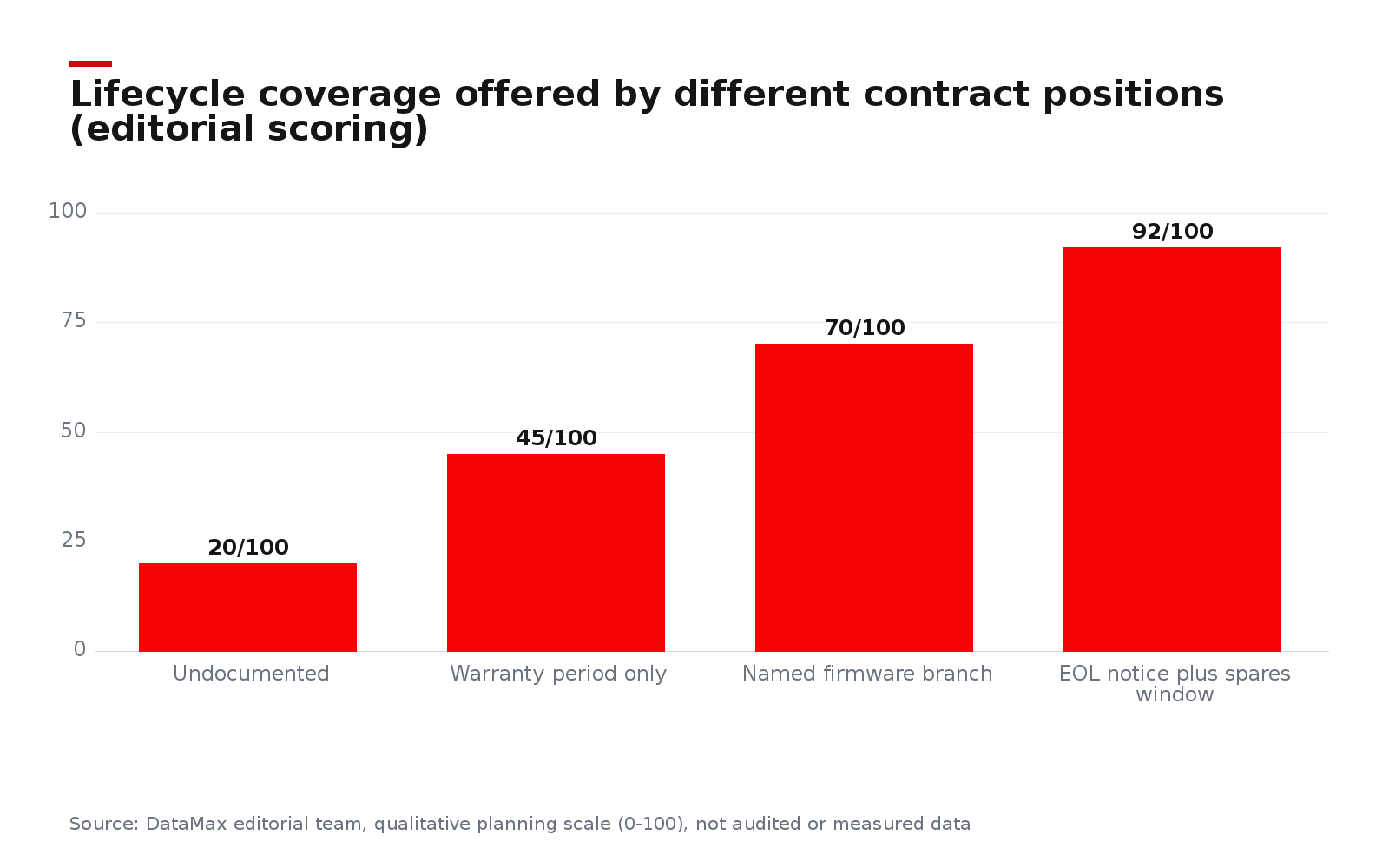
The same figures, in searchable form:
| Contract position | Editorial score |
|---|---|
| Undocumented | 20/100 |
| Warranty period only | 45/100 |
| Named firmware branch | 70/100 |
| EOL notice plus spares window | 92/100 |
| Model and fit | SoC and OS | RAM / ROM | DRM statement | Decode and interface facts |
|---|---|---|---|---|
| DM21P 4K IPTV / operator middleware set-top box | Amlogic S905Y4, quad Cortex-A35 AOSP Android 11 | 2GB / 8GB 4GB; 16/32/64GB optional | Widevine L1 / PlayReady / HDCP 2.2 optional | AV1 [email protected]; VP9/H.265 4K@60; H.264 4K@30 HDMI 2.0b out x1; USB2.0 x2; TF; S/PDIF; 3.5mm AV; RJ45 100M; Wi-Fi6 2x2 + BT5.4; DC 5V/2A |
| DM21S 4K Android TV box for IPTV/OTT white-label | Amlogic S905Y5, quad Cortex-A55 AOSP Android 14 | 2GB / 16GB 2/4/8GB; 16/32/64GB optional | Widevine L1 / PlayReady optional; Dolby Vision/DTS | AV1 / H.265 [email protected] 4K@60 HDMI 2.0b out; S/PDIF; AV; USB2.0 x2; TF; RJ45 100M (1G optional); Wi-Fi6 2x2 + BT5.4 |
| DM21T Premium UHD / cloud-gaming box | Amlogic S905X5, quad Cortex-A510 (ARMv9) AOSP Android 14 | 4GB / 64GB family options | Widevine L1 / PlayReady optional | H.266/VVC [email protected] 4K@120; AV1/VP9/H.265 4K@120; AVS3 4K@120; H.264 4K@60; inline AI-SR HDMI 2.0b out (no HDMI in); USB2.0 x1 + USB3.0 x1; TF; S/PDIF; AV; RJ45 100M (1G opt); Wi-Fi6 + BT5.4 |
| DM22Q Gaming-oriented Android TV box | Amlogic S905X5M, quad Cortex-A55 up to 2.5GHz AOSP Android 14 | 4GB / 64GB 2/4/8GB; 16/32/64GB optional | Widevine L1 / PlayReady optional; Dolby Vision/DTS | AV1/H.265 L5.1 4K@60; inline AI-SR (no NPU TOPS stated) HDMI 2.0b out; USB2.0 x2; TF; S/PDIF; AV; RJ45 100M (1G opt); Wi-Fi6 2x2 + BT5.4 |
DM21P is the clearest platform to evaluate first when operator middleware and an explicit HDCP 2.2 option matter. DM21S aligns with an Android 14 IPTV or OTT white-label direction and lists Widevine L1 plus optional PlayReady and Dolby Vision/DTS. DM21T extends codec and frame-rate capability for premium UHD or cloud-gaming scenarios, but its HDMI output remains HDMI 2.0b and there is no HDMI input. DM22Q offers gaming-oriented positioning with Widevine L1 and optional PlayReady, while its stated decode maximum is 4K@60.
None of those statements independently establishes a complete commercial deployment. Production certification, middleware support, licences, display behavior, and SKU-specific options remain acceptance items.
The table should be used as a controlled shortlist, not as an interchangeability matrix. Each model carries a different operating-system baseline, memory position, decoder list, interface set, and option structure. The buyer should write the required field into a quotation by model and SKU. For example, an operator needing a stated HDCP 2.2 option should anchor that request to the DM21P production configuration rather than writing “HDCP 2.2” in a generic platform list. Likewise, a request for 4K@120 media capability points to DM21T and still requires confirmation of the complete protected-output path.
The lifecycle score beside the product table is also not a model certification. It ranks four editorial contract positions for documentation completeness. A procurement team can use it to identify missing contract language, but the DataMax platform choice still depends on the actual service, middleware, display, and production evidence. In particular, no supplied fact establishes an end-of-life notice period, spares window, or named firmware branch for any model. Those programme terms must be agreed separately and confirmed against the production datasheet.
A useful shortlist worksheet contains five columns: model, exact SKU, required DRM configuration, accepted firmware, and acceptance owner. Each proposed android tv box receives one row, while shared assumptions remain visible above the table. The worksheet prevents an optional DRAM or network feature from being accidentally omitted during quotation and makes clear which fields are product facts, which are buyer requirements, and which remain supplier commitments.
Where this matters in a deployment
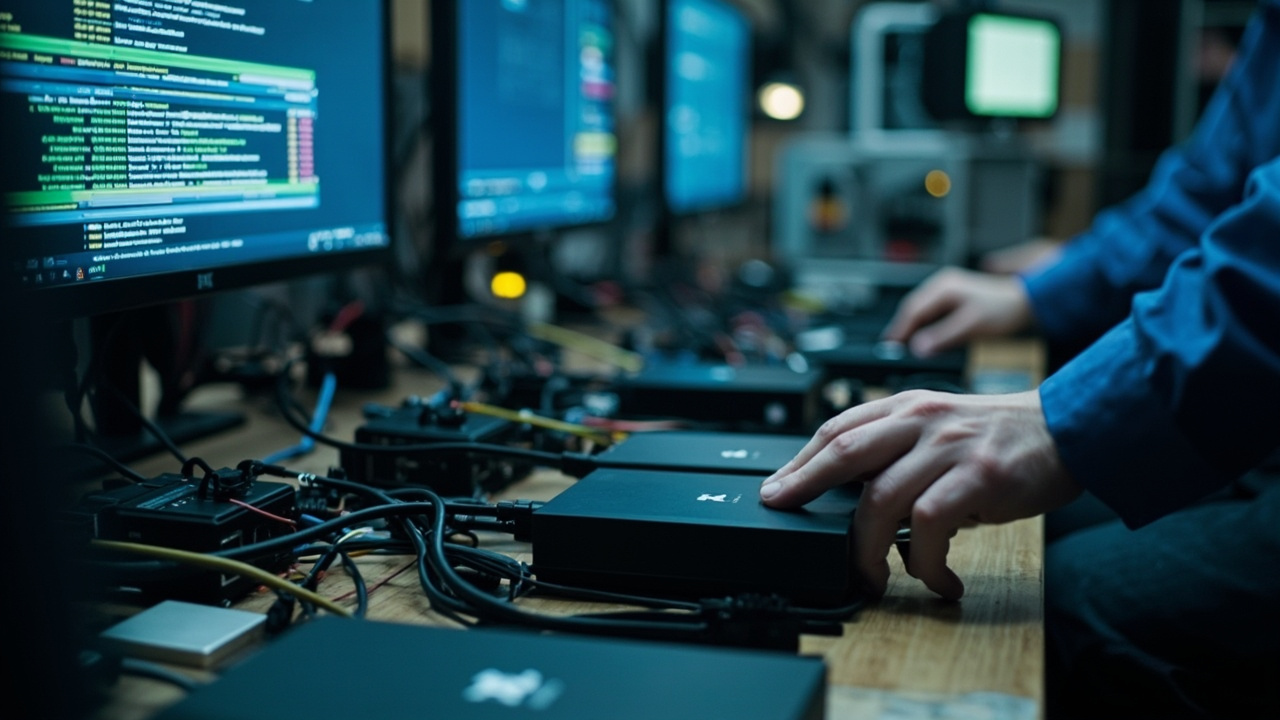
The scene is routine but unforgiving: a telecom engineering lab contains rows of small black set-top boxes connected by HDMI and network cables, with test monitors, RF measurement equipment, and engineers adjusting devices under neutral light. This is where a specification ambiguity becomes a stream failure.
| Situation | Primary requirement | Model direction | Field decision |
|---|---|---|---|
| Operator IPTV with middleware | Stable software baseline, network path, operator identity, protected stream acceptance | DM21P or DM21S | Confirm Android, middleware, Widevine L1, and production SKU in writing |
| OTT white-label service | Android 14 application path, Widevine L1, optional PlayReady, flexible branding | DM21S | Validate the intended application and optional DRM configuration |
| Premium UHD or cloud-gaming service | 4K@120 decode path, inline AI-SR, premium media pipeline | DM21T | Confirm output mode and protected-content limits; do not claim 8K |
| Gaming-oriented launch | 4K@60 media path, Widevine L1, optional PlayReady, Dolby Vision/DTS | DM22Q | Confirm the production ROM, network option, and service certification |
| Integrated AV installation | HDMI output, display interoperability, stable DRM playback | Selection by validated output path | Test the actual display, adapter, scaler, and protected stream |
| Venue signage or digital-signage player | Fixed installation, unattended restart, remote management, scheduled playback | Direction depends on managed playback and interface needs | Separate general media playback from operator-grade protected-content obligations |
For an operator, the decisive event is the production acceptance matrix across streams, displays, networks, and firmware baselines. For an integrator, the decisive event is proving the complete display path rather than the decoder alone. For a venue operator, the decisive event is restart recovery, management, and whether protected content is actually part of the service contract.
DataMax can support the platform selection and manufacturing discussion, but the deployment owner must close provider, middleware, certificate, and display obligations. Send the first RFQ message to the inquiry team with the required DRM provider and level, target resolution, production quantity context, operator middleware version, display requirements, and acceptance evidence list. For sample evaluation, use the sample request page and identify the exact model, optional configuration, firmware baseline, and protected stream matrix.
An IPTV operator should run the actual middleware build against its licence service, verify account and device entitlement, and test representative stream tiers before release. The integrator must test the final television or projector, scaling mode, adapter, and cable path. A venue operator should test power loss, restart recovery, scheduled playback, and remote-management behaviour separately from the protected-stream matrix. These are different acceptance owners even when they use the same hardware.
A staged deployment reduces ambiguity without weakening the final gate. First, use a controlled sample to confirm the hardware, application, and display combination. Second, freeze the approved configuration and record every optional feature. Third, run the production acceptance matrix against the intended service. Fourth, connect serial numbers to firmware and provisioning records. Fifth, release the fleet against the signed baseline. For an android tv box programme, this sequence creates a traceable decision rather than a collection of successful demonstrations.
The venue case also exposes where general playback and protected playback diverge. A digital-signage player may show ordinary local or network media without an operator-grade DRM service, so its procurement may centre on management, storage, restart behavior, and display compatibility rather than Widevine L1. If the venue later adds subscription or transactional content, the protected-content requirement changes and the acceptance plan must be reopened. Do not transfer a DRM conclusion from consumer signage to operator IPTV without evidence.
Further reading
- Guide android tv box for isps
- DRM compliance solutions
- Telecom solutions
- Amlogic Android TV boxes
- Google TV devices
- DataMax DM21P specifications and fit
- DataMax DM21S specifications and fit
FAQ
Is Widevine L1 always preferable to L3?
Not universally. L1 provides a stronger hardware-backed security boundary by keeping content processing, cryptography, and control within the TEE. L3 may be operationally appropriate where the service, threat model, and device implementation support host-OS protection. Select the level required by the content contract, provider requirements, and security assessment rather than treating L1 as a universal replacement for L3.
Does Widevine L1 guarantee HDCP 2.2 output?
No. Widevine and HDCP operate at different layers. Widevine protects the software content flow, while HDCP protects the AV output path. A device must be configured and tested for the required HDCP version across its complete HDMI chain. Confirm the exact production option and protected-display behavior against the production datasheet.
Can a chipset codec list prove 4K DRM playback?
No. Codec support, DRM certification, output bandwidth, display negotiation, application behavior, and protected-content limits are separate constraints. A procurement should require a tested matrix connecting codec, resolution, frame rate, DRM level, HDMI mode, and firmware baseline to each accepted model.
What production evidence should an operator request?
Request the approved model and SKU, firmware identifier, device-certificate status, provisioning records, protected-stream test matrix, display-path results, and audit trail from assembly through release. For fleet management, also require the firmware branch, change-control process, regression responsibility, rollback rule, and end-of-life notice mechanism.
Do optional DRM features belong in the final quotation?
Optional features require an exact production SKU and written availability condition. The quotation should identify which optional DRM, PlayReady, HDCP, Dolby Vision, DTS, memory, and Ethernet configurations are included. A family-level statement is insufficient for acceptance because production BOM, firmware, and certification scope can diverge.
Which DataMax platform fits a 4K operator deployment?
DM21P is defined for 4K IPTV and operator middleware, while DM21S is defined for 4K IPTV/OTT white-label use. Both list Widevine L1, but PlayReady and HDCP 2.2 are optional on DM21P, while PlayReady is optional on DM21S. Select using the complete deployment matrix and confirm production configuration against the production datasheet.


