

The procurement answer in one screen
android tv box DRM procurement in the UAE should be decided by app playback path, hardware trust boundary and service lifetime, not by a headline security label. Widevine L1 keeps content processing, cryptography and control inside the device Trusted Execution Environment; Widevine L3 provides protection in the host OS when no TEE is present. A supplier’s “L1” claim therefore needs to be tied to the exact device configuration, firmware, display path and operator application. For an UAE IPTV deployment, request device-level evidence rather than accepting a platform-wide declaration.
| Decision point | Operator requirement | Procurement evidence |
|---|---|---|
| Playback route | Protected IPTV, OTT or transactional streaming | Named app, content type, screen and audio output |
| Device trust | TEE-backed Widevine L1 where required | Production hardware identifier and L1 playback test record |
| Software baseline | Supported AOSP release and operator middleware | Software Bill of Materials, image identifier and update policy |
| Lifecycle | Documented firmware and end-of-life handling | Named branch, security-update coverage and notice terms |
| Commercial configuration | Approved model, memory, network and optional features | Bill of materials linked to serial number and test image |
For DataMax, all 4 listed platforms state Widevine L1; DM21P additionally lists HDCP 2.2 as optional, while L3 is not listed as a DataMax configuration. Select the platform by operator workload, then require the factory to prove the production configuration. This angle extends the broader android tv box for ISPs guidance with DRM-specific acceptance criteria.
The short answer has 3 parts. First, treat Widevine L1 as a device-and-image acceptance requirement, not a catalogue headline. Second, match the DataMax platform to the workload rather than DRM level: DM21P for operator middleware, DM21S for IPTV/OTT white label, DM21T for premium UHD and cloud gaming, and DM22Q for gaming-oriented deployment. Third, contract the evidence chain: model, board, memory, optional features, firmware, application, content, output route, unit identifier and signed playback result.
A buyer should also avoid treating L1 and L3 as the only procurement variables. Codec profile, HDMI path, network provisioning, middleware compatibility and fleet lifecycle can prevent service launch even when the DRM level is correct. The acceptance test must therefore reproduce the operator’s actual delivery chain from image installation to the nominated television and audio equipment.
Real DataMax platforms, field by field
The product facts support four distinct deployment positions. They do not provide Widevine certificate identifiers, TEE implementation details, update cadence or individual UAE operator approvals. Those variables must be confirmed against the production datasheet and a device-level test report before purchase.
| Model | SoC and OS | RAM / ROM | DRM and decode | Ports and connectivity |
|---|---|---|---|---|
| DM21P | Amlogic S905Y4, quad Cortex-A35; AOSP Android 11 | 2GB / 8GB (4GB; 16/32/64GB optional) | Widevine L1 / PlayReady / HDCP 2.2 optional; AV1 [email protected], VP9/H.265 4K@60, H.264 4K@30 | HDMI 2.0b out x1, USB2.0 x2, TF, S/PDIF, 3.5mm AV, RJ45 100M, Wi-Fi6 2x2 + BT5.4, DC 5V/2A |
| DM21S | Amlogic S905Y5, quad Cortex-A55; AOSP Android 14 | 2GB / 16GB (2/4/8GB; 16/32/64GB optional) | Widevine L1 / PlayReady optional; Dolby Vision/DTS; AV1 / H.265 [email protected] 4K@60 | HDMI 2.0b out, S/PDIF, AV, USB2.0 x2, TF, RJ45 100M (1G optional), Wi-Fi6 2x2 + BT5.4 |
| DM21T | Amlogic S905X5, quad Cortex-A510 (ARMv9); AOSP Android 14 | 4GB / 64GB (family options) | Widevine L1 / PlayReady optional; H.266/VVC [email protected] 4K@120, AV1/VP9/H.265 4K@120, AVS3 4K@120, H.264 4K@60; inline AI-SR | HDMI 2.0b out (no HDMI in), USB2.0 x1 + USB3.0 x1, TF, S/PDIF, AV, RJ45 100M (1G opt), Wi-Fi6 + BT5.4 |
| DM22Q | Amlogic S905X5M, quad Cortex-A55 up to 2.5GHz; AOSP Android 14 | 4GB / 64GB (2/4/8GB; 16/32/64GB optional) | Widevine L1 / PlayReady optional; Dolby Vision/DTS; AV1/H.265 L5.1 4K@60; inline AI-SR | HDMI 2.0b out, USB2.0 x2, TF, S/PDIF, AV, RJ45 100M (1G opt), Wi-Fi6 2x2 + BT5.4 |
DM21P is the operator-middleware set-top-box option and uses AOSP Android 11. DM21S targets IPTV and OTT white-label programmes on AOSP Android 14. DM21T is specified for premium UHD and cloud-gaming workloads, while DM22Q is gaming-oriented. Both use 4GB / 64GB in their stated base configurations. The hardware paths differ materially, so a DRM quotation should identify the model and memory configuration rather than say “DataMax android tv box.”
The table separates supplied facts from missing evidence. For example, DM21S, DM21T and DM22Q identify 1G Ethernet as optional; a purchase order must state whether that option is included. Similarly, “PlayReady optional” cannot be converted into a delivery commitment unless the order names the enabled feature and the acceptance test covers it. The optional designation is part of the commercial specification, not a footnote.
Decode capability also needs a controlled interpretation. DM21T lists H.266/VVC [email protected] 4K@120 and several 4K@120 paths, while the other models have different stated profiles. Those figures describe media-processing capability. They do not guarantee that every operator service, television, HDMI adapter or content-protection policy will expose the same result. Record display capabilities and the end-to-end output topology in the acceptance sheet.
A procurement example makes the distinction concrete. If an operator orders DM21S for a branded IPTV service, the RFQ should identify AOSP Android 14, the selected RAM/ROM option, Widevine L1, PlayReady status, Dolby Vision/DTS status, and whether RJ45 100M or 1G is included. It should also name the operator application, content profile, television model and production image. “DM21S with best DRM” is not an orderable line.
Use sample ordering to test the intended content and display topology. For each sample, verify Widevine L1 on the exact production image and retain the result with the serial identifier and firmware build. A sample confirms the proposed configuration; it does not by itself create a fleet-wide traceability record.
Definitions a buyer cannot outsource
Widevine has 2 security levels with materially different architecture. Google defines “Security Level 1: all content processing, cryptography and control performed within the TEE”. It defines “Security Level 3: no TEE on the device; protection in the host OS; a hardware crypto engine improves performance only, not security”. These definitions are the source of the qualification logic, not interchangeable marketing grades.
A Trusted Execution Environment, or TEE, is an isolated execution domain for protected media operations. A device can expose a hardware crypto engine while still lacking the TEE properties needed for Widevine L1. The request must therefore identify L1 as the target and require proof against the production hardware and image. A chipset feature statement is insufficient.
The playback chain also matters. A valid licence can be constrained by device security level, application identity, content policy and output path. HDCP is a separate output-protection mechanism. Widevine L1 does not by itself prove that every supported display, adapter or audio route will preserve the intended protected-output behavior. The DM21P fact “HDCP 2.2 optional” describes an available option, not a default entitlement on every production unit.
Operators should separate 3 requirements in the RFQ:
- Device security: Widevine L1 on the quoted model and hardware revision.
- Application security: the named IPTV or OTT app must initialize and play the required catalog under the production operator image.
- Protected output: the intended HDMI, audio and display topology must pass the selected content’s output-protection policy.
Source: Google / Widevine, Widevine DRM Architecture Overview
For UAE procurement, document whether the service uses HLS or DASH, whether it is live or on-demand, which application performs playback, and whether external storage or USB playback is in scope. Those parameters determine the acceptance test. They also prevent an L1 feature declaration from becoming an unenforceable one-line promise.
The application identity is not administrative metadata. A generic demo can exercise device security without reproducing the operator’s package signature, middleware services, token exchange, entitlement path or content catalogue. An L1 report should identify the application package and version, the licence service used, the account or entitlement profile, the content identifier, and whether the content is live, VOD or ad-supported.
TEE evidence should be tied to the delivered board. A laboratory result on an engineering sample does not establish that the production line populated the same security components, firmware keys and image. Ask whether the result is derived from a production unit, identify its device or serial number, and tie it to the board revision and production image. If the answer is only “the SoC supports L1,” the claim remains a component-level indication.
Do not confuse a hardware crypto engine with a TEE. Google’s definition of L3 expressly says that a hardware crypto engine improves performance only, not security. This distinction matters when a supplier compares a low-cost board with a TEE-backed design: both may accelerate cryptographic operations, yet only the architecture described for L1 places the complete protected operation in the isolated environment.
HDCP must be managed through its own specification. For a DM21P order that includes the optional HDCP 2.2 route, identify the exact output configuration and test with the nominated display and cable path. For other models, do not infer an HDCP version from Widevine L1. The protected-output requirement may also vary with S/PDIF, analogue AV and any downstream amplifier, receiver or extender.
Finally, define what failure means. “No playback” is too broad to diagnose. The test record should distinguish application launch failure, licence request failure, entitlement rejection, unsupported codec, display capability mismatch, HDMI topology failure and audio-route failure. This classification prevents the procurement team from replacing hardware when the actual cause is an image, entitlement or venue configuration defect.
Options placed side by side
The first option is “quote the platform name and accept the listed DRM”. This is fast but weak: all 4 DataMax models list Widevine L1, yet the supported OS versions, memory, connectivity and intended workloads differ. The second option is “state the content and operator image in the RFQ”. This is stronger because it gives the factory a reproducible acceptance target and separates DRM from codec claims.
The chart ranks contract positions, not DRM security grades. Undocumented support gives the buyer little visibility beyond shipment. A named firmware branch allows a reproducible build to be identified. An end-of-life notice combined with a spares window provides the clearest transition path for an operator fleet.
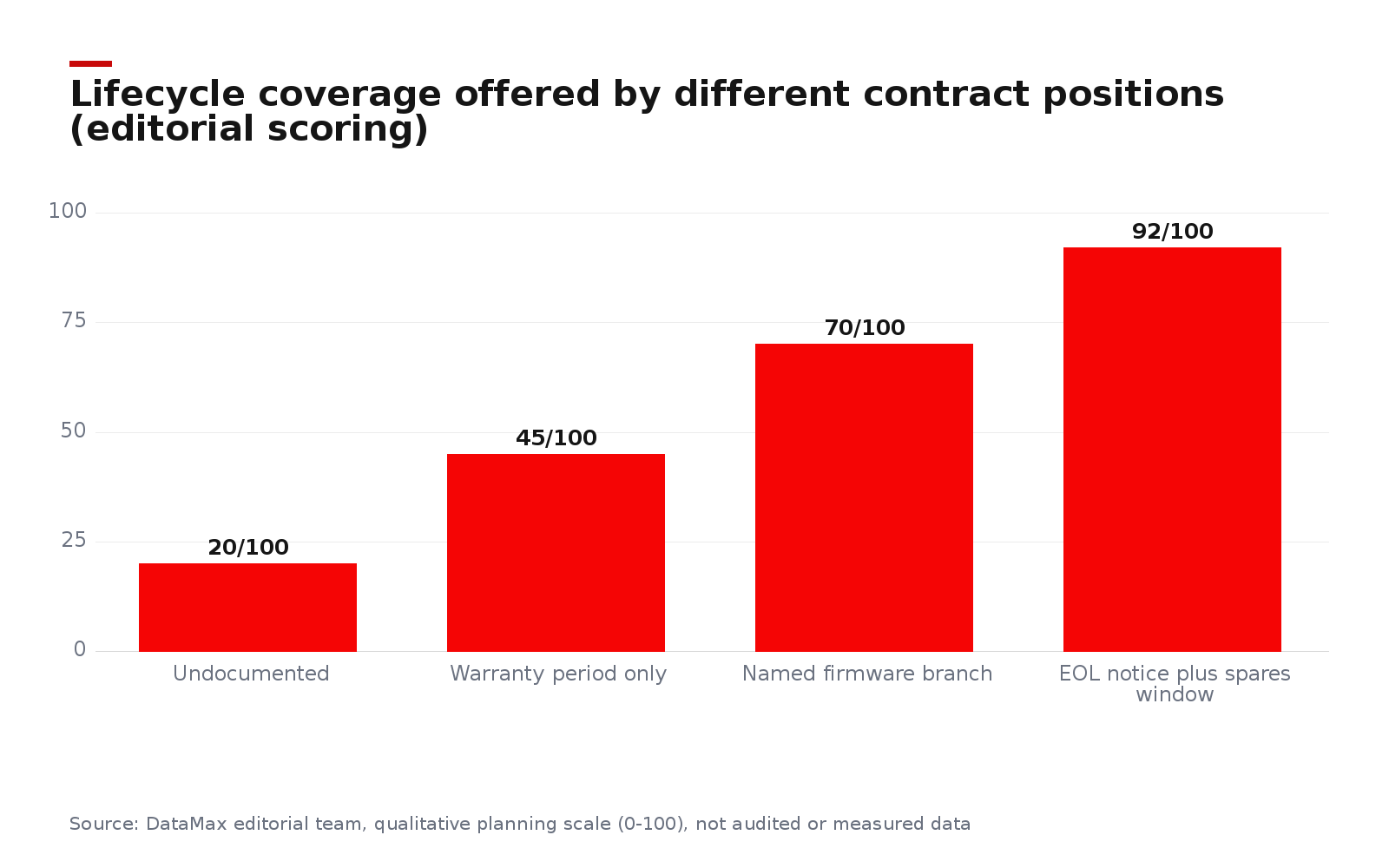
The same figures, in searchable form:
| Contract position | Editorial score |
|---|---|
| Undocumented | 20 |
| Warranty period only | 45 |
| Named firmware branch | 70 |
| EOL notice plus spares window | 92 |
| RFQ element | Entry position | Committed position |
|---|---|---|
| DRM | “Widevine supported” | Widevine L1 on named model, hardware and image |
| Application | Generic playback | Named operator app and content catalog |
| Output | HDMI capability | Defined display, audio and protected-output route |
| Lifecycle | No named branch | Firmware branch, notice period and spares treatment |
| Codec | Marketing list only | Named content profile and tested resolution |
| Ethernet | “RJ45” | 100M or 1G option identified on the order |
| Evidence | Demo result | Production-unit report linked to build and serial |
The lifecycle score remains an editorial planning aid; no score in the chart is a warranty promise, measured service metric or certification result. It simply shows why a model-level DRM quote should not end the negotiation.
The comparison also exposes a procurement trade-off. A narrowly stated entry configuration can reduce initial paperwork, but it transfers validation risk to the buyer and creates a late qualification gate. A committed specification adds writing and factory test work at the start, yet creates an acceptance basis that can be repeated across purchase orders and recovery batches.
A practical compromise is a 2-stage programme. Stage 1 qualifies the platform, image, operator app, protected content and venue display. Stage 2 converts the successful combination into a controlled purchase specification and a repeatable audit method. The model, RAM/ROM option and optional-feature status remain locked between stages unless a change triggers revalidation.
Do not use the chart to rank Widevine L1 above L3. The 20, 45, 70 and 92 values concern documentation completeness only. The security decision remains tied to the service requirement, and the commercial decision remains tied to the evidence attached to the quoted production configuration.
The operator, the integrator and the venue
Operators buying for an IPTV subscriber base need a controlled firmware branch, reproducible app playback and predictable replacement stock. For that case, DM21P fits the operator-middleware set-top-box position, while DM21S fits an IPTV/OTT white-label programme requiring AOSP Android 14. The decisive factor is the production image and operator middleware, not the widest codec list.
Cloud-gaming and premium UHD operators should evaluate DM21T because its supplied facts include AOSP Android 14, 4GB / 64GB and decode paths through 4K@120. Integrators handling public venues must add display, network and recovery constraints. A boxed android tv box with Widevine L1 can still fail acceptance if the selected television, switcher, extender or audio receiver changes the output path.
| Situation | Primary requirement | Model direction | Acceptance focus |
|---|---|---|---|
| Operator middleware rollout | Stable operator image and set-top-box integration | DM21P direction | DRM app, middleware, LAN and updates |
| IPTV/OTT white label | AOSP Android 14 platform for branded deployment | DM21S direction | Catalog playback, branding and ROM configuration |
| Premium UHD or cloud gaming | 4K-class decode and stated high-frame-rate workloads | DM21T direction | Content profile, output path and sustained playback |
| Gaming-oriented offer | AOSP Android 14 with 4GB / 64GB base configuration | DM22Q direction | Input path, gameplay package and DRM service |
| Hotel, retail or hospitality venue | Fleet visibility, recovery and display compatibility | Select after venue display audit | Wall display, topology, reset and spare image |
The field scene matters because a procurement sample and a venue television are not interchangeable test fixtures. During site acceptance, record the display model, firmware, HDMI route, audio route and app version. Replaying the same licence path on a different room setup can expose a topology issue that appears to be a device failure.
The operator has a fleet-wide concern. A 10-unit trial should not become the only evidence for thousands of units. Define sampling boundaries, approved test content, failure handling and the conditions that trigger a wider check. If one board revision, memory option or image build fails, the traceability record should reveal which other units share that identity.
The integrator has a topology concern. The selected television, matrix switcher, extender, receiver and cabling may each affect the path. A test at the factory can pass while the installed path fails, so acceptance must use the representative room setup. Record model identifiers and firmware for the downstream equipment wherever those details affect playback.
The venue owner has an operational concern. Recovery, re-imaging and replacement are more visible than laboratory DRM reports. The fleet image should be reproducible, and a replacement should carry the same approved configuration. Otherwise, a technician may restore hardware but not the tested environment, prompting another site visit.
Rows of identical compact black Android TV boxes on warehouse shelving with neutral packaging, pallets and a packing station in the background illustrate the scale at which identity control matters.
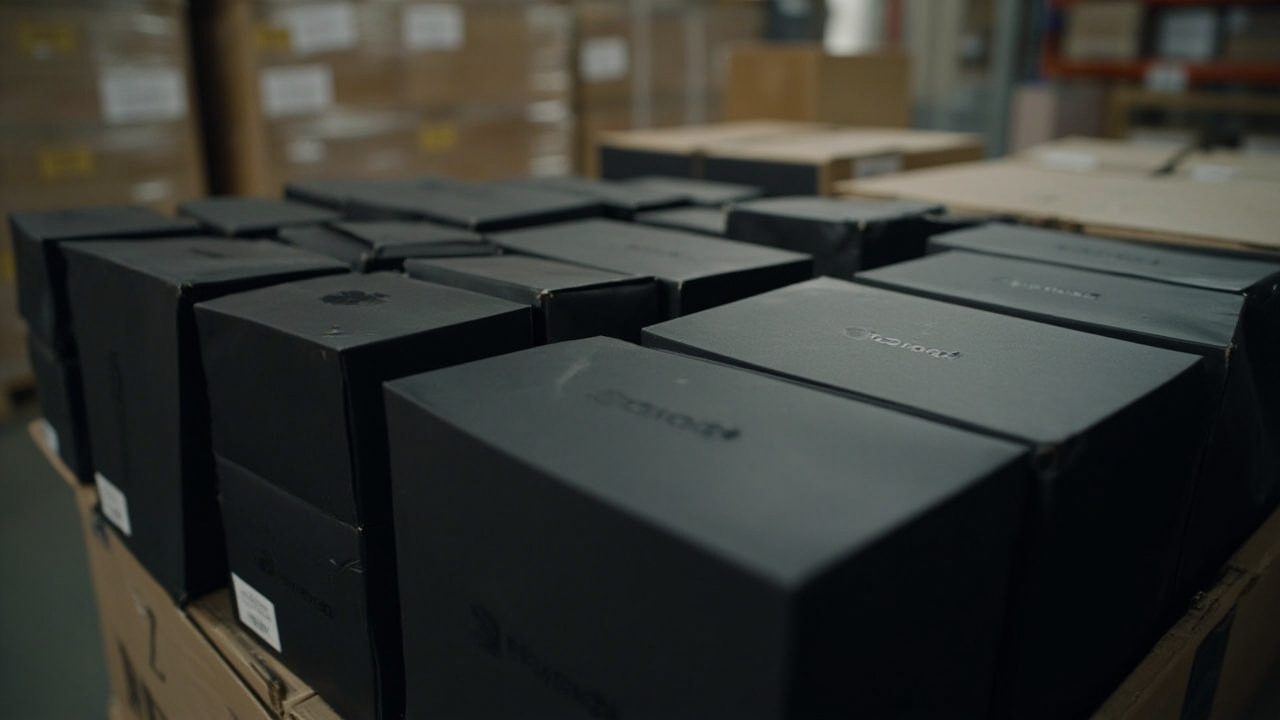
A practical deployment example is a hotel operator replacing a room-control display. The buyer may select DM21S because AOSP Android 14 matches the branded IPTV/OTT programme, but the acceptance gate should include the actual room television, HDMI extender and audio route. The fleet record should then carry the same model, RAM/ROM option, image build and application version. This turns the DRM requirement into a repeatable deployment control rather than a one-time laboratory statement.
Where quotations quietly diverge
The first divergence is the meaning of “L1”. One quotation may mean the SoC supports the required environment, another may mean the delivered android tv box passes a production-image test, and a third may refer to an emulator or development build. Specify the measurement: serial-numbered production hardware, production image, named application, required content and result.
The second divergence is “L1 versus L3”. L3 may be adequate for a particular content workflow because its protection resides in the host OS, while L1 provides the TEE-based execution described by Google. Neither label automatically establishes compatibility with the operator’s service agreement or content catalogue. The purchasing test is controlled playback of the actual service, not a generic demo application.
Field trap
A quotation that names Widevine L1 but omits the model, hardware revision, firmware build, app version and output topology is not a testable DRM commitment. The cost of accepting it is a late failure during subscriber or venue acceptance, with replacement, rework and revalidation distributed across the programme.
Other divergences involve optional features. DM21P lists HDCP 2.2 as optional. DM21S and DM22Q list Dolby Vision/DTS, while their supplied DRM fields also identify PlayReady as optional. These words create four distinct questions: which units include the option, which firmware enables it, what content requires it and what test instrument confirms the output path?
Codec support is not DRM support. AV1, H.265, VVC, AVS3 and H.264 describe media-processing paths; Widevine or PlayReady describes protected-licence operation. A device can decode a stream and still fail protected playback if the service, entitlement and device security configuration are wrong.
A feature matrix that merges DRM, codec, display and audio options can conceal an unavailable combination. Require the approved bill of materials, firmware feature manifest and one end-to-end test record for the exact commercial configuration.
Network controls create another false equivalence. RJ45 100M is the stated base on all 4 models; 1G is optional on DM21S, DM21T and DM22Q. A product requirement written as “1G Ethernet” must identify whether that is mandatory or optional, because an operator’s software image and provisioning plan may depend on it.
Memory wording creates a further commercial risk. The supplied facts use base configurations and optional alternatives. A quotation stating only “4GB” or “64GB” may not reveal whether it refers to RAM or ROM, nor whether a particular combination is actually ordered. Translate the commercial line into the complete RAM/ROM pair and require the approved bill of materials to match it.
Software baselines can also drift. DM21P uses AOSP Android 11, while DM21S, DM21T and DM22Q use AOSP Android 14. If the operator middleware, test app or security policy has been qualified only against one release, switching Android versions can require another compatibility pass even when the DRM level remains L1.
Output specifications require equal precision. The facts list HDMI 2.0b output across the 4 platforms, but DM21T explicitly has no HDMI input. A procurement team that needs pass-through, capture or looped presentation must detect that gap before deployment. Likewise, “HDMI 2.0b out” does not identify downstream device compatibility, cable behaviour or protected-output entitlement.
Finally, lifecycle language can hide an operational dependency. A named firmware branch provides a recoverable image; an end-of-life notice adds transition planning. Neither term identifies who owns security updates, who packages recovery media and how a replacement unit receives the approved image. Contract those responsibilities explicitly instead of inferring them from a DRM test report.
Turning the question into a spec line
Start from the protected service, not the model name. Identify the operator app, catalogue, live/on-demand mix, output topology and required DRM level. Then map the workload to the DataMax platform whose stated OS, memory and media paths fit. Only after that should the RFQ contain a DRM clause that a factory can demonstrate.
- Write the playback obligation State “The delivered android tv box shall support Widevine L1 for the named operator application and contracted content catalogue on the production hardware and production firmware.”
- Lock the configuration Add the DataMax model, RAM/ROM option, SoC, OS, connectivity and every enabled optional feature. Do not substitute a family name for an orderable configuration.
- Define the test chain Specify content identifiers, resolution and frame-rate profile, serial number, image build, app version, television, HDMI or audio route and expected result.
- Separate DRM from output Add the applicable HDCP and audio-output requirements independently. Do not infer protected output from Widevine L1.
- Set lifecycle terms Require the named firmware branch, image identifiers, security-update responsibility, end-of-life notice and spare-part treatment in the contract.
- Define evidence Attach a signed production-unit test report and require retention of the image hash, device identifier, test date and result.
- Define failure handling State the remedy for a failed unit, the population that shares its build identity, the revalidation trigger and the record required before release.
A usable RFQ line might read: “DM21S, AOSP Android 14, quoted RAM/ROM configuration; Widevine L1 acceptance demonstrated on serial-numbered production hardware with the agreed operator image and app build; catalogue playback through the nominated HDMI display route; PlayReady and Dolby Vision/DTS status stated separately; evidence package includes device identifier, image build, test content and result.” This is more precise than a standalone “DRM L1” request.
Use separate lines for separate obligations. Line 1 identifies the model, hardware and software. Line 2 states Widevine L1 and the protected service. Line 3 defines output protection and codec profiles. Line 4 identifies optional features. Line 5 sets lifecycle obligations. Line 6 defines evidence, sampling and nonconformance handling. Merging all 6 into 1 paragraph increases ambiguity and makes supplier responses difficult to compare.
The sequence also protects against specification drift. Every change to SoC, board revision, RAM/ROM capacity, Android baseline, operator image, middleware, application version, protected content or downstream display should trigger a documented review of the affected test. The buyer then decides whether the existing result remains applicable or a new production-unit test is required.
Do not write an unverified SoC name into the RFQ. The supplied facts identify Amlogic S905Y4, Amlogic S905Y5, Amlogic S905X5 and Amlogic S905X5M for the 4 models. Any variant or custom silicon path must be confirmed against the production datasheet. Likewise, request a written playback report from the factory before committing the fleet.
For an operator rollout, the pasted evidence clause can be: “The report shall identify model, SoC, board revision, RAM/ROM, serial number, image build, operator application version, test content identifier, display model, HDMI and audio route, Widevine L1 result and test date.” This line turns an abstract security requirement into evidence another engineer can reproduce.
Verification you can ask for on paper
Factory verification must connect the DRM requirement to the hardware, image and test evidence. A certificate screenshot without a serial-to-image relationship cannot demonstrate the delivered fleet. The evidence chain should begin at the build record and end at an operator-relevant playback result.
- Trace the unit Link serial number or device identifier to SoC, board revision, RAM/ROM configuration and production-line batch record.
- Trace the image Record image build, operator middleware version, application version and the firmware feature manifest used in the test.
- Verify assembly Retain SMT records and AOI inspection results for the relevant board revision, with inspection criteria tied to the manufacturing package.
- Exercise the unit Complete aging, power-cycle, network, display and application checks defined for the production test plan.
- Test protected media Run Widevine L1 on the production image with the agreed app and content, using the nominated display and audio route.
- Audit the record Review traceability across line records, test logs and the sample shipped for customer acceptance.
- Reconcile identities Match the purchase-order model, line record, image identifier and shipped test unit; document any deviation before approval.
Request the evidence before approval: serial-to-build traceability, AOI criteria, aging procedure, dark-room or controlled-room visual test records where applicable, DRM test logs and audit access. The existence of a test procedure does not establish that the delivered unit passed it; approval needs the signed result tied to the quoted hardware and image.
A DataMax factory-quality review can be requested for this topic. Ask for a video factory audit focused on SMT/AOI traceability, aging evidence and the production-image DRM test path. Alternatively, use the manufacturer information to request documentation aligned with the exact model and commercial configuration.
The acceptance packet should reconcile 4 identities: the model stated in the purchase order, the hardware identifier recorded on the line, the firmware image exercised in the lab and the device used for operator playback. Any mismatch should block unconditional approval or be resolved through an explicitly documented deviation.
For fleet logistics, include the image identifier in the recovery procedure. A replacement unit with a different branch may reproduce the same hardware and model number but not the tested environment. That control reduces repeat site visits and makes the DRM requirement part of operational continuity rather than a one-time laboratory result.
The paper trail should also distinguish sample evidence from line evidence. The customer sample can prove that the proposed combination works. A signed line record proves that the shipped unit was associated with the tested build identity. A supplier claiming that every unit is equivalent should support that claim with sampling rules, failure criteria and retained results for the relevant batch.
Dark-room or controlled-room visual records should be requested where the production test plan calls for display inspection. They support panel and output checks, but they do not replace protected-media testing. Likewise, aging and power-cycle checks expose stability issues; they do not establish Widevine L1 by themselves. The acceptance package works only when the manufacturing evidence and the DRM playback record converge on the same unit and image.
Further reading
- Guide android tv box for isps
- Telecom and pay-TV operator solutions
- Allwinner Android TV boxes
- AOSP Android TV boxes
- H.265 HEVC Android TV box guide
- DataMax DM21P specifications and fit
- DataMax DM21S specifications and fit
FAQ
Is Widevine L1 always preferable to L3 for a UAE IPTV box?
Not universally. Prefer L1 when the service and security policy require TEE-backed processing. L3 may be sufficient for a defined workload because protection is provided in the host OS, while a hardware crypto engine improves performance without creating a TEE. The operator should validate its own content, app and output requirements rather than select a level from a marketing comparison.
Which DataMax model should an operator choose for Widevine L1?
All 4 supplied DataMax model facts list Widevine L1. DM21P is positioned for operator middleware, DM21S for IPTV/OTT white label, DM21T for premium UHD and cloud gaming, and DM22Q for gaming-oriented deployment. The final selection depends on the production image, memory configuration, output path and workload; confirm the exact production datasheet.
Does Widevine L1 guarantee HDCP 2.2 output?
No. Widevine protects the content-processing and licence-control path; HDCP governs a separate protected-output path. DM21P lists HDCP 2.2 as optional. The order must identify whether that option is included, and acceptance must test the intended display and cable topology.
Can a Widevine demonstration app validate an operator deployment?
Not by itself. A demonstration can show that the device level initializes, but it does not prove that the contracted operator app, catalogue, entitlement service and display route pass. Request a production-image test using named content and preserve the device, image, application and result in the acceptance record.
What evidence should accompany an android tv box quotation?
Request model-specific hardware and image traceability, a Widevine L1 playback report, optional-feature status, test content and app versions, output topology, and the production-line quality evidence. For lifecycle planning, also require the named firmware branch, update responsibility, end-of-life notice terms and spare-part treatment in the contract.
Can DataMax customize the DRM configuration for an operator programme?
Confirm the feasible software, memory, connectivity and optional-feature combinations against the production datasheet. The current facts do not specify custom DRM certificates, TEE implementation details or individual content-service approvals. Ask for a written configuration and validation plan before treating customization as committed scope.


