

The precise meaning of an FCC ID
The industry often treats an fcc id as if it were a certification mark printed on a product. It is not. An fcc id is the identification number associated with an equipment authorization in the FCC’s public records. The number identifies a specific regulatory record; it does not, by itself, prove that every unit sold under the same product name matches the record.
That distinction determines the buyer’s verification method. A valid lookup may confirm the grantee, equipment class, applicant, authorized components and covered frequencies. It cannot independently prove the chip population, antenna, RF layout, firmware configuration, enclosure, label placement or factory process behind a delivered unit. For an Android TV or OTT set-top box, the defensible workflow links the fcc id record to the production model, radio configuration, test evidence and shipment-level quality controls.
Fcc id verification should therefore be treated as a traceable chain rather than a single database check. Start with the identifier in the RFQ, resolve the public record, compare the authorized equipment with the ordered hardware, and retain the supplier’s evidence for the production configuration. DataMax can support this review through its certification documentation process; certificates and DRM or security provisions must be confirmed against the ordered SKU, not inferred from a catalogue page.
A useful buyer request contains 6 fields: model, fcc id, radio module, antenna configuration, target market and evidence date. That request exposes mismatch risk before tooling, certification or a volume purchase order is released.
The direct verification sequence
- Capture the identifier Record the exact characters, including the separator, from the product label, RFQ or equipment authorization.
- Resolve the public entry Match the grantee, applicant, equipment class and authorization status rather than relying on a search-result title.
- Compare the covered configuration Check radio bands, antenna provisions, RF options and any module or host relationships relevant to the SKU.
- Bind the record to the BOM Require the supplier to identify the production radio and antenna implementation associated with the quoted model.
- Retain evidence Store the public record, supporting test reports, production inspection records and label artwork under one evidence index.
This sequence separates record identity from manufacturing consistency, which is the central control point in a high-volume TV-box program.
The selection sequence that removes rework
A buyer should convert fcc id verification into RFQ lines before asking for samples. Merely requesting “FCC certification” leaves several uncontrolled variables: the exact equipment authorization, transmitter implementation, antenna, certification route, label placement and evidence owner. The selection sequence below turns a loose request into an auditable package.
Paste the following into the specification:
SKU:state the manufacturer model and production revision.Target market:identify the country or territory where the unit will be placed on sale.Equipment authorization:state the exact fcc id, or require the supplier to provide it before technical approval.Radio implementation:identify the Wi-Fi module or chipset, band plan, antenna type and antenna connection arrangement.Public-record comparison:require the supplier to map the public entry to the production configuration.Evidence set:require an equipment authorization, applicable test reports, grant or supplier-declaration documents as applicable, label artwork and production inspection evidence.Change control:require notice before the radio module, antenna, PCB, enclosure or authorized configuration changes.
The terms “FCC-compliant,” “pre-approved” and “uses an approved module” are not interchangeable. An equipment authorization may cover a radio configuration that differs from the production SKU. A module can support a compliant end product without making every host configuration automatically identical to the public record.
| RFQ line | Minimum content | Procurement decision |
|---|---|---|
| Authorization identity | Exact **fcc id** and responsible applicant/grantee details | Whether the record can be resolved without interpretation |
| Configuration linkage | Radio, band plan, antenna and host relationship | Whether the production build matches the authorized scope |
| Technical evidence | Report identity, test scope, standards and laboratory details | Whether the evidence is specific enough for review |
| Production linkage | Line inspection, label control and revision history | Whether errors can be contained after manufacture |
The selection decision should not rely on document quantity. One equipment authorization mapped to the current BOM, one current label proof and one controlled inspection record may provide more decision value than several generic documents with inconsistent model names. Confirm the compliance route for the ordered SKU with the compliance team, especially where the product family contains multiple SoC or radio configurations.
Before issuing the RFQ, ask the supplier to state whether the cited fcc id belongs to the final end product, a radio module or a related family member. Each route requires a different comparison. If it is an end-product authorization, compare the complete production configuration. If it is a module record, request the host integration conditions and the supplier’s basis for applying that module evidence to the quoted device. The RFQ should not use one identifier as a catch-all for several revisions.
The sample request should name the revision under review and prohibit undocumented substitutions. For example: “The sample must use the released Wi-Fi module, antenna assembly, PCB revision, enclosure and label identified in the conformity package; any alternative must be listed with its regulatory assessment.” This converts a general request for a working box into an acceptance criterion that the quality team can inspect.
Failure modes that reach the field
The most damaging failure is not an absent number. It is a number that resolves cleanly while describing a different product than the one being shipped. Buyers can create that mismatch through product naming, region variants, antenna substitutions, radio changes, software assumptions or label-control errors. Each divergence survives quotation but appears during certification review, customs inspection, channel onboarding or field troubleshooting.
Field trap
A public-record match is not evidence that the delivered hardware is identical. Require the supplier to map the authorized radio and antenna arrangement to the production BOM and label artwork. If that mapping changes, the buyer needs a documented reassessment before shipment.
| Quotation language | Hidden variable | Control before shipment |
|---|---|---|
| “Same chipset as the certified model” | Module, antenna, RF layout or host may differ | Request configuration-level comparison |
| “Certificate available on request” | Document may cover another revision or grantee | Bind documents to model and revision |
| “Label preprinted” | Label artwork may not match the authorized record | Approve golden samples before production |
| “Same software” | Radio configuration may be enabled or disabled differently | Define firmware and regulatory settings by SKU |
A second field trap concerns responsibility. If a supplier sends a public link and no production linkage, the buyer cannot determine who investigated a mismatch. Require a named owner for the authorization package, a document revision date and a controlled method for recording model substitutions.
Field trap
Do not accept a document package whose model names, hardware revisions or dates conflict. A mismatch may indicate a stale record, an obsolete catalogue entry or an unreported engineering change. Freeze approval until the responsible party reconciles the package.
The cost of getting this wrong is not limited to a failed public lookup. It can include quarantine, relabelling, certification rework, delayed channel deployment and inconsistent answers across distributors. Put acceptance criteria into the purchase specification, and require the production build to remain frozen after evidence approval. The factory-quality team can support requests for SMT/AOI, aging and audit evidence specific to the program.
Three operational failures deserve separate treatment. First, a distributor may quote the exact fcc id but omit the antenna specification, leaving an RF configuration variable unresolved. Second, a buying team may approve a sample, then permit the OEM to switch the Wi-Fi module for availability without repeating the configuration review. Third, a software team may introduce a new regional image after the hardware baseline is frozen. None of these changes is automatically visible in the public entry, so the purchase order must require written approval for each affected production variable.
The quotation comparison should also normalize model naming. A retailer name, an engineering name and a certification name may refer to different revisions. Require one cross-reference table showing every identifier, its role and its effective production date. A single stray suffix can direct a buyer to the wrong record, while two names for the same assembly can create a false impression that the product lacks a common authorization.
The evidence trail from SMT to shipment
The strongest verification package follows the physical unit through production. Radio compliance is established at a hardware and configuration level, so SMT inspection, RF-related assembly checks, software configuration, label control and final test must use the same controlled product identity.
- Engineering release Freeze the SKU, radio component, antenna specification, target market and regulatory evidence baseline.
- SMT inspection Apply AOI or approved inspection controls to populated PCBs, with recorded rules for components that affect radio or product identity.
- Assembly verification Record the radio module and antenna installation against the released work instruction; reject substitutions outside the change process.
- Configuration loading Ensure software image, region parameters and regulatory settings are tied to the released SKU.
- Dark-room or RF test Apply the supplier’s defined RF test procedure to production units, with limits and acceptance rules linked to the test plan.
- Label and final inspection Compare the physical label, model identifier and **fcc id** artwork with the approved golden sample.
- Aging and shipment review Record stress-test disposition, nonconformance outcomes and the release decision before shipment.
Evidence index: assign one controlled record set to each production revision: public authorization record, applicable test reports, radio and antenna specification, software baseline, label artwork, inspection plan, test limits, aging record, nonconformance log and approved release note.
The crucial distinction is configuration control. A public record can remain unchanged while an unauthorized component substitution occurs inside the factory. Inspection records close that gap by demonstrating what was present on the line. A buyer should ask whether the inspection method can identify the relevant module, antenna and label without relying on visual similarity alone.
For sampling, request evidence from the same process intended for volume production, not a demonstration unit built for the visit. A video factory audit can clarify how AOI rules, RF test stations, label verification and nonconforming material are controlled. The manufacturer overview is the appropriate starting point for an audit request, while the engineering team can define which records are required for the exact ordered configuration.
A practical evidence-index naming convention can prevent accidental mixing. Include the order, SKU, production revision, fcc id, evidence date and record owner in the folder identifier. For example, a release index should identify the exact model revision and market rather than only the product family. That convention makes it possible to retrieve the correct radio specification, label proof, test plan and release decision when a distributor asks whether a shipment belongs to the approved configuration.
Sampling should be defined at 2 levels. The engineering sample verifies physical configuration, interfaces, software behaviour and label placement. The process sample verifies that AOI rules, RF or dark-room testing, aging and final inspection can distinguish the released configuration from an unauthorized substitute. A unit displayed in a showroom may pass functional checks while providing no evidence about the controls that govern a volume line.
The factory should also describe the disposition path. A nonconforming radio module, antenna or label must be quarantined and recorded, not corrected through an informal workstation instruction. If the supplier’s process cannot show what happens after a failed inspection, the buyer has no evidence that detected divergence will be prevented from reaching the shipment channel.
The comparison buyers actually make
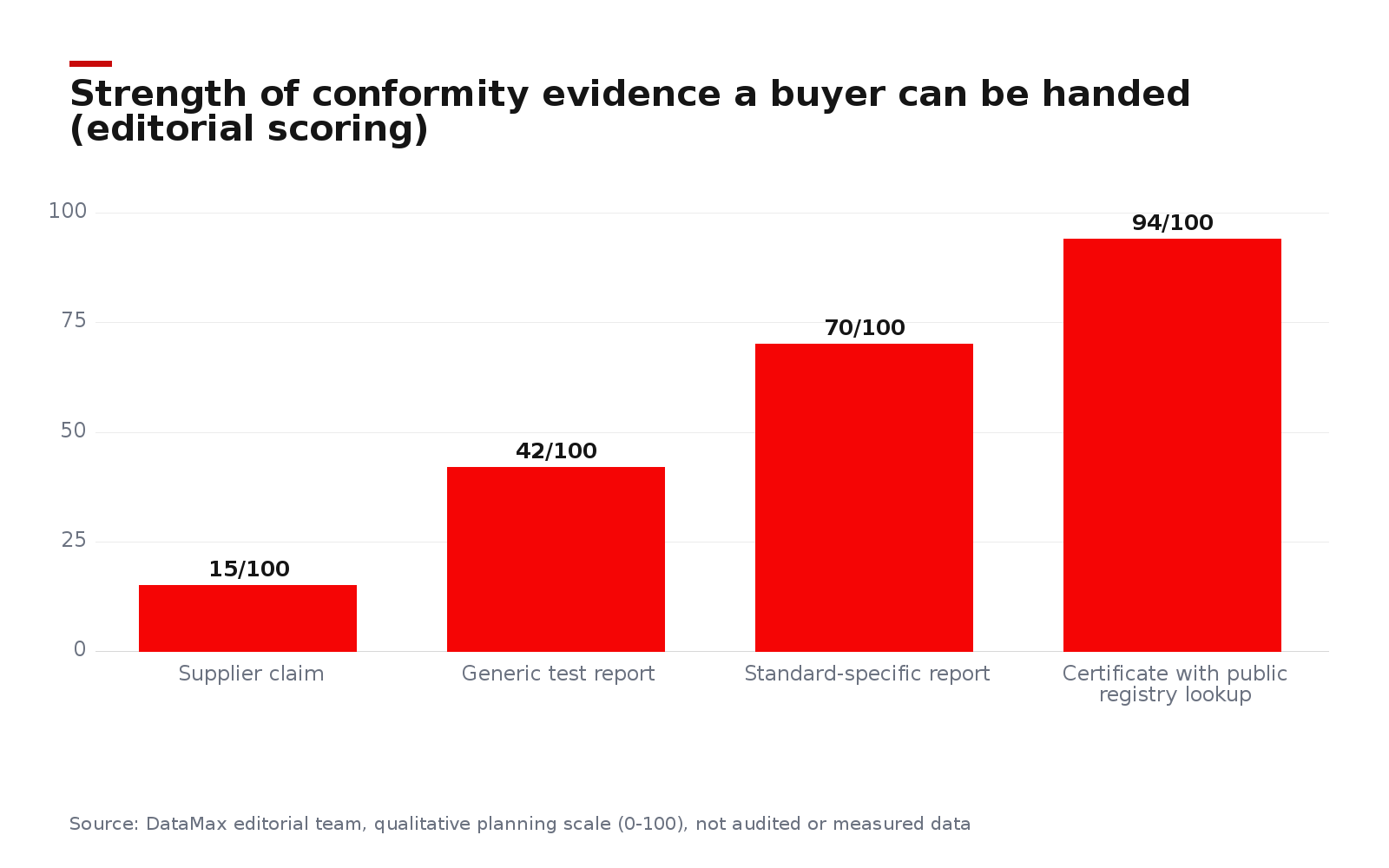
Buyers usually compare evidence strength, not just document count. A supplier claim may be enough to start a technical discussion, but it cannot support final release. A generic test report adds technical context only if its scope, standards, laboratory and device configuration can be reconciled with the ordered SKU. A standard-specific report provides a more direct chain. A certificate with a successful public-registry lookup provides the strongest starting package, provided that the production configuration and factory controls are separately verified.
The gap between entry-tier and commitment-tier evidence lies in traceability. Entry-tier documentation establishes that a supplier has a document. Commitment-tier documentation establishes which model, revision, radio, antenna, label and shipment population the document supports.
| Control | Entry tier | Commitment tier |
|---|---|---|
| Public record | Supplier supplies a link or identifier | Buyer resolves and archives the exact entry |
| Configuration | General chipset or family statement | SKU-specific radio, antenna and host mapping |
| Production evidence | Sample inspection or generic factory record | Line-controlled SMT/AOI, RF, label and release records |
| Change control | Informal notification expectation | Written approval gate before substitution |
| Shipment release | Commercial acceptance | Documented technical and quality disposition |
The scoring should guide procurement effort, not replace legal or regulatory review. Even the highest-ranked option cannot substitute for confirming the exact ordered SKU, target market and permitted configuration. For production programs, the sample request should specify that the sample exposes the label, radio/antenna arrangement and packaging needed for the buyer’s review.
The comparison should also expose who bears residual risk. Under the entry tier, the buyer relies on the supplier’s interpretation of a family statement and accepts the risk that the sample or volume hardware may differ. Under the commitment tier, the buyer receives revision-controlled records, documented substitutions and a shipment-release trail. This is not a guarantee that defects cannot occur; it provides a defined route for detecting and containing them before deployment.
A practical side-by-side review assigns a pass, gap or not-applicable status to each evidence layer. “Pass” requires a named document, a matching model revision and a configuration statement. “Gap” identifies missing information or an unresolved difference. “Not applicable” requires a documented technical basis. Avoid approving the package through document age alone, because a recent PDF may still cover an older radio arrangement.
For an operator running several markets, repeat the comparison per destination configuration rather than averaging the evidence. A record resolved for one region may not answer the questions relevant to another. The same principle applies to white-label programmes: operator software and branding may change the commercial identity while the authorized radio and host configuration remain traceable. Record those distinctions explicitly.
Where the terminology comes from
The FCC’s equipment authorization process provides the public regulatory record that procurement teams call fcc id verification. Equipment subject to FCC requirements is handled through an applicable authorization route, such as certification or another recognized procedure. The public record exposes information tied to the application and authorization, but terminology can blur several layers that buyers should keep separate.
An applicant or grantee is a party associated with the authorization. An equipment authorization is the regulatory result and public record. The authorized equipment is the specific radio configuration evaluated within that context. A certification body may issue an equipment authorization under the FCC’s Certification Program for telecommunications equipment. Test laboratories evaluate the relevant technical requirements and issue reports used in the authorization process.
The device’s label connects the physical product to the regulatory record. For a modular design, the radio module, host product and antenna arrangement may form part of the authorization structure. A buyer should not infer that a module’s public record proves every possible host, enclosure, antenna and market configuration. Conversely, an end-product record can be valid for a defined host arrangement that differs from a competitor’s implementation.
The public record is one part of the architecture of evidence:
- Regulatory layer Applicant or grantee, equipment class, authorization type and public entry
- Technical layer Test standards, radio parameters, host conditions and laboratory reports
- Production layer BOM identity, antenna implementation, firmware settings, inspection and labels
- Commercial layer PO model, revision, destination market, quantity and release record
This structure explains why a lookup can be valid yet operationally incomplete. The public registry answers “what record exists under this identifier?” A controlled fcc id process must also answer “which unit in this shipment corresponds to that record, and what evidence connects them?”
Software does not erase that distinction. Region settings, radio enablement and firmware image baselines can matter to a production configuration, but the buyer should specify relevant configuration checks rather than assume that a software update changes or preserves regulatory status automatically. Similarly, a low-power radio exception may not remove the need to understand how the complete product was evaluated. The applicable FCC rule and authorization path determine the route; the public record and production evidence establish the implementation.
The certificate, the test report and the physical label perform different jobs. The equipment authorization establishes the public regulatory entry. A test report records the technical evaluation and its scope. The label identifies the authorized product at the point of sale or placement. The production records then demonstrate whether the factory consistently assembled the product described by that evidence. Treating those artifacts as interchangeable creates gaps that no single search can repair.
“Certification,” “authorization,” “declaration” and “approval” should also be used carefully in contracts and inspection plans. The contractual description must name the actual document type and regulatory route for the ordered SKU. A generic compliance phrase is insufficient because it can conceal whether a public lookup, an applicable test report or a production linkage was actually supplied. Require the document owner to use consistent terminology across the RFQ, quote, sample report and shipment dossier.
Five production SKUs compared
DataMax provides four supplied production platforms for this product category; the fifth comparison slot is reserved for a candidate SKU submitted for equivalence review. That candidate is not a DataMax model and should not be described as one. Its column remains deliberately unpopulated until its production facts are approved.
The same figures, in searchable form:
| Evidence option | Editorial score (/100) |
|---|---|
| Supplier claim | 15 |
| Generic test report | 42 |
| Standard-specific report | 70 |
| Certificate with public registry lookup | 94 |
| Model | Fit | SoC and OS | RAM / ROM | Decode | DRM | Ports |
|---|---|---|---|---|---|---|
| DM21P | 4K IPTV / operator middleware set-top box | Amlogic S905Y4, quad Cortex-A35; AOSP Android 11 | 2GB / 8GB (4GB; 16/32/64GB optional) | AV1 [email protected], VP9/H.265 4K@60, H.264 4K@30 | Widevine L1 / PlayReady / HDCP 2.2 optional | HDMI 2.0b out x1, USB2.0 x2, TF, S/PDIF, 3.5mm AV, RJ45 100M, Wi-Fi6 2x2 + BT5.4, DC 5V/2A |
| DM21S | 4K Android TV box for IPTV/OTT white-label | Amlogic S905Y5, quad Cortex-A55; AOSP Android 14 | 2GB / 16GB (2/4/8GB; 16/32/64GB optional) | AV1 / H.265 [email protected] 4K@60 | Widevine L1 / PlayReady optional; Dolby Vision/DTS | HDMI 2.0b out, S/PDIF, AV, USB2.0 x2, TF, RJ45 100M (1G optional), Wi-Fi6 2x2 + BT5.4 |
| DM21T | Premium UHD / cloud-gaming box | Amlogic S905X5, quad Cortex-A510 (ARMv9); AOSP Android 14 | 4GB / 64GB (family options) | H.266/VVC [email protected] 4K@120, AV1/VP9/H.265 4K@120, AVS3 4K@120, H.264 4K@60; inline AI-SR | Widevine L1 / PlayReady optional | HDMI 2.0b out (no HDMI in), USB2.0 x1 + USB3.0 x1, TF, S/PDIF, AV, RJ45 100M (1G opt), Wi-Fi6 + BT5.4 |
| DM22Q | Gaming-oriented Android TV box | Amlogic S905X5M, quad Cortex-A55 up to 2.5GHz; AOSP Android 14 | 4GB / 64GB (2/4/8GB; 16/32/64GB optional) | AV1/H.265 L5.1 4K@60; inline AI-SR (no NPU TOPS stated) | Widevine L1 / PlayReady optional; Dolby Vision/DTS | HDMI 2.0b out, USB2.0 x2, TF, S/PDIF, AV, RJ45 100M (1G opt), Wi-Fi6 2x2 + BT5.4 |
| Candidate SKU pending approval | Not assigned | Confirm against the production datasheet | Confirm against the production datasheet | Confirm against the production datasheet | Confirm against the production datasheet | Confirm against the production datasheet |
The table deliberately separates platform capability from regulatory evidence. Model selection does not determine the fcc id result by itself; the released radio and antenna configuration does. Likewise, DRM availability and decode capability do not replace radio-compliance evidence. For each ordered SKU, request the production fcc id, public-record comparison and relevant configuration documents. Certificate status, optional DRM provisions and radio details must be confirmed against the production datasheet and current order-specific evidence.
For DM21P, the operator middleware positioning makes configuration control and lifecycle documentation central. DM21S provides a later Android baseline for white-label deployments. DM21T addresses premium UHD and cloud-gaming requirements, while DM22Q targets gaming-oriented Android TV deployments. These fit statements guide architectural selection; they do not authorize a particular certification route or market configuration.
A buyer should not use the decode column as a proxy for radio status. AV1, VP9, H.265, H.264, H.266/VVC or AVS3 decoding concerns media capability; the public authorization record concerns the radio configuration. Likewise, Widevine L1, PlayReady, HDCP 2.2, Dolby Vision or DTS concerns content protection and output handling. Each evidence family must be reviewed separately against the exact order.
The port rows also show why a generic “same box” assumption is weak. The supplied models differ in HDMI output detail, USB counts, AV provisions, Ethernet options and power treatment. Such differences can affect installation and may accompany distinct production revisions. The fcc id comparison must therefore use the released hardware configuration rather than a catalogue-level description, and every option shown in the table must remain subject to confirmation against the production datasheet.
DataMax’s certification documentation can be requested for each selected platform, but the output should be tied to a specific SKU, revision and target market. For the candidate fifth slot, no product facts are available, so no equivalent inference is permitted. The correct procurement action is to obtain an approved datasheet and evidence package before placing the candidate in a technical comparison.
The operator, the integrator and the venue
A modern hotel room illustrates why public-record verification and physical production control must meet. The television is the visible endpoint, while the operator box is hidden behind the furniture and connected through a stable installation path.

Different buying situations require different evidence emphasis. The operator manages a fleet and standardized middleware; the integrator controls installation and local network behaviour; the venue manages room assets, service recovery and operator coordination. Each party needs the same identity chain but asks different operational questions.
| Situation | Primary requirement | Evidence or deployment control | Model direction |
|---|---|---|---|
| • Pay-TV / IPTV operator | • Standardized fleet management and middleware fit | • Bind **fcc id**, radio configuration, label and shipment revision; confirm fleet provisioning baseline | • DM21P for operator middleware set-top box deployments; DM21S for white-label operator programs |
| • AV or IT integrator | • Stable interfaces, installation repeatability and replacement traceability | • Use golden label samples, record approved port configurations and retain SKU-to-unit traceability | • DM21S or DM22Q according to confirmed production configuration |
| • Hospitality venue | • Compact enclosure, recovery planning and managed service access | • Confirm physical ports, power, network options, asset labelling and the operator’s update process | • DM21P where operator middleware is required; DM21S for an Android TV white-label deployment |
| • Streaming or cloud-gaming programme | • Video decode profile, DRM alignment and sustained deployment configuration | • Confirm decode and DRM per ordered SKU; keep radio evidence separate from content-security approval | • DM21T for premium UHD / cloud-gaming fit; DM21S for IPTV/OTT white-label fit |
For the operator, the key risk is fleet fragmentation: identical housings with unreported radio or label differences. For the integrator, the key risk is installation variation, particularly around network, HDMI and accessory choices. For the venue, the risk is service continuity when a replacement unit does not match the approved asset record. A common evidence index solves all 3 problems by linking the model, revision, fcc id, label and shipment disposition to one record.
Model direction still requires an SKU-specific review. Confirm the ordered radio, antenna, target market and applicable evidence against the production datasheet. For a new operator or venue program, DataMax’s custom-development route can be combined with a factory audit and an order-specific compliance review through the inquiry team.
The operator’s installation runbook should assign the fcc id, label artwork and shipment revision to the fleet asset record, then link those fields to the operator middleware image. The integrator’s acceptance sheet should capture the approved port configuration, network arrangement, antenna implementation where exposed and the physical label reference. The venue’s replacement procedure should require the installer to match the approved SKU before deploying a substitute unit.
These controls prevent a subtle but expensive failure: a replacement device that boots the correct operator image but carries an unapproved radio or label configuration. Functional service can appear normal while the asset no longer matches the procurement baseline. A photo of the physical label, a record of the production revision and the applicable public-record reference can be captured during installation without implying that they replace factory evidence.
For estates that conceal the box behind furniture, physical access and serviceability still belong in the RFQ. The DM21P and DM21S fit directions support operator or white-label deployments, while DM21T and DM22Q align with different performance priorities. Actual port, power, network and enclosure requirements must be confirmed for the ordered configuration. DataMax can provide the production evidence needed for the selected direction through its certification process, with certificates and DRM or security provisions confirmed per SKU.
Further reading
- Rockchip Android TV boxes
- Edge computing boxes
- 4K 60fps Android TV box guide
- Rockchip Android TV box guide
- Dolby Vision Android TV box guide
- DataMax DM21P specifications and fit
- DataMax DM21S specifications and fit
FAQ
What does an FCC ID identify?
An fcc id identifies a specific equipment authorization within the FCC public record. The associated entry may identify the applicant or grantee, equipment class and authorized radio configuration. It is not a general conformity label, and a successful lookup does not prove that every manufactured unit matches the authorized hardware. Configuration mapping and production evidence remain necessary.
Can two related TV boxes share an FCC ID?
They can only be treated as covered by the same record when the relevant authorized configuration permits it. A different radio module, antenna, host arrangement, frequency plan or other material condition may require separate assessment. Buyers should compare the exact SKU and production revision with the public record rather than assume that a shared enclosure or chipset establishes equivalence.
Is a supplier declaration enough for procurement?
A supplier declaration can support initial review, but it does not provide the same traceability as the public record, applicable technical reports and production inspection evidence. Procurement should identify who owns each document, which model and revision it covers, and how any engineering or component change is controlled before shipment.
What evidence should accompany an Android TV-box sample?
Request the exact fcc id, public-record comparison, radio and antenna specification, applicable test reports, label artwork, model revision and production-process evidence. Confirm whether the sample was produced through the same controlled line and test process intended for the order. An isolated demonstration unit does not establish volume-production traceability.
Does firmware affect the FCC record?
Firmware and configuration can affect how a radio is enabled, restricted or tested, so the relevant software baseline should be documented. A software update does not automatically preserve, alter or expand a regulatory authorization. The applicable authorization path and production configuration must be reviewed before deployment.
Can DataMax provide the documents for my exact order?
DataMax can review the ordered SKU, production revision and target market through its certification and compliance process. The customer should request an order-specific evidence package and a factory evidence review where needed. Certificates, radio details and DRM or security provisions must be confirmed per ordered SKU rather than inferred from a catalogue page.


