The short answer first
An RFQ lands in a hotel technology review with three columns: control method, integration depth, and operational responsibility. The purchasing team wants a single device specification, but the property team needs lighting, climate, curtains, television, signage, and service requests to behave predictably when the guest, operator, or integrator changes state. The direct answer is to treat the hotel room control system as a layered interface contract, not as a box with “smart-room support” written on its quotation.
The control layer defines how commands move: local panel, room controller, network management, cloud platform, or building system. The integration layer defines which functions participate: television power and volume, IR or serial control, IP control, room-service events, PMS links, occupancy logic, and analytics. The operational layer then assigns responsibility for provisioning, firmware and middleware versions, device recovery, fault reporting, and end-of-life changes. A quotation that names only the hardware platform leaves most of the acceptance criteria undefined.
For a TV-oriented deployment, the decisive sequence is: establish the control protocol and command table, define the room-controller interface, approve the television hardware profile, then write service and recovery responsibilities into the acceptance test. The product is one endpoint in that chain. Review the underlying hotel room control system protocol surface before freezing interface language.
The four procurement levels are therefore:
- Level 1: television endpoint — the box displays operator content and receives a permitted television-control command set.
- Level 2: controlled endpoint — the box also receives room events or device status through a defined local or network interface.
- Level 3: integrated room service — television, environment controls, PMS or service workflow, and monitoring exchange defined messages across approved interfaces.
- Level 4: managed estate — device identity, configuration, health, policy, software, and service records operate across a property portfolio.
Procurement should award a level only after its boundaries are documented. “Level 3” without a message list, network topology, security method, and fault owner is not an integration level; it is a slogan.
Buyer situations, ranked by what they punish
The same room-control requirement affects buyers differently. A hotel operator is punished by inconsistent guest journeys and support calls. An AV integrator is punished when television control works in the lab but fails after installation. A venue operator may punish an entire deployment when signage, content, and room automation share a failure domain. The control-system level must follow that consequence, not the feature count in a comparison table.
| Situation | Primary requirement | Model direction |
|---|---|---|
| Operator-owned IPTV room | Predictable television control, controlled software, repeatable provisioning | Start with a 4K IPTV or operator-middleware set-top box; keep the management scope explicit |
| Independent property or branded hotel | Android flexibility, operator middleware fit, white-label presentation | Evaluate an Android TV platform whose fixed and optional memory options fit the deployment |
| Premium UHD room or cloud-gaming offer | 4K output path, codec coverage, bandwidth and thermal headroom | Use the premium UHD model as the endpoint candidate; do not infer television-control capability from the chipset |
| Gaming-led room | 4K media support, input availability, stable operating platform | Evaluate the gaming-oriented model; validate ports and control requirements separately |
| AV integrator delivering a staged fit-out | Documented interfaces, approved golden sample, room-level test script | Freeze hardware and software only after a controlled property trial |
| Estate-wide managed service | Central policy, version control, health evidence and rollback responsibility | Do not select from the endpoint alone; define the management platform and operator duties |
A compact operator box hidden behind a television can simplify the room’s visible hardware, but it does not simplify the control architecture. The photograph below shows the physical placement that often creates an incorrect assumption: a small enclosure does not imply a small systems boundary.
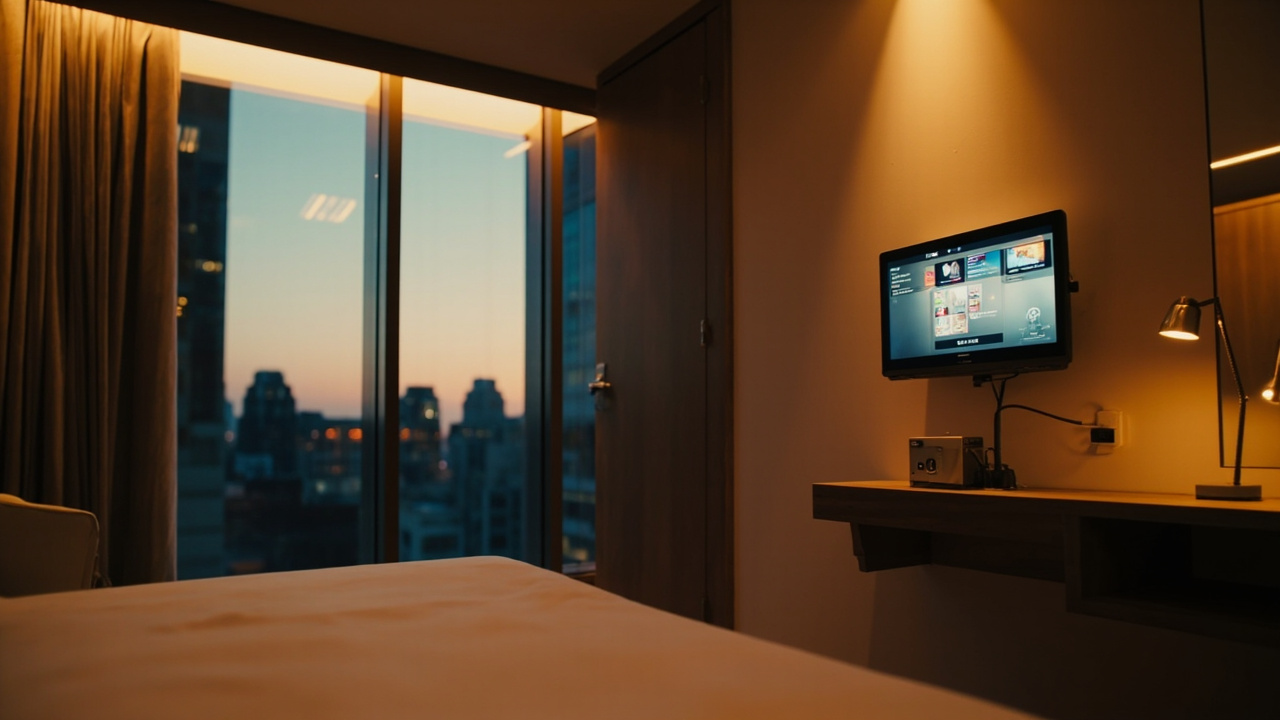
Modern hotel room interior at dusk, wall-mounted television connected to a small compact operator box hidden behind, clean bedside desk, warm ambient lighting, architectural photography, photorealistic, no people, no logos, no readable text.
For room automation, segment “control” into four verbs. Command asks the television to switch, adjust, or expose a service. Report returns television state, room state, or a device fault. Configure establishes endpoint identity, network settings, middleware, and room mapping. Manage distributes policy, software, diagnostics, and recovery actions across the estate. A product that supports the first verb does not necessarily support the remaining three.
The RFQ should name the buyer situation and penalize ambiguity. For an operator rollout, request room-level acceptance evidence. For a branded property, request the exact operator middleware, DRM, and regional compliance checklist. For a staged fit-out, require the golden sample to undergo the same power, network, television-control, and recovery sequence as production units. The matrix then becomes a deployment map rather than a catalog filter.
A decision path for the RFQ
Start with the control contract, not the chipset. A television endpoint can be evaluated only after the buyer knows what it must listen to, answer, and do when a message is malformed. Convert the estate requirements into testable lines before asking the supplier to quote variants.
- Define the room boundary List every device in scope, the room controller, network segment, operator backend, PMS or service platform, and any environment-control gateway. Exclude products or interfaces that are not yet approved.
- Classify each command Mark television commands as mandatory, optional, or prohibited. For each mandatory command, specify direction, trigger, payload, expected response, timeout, retry count, and safe default.
- Choose the control method State whether IR, serial, HDMI-CEC, local API, network API, or another mechanism is permitted. Do not combine several methods in one acceptance sentence unless the source of command priority is defined.
- Freeze the interface profile Attach the protocol version, authentication approach, network requirements, port mapping, room-ID format, message examples, and firmware compatibility statement. The protocol surface must be documented independently of the processor model.
- Set the endpoint specification Record operating system, RAM/ROM, video and audio requirements, DRM, connectivity, outputs, dimensions, and environmental or regulatory needs. Confirm every value against the production datasheet.
- Define the operating model Assign enrollment, certificate or credential handling, image delivery, middleware licensing, configuration ownership, monitoring, spare-unit process, incident escalation, and rollback to named parties.
- Approve a golden sample Test the exact production configuration in representative rooms. The sample must pass television control, content playback, connectivity, recovery, and update tests before scale approval.
- Run the pilot and sign residual risk Use a controlled batch across room types, network paths, and occupancy patterns. Record defects by firmware, room type, topology, and severity before releasing the next batch.
The RFQ can then contain lines in this form:
The endpoint shall accept the approved television command set through [specified interface]. A valid power command shall produce the defined state within [specified observation window]. The room controller shall receive [specified state/event]. Invalid commands shall be ignored without changing the television state. Network loss shall leave [specified fallback behavior]. The supplier shall provide [named test report, configuration record, and traceability evidence].
Do not insert an unproven timeout, retry count, or fallback into the quotation. The buyer must obtain these values through interface confirmation and room testing. Likewise, a supplier statement such as “supports hotel room integration” is not a substitute for a command table. Translate that statement into observable behavior.
A useful flow is:
This sequence exposes missing handoffs. If the operator backend generates an event but no acknowledgement is defined, support cannot distinguish a delivered command from a failed action. If the endpoint can report state but the room controller cannot interpret the response, the integration remains incomplete. If software updates occur outside a controlled window, a routine maintenance action can become a guest-visible incident.
The traps in this category
The central trap is confusing a television endpoint with the controller for the entire room. A set-top box can implement a television command set, but lighting, curtains, HVAC, door-state and service-request functions usually involve other controllers and message paths. If the RFQ does not identify the system of record for each function, quotations can differ by hundreds of lines while describing incompatible systems.
Field trap
A “single-box room controller” claim can conceal multiple unpriced dependencies: infrared or serial adapters, room-control firmware, API licences, network design, certificates, middleware integration, installation labour, and long-term monitoring. Require a bill of interfaces and responsibility matrix before treating it as one product.
The second trap is using a chipset label as an acceptance criterion. Processor generation can indicate capability direction, but it does not prove the room-control interface, update mechanism, thermal performance, broadcast profile, or integration status. The buyer should receive configuration identifiers, test evidence, and production datasheet references instead.
Field trap
Quotations can diverge around optional DRM, optional Ethernet speed, optional memory configurations, included cables, adapters, licences, and installation support. Mark every option explicitly as included, excluded, or dependent on the production configuration. “Free” is not an acceptable commercial statement in an RFQ.
Further field traps follow a repeatable pattern:
- Undefined ownership: one party installs the television, another supplies middleware, and a third claims network faults. Create an owner for each interface and evidence artifact.
- Late guest-event mapping: a room number exists in the property system but not in the television operator portal. Validate both identities before rollout.
- Reset ambiguity: power cycling, network loss, application exit, and remote factory reset are treated as equivalent. Define the expected state for each.
- Version drift: the room controller, middleware, endpoint image, and management policy change on different dates. Require compatible-version records.
- Pilot substitution: a demonstration unit uses a different image from production. Bind acceptance to the production configuration identifier.
- TV-control interference: guide data, HDMI-CEC, infrared, and network commands compete for the same television function. Assign command priority in the command table.
- Physical-access assumptions: wall brackets, concealed boxes, cable length, heat dissipation, and service access are absent from electrical drawings. Include the installation condition in the sample review.
The quotation therefore needs three attachments: a requirements baseline, an interface or command schedule, and a configuration register. If any attachment changes, use formal change control. A verbal assurance that the next firmware release will support a function does not satisfy the control contract.
Verification you can ask for on paper
Factory verification should be tied to the same configuration that enters the property. The evidence chain should connect the ordered bill of materials, production board, software image, test result, serialized unit, and room acceptance record. A factory report that cannot be tied to a shipment or configuration is evidence of activity, not traceability.
- Incoming-material controls Request the approved part list, change-control record, and supplier traceability for components affecting the configured platform.
- SMT and AOI evidence Ask for inspection scope, defect disposition, and records for the production lot under review. The evidence should identify the line, date, and relevant work-in-progress stage.
- Electrical and functional checks Review the production test plan for power, interfaces, storage, connectivity, video output, audio, and the functions relevant to the RFQ.
- Software-image identity Record the image version, middleware version, configuration profile, and update source used on each serialized unit.
- Aging or burn-in evidence Ask what load, duration, and environmental condition were used, plus the units or samples covered. Do not assume every port was exercised simultaneously unless the procedure states it.
- Dark-room or display validation Request evidence appropriate to the video specification, including image output and panel compatibility where applicable. Clarify whether the test covers the television model used by the property.
- Audit and release records Review the factory audit, nonconformance process, corrective-action trail, and authorization point before shipment.
- Property-level acceptance Repeat the critical commands and recovery cases in the pilot room and link the signed result to the exact production configuration.
Ask for a sample evidence packet tied to one lot: the approved configuration, SMT/AOI report, functional-test summary, software-image record, applicable aging or dark-room result, audit reference, and serialized-unit traceability. DataMax can support a video factory audit or provide the SMT/AOI and aging evidence relevant to the selected SKU and configuration.
Verification must distinguish three claims. Designed to means the specification includes the function. Manufactured with means the production configuration and test records show it. Accepted in service means the deployed unit passed the property’s room-control scenario. These are different stages with different evidence.
The RFQ should also state the sampling method and acceptance authority. For example, specify whether every unit receives a full functional test or whether a defined production test covers a sample, with separate 100% checks for critical ports. Require quarantine rules for failed units and escalation for repeated failures. For room-control projects, add a golden-sample comparison so engineering can distinguish a hardware variation from a room-controller, television, network, or middleware variation.
Documentation should survive the handover. A PDF on a factory laptop is weaker evidence than a controlled index containing revision numbers, approval dates, and links to underlying records. The buyer can request redacted extracts for confidentiality while preserving lot, line, configuration, and test identifiers.
Entry tier versus commitment tier
The entry tier buys a television endpoint and the minimum control behavior required in the room. The commitment tier adds documented room-event exchange, centralized management, controlled updates, and estate-level service evidence. The difference is not the number of logos on the device; it is how much uncertainty has been converted into a testable contract.
| Decision field | Entry tier | Commitment tier |
|---|---|---|
| Primary scope | Television playback and a limited command set | Television plus defined room events, status, management, and service evidence |
| Interface baseline | Supplier statement or basic control list | Versioned command table, message examples, and interface-owner map |
| Configuration control | Model-level configuration | Unit, room, firmware, middleware, and property mapping |
| Deployment method | Manual configuration and local troubleshooting | Documented provisioning, staged rollout, and remote or centralized management subject to scope |
| Acceptance | Playback, output, and basic control check | Command, fault, recovery, update, and multi-room scenario testing |
| Commercial boundary | Hardware and basic configuration | Licences, integration labour, middleware, infrastructure, support, and change control must be itemized |
| Exit risk | Unit replacement may conceal configuration errors | Residual failures can be traced to configuration, interface, or operating owner |
The entry tier suits a controlled pilot, operator-operated television service, or property seeking a simple television command surface. The commitment tier suits an estate where room state, remote support, consistent software, and coordinated PMS or service workflows affect operational cost.
A commitment tier must define who owns the management platform. “Managed” can mean the supplier provides an image, the operator provides a portal, or a third-party system repository holds the binary. These are different contracts. Similarly, a television-control integration can be local, cloud-mediated, or gateway-mediated. Name the topology and the party that stores room maps and logs.

The same figures, in searchable form:
| Stage | Editorial score |
|---|---|
| Requirements only | 25/100 |
| Requirements plus target price | 46/100 |
| Approved golden sample | 74/100 |
| Pilot batch sign-off | 91/100 |
For the hotel room control system, the commitment tier adds contractual evidence, not necessarily a more expensive processor. A lower-tier endpoint can enter the commitment tier if its interfaces, configuration, management, and acceptance controls are mature. Conversely, a high-tier media platform does not create room integration by itself.
The mechanism behind the spec
The mechanism begins with separate control planes. The room-control plane concerns commands and events; the media plane concerns video, audio, application, and content; the management plane concerns inventory, identity, software, configuration, and health. A commercial television specification may describe only the media plane. Buyers must require the other planes to be documented separately.
Television control can use infrared, serial, network APIs, HDMI-CEC, or a combination. Infrared is a physical line-of-sight channel and requires mapping, emitter placement, and repeatability checks. Serial requires a defined electrical interface, baud rate, framing, and command vocabulary. A network API requires addressing, authentication, session behavior, and error semantics. HDMI-CEC uses capabilities negotiated between devices and can therefore vary with television firmware, input selection, and supported feature sets. Naming the mechanism is not enough; its operating conditions must be stated.
IPTV multicast is a separate distribution mechanism. A service may receive video through multicast while receiving management or room-control messages through unicast. This split changes switch design, traffic policies, and troubleshooting. The hotel room control system therefore needs a topology diagram that marks control, media, management, power, and physical-service paths. Labeling every arrow “IP” conceals important differences.
Android introduces another layer. AOSP Android 11 or Android 14 identifies the platform family, but the production image, operator middleware, application permissions, device-owner policy, boot behavior, update mechanism, and television-control integration determine room behavior. Android Management APIs can manage certain enterprise-managed device behaviors, but their presence does not prove that a particular property workflow is implemented. The operator must show the actual policy and enrollment procedure.
DRM and output protection are separate acceptance fields. Widevine L1, PlayReady, HDCP 2.2, Dolby Vision, and DTS appear only where the supplied product facts permit. The buyer should ask which profile is optional, which service is authorized, which device identity is used for licensing, and what television output mode is required. A codec capability list also does not guarantee playback of every commercial stream; operator packaging, profile, level, bitrate, and service authorization remain relevant.
Network design must match the control topology. RJ45 100M, Wi-Fi6 2x2, Bluetooth 5.4, HDMI 2.0b, USB, optical audio, analogue AV, and TF are physical interface facts, not proof of an end-to-end room service. The architecture team must confirm switch capability, VLAN plan, addressing, multicast configuration, authentication service, monitoring source, and physical access.
Finally, define state semantics. Commands should specify whether they are level-set, toggle, edge-triggered, idempotent, queued, or advisory. Reports should distinguish “received,” “accepted,” “completed,” and “failed.” Without that distinction, the operator log can show an action that never reached the television. A precise hotel room control system contract therefore covers command direction, payload, response, timeout, fallback, and ownership for every mandatory function.
Which DataMax models actually sit here
The following models are television endpoints that can participate in a room-control project only after their interfaces and firmware configuration are approved. DataMax specifications below are limited to the supplied product facts; room-control APIs, IR profiles, management platforms, dimensions, and certifications not listed require confirmation against the production datasheet.
| Model | Platform and fit | Memory | Media and DRM | Connectivity and output |
|---|---|---|---|---|
| DM21P | Amlogic S905Y4, quad Cortex-A35; AOSP Android 11; 4K IPTV / operator middleware set-top box | 2GB / 8GB; 4GB; 16/32/64GB optional | AV1 [email protected]; VP9/H.265 4K@60; H.264 4K@30; Widevine L1 / PlayReady / HDCP 2.2 optional | HDMI 2.0b out x1; USB2.0 x2; TF; S/PDIF; 3.5mm AV; RJ45 100M; Wi-Fi6 2x2 + BT5.4; DC 5V/2A |
| DM21S | Amlogic S905Y5, quad Cortex-A55; AOSP Android 14; 4K Android TV box for IPTV/OTT white-label | 2GB / 16GB; 2/4/8GB; 16/32/64GB optional | AV1 / H.265 [email protected] 4K@60; Widevine L1 / PlayReady optional; Dolby Vision/DTS | HDMI 2.0b out; S/PDIF; AV; USB2.0 x2; TF; RJ45 100M; 1G optional; Wi-Fi6 2x2 + BT5.4 |
| DM21T | Amlogic S905X5, quad Cortex-A510 (ARMv9); AOSP Android 14; premium UHD / cloud-gaming box | 4GB / 64GB; family options | H.266/VVC [email protected] 4K@120; AV1/VP9/H.265 4K@120; AVS3 4K@120; H.264 4K@60; inline AI-SR; Widevine L1 / PlayReady optional | HDMI 2.0b out with no HDMI in; USB2.0 x1 + USB3.0 x1; TF; S/PDIF; AV; RJ45 100M; 1G opt; Wi-Fi6 + BT5.4 |
| DM22Q | Amlogic S905X5M, quad Cortex-A55 up to 2.5GHz; AOSP Android 14; gaming-oriented Android TV box | 4GB / 64GB; 2/4/8GB; 16/32/64GB optional | AV1/H.265 L5.1 4K@60; inline AI-SR; Widevine L1 / PlayReady optional; Dolby Vision/DTS | HDMI 2.0b out; USB2.0 x2; TF; S/PDIF; AV; RJ45 100M; 1G opt; Wi-Fi6 2x2 + BT5.4 |
DM21P is the clearest operator-IPTV starting point because its stated fit is a 4K IPTV/operator middleware set-top box. DM21S suits a 4K Android TV white-label direction where the operator middleware and television-control implementation are separately validated. DM21T fits a premium UHD or cloud-gaming requirement, with no HDMI input listed. DM22Q aligns with a gaming-oriented Android TV requirement. Neither gaming designation nor codec capability establishes hotel room-control readiness.
Configuration discipline matters. “2GB / 8GB” and the listed optional memory values for DM21P, plus the optional storage paths for DM21S and DM22Q, must be tied to an approved production SKU. The Ethernet options, DRM options, and output variants also need explicit inclusion in the quotation and golden-sample record. For dimensions, environmental ratings, protocol support, management software, and certifications not stated in the facts, confirm against the production datasheet.
Before the pilot, request a configuration sheet for each proposed model: exact RAM/ROM, Android version, firmware image, middleware, DRM authorization, Ethernet option, output mode, television-control method, and supported recovery path. Link that sheet to the factory evidence packet and room test. That closes the chain between DataMax hardware, operator configuration, and the property’s hotel room control system contract.
For a volume program, the engineering team can review the proposed room topology, command schedule, and golden-sample protocol before production release. Email [email protected] with the SKU list, target-market certificates, middleware and DRM checklist, and room-control acceptance script to request a focused response.
Further reading
- hotel room control system: Protocol and PMS Interfaces
- Allwinner Android TV boxes
- AOSP Android TV boxes
- H.265 HEVC Android TV box guide
- Widevine L1 certification guide
- DataMax DM21P specifications and fit
- DataMax DM21S specifications and fit
FAQ
What is the highest level of hotel room control integration?
The highest practical level is an estate-managed service in which device identity, room events, television state, software, configuration, health, and recovery operate through approved interfaces and assigned ownership. Calling a device “Level 4” without an interface specification, security method, update process, and acceptance procedure does not establish that maturity.
Which level should a hotel pilot first implement?
Start with a controlled Level 1 or Level 2 television endpoint, depending on whether the room controller must send events or receive television status. Freeze the command list, approved configuration, recovery behavior, and property-side test cases. Expand toward broader integration only after the golden sample and pilot batch pass the same criteria.
Does a 4K television box automatically support room control?
No. 4K decode, HDMI output, DRM, and processor specifications describe media capability. Room control requires a defined command path, such as IR, serial, HDMI-CEC, or a network interface, plus response behavior, fallback, configuration, and testing. Confirm these against the production datasheet and an approved sample.
How should optional Ethernet and DRM configurations be specified?
List the exact production option in the quotation, golden-sample record, and test plan. For example, state whether RJ45 100M or the optional 1G configuration is fitted, and which DRM profile is authorized. A family-level capability list is insufficient because acceptance follows the shipped configuration.
Who should own room integration failures?
Assign ownership by interface: television control, network, room controller, operator middleware, device image, and property workflow can have different owners. The final contract should identify the escalation path, evidence required, rollback action, and sign-off authority for each failure class.
What should be included in a pilot sign-off?
Include the approved command schedule, device and firmware identifiers, television compatibility, event and state behavior, network loss, restart, remote reset, update, recovery, and multi-room operation. A pilot-batch sign-off should link those results to the production configuration and residual-risk decisions.