
Commercial projector decision context
A consumer projector guide normally treats brightness as a headline specification, evaluates a single demonstration unit and ignores service access, mounting structure, network control and replacement logistics. Those assumptions fail in installed systems where one projector may support 12-hour daily operation, 365-day scheduling, centralized control and several years of service. Procurement should instead define the viewing task, measured room illumination, screen geometry, operating schedule, content path, maintenance authority and failure-recovery requirement before selecting a display technology.
An LCD projector uses an LED or other light source to illuminate transmissive red, green and blue liquid-crystal panels. Each panel forms one color component; the optical system recombines the three paths and projects them onto a screen or wall. Digital light-processing, such as DLP, and hybrid systems use a different imaging mechanism, so the original LCD description must not be applied indiscriminately to the DataMax GP8. That model’s supplied record identifies a 0.23-inch DMD while calling the product a UST projector; the imaging architecture and “LCD size” field therefore require written clarification before technical approval.
- Design objective: quantify usable lumens at the screen, not only source output, and preserve native pixel structure after geometric correction.
- Operating objective: specify daily hours, calendar life, ventilation exposure, dust loading, service access and maximum acceptable downtime.
- Integration objective: identify every signal, control, network, power and room-control interface before product selection.
- Commercial objective: define warranty response, spare-unit stock, firmware policy, PCN approval and evidence-retention responsibilities.
- Risk objective: separate manufacturer claims from independently measured acceptance criteria, especially for ANSI lumens, focus, noise and automatic geometry.
| Installed-system variable | Consumer-guide treatment | Commercial specification | Procurement evidence |
|---|---|---|---|
| Luminance | “Bright” or one peak rating | ANSI lumens, measured sample tolerance and screen-use point | Test report plus site photometric measurement |
| Resolution | Marketing resolution | Native panel resolution, input maximum and scaling behavior | Test-pattern captures at every operating mode |
| Software | Feature checklist | OS baseline, application rights, signed firmware, DRM and rollback | Build sheet, licenses, CVE process and update policy |
| Maintenance | Cleaning advice | Duty cycle, filter path, optical-engine service and spare strategy | Service manual, MTBF basis and inspection procedure |
| Failure | Not quantified | Failure rate, replacement SLA and firmware-recovery procedure | Field trial, log export and contractual acceptance plan |
Optical and measurement fundamentals
Commercial brightness should be expressed in ANSI lumens because ANSI/InfoLuma Projector Measurement Standard 3-2021 defines a controlled procedure for measuring lumens across a defined grid rather than relying on a lamp-lumen marketing calculation. A proposal should request the test standard, normalization method, sample size and calibration uncertainty. A larger measured value has engineering meaning only if measurement conditions and optical output remain comparable.
The useful screen illuminance depends on projected lumens, screen area and maintenance. The basic relationship is:
Escreen = Φscreen / Ascreen, where E is average screen illuminance in lux, Φ is maintained lumens reaching the screen and A is screen area in square metres.
For a 16:9 screen of diagonal D inches:
W = D × 0.8716 m; H = W / 1.7778; A = W × H.
Throw distance is governed by throw ratio:
TR = distance / image width; therefore width = distance / TR. A quoted ratio must identify whether it is wide-to-wide or tele-to-wide. UST ratios near 0.24:1 and long-throw ratios above 1.2:1 produce fundamentally different cabinet and installation constraints.
| Quantity | Definition | Specification method | Acceptance control |
|---|---|---|---|
| ANSI lumens | Normalized luminous output measured by a defined grid method | Report ANSI/InfoLuma 3-2021 or disclose alternate method | Measure in final operating mode at stabilized output |
| Native resolution | Physical addressable pixels of the imaging system | State horizontal × vertical pixels | Inspect 1:1 pixel mapping and text edges |
| Contrast ratio | Luminance ratio between specified bright and dark states | State room conditions, image mode and whether ANSI is used | Measure on the intended screen or reference surface |
| Throw ratio | Projection distance divided by image width | Define lens position and zoom state | Verify physical distance and exact image width |
| Keystone | Geometric correction that changes effective pixel pitch | State correction range and measured resolution | Reject installations dependent on severe digital correction |
| Focus | Sharpness across the image plane and tolerance depth | Report center, corner and screen-edge results | Test after thermal stabilization and at operating angle |
| Light-source life | Time or use until output or color reaches a specified criterion | State test basis and failure threshold | Require lumen-depreciation curve and warranty definition |
Native resolution does not create detail beyond its pixel count. A native 1920×1080 panel has 2,073,600 addressable pixels; calling 3840×2160 input “4K” does not establish 4K native projection. Input compatibility should therefore be recorded separately from displayed resolution. Likewise, digital keystone correction can maintain rectangular geometry while reducing effective sharpness, so mounting geometry remains preferable to correction.
Focus stability depends on heat, mechanical movement and panel alignment. Automated focus and obstacle avoidance improve commissioning but do not eliminate structural surveys. Temperature rise also changes color, geometry and output over a 2-hour stabilization period. A rigorous purchase should test warm and cold states rather than a newly unpacked unit.
DataMax real-data model comparison
The following comparison contains only supplied DataMax values. Missing DM-P5, DM-P280 and Android 13-projector fields are not inferred from model names. Several supplied values conflict and are explicitly retained for supplier clarification.
| Model | Imaging and output | Optical placement | Platform | Connectivity and controls | Mechanical and acoustic |
|---|---|---|---|---|---|
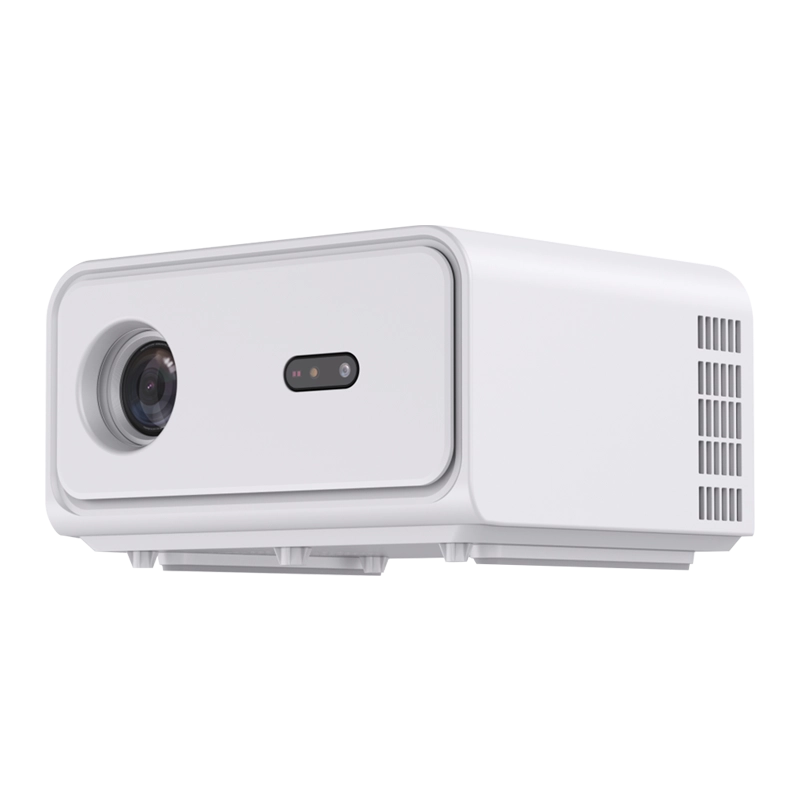
| GP8 | 450 ANSI lumens; 1920×1080 native; 1200:1 contrast; 30–200 in; LED | 0.24:1; 15–116 cm; front projection; auto focus; auto keystone | Amlogic T972; Android 9; 2 GB RAM; 32 GB ROM | Wi-Fi 6 dual-band; BT 5.0; 1 HDMI; 2 USB 2.0; Airplay, Miracast and EShare | 94×71×190 mm; 0.88 kg; 89 W; 30 dB; 1×5 W speaker |
| DM-P5 | Supplied title states 1080P LCD; no complete technical record supplied | Confirm against production datasheet | Supplied title states Official Netflix and CTS-certified Android OS; version unspecified | Confirm interface, DRM, OTA and remote-control details | Confirm against production datasheet |
| DM-P280 | Supplied title states 1080P; brightness and contrast not supplied | Auto focus and auto keystone stated; throw data not supplied | Android 13 stated; CPU, RAM and ROM not supplied | Confirm against production datasheet | Confirm against production datasheet |
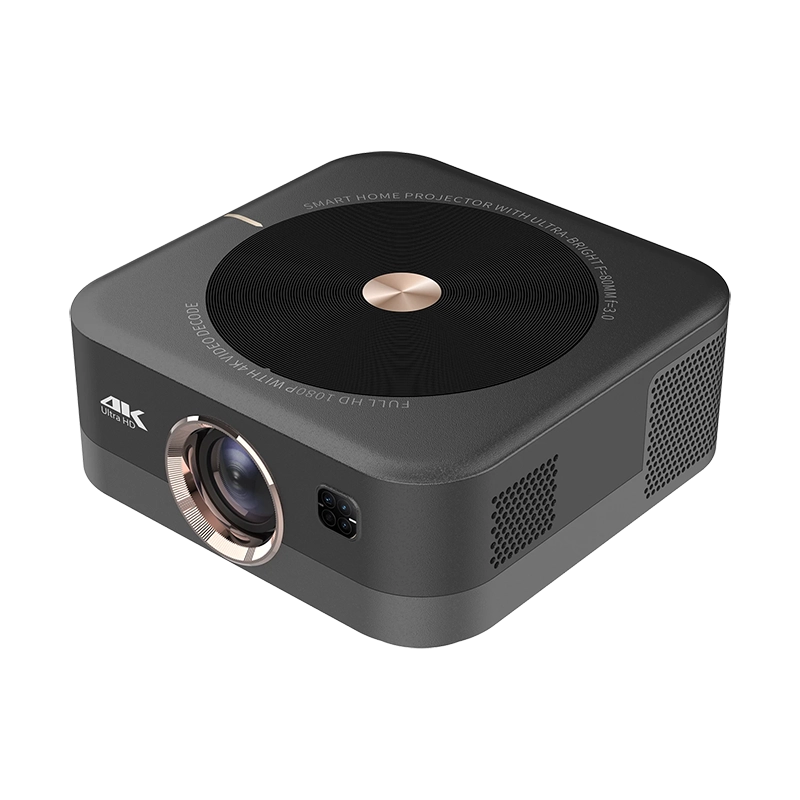
| GP96-GTV | 1000 ANSI lumens; 1920×1080 native; 1600:1; 80–120 in; 4.45-inch LCD display | 1.2:1; 1.26–3.5 m; front, rear or hang; auto focus, keystone and screen alignment | Allwinner H137 plus Google TV dongle; Google TV 11 or 14; dongle CPU S805X2 or RTD1332; 1 GB DDR4; 8 GB eMMC | 1 HDMI; 1 USB; mini-jack audio; dual-band Wi-Fi; BT 5.0; IR receiver; claimed HDR and Dolby support | 256×203×140 mm; 2.95 kg; 130 W; 32 dB; 2×5 W speakers |
| GP94C | Supplied title says 550 ANSI; specification table says 500 ANSI; 1920×1080; 1500:1; 29–150 in | 1.35:1; best range 1.15–6 m; front, rear or hang; auto focus, keystone, alignment and obstacle avoidance | MTK9269; Android 9; 1 GB RAM; 32 GB ROM | 1 HDMI; 1 USB; mini-jack; 100M Ethernet; dual-band Wi-Fi 6; BT 5.1 | 315×305×155 mm; 2.42 kg; 86 W; 32 dB; 2×5 W speakers |
Conflict flags: GP8 is named 400 ANSI lumens in the supplied title but 450 ANSI lumens in its specification record. GP8 is named an LCD projector but lists a 0.23-inch DMD. GP8 native resolution is written “1920×1080P WVGA,” an internally inconsistent resolution-class description. GP96-GTV specifies Google TV 11 or 14, two possible dongle CPUs, and an LED output of 10,000–10,500 lumens alongside 1000 ANSI lumens. GP94C is titled 550 ANSI but specifies 500 ANSI. These points must be confirmed against the production datasheet before drawing.

Quantitative selection and worked sizing example
Start with a photometric target rather than a screen diagonal. One common commercial classroom rule is approximately 3,000–3,500 maintained ANSI lumens for typical controlled-light classrooms, while retail, hospitality and daylight-active spaces can require 4,000–10,000 ANSI lumens. These are industry planning ranges, not universal rules; the final value should derive from measured ambient light, screen gain, viewing angles and the client’s contrast criterion.
Consider a corporate training room with a 100-inch 16:9 matte-white screen. Its dimensions are W = 100 × 0.8716 = 87.16 inches = 2.214 m; H = W/1.7778 = 1.245 m; A = 2.757 m². If the design target is 250 lux at the screen, the required maintained output is:
Φ = E × A = 250 × 2.757 = 689 lm.
Adding a 25% maintenance reserve yields 861 lm. A 1000-ANSI-lumen unit would meet this illustrative threshold only if the measured maintained output is at least 861 lumens and actual room conditions remain near the design target. The calculation does not prove suitability because ANSI measurement, screen gain, optical alignment and maintenance limits differ.
At a GP96-GTV throw ratio of 1.2:1, a 2.214 m image width requires approximately 2.657 m from lens reference point to image plane under the supplied ratio definition. The installed unit dimensions are 256×203×140 mm, but mount reference points, lens shift and required clearances are absent; the final mount position must be confirmed against the production mechanical drawing.
A 25% reserve should not be treated as a universal life allowance. Build a maintenance model from supplier lumen-depreciation data, operating hours, cleaning intervals and the contractual replacement threshold. A nominally 10,000-hour LED rating has no financial meaning unless the manufacturer defines whether it is time, brightness, color, instantaneous failure or a combination.
- Measure or document room illuminance across the screen plane under scheduled lighting.
- Select screen diagonal, aspect ratio, gain and viewing cone from the seating plan.
- Calculate required maintained screen lumens using E × A, then add a justified reserve.
- Verify candidate throw distance, projection geometry and physical mounting envelope.
- Calculate annual energy use from measured operating power and scheduled hours.
- Re-test a production-equivalent unit at room temperature after two hours of operation.
| Use condition | Illustrative maintained output | Screen/mounting implication | Key procurement test |
|---|---|---|---|
| Controlled classroom or meeting room | 3,000–3,500 ANSI lumens as an initial planning range | 80–120 in; wall or fixed-frame matte screen; ceiling mount | Text readability at rear seats under specified lighting |
| Hotel guestroom | 250–1,000 ANSI lumens depending on window control and content | Ceiling or cabinet projection; blackouts may improve contrast | Night scene, ambient-light leakage and PMS control |
| Retail or corporate atrium | 4,000–10,000 ANSI lumens initial planning range | High-mounted, locked image and protective cage where required | 3-hour stabilized output, security and service access |
| High-ambient teaching lab | 5,000 ANSI lumens or measured photometric calculation | ALR screen only after glare, hotspot and geometry validation | No visible hotspot; contrast under occupied-room lighting |
| Critical digital-signage function | Demand calculation plus redundancy, not an ANSI range | Fixed geometry, environmental monitoring and protected power | 24-hour burn-in, reboot recovery and spare swap |
Hotel and hospitality deployment profile
A guestroom projector requires a controlled content and service workflow rather than unrestricted casting. The condition is typically a 29–120-inch target with guest-controlled volume, blackout curtains, bedside controls and a property-managed network. A ceiling UST unit such as the GP8 can reduce throw distance, but its DMD-versus-LCD architecture contradiction and 30 dB specification must be resolved before design approval.
| Layer | Recommended architecture | DataMax relevance | Primary risk |
|---|---|---|---|
| Presentation | HDMI source from room controller or streaming dongle; disable direct casting unless policy allows | GP8 has 1 HDMI; GP94C has 1 HDMI and 100M Ethernet; GP96 has 1 HDMI | Guest bypass of content controls or unsupported streaming rights |
| Room control | Integrate ceiling IR, PMS or hotel-room-control API where licensed | No DataMax PMS API is stated; confirm interface availability | No event state reconciliation between PMS and projector |
| Audio | Use line/headphone output to in-room amplified speakers only after level and ground-noise testing | Mini-jack outputs and built-in 5 W speakers are stated | Popping noise, low headroom and weak bass |
| Power | Scheduled AC branch, surge protection and asset inventory | GP8: AC 100–240 V, 19 V/4.7 A adapter; others: AC 110–240 V | Tripping from room-control relays or incompatible adapter sequencing |
| Maintenance | Treat as consumable signage asset; define swap process and remote diagnostic access | RAM, OS and interfaces vary by model | Unauthorized access or long RMA turnaround |
Corporate, education and retail deployment profiles
Corporate meeting rooms emphasize repeatable digital geometry, conferencing compatibility and fast reset. A 100-inch screen is convenient for 6–12 participants, but sightlines and wall space determine suitability. Ceiling placement should use the projector’s physical lens reference, not the center of its shipping carton. Recessed mounting must preserve intake and exhaust clearances, service loops and access to the IR receiver.
Education installations need higher duty cycles and repairability. Laser or LED sources reduce lamp-stock handling, but filters, speakers, power supplies and thermal systems still fail. Classrooms should be provisioned with cable paths for future 16:9 or 16:10 replacement, even if the current projector supports only 16:9. Google Android 13 is stated for the unnamed DM-P280 model, but CPU, RAM, storage, update policy and widevine security are not supplied; do not treat that title as sufficient platform evidence.
Retail digital signage requires high ambient illuminance, tamper resistance and unattended recovery. The GP96-GTV’s supplied 1000 ANSI-lumen rating is a starting candidate for controlled ambient conditions, not a universal retail rating. A measured screen target should be established; the 130 W operating power is also relevant to a 16-hour retail day, generating 2.08 kWh/day and approximately 13,952 kWh over 250 operating days before power-supply losses or standby loads.
| Profile | Condition thresholds | Mounting and connectivity | Management architecture | Principal risks |
|---|---|---|---|---|
| Corporate boardroom | 100–120 in; controlled lighting; native 1080p may suit 16:9 at typical distances | Ceiling mount; fixed HDMI and network; hidden cable raceway | Room controller, calendar automation, MDM or site platform | Wake timing, camera overscan and firmware drift |
| Education classroom | 80–100 in; often 2,000–5,000 operating hours/year | Ceiling mount; spare HDMI, network and USB service loop | Central image policy, device staging and firmware ring management | High duty cycle, dust and unauthorized casting |
| Retail campaign display | 16-hour daily use is illustrative; ambient light measured at screen | Fixed high mount; locked geometry; tamper-resistant enclosure | Head-end content or Android device management; automated restart | Heat, vandalism, Wi-Fi failure and inconsistent color |
| High-ambient lab | Photometric output at least 5,000 ANSI lumens as an initial range | Precise mount and controlled ambient light; ALR screen only after tests | Fixed image plus environmental monitoring | Hotspots, reflections and brightness overstatement |
| Hospitality room | Window-controlled environment and managed content | Ceiling/cabinet projection; HDMI and room-control wiring | PMS or BMS event integration with heartbeat monitoring | Guest configuration drift and service access |

Google TV, AOSP, DRM and device management
Google TV is a certified Android TV experience with specific launcher, compatibility and security requirements; AOSP is an open-source software baseline. The supplied GP96-GTV record identifies Google TV 11 or 14, an S805X2 or RTD1332 dongle and 8 GB eMMC. It does not identify which production variant is assigned to a shipment, whether it has current Google certification, or what Widevine security level is supported. Procurement should require model-level evidence rather than infer certification from the “Google TV” name.
Android 9 and Android 13 versions are supplied for GP8 and the unnamed DM-P280 respectively, but those versions alone do not establish Google Mobile Services, Google Play licensing, Widevine L1, Dolby licensing or update support. ACD devices sold with Google applications generally require applicable GMS licensing and certification. Android CDD compatibility testing validates designated Android device behavior, while CTS/VTS are Android compatibility tests; none is a substitute for projector-specific optical, thermal and network acceptance.
- DRM: identify Widevine security level L1 or L3, supported HDCP versions where applicable, test vectors and license-service behavior. See the Widevine L1 versus L3 deployment guide.
- Content: record Netflix, Google Play, DRM, codec and 4K claims by exact model and regional license; a product title is insufficient evidence.
- OTA: define signed packages, staging percentage, rollback, release notes, update windows and responsibility for failed updates.
- MDM: require Android Management API or documented alternative, ownership state, device enrollment, app allowlisting and remote restart support.
- Network: validate DHCP, DNS, proxy, captive portal, multicast and destination IP allow-lists in the actual network segment.
- Platform proof: collect Android security patch level, build ID, bootloader policy, root status, open ports and long-term support roadmap.
| Integration layer | Required interface | Platform question | Failure impact |
|---|---|---|---|
| Signage/content | API, CMS agent, URL allow-list or controlled local app | Does the Android build permit managed install? | Campaigns stop at the last cached screen |
| DRM | License challenge through hardware-backed path | Is Widevine L1 supported and maintained? | 1080p or higher output may be blocked |
| OTA | HTTPS firmware service and rollback | Who signs images and approves releases? | Fleet-wide outage or version fragmentation |
| Network | Ethernet/Wi-Fi, NTP, proxy and multicast if required | Are IPTV credentials stored locally or provisioned remotely? | No boot image, control or licensing |
| Room control | IR, serial, API, CEC or trigger I/O | Which documented protocol is supported? | Power, screen and projector become desynchronized |
| Audio | Analog output or supported digital audio | Are audio formats licensed and endpoints exposed? | Lip-sync errors or silent output |
Connected and IPTV deployments can also be blocked by broadcast paths. Multicast IPTV generally requires IGMP snooping or an appropriate multicast design, controlled switch behavior and stable group membership; unicast personalization generally uses HTTP/DASH/HLS-style delivery rather than the IPTV multicast profile. These network requirements apply independently of LCD versus DLP imaging.
Mechanical, thermal and acoustic integration
Mount design must use the production mechanical drawing rather than carton dimensions. The GP8 is listed as 94×71×190 mm and 0.88 kg, but no mount points, lens-center offset, center of gravity or intake/exhaust map is supplied. A UST product placed above a bed or conference table also needs a defined keep-out volume to prevent users and furniture from contacting the optical path.
Thermal design should use the maximum operating power, ambient temperature and required service clearances. For continuous commercial use, an illustrative duty-cycle calculation is:
Annual energy = operating power × scheduled hours/day × operating days/year ÷ 1,000.
At the supplied operating powers, GP8 at 89 W for 2,000 hours consumes 178 kWh annually; GP94C at 86 W consumes 172 kWh; GP96-GTV at 130 W consumes 260 kWh. These figures exclude standby power, controls, infrastructure losses and battery use, none of which are fully supplied.
| Mechanical item | Specification needed | Why it matters | Release condition |
|---|---|---|---|
| Mount interface | Hole pattern, plate dimensions, screw torque and load rating | Prevents oscillation and mount detachment | Approved drawing for exact model/revision |
| Lens throw envelope | Lens reference point, image offset and tolerance | Determines cabinet and screen geometry | Physical template or verified CAD overlay |
| Ventilation | Intake/exhaust areas and minimum clearance | Controls thermal throttling and dust loading | Site airflow temperature test |
| Acoustics | Declared noise condition and listener distance | 32 dB may intrude in quiet hospitality spaces | Measured at specified distance and operating mode |
| Cable strain | HDMI, power, network and control bend radius | Prevents intermittent signal and connector failure | Installer-approved service loop |
| Security | Lock points or cage design without blocking vents | Reduces theft in retail and education | Physical security inspection |
Sound specifications require measurement context. The supplied 30 dB for GP8 and 32 dB for GP94C/GP96-GTV cannot be compared responsibly without microphone distance, weighting, room reflection and operating mode. Built-in 5 W speakers may support room-control use but should not be assumed to provide intelligible coverage for a classroom or retail environment.
Compliance evidence and optical-engine reliability
A compliance package should connect the exact SKU, PCB revision, firmware baseline and manufacturing site to traceable reports. Regulatory scope depends on destination market and product radio configuration: examples include FCC or ISED in the United States and Canada, CE/RED and EMC/LVD in the European Economic Area, UKCA/UK requirements for applicable Great Britain products, and national radio approvals. The supplier must identify applicable legislation; this article does not certify a DataMax model.
| Evidence class | Required artifact | Acceptance detail | Procurement risk |
|---|---|---|---|
| Electrical safety | CB, UL, EN/IEC or destination-equivalent report and certificate | Model, ratings and factory must match | Unauthorized substitutions invalidate certification |
| EMC | Emissions and immunity test report | Include ports, wireless modes and representative firmware | Network or power accessory changes alter compliance |
| Radio | 2.4/5 GHz test evidence and grant/certification identifiers | Match antenna and final enclosure | Country-specific restrictions |
| Material | RoHS and REACH declarations, including SVHC tracking | Identify homogeneous materials and suppliers | Conflicting supplier declarations |
| Battery | UN 38.3, IEC 62133 and transport declaration where applicable | Only relevant to models containing batteries | No battery specification was supplied here |
| Software licensing | Google certification, GMS agreement status and AV1/AVS/HDR/Dololby licenses as applicable | Exact model and destination region | Application failure after shipment |
| Optical safety | Applicable laser or lamp-product assessment based on source technology | Exact optical engine and installation class | Misclassifying LED or DLP system |
A “dust-free design,” stated in the GP96-GTV product title, is not itself proof of a sealed optical path. The supplier should define whether the optical engine is sealed, how the filter is serviced, whether the warranty covers contamination and what the ingress test covered. Condensation remains possible in non-climate-controlled rooms even with a sealed enclosure; ventilation and dew-point management must be part of building design.
Lumen depreciation should be reported as output and color maintenance curves against elapsed hours, with test temperature, mode and failure criteria. The supplied GP94C and GP96 records give an LED source figure of 10,000–10,500 lumens, but that appears separate from ANSI output and lacks a defined life endpoint. Do not use it as warranty life without confirmation.
Lifecycle, total cost and spare planning
Total cost of ownership extends beyond acquisition. Build a 5-year illustrative cash-flow structure using validated unit energy, replacement cycles, cleaning labor, service travel, control integration, spare units and content operations. Avoid applying generic percentages until actual site data exists.
5-year TCO = acquisition + installation + energy + maintenance + replacements + service travel + integration operations + end-of-life disposal.
For a comparison, 12 projectors operating 10 hours/day on 250 days/year at the supplied operating powers produce an illustrative annual electricity use of 2,670 kWh for GP8, 2,580 kWh for GP94C and 3,900 kWh for GP96-GTV. Applying an illustrative electricity tariff solely as a variable placeholder, annual cost is energy × tariff; the procurement team must insert its actual contracted rate and confirm that the operating specification represents the relevant power mode.
- Establish a five-year quantity plan by site, model, room and commissioning phase.
- Apply supplier lumen-depreciation curves at scheduled annual hours.
- Define preventive tasks: lens inspection, filter service, cleaning, mount torque and cable inspection.
- Estimate labor separately from parts because technicians may charge minimum site-visit time.
- Hold critical spares based on failure-rate evidence, deployment density and replacement lead time.
- Track RMA defect code, firmware version, room condition and elapsed operating hours.
- Recalculate the spare ratio after the first 90 days and every 6 months.
| TCO element | Calculation input | Evidence required | Control action |
|---|---|---|---|
| Acquisition | Units, approved configurations and logistics | Quoted BOM and SKU schedule | Lock configuration before pilot approval |
| Installation | Mount, screen, cabling, labor and travel | Site survey and work package | Standardize room types |
| Energy | Watts × hours × tariff | Measured operating and standby power | Use scheduled shutdown and efficient modes |
| Maintenance | Cleaning, filters, inspections and labor | Service manual and CMMS history | Preventive maintenance schedule |
| Spares | Fleet quantity × applicable service ratio | Failure distribution and lead time | Hold initial spares, then revalidate |
| Retirement | Disposal, data wipe and refurbishment | Corporate environmental procedure | Asset disposition record |
OEM/ODM commercial process and change control
An OEM/ODM program moves from requirements freeze through EVT, DVT, PVT and fleet deployment. The integrator supplies room data, content rights, environmental conditions and acceptance criteria; the manufacturer responds with an exact SKU/BOM, firmware baseline, certification scope, test evidence, capacity plan and warranty process. Product development should not begin from a catalogue model when required changes affect optics, thermal design, power supply or certification.
| Stage | Supplier deliverable | Buyer gate | Exit evidence |
|---|---|---|---|
| Requirements definition | Feasibility, compliance route and options analysis | Use cases and measurable acceptance approved | Signed specification |
| Design freeze | BOM, PCB, optics, mechanical drawing and firmware manifest | No unapproved substitutions | Configuration-control baseline |
| EVT | Engineering units and preliminary measurements | Architecture meets target | Issue log and risk register |
| DVT | Reliability, environmental, EMC and integration tests | No critical unresolved defects | Design validation report |
| PVT | Production-line test, process capability and golden sample | Yield and AQL plan accepted | PVT report |
| Pilot deployment | Firmware, mounts, content and spares | Site acceptance complete | Signed acceptance and as-built records |
| Mass rollout | Serialization, packing and delivery batches | Traceability verified | Asset register and batch record |
Customization can cover branded boot and packaging, preloaded managed apps, regional power cords, remotes, mounts, cable sets, room-control firmware, provisioning and packaging. Changes to optics, panel, light source, radio, enclosure, power supply or heat sink can alter certification, optical calibration and thermal performance. Each such change requires revalidation and possibly new approval.
- AQL: agree inspection level, defect classes, sample size and acceptance/rejection number by phase; do not use AQL as a substitute for critical safety testing.
- PCN: require advance notice covering firmware, app, chip, panel, power, optics, mechanics and supplier-site changes.
- Spares: hold units for project phasing, exact revision alignment and rapid replacement; controls and mounts may age differently.
- Warranty: define term, advance replacement eligibility, RMA evidence, turnaround objective, freight responsibility and excluded conditions.
- Traceability: map serial number to production date, factory, hardware revision, firmware, color calibration and shipment batch.
- End of life: agree final-order date, last-time-buy rule, firmware support period and certified spare availability.
See the projector OEM/ODM process reference for the broader contract and manufacturing workflow.

Weighted RFP scoring and ordered selection
An RFP should require evidence rather than narrative claims. Weighting depends on deployment profile; the table below is a starting matrix for a mixed commercial fleet. Apply the same evidence standard to every bidder and prevent unresolved critical defects from being offset by marketing scores.
| RFP criterion | Weight | Objective evidence | Scoring rule |
|---|---|---|---|
| Image and optical performance | 25% | ANSI report, native-resolution captures, focus, contrast and geometry tests | 0–5 by measured threshold; model-name claims receive 0 |
| Platform, DRM and security | 15% | Build sheet, licenses, certification, patch baseline and OTA demo | 0–5; unresolved content rights cap score |
| Integration and management | 15% | API, protocol documents, network log and remote-management trial | 0–5 based on tested functions |
| Reliability and serviceability | 15% | Thermal test, logs, service procedure, failure data and replacement plan | 0–5 with mandatory critical-defect rule |
| Mechanical and acoustic fit | 10% | CAD, thermal clearances, measured noise and mount trial | 0–5 against room drawing |
| Compliance and quality system | 10% | Certificates, reports, audit trail and AQL process | 0–5; exact-SKU traceability required |
| Lifecycle and commercial governance | 10% | PCN, EOL, spares, warranty workflow and firmware policy | 0–5 against contractual terms |
- Reject any candidate that lacks an exact model/revision datasheet or mandatory safety evidence.
- Reject candidates whose licensed application, DRM or certified Android requirements cannot meet the intended content path.
- Reject candidates whose mechanical drawing does not fit the surveyed mount and thermal envelope.
- Calculate ANSI maintenance units and screen illuminance using one common measurement method.
- Score optical quality, image mapping, noise, thermal behavior and automatic controls on production-equivalent units.
- Verify network boot, OTA rollback, device enrollment, API control and room-control events.
- Score documented reliability, service access, PCN, warranty and spares rather than unsupported lifetime claims.
- Award pilot deployment only after weighted scoring and every mandatory gate pass.
Site acceptance and commissioning test plan
Acceptance should use production-equivalent hardware and firmware, calibrated measurement tools and recorded environmental conditions. A test that does not identify serial number, room, mode, input resolution and operator is not reproducible. Stabilize the projector for at least 2 hours before final light-output and thermal readings unless the production specification defines another procedure.
| Acceptance test | Procedure | Acceptance criterion | Record |
|---|---|---|---|
| Identity/configuration | Read model, hardware revision, serial and software build | Matches approved configuration baseline | Photos and asset record |
| Power-on behavior | Perform 20 cold starts and 10 power interrupts | Meets contractual startup time with no permanent lockup | Timing log and event log |
| Native pixel structure | Display grid and text at native input resolution | No unintended interpolation; alignment within approved tolerance | Capture and measured overlap |
| Brightness | Measure ANSI output using agreed grid method | At or above contract threshold after stabilization | Instrument report and ambient conditions |
| Screen illuminance | Measure center and four quadrants | Meets photometric design target and uniformity criterion | Lux map and luxmeter calibration ID |
| Geometry/focus | Test all supported inputs, aspect ratios and correction modes | Corners sharp; no tolerance breach for normal installation | Test patterns and measured lens distance |
| Connectivity | Exercise HDMI, USB, audio, Ethernet, Wi-Fi and Bluetooth where required | No signal loss within approved cable and network limits | Port matrix |
| Management/OTA | Enroll, schedule update, simulate failure and rollback | Device remains recoverable and policy is enforced | Dashboard and update logs |
| Thermal/noise | Measure after 2 hours at worst specified mode | No shutdown; output and noise meet specification | Temperature, noise condition and event log |
| Room control | Run 50 screen/projector/power state cycles | No failed synchronization or stuck state | PMS/BMS/IR test log |
| Documentation | Deliver manual, certificates, drawings and serial schedule | Package complete and internally consistent | Document register |
- Retain the signed as-built geometry, measured lux map and calibration certificate.
- Capture native-resolution test patterns without camera distortion where possible.
- Record the IP address, account ownership, firmware build and installed application versions.
- Execute an authorized rollback test on a pilot unit before fleet-wide OTA use.
- Mark punch-list items as optical, software, electrical, network, documentation or security.
Field troubleshooting and escalation
Troubleshooting should separate signal, power, optical, thermal, network and content failures before replacing hardware. Preserve logs, confirm the exact input and mode, and compare against the known-good configuration. Swapping a product without capturing evidence can destroy root-cause data.
| Symptom | Likely checks | Corrective action | Escalate when |
|---|---|---|---|
| No image | Power LED, source selection, HDMI handshake, input resolution and lens cover | Restore known-good source and cable; correct input format | No backlight/output indicator or failure persists |
| Dim image | Lamp/LED mode, room lights, screen gain and lumen history | Disable eco mode if permitted; clean screen; replace per policy | Output is below acceptance threshold after stabilization |
| Keystone or blur | Mount rigidity, lens distance, focus, temperature and correction amount | Correct physical geometry and refocus; disable unnecessary keystone | Native sharpness remains unacceptable after physical correction |
| Intermittent video | HDMI cable, contact, bandwidth, EDID and power supply | Replace cable within rating; lock EDID; stabilize power | Event log shows thermal or board-level failures |
| No network boot | DHCP lease, DNS, proxy, NTP, date and certificate state | Renew address; test alternate network; correct time | Captive portal, firewall or platform defect persists |
| DRM error | License server, Widevine level, time, account, app version and region | Refresh entitlement; correct clock; update authorized build | Certified L1 path is unavailable on the delivered SKU |
| OTA failure | Space, battery/AC state, signature, network and current build | Use approved recovery package and network path | Rollback or unattended recovery fails |
| Fan noise or shutdown | Ambient temperature, vents, filters, fan error and mounting orientation | Clear airflow; service filter per manual; restore room condition | Thermal sensor or fan defect remains |
| PMS desynchronization | Event sequence, device heartbeat, IR/API ack and timeout | Force state reconciliation; repair mapping | Projector lacks documented control protocol |
| Image color shifts over time | Warm-up time, room color, picture mode and calibration history | Lock picture mode; wait for stabilization; recalibrate if drift exceeds limit | Drift exceeds supplier calibration tolerance |
- Record serial number, room, symptom, time, firmware, source format and ambient temperature.
- Reproduce with the known-good input and disable automatic features one at a time.
- Capture event logs and photographs before reboot or module replacement.
- Apply the approved recovery sequence; do not bypass signed software controls.
- Open an RMA with measured evidence, defect code, accessories and exact configuration.
Expert FAQ
Are 400 ANSI lumens and 450 ANSI lumens the same specification for the GP8?
No. The supplied GP8 title states 400 ANSI lumens while the specification record states 450 ANSI lumens. Procurement should mark the model as unresolved and confirm against the production datasheet and an ANSI/InfoLuma 3-2021 test report for the exact hardware revision.
Is the GP8 an LCD projector if its record lists a DMD?
The supplied record contains a material contradiction: the product title calls GP8 an LCD UST projector, while the display field lists a “0.23-inch DMD.” DMD normally denotes a digital micromirror device rather than a transmissive LCD panel. The optical architecture must be confirmed against the production datasheet before white-paper, service or compliance claims are approved.
Does 4K decoding mean a projector has 4K native resolution?
No. Input decoding and physical pixel count are different specifications. A device may accept a 3840×2160 signal and downscale it to a 1920×1080 native panel. Contracts should state native resolution, supported input modes, scaling behavior and whether the optical path preserves detail.
Why does a 0.24:1 throw ratio require different installation rules?
A 0.24:1 ratio places the lens approximately 0.24 image widths from the screen, so the image can be large in a shallow space but is highly sensitive to placement error. The production drawing must define the lens reference point, offsets, screen flatness and obstacle envelope. The stated 15–116 cm range cannot substitute for a mechanical survey.
Does “dust-free design” mean the projector requires no filter maintenance?
No. The term does not define a sealing boundary, test standard, filter interval or contamination warranty. Require a cross-section, ingress-test evidence, filter procedure and service policy. Condensation can still occur if the enclosure temperature falls below the room dew point.
Does “Google TV” in the GP96-GTV name prove Google certification?
No. The supplied record states Google TV 11 or 14 and two possible dongle CPUs, but it does not provide model-level Google certification evidence or Widevine level. Require certificate identifiers, application rights, DRM test results and the exact production configuration before approving an OTT or commercial-signage deployment.
How should an LED source rated at 10,000–10,500 lumens be treated?
Do not treat that figure as projector brightness or light-source life without clarification. It appears separately from the GP96-GTV and GP94C ANSI ratings and lacks a depreciation endpoint. Require lumen-maintenance curves, chromaticity shift, operating-temperature basis and warranty thresholds.
What controls should an AV integrator require for a rental or event fleet?
Require serial-number reconciliation, signed firmware, remote enrollment, controlled reset, optical-pattern records, cable inventory and a 20-cycle power test at dispatch and return. OTA updates should be frozen during event windows or protected by a tested rollback package to avoid field outages.
For a production deployment, provide the room drawings, screen sizes, ambient-light measurements, operating hours, content rights, control protocols and fleet quantity to a qualified engineering team for model selection, optical calculations and an acceptance-test specification. An RFQ can then be evaluated against the same evidence gates, without assuming that catalogue claims match installed performance.




