

The procurement answer in one screen
Before approving an in room entertainment hotel deployment, confirm 6 boundaries: device class, content entitlement, network path, room-control integration, physical installation and acceptance evidence. Verification starts with a room-by-room content test on the target operator middleware. DRM status must be demonstrated for every contracted service, not inferred from chipset support. Ethernet and Wi-Fi profiles, addressing, DNS, captive-portal behaviour and multicast requirements need an explicit operator sheet. The television, IRD or operator box, sound system, property-management system and portal must then be tested as one system.
An IRD is the dedicated set-top box that terminates operator-controlled video, audio and interactive services in the room. A content portal is the web or application layer through which users access branded or contracted content. They may share a device, but procurement must define whether the box runs operator middleware, an Android TV launcher, a captive portal or a combined control agent. That architectural choice determines DRM enforcement, telemetry, update control, login handling and the evidence needed after rollout.
No DataMax model can be selected from the phrase “hotel TV” alone. The shortlist must be driven by processor generation, Android release, memory, video format, DRM, wired-network option and output limitations. DM21P fits an operator-middleware orientation; DM21S suits 4K IPTV/OTT white-label work; DM21T addresses premium UHD or cloud-gaming requirements; DM22Q targets gaming-oriented Android TV use. Confirm the production datasheet for any configuration or option not stated here.
The sign-off decision can be reduced to 4 questions: Is the controlled service plane clear? Is every content right mapped to an identity and DRM rule? Is the room network deterministic? Can the supplier reproduce the accepted configuration in production? A yes answer to hardware compatibility alone is insufficient for in room entertainment hotel procurement, because the guest experience can fail at the licence, login, network, television-mode or recovery boundary even when the box boots normally.
The operator, integrator and property should also sign one responsibility matrix before pilot approval. The operator owns contracted services and entitlement delivery where applicable; the integrator owns network and room integration; the property owns guest-facing acceptance. Where one entity installs a portal supplied by another, the purchase order must identify the accountable party for certificates, updates, first-line support and content outages.
Options placed side by side
The procurement decision is rarely “operator box versus portal” because a hotel programme may need both functions on one platform. It is a choice between integration depth, device responsibility and service-control boundaries. A portable web portal can accelerate a pilot, but operator middleware provides stronger control over entitlement, telemetry and room recovery when these have been specified and validated.
| Option | Primary control model | Content model | Integrator obligation | Best-fit use |
|---|---|---|---|---|
| Operator middleware IRD | Operator provisions and manages the device | Contracted IPTV, subscription entitlement and operator services | Integrate middleware, conditional access, DRM, EPG and network policy | Managed pay-TV service in hotel rooms |
| Android TV operator box | Operator or integrator controls firmware and launcher | IPTV/OTT applications, branded portal and managed catalogue | Validate launcher, account flow, DRM and update mechanism | OTT delivery with operator-grade access control |
| Portal-only television access | Property or portal operator manages the session | Web catalogue and on-demand applications | Secure network, browser support, identity and payment workflow | Pilot, secondary rooms or supplemental content |
| Joint hardware/software ODM | Programme owner defines the complete appliance | Operator middleware, portal, branding and room-control functions | Own software branch, certification, supply chain and acceptance tests | Large programmes with stable bespoke requirements |
The table separates buying intent from device capability. It does not claim that one platform automatically satisfies an operator’s security policy. DRM licences, middleware integration, network authentication and content contracts still require service-level acceptance.
A further comparison should include failure ownership. Under operator middleware, the operator usually controls the service plane, but the venue may still own physical power, television input and network access. Under a portal-only model, browser compatibility and session handling can create more guest-visible variation, although the software boundary may be simpler for a pilot. Under joint ODM, the programme owner accepts greater design responsibility but obtains clearer control over launcher priority, update sequencing, boot logo and recovery state.

The same figures, in searchable form:
| Engagement option | Editorial score |
|---|---|
| Logo print only | 30 |
| Boot logo plus launcher | 55 |
| Firmware feature branch | 78 |
| Joint hardware/software ODM | 93 |
Source: DataMax editorial team, qualitative planning scale (0-100), not audited or measured data. Values use the /100 suffix; the scale ranks engagement depth rather than measured performance.
For procurement, the practical bill of differences includes 7 items: software-maintenance burden, entitlement control, portal flexibility, room recovery, telemetry ownership, certification scope and update control. A logo-only engagement changes appearance but not service behaviour. A launcher engagement changes the room entry point but may not control applications below it. A firmware branch affects system-level behaviour and therefore needs regression testing. Joint hardware/software ODM extends the scope to board, enclosure, firmware, middleware, documentation and acceptance as one release.
These engagement levels should not be confused with product tiers. The scores are editorial planning aids, not measured performance, and they do not certify a DataMax platform. For in room entertainment hotel programmes, the correct comparison is the control objective for each function: who can change the launcher, who can issue a licence, who can revoke access and who must retrieve a failed box.
Definitions a buyer cannot outsource
A set-top box decodes access streams and signals to the television. An IRD adds a service-controlled television endpoint: its boot sequence, launcher, identity, entitlement state, network session and updates can be governed by the service provider. In a managed hotel deployment, the IRD is therefore part of the operator’s service boundary, not merely an accessory selected by the property.
An Android TV device adds an application runtime, launcher, account system, update channel and interoperability layer. AOSP Android 11 or Android 14 describes the base software family, not the operator middleware or content catalogue. Procurement must separately identify the launcher, applications, signing model, device-management policy, Widevine module and PlayReady implementation where required. Widevine L1 and PlayReady indicate DRM-class requirements; HDCP 2.2 concerns output protection. None of these labels substitutes for a successful licence-request and playback test.
The portal may be implemented as a web portal, a native application, a captive portal or middleware-integrated storefront. Its identity flow should state whether the room number, guest profile, operator subscription or property account controls access. Session persistence matters: after a network interruption, the television should return to a defined state rather than expose a stale entitlement or a dead login screen.
The network design also determines feasibility. RJ45 100M is the stated baseline on the DataMax models in scope; 1G is listed as optional for DM21S, DM21T and DM22Q. Wi-Fi6 2x2 plus BT5.4 is stated for DM21P, DM21S and DM22Q; DM21T lists Wi-Fi6 plus BT5.4. These statements do not confirm multicast support, proxy behaviour, certificate installation, portal interception, VLAN assignment or managed-network compatibility. Each must be tested in the target hotel network.
IPTV or OTT entitlement
Conditional access
Telemetry and updates
The logical path contains several contracts that must be separately verified. The identity contract maps a room or guest to an account. The entitlement contract determines which channel, catalogue or asset that account may request. The DRM contract governs the licence request, device policy and persistence window. The transport contract covers DNS, addressing, certificates, proxies and multicast. The presentation contract links the decoded output to television mode, audio routing and room controls. A failure at any one interface can be mistaken for a hardware fault.
For example, an operator may issue a valid account entitlement but still fail to deliver a DRM licence if the application version, device policy, clock or network path differs from the certified configuration. Likewise, a browser portal may pass a basic page load while failing its actual authentication redirect. The acceptance script should therefore validate the complete route, not just the first frame.
For in room entertainment hotel tenders, include the management path in the architecture diagram. Device provisioning, OTA updates, log collection and remote recovery must connect to the same room identity used for content access. If the hotel network permits outbound internet but blocks operator management endpoints, that asymmetry can leave guest playback functional while preventing a failed image from being repaired.
Real DataMax platforms, field by field
The following fields reproduce the supplied production facts. Optional entries remain optional; confirm the ordered configuration against the production datasheet and golden sample.
| Field | DM21P | DM21S | DM21T | DM22Q |
|---|---|---|---|---|
| Product fit | 4K IPTV / operator middleware set-top box | 4K Android TV box for IPTV/OTT white-label | Premium UHD / cloud-gaming box | Gaming-oriented Android TV box |
| SoC | Amlogic S905Y4, quad Cortex-A35 | Amlogic S905Y5, quad Cortex-A55 | Amlogic S905X5, quad Cortex-A510 (ARMv9) | Amlogic S905X5M, quad Cortex-A55 up to 2.5GHz |
| OS | AOSP Android 11 | AOSP Android 14 | AOSP Android 14 | AOSP Android 14 |
| RAM / ROM | 2GB / 8GB; 4GB; 16/32/64GB optional | 2GB / 16GB; 2/4/8GB; 16/32/64GB optional | 4GB / 64GB; family options | 4GB / 64GB; 2/4/8GB; 16/32/64GB optional |
| Video decode | AV1 [email protected]; VP9/H.265 4K@60; H.264 4K@30 | AV1 / H.265 [email protected] 4K@60 | H.266/VVC [email protected] 4K@120; AV1/VP9/H.265 4K@120; AVS3 4K@120; H.264 4K@60; inline AI-SR | AV1/H.265 L5.1 4K@60; inline AI-SR; no NPU TOPS stated |
| DRM | Widevine L1 / PlayReady / HDCP 2.2 optional | Widevine L1 / PlayReady optional; Dolby Vision/DTS | Widevine L1 / PlayReady optional | Widevine L1 / PlayReady optional; Dolby Vision/DTS |
| HDMI | HDMI 2.0b out x1 | HDMI 2.0b out | HDMI 2.0b out; no HDMI input | HDMI 2.0b out |
| USB and storage | USB2.0 x2; TF | USB2.0 x2; TF | USB2.0 x1 + USB3.0 x1; TF | USB2.0 x2; TF |
| Audio | S/PDIF; 3.5mm AV | S/PDIF; AV | S/PDIF; AV | S/PDIF; AV |
| Wired network | RJ45 100M | RJ45 100M; 1G optional | RJ45 100M; 1G optional | RJ45 100M; 1G optional |
| Wireless | Wi-Fi6 2x2 + BT5.4 | Wi-Fi6 2x2 + BT5.4 | Wi-Fi6 + BT5.4 | Wi-Fi6 2x2 + BT5.4 |
| Power | DC 5V/2A | Not stated in supplied facts | Not stated in supplied facts | Not stated in supplied facts |
DM21P is the clearest starting point when the written requirement explicitly calls for an operator-middleware set-top box. Its AOSP Android 11 base is not the middleware itself, so the middleware version, launcher and service integration must be specified separately. The optional HDCP 2.2 entry should be confirmed in the purchase configuration when protected-output compliance forms part of the acceptance criteria.
DM21S moves to AOSP Android 14 for an IPTV/OTT white-label programme. Its listed Dolby Vision/DTS and optional Widevine L1/PlayReady make it relevant where feature parity and operator application integration matter. Do not treat the presence of a DRM name as proof that every commercial application will issue a licence.
DM21T is the fit when the programme specifies premium UHD or cloud-gaming performance. The stated H.266/VVC [email protected] 4K@120 support and 4GB/64GB baseline distinguish it from the other platforms. Its HDMI output has no HDMI input, so capture, pass-through and low-latency routing assumptions must be checked against the actual television arrangement. Marketing references to 8K do not match the supplied datasheet; describe the device only as 4K-class as specified.
DM22Q offers AOSP Android 14 with 4GB/64GB and gaming-oriented decoding. Its AV1/H.265 L5.1 4K@60 support is paired with inline AI-SR, but no NPU TOPS figure is stated. The live name may contain an 8K reference while the production datasheet caps the device at 4K@60; RFQs and acceptance sheets should use the latter specification.
A configuration-level comparison is more useful than a model-name comparison. For example, the DM21S, DM21T and DM22Q entries allow 1G as an option, while DM21P is listed only with RJ45 100M. That distinction may matter where the hotel network plan requires a specific wired profile, but it must be validated against the ordered SKU rather than inferred as a standard feature.
The memory entries also need careful transcription. The DM21P baseline is 2GB/8GB with 4GB and 16/32/64GB options stated. The DM21S baseline is 2GB/16GB, with other memory combinations stated. DM21T is listed as 4GB/64GB with family options. DM22Q is listed as 4GB/64GB with additional family options. These are selectable configurations, not proof that every listed capacity can be combined with every optional network or DRM setting.
For in room entertainment hotel comparisons, the application and middleware build should be treated as separate line items. Hardware can pass video decoding, Ethernet and HDMI checks while still failing a contracted middleware build. Conversely, changing the launcher may create new thermal, update or compatibility consequences that require a revised golden sample.
The operator, the integrator and the venue
Each buying situation assigns a different system boundary. The operator controls service contracts, middleware and entitlement; the integrator controls the physical and logical room estate; the venue manages guest experience, property systems and acceptance. A quotation becomes ambiguous when each party assumes another owns authentication, recovery and telemetry.
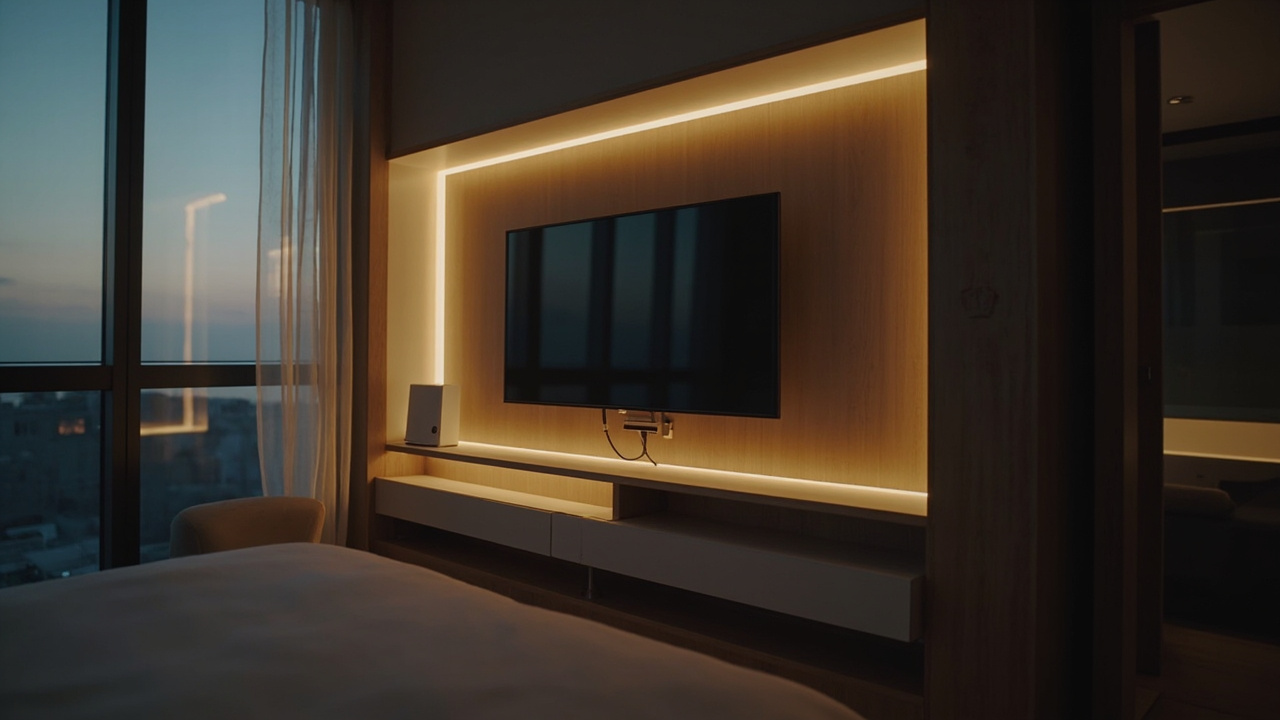
In a real room, the compact box may sit behind the television while Ethernet, power and an audio path remain hidden. The photograph illustrates the physical endpoint only; it does not validate Wi-Fi coverage, cable reach, thermal placement or service access.
| Situation | Primary requirement | Critical acceptance evidence | Model direction |
|---|---|---|---|
| Operator-owned managed IPTV | Controlled IRD with operator middleware, entitlement and room telemetry | Licence issuance, channel lock, reboot recovery and update control | DM21P first; validate another model against middleware support |
| Integrator-managed IPTV/OTT white-label | Android TV launcher, branded portal and managed applications | Portal login, catalogue navigation, forced-update and recovery tests | DM21S; confirm production configuration |
| Premium UHD or cloud-gaming rooms | Higher-format decode, 4K/120 use case and stable wired operation | Format playback, display compatibility, latency and sustained operation | DM21T; confirm television and source capabilities |
| Gaming-oriented property offering | Android TV application compatibility and gaming controls | Application launch, input latency, network stability and thermal check | DM22Q; validate game title and controller requirements |
| Property-led portal pilot | Simple catalogue access with venue-controlled session policy | Guest identification, logout, network interruption and content-rights review | Select only after a middleware-versus-portal architecture review |
For an operator, the primary artefact is the device-management and entitlement contract: supported middleware release, device provisioning, licence delivery, telemetry fields and update policy. For an integrator, the key artefact is the room wiring and network schedule: outlet location, IP addressing, VLAN, DNS, multicast path, television EDID behaviour and recovery procedure. For the venue, the key artefact is the guest journey: power-on state, language, guide visibility, logout and support escalation.
The portal must also respect content rights. A hotel’s physical location does not extend a studio licence to every guest-accessed service. Procurement should identify the content owner, territory, viewing model and authentication method, then attach the relevant operator agreement to the acceptance criteria.
Operator-led managed IPTV has a different procurement emphasis from property-led portal access. The operator normally needs provisioning by room, revocable entitlement, channel-change history and centralised recovery. The property may care more about branded startup, catalogue visibility, language, logout and support. Both require a tested recovery path, but the telemetry fields and escalation owner will differ.
The integrator should add a room schedule containing the outlet identifier, television model, input used, amplifier or soundbar path, wired-network availability, power position and box location. If some rooms will use Wi-Fi6 and others Ethernet, the acceptance plan should separate the two classes rather than averaging them into one “network pass”.
A venue commissioning team can add a guest-journey script. It starts at power-on, checks whether the expected portal or guide appears, tests channel or catalogue navigation, simulates a session expiry, logs out and verifies what a departing guest can still access. For in room entertainment hotel projects, this script often reveals ownership gaps earlier than technical benchmarking because the visible failure occurs at a handoff between operator, installer and property systems.
Several deployment situations require distinct model directions. A sports-viewing room with 4K/120 sources may point to DM21T, subject to television and source validation. A standard managed IPTV room can start with DM21P. A branded OTT room can start with DM21S. A property gaming service can start with DM22Q. None of those directions removes the need to confirm the exact production configuration and application stack.
How to choose, step by step
Selection begins with the service contract, not the chipset. Write down what must run on the device, which entity controls updates, whether the television receives content directly or through the box, and which devices belong to the operator, integrator or property. These lines prevent a portal requirement from being quoted as a generic Android TV box.
- Freeze the room function State managed IPTV, operator middleware, branded OTT portal, premium UHD, cloud gaming or a combination. Do not write “hotel TV” as the sole requirement.
- Define the content path List live channels, on-demand catalogue, applications, DRM, conditional access, geographic rights, authentication and session recovery.
- Define the network path Specify Ethernet as the production path, the 100M or optional 1G configuration, VLAN, DHCP or static addressing, DNS, multicast, proxy and captive-portal behaviour.
- Map the physical room Record television input, audio output, IRD location, power source, cable distance, wall bracket, ventilation and service access.
- Match the platform Compare the frozen requirements against the DataMax field table. Keep the exact product facts in the RFQ.
- Define acceptance Add format-by-format playback, DRM licence tests, power-cycle recovery, portal expiry, update rollout and room-level telemetry checks.
- Approve a golden sample Freeze the hardware configuration, firmware branch, launcher build, applications, signage, packaging and test evidence before volume acceptance.
A usable RFQ line states: “Provide an AOSP Android 14 Android TV box with 4GB RAM and 64GB ROM, HDMI 2.0b output, 2 USB2.0 ports, RJ45 100M with 1G optional, and Widevine L1/PlayReady optional; confirm the ordered configuration against the production datasheet.” A second line defines evidence: “For each golden sample, record the operator middleware version, launcher build, application versions, DRM licence result, output format and recovery sequence.”
Turn the remaining decisions into measurable conditions. Replace “reliable Wi-Fi” with a designated coverage test, defined service IP address and required signal margin. Replace “support for 4K” with the source codec, resolution, frame rate and television mode. Replace “DRM compliant” with the named application, account entitlement, device policy, licence result and protected-output requirement. Replace “OTA updates” with the update source, signature check, staging rule, rollback method and reporting owner.
The sequence also separates a pilot from production approval. A pilot may use a limited room set, a temporary portal configuration and a manually updated image, provided those differences are documented. Production approval requires the intended hardware configuration, software build, network profile, signage and acceptance script to match the golden sample. A successful pilot does not automatically validate a later volume batch.
For in room entertainment hotel tenders, ask bidders to identify every item that changes the delivered SKU: SoC, RAM/ROM, wired-network option, DRM option, output arrangement, launcher build, middleware version, portal build, signage and packaging. Each change should trigger a stated regression test. That avoids treating a harmless packaging update and a middleware update as equivalent risk events.
Quotation trap
A product-family name does not lock the sellable configuration. Ask for the exact RAM/ROM combination, wired-network option, DRM status, HDMI arrangement and power details in the order line. A portal logo does not prove that the content platform, middleware build and DRM service have completed end-to-end integration.
Commercial evaluation should compare total programme burden, not just the device line. Include software integration, certification, room installation, remote support, spare logistics, update control and content-licence administration. DataMax can define the hardware and software scope through its custom-development route, while the operator or integrator retains the content-service contract.
A weighted evaluation prevents large but soft integration items from disappearing into the final negotiation. Suggested technical gates are middleware compatibility, content-path completeness, network determinism and recovery. Commercial gates are exact configuration, documented test evidence, update responsibilities and escalation coverage. If a bid fails a technical gate, feature weightings should not convert it into an apparently equivalent proposal.
What goes wrong after the PO
The first common failure is an architectural ambiguity between “IRD”, “Android TV box” and “portal terminal”. Each name can describe the same physical appliance while implying different owners for authentication, catalogue, updates and telemetry. The symptom appears during installation when the portal opens but operator middleware cannot activate, or a guest reaches a catalogue without the correct entitlement.
The second failure is an unverified format chain. A decoder specification does not guarantee that the television, HDMI mode, source resolution, colour format, HDR mode and service encoding agree. For DM21T, the supplied 4K@120 decode claims require a compatible source, television and configured mode. For DM21S and DM22Q, the supplied 4K@60 ceiling must not be confused with DM21T’s 4K@120 capability. HDR claims also require careful verification of Dolby Vision/DTS feature support and application behaviour.
Network assumptions cause repeated site visits. A laboratory connection using DHCP and public DNS may conceal the hotel’s VLAN rules, proxy, certificate policy, multicast configuration or session timeout. A 100M wired path can also expose poor in-room cabling or switch capacity that was never represented in the quotation. Specify the production path and include a packet-level or service-level test in the acceptance pack.
Field trap
Do not accept “Widevine enabled” as a content-rights approval. Test the contracted application, account tier, device policy, licence request and playback output. Similarly, do not accept “Wi-Fi6” as proof of portal interoperability; Wi-Fi coverage, authentication, DHCP and captive-portal handling determine the guest experience.
Software lifecycle is another divergence. A quotation may include an image that passes demonstration but lacks an over-the-air update mechanism, rollback policy, certificate renewal route or signed application process. In a multi-property deployment, manual recovery across hundreds of rooms becomes operationally expensive. Add the update trigger, package integrity, deployment wave, failure reporting and restore procedure to the purchase order.
Finally, physical fit and thermal behaviour can erase an otherwise correct specification. A box advertised for compact integration still needs power, cable bend radius, ventilation and service access. Document the bracket, power adapter, television mode and amplifier delay together; correcting only the source device can leave sound synchronisation or input-selection problems in the room.
Catalogue mapping is another frequent post-PO dispute. A platform may decode a codec but the service may deliver a different rendition, profile or bitrate. A TV may accept the output but default to another input after power cycling. An operator may use channel numbers that differ from the portal catalogue. These are configuration and service-definition issues, and they become expensive when the buyer’s quotation promised only a generic 4K capability.
Configuration drift creates a parallel risk. The sample may contain the requested 1G option, while the volume order specifies only the family default. It may carry the required DRM option, while the production build omits it. The purchasing record, firmware release and serial-level test report should identify the same configuration; otherwise each organisation may certify a different object.
Remote support can also expose missing observability. Without a defined log path, update status, room identity or remote diagnostic procedure, the operator may dispatch staff for a recoverable software fault. Include a test that proves the management service can identify the room, report the active build and execute the approved recovery action without physical access.
For in room entertainment hotel operations, the quotation should separate one-time commissioning from recurring support. Guest-facing faults, network faults, content faults and failed updates have different first-line routes. A support matrix naming the owner, response path and evidence required prevents an operator from rejecting a device fault that was actually a portal authentication failure.
Verification you can ask for on paper
A factory audit should follow the physical production path rather than a curated showroom. Request a video factory audit through DataMax’s factory-quality process and ask for evidence tied to the ordered SKU: SMT, AOI, functional test, burn-in or aging, dark-room image validation, firmware loading, network testing and final inspection. Evidence should identify the production date, line, configuration and serial range.
- Incoming-material and SMT evidence Match the SoC, memory and other critical components against the purchase configuration; retain traceability for the approved build.
- AOI and inspection records Review soldering and assembly exceptions, including any deviation or repair recorded against the serial number.
- Aging and thermal evidence Confirm that the production unit completed the defined burn-in or aging cycle and remained stable under load.
- Dark-room image check Verify panel output, dead-pixel or image-defect criteria, screen position and intended operating mode.
- Software and service test Record the firmware, launcher, application, DRM, Ethernet, Wi-Fi, HDMI, USB, TF and audio checks actually performed.
- Release audit Link the test report and golden-sample approval to the shipment configuration and any permitted substitutions.
Ask for 1) the ordered SKU and BOM revision, 2) the firmware and middleware build identifiers, 3) serial-linked SMT/AOI and aging records, 4) dark-room test results, and 5) a traceability matrix from components to finished units. These records support acceptance; they do not replace an operator-side DRM and content-playback test.
The procurement file should also include a room test script, not only factory data. It should cover power loss, network loss, portal session expiry, licence failure, channel or catalogue navigation, reboot, forced update, audio output and recovery to the defined home screen. Discuss the test package with the DataMax engineering team and request SMT/AOI/aging evidence specific to the selected room programme.
Request the audit against the actual production scope, not an unrelated reference model. The reviewer should be able to connect the ordered RAM/ROM, network option, DRM configuration and software branch to the golden sample, then connect that approval to the line records for the shipment. If evidence is supplied only as an unmarked file, it may be impossible to establish which units it covers.
A paper audit should also reveal who approves deviations. A repaired board, substituted memory configuration or modified firmware should have an owner, reason and disposition. The release note should state whether the deviation affects the previously accepted DRM, network, output or thermal results. Without that link, a small factory exception can invalidate the programme’s configuration baseline.
For in room entertainment hotel acceptance, combine factory evidence with operator and venue observations. Factory records show whether the unit was built and tested as declared. The operator confirms entitlement, licence and service behaviour. The venue confirms television mode, audio path, guest journey and room recovery. One report cannot substitute for all three responsibilities.
A practical release dossier can be indexed by SKU, firmware build and serial range. Include the hardware configuration, middleware build, launcher image, application versions, network test, DRM result, image inspection, aging record and final inspection report. Review the dossier against the golden-sample signature before shipment release, then retain it with the purchase-order configuration.
For a hotel buyer preparing the final evidence pack, email [email protected] with the intended SKU list, target-market certificates, middleware/DRM checklist, network profile and golden-sample acceptance sheet. DataMax can align the production document set with the operator and venue responsibilities before rollout.
Further reading
- Dolby Atmos Android TV box guide
- TV box vendor selection checklist
- AOSP vs GMS solution notes
- Telecom and pay-TV operator solutions
- Allwinner Android TV boxes
- DataMax DM21P specifications and fit
- DataMax DM21S specifications and fit
FAQ
What is the difference between a hotel IRD and an Android TV box?
An IRD is a dedicated endpoint whose boot, middleware, entitlement and operator services can be centrally controlled. An Android TV box provides an application-based user experience and may carry operator middleware, a branded launcher, captive portal or managed OTT applications. Procurement must identify the controlling software, not rely on the hardware label.
Can one device provide both operator middleware and a content portal?
Yes, if the operating architecture and software stack support both functions. The RFQ must define portal placement, launcher priority, authentication handoff, DRM responsibility, session recovery, update control and telemetry ownership. Demonstration on a sample does not establish production integration without documented acceptance tests.
Which DataMax model is the best starting point for operator middleware?
The supplied fit identifies DM21P for an operator middleware set-top box. Its AOSP Android 11 base, 2GB/8GB baseline, HDMI 2.0b output and RJ45 100M are the stated starting facts. Confirm middleware compatibility, ordered memory, DRM configuration and the production datasheet before approval.
Does Wi-Fi6 make a DataMax box suitable for a hotel portal?
No conclusion follows from the wireless generation alone. The hotel must validate authentication, DHCP, DNS, VLAN, certificate handling, captive-portal behaviour, multicast and coverage. Ethernet remains the more deterministic production path when the selected configuration provides it; confirm the ordered wired-network option.
What evidence should accompany a volume order?
Request a traceability matrix linking the approved BOM, firmware and middleware builds to serial-linked SMT, AOI, aging, dark-room and functional-test records. Add a room-level script for DRM playback, network recovery, portal expiry, reboot and updates. Factory evidence and operator-side service acceptance answer different risks.
Can DM21T or DM22Q be described as an 8K product?
No. The supplied DM21T facts cap output and decode at 4K, while DM22Q’s supplied maximum is 4K@60. Marketing references to 8K conflict with those production facts. RFQs and acceptance criteria should use the confirmed production datasheet, not the wider marketing name.


