
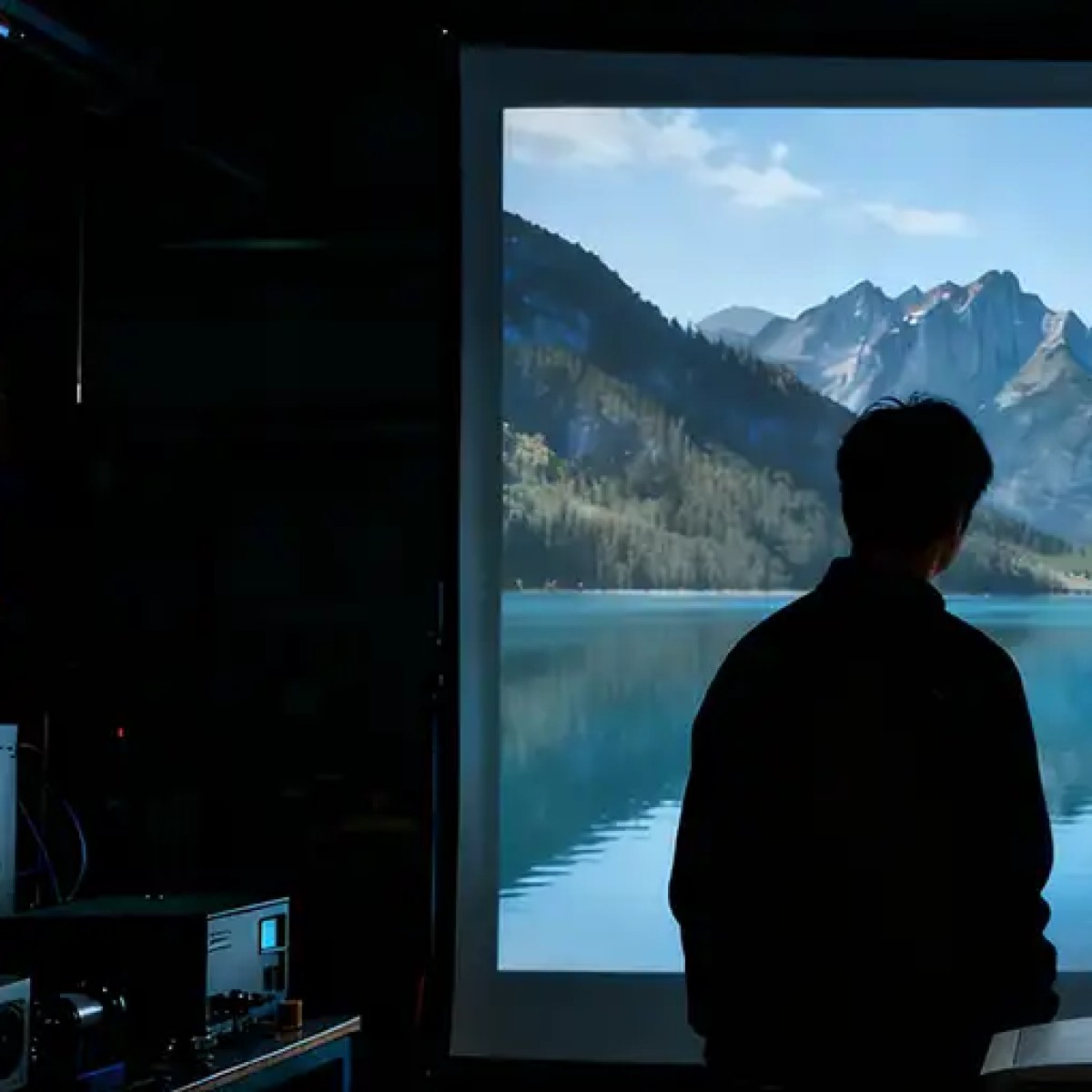
Commercial decision context
“HD” and “4K” describe input or marketing categories, not sufficient procurement criteria for an installed commercial display. A buyer must define the native pixel grid, optical output, target image size, ambient-light condition, source resolution, maintenance access, electrical provision and integration protocol before comparing platforms. A 4K label based on pixel-shifting or signal acceptance does not establish native 3840×2160 detail, while an HD projector may remain preferable when the application prioritizes brightness, low cost-per-installed-lumen and serviceability.
The supplied DataMax GP8 illustrates why model naming must be verified. Its listing says “400 ANSI Lumens 4K Projector,” while the structured display data specifies 450 ANSI lumens and native 1920×1080 resolution. Treat brightness and resolution as unresolved until the production datasheet, current firmware behavior and test method are supplied. Product #290, #283, #288 and #280 provide only titles, so their brightness, light source, resolution, interfaces, battery endurance and certifications must not be inferred from those titles.
- Installed AV: size the optical system for the longest maintained operating hours, ambient light and screen gain rather than consumer resolution preferences.
- Digital signage: specify 24/7 duty behavior, managed Android functions, recovery requirements and environmental limits.
- Education and hospitality: validate room-control, content security, mounting safety, acoustic limits and centralized support.
- Outdoor or mobile use: require weather enclosure, temperature data, battery-cycle evidence and service access; a headline 4K claim is insufficient.
| Procurement question | Required evidence | Commercial failure if omitted |
|---|---|---|
| What is the native optical resolution? | Pixel-grid specification and test report, not supported-input wording | Overpayment for interpolation or incorrect content sizing |
| What is usable brightness? | ANSI/ISO method, color mode, power setting and measurement conditions | Undersized image or excessive operating power |
| How is the unit installed? | Throw-distance drawing, screen details, mounting and cable route | Image-size shortfall, obstruction or service failure |
| How is it recovered? | OTA/MDM, signed image, reset procedure and rollback evidence | Fleet-wide application or security outage |
Optical and measurement fundamentals
Resolution, luminance, contrast and projection geometry must be measured separately. A projector can have more pixels without having enough light for those pixels, and a high-contrast ratio measured under controlled black conditions may not predict perceived contrast in a lit room. Commercial acceptance should record the model, serial number, firmware, input source, color mode, ambient illuminance, screen material and measurement distance.
| Parameter | Definition or formula | Procurement interpretation |
|---|---|---|
| ANSI lumens | Flux measurement method specified by ANSI/ISA-8.2M; do not compare with unreferenced LED-lumen claims | Use the same mode, lamp or light-source state and sample configuration across candidates |
| Native resolution | Physical addressable image grid, such as 1920×1080 or 3840×2160 | Prefer native 4K when source detail and screen size justify it; otherwise 1080p can be operationally adequate |
| Contrast ratio | Maximum luminance divided by minimum black luminance under defined conditions | Require room and screen conditions; FOFO numbers do not represent ambient-light performance |
| Throw ratio | Projection distance ÷ image width; manufacturer convention must be confirmed | Use the mounting geometry, not the screen diagonal, to verify fit |
| Screen gain | Peak screen luminance divided by incident luminance at the same point | Viewing-angle and ambient-light behavior may offset a nominal gain advantage |
| Pixel density | Width × height; practical angular resolution also depends on viewing distance | Calculate pixels per degree from the actual image width and audience distance |
A useful sizing approximation is image width = projection distance ÷ throw ratio. If the throw-ratio convention is distance divided by width, a 1.2 m projection distance and 0.24 ratio imply approximately 5.0 m width under ideal geometry. The GP8 structured specification gives 0.24:1, but confirms neither the reference surface nor whether the ratio is horizontal or diagonal; obtain the mechanical drawing before installation.
Automatic keystone correction changes effective resolution and usable image area. Digital correction can reduce sharpness, crop content or introduce scaling artifacts, especially in a permanent installation. Auto focus helps initial commissioning but does not compensate for screen non-flatness, vibration or unstable projection distance. Measure focus at the screen center and corners after thermal stabilization.
- Lamp life: use the manufacturer’s stated hours and replacement mode; ANSI-lumen output at end of life is not necessarily equal to rated lifetime.
- LED depreciation: request lumen maintenance curves, color-shift limits and service thresholds at operating temperature.
- Brightness reserve: compare measured initial luminance with the contractual minimum, not only the headroom specification.
- Installation tolerance: record lens shift range, focus range, mounting orientation and allowable screen flatness.
| Operating case | Illustrative target | Validation method |
|---|---|---|
| Controlled meeting room | 80–120% of calculated target after screen gain | Measure ANSI luminance at the specified mode and screen point |
| Classroom with daylight managed | Document ambient lux and set brightness mode from measured contrast | Measure with blinds and lighting in the operating state |
| Digital-signage duty | Minimum luminance and maximum degradation point | Run a thermal and maintenance test over the declared duty interval |
Real DataMax model comparison
Only the GP8 has a complete structured record in the supplied data. The other four entries are title-level references; blank cells mean that the fact was not supplied, not that the capability is absent. Any model selected for quotation must be matched to a current production datasheet and serial-controlled configuration.
| Model | Optical and platform data | Connectivity and mechanical data | Evidence status |
|---|---|---|---|
| DataMax GP8 | Amlogic T972; Android 9; 2 GB RAM; 32 GB ROM; LED; 0.23-inch DMD; native 1920×1080 WVGA; 450 ANSI lumens in structured data, but 400 ANSI lumens in the model title; 1200:1 contrast; 0.24:1 ratio; 30–200 inch image; 30 dB noise; 89 W working consumption | Front projection; auto focus; auto keystone; 3D; dual-band Wi-Fi 6; Bluetooth 5.0; AirPlay, MirCast and EShare; HDMI×1; 3.5 mm audio; USB 2.0×2; 94×71×190 mm; 0.88 kg; AC 100–240 V, 50/60 Hz, DC 19 V 4.7 A | Native 1920×1080 conflicts with the “4K” title; 400 versus 450 ANSI lumens conflicts; contrast, throw ratio and package data require production confirmation |
| Mini HD Projector, product #290 | Title states 300 ANSI lumens and built-in battery | Not supplied | Confirm against production datasheet |
| DM-P5, product #283 | Title states 1080p, official Netflix, LCD projector and ChatGPT remote | Not supplied; do not infer Netflix certification or Android version | Confirm against production datasheet |
| 4K Smart DLP Outdoor Projector, product #288 | Title states 4K, DLP, outdoor use, 10,000 mAh battery and Android 9 | Not supplied; weather rating, battery runtime and brightness are unconfirmed | Confirm against production datasheet |
| 1080P LCD Projector, product #280 | Title states 1080p, LCD, auto-focus, keystone and Android 13 | Not supplied | Confirm against production datasheet |


Quantitative selection method
Start with a site survey rather than a model shortlist. Record ambient lux at the screen, screen dimensions and gain, projection distance, ceiling height, mounting constraints, audience viewing angle, source resolution, operating schedule, noise limit and control-system interfaces. Calculate the target image width from the screen, then apply the manufacturer’s throw ratio. If the required width falls outside the model’s stated range, reject it before pricing or feature comparison.
| Step | Calculation or decision rule | Example |
|---|---|---|
| 1. Define image | Use physical screen width and height, not source resolution alone | 2.40 m wide training-room projection |
| 2. Check geometry | Width = distance ÷ throw ratio | At 0.24:1, 2.40 m width requires approximately 0.576 m nominal distance if the convention is confirmed |
| 3. Check image range | Distance and image size must be inside the manufacturer’s stated limits | GP8 lists 15–116 cm and 30–200 inch; the nominal 57.6 cm distance is inside the listed distance range, but the angle convention must be verified |
| 4. Set light target | Measure with screen gain and ambient conditions; reserve for maintenance | Choose a measured mode that maintains the contract minimum at the specified screen point |
| 5. Validate platform | Map content, DRM, network, OTA/MDM and control requirements | Android 9 is documented for GP8; do not assume current Google certification or Widevine level |
For a worked classroom case, the target image is 2.40 m wide and the screen requires 0.576 m projection distance using the 0.24 ratio convention. The calculated image is approximately 94.5 inches diagonal if a 16:9 surface is used, calculated from the diagonal formula √(width² + height²), where height = width ÷ 1.778. That diagonal lies within the GP8 title-level range of 30–200 inches. The buyer must still verify the exact projection distance definition, lens geometry, image shift, focus and screen flatness. If content is 1080p, the GP8 native specification is directionally aligned, but the “4K” title cannot be accepted as proof of native 4K.
- Reject 1: native resolution, brightness and operating mode do not meet the content and room targets.
- Reject 2: throw geometry exceeds the declared image or distance limits.
- Reject 3: acoustic, thermal, electrical or certification evidence is absent.
- Reject 4: management, DRM or control integration has no documented test path.
- Shortlist: retain only models with traceable evidence for all four rejection tests.
Deployment profiles by environment
Hotel and hospitality
Rooms typically prioritize ceiling or furniture integration, low visual intrusion, remote recovery and PMS-linked content. The mounting system must maintain the stated projection distance and isolate vibration. Use HDMI or a network source selected by the PMS integrator, and validate Bluetooth discovery, audio routing and service access from an engineer account rather than exposing an unrestricted guest network.
| Control | Integration condition | Primary risk |
|---|---|---|
| PMS/IPTV | Map room power, input source, volume and mute events to the actual projector interface | Guest can bypass intended content policy |
| CEC | Test startup, shutdown and source-selection behavior with the specified TV or receiver | Power-state loops |
| Audio | Verify 3.5 mm output, latency, mute and amplifier fault handling | Lip-sync offset or room disturbance |
Corporate offices and training rooms
Use native resolution matched to collaboration software, whiteboard capture and conferencing layouts. Mounting must preserve focus across the screen, while acoustic noise limits should be measured at the seating position. Enterprise fleet management should support staged deployment, signed software, device identity and remote logging; Android 9 on the GP8 requires a compatibility and support-window decision.
- Run 8-hour source-switching tests across laptop, HDMI and wireless presentation paths.
- Measure noise at the listener position after the unit reaches thermal equilibrium.
- Record recovery behavior after application crash, network loss and deliberate power interruption.
- Confirm that the management agent supports the selected Android version before fleet rollout.
Education and training
Classrooms favor simple recovery, captive-port controls and protection against unauthorized application changes. A portable model should be evaluated for impact, connector wear and battery safety; a fixed model requires a locked mount, tamper-resistant fasteners and a documented cleaning process. Content delivery must be tested with the school’s identity, network policy and learning-platform requirements.
| Failure mode | Observable symptom | Control |
|---|---|---|
| Image drift | Keystone changes after warm-up | Mechanical alignment lock and post-thermal geometric check |
| Source mismatch | Room powers on without the intended HDMI input | PMS or control-system scene test |
| Unauthorized change | Application, input or wallpaper differs by room | Signed kiosk image, account policy and reset control |
Retail and digital signage
Retail deployments should specify screen hours, content cadence, network reliability, brightness degradation and replacement logistics. A 24/7 label cannot be inferred from a consumer-style product description. Record the ambient-light range and whether the content is SDR or HDR; HDR capability, peak brightness and color behavior require separate evidence.
High-ambient and outdoor environments
High ambient light increases the contrast challenge because ambient luminance adds directly to the projected image. Use screen gain and black-level measurements from the actual site; do not rely on a manufacturer contrast ratio alone. Outdoor deployment additionally requires an environmental enclosure, cable ingress control, temperature limits, condensation management and a documented service interval.
| Condition | Required profile | Risk to reject |
|---|---|---|
| Daylight controlled | Measured ambient lux, screen gain and brightness mode | Unverified screen gain or overheating |
| Semi-outdoor | Enclosure, temperature range, humidity and condensation control | No production environmental rating |
| Fully outdoor | Weatherproof installation, surge protection, maintenance access and battery policy | Title-only “outdoor” claim |

Platform and integration architecture
Google TV and AOSP are not interchangeable procurement labels. Google TV with Google Play and Google services requires the corresponding certification and operator approval; AOSP builds can provide a different update, application and security posture. A model labeled “official Netflix” does not by itself document Netflix certification, device certification, service region or Widevine security level. Confirm production software, license authority and approval status.
| Layer | Required evidence | Acceptance test |
|---|---|---|
| Application layer | Signed APK/AAB, package allowlist, kiosk mode and regional app catalog | Install, launch, update, revoke and reset with network interruption |
| DRM/content | Widevine L1 or L3 level, HDCP path, key delivery and license-server availability | Play protected 1080p and 4K assets where licensed; capture error states |
| Network | Wi-Fi 6 dual-band, Bluetooth 5.0, DHCP, DNS, VLAN, proxy and multicast behavior | Join network, stream, cast, recover and remove device from service |
| OTA/MDM | Signed images, staging rings, rollback, inventory and audit logs | Deploy to a pilot, fail a rollout and recover without physical access |
| Facility control | PMS/API, IR, CEC, serial, audio and power-state mapping | Room-on, room-off, input change, mute and network-loss sequence |
- DRM: require Widevine L1/L3 evidence and HDCP topology where protected content is commercial.
- Network: separate management, content and guest access; test multicast IPTV behavior where required.
- OTA: stage updates by hardware revision and application version; preserve a tested rollback image.
- Mechanical: measure power, heat, noise, vibration, cable bend radius and service clearance.

Mechanical, thermal and acoustic integration
For the GP8, the structured record gives 89 W working consumption, 30 dB noise and a 94×71×190 mm product size. Those values are not sufficient for final design: confirm whether noise is measured at a stated distance, whether consumption is maximum or typical, and whether the listed dimensions include feet or accessories. A fixed installation must reserve airflow, lens clearance and cable service loops; a portable installation must address acoustic variability and impact risk.
| Design check | Procurement record | Release criterion |
|---|---|---|
| Thermal | Ambient and surface temperature, duty cycle, exhaust path | No thermal shutdown during declared operating profile |
| Acoustic | dB measurement distance, weighting, mode and room absorption | Below site limit at listener position |
| Power | Input range, DC output, rated load and standby behavior | Facility power and surge protection accepted |
| Mount | Weight, center of gravity, fixing pattern and vibration isolation | Installation drawing signed by integrator |
Do not route signal or mains cables across hot exhaust paths. Test service removal without dismantling the screen or wall assembly. If the unit is installed above or beside audience areas, acoustic limits and maintenance access become acceptance criteria rather than optional preferences.
Compliance evidence and optical-engine integrity
Request test reports and declarations applicable to the destination market, power supply, radio, EMC, safety, RoHS where required, and any optical or display certification claimed by the manufacturer. Android compatibility claims such as CDD/CTS or Google certification require the exact device family, build, security patch baseline and test date. Do not convert a distributor statement into a compliance claim.
| Evidence package | Minimum content | Buyer review |
|---|---|---|
| Electrical safety | Model, rated input, report number, lab, date and marking | Match the exact production configuration |
| EMC and radio | Band, test standard, antenna variant and report scope | Check destination-market validity |
| Platform | Android version, build security, GMS/EDLA or CTS/CDD evidence if claimed | Verify against the shipping image |
| DRM | Widevine security level, device certification, HDCP path | Test licensed content and failure recovery |
| Optical | ANSI/ISO brightness method, native resolution, focus and uniformity | Compare under identical conditions |
For sealed or dust-free optical engines, obtain the ingress-protection construction description, maintenance interval and replacement policy. A sealed engine may reduce dust cleaning but can raise thermal or repair consequences. Confirm whether the optical path is sealed, what filter or aperture is used, and whether accumulated dust or heat triggers an alert. Record evidence for an optical engine, not merely a marketing label.
- Require a model-specific optical-engine diagram or service statement.
- Define acceptable brightness uniformity at the screen corners and center.
- Record lens shift, focus retention and keystone behavior after 60 minutes of operation.
- Keep certification documents under change control whenever the SoC, PCB, radio module or firmware changes.
Lifecycle, lumen depreciation and TCO
Total cost of ownership includes acquisition evaluation, installation, electrical work, mounting, network configuration, application licensing, maintenance, replacement stock, freight, warranty claims and end-of-life handling. Use a 3-year, 5-year or site-specific planning interval, with the same usage profile for each model. Illustrative figures must be replaced by supplier quotations or internal service data; no DataMax cost values are supplied here.
| TCO category | Calculation basis | Control metric |
|---|---|---|
| Installed hardware | Unit evaluation + mount + power + cabling + labor | Cost per installed operating position |
| Operations | Configuration labor + monitoring + application support | Technician minutes per device per month |
| Maintenance | Lumen depreciation + cleaning + parts + replacement logistics | Mean time between intervention |
| Risk reserve | Failures × spare and dispatch assumptions | Annualized downtime exposure |
| End of life | Return, recycling, data sanitization and asset disposal | Documented disposal lead time |
Depreciation planning should use measured output at commissioning and at defined intervals. The GP8 title’s 400-ANSI-lumen figure conflicts with its 450-ANSI-lumen structured figure, so neither number should enter a warranty threshold until resolved. Require the supplier to state the reference mode, ambient conditions, test instrument, sample count and acceptable variation. For LED models, also request chromaticity drift and the point at which output falls below the contractual minimum.
Illustrative TCO model: annualized TCO = (installed hardware + software allocation + annual operations + annual maintenance + annual risk reserve − residual value) ÷ service years. The model is a framework, not a DataMax quotation. A warranty without a replacement process, remote-recovery policy or regional spare location is an incomplete commercial commitment.
OEM/ODM commercial process and sourcing controls
A commercial projector program should move from requirements to evidence-based sourcing. Define the target configuration, approved suppliers, firmware ownership, certification scope, manufacturing revision and change-notification process before approving samples.
- Issue an engineering specification covering optical mode, native resolution, brightness, throw geometry, noise, thermal duty, interfaces and platform version.
- Request golden samples, test reports, firmware hash, bill of material revision, packaging data and a controlled sample log.
- Run design validation with the intended screen, source, network, room-control system and ambient-light conditions.
- Approve pilot units against the acceptance matrix, then freeze the production configuration and serial traceability.
- Stage shipment inspection using a written AQL plan and defect definitions for display, optics, ports, accessories and packaging.
| Customization variable | Controlled scope | Evidence required |
|---|---|---|
| Hardware | Logo, enclosure, cable, mount or regional power variant | Revision-controlled sample and pre-production approval |
| Software | Boot image, applications, wallpaper, network and OTA settings | Signed build, hash, test report and rollback plan |
| Certification | Radio, safety, EMC and destination-market approvals | Model-specific report and change-impact assessment |
| Packaging | Carton, labels, serial number, accessories and language | Packaging specification and line photos |
AQL sampling plan should define defect classes and acceptance numbers before production. PCN control requires advance notice for SoC, panel, light source, firmware, power supply, radio module, packaging or supplier changes, with a written disposition for qualification. Spares should cover the optical engine, power adapter, remote, mounting hardware, cables and boards identified as serviceable; otherwise document a replacement-stock strategy.
- Request a 12-month rolling demand forecast with no automatic volume commitment.
- Define serial-number, firmware, accessory and carton traceability.
- Agree RMA diagnosis, replacement and credit-claim responsibilities.
- Keep a golden image, golden firmware and approved supplier list in the change-control record.
- Obtain written warranty exclusions for lens damage, liquid ingress, voltage faults and unauthorized modification.

Weighted RFP scoring and decision sequence
Use a 100-point RFP with evidence rather than feature keywords. Optical performance receives the greatest weight for display programs; platform and integration receive greater weight where rooms or fleet operations dominate. Scores should be independently verified and tied to acceptance evidence.
| Criterion | Weight | Evidence and scoring rule |
|---|---|---|
| Optical performance | 30 | 30 native-resolution, brightness, contrast, uniformity and ANSI-method evidence |
| Fit and mechanics | 15 | 15 verified throw geometry, image range, dimensions, weight, power and noise |
| Platform and content | 15 | 15 Android version, app catalog, DRM, HDCP, signage and update capability |
| Integration | 15 | 15 network, PMS, CEC, audio, API, OTA and MDM test results |
| Compliance | 10 | 10 exact-model safety, EMC, radio, Android and DRM evidence |
| Operations and support | 10 | 10 warranty, spares, RMA, documentation and escalation process |
| Commercial responsiveness | 5 | 5 traceability, lead-time governance and change control |
Decision tree:
- Does the exact production model provide native resolution and ANSI-method brightness evidence? If no, reject or hold as unresolved.
- Does the measured geometry fit the site without prohibited digital correction? If no, reject.
- Does the platform meet content security and fleet-management requirements? If no, reject unless the use case explicitly permits it.
- Do compliance documents match the exact hardware and destination market? If no, hold.
- Does the pilot pass site acceptance, including recovery, noise, thermal and PMS tests? If no, do not release to fleet.
- Otherwise negotiate a frozen configuration, documented warranty, PCN process and spares plan.
No prices or currency figures are required for this technical comparison. Commercial evaluation should use a complete landed-cost model supplied by the buyer’s procurement process, without treating an introductory quotation as a production commitment.
Site acceptance testing
Acceptance should be performed on the production hardware, production firmware and representative content. Record serial number, installation coordinates, ambient lux, screen gain, input format, color mode, firmware hash and test operator. A pass applies only to the tested configuration.
| Test | Procedure | Pass condition |
|---|---|---|
| Native image | Display a test grid and text at native source resolution | No unintended upscaling, cropping or interpolation artifact |
| Brightness | Measure using the agreed ANSI/ISO procedure and operating mode | Output meets contract minimum at specified screen point |
| Geometry | Measure width, height, offset and keystone after warm-up | Image fits screen and remains stable within agreed tolerance |
| Focus and uniformity | Inspect center, corners and text edges | No unacceptable blur, dead-pixel pattern or visible uniformity defect |
| Thermal/noise | Run declared duty period; measure sound at listener position | No shutdown and noise below site limit |
| Connectivity | Exercise HDMI, USB, Wi-Fi, Bluetooth, mirroring and audio paths | All required functions connect and recover |
| Management | Apply update, revoke app, simulate network loss and reset | Device returns to approved state without local intervention |
| DRM | Play representative licensed streams and invalid-license cases | Authorized content plays; errors are logged and recover correctly |
Troubleshooting matrix
Use a controlled diagnostic sequence. Capture the symptom, firmware, input, network state, temperature and recent event log before changing factory settings. Replace one variable at a time so the root cause is not obscured.
| Symptom | Likely area | Procedure | Escalate when |
|---|---|---|---|
| Image is too small or oversized | Throw geometry or image-range setting | Measure distance and image; verify throw-ratio convention and screen diagonal | Required distance falls outside the production specification |
| Keystone changes after startup | Auto geometry, warm-up or vibration | Wait for stabilization, lock mount and disable automatic correction if site policy permits | Correction remains unstable after mechanical reinstallation |
| Image is dim | Brightness mode, ambient light, lens condition | Measure ANSI output at the screen; compare with contract minimum | Measured output is below threshold or drifts with temperature |
| No network | Wi-Fi, DHCP, VLAN or firmware | Test SSID association, IP, DNS, proxy and captive portal behavior | Device cannot recover after approved network policy is restored |
| Protected video fails | DRM license, HDCP path or time synchronization | Verify device security level, license service, clock and HDCP topology | Licensed content fails on multiple devices with a valid license |
| Room power sequence loops | PMS, CEC or IR feedback | Log power events and test one control protocol at a time | Loop remains with documented standalone operation |
| Fan or thermal shutdown | Ventilation, ambient temperature or sensor | Measure inlet and exhaust temperature; remove blockage | Shutdown recurs at the specified operating profile |
| Focus drifts | Warm-up, mount movement or screen flatness | Re-focus after stabilization and inspect fixing hardware | Mechanical movement or optical fault is identified |
Expert FAQs
Is 4K always better than HD?
No. Native 3840×2160 detail is useful only when the source contains that detail, the screen and viewing distance reveal it, and the optical engine maintains adequate luminance and focus. A well-aligned 1080p installation can outperform a 4K-marked unit with poor geometry, low measured brightness or digital scaling.
Why should ANSI lumens be specified?
ANSI lumens provide a defined flux-measurement framework, while unreferenced brightness claims are not comparable. Require the test mode, screen setup, ambient conditions, sample count and instrument report. The GP8’s title and structured data conflict between 400 and 450 ANSI lumens, so confirm against the production datasheet before setting a contract threshold.
Does auto keystone improve installation quality?
It can correct alignment, but digital correction may crop, scale or reduce effective resolution. For permanent rooms, use mechanical placement first, then lock the final setting. Validate center and corner geometry after thermal stabilization and document the permanent operating mode.
How much brightness is needed for a lit room?
There is no universal ANSI-lumen figure. Measure screen gain, ambient lux at the screen, image size, content black level and required viewing contrast. A high-ambient installation may need more optical output, a suitable gain screen, controlled lighting or a different display architecture; brightness alone cannot guarantee legibility.
Is Google TV preferable to AOSP?
Choose Google TV when the operator requires the certified Google application and service experience. Choose AOSP only when its controlled software, update model and application scope are technically acceptable. Confirm the exact build, certification, DRM and fleet-management evidence; the words “Android 9” or “Android 13” alone do not establish either platform class.
Does 4K imply Widevine L1?
No. Resolution and DRM security are independent. Widevine L1 or L3 status must be documented for the exact device and software build, and HDCP 2.2 or 2.3 topology must be tested where required. A product title mentioning Netflix does not prove a particular Widevine level or commercial license entitlement.
When is a battery projector suitable?
Battery operation is useful for temporary installations, mobile training and field service, not as an unverified substitute for facility power. Product #290 and #288 list batteries, but runtime, charge time, cycle life, thermal limits and replacement policy are not supplied. Require a measured duty profile and enclosure decision before field deployment.
What should a buyer freeze before OEM production?
Freeze the optical mode, native-resolution definition, brightness threshold, platform build, SoC and PCB revision, radio module, power supply, accessories, packaging, firmware hash, test report and warranty process. Any PCN affecting these fields requires qualification and written customer disposition before shipment.
Engineering consultation and next step
For a production decision, provide the screen dimensions, room coordinates, ambient lux, source formats, network topology, control protocol, operating hours and required compliance destinations. An engineering review can convert those inputs into an optical calculation, integration architecture, evidence matrix and RFQ-ready test plan for DataMax or competing projector platforms without introducing unverified product specifications.




