

Before the terminology: the board-level decision
“Linux RDK Android TV box” mixes 3 layers that procurement must separate: Linux/RDK middleware, the Android TV application platform, and production hardware. The android tv box is not one interchangeable configuration. An operator may qualify the board, middleware release, application build, update mechanism, and DRM provisioning as separate deliverables, then require all 5 to be traceable to one production identity.
The direct decision is to qualify 3 linked records. The hardware record fixes the SoC, memory, interfaces, and display path. The software record fixes the Android version, bootloader, device tree, drivers, middleware, application build, and update policy. The compliance record fixes codec, DRM, security, network, and operator requirements for the production units. A catalogue page or generic “Android certified” statement cannot close that gap.
For broader selection criteria, use the canonical guide to an android tv box for ISPs. This article addresses the BSP, OTA, evidence, and certification angle: what to request, how to separate claims from test results, and which DataMax platform direction fits a defined deployment.
Decision rule: qualify an android tv box only when the quoted SKU, firmware baseline, middleware version, update mechanism, and compliance evidence share one traceable release identity.
Linux/RDK compatibility may apply below the Android layer, while Google TV certification, Widevine L1 validation, Netflix device approval, and operator middleware acceptance apply at different boundaries. These layers can coexist, but 1 does not prove another. The commercial objective is to make every boundary auditable before the purchase order creates a firmware-integration dependency.
Name the system integrator before awarding the project. The device supplier may own the BSP and image. The middleware provider may own the launcher, service APIs, DRM integration, and operator applications. The buyer may own enrollment, entitlement, release policy, and acceptance criteria. The same nominal platform can therefore carry 3 different integration burdens.
For example, a 4K operator program using 100M Ethernet may suit a controlled access network, while an OTT deployment with large application packages may require the confirmed 1G option. That difference changes the network driver, bootloader image, certification scope, and factory test fixture. An application-only RDK integration may also have different update ownership from an operator-managed Android system image. The decisive variable is the implemented release, not the amount of memory or the presence of an OTA label.
The procurement document should contain 1 release identity, 1 named update authority, 1 acceptance-test baseline, and 1 evidence index. Carry every conditional item into the RFQ as an explicit confirmation request. Do not convert an optional DataMax configuration, family option, or catalogue label into a committed production specification without written confirmation against the production datasheet.
How to choose, step by step
Start with the deployed service, not the chipset label. Write the operating profile into the RFQ: video format, output mode, network access, middleware base, application delivery, update authority, security ownership, and expected fleet size. These fields determine whether the requirement is an operator-managed RDK environment, an AOSP Android TV platform, or a device expected to execute both through a defined abstraction layer.
- Define the software boundary State whether RDK is mandatory, Android TV is mandatory, or the 2 are alternatives. Identify the middleware supplier, API revision, application ABI, launcher responsibility, and telemetry interface. Do not accept “RDK compatible” without a version and test scope.
- Fix the video and display contract Record output resolution, refresh rate, HDR mode, codec profile, audio format, HDMI routing, and whether HDMI input is needed. HDMI 2.0b output does not imply HDMI input capability.
- Fix the update authority Name the OTA controller, release server, package format, signing authority, staged rollout policy, rollback behavior, recovery partition, and network constraints. Android system, application, middleware, and root-filesystem updates are different workstreams.
- Attach evidence to the SKU Request reports naming the SoC, firmware baseline, build identifier, Android version, codec profile, DRM configuration, and tested hardware revision. A generic report for another board has little evidentiary value.
- Freeze the acceptance test Convert requirements into repeatable tests covering boot, network, video, DRM, update, recovery, remote-control behavior, and operator middleware APIs. Require production-intent hardware, not only an engineering sample.
The resulting RFQ can be pasted into a supplier response template:
State the exact DataMax model and ordering option; SoC and core configuration; AOSP Android version; RDK middleware version and API level if applicable; boot and update architecture; OTA package, signing and rollback controls; supported display, video and audio modes; DRM and certification scope; Ethernet and wireless configuration; test-report identifiers; production sample identification; and the responsible owner for every unresolved item.
Separate a catalogue option from a committed configuration. “1G optional” is a selectable route only if the supplier confirms the production BOM, bootloader image, network driver, certification scope, and test evidence for that route. Otherwise, the committed specification remains the base configuration.
Add 6 response columns: “mandatory,” “optional,” “not supported,” “included,” “buyer supplied,” and “unconfirmed.” Require a named reply for every unconfirmed field. This prevents “optional” from becoming a production change after the purchase order and makes exclusions commercially visible.
State the software release identifier, not merely the Android version. An AOSP Android 14 image can exist in multiple bootloader, kernel, security-patch, middleware, application, and device-tree combinations. Ask which combination was tested and which document governs the answer. If RDK is not present in the supplied platform facts, request a statement of the exact middleware release and integration boundary rather than inferring it from “Linux.”
End with a sample gate. The sample must carry the intended board revision, memory configuration, Ethernet option, display path, and release image. Exercise boot, content, middleware APIs, signed update, interrupted update, recovery, and reboot before production configuration is frozen. A representative android tv box passing this sequence provides more procurement value than a higher specification printed on a catalogue sheet.
What goes wrong after the purchase order
The first failure mode is platform ambiguity. A supplier may combine an RDK statement, an AOSP image, and a Google TV-oriented application description without defining how launchers, DRM agents, update agents, input drivers, or middleware APIs interact. Engineering then discovers that “Android support” concerns the application layer while the kernel, bootloader, device tree, and operator middleware belong to another release train.
Field trap
A BSP named by product family is not a controlled BSP. Require board revision, bootloader version, kernel or source branch, build identifier, device-tree revision, Android build, middleware version, and application ABI to travel together. Without that set, version drift becomes a field incident.
The second failure mode is OTA treated as one mechanism. An operator may assume 1 signed package updates the bootloader, kernel, system partition, middleware, operator application, and configuration. In practice, bootloader and firmware recovery may be vendor-controlled; Android system images may use A/B or another recovery design; middleware and applications may have independent channels. Without a written partition map and update-state model, rollback and provisioning are hard to prove.
Field trap
“Supports OTA” does not establish fleet control. Require package origin, cryptographic signing hierarchy, transport, failure threshold, rollback trigger, enrollment method, audit fields, and behavior after extended offline operation. A manual APK path is not managed fleet OTA.
A third risk sits in certification language. “Widevine L1” can omit the device configuration. “Netflix certified” can refer to another model. Codec support can be confused with a profile and output mode. A certificate can describe a software release while the proposal adds a different radio, memory option, display path, or region constraint.
A fourth failure is late Ethernet or memory substitution. Selecting the optional 1G Ethernet route changes a quoted box from the base 100M configuration. The application build, network driver, thermal or power design, and certification record may not cover the changed route. The same applies to storage. A low-cost paper answer can become an engineering change, retest, or delayed acceptance.
A fifth failure is an unowned build. If the device supplier, middleware supplier, application developer, and certification owner each assume another party maintains the launcher and update agent, a minor ambiguity can block every image. Put the release, security, OTA, middleware, and evidence owners into the acceptance matrix.
These divergences become costly when the error appears after tooling, packaging, middleware integration, or deployment. A missing OEM application, incomplete Widevine device-integrity configuration, or unsupported DRM path can stop content playback although ordinary applications work. Require the report or certificate identifier, covered model, hardware revision, firmware build, registry status where applicable, and issuer-stated restrictions.
Verification you can ask for on paper
Factory evidence should form a trail from component assembly to shipped configuration. SMT records show what was mounted; AOI records show what inspection detected; functional-test records show unit behavior; aging records show operation under controlled stress. The trail must link those records to a serial number and production revision. Each result should identify the station, test limit, operator or fixture, and firmware image.
- Incoming and placement control Request component traceability, line-control records, solder and AOI exception handling, and the mechanism containing rework. Confirm that accepted deviations remain visible in the serial-number record.
- Hardware validation Ask for the firmware used during functional test, display and network limits, port-mapping records, storage checks, boot-time sampling, and treatment of failed units. Identify the board and firmware under test.
- Aging or burn-in evidence Request test duration, workload, temperature conditions, power-cycle behavior, and failure criteria. Avoid accepting “aging” without its parameter sheet.
- Release configuration control Require the approved hardware revision, Android build, bootloader, BSP, middleware, application package, and asset identifiers. Confirm that a build change triggers the agreed regression set.
- Traceability and change notification Request the factory method for linking test records to serial numbers and communicating component, firmware, supplier, or process changes before implementation.
Name the intended program rather than asking for a generic factory presentation. Specify model, board revision, RAM and ROM selection, Ethernet route, Android build, middleware release, and update mechanism. Request matching SMT records, AOI exception list, functional-test configuration, aging parameters, release manifest, change-control procedure, serial-number extract, and certificate index. A packet may contain extensive records for another product family and still fail to prove the ordered configuration.
Paper packet: factory route map; SMT and AOI sample record; firmware-release manifest; functional-test configuration; aging parameters; change-control procedure; serial-number traceability extract; certificate index; test-report index; and a production sample tied to its release record.
Judge evidence by specificity and reproducibility. A generic report without product or build identity is weaker than a standard-specific report tied to the ordered SKU. A certificate with a public-registry check provides another traceability level, subject to issuer rules.
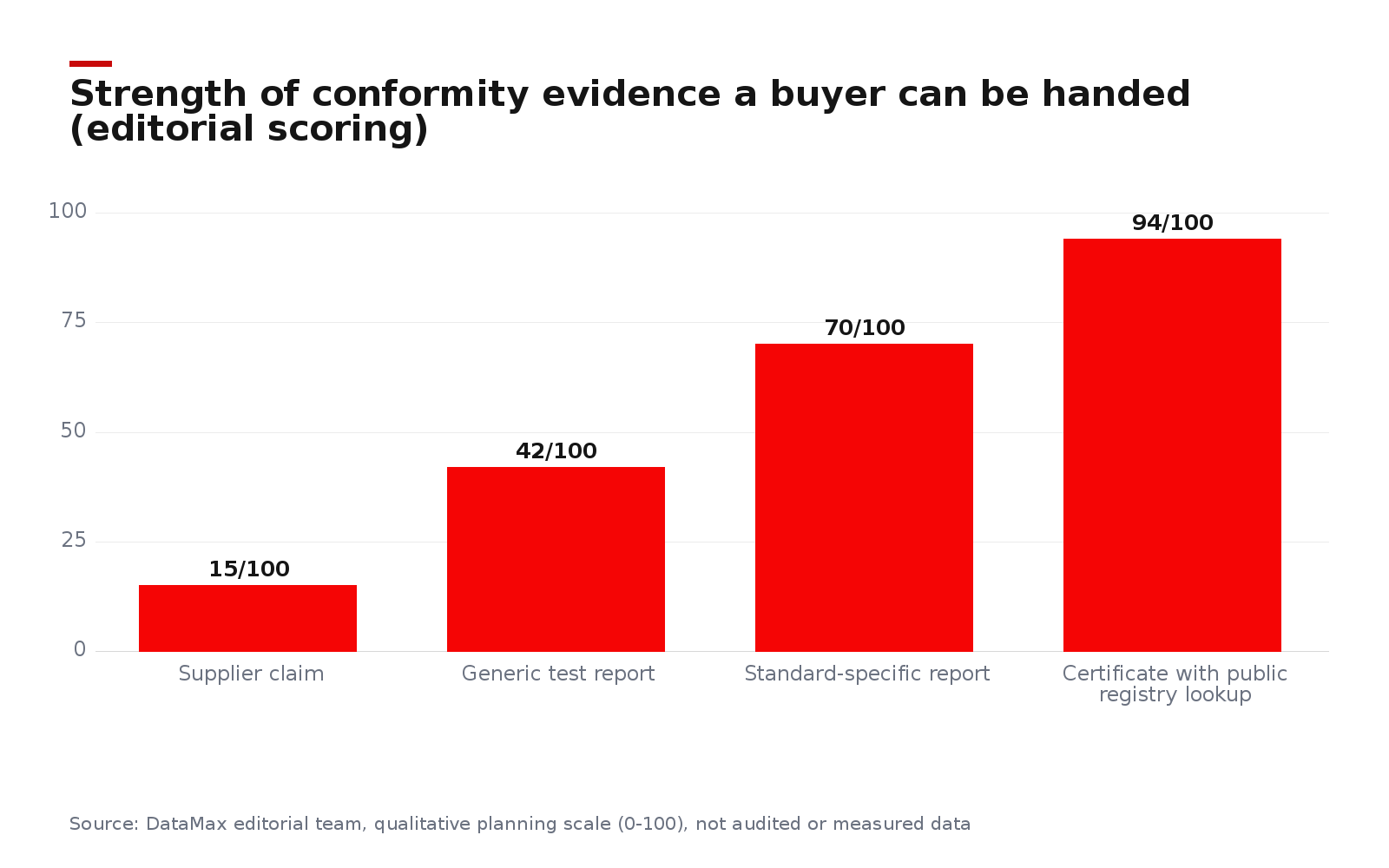
The same figures, in searchable form:
| Evidence type | Editorial score |
|---|---|
| Supplier claim | 15/100 |
| Generic test report | 42/100 |
| Standard-specific report | 70/100 |
| Certificate with public registry lookup | 94/100 |
The scores do not create a compliance conclusion. A 94/100 category must still identify the issuer, covered device, applicable software build, and registry conditions. Conversely, a 15/100 supplier claim can identify a real project and guide a deeper evidence request.
For factory-specific process evidence, DataMax invites buyers to request a video factory audit or a focused package covering SMT, AOI, aging, firmware control, and serial-number traceability for the intended program.
Two routes, one bill of differences
The procurement decision is often framed as “base platform” versus “committed platform,” but software and compliance effort can move independently. A buyer can choose a lower-complexity Android configuration and still require managed OTA, operator middleware, and SKU-specific certification. A higher-memory platform does not remove release-control requirements.
| Decision field | Entry route | Commitment route |
|---|---|---|
| Software baseline | Quoted AOSP or operator middleware baseline | Locked BSP, middleware, application and firmware release train |
| OTA scope | Documented package and signing approach | Partition map, staged rollout, rollback, audit and recovery validation |
| Evidence | SKU-level configuration sheet | Report index, certificate index, audit trail and production acceptance results |
| Certification | Base feature requirements defined before sourcing | Exact ordered SKU, firmware build and regional constraints mapped to evidence |
| Engineering commitment | Standard interface and application acceptance | Named change-control process and release-review gates |
| Sample gate | Functional sample on quoted base route | Production-intent sample with update, interruption and recovery tests |
| Configuration changes | Buyer accepts exclusions and revalidates options | Change trigger, regression set and evidence update are contractually defined |
| Operational ownership | Supplier supports standard update channel | Buyer, supplier and middleware owner share enrollment, rollout and rollback duties |
Convert the bill of differences into work packages and ownership. The supplier may own BSP bring-up, image integration, bootloader signing, and factory fixtures. The middleware provider may own the launcher, APIs, DRM integration, and operator applications. The buyer may own content security, entitlement, enrollment, fleet policy, and acceptance criteria. Unassigned gaps create disputes even when each component has a nominal owner.
A bid comparison should price or explicitly exclude board adaptation, middleware integration, application porting, Android GMS or Android TV certification, Widevine L1 provisioning, Netflix certification, secure boot and key injection, OTA server integration, pilot testing, production fixtures, retesting after firmware changes, and release maintenance. This exposes differences hidden by RAM, storage, or codec comparisons.
Define network-unavailable behavior. The entry route may rely on a periodic connection window. The commitment route should define deferred installation, retry behavior, maximum offline age, and manual recovery. It should state whether failure causes automatic rollback or engineering intervention. It should state whether operator application and middleware update atomically with the Android system image. These operational questions often cost more after deployment than initial board adaptation.
Certification is configuration control, not a checkbox. For the ordered hardware and software combination, confirm whether Widevine L1 and other DRM provisions apply. DataMax’s certification and DRM evidence must be confirmed per ordered SKU, not inferred from a catalogue page.
How the requirement actually works
A BSP is the layer between silicon and product software. It includes board-support code, boot chain, kernel configuration, device tree, drivers, power management, media-acceleration integration, memory configuration, peripherals, and build integration. On Android, the BSP establishes the hardware abstraction through which frameworks and middleware access the SoC, display, network, storage, security modules, and input devices.
RDK and AOSP can meet in an Android-based operator device, but ownership boundaries must be explicit. RDK middleware commonly defines set-top-box application and service APIs, a middleware abstraction layer, broadcast or IP delivery functions, and operator interfaces. AOSP Android supplies the Linux-based open-source stack and Android framework. The precise middleware build and API revision are not implied by the DataMax facts, so confirm them against the production datasheet and selected middleware release.
OTA is an architecture, not file transfer. A controlled design identifies packages, trusted signing keys, transport, scheduling, download staging, verification, partition switching, reboot handling, success reporting, failure thresholds, and recovery. In an A/B design, 1 slot runs the active system while the other receives the update; switching and health checks determine whether the new slot becomes active. Other designs use different recovery mechanisms, so request the implemented method rather than assume A/B support.
- Boot and firmware Bootloader verification and recovery responsibility
- System image Android build, partition layout and upgrade policy
- Middleware RDK middleware package, APIs and service compatibility
- Applications Operator application, launcher, content and configuration packages
- Evidence Signed package, test device, result record and rollback proof
Certification is layered. Codec capability is established against a defined profile and operating mode. Widevine L1 involves hardware-backed security and device-level provisioning; a catalogue label alone does not establish the requested device’s protected-path behavior. Android TV certification concerns the platform, applications, UX, and device compliance. Netflix device certification is separate from codec support.
Distinguish decode, display, and service certification. Decode means the media engine processes a specified format, profile, level, resolution, and frame rate. Display means the output path and connected panel carry the intended mode. Service certification means a particular device and release passed a provider’s approval process. An AV1 decoder does not prove either the requested display mode or Netflix certification.
The same distinction applies to DRM. Widevine L1, PlayReady, Dolby Vision, DTS, and HDCP are separate obligations or capabilities. Identify which service requires each path, which component provisions it, which build carries it, and which certificate or report covers the ordered configuration.
Codec roadmaps add measurable acceptance criteria. Netflix reported that “88% of large-screen devices (TVs, set-top boxes, streaming sticks) submitted for Netflix certification 2021-2025 supported AV1.” The population is submitted devices, not all shipped devices. The source also stated that “AV1 powers approximately 30% of all Netflix viewing; second most-used codec.” These are planning signals, not model-level approval.
That submitted-device figure matters when selecting an android tv box because it separates codec adoption among certification candidates from general market penetration. It does not establish identical decoder profiles, output paths, memory configurations, or service approvals. Use it to make AV1 an explicit RFQ and acceptance-test field, then require model-specific evidence.
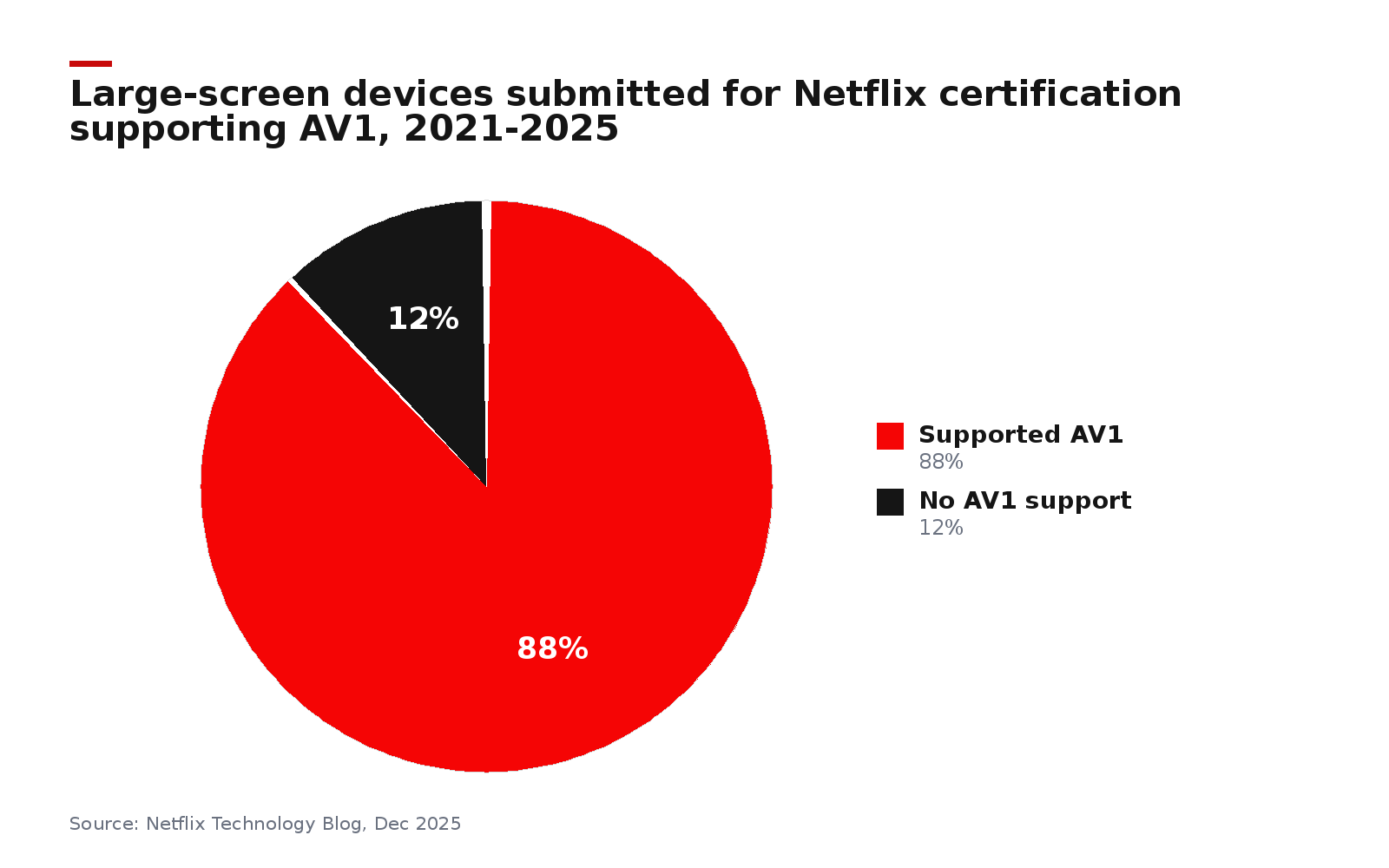
The same figures, in searchable form:
| AV1 support among submitted large-screen devices | Share |
|---|---|
| Supported AV1 | 88% |
| No AV1 support | 12% |
The evidence request should include candidate model, board revision, AV1 profile and level, firmware build, content-security configuration, and certification identifier where applicable. For a DRM stream, run provisioning, key exchange, playback, pause/resume, seek, reboot, and update. A codec-only test file proves less than the production entitlement flow.
Source: Netflix Technology Blog, AV1 — Now Powering 30% of Netflix Streaming
The platform shortlist with datasheet values
The DataMax shortlist is constrained by the supplied production facts. It does not replace the ordered BOM, production datasheet, or certification record. Optional items remain optional and require confirmation against the production datasheet.
| Field | DM21P | DM21S | DM21T | DM22Q |
|---|---|---|---|---|
| Position | 4K IPTV / operator middleware set-top box | 4K Android TV box for IPTV/OTT white-label | Premium UHD / cloud-gaming box | Gaming-oriented Android TV box |
| SoC | Amlogic S905Y4, quad Cortex-A35 | Amlogic S905Y5, quad Cortex-A55 | Amlogic S905X5, quad Cortex-A510 (ARMv9) | Amlogic S905X5M, quad Cortex-A55 up to 2.5GHz |
| OS | AOSP Android 11 | AOSP Android 14 | AOSP Android 14 | AOSP Android 14 |
| RAM / ROM | 2GB / 8GB (4GB; 16/32/64GB optional) | 2GB / 16GB (2/4/8GB; 16/32/64GB optional) | 4GB / 64GB (family options) | 4GB / 64GB (2/4/8GB; 16/32/64GB optional) |
| Decode | AV1 [email protected], VP9/H.265 4K@60, H.264 4K@30 | AV1 / H.265 [email protected] 4K@60 | H.266/VVC [email protected] 4K@120, AV1/VP9/H.265 4K@120, AVS3 4K@120, H.264 4K@60; inline AI-SR | AV1/H.265 L5.1 4K@60; inline AI-SR (no NPU TOPS stated) |
| DRM | Widevine L1 / PlayReady / HDCP 2.2 optional | Widevine L1 / PlayReady optional; Dolby Vision/DTS | Widevine L1 / PlayReady optional | Widevine L1 / PlayReady optional; Dolby Vision/DTS |
| Video and AV | HDMI 2.0b out x1; S/PDIF; 3.5mm AV | HDMI 2.0b out; S/PDIF; AV | HDMI 2.0b out (no HDMI input); S/PDIF; AV | HDMI 2.0b out; S/PDIF; AV |
| USB / storage | USB2.0 x2; TF | USB2.0 x2; TF | USB2.0 x1 + USB3.0 x1; TF | USB2.0 x2; TF |
| Ethernet / wireless | RJ45 100M; Wi-Fi6 2x2 + BT5.4 | RJ45 100M (1G optional); Wi-Fi6 2x2 + BT5.4 | RJ45 100M (1G opt); Wi-Fi6 + BT5.4 | RJ45 100M (1G opt); Wi-Fi6 2x2 + BT5.4 |
| Power | DC 5V/2A | Not stated in the supplied facts | Not stated in the supplied facts | Not stated in the supplied facts |
DM21P is the operator-middleware-oriented direction for a 4K IPTV deployment, but its AOSP Android 11 baseline requires confirmation against the target middleware and application release. The 100M Ethernet entry should be checked against access-node traffic and installation topology.
DM21S aligns with a 4K IPTV or OTT white-label requirement using AOSP Android 14. Its 1G Ethernet option requires BOM and BSP confirmation. DM21T is the higher-video-profile direction for premium UHD or cloud gaming, with 4K@120 decode modes and HDMI 2.0b output; the facts explicitly record no HDMI input. DM22Q targets gaming-oriented Android TV use with AOSP Android 14 and 4K@60 AV1/H.265 capability.
The shortlist maps to architecture questions rather than market labels. DM21P begins with operator middleware fit and an Android 11 baseline. DM21S begins with an Android 14 white-label requirement and simpler stated decode scope. DM21T begins with premium UHD or cloud-gaming requirements including 120-frame decode paths. DM22Q begins with a gaming orientation and a 60-frame maximum in the supplied facts. Put these distinctions in the RFQ rather than collapsing them into one “4K” column.
Memory requires the same discipline. The table lists optional RAM and ROM combinations, but optional means the production BOM, boot image, partition layout, application behavior, and test record must be confirmed. Do not infer that every storage option shares the same update partition or certification scope. A 64GB configuration can change layout and testing baseline even when the SoC and enclosure remain unchanged.
Treat DRM fields exactly. “Widevine L1 / PlayReady optional” identifies an optional feature. “Widevine L1 / PlayReady / HDCP 2.2 optional” groups 3 provisions under an optional scope on DM21P. Dolby Vision/DTS is separately listed on DM21S and DM22Q. Request the provisioning route, certificate, build, and service acceptance for every required DRM feature.
Field trap
Do not convert a marketing resolution label into an unsupported output claim. For DM21T and DM22Q, the supplied datasheet caps the stated maximum decode path at 4K; verify the production datasheet and display certification before publishing 8K claims.
For an RDK-oriented commitment, use the model’s operator fit as the starting point and request exact middleware, BSP, OTA, and certification evidence against that model. Do not infer RDK version, OTA method, GMS status, Google TV status, Netflix certification, or security provisioning from the fields above. Request samples and define the acceptance sequence through the sample order process.
Where this matters in a deployment
In an operator deployment, the controlling issue is fleet control: enrollment, deterministic middleware, service integration, update authority, and content security. In an integrator deployment, it is interoperability with the venue network, display, control system, and acceptance test. In a white-label program, branding and application ownership sit above the same board, firmware, update, and evidence chain.
| Situation | Primary requirement | Model direction | Evidence gate |
|---|---|---|---|
| IPTV operator with middleware integration | • Operator middleware baseline • Managed OTA and recovery • 100M or confirmed 1G Ethernet | Direction: DM21P for operator middleware fit; evaluate DM21S for AOSP Android 14 | Confirm BSP, middleware API, update design, Ethernet BOM and DRM evidence |
| OTT or IPTV white-label program | • AOSP Android 14 baseline • AV1/H.265 4K@60 direction • Application and launcher ownership | Direction: DM21S | Confirm white-label application build, OTA signing, Widevine scope and production identity |
| Premium UHD viewing deployment | • High-refresh 4K codec path • HDR and display validation • Controlled firmware baseline | Direction: DM21T | Confirm actual panel mode, HDMI behavior, DRM configuration and per-SKU certificates |
| Cloud-gaming or gaming-oriented venue | • 4K@120 decode direction • Latency and service integration • Stable update and recovery | Direction: DM21T or DM22Q | Test the complete service path; do not infer network or NPU performance beyond stated facts |
| Digital-signage integrator | • Stable image and application runtime • Remote management integration • Fixed hardware revision | Direction: DM21S or DM22Q, subject to workload | Freeze SKU, run burn-in, validate display behavior and document update ownership |
| Managed residential access program | • Device enrollment • Deterministic middleware • Staged rollout and rollback | Direction: evaluate DM21P and DM21S against the service stack | Proof of enrollment, signed update, interrupted-transfer recovery and audit reporting |
| Hospitality-room or operator-branded UI | • Fixed launcher and configuration • Remote management integration • Field replacement control | Direction: evaluate DM21S or DM22Q against workload | Freeze hardware, image, launcher, application package and recovery image |
An operator lab should reproduce the field network and display path. For wired access, connect the candidate device to the intended Ethernet equipment and verify the negotiated link. For Wi-Fi, reproduce the RF environment and authentication path rather than relying on a bench access point. For premium displays, connect the production panel, receiver, or extender because HDMI negotiation can differ from a generic monitor.
The qualification bench should resemble the deployment, not a showroom. Rows of black Android set-top boxes need HDMI and network connectivity, controlled display targets, instrumented network conditions, and engineers able to reproduce boot, content, update, and recovery tests.

Structure the sequence around evidence rather than demonstration: establish the exact firmware image, prove signed-update installation, interrupt connectivity during transfer, exercise recovery, reproduce content playback under the required DRM and codec path, then capture the result against the serial number. For a venue deployment, include the real display, switching or extender path, control system, Wi-Fi or wired behavior, and long-duration image stability.
Add 4 release scenarios. First, boot without a network and verify documented offline behavior. Second, interrupt an update after download and during installation. Third, corrupt or reject the test package and confirm that an unauthorized image is not accepted. Fourth, replace the network credential or enroll the device in a new service account and verify intended cleanup behavior. These cases expose ownership gaps missed by a routine update demonstration.
Close procurement by assigning every unresolved dependency. For DataMax platform selection, the engineering team can confirm the ordered SKU, board configuration, and required evidence through an inquiry. Certificates and DRM/security provisions must be confirmed per ordered SKU, not per catalogue page, using the compliance record and applicable certification evidence. For the selected android tv box, record the resulting evidence against the same serial-number and release identity used for OTA qualification.
Further reading
- Guide android tv box for isps
- Widevine L1 certification guide
- Dolby Atmos Android TV box guide
- TV box vendor selection checklist
- AOSP vs GMS solution notes
- DataMax DM21P specifications and fit
- DataMax DM21S specifications and fit
FAQ
Does an AOSP Android TV box qualify as an RDK device?
Not automatically. AOSP identifies the Android software base; RDK identifies a middleware platform and its APIs. An operator requirement may combine them, but the supplier must identify the middleware version, BSP integration, launcher ownership, APIs, application ABI, and tested build. Confirm the implementation against the production datasheet and acceptance results.
What evidence proves that OTA is production-ready?
Ask for the update architecture, signed-package hierarchy, supported partitions, enrollment, transport, staged rollout, failure threshold, rollback, recovery, audit reporting, and offline behavior. A video demonstration is weaker than a repeatable test record tied to a firmware build and production hardware revision.
Is Widevine L1 enough to prove DRM readiness?
No. Verify the protected-path configuration for the ordered model, memory and Ethernet options, firmware build, and service requirements. Widevine L1, PlayReady, Dolby Vision, DTS, and HDCP provisions may have different scopes. Confirm certificates and DRM/security provisions per ordered SKU.
Can a 4K Android TV box support AV1 without being Netflix certified?
Yes, as distinct technical questions. AV1 decode capability is specified in the platform facts, while Netflix certification establishes a separate service and device approval. Verify the proposed model against both the required codec path and the exact certification record rather than inferring 1 from the other.
Which DataMax platform fits an operator middleware program?
DM21P is positioned for a 4K IPTV and operator middleware set-top box, while DM21S provides an AOSP Android 14 direction for IPTV or OTT white-label use. The final choice depends on middleware release, connectivity option, OTA design, certification scope, and production acceptance results.
How should a buyer request factory evidence?
Request evidence tied to the intended program rather than a general factory claim: SMT and AOI records, aging parameters, functional-test configuration, firmware manifest, serial-number traceability, change-control procedure, and certification indexes. DataMax can support a video factory audit and topic-specific document review through its factory-quality process.


