
Before the terminology: the decision
If the device must run operator-controlled middleware, service provisioning, entitlement workflows, and operator-grade updates, treat android tv box as a hardware platform and require a separate software-rights decision before comparing models. If it must run a consumer-style Android TV application store with third-party applications, start from Google-certified Android TV compatibility and Google services requirements. Linux RDK may sit in a different product and compliance class entirely.
Most readers asking about android tv box are actually deciding among 4 paths: RDK-based operator middleware, AOSP Android TV, a Google Android TV build, or a mixed Android/RDK architecture. The correct comparison is not “Linux versus Android.” It is which application runtime, certification regime, DRM service, update control model, and operator integration boundary the deployment requires.
This page isolates that terminology and procurement angle. The broader selection framework is covered in Android TV box for ISPs. DataMax’s supplied platform facts below are specific; other RDK, Google, chipset, interface, or compliance details must be confirmed against the production datasheet and applicable certification record.
| Decision | If Linux/RDK is required | If Android TV is required |
|---|---|---|
| Primary runtime | Specify the RDK release, middleware ABI, and operator integration boundary. | Specify AOSP or Google Android TV, application ecosystem, and device approval route. |
| Certification evidence | Request the applicable RDK and operator/middleware compliance records. | Request Google Android TV device approval evidence plus target-market certifications. |
| Content protection | Map license servers, conditional access, and DRM to the exact operator stack. | Map Widevine, PlayReady, HDCP, and playback paths to the service contract. |
| Updates | Define image ownership, partition layout, rollback, and release approval. | Define OTA channels, signed builds, recovery, and application update policy. |
The practical side of the decision is the control boundary. If the operator controls entitlements, provisioning, middleware releases, device telemetry, and fleet recovery, write those functions into the RFQ before naming a device. If the program instead depends on a public application catalogue, commercial Google services, retail-device compatibility, or third-party consumer applications, request the corresponding device approval and application policy. A mixed architecture can satisfy both needs, but only if the division of responsibility is documented: who owns the bootloader, BSP, middleware, application framework, DRM integration, OTA system, security updates, and end-of-life support.
For procurement teams, the first question is not whether a box is “Linux” or “Android.” It is whether the quoted configuration is a product, a development board, an image on hardware, or a fully approved commercial platform. A supplier may offer the same SoC with an AOSP image, an operator image, a Google-approved design, or a custom middleware build. Those variants can have different certification tasks, test evidence, software responsibilities, and launch dependencies.
Where quotations quietly diverge
Quotation divergence usually starts when a supplier treats “platform” as a synonym for the SoC. A chipset name identifies the silicon family, not the operating system, middleware, certification status, DRM implementation, update rights, or operator integration depth. A quotation that says “Amlogic Android 14” therefore omits more program variables than it resolves.
Field trap
A unit quoted as an **android tv box** may be an AOSP build without Google Play, an uncertified image, an operator image with another middleware layer, or a retail-certified design. A buyer who treats all 4 as equivalent can pay for unusable firmware features, blocked applications, or an approval path that begins after the first production order.
The second trap is “Linux” used as if it settles the architecture. Linux can describe an operating-system kernel, a BSP layer, an RDK implementation, AOSP-derived Android, or a distribution assembled from vendor components. The RFQ must name the exact software baseline: release identifier, source/build policy, device tree, bootloader, security patch policy, partition layout, middleware version, and application approval process.
A third divergence is capability language. “4K,” “HDR,” “Dolby Vision,” “HDCP,” “Widevine L1,” and “AV1” can refer to hardware decode, output format, protected-path implementation, licensing state, application compatibility, or marketing labels. Every quoted term needs an evidence column. If the production datasheet does not define the version, profile, level, or certification scope, mark it “confirm against the production datasheet.”
Commercial trap
An unresolved label can trigger tooling changes, certification expense, middleware rework, packaging corrections, delayed launch, or rejected units. The cost is not only the initial purchase; it is also the engineering and schedule impact of discovering that the delivered configuration differs from the commercial baseline.
Use a quotation-version discipline: attach the hardware SKU, storage variant, OS baseline, middleware baseline, regional application and content requirements, firmware-owner name, evidence list, and build quantity to every price-bearing offer. Without that envelope, apparently comparable quotations are different products.
A practical example shows why this matters. One quotation may specify an AOSP Android 14 image with AV1 decoding, while another specifies the same OS family, a Google-approved application environment, an operator middleware build, and a particular protected-content implementation. The processor capability may be identical, but the software approval work, integration tests, licensing conditions, and field responsibilities differ. The buyer should compare the complete delivery state, not infer equivalence from the SoC line.
Another common divergence is the use of “operator version.” That phrase can mean a hardened image, a middleware integration, a provisioning-enabled profile, a regional application build, or a hardware variant with an operator-facing logo. Require the configuration identifier and release notes. If the supplier cannot identify which statement applies, the RFQ should leave that line open rather than accept an implied commitment.
Questions to put in the supplier review
Factory evidence should connect the ordered configuration to a repeatable production process. Start with a document map, then sample the evidence at each transition.
- Configuration lock Require a signed configuration sheet identifying the exact SKU, SoC, RAM/ROM combination, OS baseline, middleware or image identifier, ports, regional applications, and protected-content options.
- SMT and AOI record Request dated evidence for the relevant production lot: line identification, feeder or material traceability where available, first-article inspection, AOI records, and the approved golden sample used by operators.
- Functional test trace Map test records to the ordered SKU and revision: boot, Ethernet, Wi-Fi, Bluetooth, USB, HDMI output, audio, storage, decoding, DRM paths, operator middleware, and application workflows.
- Dark-room validation Obtain the visual-validation procedure and sample result for panel uniformity, dead-pixel criteria, backlight behavior, screen markings, and any approved cosmetic tolerances.
- Burn-in or aging record Review chamber or rack time, workload profile, temperature conditions, failure definitions, retest procedure, and disposition of failed units for the production lot.
- Audit and release evidence Review the audit scope, closure records, firmware hash or release identifier, and change-control process connecting the tested unit to the shippable image.
Evidence rule: A report is stronger when it identifies the tested product, firmware, revision, date, standard or test scope, laboratory or line context, and result. A generic “pass” document without those fields cannot be mapped reliably to the shipment. Requesting a video factory audit is the practical next step through DataMax’s factory quality process, with SMT/AOI and aging evidence scoped to this RFQ.
For an android tv box order, add boot-state coverage, remote-control mapping, application install/launch tests, account and DRM flows, recovery, update interruption, and operator middleware integration. For RDK-related comparison work, request the applicable middleware and stack evidence rather than assuming an AOSP test report substitutes for it.
The buyer should also define acceptable evidence in advance. “Latest report” is not a traceable requirement. “Report naming the SKU, firmware release, test date, and applicable scope, with a lot link or serial-range reference” can be audited. Keep unrelated certifications out of the file: each document should answer a named requirement rather than create general assurance.
Turn this review into a sampling exercise. For a pilot build, ask the supplier to identify one completed unit and follow it through the records: board revision, component placement, AOI disposition, firmware download, functional test, aging result, firmware version, and final release check. Then ask for the same route on one commercial shipment. Differences between the records reveal where the “golden sample” has become a different production configuration.
Include a negative-path test in the file. The evidence should show what happens when a unit fails AOI, fails a media playback test, cannot complete DRM initialization, loses network connectivity, or rejects an update. A retest procedure without a defect definition and disposition rule is only a record of activity. The buyer needs to know whether the unit is reworked, scrapped, quarantined, or released through an approved deviation.
A factory audit should be scoped to the actual RFQ rather than presented as a general tour. Ask to observe the line used for the quoted SKU, understand how AOI exceptions are reviewed, see how the approved firmware reaches production, and inspect the relationship between the tested sample and the shipped unit. Requesting that evidence through DataMax’s manufacturing overview can give the engineering and procurement teams a concrete document list.
The comparison buyers actually make
Buyers rarely compare only hardware. They compare the delivered operating baseline, certification evidence, licensing, memory, connectivity, and the supplier’s ability to make changes without breaking the program.
| Decision field | Entry commercial position | Committed operator position |
|---|---|---|
| Software baseline | Fixed AOSP image with documented feature scope | Operator-controlled image, middleware integration, rollback and release governance |
| Certification | Target-market evidence tied to the SKU and configuration | Device approval, RDK or middleware evidence, service certification and operator security requirements |
| DRM and content protection | Documented playback and protection paths | Entitlement integration, secure keys, license servers, conditional access and production provisioning |
| Memory | Fixed RAM/ROM configuration suitable for the application set | Capacity assigned to middleware, cache, telemetry, OTA staging and recovery functions |
| Connectivity | Required interfaces fitted and tested | Interface behavior plus Ethernet, Wi-Fi, remote, reset and recovery requirements validated as a system |
| Change control | Documented patch and image process | Named release owner, signed artifacts, compatibility rules and deployment sequencing |
| Device identity | Serial, hardware revision and software image recorded | Device identity joined to operator account, provisioning state, entitlement record and release history |
| Recovery | Local restart and documented reset path | Remote recovery, boot-loop protection, rollback, staged rollout and escalation path |
| Acceptance | Factory functional test and sample playback test | Operator workflow, service activation, entitlement, update interruption and fleet reporting tests |
The relevant tier is not determined by the fastest processor or largest storage. An operator set-top box may need stable middleware integration, restricted provisioning, remote recovery, and long-lived firmware governance more than an entry retail-style box needs general application freedom.
Evidence quality should be treated as a procurement variable. The following editorial ranking helps buyers ask better questions; it is not audited or measured data.
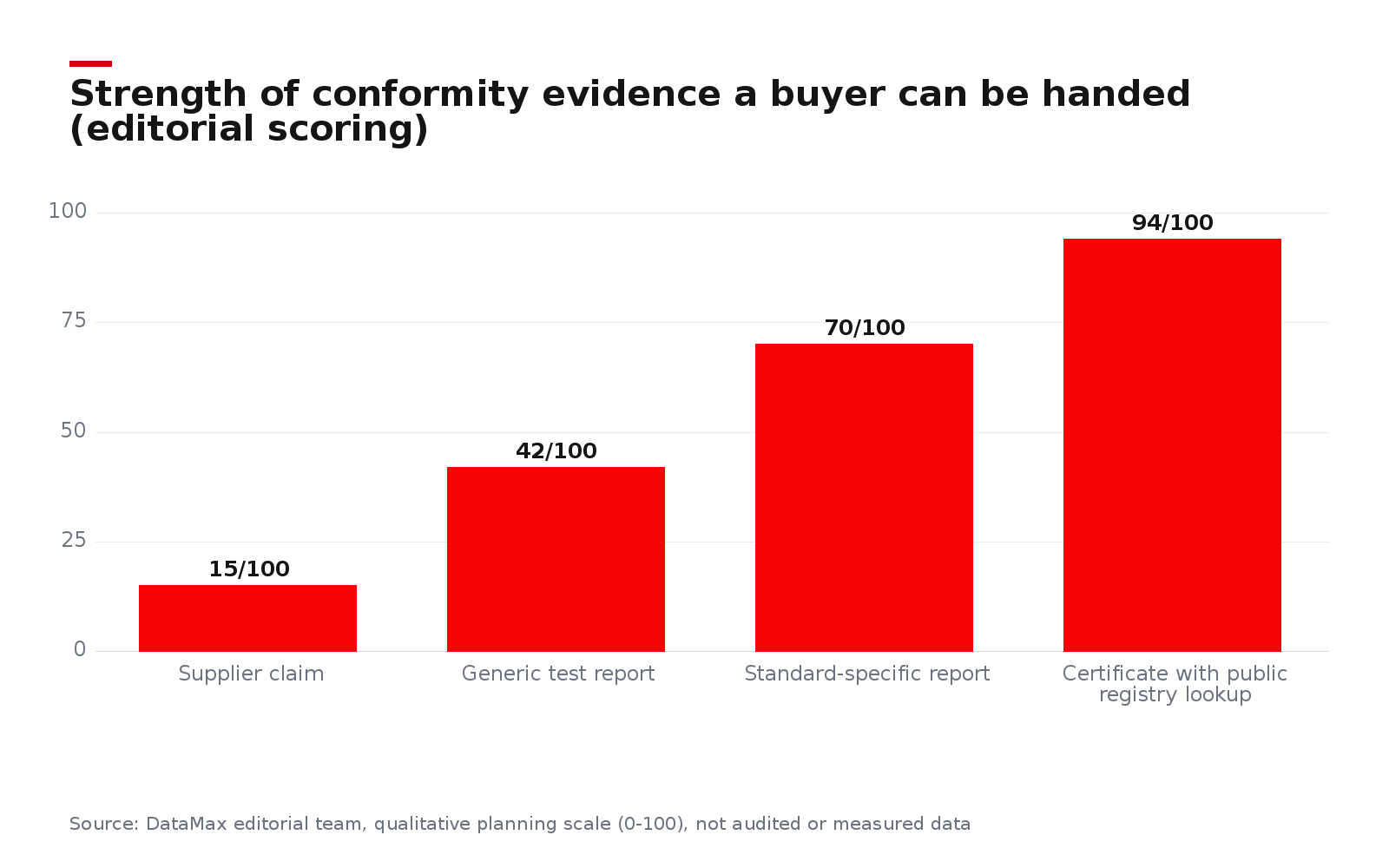
The same figures, in searchable form:
| Evidence option | Editorial score |
|---|---|
| Supplier claim | 15 |
| Generic test report | 42 |
| Standard-specific report | 70 |
| Certificate with public registry lookup | 94 |
An android tv box comparison is defensible only when both suppliers attach evidence to the same requirement lines. A higher-confidence document for one field does not offset an absent document in another field. The most useful comparison sheet therefore has 4 columns: requirement, quoted configuration, evidence reference, and acceptance owner. It should expose omissions before commercial negotiation turns them into assumptions.
A second comparison axis is the consequence of change. If a storage option is optional, the RFQ should identify which memory arrangement supports the intended application and which tests must be repeated. If Ethernet is optional, the buyer should know whether the connected service path, operator middleware, and update strategy remain unchanged. Optional means unquoted until selected; it does not mean that the capability is present in every unit.
Definitions a buyer cannot outsource
“Android TV” is a product and platform designation with a specific application and compatibility framework. “AOSP Android” identifies the Android Open Source Project baseline, but an AOSP build does not automatically provide Google Play services, Google device approval, or every retail application. If commercial applications depend on Google services, request the exact device-approval evidence and commercial terms rather than inferring them from the AOSP version number.
RDK is a connected-device software architecture and specification framework used for operator-oriented set-top and TV platforms. Its relevance must be defined by the applicable RDK release and middleware stack. RDK compatibility cannot be inferred from Linux, an Android UI, or a common chipset. A mixed design requires a clear division of ownership: application environment, middleware services, hardware abstraction, bootloader, OTA system, security architecture, and device certification.
- Application layer Operator portal, retail applications, games, or sign-on flow.
- Framework and middleware DRM, entitlement, media, networking, telemetry, device management, and operator services.
- OS and BSP Kernel, drivers, bootloader, device tree, HAL, codec and display integration.
- Silicon SoC, memory, interfaces, and hardware video processing.
DRM names also need separate treatment. Widevine L1 indicates a secure-level implementation designation, but the service entitlement, test route, application integration and production key workflow still require confirmation. PlayReady, HDCP 2.2, Dolby Vision and DTS are distinct capability and licensing claims. A processor-support statement does not prove a complete product implementation.
The buyer should define the terms it will accept in 4 fields: build identity, compliance scope, playback capability, and lifecycle control. Build identity requires a release or image identifier. Compliance scope requires a named standard, version, and market. Playback capability requires format, profile, level and output where applicable. Lifecycle control requires update ownership, signing, rollback and change notification.
These definitions apply to an android tv box even when its final label is retail, operator, or white-label. They also explain why Linux RDK should not be presented as an interchangeable OS choice with Android TV.
For operators, “Android” and “RDK” can appear in different layers of the same product discussion. Android may describe the application-facing runtime while RDK components provide broadcast, media, networking, or device-management services. Procurement should identify whether the terms describe a complete platform, a middleware subset, or an implementation reference. Otherwise, a supplier can respond to a requirement with a component rather than the complete deliverable.
Hardware acceleration is another term that cannot be outsourced into a supplier’s shorthand. Codec support may exist in silicon, be enabled in the BSP, be accepted by a media framework, pass an application test, and remain usable through the protected-content path. Those are separate conditions. The RFQ should identify where each capability must be demonstrated: decoder, output, application, or service workflow.
The same discipline applies to updates. “OTA supported” does not specify signed images, staged deployment, failure rollback, recovery partition behavior, middleware compatibility, or operator approval. Define the release unit, owner, cadence, interruption behavior, and field visibility. These requirements often cost more engineering time than the initial hardware selection.
Real DataMax platforms, field by field
The following table uses only the supplied DataMax product facts. It does not assign RDK certification, Google device approval, target-market compliance, or unlisted production details to any model. Confirm each configuration against the production datasheet before converting it into an RFQ line.
| Model and fit | Compute and OS | Memory | Decode and DRM | Interfaces |
|---|---|---|---|---|
| DM21P 4K IPTV / operator middleware set-top box | Amlogic S905Y4, quad Cortex-A35 AOSP Android 11 | 2GB / 8GB 4GB; 16/32/64GB optional | AV1 [email protected]; VP9/H.265 4K@60; H.264 4K@30 Widevine L1 / PlayReady / HDCP 2.2 optional | HDMI 2.0b out x1; USB2.0 x2; TF; S/PDIF; 3.5mm AV; RJ45 100M; Wi-Fi6 2x2 + BT5.4; DC 5V/2A |
| DM21S 4K Android TV box for IPTV/OTT white-label | Amlogic S905Y5, quad Cortex-A55 AOSP Android 14 | 2GB / 16GB 2/4/8GB; 16/32/64GB optional | AV1 / H.265 [email protected] 4K@60 Widevine L1 / PlayReady optional; Dolby Vision/DTS | HDMI 2.0b out; S/PDIF; AV; USB2.0 x2; TF; RJ45 100M (1G optional); Wi-Fi6 2x2 + BT5.4 |
| DM21T Premium UHD / cloud-gaming box | Amlogic S905X5, quad Cortex-A510 (ARMv9) AOSP Android 14 | 4GB / 64GB family options | H.266/VVC [email protected] 4K@120; AV1/VP9/H.265 4K@120; AVS3 4K@120; H.264 4K@60; inline AI-SR Widevine L1 / PlayReady optional | HDMI 2.0b out (no HDMI in); USB2.0 x1 + USB3.0 x1; TF; S/PDIF; AV; RJ45 100M (1G opt); Wi-Fi6 + BT5.4 |
| DM22Q Gaming-oriented Android TV box | Amlogic S905X5M, quad Cortex-A55 up to 2.5GHz AOSP Android 14 | 4GB / 64GB 2/4/8GB; 16/32/64GB optional | AV1/H.265 L5.1 4K@60; inline AI-SR (no NPU TOPS stated) Widevine L1 / PlayReady optional; Dolby Vision/DTS | HDMI 2.0b out; USB2.0 x2; TF; S/PDIF; AV; RJ45 100M (1G opt); Wi-Fi6 2x2 + BT5.4 |
The model mapping is directional. DM21P is identified for 4K IPTV and operator middleware set-top-box use. DM21S is identified for 4K IPTV/OTT white-label use. DM21T is identified for premium UHD and cloud-gaming use, and DM22Q for gaming-oriented use. These descriptions do not establish RDK conformance, Google Android TV approval, protected-content license readiness, or a specific operator middleware configuration; those points require separate evidence.
That distinction matters when a quotation calls one unit an android tv box and another a Linux RDK product. Compare the complete software stack and approval obligations, not just the SoC or the word “Android.”
The RAM/ROM lines require particular care. DM21P has a supplied baseline of 2GB / 8GB, with 4GB and 16/32/64GB options identified. DM21S has 2GB / 16GB, with 2/4/8GB and 16/32/64GB options identified. DM21T has 4GB / 64GB and family options. DM22Q has 4GB / 64GB, with 2/4/8GB and 16/32/64GB options identified. These are selection fields, not permission to infer every permutation as production-ready; confirm the selected configuration against the production datasheet.
Likewise, “optional” is a quotation control point. HDCP 2.2 is optional on DM21P, while Widevine L1 and PlayReady are optional there. Widevine L1, PlayReady, and Dolby Vision/DTS are optional on DM21S and DM22Q; Widevine L1 and PlayReady are optional on DM21T. The RFQ should name the selected state, the evidence required, and whether the protected-content work is part of the device supplier’s scope.
Do not convert legacy marketing labels into RFQ claims. DM21T and DM22Q must not be described as 8K-output products because the supplied datasheet facts cap their relevant decode or output capability at 4K. Use the listed 4K@60 or 4K@120 limits, and preserve any output distinction stated in the production datasheet.
Buyer situations, ranked by what they punish
Deployment context determines which mistake becomes expensive. Operator fleets punish lost provisioning and weak fleet control. Integrators punish missing interfaces and inconsistent firmware. Venue or vertical deployments punish lifecycle ambiguity, support ownership, and updates that disrupt service.
| Situation | Primary requirement | Model direction |
|---|---|---|
| IPTV operator deployment | Operator middleware, provisioning, entitlement, DRM and fleet update control | Start with DM21P because its stated fit is 4K IPTV and operator middleware set-top-box use; validate the software stack separately. |
| OTT or white-label service | Application compatibility, content paths, flexible storage and regional UI | Evaluate DM21S against the IPTV/OTT white-label requirement; confirm Google TV approval if required. |
| Cloud gaming | Decode throughput, display path, input latency validation and network behavior | Evaluate DM21T for its stated premium UHD and cloud-gaming fit; latency needs a controlled test. |
| Gaming-oriented retail channel | AV1/H.265 support, graphics path, thermal behavior and sustained performance | Evaluate DM22Q for its stated gaming orientation; validate sustained workloads rather than infer them from AI-SR. |
| AV integrator installation | HDMI, audio, Ethernet, remote, recovery and repeatability | Choose by measured interface and firmware requirements, not processor tier alone. |
| Digital signage or edge compute | Boot reliability, update control, application behavior and lifecycle support | Confirm against the production datasheet because the supplied facts do not assign these models to that vertical. |
| Pay-TV operator | Conditional access or DRM flow, hardware trust, activation and entitlement lifecycle | Use DM21P as the operator-middleware direction; require the exact service-security and provisioning evidence. |
| Distributor-led retail program | Regional branding, packaging, application policy, defect triage and repeatable configuration | Evaluate DM21S for white-label direction and define who owns regional image and application changes. |
| Hospitality or venue deployment | Remote recovery, stable networking, update windows and simple redeployment | Select from measured Wi-Fi, Ethernet, recovery and OTA behavior; no supplied model designation establishes this vertical. |
The ranking principle is simple: the first purchaser to suffer is not necessarily the owner of the shipment. A distributor may absorb the immediate integration work, while the operator absorbs service activation failures after installation. Procurement should therefore assign evidence to the party that will be measured against the outcome.
A modern manufacturing scene illustrates where variation enters production. The process is not complete when components are placed; the controlled chain continues through inspection, firmware loading, functional testing, aging, and final configuration verification.

For an android tv box program, the factory scene should map to named checkpoints: AOI records, firmware identity, decoded output, network behavior, DRM application tests, and recovery. For an RDK-oriented comparison, add the middleware build, stack-version validation, and operator acceptance record. The purchasing team should see the same traceability across both paths.
Operator and integrator risk can be separated by the event that exposes it. A missed entitlement activation blocks subscriber service. An incorrect HDMI or audio configuration blocks installation. A missing USB or Ethernet interface may appear only when the device is physically deployed. A reboot loop discovered during aging is cheaper than one discovered after installation. The acceptance plan should therefore cover all 4 stages instead of concentrating every test on codec playback.
For venue deployments, update control often becomes the dominant operational requirement. The buyer should ask whether an interrupted update recovers, whether a failed image can be replaced from the field, and who approves a new image. For retail channels, regional application and branding changes may dominate. For operator fleets, provisioning state and entitlement synchronization dominate. The matrix helps procurement allocate test effort; it does not substitute for the production datasheet.
A decision path for the RFQ
Turn terminology into ordered gates. A supplier may progress only when the preceding requirement has evidence attached. This prevents a capable SoC from masking an incomplete platform.
- Write the use case Specify operator IPTV, OTT white-label, cloud gaming, gaming channel, integrator installation, signage, or edge compute. State the application and fleet owner.
- Name the platform Choose the required RDK release and middleware stack, or AOSP Android/Google Android TV route. Do not write “Linux” or “Android” alone.
- Lock the SKU Identify model, exact RAM/ROM configuration, SoC, OS baseline, ports, regional applications and content-protection options.
- Attach the evidence Require standard-specific reports, device-approval records where applicable, and a traceability statement connecting evidence to the quoted SKU and firmware.
- Define manufacturing controls Require SMT/AOI, functional test, dark-room, aging or burn-in, firmware hash or release, and audit records for the production process.
- Set acceptance rules Define boot, network, media, DRM, recovery, update, remote and operator workflow results, including defect and retest disposition.
Pasteable RFQ lines should be specific. For example: “OS baseline: AOSP Android 14; middleware/image identifier: [supplier to state]; application ecosystem: [Google TV or operator stack]; RAM/ROM: 4GB/64GB; HDMI 2.0b output; required protected-content implementation: [state standard, version and scope]; evidence: report naming SKU, firmware and test date.”
For operator middleware, append: “Provisioning, entitlement, conditional access or DRM flow, remote recovery, update interruption and rollback shall be demonstrated against the approved middleware release.” For RDK, append the applicable release and validation requirement rather than leaving the stack unspecified.
Before issuing the package to a supplier, remove contradictions. A line claiming 8K output conflicts with supplied facts that cap DM21T and DM22Q decode/output at 4K; do not include it. Likewise, “Dolby Vision/DTS,” “Widevine L1,” “PlayReady,” and “HDCP 2.2 optional” require exact configuration and evidence language.
A complete RFQ should ask for: the SKU list, target-market certificates, the middleware/DRM checklist, and lot-linked SMT/AOI/aging evidence. DataMax can support that review through a project inquiry or a factory-evidence request through the manufacturer overview. Email [email protected] with those 4 attachments plus the exact proposed RFQ wording so the technical team can map every requirement to a model and evidence class.
Use a commercial response sheet with 5 columns: requirement text, supplier response, evidence reference, test method, and responsible owner. “Included” is not an acceptable response without an evidence reference. The same rule applies to ports, storage, codec levels, protected-content options, middleware versions, and recovery behavior. It creates an auditable record when the RFQ moves from quotation into pilot approval.
Finally, set a change-control trigger. Any change to SoC, PCB revision, RAM/ROM, OS baseline, bootloader, middleware, protected-content option, or regional image should trigger a documented impact review. The review should identify which tests, certificates, application builds, packaging assets, and operator records must be revisited. That clause prevents a later “equivalent” substitution from silently changing the accepted platform.
Further reading
- Guide android tv box for isps
- AOSP vs GMS solution notes
- Telecom and pay-TV operator solutions
- Allwinner Android TV boxes
- AOSP Android TV boxes
- DataMax DM21P specifications and fit
- DataMax DM21S specifications and fit
FAQ
Is an RDK device the same as an Android TV box?
No. RDK defines an operator-oriented connected-device software framework and stack, while Android TV is a distinct platform and product designation. A mixed architecture may exist, but the application runtime, middleware, certification path, DRM, provisioning and update ownership must be specified separately. For broader ISP selection criteria, see Android TV box for ISPs.
Does AOSP Android 14 mean Google Android TV approval?
No. AOSP identifies the source baseline; it does not itself establish Google device approval, Google Play services availability, or retail application compatibility. If those are required, request the exact approval evidence and application policy from the supplier.
Which specification should be written into an RFQ?
Write the software baseline, exact hardware SKU, RAM/ROM combination, interfaces, regional application requirements, content-protection options, middleware or image identifier, applicable certification scope, and production evidence. Avoid an unqualified “Linux” or “Android” line because it leaves critical commercial and technical variables unresolved.
Can codec support alone determine box suitability?
No. Codec support must be connected to profile, level, output path, application compatibility and protected-content behavior. An operator deployment also needs provisioning, entitlement, fleet updates, recovery and acceptance evidence; those software and operational layers can be more restrictive than the processor.
What production records should a buyer request?
Request configuration records, SMT/AOI evidence, functional test results, dark-room validation, aging or burn-in records, firmware or release identity, and audit closure for the relevant lot. The buyer can request a video factory audit and topic-specific evidence through DataMax’s factory quality page.
How should DataMax models be selected for operator or OTT work?
Use the stated fit as a starting point, not as proof of certification. DM21P is designated for 4K IPTV and operator middleware set-top-box use, while DM21S is designated for 4K IPTV/OTT white-label use. Confirm storage, middleware, Google approval if needed, target-market compliance, DRM evidence, and production datasheet details before approval.


