

Before the terminology: the decision
| Decision axis | Operator requirement | Procurement consequence |
|---|---|---|
| Platform | AOSP-based set-top box for operator middleware | Start with DM21P; use the product fit, not the retail label, as the shortlist criterion. |
| Software channel | Google-certified non-Google-TV distribution | Use DM21RTD where the specified GMS-certified AOSP route is mandatory. |
| Program tier | 4K IPTV, OTT white-label, or premium UHD/cloud gaming | Compare DM21S and DM21T only where their published fit matches the actual service profile. |
| Commercial support | A controlled firmware branch, product-change notice, and spare-parts window | Require a written lifecycle statement; an undocumented position is the highest procurement risk. |
For a small cable operator, the short answer is to choose an operator-oriented platform, specify the middleware, DRM, connectivity, and lifecycle obligations in the purchase order, then require evidence during production. android tv box is a useful search phrase, but it does not identify a deployable platform. The relevant question is which production configuration can be certified, provisioned, updated, and replaced without breaking service.
This brief addresses that narrow procurement angle for small cable operators rather than repeating the general buying guide. For broader selection criteria, see the canonical Android TV box guide for ISPs. DataMax supplies multiple production families, so “small” does not automatically mean the lowest-capacity SKU.
The one-screen answer
Start with the operator fit stated in the product record. For an IPTV or middleware programme, evaluate DM21P first because its documented position is a 4K IPTV and operator middleware set-top box. If the commercial requirement specifically calls for a Google-certified, non-Google-TV AOSP configuration, evaluate DM21RTD. Do not infer GMS certification from an AOSP designation; the distinction is operational, not cosmetic.
For white-label OTT, compare DM21S against the service requirements. For premium UHD or cloud gaming, assess DM21T against the decode workload and port budget. Every unresolved technical line belongs in the RFQ, not in a commercial assumption.
A regional IPTV service with operator middleware, 100M access Ethernet, 4K channels, Widevine L1, and staged firmware updates makes DM21P the initial candidate. Its published fit matches that role, but the RFQ must still resolve optional DRM, exact memory selection, accepted codec profiles, and the update branch before the purchase order is released.
A white-label OTT service needing AOSP Android 14, AV1, H.265 [email protected] 4K@60, and selectable 1G Ethernet makes DM21S the documented fit, provided 1G and every optional entitlement are frozen into the SKU rather than left as catalogue choices.
A decision test before quotation
Ask whether the box is merely the endpoint or the managed product. If the operator expects remote middleware, controlled updates, device identity, entitlement handling, and a defined replacement path, those functions belong in the RFQ as acceptance items. Hardware selection alone cannot demonstrate that the installed base can be maintained.
A small operator should decide who owns each operational function before choosing a model. The platform supplier may provide hardware and a firmware branch, while the operator supplies middleware, entitlement, content agreements, network access, and remote support. Naming these owners prevents a quotation from treating an unresolved integration dependency as a factory deliverable.
The term android tv box can describe a retail-oriented product, an operator-managed endpoint, or an evaluation board. For procurement, write the required operating system, certification route, service middleware, content protection, managed-update requirement, and hardware options as separate acceptance lines. This makes the ordered unit auditable from quotation through field replacement.
Five production SKUs compared
The comparison contains only published DataMax product facts. Options appear as stated in the product record; where a field is not supplied, confirm it against the production datasheet.
| Model | SoC and OS | Memory | Video and DRM | Interfaces | Documented fit |
|---|---|---|---|---|---|
| DM21P | Amlogic S905Y4, quad Cortex-A35; AOSP Android 11 | 2GB / 8GB; 4GB; 16/32/64GB optional | AV1 [email protected]; VP9/H.265 4K@60; H.264 4K@30. Widevine L1 / PlayReady / HDCP 2.2 optional. | HDMI 2.0b out x1; USB2.0 x2; TF; S/PDIF; 3.5mm AV; RJ45 100M; Wi-Fi6 2x2 + BT5.4; DC 5V/2A | 4K IPTV / operator middleware set-top box |
| DM21RTD | Realtek RTD1325; GMS-certified AOSP | Confirm against the production datasheet | AV1 capable. Other decode, memory, DRM, and interface details require confirmation. | Confirm against the production datasheet | Operators/retail that require a Google-certified non-Google-TV (AOSP+GMS) SKU |
| DM21S | Amlogic S905Y5, quad Cortex-A55; AOSP Android 14 | 2GB / 16GB; 2/4/8GB; 16/32/64GB optional | AV1 / H.265 [email protected] 4K@60. Widevine L1 / PlayReady optional; Dolby Vision/DTS. | HDMI 2.0b out; S/PDIF; AV; USB2.0 x2; TF; RJ45 100M with 1G optional; Wi-Fi6 2x2 + BT5.4 | 4K Android TV box for IPTV/OTT white-label |
| DM21T | Amlogic S905X5, quad Cortex-A510 (ARMv9); AOSP Android 14 | 4GB / 64GB; family options | H.266/VVC [email protected] 4K@120; AV1/VP9/H.265 4K@120; AVS3 4K@120; H.264 4K@60; inline AI-SR. Widevine L1 / PlayReady optional. | HDMI 2.0b out with no HDMI in; USB2.0 x1 + USB3.0 x1; TF; S/PDIF; AV; RJ45 100M with 1G optional; Wi-Fi6 + BT5.4 | Premium UHD / cloud-gaming box |
DM21P is the clearest baseline for an operator middleware programme because its product facts identify that use case directly. Its published 2GB / 8GB base configuration and optional storage variants should be frozen in the BOM rather than treated as interchangeable production options. Widevine L1, PlayReady, and HDCP 2.2 are marked optional; each needs an explicit line in the order because optional does not mean included.
An operator requiring HDCP 2.2 should identify it in the model line and define the receiving test. “DRM supported” is not an acceptable configuration statement because supported and ordered are separate commercial states. If the supplied configuration omits an optional capability, the middleware and content plan must be adjusted or a different configured platform evaluated.
DM21RTD answers a different procurement requirement: the stated need for a Google-certified non-Google-TV AOSP+GMS SKU. The facts do not provide memory, detailed decode formats, DRM, or port data, so those fields remain open rather than being copied from another model. Request the production datasheet for the exact ordered configuration before comparing capacity, interfaces, or media behavior with DM21P and DM21S.
DM21S is positioned for 4K IPTV/OTT white-label work. Its RJ45 is 100M with 1G optional, which matters where the access-network handoff or in-home distribution design requires Gigabit Ethernet. Dolby Vision and DTS appear in the record, but licensing and the exact enabled configuration still require contractual confirmation. Its memory line contains a base selection and options, so the quotation should identify one accepted configuration rather than several unresolved alternatives.
DM21T targets premium UHD and cloud-gaming workloads. Its published codecs include 4K@120 formats and H.266/VVC [email protected], while the output remains HDMI 2.0b. The absence of HDMI input is explicit. Marketing references to 8K must not enter the RFQ because the supplied datasheet caps output and decode at 4K.
The four documented models cover distinct procurement positions, not successive quality grades. DM21RTD is the software-certification-led choice, DM21S the white-label video choice, and DM21T the premium decode choice. Selecting by catalogue order rather than service requirement can add cost without improving the service.
Keep certification evidence beside hardware facts. For DM21RTD, record the exact certification route and software baseline with the Realtek RTD1325. For the other models, record the AOSP version and codec profile separately. This avoids a quotation pairing a correctly described SoC with an incorrect software expectation.
The published interfaces define physical differences. DM21P has two USB2.0 ports, a 3.5mm AV connection, and DC 5V/2A. DM21S has two USB2.0 ports and AV, but its power input is not specified. DM21T has one USB2.0 and one USB3.0 port, no HDMI input, and an unspecified power input. Do not infer equivalent electrical or peripheral support across the family.
Operators should compare the exact memory field rather than infer capacity from model hierarchy. DM21P lists 2GB / 8GB, 4GB, and 16/32/64GB optional selections; DM21S lists 2GB / 16GB with 2/4/8GB and 16/32/64GB options; DM21T lists 4GB / 64GB with family options. The quotation must select one configuration and identify how the approved sample relates to production.
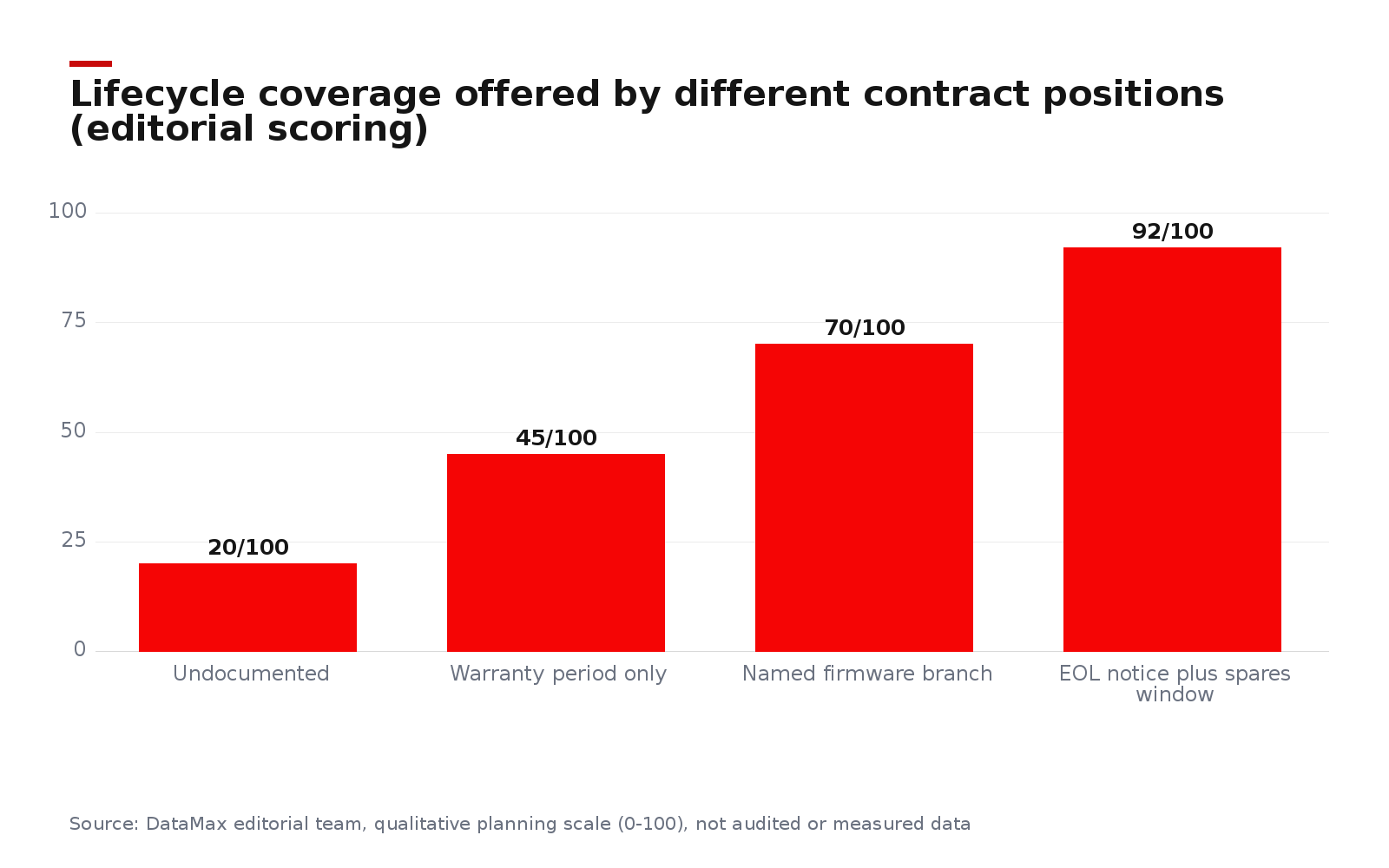
The same figures, in searchable form:
| Contract position | Editorial score |
|---|---|
| Undocumented | 20/100 |
| Warranty period only | 45/100 |
| Named firmware branch | 70/100 |
| EOL notice plus spares window | 92/100 |
Lifecycle coverage belongs in the commercial comparison because the hardware table cannot answer who will maintain the installed base. A 92/100 position represents EOL notice plus a spares window, while 70/100 identifies a named firmware branch. These are planning scores, not measured performance, and contract language must provide the actual obligations.
Where the terminology comes from
The phrase android tv box spans several categories that should not be collapsed during an RFQ. AOSP Android 11 or AOSP Android 14 identifies the operating-system basis in the product record. GMS-certified AOSP identifies a Google certification route for a non-Google-TV device. Those are different procurement objects: one is an OS configuration; the other includes certification and distribution conditions.
The first layer is the silicon and media pipeline. The listed SoCs define the platform baseline, while codec support defines admissible stream classes. AV1, VP9, H.265, H.264, AVS3, and H.266/VVC are not interchangeable in a channel plan. A stream must be encoded, packaged, delivered, decrypted, decoded, and rendered within one capability chain. Request the exact codec profile and resolution assumptions rather than relying on “4K ready.”
For a live IPTV channel, the acceptance profile can identify source codec, resolution, frame rate, output path, and protected-content mode. For OTT, it can include adaptive-bitrate switching and recovery after network interruption. Successful playback of one test file does not establish support for the full channel plan.
The second layer is content protection. Widevine L1 and PlayReady support are separate commercial and certification dependencies. HDCP 2.2 is optional for DM21P and must be specified if the distribution design requires it. Align device DRM capability with the licence server, account model, and studio agreement; device support alone does not create a complete content-protection chain.
The third layer is distribution. RJ45 100M, RJ45 100M with 1G optional, and Wi-Fi6 impose different installation constraints. Map traffic through the access network, Wi-Fi policy, multicast gateway, or OTT delivery platform. The box cannot compensate for an undersized upstream or an untested multicast design.
The fourth consideration is the update path. AOSP identifies the source basis, while a firmware branch identifies the operator’s managed software baseline. Specify branch name, OTA mechanism, staged rollout rule, rollback behavior, and recovery image. Without them, “AOSP Android 11” or “AOSP Android 14” is a descriptor, not a maintenance plan.
The fifth layer is service identity. Operator middleware commonly depends on device registration, entitlement, provisioning, and remote diagnostics. Evaluate those functions with the actual middleware and backend, not the OS label. Provision a sample through the intended workflow so identity, entitlement, update, and recovery are tested as one chain.
The sixth layer is physical installation. HDMI, USB, S/PDIF, AV, RJ45, Wi-Fi6, BT5.4, TF, and power differ across models. A venue integrator may require a specific AV output, wired network, or peripheral, but the facts do not include dimensions for every model. Physical footprint, mounting, thermal limits, and cable reach must be confirmed against the production datasheet.
The seventh layer is commercial application. A white-label service may require removal or replacement of preinstalled applications, a controlled boot environment, or a particular user experience. None follows automatically from AOSP. Add launcher policy, application ownership, signed-image policy, and provisioning responsibilities, then validate the complete boot sequence on an approved sample.
The eighth layer is serviceability. Distinguish a device that can be replaced from one recovered in place. Define reset, firmware reapplication, diagnostic log collection, and replacement-unit identity. These backend and process requirements determine whether an android tv box becomes a managed endpoint or a recurring field-service burden.
Terminology trap
An AOSP box and a GMS-certified AOSP box are not equivalent for an operator. If the channel requires Google distribution, certification, or a specific application dependency, put the requirement in the RFQ and demand the exact certification route for the ordered configuration.
The comparison buyers actually make
Buyers make three comparisons: operator fit against retail fit, current hardware against lifecycle commitment, and included configuration against change-control cost. The first prevents platform substitution. The second prevents low hardware cost from creating high replacement cost. The third prevents optional features disappearing between quotation, purchase order, and delivery.
| Option | Operator fit | Software constraint | Interface consequence | Commercial question |
|---|---|---|---|---|
| DM21P | Direct fit for IPTV and operator middleware | AOSP Android 11 | RJ45 100M; HDMI 2.0b x1 | Are optional DRM and HDCP configurations included? |
| DM21RTD | Direct fit where GMS-certified AOSP is required | GMS-certified AOSP | Confirm against the production datasheet | Which certification and distribution conditions attach? |
| DM21S | Direct fit for IPTV/OTT white-label work | AOSP Android 14 | RJ45 100M; 1G optional | Which storage, Ethernet, DRM, and audio options are frozen? |
| DM21T | Premium UHD and cloud-gaming orientation | AOSP Android 14 | RJ45 100M; 1G optional; no HDMI input | Does the workload justify configuration and lifecycle scope? |
Lifecycle quotations diverge around four artefacts: firmware branch definition, update-policy commitment, EOL notification commitment, and spare-parts window. A single “support included” statement cannot substitute for those records. A named branch without notification or spare-parts terms still leaves the refresh milestone partly undefined.
The 20/100 score for an undocumented position means the operator cannot plan an update or replacement milestone from the commercial file. The 45/100 position adds a service boundary but leaves software dependency unresolved. The 70/100 position provides a named branch, while 92/100 adds advance notice and a spares interval. These are editorial planning scores, not service-level statistics.
Configuration control is the second bill of differences. For DM21P, resolve memory, Widevine L1, PlayReady, and HDCP 2.2. For DM21S, resolve memory, 1G Ethernet, Widevine L1, PlayReady, Dolby Vision, and DTS. For DM21T, resolve the family option, 1G Ethernet, Widevine L1, and PlayReady. The option list is not a purchase-order line.
Implementation effort is a third comparison. AOSP Android 11 and AOSP Android 14 are separate software baselines, while GMS-certified AOSP adds certification and distribution conditions. Compare middleware support, image-building responsibility, update method, and recovery path rather than assuming a newer label reduces integration work.
Media workload is a fourth comparison. DM21P lists AV1 [email protected], VP9 and H.265 at 4K@60, and H.264 at 4K@30. DM21S lists AV1 and H.265 [email protected] at 4K@60. DM21T lists H.266/VVC [email protected], AV1, VP9, H.265, and AVS3 at 4K@120, plus H.264 at 4K@60. These are acceptance envelopes, not one marketing tier.
Network and peripheral fit is a fifth comparison. DM21P provides RJ45 100M, two USB2.0 ports, Wi-Fi6 2x2, and BT5.4. DM21S adds optional 1G Ethernet while retaining two USB2.0 ports. DM21T has one USB2.0, one USB3.0, optional 1G Ethernet, Wi-Fi6, and BT5.4. Map each difference to a service or installation need; otherwise the comparison records features without establishing value.
Buyer situations, ranked by what they punish
A small operator does not evaluate every deployment identically. The primary variable is the failure it cannot absorb. A rural access network punishes weak Ethernet assumptions. A shared hospitality network punishes Wi-Fi contention and device-control ambiguity. Live IPTV punishes decoder, DRM, and update failures. Cloud gaming punishes latency, port, and decode gaps.
| Situation | Primary requirement | Model direction | Failure that must be controlled |
|---|---|---|---|
| Small regional IPTV operator | Operator middleware with controlled updates | DM21P baseline; DM21RTD if the specified GMS route is mandatory | Firmware drift and incomplete DRM configuration |
| IPTV/OTT white-label launch | 4K service, white-label control, flexible interfaces | DM21S | Accreted options changing the delivered BOM |
| Hospitality or integrator deployment | Predictable AV, network, and recovery interfaces | DM21S or DM21T according to service tier | HDMI and Ethernet assumptions differing from installation |
| Premium UHD or cloud-gaming service | Higher-rate decode workloads and premium positioning | DM21T | Unrealistic 8K expectations conflicting with the 4K datasheet |
Operator stability should be the primary priority. A service deployed, activated, updated, diagnosed, and recovered across a distributed installed base must be evaluated as a system. The set-top box is one endpoint, but procurement consequences extend into middleware, conditional access, DRM, CDN or multicast delivery, and remote monitoring.
For a regional operator, test a representative channel set rather than a generic sample. Include the selected 100M or optional 1G path, required DRM configuration, restart behavior, entitlement failure handling, and OTA staging. This reveals whether the endpoint fits the operating process or only the bench test.
An integrator’s priority is installation repeatability. Port names, physical arrangement, power requirements, network speed, and recovery method must remain stable across batches. This is where an android tv box specification becomes useful only if it distinguishes required interfaces from optional ones. A generic port list does not prove repeatable deployment without site-specific rework.
A hotel or serviced residence punishes installation variation above peak decode capacity. Contractors must connect the same leads, identify the same indicators, recover through a documented procedure, and replace units without recalibrating the service. The RFQ should identify the exact HDMI output, Ethernet path, audio route, and update method.
A venue operator may prioritize compactness, but the supplied facts do not state physical dimensions. Do not request a quotation based on an assumed footprint. Confirm dimensions against the production datasheet and the enclosure or mounting requirements. The same rule applies to power, thermal behavior, and wall-mount arrangements.
A distributor may carry several models but still need one operational process. The risk is a catalogue permitting multiple memory, DRM, and Ethernet configurations without clear serial-level records. Give each shipped variant a configuration identifier and separate approved samples, operator batches, and retail stock.
A managed-hotel operator may punish unauthenticated local control more than decode capacity. Test device identity, entitlement recovery, factory-reset behavior, and remote diagnostics. This makes the android tv box a managed endpoint rather than an isolated appliance and shifts selection toward the platform whose provisioning route matches the back office.
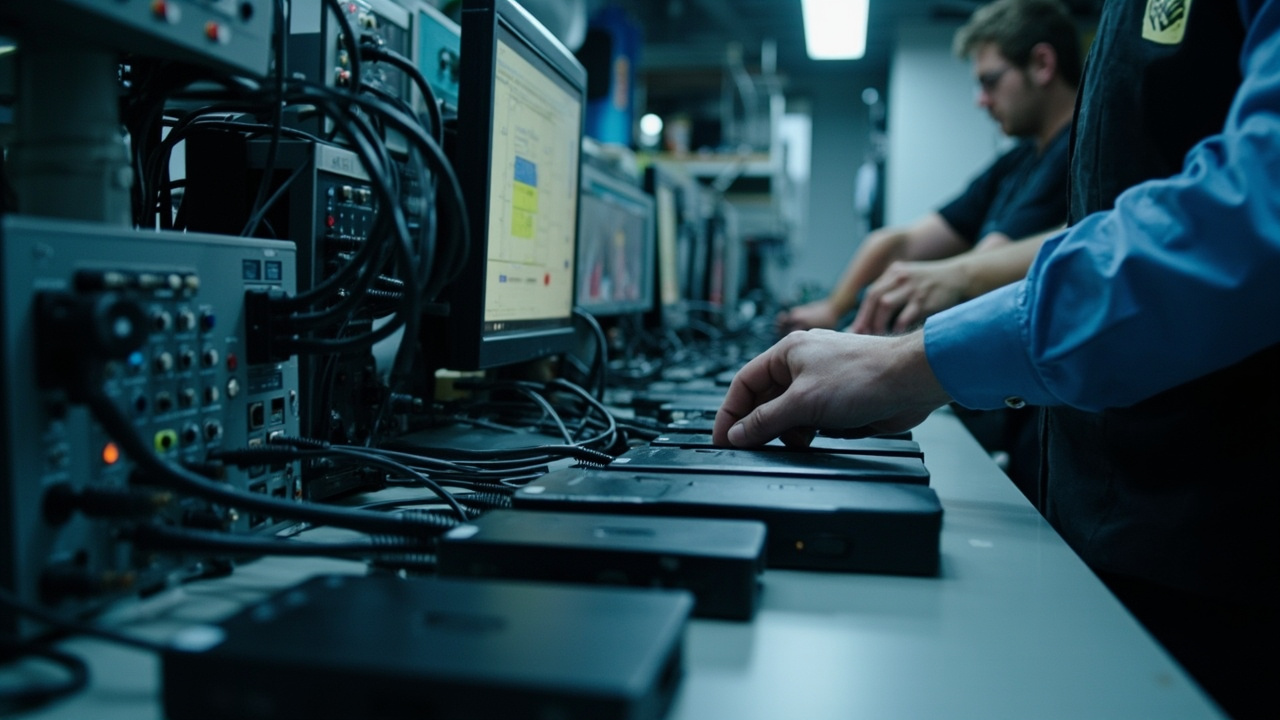
The scene represents the useful test environment: multiple devices, HDMI and network paths, measurement equipment, and repeatable engineering intervention. It is not evidence of DataMax laboratory capacity. Ask for actual records tied to the ordered configuration.
Failure modes that reach the field
Configuration drift is the first field failure. A quotation may list Widevine L1, PlayReady, HDCP 2.2, 1G Ethernet, Dolby Vision, DTS, storage, or an OS branch as “optional.” If the purchase order does not identify the selection, receiving inspection cannot distinguish an intentional variant from an omitted feature. Give each option a part number, quantity, and acceptance criterion.
A mismatch can remain invisible until a protected stream launches, an installer needs 1G, or support cannot reproduce the fault. The operator may then flash firmware, reissue entitlement, reorder hardware, or dispatch technicians. Traceability prevents these costs by linking each unit to one accepted build.
Field trap
A line that merely says “optional” creates a receiving dispute. If the service requires 1G Ethernet, write the selected speed into the order and require it in inspection evidence. Apply the same rule to optional DRM and HDCP configurations. Discovery affects middleware provisioning, entitlement, and field logistics, not only replacement hardware.
The second failure is 8K wording. Some marketing language associates a premium box with 8K, but DM21T production facts cap output and decode at 4K. RFQs, channel plans, packaging, and operator documentation must use the 4K ceiling. A stream above that boundary is not a factory option unless separately validated and documented.
The third failure is certification mismatch. “AOSP Android 14” and “GMS-certified AOSP” are not interchangeable. Confirm the certification status of the exact SKU, build, and application-distribution route. Widevine L1 or PlayReady naming likewise does not replace the operator’s licence-server and account arrangements.
The fourth failure is lifecycle ambiguity. A warranty period can end while the firmware branch remains active, or coincide with an EOL notice the operator never received. Missing EOL notification or a spares window can turn routine hardware refresh into emergency replacement, especially where engineering resources are limited.
The fifth failure is port interpretation. DM21T has HDMI 2.0b output and no HDMI input. DM21P has one HDMI 2.0b output. RJ45 is 100M on DM21P, while 1G is optional on DM21S and DM21T. These differences alter network plans, capture equipment, and venue integration.
The sixth failure is accepting an unsupported physical assumption. The records list interfaces and, for DM21P, DC 5V/2A. They do not supply a complete installation-envelope description. Do not infer dimensions, mounting provisions, thermal limits, or remote-control behavior from a product name. Close those omissions against the production datasheet before site approval.
The seventh failure is testing only a successful boot. The field device must prove network association, entitlement handling, protected playback, output, restart, update, and recovery under the agreed profile. A golden sample establishes a reference configuration, but repeated unit testing controls variation across the shipment.
The eighth failure is confusing a representative sample with production equivalence. The sample may carry the required memory, DRM, Ethernet, and firmware while production uses defaults. Require the sample identifier to match the released build and link it to serial-level test records. This converts the phrase android tv box from a catalogue description into an auditable delivery object.
Quotation trap
A model name alone does not identify the deliverable configuration. Require the SKU, OS branch, memory selection, DRM selection, Ethernet speed, codec entitlement, power variant, and lifecycle terms in one frozen configuration record.
The selection sequence that removes rework
The selection process should move from service requirement to model, then to frozen configuration, and finally to acceptance evidence. This sequence prevents a preferred chipset from dictating a service design it cannot support.
- Define the service boundary Record video codecs, maximum resolution, frame rate, HDR or audio requirements, DRM obligations, content source, network access, and recovery procedure.
- Select the platform family Choose DM21P for the stated IPTV or operator-middleware fit; DM21RTD for the stated GMS-certified AOSP requirement; DM21S for 4K IPTV/OTT white-label work; DM21T for premium UHD or cloud-gaming work.
- Freeze the build Record the SoC, OS, RAM/ROM, optional Ethernet speed, DRM set, HDCP requirement, codec entitlement, and port configuration in the purchase order.
- Define lifecycle evidence Require a named firmware branch, update mechanism, EOL notification commitment, and spare-parts window suitable for the deployment plan.
- Approve the test protocol Define representative channel profiles, network conditions, HDMI checks, boot and recovery checks, and the evidence package required before shipment approval.
- Release production Tie the purchase order, approved golden sample, configuration record, test report, and serial traceability into one shipment file.
The RFQ can use paste-ready lines: “Model and SoC: [selected DataMax model] with [stated SoC]. OS: [stated OS]. Memory: [selected configuration]. Video: [approved codec and resolution profile]. DRM: [named requirement, optional status resolved]. Ethernet: [selected speed]. Ports: [required interfaces]. Firmware branch: [identifier]. Update mechanism: [requirement]. EOL notice: [commitment]. Spares window: [requirement]. Acceptance evidence: [tests and report format].”
Do not substitute a model name for a build identifier. “DM21S, 2GB / 16GB, AOSP Android 14, RJ45 100M” is a more useful starting line than “DM21S.” If 1G Ethernet is required, the purchase order must say so. If DRM is optional, the order must identify whether the selected configuration includes it.
Add a middleware row stating provisioning method, entitlement interface, diagnostic access, update route, and recovery behavior. This closes the gap between an endpoint specification and an operable service. Remote support also needs a failure-code or log-retention procedure if the endpoint cannot expose enough diagnostic information.
Add an acceptance row for each service class. A regional IPTV batch, white-label OTT batch, and premium UHD batch should not inherit one generic test sheet if decode, DRM, network, or port requirements differ. Identify channel profile, duration, network condition, expected output, recovery criterion, and evidence location.
Add a field-responsibility row. State who installs, registers, applies entitlement, receives diagnostics, replaces failed units, and approves firmware rollout. A service expecting technician-side recovery needs a documented reset procedure; unattended replacement needs reliable identity transfer.
The first message in an RFQ to the DataMax engineering team should contain the service profile, candidate model, required options, permitted target quantity information, destination, and expected evidence format. For evaluation, the sample request should identify the exact configuration rather than request a generic unit.
AOSP versus Google Android TV helps determine whether the required certification route matches the operator use case. It cannot replace the production datasheet for the selected SKU.
A one-page RFQ can be decision-grade when each field has an owner and evidence route. The operator states the service, DataMax maps it to a documented platform and configuration, and the approval record returns a frozen SKU. Anything still marked optional or “confirm” remains outside the approved build.
How the factory controls the variable
Factory control begins with a controlled bill of materials and ends with a traceable shipment record. The variable is not merely the android tv box hardware. It is the combined hardware, firmware, configuration, test result, and lifecycle document delivered to the operator.
- Material and SMT control Match components and firmware inputs to the approved configuration; prevent substitutions from changing an unrequested option.
- AOI and assembly inspection Inspect surface-mount workmanship and assembly conditions under the approved process, recording exceptions and dispositions before functional testing.
- Functional and interface testing Verify HDMI output, USB, TF, S/PDIF, AV, RJ45 speed, Wi-Fi6 and BT5.4 as applicable, plus boot and recovery behavior.
- Media and DRM verification Exercise approved codec, resolution, frame-rate, Widevine L1, PlayReady, HDCP, Dolby Vision, and DTS paths only where included.
- Aging and burn-in Apply the approved stress profile to expose thermal, stability, network, and early-life failures before shipment approval.
- Dark-room and visual control Inspect screen output under defined dark-room conditions so intended rendering is distinguished from unit-level defects.
- Audit and evidence closure Reconcile serial identifiers, golden sample, firmware branch, configuration, test results, exceptions, and shipment disposition.
Factory evidence should be a structured set: approved configuration record, firmware identification, production test report, ageing result, visual-inspection result, exception log, and serial-to-shipment traceability. A declaration that testing occurred is less useful than a report defining method, sample coverage, pass criterion, and disposition.
The process should map directly to the contract. A required 1G configuration needs an acceptance result for that speed. A selected DRM set needs a traceable test record. A required codec profile needs a representative media check. An update route needs verification against the named branch, not merely proof that the device boots.
SMT and AOI control protect the hardware build, but they do not prove the commercial configuration. The line inspector must also verify that the material record, firmware load, and option fields match the approved SKU. A well-assembled unit with the wrong Ethernet variant is the wrong deliverable.
Aging and burn-in provide time under an approved stress profile. Criteria should cover relevant workload such as continuous media playback, network association, output stability, and repeated boot or recovery. The report should identify duration, sample coverage, environmental conditions, exceptions, and retest disposition.
Dark-room visual inspection separates intended screen output from defects such as unintended lines, dark areas, or unstable rendering. Use the agreed content, display, viewing conditions, and pass criterion. Where Dolby Vision or another display feature is included, verification belongs in the frozen configuration rather than an assumed general test.
An audit examines configuration discipline: what was ordered, assembled, tested, and shipped. A mismatch among those records is a process defect even if the device works in the laboratory. For small operators, that discipline reduces variation across a rollout and speeds replacement analysis.
DataMax presents this as an auditable factory process rather than a generic quality claim. Inspect the actual DataMax factory-quality process, applicable certification evidence, and compliance information for the selected programme. Scope such as custom development must be tied to a written requirement.
Map each release gate to a named document: approved BOM, configuration sheet, firmware identifier, golden-sample approval, test protocol, production report, exception disposition, and serial traceability. The operator can then distinguish a repeatable product from a collection of individually working units.
An android tv box shipment is controlled when the receiving team can reproduce the accepted configuration from records. The equipment identifier, firmware image, selected options, test results, and exception disposition must tell the same story. For a small cable operator, that evidence chain reduces field troubleshooting, replacement disputes, and unmanaged variation across successive orders.
Further reading
- Guide android tv box for isps
- AV1 Android TV box guide
- AOSP vs Google TV guide
- HDR10+ Android TV box guide
- DTS:X Android TV box guide
- DataMax DM21P specifications and fit
- DataMax DM21RTD specifications and fit
FAQ
Is DM21P the right starting point for a small cable operator?
DM21P is the direct starting point when the requirement is an IPTV or operator middleware set-top box, because that use case is stated in its product record. Confirm the AOSP Android 11 configuration, 2GB / 8GB or selected memory option, 100M Ethernet, codec profile, and optional DRM requirements. It should not be selected solely because it appears early in a catalogue.
When should an operator choose the GMS-certified model?
Choose DM21RTD when the operator specifically requires a Google-certified non-Google-TV AOSP+GMS configuration. Do not assume another AOSP model inherits the same certification. Identify the exact certification route, software baseline, and distribution conditions in the RFQ, while memory, detailed codecs, DRM, and ports remain subject to confirmation against the production datasheet.
Does DM21T support 8K output?
The supplied DM21T production facts specify output and decode capability up to 4K. Its published decode list includes H.266/VVC [email protected] 4K@120, AV1, VP9, and H.265 at 4K@120, with AVS3 at 4K@120 and H.264 at 4K@60. Any 8K requirement is outside the confirmed configuration and requires separate validation.
Which model fits IPTV and OTT white-label work?
DM21S is documented for the 4K IPTV/OTT white-label position. Its stated configuration includes AOSP Android 14, 2GB / 16GB, AV1 and H.265 [email protected] 4K@60, 100M Ethernet with 1G optional, and optional Widevine L1, PlayReady, Dolby Vision, and DTS. Resolve every optional field in the frozen build before deployment approval.
What lifecycle evidence should a small operator request?
Request a named firmware branch, update mechanism, EOL notification commitment, and spare-parts window. Also require the exact configuration, test evidence, and serial traceability. A warranty statement alone does not answer how long the installed base can be maintained or when a replacement programme must begin.
What should the first RFQ message contain?
State the operator use case, candidate DataMax model, OS expectation, memory selection, codec profile, DRM and HDCP requirements, Ethernet speed, required ports, deployment information, destination, and test evidence. If samples are requested, identify the exact configuration and ask for its configuration sheet alongside the unit.


