

Before the terminology: the decision
An RFQ arrives with a 4K operator bundle, a white-label launcher, and three rows of “8K” claims. The purchasing team needs more than a supplier name: it needs a manufacturer that can show which platform fits, how configuration is controlled, and what evidence connects the quoted specification to shipped hardware. A trading company can arrange supply, but it may not own the production line, firmware baseline, test process, or change-control decisions that determine whether 5,000 or 50,000 units behave consistently.
The short answer is to treat the manufacturer as a system of accountability rather than a label. Require four linked records: an approved product specification, a controlled bill of materials and firmware branch, a factory inspection and test plan, and a shipment acceptance record linked to the production lot. Then match the platform to the workload: IPTV middleware, white-label OTT, premium cloud gaming, or general Android TV use. This is the specific angle of the broader TV box vendor selection checklist; the checklist covers the supplier landscape, while this page focuses on what must be provable when the manufacturer is making the device.
Four distinctions prevent early RFQ drift. First, OEM controls a customer-specified product, while ODM supplies a configurable product platform. Second, a quoted SKU is not the same as a validated production configuration. Third, DRM labels describe licence-service support, not operator entitlement integration. Fourth, “4K” is incomplete unless output resolution, refresh rate, codec profile, and content path are stated. DataMax product facts are used only as platform examples; confirm every shipping revision against the production datasheet. A procurement team that demands this evidence before comparing commercial terms can prevent a technically attractive quotation from becoming an operationally weak program.
A practical first screen asks who owns the approved specification, who may approve a component substitution, who signs the firmware image, who releases a production lot, and who receives a field-failure report. If those answers point to several unrelated parties without a named integration owner, the programme has an accountability gap before the first sample is built. The manufacturer may be the direct producer, an ODM platform owner, or a factory working to an OEM brief; the commercial title matters less than the documented control boundary.
For a programme review, request three artefacts before opening detailed technical comparisons: a sample SKU cross-reference, a proposed evidence index, and a named configuration owner. A sample alone can demonstrate fit, but it cannot demonstrate repeatability. The evidence index should reveal whether the proposed manufacturer can connect requirements to inspection records and shipment release. If the index contains only certificates or photographs, request the lot-level records that explain failed-unit disposition and engineering-change approval.
Deployment scenarios and the spec each needs
An operator, an AV integrator, and a venue operator can all describe the device as an “OTT streaming device,” yet their acceptance tests differ. The procurement question is therefore not simply which manufacturer offers the lowest unit cost. It is which controlled platform and production route can satisfy the actual content, network, update, and recovery requirements.
| Situation | Primary requirement | Specification direction | Model direction |
|---|---|---|---|
| IPTV operator | Operator middleware, entitlement integration, managed updates, stable Ethernet path | Native operator image; middleware and DRM acceptance test; 4K codec support; recovery policy | DM21P as the operator set-top-box reference; confirm middleware port against the production datasheet |
| OTT brand or white-label buyer | Launcher branding, regional apps, Android compatibility, flexible configuration | Controlled Android build; GMS or EDLA position stated separately; storage and app-impacting RAM requirements | DM21S as the 4K Android TV white-label reference |
| Premium UHD or cloud-gaming program | High-frame-rate 4K path, latency-sensitive behavior, thermal stability | Exact 4K mode, frame rate, codec, bandwidth, and HDMI configuration; no unsupported resolution claims | DM21T as the high-frame-rate UHD reference; validate workload-specific performance |
| Gaming-oriented Android TV | 4K gaming output, game-optimized platform, Wi-Fi and peripheral readiness | 4K@60 path, controller and storage requirements, network fallback, sustained thermal test | DM22Q as the gaming-oriented reference; confirm the selected memory option |
| Hospitality or signage integrator | Managed deployment, remote recovery, peripheral integration | Android Management or operator update method; USB, AV, Ethernet, and recovery requirements | Select by port and management needs; confirm against the production datasheet |
For a national IPTV rollout, the decisive line may be the operator middleware image, not the processor family. A device integrator may prioritize USB, AV, and managed recovery over a gaming-oriented platform. A cloud-gaming distributor needs sustained frame delivery and a defined network fallback, because a peak codec capability does not prove end-to-end performance. A venue buyer may need recovery after power loss and unattended peripheral operation.
The manufacturer should translate each scenario into a testable acceptance matrix. For DM21P, the stated fit includes operator middleware and 4K IPTV. For DM21S, it is a 4K Android TV platform for IPTV/OTT white-label use. DM21T is positioned for premium UHD and cloud gaming, while DM22Q is gaming-oriented. Those fit statements are not substitutes for a workload test. Ask how the device handles installation, upgrade, rollback, boot failure, network loss, and recovery after power interruption. Confirm against the production datasheet.
The network path also changes by site. An operator warehouse may receive devices through wired Ethernet and install them through a controlled provisioning tool; a hotel may require a captive-portal workflow, local content fallback, and recovery without a technician. A broadcaster may need S/PDIF or AV integration for secondary displays. Instead of treating these as optional port benefits, list the external system, the expected connection, the authentication method, and the recovery procedure. That gives the manufacturer a concrete integration statement to accept or reject.
For commercial displays, add a power-loss test. Cycle the device during application installation, firmware update, launcher registration, and local playback. Repeat with the target remote, display, network, and peripheral set. Record whether the unit returns to an expected state or requires a reset command. This test exposes interactions that a laboratory codec demonstration does not cover and allows the buyer to state the permitted recovery mechanism in the acceptance document.
Procurement move: ask each candidate to attach one acceptance-test row per deployment. A generic “supports 4K” statement is not a deployment requirement; a decoder mode, output mode, input profile, and recovery result are.
Turning the question into a spec line
A useful RFQ converts the title question into controlled statements. Begin with the workload, then separate platform capability, production configuration, and evidence. This prevents a manufacturer from substituting a nearby model without revealing the change.
- Define the platform boundary State the operating scenario, customer identity, launcher or middleware, target market, certification obligations, expected lifecycle, and whether the source is operator-managed or consumer-updatable.
- Specify output and media Name the maximum output mode, refresh rate, required codecs, HDR or DRM expectation, and whether HDMI input exists. Separate content decoding from output capability.
- Fix the memory and connectivity baseline Write the exact RAM/ROM option, Ethernet speed, Wi-Fi configuration, Bluetooth version, port inventory, and required accessories. Do not rely on “family options.”
- Attach software obligations Define the OS baseline, AOSP or certified build status, GMS/EDLA requirement, OTA or Android Management responsibility, middleware image, and update ownership.
- Request production evidence Identify the factory line, SMT and AOI records, aging procedure, dark-room or output verification, firmware flashing record, packing evidence, and lot traceability.
- Convert acceptance into measurable rows Require pass criteria for boot, output mode, codec playback, network recovery, USB enumeration, remote update, reset, and final packing inspection.
The resulting specification line should be pasteable without interpretation. Instead of “4K Android box with strong Wi-Fi,” write: “AOSP Android 14, 4GB RAM/64GB storage, H.265 [email protected] 4K@60, HDMI 2.0b output, RJ45 100M with 1G optional, Wi-Fi6 2x2, BT5.4, and the exact SKU under quotation.” This gives the RFQ reviewer a baseline against which a change notice can be judged.
Software requires equal precision. “DRM ready” does not establish whether the device carries Widevine L1, PlayReady, or HDCP 2.2; whether the service is a production licence; or whether the operator middleware has completed entitlement-flow testing. The manufacturer should identify the software baseline, signing chain, build responsibility, and security-patch process. If Google services are required, state the certification route separately rather than implying that AOSP automatically includes them.
A compact ownership flow prevents ambiguous answers:
requirement baseline
engineering review
and golden sample
and lot evidence
and shipment
The golden sample matters because it converts ambiguous catalogue language into an inspected reference unit. It should carry the exact production firmware, approved accessories, packaging, labels, and configuration identifiers. The manufacturer then owns configuration drift and must document any substitution.
Make the specification line usable by three functions. Engineering needs a platform and interface baseline; procurement needs an exact configuration code; quality needs a binary pass criterion. For example: “DM22Q platform direction; 4GB/64GB; AV1 and H.265 L5.1 4K@60; HDMI 2.0b output; no claimed 8K output; one USB2.0 port; two USB2.0 ports; RJ45 100M; the 1G option is not included unless written in the release.” That wording prevents optional features from becoming assumed deliverables.
Add a change-control clause. It should state that substitutions affecting the SoC, RAM/ROM, Wi-Fi module, Ethernet controller, storage, firmware baseline, DRM path, port set, power supply, or enclosure require written approval. It should also define who validates a replacement part and whether existing test records remain valid. Without this clause, a seemingly equivalent component can alter power, thermal, radio, boot, or update behavior after the golden sample has been approved.
Where quotations quietly diverge
Most quotation errors begin with a small difference that remains invisible until deployment. A buyer compares headline lines while the manufacturer has changed storage, network hardware, firmware branch, certification status, or test depth. The commercial gap then becomes an integration, compliance, or field-service gap.
| Ambiguous quotation | What may differ | Required clarification | Operational consequence |
|---|---|---|---|
| “4K streaming” | 4K@30 versus 4K@60; codec profile; output and decode limits | State mode, refresh rate, codec, profile, HDR path, and tested source | Playback, frame pacing, or compliance mismatch |
| “DRM supported” | Widevine L1 versus PlayReady; HDCP version; service configuration | Name the service, security level, optional status, and integration test | Entitlement failures on target content |
| “Same platform” | SoC, RAM/ROM, ports, cooling, Wi-Fi module, and firmware | Require a signed SKU/BOM/firmware cross-reference | Thermal, networking, or lifecycle risk |
| “Android TV box” | AOSP build, EDLA certification, GMS position, launcher responsibilities | State build basis, certification, app access, and OTA ownership | Store, update, and service restrictions |
| “OEM/ODM” | Actual ownership of industrial design, software, sourcing, and production control | Map each deliverable to a named owner | Change requests and escalation gaps |
A third divergence often sits in the power and thermal specification. A 4K-capable platform can be constrained by the power adapter, ventilation path, ambient temperature, or continuous workload. If the quotation states only processor capability, the buyer has no basis for comparing the thermal margin of two proposals. Request the exact power-supply rating, the display and network workload, the ambient condition, and the duration of the sustained test. Where no endurance evidence exists, record that limitation rather than treating the decode list as a performance guarantee.
Software localization creates another mismatch. A launcher can be simple to brand, but regional app access, account policy, update channels, screen certification, and middleware provisioning may be constrained by the underlying build. The manufacturer must identify the image used in the golden sample and the image proposed for production. A storefront image used for evaluation should not be mistaken for the operator image, and an AOSP baseline should not be described as equivalent to a certified commercial Android TV build.
Field trap 1
A decorative product name may carry an “8K” label while the production datasheet caps output and decode at 4K. For the DataMax DM21T, the stated maximum modes are 4K@120 for the listed codecs; do not treat marketing terminology as a technical acceptance criterion. The **manufacturer** must provide the datasheet-backed mode and test method.
Field trap 2
A quotation that lists “Wi-Fi6” but omits spatial streams, module identity, antenna choice, and regional radio configuration may not reproduce the same RF behavior in the final enclosure. Ask for the approved configuration and regulatory evidence. The cost of discovering a radio change after tooling is much higher than resolving it during RFQ review.
Thermal and storage claims create similar divergence. A processor capable of decoding 4K@120 does not establish that the enclosure sustains that mode; a high-performance platform can throttle under sustained load. Require sustained-load criteria, ambient conditions, and sample count. Likewise, an 8GB and 64GB storage option creates different app-update and cache headroom. The manufacturer should quote the selected configuration, not only the range available in a product family.
A practical discrepancy log should record every difference by field, owner, disposition, and evidence requirement. Include model, SoC, memory, ports, Ethernet speed, wireless configuration, firmware, DRM, target-market build, power supply, packaging, and accessories. Assign one person to approve each closure. This prevents a resolved storage ambiguity from reappearing when the final packing list is compared with the purchase order.
The evidence trail from SMT to shipment
The factory is where a quoted specification becomes physical evidence. A manufacturer should be able to trace a finished serial number back to the production order, material lot, firmware image, inspection result, and packing record. The evidence trail does not need to be a large document set if each record has a clear owner and lot identifier.

- Incoming material control Record approved part numbers, supplier status, lot identifiers, date codes, and inspection results for components and modules. Flag substitutions before they enter the line.
- SMT and AOI Preserve stencil, placement, reflow, AOI, and repair records under the production lot. A visual inspection record only has value if it references the approved BOM revision.
- Assembly and firmware loading Capture board revision, image identifier, flashing result, and failed-unit disposition. Keep the approved golden unit and recovery procedure available.
- Aging and functional verification Document the burn-in duration, environmental condition, and tested functions. Use an appropriate dark-room or output-verification procedure where the output path is a required acceptance item.
- Final inspection and packing Check the exact SKU, accessories, labels, ports, firmware version, and carton contents against the release packet. Record exceptions before dispatch.
- Lot release and shipment Bind accepted output to the production order, test summary, packing list, and shipment identifier. Preserve retention samples and non-conformance records for the agreed period.
The first record boundary is incoming material inspection. For a Wi-Fi module, Ethernet controller, storage device, or memory configuration, the receiving record should identify what was approved and what was physically received. The second boundary is board revision: a test report tied to one board revision must not silently cover another. The third boundary is firmware: record the image identifier and flashing result so a unit cannot be released with an untracked build.
Functional testing should be specified separately from AOI. AOI detects visible assembly conditions at defined points; it does not prove HDMI output, network attachment, codec playback, DRM entitlement, or update success. Likewise, aging is not a substitute for functional validation. The manufacturer should show the actual sequence, equipment or station identifier, sample coverage, failure criteria, and disposition rule. A dark-room or output-verification step is relevant when the display path is part of the acceptance criteria, but the procedure and endpoints must be visible.
A defensible review packet contains the approved specification, BOM and software revision, golden-sample report, SMT/AOI summary, aging record, functional test report, line audit, and shipment release note. Ask the **manufacturer** for a sample lot first and verify that its identifiers connect the same records. Request factory evidence or arrange a video factory audit before committing a volume program.
The review should test traceability, not merely the presence of a PDF. Choose a serial number and ask which lot, image, test record, and packing record refer to it. Ask how an unauthorized IC, module, or storage component would be detected and recorded. Review what happens after a failed unit: quarantine, diagnosis, repair authorization, retest, and final disposition. A controlled manufacturer makes those actions visible.
For a buyer without an on-site audit, request dated photographs or video of the relevant line, operator work instructions, inspection equipment records, and a redacted example packet. Live video alone does not prove production history, but it enables comparison with the documentary trail. The key is consistency: the line shown should match the process codes in the records, and the test steps should match the acceptance specification.
Introduce a traceability drill during the review. Pick one unit from the proposed sample lot, one deliberately identified non-conforming unit if available, and one finished unit. Ask the manufacturer to reconstruct the route from goods receipt to final release without moving to a generic summary. The exercise should reveal who signs repairs, how a reworked board is re-tested, and whether a unit with a different memory option could enter the same carton configuration.
Options placed side by side
Sourcing routes can look similar in a quotation while providing very different control. The useful comparison is not a generic OEM-versus-ODM label; it is ownership of the specification, engineering changes, production control, and evidence package. A sourcing agent may coordinate commercially. A component distributor may offer supply continuity. A factory-type OEM controls production against a customer-defined design. A factory-type ODM contributes a configurable product platform.
| Route | Typical control boundary | Evidence to request | Best fit | Main buyer risk |
|---|---|---|---|---|
| Sourcing agent | Commercial coordination and supplier management | Named factory, approved specification, authorization path, shipment records | Buyers needing supplier orchestration without direct factory administration | Accountability may be distributed across intermediaries |
| Component distributor | Material supply and inventory coordination | Part traceability, authorized channel records, configuration and packing control | Continuity-led programs with controlled component demand | Finished-product responsibility may be limited |
| Factory-type OEM | Production execution against the customer’s defined product | BOM, routing, firmware, SMT/AOI, aging, functional test, and lot release | Operators with a mature specification and middleware | Design changes can require formal engineering-control effort |
| Factory-type ODM | Configurable platform with engineering and production contribution | Platform options, validated SKUs, customization limits, release records, test evidence | Brands and integrators seeking a faster configurable baseline | Platform boundaries and variation must be managed explicitly |
A second comparison should use programme maturity. A new OTT brand with limited middleware ownership benefits from an ODM baseline because the platform team can supply an established configuration, but the buyer must define the non-negotiable parts of the product. A national operator with a mature device contract has a different requirement: it may need controlled changes, multi-lot consistency, and a stable firmware maintenance path. The manufacturer selection follows from that operating model, not from the label preferred in the supplier’s presentation.
The chart below provides an editorial comparison of how readily each route can trace a failure through its control chain. It is a qualitative planning scale, not audited or measured data.
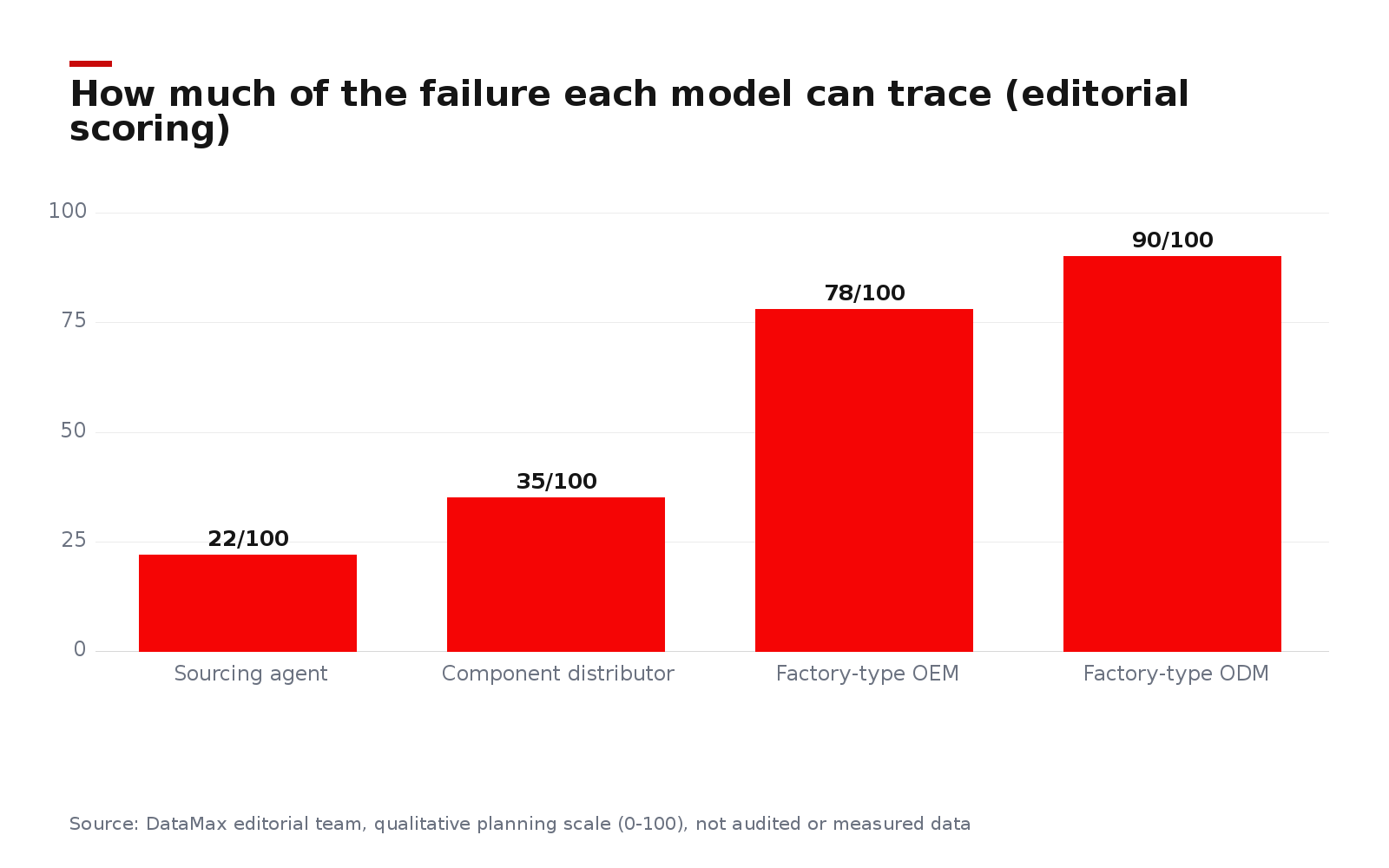
The same figures, in searchable form:
| Model | Editorial score |
|---|---|
| Sourcing agent | 22/100 |
| Component distributor | 35/100 |
| Factory-type OEM | 78/100 |
| Factory-type ODM | 90/100 |
The practical distinction is access to evidence. A buyer should be able to identify where a change decision is made, who releases firmware, who accepts non-conforming output, and who authorizes a shipment. If the route lacks direct factory visibility, require transparent delegation so the evidence still reaches the buyer. The manufacturer role becomes effective when control is demonstrable, not when a marketing page uses the term.
For an agent-led arrangement, make the delegation explicit. Name the factory, identify which party owns incoming inspection, identify which party owns the functional test, and specify where the buyer receives the release packet. A component-distributor-led arrangement needs an equally clear point at which finished-device responsibility begins. These routes can still be valid, but their weaker direct control makes evidence access, approved suppliers, and escalation paths central to the commercial review.
Definitions a buyer cannot outsource
OEM and ODM labels describe broad commercial arrangements, while the underlying technical mechanisms determine deployment behavior. A buyer must understand these mechanisms enough to ask discriminating questions and verify the responses.
OEM and ODM. In an OEM arrangement, the customer defines the product and the supplier manufactures it. In an ODM arrangement, the supplier provides a configurable platform and the customer selects or modifies defined elements. Real programs combine the models. The controlling document should allocate design, component selection, firmware, certification, tooling, production test, update service, and warranty handling for each party.
AOSP and certified Android builds. AOSP is the open-source software foundation used to build Android products. A device described as running AOSP does not thereby possess Google Play, Widevine service access, Google app compatibility, or an Android TV certification. GMS and EDLA status should be stated separately, with the actual target-market configuration identified.
DRM and HDCP. Widevine L1, PlayReady, and HDCP address different layers: secure content processing, platform licensing, and protected output. Their presence does not prove operator entitlement, app compatibility, or deployment-specific playback. Ask which components are standard, which are optional, and what validation is included.
Codec decoding versus HDMI output. Decode support describes whether the SoC can process a media format. Output support describes the maximum signal sent to the display. A quotation must name both when they differ. Refresh rate also matters: “4K” can refer to multiple frame rates, and the mode must survive the complete playback path.
OTA and Android Management. OTA is a firmware delivery mechanism; Android Management provides policy-based device management. Neither term automatically defines app deployment, staged rollout, rollback, regional release, or operator middleware ownership. The manufacturer should identify the update server, signing process, target groups, failure recovery, and release evidence.
Ethernet and Wi-Fi. RJ45 100M and 1G options are different network baselines. Wi-Fi6 2x2 identifies a spatial-stream arrangement, but antenna design, enclosure, module, driver, firmware, and regional radio configuration still affect field behavior. Verify the exact approved configuration rather than the family label.
S/PDIF, AV, and display routing. These interfaces are not interchangeable in an installation. Digital audio, analogue audio-video, and HDMI output have different cable, format, and display-routing implications. A device can expose the required physical connector while still failing the intended installation because of resolution negotiation, unsupported format, or unavailable audio mode. Include the target television, sound system, cables, and supported media path in the acceptance test.
Production line terminology. SMT means placing and soldering surface-mount components on a printed circuit board. AOI means automated optical inspection, using imaging to check assembly conditions at defined inspection points. Neither mechanism verifies the complete product behaviour. Functional test, aging, and lot release provide separate evidence, and the manufacturer should explain how those records are connected to the accepted shipment.
Certification and regulatory scope. A target-market requirement may concern radio, EMC, electrical safety, environmental obligations, or platform certification. A device-level label does not substitute for the exact product variant, market, and accessory set covered by the document. The buyer should check model designations and configuration differences before applying a report to a different production SKU.
Real DataMax platforms, field by field
DataMax provides four relevant Android TV and set-top-box references. The table below reproduces only the supplied production facts; any optional path, certification requirement, packaging detail, or regulatory configuration must be confirmed against the production datasheet.
| Field | DM21P | DM21S | DM21T | DM22Q |
|---|---|---|---|---|
| Positioning | 4K IPTV / operator middleware set-top box | 4K Android TV box for IPTV/OTT white-label | Premium UHD / cloud-gaming box | Gaming-oriented Android TV box |
| SoC | Amlogic S905Y4, quad Cortex-A35 | Amlogic S905Y5, quad Cortex-A55 | Amlogic S905X5, quad Cortex-A510 (ARMv9) | Amlogic S905X5M, quad Cortex-A55 up to 2.5GHz |
| OS | AOSP Android 11 | AOSP Android 14 | AOSP Android 14 | AOSP Android 14 |
| RAM/ROM | 2GB / 8GB (4GB; 16/32/64GB optional) | 2GB / 16GB (2/4/8GB; 16/32/64GB optional) | 4GB / 64GB (family options) | 4GB / 64GB (2/4/8GB; 16/32/64GB optional) |
| Decode | AV1 [email protected], VP9/H.265 4K@60, H.264 4K@30 | AV1 / H.265 [email protected] 4K@60 | H.266/VVC [email protected] 4K@120, AV1/VP9/H.265 4K@120, AVS3 4K@120, H.264 4K@60; inline AI-SR | AV1/H.265 L5.1 4K@60; inline AI-SR (no NPU TOPS stated) |
| DRM | Widevine L1 / PlayReady / HDCP 2.2 optional | Widevine L1 / PlayReady optional; Dolby Vision/DTS | Widevine L1 / PlayReady optional | Widevine L1 / PlayReady optional; Dolby Vision/DTS |
| Ports and connectivity | HDMI 2.0b out x1, USB2.0 x2, TF, S/PDIF, 3.5mm AV, RJ45 100M, Wi-Fi6 2x2 + BT5.4, DC 5V/2A | HDMI 2.0b out, S/PDIF, AV, USB2.0 x2, TF, RJ45 100M (1G optional), Wi-Fi6 2x2 + BT5.4 | HDMI 2.0b out (no HDMI in), USB2.0 x1 + USB3.0 x1, TF, S/PDIF, AV, RJ45 100M (1G opt), Wi-Fi6 + BT5.4 | HDMI 2.0b out, USB2.0 x2, TF, S/PDIF, AV, RJ45 100M (1G opt), Wi-Fi6 2x2 + BT5.4 |
The table supports a disciplined selection rather than a single universal device. DM21P provides the explicit operator-middleware fit and an RJ45 100M baseline. DM21S provides the newer AOSP Android 14 baseline and a 2GB/16GB configuration for white-label use. DM21T lists the broadest stated high-frame-rate decode set, including 4K@120 modes and inline AI-SR, but its HDMI 2.0b output has no HDMI input. DM22Q provides a 4GB/64GB baseline with 4K@60 AV1 and H.265 L5.1 support.
Two cautions apply. First, both DM21T and DM22Q carry do-not-write cautions regarding “8K” marketing language: the stated datasheet maxima are 4K@120 for DM21T and 4K@60 for DM22Q. Do not claim 8K output. Second, an option is not an included configuration. For example, “1G optional,” “HDCP 2.2 optional,” and listed storage alternatives require an approved production SKU. The buyer should tie every quoted line to the chosen DataMax model, accessory set, software baseline, and factory release record. Start with sample ordering and an inquiry, then request the production datasheet and lot-specific evidence from the selected manufacturer.
A procurement example demonstrates how the table becomes a specification. For an operator-controlled IPTV device, select the DM21P direction and state AOSP Android 11, 2GB/8GB, RJ45 100M, HDMI 2.0b out x1, and the Widevine L1/PlayReady/HDCP 2.2 configuration approved for production. For a white-label programme using a newer Android baseline, DM21S provides the platform direction, but the selected memory, Ethernet option, DRM configuration, and launcher image still require written release. These examples do not create new product specifications; they demonstrate how supplied facts and deployment requirements can be joined.
For a cloud-gaming or premium UHD evaluation, DM21T supplies the stated 4K@120 codec directions, while the absence of HDMI input must remain visible in the requirement document. DM22Q serves the gaming-oriented direction with stated AV1/H.265 L5.1 4K@60 and inline AI-SR capability. Since no NPU TOPS figure is stated, the RFQ must not imply one. The appropriate next step is a workload sample using the target controller, display, network, game or media path, and recovery procedure.
Further reading
- Guide tv box vendor selection checklist
- Certifications and test evidence
- Amlogic Android TV boxes
- Google TV devices
- AV1 Android TV box guide
- DataMax DM21P specifications and fit
- DataMax DM21S specifications and fit
FAQ
What is an OTT streaming device manufacturer?
An OTT streaming device manufacturer produces the physical Android TV or set-top-box platform and controls some combination of hardware design, firmware, components, assembly, testing, and shipment release. A complete buyer review should identify who owns each function, especially when a sourcing agent or distributor sits between the customer and factory.
Is an OEM always better than an ODM?
No. An OEM can suit a buyer with a mature specification and controlled custom design. An ODM can suit a buyer needing a configurable platform and faster application of standard engineering options. The stronger route is the one whose controlled SKU, change process, test evidence, and accountability match the program.
What evidence proves a factory manufactured the quoted device?
Request an approved specification, BOM and firmware revision, golden-sample report, SMT/AOI records, aging and functional-test results, line-audit evidence, lot release, and shipment records. Trace one serial number through those records. Documentation can be delegated, but the buyer must retain visibility into it.
How should a buyer verify 4K and DRM claims?
Require the exact output resolution, refresh rate, codec, profile, HDR path, DRM service, security level, and test source. Decoder support and HDMI output are separate characteristics. Widevine L1, PlayReady, and HDCP 2.2 also solve different parts of the content-protection chain.
Which DataMax platform fits an operator or white-label project?
DM21P is positioned for 4K IPTV and operator middleware set-top boxes. DM21S is positioned for 4K Android TV IPTV/OTT white-label use. Confirm the selected memory, optional DRM, connectivity, target-market software, and production datasheet before release.
What should be attached to a factory inquiry?
Email [email protected] with the target SKU list, target-market certification requirements, middleware and DRM checklist, approved port or memory configuration, and current golden-sample or RFQ specification. DataMax can then connect each request to the relevant production and quality evidence.
How can a buyer request a relevant factory audit?
Ask the proposed manufacturer for SMT/AOI, aging, firmware-flashing, functional-test, and lot-release evidence specific to the quoted SKU. A video factory audit can establish whether the production line, inspection stations, and record codes correspond. Request the current production datasheet and clarify any optional DRM, storage, or Ethernet path before the audit checklist is finalized.


