

Before the terminology: the decision
If you are buying a retail android tv box for an operator-grade IPTV service, the manufacturer can implement PlayReady, but the service owner must control the commercial relationship with Microsoft and the account structure used to issue licences. If you are buying a white-label OTT appliance for a distributor, the distributor or platform operator may hold that account while the OEM supplies a technically compliant device. If you are evaluating a product for internal corporate video, the legal rights holder and content service determine the licence chain.
Most readers sit on the operator or distributor side of that fork. They need a device that negotiates with a known PlayReady service, requests the correct device-bound licence, enforces the required output policy and passes certification evidence without creating an undisclosed licence dependency.
The short answer is that “PlayReady supported” is a device claim, not proof that the supplier owns the service licence. For an android tv box, distinguish four owners: the device maker, the service operator, the content distributor and the rights holder. DataMax may provide the hardware and AOSP integration, but a valid production service requires a separate licence/account relationship and an implemented Microsoft-approved PlayReady path. Confirm the account holder, production security level, device registration policy and licence request workflow against the production datasheet and the operator’s own PlayReady documentation.
Before placing the order, determine who administers the production account, whether that entity can transfer administration to the buyer, and which exact hardware and firmware build is covered by the PlayReady evidence. If the answer is “the supplier will arrange it,” require the legal entity name, administrator role, renewal responsibility and fallback procedure. If the answer is “the operator owns it,” require the supplier to demonstrate registration, licence persistence, renewal, reset recovery and deactivation against production-like conditions. The selected account arrangement then determines which platform is commercially suitable.
This article covers that ownership boundary only. For the broader platform selection, use the canonical guide-android-tv-box-for-isps.
Where quotations quietly diverge
A quotation can describe the same product as “PlayReady certified,” “PlayReady ready,” “Widevine L1 and PlayReady,” or “DRM supported.” Those phrases do not establish the same commercial or operational position. A buyer comparing an operator programme with a white-label distribution deal should identify whether the quoted device is a hardware platform, a pre-integrated client, a certified product or a managed production service. Each category answers a different part of the licence chain.
Field trap
A supplier statement that the hardware supports PlayReady may refer only to the client stack, OEM integration or a development test service. It does not establish who owns the production service licence, which security level the device implements, whether the operator can control account administration or whether the commercial terms permit the intended distribution model.
The first divergence is between technical capability and licence issuance. The device must satisfy the applicable PlayReady requirements, while the licensed account must be entitled to use the relevant content. A functioning decoder and a successful licence request on a developer account are not evidence that a production account is correctly provisioned. Ask whether the demonstration used the buyer’s content, a distributor catalogue, a public sample or a supplier-hosted test entitlement. A request that succeeds against a test service may still fail when the production service applies a different device class, policy or account state.
The second divergence concerns security level. Widevine documentation defines its security levels as “Security Level 1: all content processing, cryptography and control performed within the TEE” and “Security Level 3: no TEE on the device; protection in the host OS; a hardware crypto engine improves performance only, not security.” Do not transfer those definitions to PlayReady. Ask for the PlayReady-specific implementation and certification record, including the claimed security level, protected path, certificate validity and test scope.
Source: Google / Widevine, Widevine DRM Architecture Overview
The third divergence is account ownership. “Manufacturer licences” can mean that the factory created an account, holds credentials or brokers licences for many customers. For security and continuity, identify the legal entity holding the service account, the administrator, the billing party, the recovery process and the rules for transferring service if the OEM or distributor changes. A supplier may administer an account contractually while the customer remains the service operator; document those roles instead of using “owner” for both.
Field trap
A certificate screenshot without a query path can conceal an expired, revoked, wrong-product or non-production record. The document name alone is insufficient. Require the issuing party, certificate subject, product mapping, validity dates, revocability information and a verification route that the buyer can execute independently.
A fourth divergence appears in the device profile. A box may be certified as a model while the delivered hardware revision, firmware branch, regional key configuration or operator build changes the production status. Contract the certificate identifier to the exact SoC, memory configuration, OS branch, firmware release and customer SKU. Require the supplier to state which changes invalidate or suspend the evidence rather than promising that the claim applies to every software image.
The fifth divergence concerns support and renewal. A production licence may depend on certificate renewal, a maintained client, an updated firmware baseline and account monitoring. If the supplier ends support for the AOSP branch, moves the client to a different package or removes the operator middleware, playback can fail even when the hardware remains unchanged. Add notification periods, regression-test duties and end-of-life escalation to the technical schedule.
For an android tv box, compare five lines in the quotation: device implementation, service account, content rights, device registration and long-term administration. Any gap creates an RFQ risk: development-service failure, licence-request rejection, unsupported fleet growth or an account dependency after deployment. The practical test is whether a replacement unit can enrol in the same production service after a reset, whether a firmware update preserves enrolment and whether the buyer can move administration without replacing the fleet.
Questions to put in the supplier review
Turn the licence boundary into a controlled evidence request. The supplier should answer who owns the service relationship and separately prove that the proposed hardware and software can participate in the intended production workflow. A mature response should separate those requests into a commercial service questionnaire, a product-evidence pack and a factory-control pack.
- Identify the account owner Ask for the legal entity that holds the PlayReady service account, its role in issuing licences and the named administrator or operational contact.
- Bind the request to the exact SKU Record the SoC, Android/AOSP branch, RAM/ROM configuration, board revision, firmware release and any operator middleware installed by the buyer.
- Classify the service state State whether the supplier uses a development, test or production service and identify which entity is responsible for production transition.
- Request standard-specific evidence Obtain PlayReady certification or implementation records rather than a generic DRM statement or a certificate for an unrelated product.
- Verify the device-registration path Confirm whether registration is automated, how many devices are permitted, what happens after a reset or transfer and who controls deactivation.
- Map the licence-request workflow Record the request sequence from application launch through token delivery, persistent storage, renewal, error handling and service-account monitoring.
- Review change control Tie security updates, certificate renewal, key rotation, OS patching and account migration to named owners and service levels.
- Validate production readiness Run an acceptance test against the buyer’s content and licence server before treating the platform as production-qualified.
Expand the evidence request with eight operational questions. Ask whether registration is manual, operator-issued or automatically bound to a serial number. Determine whether the account permits the intended deployment population and how excess-device alarms are raised. Require the expected response for an expired certificate, a revoked entitlement, a deleted licence, a corrupted local store and an interrupted network session. Ask which logs expose request failures without exposing licence tokens. Finally, request the recovery route after an administrator account is lost and the process for moving a batch between customers, territories or distributors.
Factory evidence must be separate from service-account evidence. Ask DataMax for production-line evidence tied to the ordered configuration: SMT records, AOI results, ageing or burn-in records, firmware flashing records, serial-number traceability, packing evidence and audit trails. The factory-quality page provides the appropriate route for a video factory audit or a request for SMT/AOI/aging evidence specific to the PlayReady programme.
Evidence rule: a generic “HD ready” or “DRM support” statement is not equivalent to a PlayReady conformance record, and a factory board inspection is not equivalent to a live licence-issuance test. Keep hardware, firmware, certification and service-operation evidence in four separate acceptance gates.
A practical supplier questionnaire should require file names, revision dates and named issuers. For each certificate, request the public or issuing-party lookup method where available. For each software claim, request a build identifier. For each service statement, request the account owner and operating procedure. Redact commercial secrets if necessary, but preserve enough metadata for independent verification.
For hardware, require AOI acceptance criteria and the treatment of inspected failures rather than a list of inspected components. For ageing, require the duration or test condition defined in the production datasheet and a trace from an assembled board to its serial number. For firmware, require the flashing record and the hash or release identifier loaded on the delivered unit. These records prove manufacturing consistency; they do not prove a production licence account or entitlement.
For an android tv box, require the supplier to demonstrate the complete chain: operator application, PlayReady client, device identity, certificate or key material, licence request, licence storage, renewal and failure reporting. An isolated demonstration stream can conceal missing production hooks. A suitable acceptance test should include a first-time enrolment, a second unit on the same service, an application restart, a network interruption, a device reset, renewed playback and administrative deactivation. Record device identity, build identifier, application version and result for each case.
The comparison buyers actually make
The practical comparison is between an OEM-led arrangement and an operator-controlled arrangement. The first can reduce integration work, but it concentrates account, licence-service and continuity dependencies. The second requires stronger platform-management capability, while the operator retains control of service policy and content relationships.
| Decision area | OEM-led arrangement | Operator-controlled arrangement | Procurement evidence |
|---|---|---|---|
| PlayReady service account | OEM or nominated partner may administer | Operator or nominated licence provider administers | Legal entity, administrator and recovery path |
| Device implementation | OEM integrates against the service | Operator builds or governs the integration | SKU-bound PlayReady evidence and release record |
| Certificate and key handling | OEM supplies protected chain or evidence | Operator controls provisioning and recovery | Issuing-party verification and rotation procedure |
| Content rights | May be supplied by upstream content partner | Operator confirms rights for intended service | Entitlement and territory mapping |
| Device registration | OEM may perform initial enrolment | Operator sets fleet policy and deactivation | Scale, transfer, reset and revocation test |
| Production transition | OEM coordinates test-to-production handoff | Operator approves production account and release | Named sign-off and rollback plan |
| Operational ownership | More dependent on OEM support | More operational responsibility for the operator | Escalation tree, monitoring and service record |
Do not convert this ownership difference into an assumed capability difference. An OEM-led model is appropriate when the operator wants the factory to assemble a deployable service stack. An operator-controlled model is appropriate when account portability, licence administration and fleet governance must remain inside the operator. A hybrid arrangement can also work, provided the contract states which party administers the account, which party approves certificate changes and which party may suspend or deactivate individual devices.
| Evaluation point | OEM-led arrangement | Operator-controlled arrangement | Acceptance question |
|---|---|---|---|
| Contract term | Often tied to OEM support scope | Can align with content rights and service period | What expires first: hardware support, account access or entitlement? |
| Administrator changes | May require an OEM change request | Operator follows its own access procedure | Can the buyer appoint and remove administrators? |
| Certificate renewal | May be bundled with firmware work | Separately scheduled by the buyer | Who receives expiry alerts and approves the replacement? |
| Fleet diagnostics | Supplier may provide first-line analysis | Operator monitors its service dashboard | Which party sees device and entitlement identifiers? |
| Customer transfer | May require supplier processing | Operator may transfer within its service account | Can a distributor move a cohort without factory intervention? |
| Service continuity | Depends on the OEM’s production role | Depends on the operator’s account and backup procedure | Can playback recover after administrator or network failure? |
| Audit evidence | Supplier package must be accepted by the operator | Operator owns the production audit trail | Can each record be traced to an exact delivered SKU? |
For an android tv box, score each quotation on service-account ownership, SKU-bound evidence, device-registration control, entitlement separation, recovery, monitoring and production migration. A commercial comparison should also expose recurring management work: certificate renewal, account monitoring, firmware alignment, failed-licence analysis, device retirement and audit requests.
The evidence available to a buyer strengthens as the document becomes specific to the standard, product and verification path:
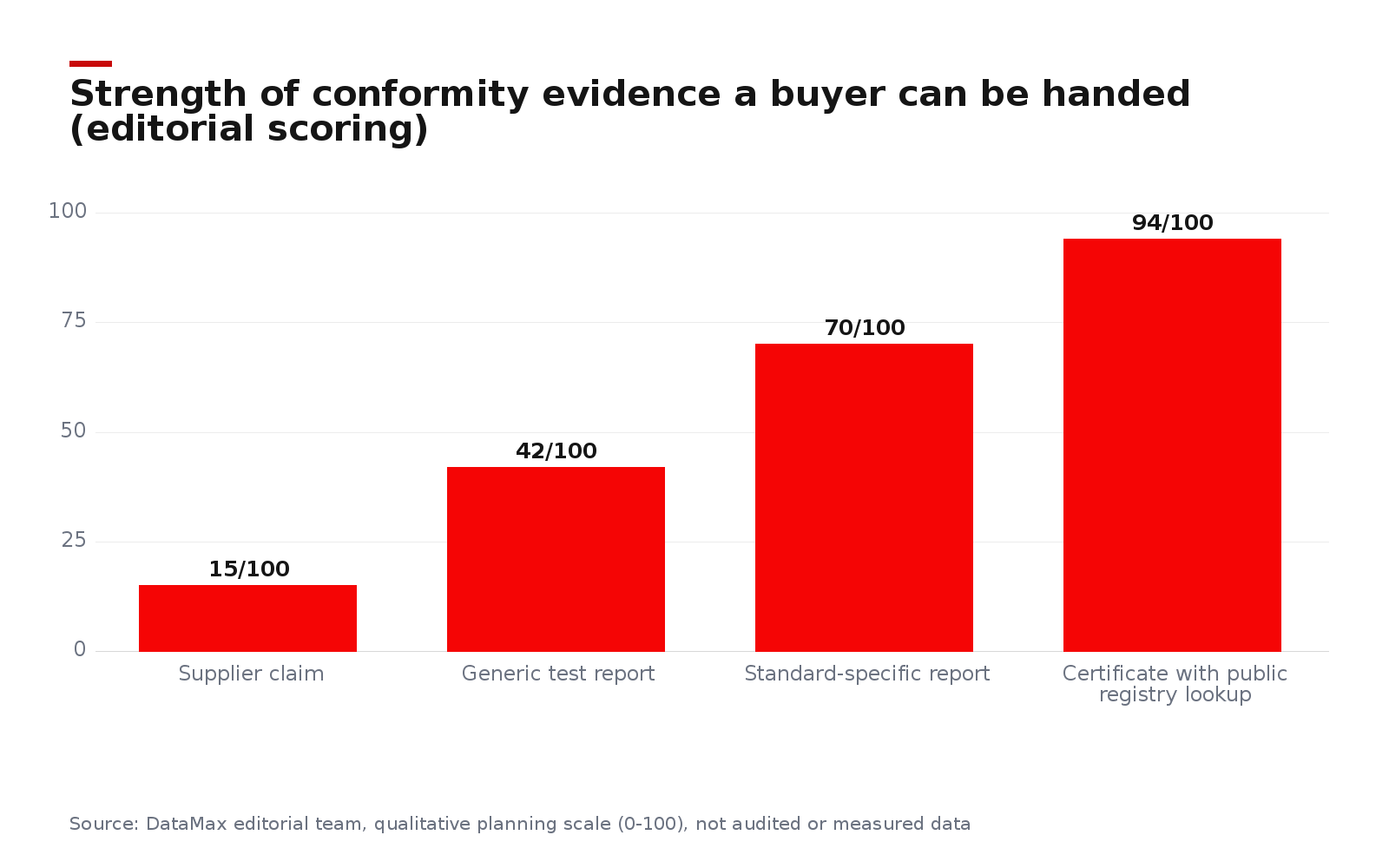
The same figures, in searchable form:
| Evidence option | Editorial score |
|---|---|
| Supplier claim | 15 |
| Generic test report | 42 |
| Standard-specific report | 70 |
| Certificate with public registry lookup | 94 |
A procurement team should treat the score as an evidence hierarchy, not a product ranking. A certificate with an independently executable lookup path provides the strongest starting point, but the certificate still must match the exact ordered SKU and intended service configuration. A standard-specific report may be more informative for the current build than a registry entry that identifies only a family. Use the hierarchy to expose missing documents, then close the remaining gaps through the operator’s live acceptance test.
Definitions a buyer cannot outsource
A service licence is the contractual and commercial permission that governs use of a DRM service. The device-side implementation proves that the product can participate in the service; it does not transfer content rights or give the buyer unrestricted control of the service account.
- Account administrator Controls access, identity and recovery
- Product or device relationship Connects the service to an approved device or deployment
- Entitlement relationship Determines which content the service may access
- Device identity and registration Establishes the relationship with the service
- Licence request Supplies the data required for entitlement evaluation
- Licence storage and use Applies output and access constraints during playback
- Operator application Supplies the service-specific playback workflow
- Content provider Owns the distribution agreement
- Playback display path Must satisfy the configured protection policy
The protected workflow depends on implementation details. For example, an android tv box may use Widevine and PlayReady for different content paths. Widevine L1 means that “all content processing, cryptography and control performed within the TEE,” whereas Widevine L3 means “no TEE on the device; protection in the host OS; a hardware crypto engine improves performance only, not security.” These are Widevine definitions, not interchangeable labels for PlayReady.
Source: Google / Widevine, Widevine DRM Architecture Overview
For PlayReady, ask the service owner or authorised programme representative for the applicable implementation, certification and operational documentation. Request the precise security level rather than copying a Widevine level. Confirm the protected video path, certificate subject, key provisioning, device-bound storage, output-protection requirement, clock behaviour, renewal mechanism and reporting interfaces. A clock failure can block a valid licence request, so the production specification should identify the time source, expected tolerance and recovery procedure.
The device profile is also a technical control. It may define how the client establishes identity, which persistent storage is used, how a licence is renewed and how output constraints are reported to the application. Request the version and release status of the PlayReady client used in the quoted firmware. Do not infer that an AOSP image containing a client library is equivalent to an integrated service build with validated storage, time handling and diagnostic paths.
The boundary also extends to output protection. HDCP policy is separate from the right to issue a PlayReady licence. A device may support PlayReady while the complete product, display, cable, firmware and content configuration must still satisfy applicable HDCP requirements. For HDCP 2.2 or 2.3 programmes, use the relevant certification body’s rules and production evidence. The purchase specification should identify whether the requirement applies to the box, the display chain, the content service or all three.
Do not treat Android as the licence owner. AOSP provides the platform base; an operator application, middleware, device provisioning and service account determine the working deployment. The guide-aosp-vs-google-android-tv comparison covers that platform distinction, but the service contract still requires a named owner.
Finally, distinguish IPTV multicast access from DRM licensing. Multicast controls how a linear channel reaches the device; PlayReady controls protected content use. An operator may combine IPTV transport, middleware and DRM, yet still need separate licence-service configuration for each relevant product or service. The RFQ should therefore identify whether protected content is delivered over multicast, unicast, adaptive streaming or a local media path, because each path may introduce a different licence request trigger.
Real DataMax platforms, field by field
DataMax supplies the hardware platform and stated DRM support. The following table reproduces only the supplied product facts. “PlayReady optional” identifies a product configuration option; it does not state who owns the service licence or replace Microsoft approval, certification and the operator’s production-service obligations.
| Model and fit | SoC and OS | RAM / ROM | DRM and decode | Ports |
|---|---|---|---|---|
| DM21P 4K IPTV / operator middleware set-top box | Amlogic S905Y4, quad Cortex-A35 AOSP Android 11 | 2GB / 8GB 4GB; 16/32/64GB optional | Widevine L1 / PlayReady / HDCP 2.2 optional AV1 [email protected], VP9/H.265 4K@60, H.264 4K@30 | HDMI 2.0b out x1, USB2.0 x2, TF, S/PDIF, 3.5mm AV, RJ45 100M, Wi-Fi6 2x2 + BT5.4, DC 5V/2A |
| DM21S 4K Android TV box for IPTV/OTT white-label | Amlogic S905Y5, quad Cortex-A55 AOSP Android 14 | 2GB / 16GB 2/4/8GB; 16/32/64GB optional | Widevine L1 / PlayReady optional; Dolby Vision/DTS AV1 / H.265 [email protected] 4K@60 | HDMI 2.0b out, S/PDIF, AV, USB2.0 x2, TF, RJ45 100M (1G optional), Wi-Fi6 2x2 + BT5.4 |
| DM21T Premium UHD / cloud-gaming box | Amlogic S905X5, quad Cortex-A510 (ARMv9) AOSP Android 14 | 4GB / 64GB family options | Widevine L1 / PlayReady optional H.266/VVC [email protected] 4K@120, AV1/VP9/H.265 4K@120, AVS3 4K@120, H.264 4K@60; inline AI-SR | HDMI 2.0b out (no HDMI in), USB2.0 x1 + USB3.0 x1, TF, S/PDIF, AV, RJ45 100M (1G opt), Wi-Fi6 + BT5.4 |
| DM22Q Gaming-oriented Android TV box | Amlogic S905X5M, quad Cortex-A55 up to 2.5GHz AOSP Android 14 | 4GB / 64GB 2/4/8GB; 16/32/64GB optional | Widevine L1 / PlayReady optional; Dolby Vision/DTS AV1/H.265 L5.1 4K@60; inline AI-SR | HDMI 2.0b out, USB2.0 x2, TF, S/PDIF, AV, RJ45 100M (1G opt), Wi-Fi6 2x2 + BT5.4 |
For the DM21P, the stated fit is operator middleware and the supplied facts include PlayReady alongside optional HDCP 2.2. That makes the licence-account boundary especially visible: the product can carry the operator stack, but the service entitlement, protected output path and production account still need named ownership. For an IPTV programme, request the exact middleware version, service identifiers and operator-build release alongside the PlayReady implementation evidence.
The DM21S targets IPTV/OTT white-label deployments. For that model, clarify whether DataMax, the distributor or the platform operator administers the production account. “Optional” PlayReady also requires a frozen SKU-level configuration line so procurement does not receive an ambiguous base-device quotation. Confirm whether the 1G Ethernet option is selected only when required by the service network design; it does not alter the licence-owner boundary.
The DM21T and DM22Q cover gaming-oriented and premium use cases where the supplied decode limits are 4K-oriented. Do not map high-performance decode claims to a PlayReady security level or service licence. For both, verify the exact firmware, output configuration and production certificate associated with the ordered SKU. The DM21T has HDMI 2.0b output and no HDMI input, while the DM22Q has HDMI 2.0b output and two USB2.0 ports; verify those physical constraints against the intended display path.
For every android tv box, the same closure requirement applies: bind the commercial service account, device implementation, content entitlement and fleet registration into one acceptance record. DataMax can support that evidence through an RFQ discussion; the first message should identify the model, RAM/ROM option, Android branch, expected fleet size, operator middleware, target PlayReady service level and the proposed owner of the production licence account.
Do not convert a decoder capability into a DRM acceptance result. The DM21P’s AV1, VP9, H.265 and H.264 entries describe decoding, not licence entitlement. Likewise, Dolby Vision/DTS entries on the DM21S and DM22Q do not replace PlayReady evidence. The correct RFQ asks for the PlayReady option, intended production build, target service level, protected output route and licence-request result as separate fields.
Buyer situations, ranked by what they punish
Different deployments fail in different ways. An operator with live IPTV punishes licence-request failures and account outages. A distributor punishes an SKU that cannot be branded, provisioned and repeated across channels. An integrator punishes missing interfaces and undocumented display behaviour. A venue vertical punishes device-management gaps and support escalation.
| Situation | Dominant requirement | Model direction | Acceptance emphasis |
|---|---|---|---|
| • IPTV operator with managed middleware | • Stable service-account integration | • DM21P is the stated operator-middleware fit | • Licence flow under production middleware |
| • OTT/IPTV white-label distributor | • Repeatable SKU and brand control | • DM21S matches the stated white-label fit | • Account ownership and batch provisioning |
| • Premium or cloud-gaming service | • Decoding capability with protected playback | • DM21T matches the stated premium/cloud-gaming fit | • Exact 4K playback path and protected output |
| • Gaming-oriented retail or distribution programme | • Configuration and output consistency | • DM22Q matches the stated gaming-oriented fit | • SKU-bound firmware and DRM evidence |
| • AV/IT integrator deploying venue displays | • Interfaces, displays and recovery | • Select by confirmed port and output requirements | • HDMI/display path and site support procedure |
| • Corporate or venue content service | • Rights clarity and device lifecycle | • Select after service-owner review | • Entitlement, registration and deactivation |
The operator situation ranks first for commercial impact because licence issuance links directly to revenue-bearing playback. A defective unit may pass an image test but fail because its service identity cannot register, its protected path cannot persist a licence, or its account has reached an administrative limit. The acceptance plan should sample several units from the production line, install the operator middleware, enrol them and confirm that a licence survives application restart and a controlled network interruption.
The white-label distributor ranks second because programme scale multiplies configuration ambiguity. A PlayReady option stated in a family brochure must become an orderable SKU with an OS branch, memory configuration, firmware identifier and service responsibility. If the distributor will own customer relationships, it must also know whether it can administer the service account without depending on DataMax. A second pilot batch should confirm that units from a later production run enrol under the same defined procedure.
An integrator’s priority is different. The relevant questions include which outputs are available, whether the box has HDMI input, which network speed is fitted, and whether the protected stream can be shown on the declared display path. These details determine failure recovery, but they do not answer the licence-owner question. The DM21P provides RJ45 100M, HDMI 2.0b output, two USB2.0 ports and S/PDIF; the exact chosen model must be reconciled against the room’s installation design rather than inferred from the broader platform family.
The photograph below represents the hardware-control stage that complements PlayReady evidence: board assembly traceability can identify the manufactured unit, but it cannot establish service-account ownership.

A practical venue test should include application installation, protected content playback, account loss, network interruption, licence renewal, display reconnection and service reset. Record whether the device returns to an unregistered state, whether an administrator can remove it, and whether support staff can identify the failure from logs without retrieving licence material. For an android tv box, this creates a measurable acceptance sequence. DataMax can provide a video factory audit or SMT/AOI/aging evidence tied to the programme through its manufacturing route.
Rank the purchasing risk by recoverability. A failed licence request on a new device may be resolved by correcting enrolment or account state. A failure affecting an entire production batch after a firmware change can interrupt playback across the fleet. A distributor that cannot repeat a certified SKU can stop future channel deployments even if existing units operate. An integrator with an undocumented HDMI or network configuration may create avoidable site failures. Weight the platform choice by the consequence and frequency of these events, not by a decoder feature list.
A decision path for the RFQ
The selection sequence should move from ownership to evidence, then from hardware to acceptance. Do not begin with a decoder chart. For an android tv box, the PlayReady service owner determines which hardware and integration commitments are commercially usable.
- Fix the operating model State whether the operator, distributor or DataMax will own and administer the production service account.
- Name the content owner Confirm the entity that holds the rights needed for the intended service and the relationship between that entity and the licence account.
- Define the device obligation Specify the PlayReady implementation or certification status required for production, without substituting a generic DRM statement.
- Select the DataMax model Match the stated fit to operator middleware, white-label OTT, premium/cloud-gaming or gaming-oriented use.
- Freeze the orderable configuration State the SoC, RAM/ROM, OS branch, firmware baseline, output configuration and any optional DRM or HDCP item.
- Accept the complete service chain Test registration, licence acquisition, playback, renewal, reset, recovery, deactivation and reporting against production-like conditions.
- Transfer operations Document account credentials, administrator roles, recovery procedures, certificate renewal, release change control and supplier escalation.
Paste these lines into the RFQ:
- “State the legal entity that owns the PlayReady production service account and each administrator role.”
- “State whether the service is development, test or production, and identify the transition owner.”
- “Provide PlayReady-specific evidence bound to the proposed model, SoC, OS branch, firmware release and SKU.”
- “Provide the device-registration method, fleet limit, reset behaviour, deactivation method and account-recovery procedure.”
- “Confirm whether PlayReady and optional HDCP 2.2 are configured on the quoted DM21P SKU.”
- “Confirm the configured PlayReady option on the selected DM21S, DM21T or DM22Q SKU.”
- “Submit SMT, AOI, ageing and serial-traceability evidence for the production configuration.”
- “Describe acceptance testing for registration, licence issuance, protected playback, renewal, service interruption and recovery.”
Add contractual clauses for account portability, administrator appointment, expiry notification, certificate replacement, failed-request escalation and change notification for the OS, firmware, client, hardware revision and display configuration. State the evidence required before mass deployment and the remedy if a delivered batch no longer matches the approved production profile. These clauses convert an ambiguous technical claim into an enforceable acceptance condition.
Use sample ordering or the inquiry form. The first message for this topic should contain the target model, RAM/ROM option, AOSP version, expected deployment quantity, operator middleware, target PlayReady security level, proposed account owner, required output protection and the evidence schedule.
The final decision rule is straightforward: select the platform that fits the deployment, but contract the service ownership separately from the hardware. For the DM21P, reconcile the operator middleware with optional HDCP 2.2. For the DM21S, define the white-label account boundary. For the DM21T and DM22Q, preserve the stated 4K decode limits and validate the exact protected output path. Confirm every final production specification against the production datasheet.
Before issuing a purchase order, require a signed evidence index. Each row should identify the document, SKU, firmware build, issuing party, date, reviewer and accepted result. Attach the live acceptance log to the index and record any outstanding exception with an owner and closure date. This final gate prevents an unverified PlayReady claim from becoming an implicit production dependency.
Further reading
- Guide android tv box for isps
- Nigeria SONCAP compliance support
- Compliance support by market
- Allwinner Android TV boxes
- AOSP Android TV boxes
- DataMax DM21P specifications and fit
- DataMax DM21S specifications and fit
FAQ
Who holds the PlayReady service licence for an Android TV box?
The service-account owner holds the operational relationship with the PlayReady service. This is commonly the IPTV operator, OTT platform company or authorised distributor, but the legal entity can vary by programme. The device manufacturer implements the device-side support. Do not infer account ownership from a product quotation stating “PlayReady” or “PlayReady optional”; require the account owner, administrator and recovery path in writing.
Can a manufacturer licence an Android TV box for a customer?
A manufacturer or service partner may provide an OEM-led arrangement in which it administers a production account and supports customer provisioning. That does not automatically transfer content rights or give the customer control of the service. Contract the entity, role, portability, renewal, monitoring and deactivation duties separately from the hardware quotation, and confirm the intended model’s PlayReady option against the production datasheet.
Does PlayReady certification prove the service licence is valid?
No. Certification or implementation evidence concerns the product meeting a defined technical standard. Licence validity depends on the relevant production account, product registration, entitlement relationship and device-request workflow. Require both standard-specific evidence and an operational test against the buyer’s production-like service. A supplier claim or generic test report alone does not close the boundary.
Which DataMax model is intended for operator middleware?
The DM21P is identified for a 4K IPTV and operator middleware set-top box. Its stated configuration includes Amlogic S905Y4, quad Cortex-A35, AOSP Android 11, 2GB / 8GB with specified options, PlayReady and optional HDCP 2.2. Confirm the exact orderable configuration and all production DRM details against the production datasheet.
Should an integrator request the PlayReady account itself?
The integrator should request enough information to test and support the installation: account owner, application identifiers, device-registration procedure, recovery route and escalation contacts. It should not receive unrelated credentials by default. Where the operator controls the service, keep account administration with the authorised operator while giving the integrator a documented recovery and support path.
What evidence should accompany the first factory audit?
Request SMT and AOI results, ageing or burn-in records, firmware-flashing records, serial-number traceability and configuration control tied to the ordered SKU. For PlayReady, add the standard-specific product evidence and a live licence-request acceptance record. Ask DataMax for a video factory audit or production evidence specific to the programme through the factory-quality route.
What should happen when the OEM changes during deployment?
Name the transfer procedure in the RFQ and contract. The successor must preserve access to the production account, device registrations, certificates, firmware baselines and audit records, or provide a documented migration to a buyer-controlled service. Test the transfer on a non-production cohort before the commercial agreement begins. A replacement hardware supplier cannot be assumed to inherit licence authority or prior certification.
Can the same PlayReady device support different operators?
A platform may be configured for different services, but each service still requires the correct account relationship, device registration, entitlement, firmware and acceptance evidence. Changing operator branding or middleware does not transfer a production licence. Confirm the exact orderable configuration and the service boundary against the production datasheet.


