

Before the terminology: make the chipset decision explicit
No third-party source card supplies a verified market figure for this category, so the procurement decision must start with the specification rather than an unsupported statistic. The exact phrase android tv box identifies a product class, not a qualified platform. A buyer must separate chipset generation, Android release, memory configuration, codec support, DRM status, connectivity, operator middleware and acceptance evidence. The short answer is that an “RK3576 Android TV Box” quotation cannot be accepted until the supplier resolves the chipset claim against a revision-controlled datasheet, physical sample and production BOM.
That distinction matters because DataMax’s supplied catalogue facts list Amlogic S905Y4, S905Y5, S905X5 and S905X5M platforms, not RK3576. A request naming RK3576 therefore identifies an engineering requirement to verify, not permission to substitute a nearby processor. The buyer should require the exact SoC part number, core architecture, boot-image version and approved sample. If RK3576 is mandatory, confirm feasibility against the production datasheet; if it is only a search term, select from the demonstrated platform list.
The operational decision remains separate from the label. An IPTV operator may require middleware integration, service activation, device management and content security. A white-label OTT programme may prioritize branding, application packaging and a stable operating baseline. A venue integrator may need predictable HDMI, USB, Ethernet, remote-control and recovery procedures. These are different qualification problems even when the enclosure and remote-control experience look similar.
This page therefore treats “RK3576” as a claim to interrogate rather than proof of capability. It explains how to qualify a DataMax platform, where quotations commonly diverge and how to convert an enquiry into testable supply conditions. For the broader platform and operator selection context, use the canonical Android TV Box for ISPs guide. DataMax can support model selection, sampling and production control through its engineering and procurement team.
Four verified DataMax platforms compared
The catalogue evidence supplied for this article identifies four production SKUs, not five. Naming a fifth model would create an unsupported product claim, so this comparison uses all four verified platforms. The “RK3576 Android TV Box” request should first be reconciled with this verified chipset list. If the requested supplier uses a different processor, it should be handled as a separate model and sample, not silently substituted.
| Model | SoC and CPU | OS | RAM / ROM | Decode | DRM | Ports and connectivity |
|---|---|---|---|---|---|---|
| DM21P | Amlogic S905Y4, quad Cortex-A35 | AOSP Android 11 | 2GB / 8GB (4GB; 16/32/64GB optional) | AV1 [email protected], VP9/H.265 4K@60, H.264 4K@30 | Widevine L1 / PlayReady / HDCP 2.2 optional | HDMI 2.0b out x1, USB2.0 x2, TF, S/PDIF, 3.5mm AV, RJ45 100M, Wi-Fi6 2x2 + BT5.4, DC 5V/2A |
| DM21S | Amlogic S905Y5, quad Cortex-A55 | AOSP Android 14 | 2GB / 16GB (2/4/8GB; 16/32/64GB optional) | AV1 / H.265 [email protected] 4K@60 | Widevine L1 / PlayReady optional; Dolby Vision/DTS | HDMI 2.0b out, S/PDIF, AV, USB2.0 x2, TF, RJ45 100M (1G optional), Wi-Fi6 2x2 + BT5.4 |
| DM21T | Amlogic S905X5, quad Cortex-A510 (ARMv9) | AOSP Android 14 | 4GB / 64GB (family options) | H.266/VVC [email protected] 4K@120, AV1/VP9/H.265 4K@120, AVS3 4K@120, H.264 4K@60; inline AI-SR | Widevine L1 / PlayReady optional | HDMI 2.0b out (no HDMI in), USB2.0 x1 + USB3.0 x1, TF, S/PDIF, AV, RJ45 100M (1G opt), Wi-Fi6 + BT5.4 |
| DM22Q | Amlogic S905X5M, quad Cortex-A55 up to 2.5GHz | AOSP Android 14 | 4GB / 64GB (2/4/8GB; 16/32/64GB optional) | AV1/H.265 L5.1 4K@60; inline AI-SR (no NPU TOPS stated) | Widevine L1 / PlayReady optional; Dolby Vision/DTS | HDMI 2.0b out, USB2.0 x2, TF, S/PDIF, AV, RJ45 100M (1G opt), Wi-Fi6 2x2 + BT5.4 |
The field differences are more useful than the labels. DM21P provides the operator-oriented baseline with AOSP Android 11, explicit HDCP 2.2 optional support and a stated 2GB / 8GB base configuration. DM21S moves to AOSP Android 14, lists Dolby Vision/DTS in the DRM field and offers 1G Ethernet as an option. DM21T is positioned for premium UHD and cloud-gaming workloads, with the broadest stated decode set, ARMv9 Cortex-A510 CPU architecture and one USB3.0 port. DM22Q targets gaming-oriented programmes and combines S905X5M, a stated CPU frequency of up to 2.5GHz and a 4GB / 64GB base configuration.
Output language must remain controlled. DM21T and DM22Q decode profiles extend to 4K@120, but HDMI 2.0b output and the absence of HDMI input in DM21T remain constraints; “no HDMI in” must not be rewritten as pass-through capability. DM22Q’s stated maximum is 4K@60. A marketing name cannot expand the supplied datasheet, so the acceptance matrix should use the listed profiles as the source of truth.
Optional status must be resolved before comparison. Widevine L1 / PlayReady, HDCP 2.2, 1G Ethernet and expanded storage are not universal across the catalogue. A buyer should state whether each option is ordered, excluded or subject to engineering confirmation. The quotation, purchase order, production BOM, golden sample and test report should all use the same configuration language.
The RAM and ROM cells also require commercial discipline. “2/4/8GB; 16/32/64GB optional” identifies a family range, not an interchangeable promise for every model or volume context. A specific RFQ should select one required configuration rather than copy the range. If the intended configuration is absent from the production datasheet, confirm against the production datasheet before treating it as deliverable.
DRM claims must also be separated by mechanism. Widevine L1 and PlayReady address different service ecosystems, while HDCP 2.2 concerns protected content output. Dolby Vision and DTS appear in the supplied DRM fields for DM21S and DM22Q, but the fields do not define every end-to-end service entitlement. Request the exact licence, output-path and certification evidence applicable to the programme.
For a focused codec decision, the AV1 Android TV Box guide helps separate decoder support from end-to-end playback performance. If the workload instead depends on legacy HEVC deployment, use the H.265 HEVC Android TV Box guide to define the profile and test method before issuing the RFQ.
The operator, the integrator and the venue
The same android tv box can serve three different buyers, but each buyer is purchasing a different evidence package. The operator validates service activation, middleware, security, device management and fleet recovery. The integrator validates signal compatibility, USB peripherals, network behaviour and installation ergonomics. The venue validates repeatability across rooms, remote-control pairing, display compatibility and support escalation.
| Situation | Decisive requirement | Model direction | Evidence to request |
|---|---|---|---|
| • IPTV operator rollout | • Middleware integration and 4K service delivery | • DM21P direction | • Provisioning, activation, network and recovery test report |
| • OTT or IPTV white-label programme | • Android 14 baseline, branding and application packaging | • DM21S direction | • Golden sample, image manifest and application installation record |
| • Premium UHD or cloud-gaming demonstration | • High-refresh 4K decode profile and mixed USB connectivity | • DM21T direction | • Codec matrix, HDMI output test and USB3.0 configuration confirmation |
| • Gaming-oriented room installation | • 4K@60 gaming baseline and repeatable platform behaviour | • DM22Q direction | • Latency method, sustained playback result and approved configuration |
| • Operator with Android 14 service requirements | • AOSP Android 14 baseline with IPTV or OTT middleware | • DM21S direction | • Middleware build manifest, entitlement flow and update test |
| • AV and installation demonstration | • HDMI output, audio and defined peripheral compatibility | • DM21T direction with display validation | • EDID or display compatibility record where applicable |
An operator should not choose from codec headlines alone. The commercial failure point occurs after installation when a handset cannot activate, a store cannot download, a network drops or a support technician cannot reproduce the fault. For that reason, ask the supplier to demonstrate the complete path: device registration, account or entitlement flow, middleware launch, stream playback, reboot, update and recovery. The model is only the starting point.
The same test can expose different issues by buyer type. An operator may find that the unit boots but cannot complete activation under the intended network policy. A venue may find that the remote pairs successfully on one display but exhibits inconsistent navigation after a firmware update. An integrator may find that USB3.0 is present while the intended peripheral requires another interface. These are qualification results, not cosmetic objections.
An integrator faces a different matrix. HDMI 2.0b output, 100M RJ45 and the optional 1G Ethernet configuration need confirmation against the actual installation network. USB2.0 versus USB3.0 can affect an external storage or peripheral decision, but only the supplied port specification is available here. An integrator should ask for the exact accessory list and test with that list rather than assume all USB devices are equivalent.
A venue operator needs fleet consistency: the same hardware revision, remote, firmware image and recovery process across every room. The photograph shows the kind of board-level object a controlled supplier should be able to inspect, rather than a decorative chipset claim. In a multi-room installation, record the room identifier, display model, signal mode, remote pairing result and recovery action for each test position.

The decision should be recorded as a use-case matrix. If service identity and operator middleware dominate, select toward DM21P. If the programme needs Android 14 and white-label packaging, inspect DM21S. If the application exercises 120Hz decode paths or USB3.0, review DM21T. If the workload is gaming-oriented and centered on 4K@60, review DM22Q. The final choice must confirm against the production datasheet.
A practical operator RFQ should name the middleware build, activation method, entitlement service, expected reboot behaviour, network profile and fleet-management responsibility. A venue RFQ should add display models, remote-control models, room count and support escalation route. An integrator RFQ should add peripheral models, cable list, network topology and signal acceptance criteria. The DataMax operator-tier Android TV Box solution can help frame the service-level discussion before model selection.
How to choose, step by step
Start by converting the chipset phrase into a controlled identity. “RK3576” may be a customer search term, a retailer label or an engineering requirement. Require the supplier to state the SoC part number, core architecture, boot-image version and an image of the component marking, with any sensitive information handled under the buyer’s confidentiality process. Then reconcile that answer with a physically inspected sample and the factory BOM.
- Define the workload State maximum resolution, refresh rate, codec, HDR or audio requirement, app type, operator middleware and service model. Replace “supports 4K” with testable profiles such as “AV1 [email protected] 4K@60” where required.
- Lock the configuration State the exact RAM, storage, OS release, Ethernet speed, Wi-Fi antenna configuration and optional DRM status. Do not leave “or similar”, “up to” or “optional” in the accepted order line without a default.
- Define the compliance boundary Identify the required certification, security, update, data-protection and territory-specific obligations. Confirm the production scope against the certification information and compliance information.
- Specify the sample protocol Define firmware, branding, remote, packaging, accessories, test duration, defect classification and the golden-sample approval gate. Production must match the approved unit.
- Attach acceptance evidence Require model identity, boot image checksum, unit serial mapping, test results, defect disposition and shipment records tied to the purchase order.
The RFQ should contain pasteable specification lines rather than adjectives. A suitable line for a white-label programme is: “AOSP Android 14; 4GB / 64GB; HDMI 2.0b output; RJ45 100M with 1G optional only if stated in the quotation; Wi-Fi6 2x2; BT5.4; AV1/H.265 L5.1 4K@60; Widevine L1 and PlayReady optional status explicitly declared.” For a premium workload, the buyer can specify the DM21T decode list rather than writing “gaming-ready”, while explicitly retaining “no HDMI in” as a boundary.
Add an identity line at the top of the RFQ: “Processor: [exact approved SoC]; CPU architecture: [stated architecture]; Android baseline: [AOSP Android 11 or AOSP Android 14]; substitution prohibited without written approval.” For a mandatory RK3576 programme, this line prevents a supplier from answering with S905Y4, S905Y5, S905X5 or S905X5M under the assumption that all four categories are equivalent.
Add an acceptance line at the end: “The golden sample, production hardware revision, boot image and test report must reference the same model and configuration; optional features are accepted only when explicitly listed.” This line closes the gap between a quotation and shipment. It also gives a quality team a document to reject when it cannot trace the delivered unit to the approved reference.
A useful first message should name the target android tv box family or the DataMax model under review, the operating region, the workload, required quantity context, desired sample stage and the no-substitution rule. The team should respond with the model, exact SoC, standard configuration, optional configurations, available evidence and any engineering dependencies. Send that request through the inquiry form; the first message for this topic should contain those six fields without relying on an unspecified chipset label.
Before issuing the RFQ, make the application environment explicit. For an IPTV deployment, include the middleware build identifier, activation API dependency and update policy. For OTT, include the application package identity, store requirement and branding deliverables. For gaming, include the title, input devices and latency measurement method. A hardware comparison cannot answer whether a particular application behaves correctly on a particular image.
A narrower operating-system decision can be resolved with the AOSP versus Google Android TV guide. It helps the buyer identify whether a Google certification or retail-service requirement exists independently of the SoC. The output requirement should also be written as a signal test: resolution, refresh rate, colour mode, audio mode, display model and acceptable pass criterion.
The traps in this category
Trap 1: chipset identity and output claims are often compressed into a market label.
Field trap
A request for an RK3576 **android tv box** may arrive without a compatible model line. Accepting a nearby platform as a substitute changes CPU architecture, OS baseline, codec behavior, firmware validation and qualification scope. The cost of getting this wrong is a sample that cannot become the production golden unit. Require an exact SoC and prohibit substitution without written approval.
A second trap is to read a marketing resolution label as an output guarantee. The verified DataMax decode figures are the controlling reference for the listed models, and a marketing label cannot expand them. DM21T lists 4K@120 decode families, but it has HDMI 2.0b output and no HDMI input. A buyer who requires loop-through, 8K output or an unstated refresh combination must obtain revised engineering confirmation. Do not infer unsupported output modes from codec capability.
A third trap is optional status. “Widevine L1 / PlayReady optional,” “1G optional” and “HDCP 2.2 optional” describe selectable configurations rather than universal equipment. An RFQ without a default configuration leaves acceptance dependent on the supplier’s interpretation. The contract should identify the production BOM, firmware image and approved sample by revision.
A fourth trap is equating codec support with application performance. AV1, H.265, VP9, AVS3 and H.266/VVC decode support do not establish end-to-end frame rate, startup time, memory stability or operator middleware compatibility. Test streams should cover the application path and the display environment. For H.265 and HDR-related architecture, the H.265 HEVC Android TV Box guide provides a focused comparison point.
Trap 5 is confusing platform capability with network capacity. RJ45 100M is the stated Ethernet configuration for the listed models, while 1G is optional on DM21S, DM21T and DM22Q. If the operator requires a specific uplink rate, negotiated speed or switching behaviour, include it in the build and verify it on the sample. “Fast Ethernet” and “Ethernet” are not adequate acceptance language.
Trap 6 is ignoring antenna configuration. Wi-Fi6 2x2 is stated for DM21P, DM21S and DM22Q, while DM21T’s supplied facts say Wi-Fi6 without the 2x2 notation. If radio performance or enclosure layout affects the project, request the production antenna configuration and confirm it against the production datasheet. Do not import a 2x2 claim into a model row that does not state it.
Trap 7 is accepting a test report without a revision reference. A report for an earlier PCB, memory configuration, image or enclosure is not evidence for the current shipment. Every record should identify model, hardware revision, software build, test method and unit or batch scope. Otherwise, the report may confirm that some unit passed, not that the ordered configuration passed.
The practical remedy is an evidence hierarchy. A verbal statement is not an acceptance criterion. A contract clause identifies the requirement. A golden sample identifies the implementation. A golden sample behind a pilot gate links the implementation to observed field performance. These controls should be proportionate to the risk: chipset identity, operator provisioning and DRM status warrant direct contractual treatment.
How the factory controls the variable
Factory control starts before SMT. The approved specification should define the SoC, memory configuration, PCB revision, power design, antenna arrangement, connector set, Android build and accessory list. Change control then prevents a bought component, alternate memory device or software branch from silently altering the approved android tv box. The production traveler should carry the same model and hardware revision as the golden sample.
During SMT, process records should show board placement, component lot, solder results and inspection status. Automated optical inspection identifies assembly defects, but AOI is not a substitute for functional verification. The manufacturing sequence should therefore connect material control to board-level electrical test and then to operating-system boot. A board can pass AOI and still fail to boot because of assembly, power, storage or firmware issues.
A useful factory record set names the controlled component, its approved part number, the lot identifier, inspection result and authorised deviation. If a deviation affects memory, Ethernet or DRM, the buyer’s approval path should be visible. A line-side “equivalent” label is not sufficient when the change can alter boot behaviour, thermal performance or content-protection operation.
Functional testing should use the same intended accessories and interfaces as the shipment. For DM21P, the test list can include HDMI 2.0b output, two USB2.0 ports, TF, S/PDIF, 3.5mm AV, RJ45 100M, Wi-Fi6 2x2, BT5.4 and DC 5V/2A. For DM21T, the record should separately identify USB2.0 and USB3.0 and confirm the “no HDMI in” boundary. A single generic “all ports pass” statement cannot diagnose field failures.
Dark-room validation should use the agreed test pattern or content, display configuration and remote-control unit. Record the resolution, refresh rate, colour output, audio path and image result. If the programme requires 4K@120 decode, demonstrate that profile on the exact production image and record whether the connected display accepts the resulting signal. Decoder acceptance and display acceptance are separate lines.
DataMax factory evidence should form a chain: incoming material control → SMT/AOI records → functional and aging results → dark-room validation → audit trail → shipment reconciliation. Request the applicable records and the approved sample linkage from the factory-quality team. A certificate without a model, revision and test record does not close the acceptance question.
The photograph illustrates why board-level evidence matters: the processor package occupies one position within a larger memory and PCB environment. A processor choice cannot compensate for an unqualified power rail, unstable storage arrangement or weak wireless implementation. Inspection must cover the assembled system, not just a loose component.
For higher-risk programmes, the factory should agree a pilot gate before mass production. The pilot establishes whether the model passes application activation, network stability, codec playback, peripheral compatibility and recovery criteria. The sample-ordering workflow is the practical entry point for turning this process into evidence rather than assurance language.
The pilot should use a bounded test script with named preconditions and pass criteria. For example: connect to the approved network, complete activation, start the required codec stream, operate the remote, disconnect and restore the network, reboot, trigger the defined update method and recover from the specified fault. Record the operator, result and corrective action for each step. A pilot that only confirms that the unit boots leaves the highest-risk paths untested.
Two routes, one bill of differences
A buyer can use two procurement routes. The sample-led route minimizes substitution risk but adds engineering review before commitment. The contract-led route accelerates release, but it is appropriate only when the specification and acceptance tests are already stable. Neither route removes the need to identify the exact platform.
The editorial comparison below ranks mechanisms for reducing specification drift. It is not measured performance, warranty data or a supplier claim.
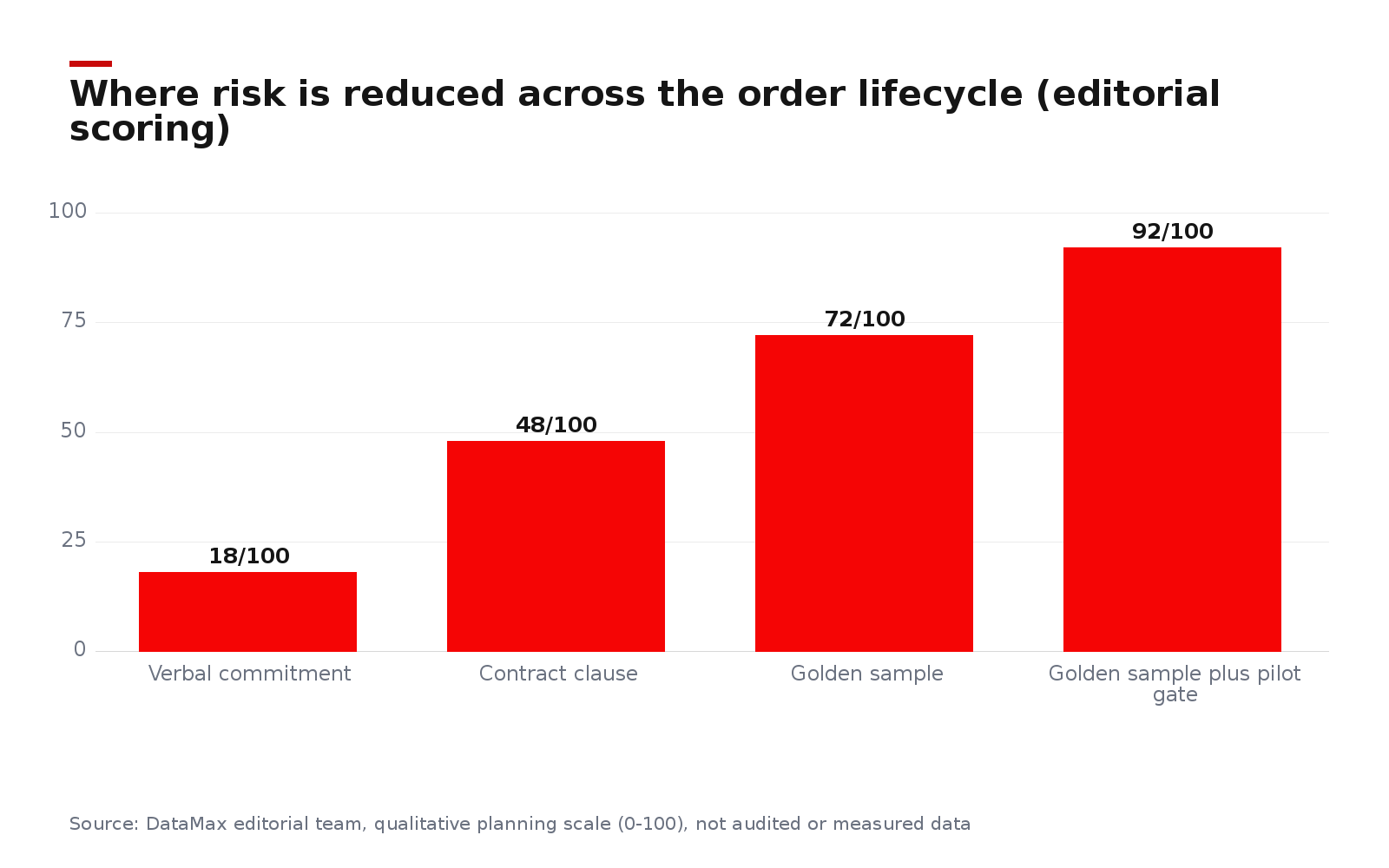
The same figures, in searchable form:
| Option | Editorial score |
|---|---|
| Verbal commitment | 18 |
| Contract clause | 48 |
| Golden sample | 72 |
| Golden sample plus pilot gate | 92 |
The first route is suited to an exploratory android tv box programme or a custom operator deployment. The buyer orders samples, verifies the exact SoC and configuration, runs the workload, then freezes the golden sample. The bill of differences is engineering time, sample logistics and a longer qualification stage. In return, the production unit has a visible physical and software reference.
The second route is suited to a repeat programme with a stable specification. The contract identifies the model, BOM, firmware, codecs, DRM status, ports, test methods and defect remedies. The supplier still supplies samples, but the production release is governed by contractual acceptance rather than open-ended interpretation. The bill of differences is stronger prespecification and less tolerance for configuration drift.
| Control point | Sample-led route | Contract-led route |
|---|---|---|
| Model identity | Verified on the physical sample | Defined by exact model, SoC and BOM |
| Software | Approved image captured before production | Image version and update boundary written into acceptance |
| Configuration | Observed and documented | Mandatory build with approved alternatives prohibited |
| Testing | Iterative workload validation | Repeatable test matrix |
| Release | Golden-sample sign-off | Contract-defined release |
| Engineering involvement | Higher before commitment | Focused on exceptions and changes |
| Configuration-change cost | Discovered during sample stage | Controlled through written change approval |
| Best fit | New operator stack or uncertain workload | Repeat deployment with stable build |
The route choice does not remove factory controls. Even a contract-led programme needs material traceability, functional testing, aging, dark-room validation and shipment reconciliation. The difference is where the buyer invests: sample-led procurement resolves ambiguity through iteration, while contract-led procurement resolves it through precise prespecification and formal deviation control.
For a procurement team, the practical cost of the sample-led route includes engineering hours, delayed deployment planning and the need to maintain several test environments. The benefit is that the team observes failures before the larger rollout. For the contract-led route, the cost is specification effort before release and the governance required to manage every approved change. The benefit is a shorter production cycle once the build is stable.
A hybrid route often provides the clearest control for a new but defined programme. Use contract clauses to lock model identity, OS baseline, RAM/ROM, optional features and no-substitution rules; use the golden sample to confirm implementation; and use a pilot gate to validate middleware, playback, networking and recovery under real operating conditions. This sequence matches the risk-control hierarchy without pretending that a paper clause can demonstrate field behaviour.
The 4K 60fps Android TV Box guide can support workload definition, while DataMax’s model selection should remain grounded in the verified platform list rather than a broad chipset keyword. For custom software, image, branding or interface changes, review DataMax custom development before treating a catalogue configuration as the complete programme.
How the requirement actually works
The procurement mechanism works by linking three controlled objects: the commercial specification, the production artifact and the acceptance evidence. The specification says what must exist. The production artifact is the assembled board, firmware image, enclosure and accessories. The evidence proves that the artifact conforms. A valid android tv box decision therefore ends with a traceable statement such as “model, hardware revision and image match the approved sample and passed the agreed test matrix.”
Start with the chipset as the execution engine. The supplied DataMax models use Amlogic S905Y4 with quad Cortex-A35, Amlogic S905Y5 with quad Cortex-A55, Amlogic S905X5 with quad Cortex-A510 using ARMv9, and Amlogic S905X5M with quad Cortex-A55 up to 2.5GHz. These are four distinct platform identities. The Android release is AOSP Android 11 for DM21P and AOSP Android 14 for DM21S, DM21T and DM22Q. AOSP describes the software baseline; it does not itself prove a Google certification status, operator entitlement or retail-service availability.
Media handling separates decoding from output. A decoder capability such as AV1 [email protected] or H.265 [email protected] 4K@60 describes one link in the chain. HDMI 2.0b output is the physical output interface. The application must invoke the correct profile, the display must accept the signal and the complete path must meet the programme’s frame-rate requirement. “4K” alone lacks a testable profile.
Content protection is similarly layered. Widevine L1, PlayReady and HDCP 2.2 are distinct mechanisms used in different parts of the ecosystem. A Widevine claim does not prove PlayReady support, and neither proves HDCP compliance for every output path. Optional DRM status must be ordered and tested against the intended content service. The Dolby Atmos Android TV Box guide can help identify additional audio-specific requirements that belong in the test matrix.
Connectivity closes the loop. RJ45 100M, optional 1G Ethernet, Wi-Fi6 configurations, Bluetooth 5.4, USB2.0, USB3.0 and TF are the stated interfaces. The buyer must define which are standard, which are optional, which antennas are fitted and which peripherals must work. A specification line should be copied into the purchase order, the test plan and the golden-sample record so that a chipset-level claim does not become a field-level assumption.
For a DRM service deployment, the licence flow should also be documented. The test should identify the application, content identity, device registration, licence request, output path and behaviour after expiry or network loss. The DRM label alone does not specify those conditions. Likewise, an update mechanism needs a test image, version identifier, rollback rule and recovery procedure. These architecture links prevent the hardware designation from becoming disconnected from the operational service.
For a manufacturer overview of how development, sourcing and production fit together, review DataMax’s manufacturing approach. For an android tv box requirement, the commercial decision is complete only when a named platform, fixed configuration, controlled firmware, tested interfaces and an evidence-backed release path all refer to the same unit.
Further reading
- Guide android tv box for isps
- Amlogic Android TV boxes
- Google TV devices
- AV1 Android TV box guide
- AOSP vs Google TV guide
- DataMax DM21P specifications and fit
- DataMax DM21S specifications and fit
FAQ
Does an RK3576 Android TV Box match the listed DataMax models?
The supplied DataMax product facts list Amlogic S905Y4, S905Y5, S905X5 and S905X5M platforms, not RK3576. Treat RK3576 as an unverified request rather than a substitute. Require the supplier to provide the exact SoC part number, an approved sample and a revision-controlled datasheet. If RK3576 is mandatory, confirm feasibility against the production datasheet before ordering samples.
Which DataMax model is the closest starting point for an IPTV operator?
DM21P is positioned as a 4K IPTV and operator-middleware set-top box, with AOSP Android 11 and 2GB / 8GB as its stated base configuration. Selection still depends on middleware integration, DRM, Ethernet, provisioning and device-management requirements. Use it as the initial model direction, then qualify the exact production configuration rather than treating the product description as an acceptance specification.
Does 4K@120 decode imply 4K@120 HDMI output?
No such conclusion is supported by the supplied facts. DM21T lists several 4K@120 decode formats but also specifies HDMI 2.0b output and no HDMI input. Decode capability, output capability and display support are separate test items. Require a signal test at the intended resolution and refresh rate, with the approved firmware and display environment recorded.
What should the first RFQ message contain?
Name the target model or workload, operating region, required configuration, sample stage and no-substitution rule. Also state the required codec, DRM, connectivity, Android baseline and acceptance evidence. For this topic, send the request through the DataMax inquiry channel and avoid relying on “RK3576” as the only technical identifier.
Can optional 1G Ethernet or Widevine L1 be assumed?
No. Both are listed as optional for relevant models. A purchase order must identify the exact production build, while the golden sample and test records must confirm the same configuration. If a feature is absent, the commercial and technical plans should be adjusted before approval rather than relying on a production substitution.
What distinguishes a golden sample from a verbal product claim?
A verbal claim describes an intention but cannot identify the delivered implementation. A golden sample links a physical hardware revision, firmware image, accessories and observed behavior to the approved production unit. A pilot gate adds field-style validation of middleware, codec playback, networking, updates and recovery. Evidence at that level reduces configuration drift during mass production.


