

The short answer: chipset is only the first line of the RFQ
The widespread mistake is treating “RK3588” as an orderable product. It is a processor family, not a complete television platform. An android tv box order should specify the SoC implementation, Android build, memory configuration, display and networking interfaces, DRM position, firmware support, enclosure, test coverage and delivery-control process.
For an RK3588-class device, the processor is a strong starting point because the listed RK3588 platform combines eight CPU cores with hardware media acceleration. That does not automatically produce a suitable IPTV, OTT, AV-over-IP or edge-compute box. A buyer also needs a defined operating system, a reproducible image, certified or licensed content path where applicable, thermal design, regulatory evidence and an agreed change-control mechanism.
The correct procurement frame is therefore:
- Define the workload and deployment environment.
- Translate that workload into measurable system requirements.
- Compare candidate platforms against those requirements.
- Audit the build and test evidence behind the quotation.
- Freeze the specification before the production order.
At DataMax, an RK3588-based DM16N is positioned as an edge-compute and AV-over-IP enterprise meeting engine, not as a generic consumer television box. That distinction illustrates the larger point: the same processor family can lead to materially different products depending on ports, software, DRM, enclosure and operating purpose.
This page addresses only that engineering angle. The broader procurement sequence is covered in the TV box ordering process and the questions buyers get wrong. For an android tv box order, use the checks below to turn a marketing headline into a technically reviewable purchase specification.
The immediate procurement action is to request a configuration-controlled RFQ rather than a generic catalogue quotation. A quotation that names only “RK3588 Android box” leaves the buyer unable to determine whether the device is a managed IPTV terminal, a premium television endpoint, an HDMI processing engine or a general-purpose Android device. Require the fitted SoC and memory, operating-system branch, media claims, DRM position, port matrix, thermal test regime, software update responsibility and approval process.
This approach also separates a valid evaluation sample from a production baseline. The sample may be useful for confirming boot, display, network and decoder behaviour, but it becomes commercially meaningful only when its BOM, PCB, image, enclosure and labelling are recorded. The order should identify that sample as the golden unit and state which changes require reapproval.
The evidence trail from SMT to shipment
An android tv box order should require evidence at the point where configuration drift is most likely: component placement, firmware assembly, ageing and final inspection. A factory quotation that lists only the SoC and memory does not establish that the delivered hardware matches the approved specification.
The operational evidence trail should move through the following sequence:
- Approved build control Link the purchase order, BOM revision, PCB revision, Android image, firmware configuration and hardware test plan to one released build record.
- SMT and AOI evidence Retain placement and automated optical inspection results, defect dispositions and any approved deviation or rework record.
- Assembly verification Check component markings, connector population, power rails and configuration against the golden sample and released BOM.
- Software-image verification Record image version, serial mapping, provisioning credentials and the result of functional tests on representative production units.
- Ageing and dark-room testing Apply the agreed thermal and burn-in sequence, then repeat visual and functional inspection after stress exposure.
- Final audit and shipment release Tie serial numbers to inspection results, packing records and shipment release before cartons leave the factory.
Evidence package
For a repeatable programme, request the inspection-plan revision, AOI record format, ageing duration defined by the agreed procedure, dark-room checklist, serial-number traceability method, non-conformance process and golden-sample approval reference. The factory must confirm each applicable item against the production datasheet and signed quality agreement rather than relying on a generic capability statement.
The purpose is not to demand an inspection report for every unit forever. It is to establish where faults are detected and who can authorise deviations. A sampled final check may be appropriate for stable production, while safety-critical or network-dependent tests need a defined sampling rule. A soak test can expose thermal instability, storage failure and driver instability that a boot test will miss. A dark-room check can reveal light leakage, panel defects or enclosure fit problems before distribution.
For example, an operator buying managed IPTV terminals should ask whether the ageing procedure exercises Ethernet attachment, service login, decoder restart and Wi-Fi fallback under the expected load. A hospitality programme should add repeated cold starts, IR responsiveness, audio routing and remote-recovery steps. An AV-over-IP programme should include sustained network traffic, HDMI input and output behaviour, PoE operation and thermal observation. The common process can remain stable while the test fixture changes to match the workload.
A practical evidence matrix assigns one owner to each output. The factory may generate the AOI result and serial record, while the buyer approves the golden sample and deviation policy. The software supplier may provide the signed image hash and update policy. The compliance owner may confirm the applicable regulatory file. Without named ownership, “factory provides evidence” becomes an unenforceable phrase that can produce incomplete handover folders at shipment.
The quality process must be tied to change control. If the SoC substitution, memory supplier, wireless module, Android image or firmware branch changes, the buyer needs a defined trigger for regression testing. Otherwise, a factory may correctly follow the revised BOM while the commercial package no longer matches the tested product.
The handover should also identify what remains open. For example, the factory may complete board assembly and functional testing while the operator remains responsible for middleware acceptance, service credentials and DRM provisioning. A useful release index separates factory acceptance from customer integration, names the open owner and prevents a partially completed programme from being represented as production-ready.
For the first engineering exchange, send the required configuration and the evidence fields through the RFQ form. The first message should contain the target workload, candidate SoC, required Android version, memory and storage, display/network/USB interfaces, DRM requirement, expected quantity range, target market and the factory evidence requested.
Options placed side by side: entry tier versus commitment tier
An android tv box order is rarely a choice between one configuration and no configuration. It is usually a choice between a lightly committed pilot and a production programme with stronger engineering controls. Comparing only unit price or headline decode capability obscures the cost of changes later.
| Decision area | Entry tier | Commitment tier |
|---|---|---|
| Configuration | Catalogue configuration with limited customisation | Frozen BOM, PCB, image and enclosure revision |
| Test evidence | Basic functional and packing checks | SMT/AOI, assembly, ageing, dark-room and audit records |
| Firmware | Standard image or limited branch | Named image, version policy, signed release and regression gate |
| DRM position | Confirmed option availability | Licensing model, provisioning path and production test agreed |
| Change control | Supplier discretion with notification | Prior approval for BOM, component and firmware changes |
| Programme governance | Order-by-order acceptance | Named build owner, escalation path and periodic quality review |
| Sample treatment | One-off functional sample | Versioned golden sample linked to production acceptance |
| Regulatory evidence | General capability statement | Applicable file set and target-market release gate |
| Recovery plan | Case-by-case return | Defined defect classification, escalation and containment process |
The entry tier can be appropriate for market testing, a small closed deployment or a hardware evaluation. Its weakness is not necessarily manufacturing quality; it is the reduced visibility into how a production variant was derived, tested and maintained.
The commitment tier adds engineering time before shipment. That work can include thermal analysis, port-compliance tests, operator middleware integration, device identity design, image provisioning, regulatory documentation review and production-fixture development. The trade-off is a heavier approval process, but it reduces ambiguity in the shipped configuration.
The same four supplier types correspond to different ownership boundaries. A general trader may aggregate boxes but offer little design ownership. A sourcing agent may coordinate suppliers but not own production engineering. A single-line factory may control a defined production process but have a narrower customisation envelope. A full-process OEM/ODM can connect board design, firmware, sourcing, assembly and quality control, although the buyer must still verify the proposed project team and released evidence.
For android tv box order evaluation, score the supplier against the programme rather than the catalogue. Ask which party owns component qualification, bootloader integration, Android image maintenance, production provisioning, regulatory documentation and defect containment. The same product may pass through several organisations, but only one accountable lead should coordinate the release. If that lead cannot produce a coherent evidence chain, the commercial structure adds coordination layers without solving technical ownership.
Editorial planning comparison
The scores below use the same qualitative scale: 28 for a general trader, 44 for a sourcing agent, 72 for a single-line factory and 89 for a full-process OEM/ODM. They are planning guidance rather than measured factory performance.
The supplier type also changes the exit path. A catalogue-led model may offer a straightforward replacement path only while the configuration remains unchanged. A customised programme should define the lifecycle of PCB revisions, image branches, spare units, fixtures and end-of-life notification. This matters most where operator middleware has been certified against a specific hardware and image combination.
For an android tv box order, select the governance tier before discussing variants. Otherwise, a low-control quote can appear cheaper while leaving firmware integration, certification work and defect analysis outside the contractual boundary.
Definitions a buyer cannot outsource
Several technical terms describe a system obligation rather than a cosmetic feature. These definitions belong in the RFQ because “support” and “optional” can otherwise conceal substantial engineering.
Decode versus output
A codec support claim does not define the maximum picture delivered to the television. Decode capability, encoder capability, output resolution, frame rate and port version must be specified separately. The DM21T, for example, has listed 4K@120 decode paths, while its HDMI 2.0b output cannot be treated as an 8K-output product. A buyer requiring 8K delivery must ask for a platform whose released output specification explicitly supports it.
The acceptance test should name both source and destination. “AV1 at 4K@60” alone does not specify whether the file contains Main 10, which profile or level applies, whether HDR metadata is retained, or whether the downstream display accepts the output mode. A procurement line should define the required profile, level, pixel format, colour treatment and test source where these affect the service.
DRM architecture
Widevine L1, PlayReady and HDCP 2.2 identify separate parts of the protected-content chain. Widevine and PlayReady relate to software DRM; HDCP relates to the protected output path. Their availability, certification status and licensing conditions must match the commercial service. “No consumer Widevine row” on an enterprise platform may be intentional, but it must match the intended software and customer distribution model.
A DRM statement should identify who provisions the device, maintains the licence service, supplies the device identity, defines recovery behaviour and confirms certificate status for the shipping market. It should also distinguish a product option from a fitted, licensed and service-tested production configuration.
Android build versus operator middleware
“AOSP Android 14” identifies a source baseline, not a finished product. The buyer must also define the launcher, device-management policy, middleware, DRM integration, network behaviour, update method, device identity, boot behaviour and required diagnostics.
For an operator programme, the image should be treated as a versioned deliverable. Record the base AOSP branch, applications, permissions, boot and shutdown behaviour, network settings, update channel and diagnostic commands. For a branded consumer programme, define signage, remote-control, casting, account and recovery behaviour instead. These software obligations can consume more engineering time than a small hardware variation.
Interface names
HDMI, USB, RJ45, Type-C DisplayPort, S/PDIF, analogue AV and TF describe physical or logical interfaces, but not the complete function matrix. For each port, specify the supported version, maximum data rate, protocol, power role, input or output direction, and whether an option is fitted at shipment.
The RFQ should distinguish standard, optional and prohibited variants. “RJ45 100M” and “1G optional” cannot be treated as interchangeable in a network-dependent deployment. Likewise, USB2.0 and USB3.0 require different device, transfer and peripheral expectations. A port checklist should also record shell dimensions, connector orientation and cable-retention requirements where the integrator controls the enclosure.
Thermal and test obligations
A processor capable of high-resolution media processing does not establish sustainable performance in the proposed enclosure. Cooling, ambient temperature, test duration, load profile and acceptance criteria must be specified. For a repeated-volume android tv box order, these terms convert an assumed product into a repeatable product.
Define the operating mode as well as the temperature. An idle lobby display, continuous IPTV playback and intermittent AV-over-IP processing create different thermal loads. The buyer should provide the enclosure, accessory and network assumptions, then require a stated test method and acceptance rule. Supplier claims about processor capacity do not substitute for enclosure-level validation.
The buyer owns the requirement definition even when the OEM/ODM owns implementation. The factory should challenge ambiguity, propose alternatives and document deviations, but it cannot infer the application’s DRM, thermal or connectivity obligations from a SoC name alone.
Five production SKUs compared
The DataMax product set demonstrates why processor identity must be matched to the application. The table below uses only the supplied production facts. Unlisted details must be confirmed against the production datasheet before they enter an android tv box order.
| Model | SoC and OS | Memory | Media and DRM | Interfaces and physical details |
|---|---|---|---|---|
| DM16N | Rockchip RK3588, quad A76 + quad A55 (8nm); AOSP Android 14 / Debian 10.6 | LPDDR4X 8GB / 64GB (2/3/4GB; 8-64GB options) | H.265/VP9 8K@60, AV1 4K@60, H.265/H.264 8K encode; enterprise build, no consumer Widevine row | HDMI in x1 + HDMI out x1; RJ45 1000M with PoE; Type-C DP1.4; USB2.0 x2; Wi-Fi6 (AP6275PR3) + BT5.0; DC12V/2A; 135x135x32mm |
| DM21P | Amlogic S905Y4, quad Cortex-A35; AOSP Android 11 | 2GB / 8GB (4GB; 16/32/64GB optional) | AV1 [email protected], VP9/H.265 4K@60, H.264 4K@30; Widevine L1 / PlayReady / HDCP 2.2 optional | HDMI 2.0b out x1; USB2.0 x2; TF; S/PDIF; 3.5mm AV; RJ45 100M; Wi-Fi6 2x2 + BT5.4; DC 5V/2A |
| DM21S | Amlogic S905Y5, quad Cortex-A55; AOSP Android 14 | 2GB / 16GB (2/4/8GB; 16/32/64GB optional) | AV1 / H.265 [email protected] 4K@60; Widevine L1 / PlayReady optional; Dolby Vision/DTS | HDMI 2.0b out; S/PDIF; AV; USB2.0 x2; TF; RJ45 100M (1G optional); Wi-Fi6 2x2 + BT5.4 |
| DM21T | Amlogic S905X5, quad Cortex-A510 (ARMv9); AOSP Android 14 | 4GB / 64GB (family options) | H.266/VVC [email protected] 4K@120; AV1/VP9/H.265 4K@120; AVS3 4K@120; H.264 4K@60; inline AI-SR; Widevine L1 / PlayReady optional | HDMI 2.0b out, no HDMI in; USB2.0 x1 + USB3.0 x1; TF; S/PDIF; AV; RJ45 100M (1G optional); Wi-Fi6 + BT5.4 |
Four SKUs appear in the supplied facts, although the section subject calls for five production SKUs. The fifth platform must be identified from an approved production fact sheet; it must not be inferred or added to this comparison. This distinction matters in an android tv box order: an incomplete product line cannot be repaired with a plausible model name.
The architectural choices are equally visible. DM16N combines RK3588 compute, enterprise Android or Debian, HDMI input, gigabit Ethernet with PoE and DisplayPort output. DM21P and DM21S address 4K television use with different SoCs, Android generations and networking options. DM21T moves toward premium UHD and cloud-gaming workloads through listed 4K@120 decode support and an inline AI-SR feature.
“Optional” requires a separate written confirmation. For example, an optional 1G Ethernet variant is not the same as a standard 100M port for a network-dependent service. Likewise, optional Widevine L1 is not evidence that every production unit is licensed and certified for the target service. These details belong in the order line, sample record and golden sample.
Memory selection should follow the same discipline. The supplied facts list several memory and storage ranges, but the buyer still needs to map operating-system overhead, middleware, cached content, update space and storage endurance to the selected configuration. For example, a 4K IPTV gateway may need more working memory than a fixed-purpose signage endpoint. These workload implications should be confirmed against the production datasheet rather than inferred from the processor architecture.
The comparison is also a decision filter, not a final approval. A model can match the application and still fail because a required Ethernet option, HDMI direction, DRM licence path or environmental test is unavailable. Before release, request the model-specific production datasheet, current sample record, package contents and any applicable certification information through the compliance route.

The same figures, in searchable form:
| Supplier type | Editorial score |
|---|---|
| General trader | 28 |
| Sourcing agent | 44 |
| Single-line factory | 72 |
| Full-process OEM/ODM | 89 |
The chart does not replace supplier due diligence. It provides an editorial starting point for deciding how much engineering ownership the android tv box order needs from a trading arrangement that offers little visible production accountability.
The operator, the integrator and the venue
The same television box can serve three buyers with different priorities. The operator needs service reliability, device identity, middleware stability and fleet management. The integrator needs signal compatibility, remote-control behaviour, installation tools and deterministic port configuration. The venue needs a device that fits the room, survives daily use and does not complicate support.
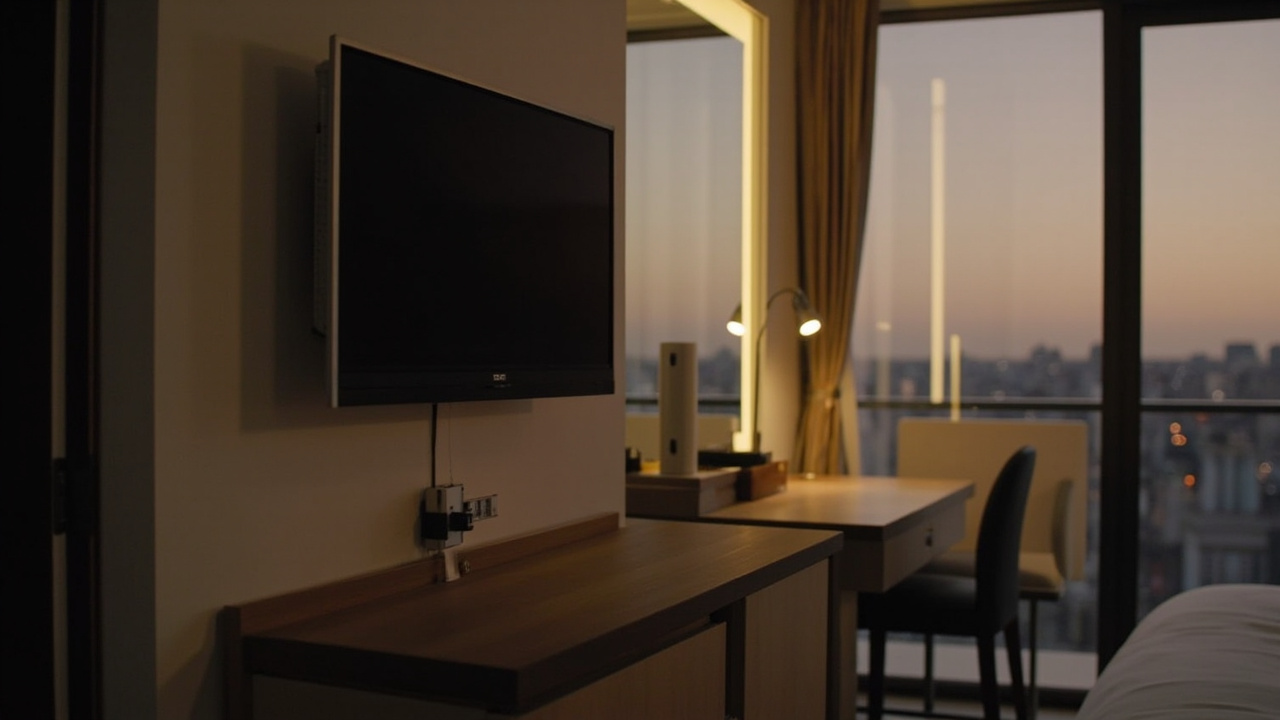
A modern hotel room at dusk illustrates the physical endpoint: a television may show a clean interface while the compact operator box remains hidden behind it. That visual simplicity depends on network reliability, heat dissipation, IR or control integration and remote recovery.
| Situation | Primary requirement | Model direction |
|---|---|---|
| • IPTV or OTT operator | • Stable middleware, device management, DRM position and repeatable fleet provisioning | • Compare DM21P, DM21S and DM21T against operator middleware and licensing requirements |
| • AV/IT integrator | • Defined HDMI, network, USB and control interfaces; deterministic configuration | • Review DM16N for AV-over-IP or meeting-engine requirements |
| • Hospitality or commercial venue | • Compact installation, remote maintenance, thermal stability and simple recovery | • Review DM21S or DM21T according to decode, Android generation and port needs |
| • Enterprise meeting engine | • HDMI input, high-bandwidth Ethernet, PoE and edge-compute software | • Use DM16N as the relevant RK3588 reference |
| • Premium UHD or cloud-gaming deployment | • High-frame-rate media path and adequate storage, memory and networking | • Assess DM21T against the actual display and service load |
An operator should ask whether the Android build supports its device-management architecture, whether DRM licensing can be provisioned at volume and whether the Ethernet option matches the access network. An integrator should verify source and sink direction, display modes, USB peripheral classes, audio routing and control protocols. A venue operator should ask how a failed unit is diagnosed and replaced without a site visit.
The acceptance test changes with ownership. An IPTV operator may test authentication, channel changes, stream restart, network reconnection and a full operating session. An AV integrator may test source-to-display latency, EDID behaviour, audio extraction, control mapping and network failover. A venue may test daily power cycles, remote recovery, audible and visual output, cable retention and heat after prolonged use. The model choice is incomplete until one of these workload tests exists.
Deployment location also affects power and connectivity. The DM16N fact sheet lists DC12V/2A, while DM21P lists DC 5V/2A; the venue must provide the correct supply and cable arrangement. The DM16N dimensions are 135x135x32mm, which allows an engineering check against the planned installation space, but the final mechanical fit still requires the production drawing.
Remote support is another acceptance criterion. Define the recovery method, log access, update path and responsible support boundary before samples arrive. A hidden box cannot depend on a technician walking into every room. For a multi-site android tv box order, include device identification, recovery after network loss, service reinstall procedures and a fleet-level dashboard or monitoring output in the operator workflow.
For android tv box order planning, use the factory quality overview to decide which evidence must accompany the build. For engineering samples, the sample-order route helps ensure the sample configuration becomes the reference configuration.
How to choose, step by step
A practical android tv box order begins with the application, not the product catalogue. Use this sequence to develop an RFQ that a factory can quote and an operations team can inspect.
Step 1: Name the workload
Write the primary use case in one sentence, then list the mandatory media formats, resolution, frame rate, network session count, latency-sensitive functions and operating schedule. “4K Android TV box” is not a workload. “Managed IPTV playback with AV1 and H.265 at 4K@60, operator middleware, daily operation and remote recovery” is closer to an acceptance requirement.
Add the operating boundary to the sentence. State whether the device runs continuously, receives power in a controlled rack, sits behind a television, or operates in a shared meeting room. The boundary affects cooling, network expectations, service recovery and the usefulness of the chosen interfaces.
Step 2: Freeze the physical and network interface matrix
Specify every populated port, supported protocol, required data rate, Ethernet speed, wireless standard, power input and physical dimension. Distinguish standard from optional. If the product must receive an HDMI signal, an output-only platform cannot qualify; DM21T explicitly has no HDMI input, while DM16N includes HDMI in and HDMI out.
Attach the proposed cable and display ecosystem to the matrix. For example, an integrator may need a specific control protocol, USB peripheral class or audio route rather than merely the presence of a connector. The supplier should mark each line “standard”, “optional”, “not supported” or “confirm against production datasheet”, preventing silent assumptions during quotation.
Step 3: Define software and content obligations
State the required Android version or Linux distribution, launcher, middleware, update mechanism, device-management integration, Widevine/PlayReady/HDCP requirement and licence provisioning process. AOSP alone is not a complete software specification.
Also identify the update authority. A managed operator may require controlled staged deployment and a rollback path, while a commercial venue may prefer an appliance with a defined application update process. The quote should state whether the factory, software partner or customer owns image signing, application packaging, remote diagnostics and field recovery.
Step 4: Attach the evidence requirement
Define sample approval, golden-sample control, SMT/AOI evidence, ageing, dark-room inspection, final functional test, traceability and change notification. Identify who signs the production release and who authorises deviations.
The sample plan should include the workload, not just a video playback check. Specify network conditions, stream types, port adapters, remote-control accessories and display modes. State how many units are needed for parallel testing and how long the approved sample remains the baseline. These details convert a demonstration into a repeatable acceptance gate.
Step 5: Issue pasteable RFQ lines
A quotation request should include lines such as:
- “SoC and core configuration: state the exact fitted part and memory/storage options.”
- “Display: state output standard, maximum supported resolution and frame rate.”
- “DRM: state supported modules, certification position and licence/provisioning responsibility.”
- “Interfaces: list fitted ports, protocol versions and optional variants.”
- “Firmware: name the Android release, image branch and update responsibility.”
- “Quality: provide the agreed inspection, ageing, dark-room and traceability records.”
- “Change control: require prior approval for BOM, PCB, firmware and component substitutions.”
- “Acceptance: define the workload test, sample configuration and golden-sample reference.”
- “Handover: provide the production datasheet, configuration record and release index.”
For the first message in an android tv box order, include target market, deployment scenario, required specification, sample needs and the evidence package. The inquiry page is the appropriate route for a technical RFQ; the custom-development page helps determine whether catalogue adaptation or a new platform is the correct starting point.
The RFQ should also ask the supplier to mark every unconfirmed item rather than silently fill the gap. “Not specified” is actionable because engineering can close it before quotation; an implied assumption is not. For an android tv box order involving custom branding, middleware or an unusual port mix, request a written deviation list as part of the response.
What goes wrong after the PO
Most post-order failures begin as ambiguous lines that looked complete during quotation. The factory complied with the order; the application depended on assumptions the RFQ never recorded.
Field trap 1: catalogue equals production
A catalogue image can describe an option, family range or earlier revision rather than the units being built. Cost of error: a fleet is populated with the wrong RAM tier, Ethernet speed, wireless configuration or DRM position, and correction requires rework, recollection or field replacement. Prevent it by requiring the production datasheet, golden sample and packed-box label to match an approved configuration record.
Field trap 2: component substitution without regression
A factory may replace a memory, Wi-Fi/Bluetooth module, power supply or display-related component for availability. Cost of error: drivers, thermals, certification or antenna performance change without a matching test gate. Prevent it by defining approved alternatives, notification timing, regression scope and the authority for acceptance in the quality agreement.
Software creates another divergence. A factory may deliver a later AOSP image, a different launcher behaviour, a modified update service or an altered remote-control mapping. The hardware may still match the BOM, but the service is no longer the image reviewed during sample approval. Pin the release by build identifier, prohibit unreviewed branch moves and define update responsibility.
Thermal acceptance can also diverge. “Burn-in passed” may mean a different duration, load and ambient condition from the operator’s real deployment. Require the test profile and acceptance criterion to match the workload. Similarly, “DRM supported” may not include a production licence, service integration or device-provisioning process. Put responsibility for each element into the acceptance matrix.
Accessory drift is another common field failure. The box may match the sample while the remote, power adapter, HDMI cable, mounting hardware or packaging differs. A low-cost accessory substitution can affect control range, power behaviour, display compatibility and installation time. List every accessory by part or specification, then require the packing record to show what was actually placed in each carton.
Software-licence failures often appear only after deployment. The hardware passes playback, but identity provisioning, licence retrieval or catalogue access fails at scale. Test the complete content path with production credentials and representative protected streams before shipment. This applies whether Widevine L1 or PlayReady is optional on the catalogue line, because the selected commercial service still needs a tested production arrangement.
The most effective safeguard is a production release gate. Before shipment, compare the packed configuration against the approved sample; confirm the firmware build; reconcile test records by serial number; review deviations; and record who accepted any exception. For a repeat-volume android tv box order, this gate should recur for each production batch rather than depend on a one-time sample inspection.
Finally, distinguish a factory defect from an integration limitation. A useful corrective-action record links the reported symptom to device serial number, image build, test step and disposition. If the root cause sits in middleware, display compatibility, network policy or site infrastructure, the factory cannot close it through component replacement alone. The procurement contract should define escalation, defect classification and the evidence each party must provide.
A damaged or incomplete shipment can also complicate traceability. Require the shipment release to reconcile carton count, serial range, packing inspection and inspection status. Any missing serial should trigger containment before delivery rather than becoming a field investigation. For a repeat programme, review this reconciliation at each batch release and preserve the approved configuration record used to make the decision.
Further reading
- TV Box Order Process: The Question Buyers Get Wrong
- Android TV boxes
- Rockchip Android TV boxes
- Edge computing boxes
- 4K 60fps Android TV box guide
- DataMax DM16N specifications and fit
- DataMax DM21P specifications and fit
FAQ
Is RK3588 sufficient for an IPTV set-top box?
Not by itself. RK3588 can support demanding media workloads, but an IPTV purchase also depends on the Android build, operator middleware, DRM licensing, memory, storage, Ethernet option, thermal design and output specification. For an android tv box order, define those requirements before comparing models and ask the supplier to identify every field that remains unconfirmed.
Which DataMax model includes HDMI input?
The DM16N includes HDMI input x1 and HDMI output x1, alongside RJ45 1000M with PoE and Type-C DP1.4. The DM21T explicitly has no HDMI input. Confirm the complete interface list against the production datasheet before release, including whether the required adapter, control method and network configuration are part of the intended application.
Should the first sample match the production build exactly?
Yes. The sample should represent the intended production configuration, enclosure, image, accessories and labelling. If it does not, discrepancies can invalidate sample approval. Require a golden-sample record and define when a later build requires reapproval.
What factory evidence should accompany an android tv box order?
Request evidence covering the released BOM and image, SMT/AOI results, assembly verification, functional testing, ageing, dark-room inspection, serial traceability, final audit and change control. The exact document format and test regime should be agreed in the quality plan, with a named owner for each record.
Does Widevine L1 automatically mean the box is ready for a commercial service?
No. The licence model, certification status, provisioning method, device identity and service integration must also be confirmed. A product marked with optional Widevine L1 requires a production configuration decision before shipment, followed by a protected-content test using the intended service credentials.
How do I choose between DM21S and DM21T?
Compare the service requirement with the released configuration. DM21S uses Amlogic S905Y5 with AOSP Android 14 and lists 4K@60 AV1/H.265 support; DM21T uses Amlogic S905X5 with AOSP Android 14 and lists 4K@120 decode paths plus inline AI-SR. Confirm output, storage, networking and DRM against the production datasheet.


