

The procurement answer in one screen
The procurement problem for DTH operators moving into campus housing is not simply which android tv box supports 4K. It is which platform can survive a multi-year deployment where HDMI topology, fixed Ethernet, in-room service, operator middleware, content protection, and resident turnover all create different acceptance tests than a retail launch.
No third-party benchmark is supplied for this angle, so a defensible numerical opening cannot be invented. The decision instead reduces to 3 procurement questions: which operator middleware and conditional-access ecosystem must run, whether the network is managed Ethernet or resident Wi-Fi, and which video, DRM, and service-access failures trigger replacement. The fourth question is whether each room needs a shared decoder or an independent stream.
For most campus-housing programmes, begin with DataMax DM21P for an IPTV or operator-middleware position, then qualify DM21S where a newer AOSP Android 14 baseline and white-label flexibility matter. If the programme requires a Google-certified non-Google-TV SKU, evaluate DM21RTD. Premium gaming or higher decode capability points to DM21T, although its bill of differences must be justified by a resident-facing workload rather than a feature checklist.
Do not convert “DTH” into a satellite-tuner specification without an explicit product fact. None of the listed DataMax platforms states a satellite tuner, LNB interface, DVB-S/S2 demodulator, or conditional-access slot. If satellite reception is inside the device rather than supplied by an external gateway, that requirement needs written confirmation against the production datasheet. This is a decisive boundary for any android tv box RFQ.
The one-screen answer is therefore conditional: use an operator-controlled AOSP platform when the operator owns provisioning, middleware and updates; use the GMS-certified position only when the application-distribution model requires it; and add higher decode, memory or USB bandwidth only when the workload can be measured. Before volume release, require a golden sample, an identified production SKU, a room-network test and a pilot gate. A laboratory feature list is not a campus acceptance result. For each proposed platform, the procurement file should identify the source boundary, operating-system position, exact Ethernet configuration, codec and DRM matrix, update mechanism, failure ownership and evidence needed for release. This approach separates the commercial question, “Which model is quoted?”, from the operational question, “Which failure is allowed to leave the resident without service?”
Real DataMax platforms, field by field
The correct comparison starts with the deployment role, not the processor generation. DataMax lists 4 L1 platforms for this review, with 3 operating-system positions: AOSP Android 11, GMS-certified AOSP, and AOSP Android 14. The table reproduces only the supplied product facts.
| Model | Position | SoC and OS | Memory | Video and DRM | Interfaces |
|---|---|---|---|---|---|
| DM21P | 4K IPTV / operator middleware set-top box | Amlogic S905Y4, quad Cortex-A35; AOSP Android 11 | 2GB / 8GB; 4GB; 16/32/64GB optional | AV1 [email protected]; VP9/H.265 4K@60; H.264 4K@30; Widevine L1 / PlayReady / HDCP 2.2 optional | HDMI 2.0b out x1; USB2.0 x2; TF; S/PDIF; 3.5mm AV; RJ45 100M; Wi-Fi6 2x2 + BT5.4; DC 5V/2A |
| DM21RTD | Operators/retail requiring a Google-certified non-Google-TV (AOSP+GMS) SKU | Realtek RTD1325; GMS-certified AOSP | Confirm against the production datasheet | AV1 capable | Confirm against the production datasheet |
| DM21S | 4K Android TV box for IPTV/OTT white-label | Amlogic S905Y5, quad Cortex-A55; AOSP Android 14 | 2GB / 16GB; 2/4/8GB; 16/32/64GB optional | AV1 / H.265 [email protected] 4K@60; Widevine L1 / PlayReady optional; Dolby Vision/DTS | HDMI 2.0b out; S/PDIF; AV; USB2.0 x2; TF; RJ45 100M; 1G optional; Wi-Fi6 2x2 + BT5.4 |
| DM21T | Premium UHD / cloud-gaming box | Amlogic S905X5, quad Cortex-A510 (ARMv9); AOSP Android 14 | 4GB / 64GB family options | H.266/VVC [email protected] 4K@120; AV1/VP9/H.265 4K@120; AVS3 4K@120; H.264 4K@60; inline AI-SR; Widevine L1 / PlayReady optional | HDMI 2.0b out, no HDMI in; USB2.0 x1 + USB3.0 x1; TF; S/PDIF; AV; RJ45 100M, 1G optional; Wi-Fi6 + BT5.4 |
Three quotation traps are visible in the specifications. First, “AOSP Android 14” does not mean Google-certified Android TV; that distinction matters when the acceptance plan depends on a specific application store or GMS distribution path. Second, optional RJ45 variants must be identified by SKU. Third, “AV1 capable” on DM21RTD is not equivalent to the explicit resolution and profile language supplied for the other models.
The interfaces also affect room installation. DM21P and DM21S specify RJ45 100M, with 1G optional on DM21S; DM21T also states RJ45 100M and 1G optional. DM21RTD’s interface list is not supplied, so do not infer that it matches another model. HDMI output count and version can be quoted, but an HDMI input requirement should not be assumed. DM21T expressly has no HDMI input, which may matter where a local console or resident source must be routed through the box.
For platform context, use the broader guide to Android TV box for ISPs when the procurement spans WAN management, middleware, or access-network design. This article remains limited to the campus-housing and DTH-operator angle.
The table also exposes where the RFQ needs supplementary evidence. DM21P lists a DC 5V/2A input, so a campus rollout must match the actual power-supply and outlet plan to that stated requirement. DM21P and DM21S specify Wi-Fi6 2x2 with BT5.4, but the operator still needs to decide whether wireless is a fallback, a local configuration channel or a prohibited video bearer. DM21S and DM21T include a 1G Ethernet option, but “1G optional” is not a deliverable configuration. Write one exact network SKU into the order.
Memory wording also requires precision. DM21P has a 2GB / 8GB base, an additional stated 4GB option and optional 16GB, 32GB or 64GB storage. DM21S has a 2GB / 16GB base, stated 2GB, 4GB or 8GB RAM alternatives and optional 16GB, 32GB or 64GB storage. The buyer should identify the exact memory and storage configuration in the quote because middleware, cached guide data and resident applications can change storage pressure without changing the model name.
Buyer situations, ranked by what they punish
A buyer’s pain point determines which platform specification deserves priority. The matrix below ranks common situations editorially from 1 to 5, where 5 indicates the situation heavily penalizes the associated failure. It is not measured market data.
| Situation | Primary requirement | Failure most penalized | Model direction | Editorial pain score |
|---|---|---|---|---|
| Managed campus IPTV with operator middleware | Stable middleware, fixed-network access, controlled deployment | Provisioning or service-authentication failure | Start with DM21P; consider DM21S for white-label work | 5 |
| DTH feed received through an external gateway | Defined video path, DRM, and HDMI topology | Black screen, unsupported codec, or protected-content failure | DM21P for its stated decode set; DM21S for AV1/H.265 4K@60 | 5 |
| Google-dependent application distribution | Google-certified non-Google-TV position | Application unavailable because AOSP-only assumptions were wrong | DM21RTD, subject to written GMS and interface confirmation | 4 |
| Resident gaming and premium entertainment | Higher decode capability and USB bandwidth | Latency, frame-rate loss, or peripheral contention | DM21T | 4 |
| Large room or shared-wall installation | Stable Ethernet and serviceable cabling | Wi-Fi congestion or undocumented 1G SKU variation | Choose a written 100M or 1G configuration; DM21S or DM21T with optional 1G | 3 |
| Room turnover with simple resident onboarding | Repeatable activation and account recovery | Middleware configuration drift across a large fleet | Operator-controlled platform such as DM21P | 3 |
The highest-penalty situation is managed campus IPTV because one middleware defect can affect many rooms. In this model, “support” is not enough: the operator needs image provisioning, package installation, secure activation, diagnostic access, and a controlled update path. The procurement should require evidence that a production image, middleware build, and operator configuration survive restart, network interruption, and re-registration.
A DTH programme introduces another boundary. If the box receives an already-decoded HDMI feed, satellite head-end details may not belong in the box RFQ. If the box must tune a DTH signal, the listed product facts do not establish that capability. Split the RFQ into gateway, transport, decoder, and display functions so a supplier cannot imply that one component supplies all 4.
Retail-campus models with consumer application expectations are different again. DM21S offers AOSP Android 14 and a 2GB / 16GB base configuration, with alternative memory options, but the acceptance test must confirm the exact application and DRM path. Premium gaming creates a narrower requirement: DM21T’s specified 4K@120 decode paths, 4GB / 64GB family configuration, and USB3.0 may justify it, while remote rendering and network latency still require separate test methods.
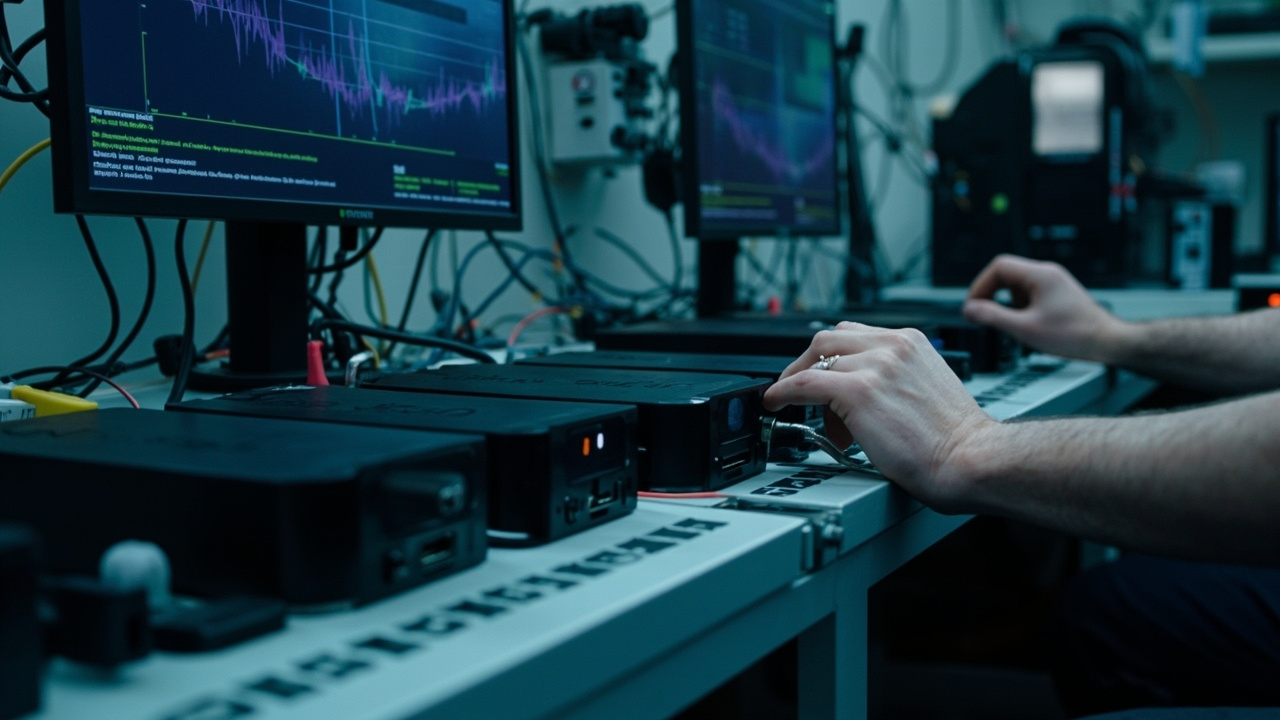
A real deployment lab exposes failures that a product photograph conceals: inconsistent HDMI handshakes, marginal Ethernet links, power-supply differences, and heat-related behaviour after sustained playback. The specified camera scene should therefore be treated as a test-environment reference, not evidence that a particular DataMax unit has passed any certification.
One further distinction separates a campus operator from a room-by-room installer. The operator may need centralized identity, entitlement and fleet visibility, whereas the installer may only need a local reset path and a stable resident interface. Both roles should be represented in the RFQ, but their acceptance evidence differs. The operator needs device identity, middleware version, package status and network reachability. The installer needs a repeatable physical replacement process, labelled cabling, a defined power position and an HDMI/display connection procedure. If the same box must support both roles, require separate documentation rather than one ambiguous “support” statement.
A shared-wall installation also changes the video-path decision. A bedroom television may be the only display and may expose only HDMI input, while a shared wall system may have a fixed input, limited control and centrally managed audio. Neither case justifies assuming an HDMI input on the set-top box. State whether the endpoint must accept a resident source, pass through a source or render only operator content. That line prevents an installer from discovering a physical limitation after room handover.
A decision path for the RFQ
The selection process should force each unknown into a named interface and test. Start by documenting whether DTH is received by an external set-top gateway, a campus television service, or a building media system. Next, define the mandatory video path, including resolution, refresh rate, HDR policy, audio output, and whether protected content must traverse the proposed chain.
Gateway, multicast, IPTV, HDMI
Codec, profile, licence path
Ethernet, Wi-Fi, HDMI, audio
Middleware, OTA, recovery
After mapping that chain, select the operating-system position. Choose AOSP when the operator controls deployment and application distribution; specify GMS-certified AOSP when the commercial model requires the supplied DM21RTD qualification. Then choose the device tier according to the workload rather than a generic premium label.
- State the source boundary Paste a line such as: “The STB receives 1080p or 4K service from the campus gateway over HDMI; satellite tuning, LNB control, and DVB demodulation are outside the device scope.”
- State the service requirement Specify operator middleware, account model, channel lineup, parental controls, guide data, and whether an external service guide is required.
- State the connectivity requirement Require RJ45 100M as the minimum written configuration or identify a specific 1G SKU where DM21S or DM21T is proposed; separately state whether Wi-Fi6 is permitted as a fallback.
- State the media requirement Identify the required codec, bitrate, resolution, refresh rate, HDR format, audio format, and DRM requirement. Do not let “4K box” substitute for a profile-level acceptance criterion.
- State the operating requirement Specify image signing, update method, rollback behavior, recovery after power loss, remote diagnostics, and the owner of device identity and middleware configuration.
- State the verification requirement Require the selected golden sample, an agreed pilot batch, test evidence, defect classification, and written sign-off before volume deployment.
The result should be a model shortlist rather than an open catalogue request. For example: “Evaluate DM21P as the operator-middleware baseline and DM21S as the Android 14 white-label alternative; include a pilot that validates the stated decode set, DRM configuration, Ethernet path, restart recovery, and room-installation process.” That line creates comparable evidence rather than comparing brochure claims.
Before sending the request, use the inquiry page with a first message containing the source boundary, target room count, Ethernet topology, middleware requirements, codec/DRM matrix, OS certification position, and the proposed pilot gate. The first message should not contain only “please quote an android tv box for campus housing.”
A useful RFQ also separates mandatory and desirable lines. Mark the source path, operating-system position, network bearer, channel codec profiles, DRM server flow and recovery behavior as mandatory. Mark higher storage, Wi-Fi use, premium decode paths or gaming features as conditional on workload evidence. A bidder can then show the price and engineering effect of each conditional item without guessing which requirement can be relaxed.
The evaluation sheet should also identify who owns each interface. The DTH operator owns the satellite or IPTV source, service entitlement and account policy. The integrator owns the room cabling, television settings and physical installation. DataMax can own the platform hardware and supplied software boundary, while the middleware supplier or operator owns the operator application. Where an android tv box is used, assigning ownership prevents an “end-to-end” statement from concealing an untested handover.
What goes wrong after the PO
Most post-PO failures originate from ambiguities that appeared harmless in the quotation. A catalogue line can describe decoding capability while omitting the actual service profile, DRM licence flow, output mode, or network persistence. The purchase order then becomes the first document that exposes which assumptions were never validated.
Field trap 1
A “DTH-ready” description may conceal an external gateway requirement. If the RFQ does not define satellite tuning, LNB control, DVB demodulation, and conditional-access ownership, the supplier may deliver a decoder-only endpoint while the operator assumes tuner support. Confirm any tuner requirement against the production datasheet; do not infer it from the DTH use case.
Field trap 2
Optional Ethernet speed, optional DRM, and optional memory create quotation ambiguity. DM21S states RJ45 100M with 1G optional, while several DRM and memory choices are marked optional. A purchase order lacking the exact SKU can therefore diverge from the unit accepted during the pilot.
Other common failure modes are operational. A fixed Ethernet deployment that falls back to congested Wi-Fi may show acceptable laboratory playback but poor service at peak hours. A middleware image that boots once may fail after a power cut if state recovery, entitlement refresh, or package persistence is not tested. A playback claim based on one codec may conceal a mismatch between channel packaging, decoder profile, display capability, and output configuration.
The acceptance plan should separate 4 defect classes. Functional defects prevent the required channel, interface, or middleware task from completing. Compatibility defects appear only with the operator’s actual gateway, middleware, DRM server, display, or audio system. Scale defects appear after sustained concurrency, elevated room temperature, or repeated network changes. Lifecycle defects appear after software updates, account recovery, or device replacement.
Assign each defect a response before pilot approval: replace the unit, correct the image, change the network or source configuration, or revise the service contract. Without that mapping, a visually normal playback test can conceal a fleet-wide recovery weakness.
A fourth failure mode is configuration drift between the pilot and the production shipment. Even when the model number is unchanged, an optional 1G Ethernet configuration, a different DRM option, a different memory variant or a changed software image can alter the tested unit. Require the production SKU, image identifier and interface configuration to be recorded on the purchase order, carton, serial record and test report. A pilot signed off by model name alone provides weak protection against substitution.
Resident turnover creates another post-PO failure. A unit may pass service activation under an installer account but fail when a new resident starts a fresh session, an entitlement expires or the previous resident’s state remains cached. Test empty-device enrollment, second-account activation, logout, token expiry and reactivation after restart. These are not edge cases in a housing estate: room change and account turnover are normal operating events.
The remedy should be agreed before shipment. Define whether the operator can remotely re-provision the device, whether middleware state must be reset, how long recovery may take, and who pays for physical replacement. A device-management platform does not remove the need for a documented fallback when the network or management server is unavailable.
Verification you can ask for on paper
Factory verification should be tied to observable production stages rather than a generic quality statement. The supplier’s evidence trail should connect the ordered SKU, component lot, software image, test result, and shipment record. For campus programmes, trace the chain from goods-in through assembly, firmware programming, functional testing, ageing, and final inspection.
- SMT and AOI evidence Request inspection records for the production lot, including the inspection method, sampling rule, defect classification, and disposition of anomalies.
- Software flashing evidence Require the approved image identifier, flashing record, boot result, and provisioning status for the sample or audit population.
- Functional and dark-room evidence Ask for HDMI output, audio, USB, Ethernet, Wi-Fi, Bluetooth, decoding, and display-pattern results as applicable to the selected model.
- Ageing evidence Request the thermal or burn-in procedure, duration, sample coverage, and exception handling used before shipment.
- Audit traceability Link the final carton or serial identifier to the test record and production lot.
Request the test report as controlled evidence, not as a checkbox. Each line should identify the tested SKU, firmware image, fixture or instrument, pass criterion, result, and serial or lot coverage. A laboratory report for a nominal sample does not replace pilot evidence across the operator’s gateway, middleware, DRM, display, and campus network.
The factory evidence answers whether the unit was built and tested consistently; the pilot answers whether it works in the intended system. Keep those layers separate. A factory can demonstrate repeatable HDMI, codec, network, and boot tests without proving interoperability with a specific DTH operator backend.
DataMax’s factory-quality and compliance routes can provide the appropriate starting point for the documentation request. Use factory quality, certifications, and compliance as document categories in the RFQ. For programmes requiring custom middleware, imagery, packaging, or deployment tooling, define custom development deliverables separately from standard hardware qualification.
Before accepting a pilot gate, include at least 6 test scenarios: cold start, warm restart after interrupted playback, loss and restoration of Ethernet, licensed-channel playback, channel change, and account reactivation after a forced restart. Add a sustained playback case using the operator’s longest production shift. The exact sample count should follow the operator’s risk and fleet scale rather than an unsupported universal number.
The evidence package should also show how nonconforming units are contained. Request the segregation rule for a failed board or image, the identification method, the disposition decision and the link between reworked units and their retest records. Otherwise, a correction can remain invisible in the shipment file even when the board itself was repaired.
For hardware configuration, request a model-to-SKU cross-reference that distinguishes base, optional and unavailable interfaces. The same cross-reference should identify the required power adapter, HDMI output arrangement, Ethernet option and software image for each quotation. This is particularly important where campus hardware is bought through a distributor, because the distributor’s description can compress several hardware variants into one model family.
Entry tier versus commitment tier
“Entry” and “commitment” describe the procurement role, not a DataMax marketing classification. The entry position is a platform selected for straightforward operator middleware or IPTV/OTT delivery. The commitment position supports broader decoding, newer AOSP Android 14, more storage, cloud-gaming requirements, or a documented GMS distribution need.
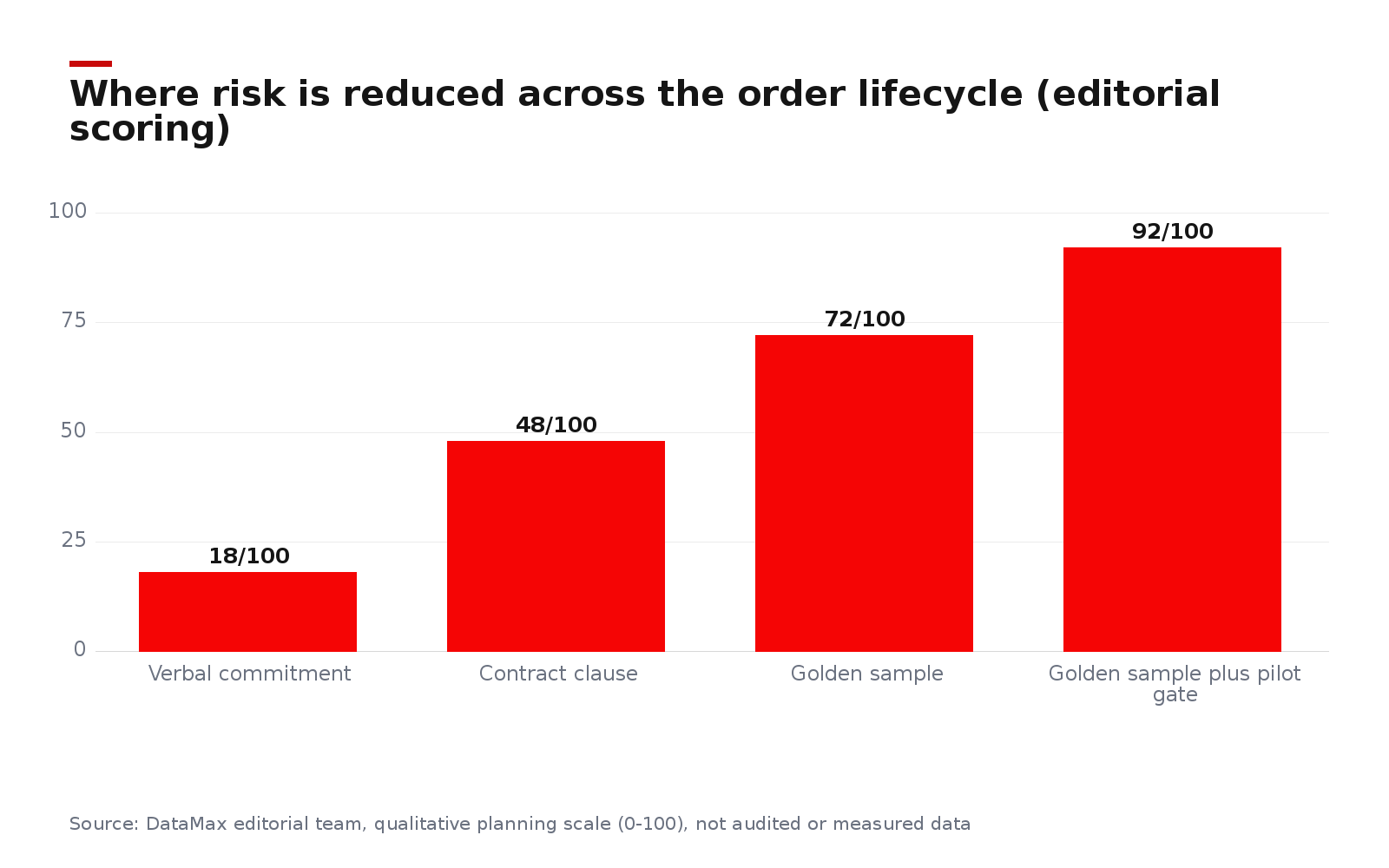
The same figures, in searchable form:
| Control option | Editorial score |
|---|---|
| Verbal commitment | 18/100 |
| Contract clause | 48/100 |
| Golden sample | 72/100 |
| Golden sample plus pilot gate | 92/100 |
Source: DataMax editorial team, qualitative planning scale (0-100), not audited or measured data. The scale ranks lifecycle controls and is not a performance measurement.
On model selection, DM21P is the clearest operator-middleware starting point because its supplied fit explicitly names 4K IPTV and operator middleware. Its 2GB / 8GB base, optional higher memory, 100M RJ45, and stated 2K USB configuration create a conventional endpoint. Its decode set includes AV1 [email protected], VP9/H.265 4K@60, and H.264 4K@30; the actual channel and DRM matrix still needs testing.
DM21S shifts the tier toward Android 14 white-label work. It offers 2GB / 16GB as the base configuration, optional alternative memory, AV1 / H.265 [email protected] 4K@60, optional 1G Ethernet, and a stated Dolby Vision/DTS position. That is a broader bill of differences, but it does not mean every DTH room needs those capabilities. “White-label” procurement should instead compare the exact image, app packaging, remote-control behavior, and operator branding deliverables.
DM21RTD solves a different ownership question: whether the programme needs a Google-certified non-Google-TV SKU. Its supplied facts are intentionally narrow, so an RFQ cannot responsibly fill in memory, ports, or detailed video profiles by analogy. Request the production datasheet before comparing its bill.
DM21T represents the largest stated capability step: 4GB / 64GB family options, 4K@120 decode paths including H.266/VVC [email protected], USB3.0, and no HDMI input. Its output and decode ceiling must be treated as 4K; do not substitute a marketing 8K claim for the supplied datasheet limit. For a DTH campus estate, the additional bill only makes sense where high-frame-rate or cloud-gaming workloads are contractual.
The practical commitment tier is therefore a procurement package, not a processor class. It combines an identified hardware SKU, a controlled image, a golden unit, acceptance evidence and a production-equivalence clause. The score shown above is an editorial ranking: a verbal statement may be forgotten, a contract clause creates a record, a golden sample fixes the configuration and a pilot gate tests that configuration in service. The scale does not measure product failure rates or supplier performance.
A buyer can also calculate the commercial consequence of a wrong tier. An unnecessary premium device adds acquisition cost, power and thermal load, installation complexity and a larger software-qualification burden. An under-specified entry device can create replacement logistics, resident complaints and repeated field visits. The correct comparison therefore includes the room-installation kit, firmware validation, middleware integration and support process—not only the box configuration.
The mechanism behind the spec
A set-top box converts an input service into a protected video and audio output. In an IPTV design, the network transport, middleware application, decoder, DRM licence service, and television display operate as distinct layers. In a DTH design, a tuner and demodulator may sit upstream or inside the endpoint. That architectural boundary explains why an android tv box fit cannot substitute for a DTH tuner specification.
For campus IPTV, Ethernet normally supplies the service path, while HDMI carries the rendered signal to the television or wall display. The operator middleware handles channel navigation, entitlement, guide information, and interaction with backend systems. AOSP identifies the Android platform basis, but it does not itself define the operator’s middleware, content rights, account provisioning, or device-management service.
DRM adds another stage. Widevine L1 or PlayReady identifies a protected-content path for platforms that offer it, while HDCP 2.2 optional is stated for DM21P. A successful playback test must therefore cover the relevant licence request, policy response, output path, and display capability. “DRM optional” in the model table means the exact production configuration must be identified in the order and sample.
Video specifications operate at several levels. “AV1” names a codec family; “[email protected]” adds profile and level; “4K@60” adds output performance intent. None of those labels alone proves that a particular operator stream, television, HDMI configuration, and middleware pipeline interoperate. The right acceptance test is the complete service chain.
Wi-Fi6 2x2 and BT5.4 are stated on DM21P and DM21S; DM21T lists Wi-Fi6 plus BT5.4. For campus housing, Wi-Fi may be resident-facing, staff-managed, or forbidden for video delivery. The specification must state the intended bearer and test radio conditions rather than treating the wireless interface as interchangeable with RJ45.
- External DTH gateway: tuning and demodulation may be upstream
- Campus IPTV: multicast or unicast delivery depends on network design
- Operator middleware and entitlement
- DRM licence exchange and policy enforcement
- Codec, profile, level, resolution, and refresh rate
- Audio format and HDMI output configuration
- Ethernet, Wi-Fi, television input, sound system, and power
- Resident onboarding, diagnostics, recovery, and physical service access
This mechanism explains the procurement principle: choose the least complex platform that satisfies the measured service path, then place the burden of interoperability on the pilot rather than on feature language. For adjacent ISP and network-selection decisions, the broader guide to Android TV box for ISPs provides the canonical context. To move this DTH campus-housing specification into a controlled quote, use order samples and state the source boundary, middleware, connectivity, media matrix, OS position, and pilot acceptance criteria in the first message.
The same chain applies to an external DTH gateway. The gateway may perform satellite tuning, LNB control and DVB demodulation before providing an IP, multicast or HDMI service. The room box then performs device management, middleware navigation, decoding and protected-content output. If the gateway provides only a decoded HDMI signal, codec and DRM requirements may reside upstream. If the box receives a transport stream, the endpoint becomes responsible for demuxing, decoding and rendering. These are different RFQs.
Conditional access should be traced separately from DRM. A satellite access system can authorize a channel service before transport, while DRM licenses govern protected digital content and output policy. Requiring “DRM” does not identify a satellite conditional-access mechanism, and requiring “DTH” does not prove a Widevine or PlayReady license flow. Name each authority, server endpoint and failure responsibility in the service description.
Finally, the display must be treated as part of the tested path. HDMI 2.0b output, the television’s accepted mode, HDCP support, refresh rate and audio format can determine whether an otherwise valid stream is visible or audible. For DM21P, the optional HDCP 2.2 status should be settled before a protected-content pilot. For DM21T, the stated 4K@120 decode capability must be matched to the actual display mode; the datasheet ceiling remains 4K.
Further reading
- Guide android tv box for isps
- Amlogic Android TV boxes
- Google TV devices
- AV1 Android TV box guide
- AOSP vs Google TV guide
- DataMax DM21P specifications and fit
- DataMax DM21RTD specifications and fit
FAQ
Does a DTH campus-housing box need an internal satellite tuner?
Not necessarily. If a gateway performs satellite tuning, demodulation, and conditional access before sending video to the room endpoint, the box can function as an IPTV or OTT decoder. If the device must tune the DTH signal directly, the listed facts do not establish that capability. State the architecture explicitly and confirm any tuner, LNB, DVB, and CA requirement against the production datasheet.
Which model fits a managed campus operator middleware deployment?
DM21P is the direct starting point because its supplied fit identifies 4K IPTV and operator middleware. DM21S is the alternative where AOSP Android 14 and white-label requirements dominate. Selection should still follow validation of middleware compatibility, Ethernet configuration, decode profiles, DRM, recovery, and the operator’s gateway.
Should campus rooms use Ethernet or Wi-Fi for video?
Use the bearer specified by the service design, not by the box’s broadest radio claim. Ethernet is generally the more deterministic route for managed video delivery, while resident Wi-Fi introduces contention and coverage variables. Require RJ45 100M or an identified 1G SKU in writing, and test the actual room Wi-Fi environment separately.
Is a Google-certified Android TV SKU required?
Only if the programme’s application distribution or commercial requirements call for that qualification. DM21RTD is supplied as a Google-certified non-Google-TV AOSP+GMS SKU. AOSP Android 11 on DM21P and AOSP Android 14 on DM21S or DM21T should not be described as GMS-certified or as Google TV without separate confirmation.
Which platform should support premium cloud gaming?
DM21T is the stated premium UHD and cloud-gaming direction, with 4GB / 64GB family options, specific 4K@120 decode paths, and USB3.0. Cloud gaming still depends on network latency, service rendering, input, and platform support, so the supplier’s gateway and middleware must be tested with the device.
What should the pilot prove before campus rollout?
The pilot should prove the complete service chain: required codec and profile, DRM path, middleware activation, channel change, Ethernet or Wi-Fi behaviour, HDMI and audio output, restart recovery, account reactivation, and sustained playback. It should also establish the failure-replacement process and confirm that the production unit matches the golden sample.


