

The short answer first
Before approving an Android TV box quotation, confirm 5 connected items: the operating environment, the device tier, the middleware and application boundary, the media-security arrangement, and the evidence package. Each must be verified against a written requirement, a production sample, or a traceable factory record; a product-page caption alone is not enough.
android tv box what-is is best understood as a definition question rather than a shopping question: it asks what software platform, hardware, licensing, and supplier commitment are included in the box. The useful answer distinguishes an operator-grade IPTV terminal from a general Android TV consumer device. The Android TV box glossary and index provides the broader vocabulary; this page focuses on the terms an IPTV operator should place in a tender and the depth of adaptation behind each quotation.
The small checklist below maps each approval item to its verification method. It also establishes the central procurement rule: a quotation should identify the production SKU, not merely describe a platform family.
For an operator middleware terminal, verification should follow a traceable sequence: define the commercial service profile, select the appropriate platform family, assign software and DRM obligations, map deployment interfaces, then audit production evidence. Hardware described as “Android TV” does not by itself prove an operator application, a GMS entitlement, a device-level Widevine L1 implementation, or a suitable update process.
Treat the phrase as a scope-control prompt. For example, a tender for “an android tv box what-is a 4K operator terminal with Widevine L1” contains a product-category term, a media requirement, and a device role, but it omits the OS image, memory, ports, middleware, update channel, and acceptance evidence. The procurement team should rewrite it as an attributable requirement line before comparing bids.
Two routes, one bill of differences
A procurement request generally resolves into 2 commercial routes: a defined configuration based on an existing platform, or a deeper joint hardware/software engagement. The distinction changes responsibilities, validation scope, and the evidence expected before shipment. It should not be left to the phrase “custom box” in a quotation.
Known hardware and OS
and app integration
Hardware plus software
| Procurement element | Defined configuration route | Joint hardware/software route |
|---|---|---|
| Starting point | Published or previously validated platform | Operator requirements developed as a new engagement |
| Software work | Boot presentation, launcher, package configuration, and defined middleware changes | Feature branch, application integration, interfaces, and agreed product behaviour |
| Hardware work | Existing ports, memory, enclosure, and electrical configuration | Board, enclosure, thermal, connectivity, or mechanical changes where justified |
| Approval evidence | Golden sample, configuration sheet, test results, and certification records | Requirements traceability, stage-gate prototypes, validation plan, and change-control record |
| Commercial risk | Hidden integration gaps and unlisted configuration assumptions | Longer qualification path and responsibility for requirements drift |
| Decision authority | Procurement can order an approved configuration after configuration review | Engineering approves requirement baselines and stage gates |
| Change control | Configuration is bounded by the selected platform and approved options | Hardware, firmware, interfaces, and documentation change through formal baselines |
| Test ownership | Factory proves standard configuration; buyer proves operator-specific functions | Joint plan allocates functional, regression, environmental, and certification tests |
| Release model | Fixed image plus a defined middleware package | Operator-specific branch with agreed release and recovery responsibility |
| Buyer artefact | Configuration sheet, golden sample, and production evidence index | Requirements traceability matrix, prototypes, validation report, and change log |
The defined route is appropriate when the operator has an existing middleware stack, stable interface requirements, and an approved reference device. The joint route is appropriate when the package must combine operator middleware, a new enclosure, or substantially different hardware and software behaviour. A branded enclosure or launcher by itself is not equivalent to a new hardware platform.
The depth of customization should be stated as a deliverable list rather than a marketing adjective. DataMax can support the full range from logo print to joint ODM, but the supplier response must define which artefacts change: artwork, boot animation, launcher, firmware branch, device tree, boot image, middleware package, remote-control map, update channel, certification filing, or test tooling.
A practical quotation can separate 4 cost and responsibility pools: one-time platform work, recurring software support, per-unit manufacturing, and external certification or laboratory work. This prevents a custom launcher or firmware branch from being confused with a new board design. It also lets the operator compare a defined SKU against a deeper ODM proposal without assuming that the extra engineering scope necessarily improves playback or device reliability.
For route selection, use a trigger table. If the ports, enclosure, thermal target, electrical design, and decoder target already match an approved platform, the defined route is the efficient starting point. If 2 or more core hardware constraints differ from that platform, document why before selecting joint ODM. If only branding differs, keep the software branch separate from any hardware redesign proposal.
How the requirement actually works
An Android TV set-top box is an endpoint, not the complete IPTV service. Its hardware runs an operating system and decoder pipeline; operator middleware handles entitlement, channel navigation, playback orchestration, and often device identity; the head-end or platform supplies service discovery, authentication, authorization, catalogue data, and content delivery. The procurement requirement must identify which of those layers DataMax supplies and which remain operator-owned.
The operating system statement needs precision. “Android 11,” “Android 14,” and “GMS-certified AOSP” are different commercial and compliance positions. Android TV compatibility, Google Play functionality, and GMS certification are separate questions. The certification should be tied to the exact SKU and market, not inherited from a chipset or a related model.
DRM is an equally important architectural boundary. Widevine L1, PlayReady, and HDCP are separate elements:
- A Widevine implementation must match the security level required by the application and service.
- PlayReady support requires its own integration and validation plan.
- HDCP protects the content path and requires attention to display, sink, and output compatibility.
- Dolby Vision or DTS support must be confirmed at the SKU and firmware level rather than inferred from an AV1 label.
Connectivity defines the operating envelope. A 100M RJ45 interface may suit many managed-IPTV deployments, while a 1G option is relevant to higher-throughput or gaming-oriented requirements. Wi-Fi 6 does not replace a predictable wired network in an operator installation where the latter is available.
The release architecture should also be named. Operators need to know how builds are identified, who signs the image, where middleware packages come from, how upgrades are staged, what rollback mechanism exists, and how a security patch reaches deployed devices. A model name and codec table cannot answer those questions.
The application boundary should be expressed through interfaces rather than product names. Require the middleware API version, identity and entitlement interface, catalogue and EPG data format, player capability report, DRM callback behaviour, restart recovery rules, and logging fields. If the operator owns the channel application, specify the build format, signing arrangement, preinstallation method, and upgrade path. If DataMax owns the middleware, the quotation must identify the corresponding milestone and acceptance test.
A procurement example illustrates the distinction. A managed-IPTV tender might require a box to receive a unicast channel list, authenticate a subscriber, retrieve a DRM licence, play a specified codec profile, and recover after network interruption. Each verb creates a separate acceptance test: list loading, authentication, licence acquisition, decode, and recovery. Writing “operator-grade IPTV support” creates no measurable obligation.
Finally, define the operator handover boundary. A complete package may include hardware, boot configuration, launcher, middleware integration, operator applications, manufacturing test, packaging, and certification coordination. Require a responsibility matrix with “supplier supplied,” “operator supplied,” and “jointly controlled” entries. A tender that omits this boundary invites both scope disputes and duplicated integration work.
The same reasoning applies to android tv box what-is terminology in technical appendices. Define each acronym once, identify whether it describes hardware capability, operating-system status, licence state, or test evidence, and attach the document that proves it. This prevents a decoder capability from being treated as an operator integration requirement.
The platform shortlist with datasheet values
The DataMax shortlist covers 4 distinct platform positions: operator middleware, certified AOSP, Android 14 white-label, and premium UHD or cloud-gaming. The table below reproduces the supplied production facts; options remain explicit where stated, and unlisted specifications must be confirmed against the production datasheet.
| Model | SoC and CPU | OS | RAM / ROM | Media and DRM | Ports and connectivity |
|---|---|---|---|---|---|
| DM21P | Amlogic S905Y4, quad Cortex-A35 | AOSP Android 11 | 2GB / 8GB; 4GB; 16/32/64GB optional | AV1 [email protected], VP9/H.265 4K@60, H.264 4K@30; Widevine L1 / PlayReady / HDCP 2.2 optional | HDMI 2.0b out x1, USB2.0 x2, TF, S/PDIF, 3.5mm AV, RJ45 100M, Wi-Fi6 2x2 + BT5.4, DC 5V/2A |
| DM21RTD | Realtek RTD1325 | GMS-certified AOSP | Confirm against the production datasheet | AV1 capable; other media and DRM details not stated | Confirm against the production datasheet |
| DM21S | Amlogic S905Y5, quad Cortex-A55 | AOSP Android 14 | 2GB / 16GB; 2/4/8GB; 16/32/64GB optional | AV1 / H.265 [email protected] 4K@60; Widevine L1 / PlayReady optional; Dolby Vision/DTS | HDMI 2.0b out, S/PDIF, AV, USB2.0 x2, TF, RJ45 100M; 1G optional, Wi-Fi6 2x2 + BT5.4 |
| DM21T | Amlogic S905X5, quad Cortex-A510 (ARMv9) | AOSP Android 14 | 4GB / 64GB family options | H.266/VVC [email protected] 4K@120; AV1/VP9/H.265 4K@120; AVS3 4K@120; H.264 4K@60; inline AI-SR; Widevine L1 / PlayReady optional | HDMI 2.0b out; no HDMI in; USB2.0 x1 + USB3.0 x1, TF, S/PDIF, AV, RJ45 100M; 1G optional, Wi-Fi6 + BT5.4 |
The editorial customization scores below are planning aids, not measured product performance. They show why a quote should specify the intended level of engineering involvement.

The same figures, in searchable form:
| Engagement depth | Editorial score |
|---|---|
| Logo print only | 30/100 |
| Boot logo plus launcher | 55/100 |
| Firmware feature branch | 78/100 |
| Joint hardware/software ODM | 93/100 |
For DM21P, the supplied configuration points toward a 4K IPTV or operator middleware terminal, with Ethernet, AV output, and optional DRM arrangements. For DM21RTD, the distinguishing requirement is a Google-certified non-Google-TV SKU described as GMS-certified AOSP; its exact market certification and remaining hardware details require documentary confirmation. DM21S fits a 4K Android TV IPTV/OTT white-label program, while DM21T addresses premium UHD or cloud-gaming use with higher-format decoding, USB3.0, and no HDMI input.
Selection by model should remain subordinate to production configuration. For example, a quotation for DM21S must state the selected RAM/ROM combination rather than repeat all available options. A DM21T proposal should select either RJ45 100M or the 1G option and identify the exact output profile. A DM21P quote should separately identify its optional DRM arrangement and the included DC 5V/2A supply.
When comparing android tv box what-is answers from different suppliers, normalize the columns before comparing them. Use the same headings for SoC, OS, memory, output, network, DRM, certification, and evidence. If one bidder omits a row, mark it as unconfirmed rather than treating silence as equivalence. The absence of a stated feature is not proof that the production unit lacks it, but it is a valid basis for withholding technical approval.
Deployment scenarios and the spec each needs
Deployment context changes the decisive specification. A telecom operator may optimize for managed Ethernet, deterministic middleware releases, and device identity. An AV integrator may prioritize HDMI and AV outputs, remote-control behaviour, and simple installation. A hospitality or venue operator may need a stable long-life image and a controlled update channel. A gaming-oriented program adds latency, storage, and graphics-related requirements, but the buyer should verify them against the actual application rather than rely on a “gaming” label.
| Situation | Primary requirement | Specification evidence | Model direction | Risk if omitted |
|---|---|---|---|---|
| • IPTV operator managed rollout | • Middleware, identity, DRM, and staged updates | • Middleware interface, release process, DRM level, and device-management scope | • DM21P or DM21S | • Platform outage or unmanaged firmware drift |
| • Operator or retail requiring GMS | • Certified non-Google-TV SKU | • SKU-linked GMS certification record and target-market evidence | • DM21RTD | • Certification applied to the wrong market or model |
| • AV integrator fixed installation | • HDMI, AV, Ethernet, and remote-control integration | • Port map, control protocol, IR/RF behaviour, and sample test | • DM21P or DM21S | • Installation rework across the estate |
| • Hospitality or venue estate | • Stable image, recovery, and long-term support | • OTA architecture, rollback method, spare-unit process, and provisioning control | • Operator middleware or white-label route | • Device recovery requires site attendance |
| • Premium UHD or cloud-gaming program | • 4K@120 formats, storage, and throughput | • Codec profile, HDMI behaviour, network option, application test | • DM21T | • Application and display pipeline are mismatched |
| • Retail self-service application | • GMS status, account workflow, and stable recovery | • Market certification, application compatibility, and reset behaviour | • DM21RTD | • Retail application is blocked or device cannot recover |
| • Enterprise signage site | • Remote management, scheduled launch, and update control | • Device-management interface, boot behaviour, and OTA schedule | • Confirm against the production datasheet | • Screens display stale or unauthorized content |
For an operator rollout, specify the service environment before selecting a model. If playback is local or network-delivered, if multicast is handled upstream, and if the set-top box receives a unicast channel list, the device-side requirement differs. The procurement document should describe the endpoint function rather than merely label the product “IPTV.”
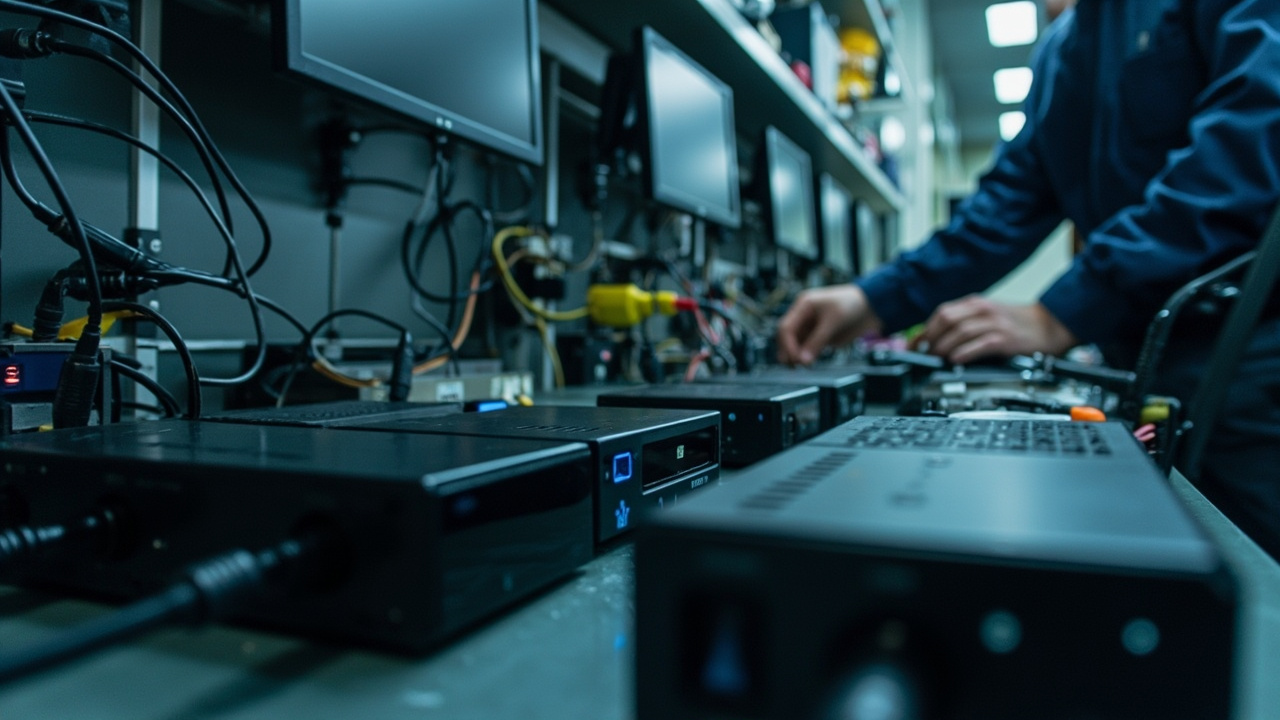
A real laboratory scene for this work contains rows of small black Android set-top boxes connected by HDMI and network cables, test monitors, RF measurement equipment, and engineers adjusting devices. The photograph below illustrates the type of controlled bench environment in which interface and media testing can be documented.
For venue deployments, request a small traceability record from pilot to production: serial-number range, image identifier, middleware version, and accessory revision. That record connects a failed field symptom to a production cohort. It is more operationally useful than a general statement that the product is “operator certified.”
Scenario definition should also cover the operating window. Record whether the device runs continuously, whether remote operation is required, what recovery time is acceptable after power loss, and whether a technician can replace the unit locally. The answers affect network, storage, update, and diagnostics requirements. A retail demonstration box and a hotel-room terminal may use the same model family but require different acceptance tests.
For an AV-integrator package, define the complete signal chain: source format, HDMI mode, display resolution and refresh rate, audio path, control protocol, network topology, and cable standard. For an operator package, define the service chain: identity, catalogue, entitlement, licence request, playback, telemetry, and update. Only then can the buyer determine which interfaces belong in the android tv box what-is specification line.
Turning the question into a spec line
The query “android tv box what-is” should be converted into a testable RFQ rather than answered with a model name. The following sequence prevents hardware selection from outrunning software requirements. It also creates a document structure that can be pasted into a supplier questionnaire without relying on ambiguous marketing language.
- Name the deployment role State whether the endpoint is an operator IPTV terminal, certified AOSP product, white-label OTT device, or premium UHD/gaming box. Include wired-network expectations, display interfaces, controls, and service region.
- Freeze the production SKU Record the model, Android/GMS status, RAM and ROM option, port configuration, power supply, enclosure, and accessory set. Replace “equivalent” with an explicit comparison and require written approval for substitutions.
- Define the software boundary List boot assets, launcher, middleware, operator applications, API level where relevant, update channel, recovery method, signed-image responsibility, and who owns source code or configuration.
- Set the content-security requirement Specify the required DRM, security level, output-protection mechanism, codec profile, resolution, frame rate, and application certification constraints as separate lines.
- Attach the production evidence Request unit serial mapping, SMT and AOI records, aging results, dark-room test evidence, firmware flashing procedure, certification records, and a golden-sample approval reference.
Role and service profile
SKU, OS, memory, ports
Tests and evidence
A pasteable RFQ line might read: “Supply the production [model] with [RAM]/[ROM], [exact port configuration], [operating-system statement], [required DRM and output-protection configuration], [specified codec and output profile], and the approved middleware/image identifier. The supplier shall provide serial-level production-test traceability, aging evidence, dark-room records, and a golden sample; any chipset, memory, OS, or interface substitution requires written approval.”
A second line should prevent commercial ambiguity: “The quotation shall separate hardware NRE, tooling, software integration, certification, application provisioning, packaging, and recurring platform responsibilities. Each line shall identify the deliverable, owner, dependency, acceptance test, and evidence record.”
A third line can govern deviations: “Any proposed change to the SoC, CPU, memory option, operating-system image, port variant, DRM configuration, enclosure, remote control, power supply, accessory, or middleware version shall be submitted with an impact assessment, revised regression-test scope, and written buyer approval before use in production.”
This conversion makes an android tv box what-is request comparable across suppliers. The model becomes one field rather than the entire specification. The buyer can issue the same technical baseline to 3 bidders, require each to state compliance or deviation, and then compare the exceptions with the same decision rules.
Where quotations quietly diverge
Most commercial divergences begin with the same noun but describe different scopes. “Android TV box” can mean the device, the licensed software environment, the application integration, and the operator service. A low quotation may exclude certification, middleware adaptation, secure provisioning, or production test evidence. A high quotation may include services that are already standardized in the operator’s own platform.
Field trap 1
A codec label is not an output guarantee. A supplier may cite AV1 or 4K while leaving the HDMI mode, frame rate, HDR format, display compatibility, and application decode path unstated. The RFQ must bind the required profile to a tested configuration; otherwise a nominally capable SoC can still fail at the display or middleware layer.
Field trap 2
“Google-certified” must identify the actual SKU, certification type, target market, and commercial status. Certification attached to a related model, a chipset, or an earlier build does not validate the offered device. Require a documentary link between the approved production hardware and the certification record.
Other discrepancies appear in memory and storage wording. A base configuration may be 2GB / 16GB while optional values include several alternatives; the quotation must identify what will be fitted, not simply list the range. Ethernet naming also needs care: “RJ45” does not establish speed, and an optional 1G interface must become a selected line item.
DRM quotations require similar precision. “Widevine supported” does not establish L1, a particular security architecture, application compatibility, licence-service behaviour, or the status of the production image. The same applies to PlayReady, HDCP 2.2, Dolby Vision, and DTS.
One common divergence is the meaning of “Android TV.” One bid may mean an AOSP set-top box, another a Google-certified non-Google-TV product, and a third an operator-specific middleware environment. The same physical shell can conceal different software obligations. Require the operating-system statement, image identifier, certification status, and preinstalled application list on separate quotation lines.
Another divergence is update responsibility. The supplier may provide an OTA updater while the operator owns the update server, device-management platform, certificate distribution, and release approval. If the interfaces are not assigned, rollout failures can be misdiagnosed as hardware faults. Define server location, package source, device eligibility, rollout groups, failure reporting, recovery behavior, and rollback authority.
Finally, quote divergences often hide acceptance conditions. One supplier may define “approved” as a functional sample; another may require operator middleware, device management, staged OTA, production certificates, and serialized factory records. Ask each bidder to state its own acceptance criteria in the quotation. The lowest commercial line is not comparable until the test scope and evidence obligation are aligned.
A deviation log should classify each difference as commercial, technical, certification, schedule, or lifecycle. This matters because an apparently minor OS change can alter memory footprint, middleware compatibility, application certification, and field-update behavior. A “same” RJ45 label can conceal a difference between 100M and the optional 1G configuration. Reviewing deviations by category exposes costs hidden inside apparently equivalent lines.
Questions to put in the supplier review
The supplier review should test whether the factory controls variables that can affect a volume program. It should focus on process evidence tied to production units, not a generic capability statement. DataMax can provide a video factory audit or the SMT, AOI, aging, and dark-room evidence relevant to the selected configuration.
- Trace the build Ask how the work order links board revision, SoC, RAM and ROM selection, firmware image, middleware build, enclosure, accessories, and serial number. The answer should reveal whether substitutions are controlled.
- Inspect SMT and AOI evidence Request representative inspection records, defect classification, rework limits, and the rule for isolating a failed board. Review the evidence for the offered configuration rather than accepting a factory-wide sample.
- Review aging and dark-room tests Confirm what loads, duration, temperatures, cycles, display modes, network conditions, and reset criteria are applied. The test record should identify the units tested and the acceptance threshold.
- Validate image flashing Follow the path from approved image to programmed device, including identity, middleware installation, version capture, failed-flash handling, and operator-specific configuration.
- Audit certificates and change control Match certification records to the exact SKU and market, then establish who authorizes hardware, firmware, dependency, and accessory changes.
Ask for a release-evidence index with 5 parts: production SKU, approved golden sample, firmware and middleware identifiers, test-report references, and certificate references. Each item should point to a controlled document or serial-cohort record. A spreadsheet listing filenames without revision and approval status is not an evidence trail.
The review should close with unresolved-item ownership. Every missing report needs an owner, due condition, and acceptance criterion. Any substitution of SoC, RAM/ROM option, OS image, port variant, enclosure, remote control, or power supply should trigger written review and, where relevant, repeat testing.
Ask the supplier to walk one production serial number from component issue through SMT, AOI, firmware flashing, functional test, aging, dark-room test, packaging, and dispatch. The walkthrough should expose whether each step records the actual configuration and whether failures are quarantined. A process presentation without unit-level or cohort-level references is insufficient for technical sign-off.
Review the operator-specific image as a separate controlled object. Its identifier, signing method, middleware package, launcher, configuration file, certificate, and recovery procedure should be listed. Confirm that the golden sample and production units use the approved combination. For a customized android tv box what-is package, the change log must distinguish artwork, configuration, firmware, and hardware revisions so that a visual change does not trigger an unnecessary full requalification, while a material change receives the agreed review.
DataMax’s production controls and certification evidence can be reviewed through a factory-quality or manufacturing discussion before the tender is closed. The engineering team can also confirm whether the proposed scope is a defined configuration, a firmware feature branch, or a joint hardware/software ODM. For RFQ closure, email [email protected] with the SKU list, target-market certificates, middleware and DRM checklist, and requested production-evidence index.
Further reading
- Best Android TV Box: Glossary and Index of Selection Terms
- Dolby Atmos Android TV box guide
- TV box vendor selection checklist
- AOSP vs GMS solution notes
- Telecom and pay-TV operator solutions
- DataMax DM21P specifications and fit
- DataMax DM21RTD specifications and fit
FAQ
What does “android tv box what-is” mean in an IPTV procurement?
It means the question asks for the complete definition of an Android TV set-top box, not merely a product category. A decision-grade answer separates the hardware, operating system, operator middleware, applications, DRM and output protection, connectivity, device provisioning, update process, certification, and production evidence. In a tender, each element needs an owner and acceptance criterion so the supplier quote and operator scope describe the same device.
Is an Android TV box automatically suitable for IPTV services?
No. Android compatibility does not establish operator middleware readiness, device identity, entitlement handling, channel-list integration, DRM security level, or a controlled update service. The buyer should also assess HDMI and Ethernet requirements, remote-control behaviour, decode profiles, and recovery. A general-purpose box may suit an OTT trial, while an operator rollout normally needs an explicitly tested terminal.
Should the tender name a model or request an equivalent?
Name the intended production SKU and define every mandatory characteristic. “Equivalent” is safer only when the quotation supplies a side-by-side comparison and the buyer reserves written approval for substitutions. The comparison should cover SoC, CPU, OS and certification status, RAM and ROM, ports, media profiles, DRM, power, enclosure, and accessories. A chipset substitution may also alter firmware, certification, thermal, and lifecycle implications.
Which production evidence should be attached to an IPTV box RFQ?
Request a golden-sample reference, image and middleware identifiers, certificate records, and serial-cohort traceability. Factory evidence should include SMT and AOI results, aging tests, and dark-room records for the offered configuration. Also request the flashing and failed-unit procedure, approved change-control process, and accessory revision. These records demonstrate control of the variables that affect a volume deployment.
When is a joint hardware/software ODM route appropriate?
Use it when the operator requires a new hardware and software product rather than a defined configuration. Typical triggers include a custom enclosure, specific interfaces, revised thermal or electrical design, operator middleware on a new branch, or a tightly coupled release process. The route adds design responsibility and qualification time, so requirements traceability, stage gates, and acceptance evidence should be agreed before commitment.
How should optional ports and memory be written in a quotation?
Name the exact selected option and identify any dependency on another configuration. For example, a quotation should state whether the Ethernet interface is 100M or the 1G option, and it should state the fitted RAM/ROM combination rather than repeat every available memory value. The acceptance record should confirm that the production sample and production records match those selected lines.


