

Executive decision framework
There is no universal fastest IPTV box. For an operator-grade program, “fastest” must be decomposed into boot latency, channel-change time, application responsiveness, sustained 4K decode, recovery after network failure, and the administrative time required to enroll or return a device. CPU peak score alone cannot predict those outcomes because the RAM/flash configuration, Android build, decoder path, DRM stack, middleware, access network and television interface participate in every measurement.
IPTV operators evaluating a fleet for linear TV, OTT or hybrid services face three commercial models. A managed IPTV/OTT hybrid carries both operator-controlled linear channels and transactional streaming, making multicast, CAS, EPG and DRM evidence core requirements. A wholesale offer supplies operators or regional partners with hardware, firmware and possibly middleware, shifting more integration and certification work to the customer. An MVNO or telco bundle adds cellular lifecycle, subscriber identity and multi-access management, so cellular certification and coverage become more important than an isolated Wi-Fi benchmark.
- Select by service KPI: define cold boot, warm resume, live channel zapping, 4K playback and OTA recovery limits before comparing SKUs.
- Separate control planes: AOSP, Google TV and Google Play services create different app-policy, launcher and update obligations.
- Validate content security: Widevine L1/L3, PlayReady, HDCP and CAS claims require device-specific manifests and reproducible playback evidence.
- Model fleet operations: zero-touch enrollment, signed staged updates, rollback, telemetry and RMA can outweigh a small difference in application launch time.
- Budget the connected life cycle: compare unit cost, NRE, certification, logistics, spare units, field returns and support over the program term.
- Require model-specific evidence: production datasheets, samples, test reports and approved production BOMs are more decision-grade than consumer review scores.
Business models, fleet economics and procurement relevance
A consumer review assumes a single unit, a retail shelf and a short ownership period. A subscriber program instead produces repeated failures across thousands of identical devices, each carrying a proprietary identity, configuration, entitlement and potentially a fixed-content license. Procurement should therefore evaluate the service contract and total-cost structure, not just the hardware specification.
| Business model | Primary operating requirement | Non-negotiable evidence | Main commercial exposure |
|---|---|---|---|
| IPTV/OTT hybrid | Live linear TV plus transactional playback | IPTV/RTSP or multicast behavior, CAS where required, DRM, EPG and channel-change evidence | Platform fragmentation and middleware integration across retail, wholesale and direct operator fleets |
| Wholesale hardware and platform | Repeatable SKU delivery with controlled firmware | Production BOM, firmware signature policy, golden sample, PCN process and homologation record | Support obligations, version drift and divergent operator customizations |
| MVNO/telco bundle | One subscriber relationship across fixed and mobile access | Cellular variant, SIM/eSIM behavior, network attach, coverage and operator identity evidence | Carrier certification, indoor/outdoor radio constraints and cellular data cost management |
| Hospitality and managed AV | Shared-room recovery, bulk configuration and fast replacement | Remote management, guest-session reset, kiosk policy and fleet telemetry | On-site support logistics and device theft or damage |
Fleet TCO should be calculated over a common period and normalized per active subscriber or room. A useful formula is:
3-year TCO per deployed unit = hardware + NRE allocation + certification + freight + installation + support + spare ratio × replacement cost + expected RMA cost − residual value.
Do not exclude connector failures, thermal throttling, remote-control returns, failed OTA recovery, subscriber churn or the cost of replacing a hard drive that was never fitted. A device that boots reliably and returns to service without a technician can be operationally faster than one with a higher benchmark result. Also record the warehouse and field labor rate applied to each scenario so that the comparison uses an auditable basis.
Hardware architecture and real product comparison
The supplied DataMax range is Amlogic-based. No Realtek- or Rockchip-based DataMax model is present in the production data, so a cross-vendor chipset comparison must not fabricate device-level specifications. The relevant architectural distinctions are that Realtek and Rockchip are alternative Android TV SoC ecosystems rather than interchangeable performance classes; actual decoder paths, memory topology, Android support and thermal behavior require model-specific validation.
| DataMax model | SoC and CPU | GPU | Memory / storage | Network and interfaces | OS / security | Decode and packaging |
|---|---|---|---|---|---|---|
| DM21P | Amlogic S905Y4, quad-core Arm Cortex-A35 | Mali-G31 MP2; OpenGL ES 1.1/2.0/3.2, OpenCL 2.0, Vulkan 1.1 | 2GB DDR; 4GB optional; 8GB eMMC; 16/32/64GB optional | Wi-Fi 6 2×2 dual-band, Bluetooth 5.4, 100M Ethernet; HDMI 2.0b; 2× USB 2.0; S/PDIF; AV 3.5mm; TF | AOSP Android 11; optional Widevine L1, PlayReady, HDCP 2.2; Dolby Digital 5.1 optional | AV1, VP9, H.265 and AVS2 claimed to 4K×2K@60; H.264 to 4K×2K@30; product 102×98×19mm; 5V/2A |
| Product #254 | Amlogic S905X2 | Confirm against production datasheet | Confirm against production datasheet | Confirm against production datasheet | Android 9/10; Dolby license indicated in product name | 4K class; exact decoder and product dimensions require the production datasheet |
| Product #255 | Amlogic S905D; DVB-T2 tuner | Confirm against production datasheet | Confirm against production datasheet | Tuner-equipped configuration; other interfaces require the production datasheet | Android 9/10 | Confirm supported resolutions, HDMI version and packaging against the production datasheet |
| Product #257 | Amlogic S905X3 | Confirm against production datasheet | Confirm against production datasheet | Confirm against production datasheet | Google TV; Irdeto CAS indicated in product title | Confirm against production datasheet |
| Product #258 | Amlogic S905X2; hybrid OTT S2 | Confirm against production datasheet | Confirm against production datasheet | Confirm against production datasheet | Android 9/10 | Hybrid tuner/broadcast architecture requires detailed production evidence |
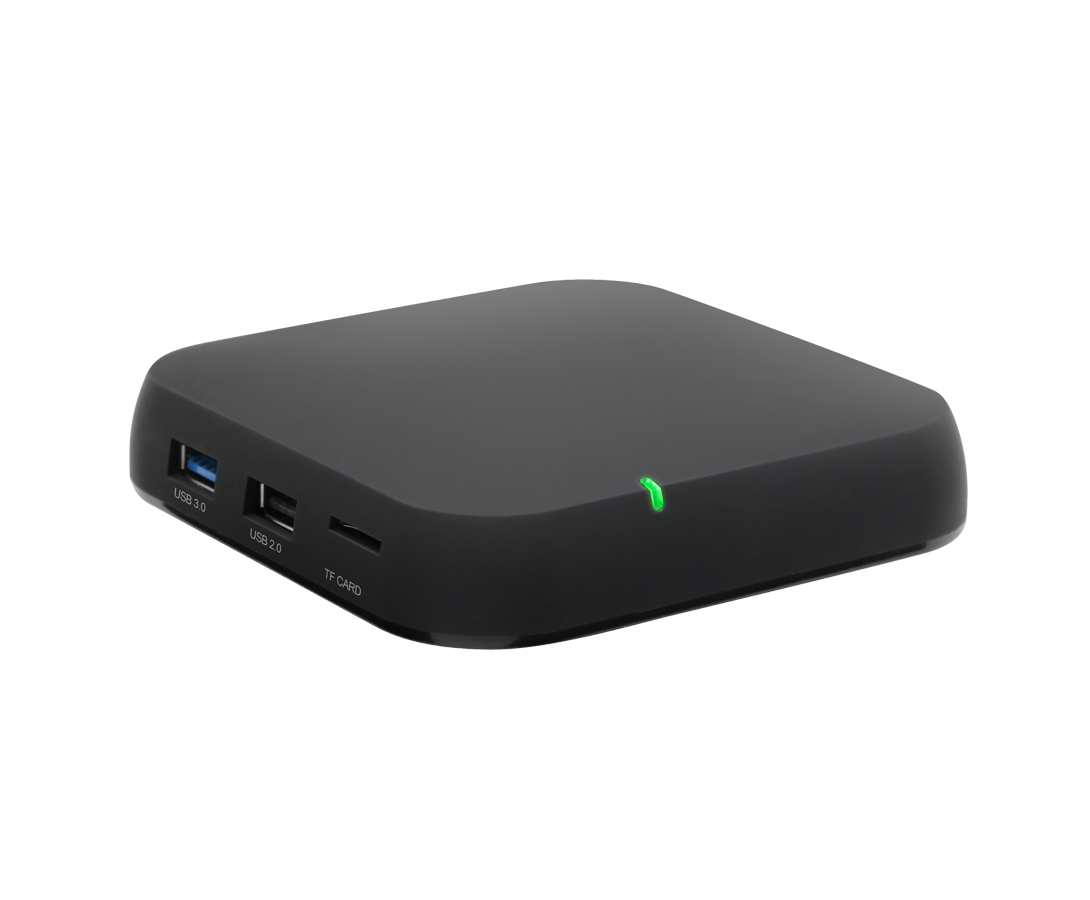
The DM21P is the only supplied model with a complete hardware data set. Its 100M Ethernet limits a wired IPTV access path to roughly 100 Mb/s before protocol overhead, so it should not be positioned for unconstrained 4K delivery over that interface. Wi-Fi 6 can outperform the Ethernet ceiling, but actual throughput depends on radio design, antenna placement, interference, channel width and driver configuration. H.265 Main Profile Level 5.1 at 4K×2K@60 is a decoder capability statement, not proof of sustained playback for every bitrate, HDR profile, tile format or protected session.


AOSP, Google TV, Google Play and EDLA control model
AOSP Android 11 on the DM21P provides the highest visible configuration control, but AOSP alone does not grant Google Play, Google TV launcher, Widevine L1 or Google application-policy functions. The product data also states that apps may be downloaded freely from the Play Store, so the exact Google licensing and distribution status must be documented rather than inferred from that sentence.
| Platform route | Launcher and app control | Certification and update obligation | Operator fit | Key limitation |
|---|---|---|---|---|
| AOSP | Operator can build or commission a launcher, preload applications and apply kiosk behavior | No Google Play obligations unless GMS is separately licensed; still subject to destination-market safety, RF and EMC rules | Maximum control for operator middleware and managed hospitality fleets | Operator owns more application distribution, device-owner and update integration work |
| Google TV | Google TV experience can be replaced or supplemented subject to the applicable Google agreement and device implementation | Requires applicable Google device and licensing approvals; GMS/EDLA obligations must be met for the licensed release | Useful where a retail or consumer-facing Google experience is required | Product #257 is identified as Google TV, but detailed licensing scope must be confirmed against the production datasheet |
| Google Play services/GMS | Enables Play distribution and Google APIs when correctly licensed and integrated | Google approval, CTS/VTS/ CDD or applicable requirements, security and update commitments | Third-party app ecosystems and standard commercial support models | GMS availability does not by itself certify operator middleware or all regional requirements |
| EDLA-certified Android TV | Follows the certified Google TV device baseline, with implementation-specific launcher behavior | EDLA certification and Google licensing evidence plus applicable regional approval | Lower integration risk for a standard retail Android TV proposition | Certification scope is model-specific and does not replace operator security review |
EDLA certification should be requested for the exact model, Android build, memory configuration and commercial region. A chipset claim, Android version or generic “Google TV” label is insufficient evidence. For operator programs, request the declaration, test reports, approval identifier, compatibility matrix and restrictions affecting preinstalled apps, background execution and launcher changes.
DRM, HDCP, CAS and output-protection evidence
DRM is a chain rather than a single logo. Hardware security, device integrity, Widevine or PlayReady provisioning, application behavior, display negotiation and service authorization must all work together. The DM21P data supports optional Widevine L1, PlayReady and HDCP 2.2. A production batch must demonstrate the requested security level rather than rely on a catalog statement.
| Security layer | Procurement requirement | Acceptance evidence | Failure mode |
|---|---|---|---|
| Widevine | Specify L1 or L3 by service risk and content contract | Device information report, provisioning record, licensed playback captures and build list | L1 hardware-backed path missing or license request rejected |
| PlayReady | Specify persistence, privacy and output restrictions | PlayReady device certificate/model evidence and protected playback test | Persistent license behavior inconsistent with operator policy |
| HDCP | Map protected content to the required receiver version | Display/AV receiver negotiation logs and 2.2 or 2.3 evidence where contracted | Black output, restricted resolution or unauthorized digital recording |
| CAS | Choose Irdeto, Verimatrix, Nagra-class or operator-required system by delivery platform | CAS security module, entitlement workflow, card/smart-card handling and jam/session test evidence | Unpairing, renewal failure or regional entitlement mismatch |
| Output protection | Define permitted analog, S/PDIF, recording and screen-capture behavior | Configuration baseline plus test results for every exposed output | Protected content appears through an unintended path |
The DM21P has HDMI 2.0b, S/PDIF and a 3.5mm AV output. Operators should explicitly state whether protected content may be delivered over analog or digital audio and whether the product is used in hotel, hospitality or retail environments where screen capture policy differs. Widevine L1 and L3 are not interchangeable procurement labels; see the Widevine L1 versus L3 operator guide before fixing the fleet requirement.
Operator customization and OEM/ODM responsibility boundaries
Customization must be divided into hardware, firmware, middleware and operational ownership. “OEM” and “ODM” are often used loosely in quotations; the contract should state who designs, sources, manufactures, flashes, signs, tests and supports each element.
- Boot identity: define boot logo, boot animation and recovery-screen behavior. Confirm whether the logo is an image resource, video package or compiled firmware object.
- Launcher: specify home-screen layout, channel-lineup access, search, EPG, notifications, account controls and PIN-protected settings.
- Applications: define preload, uninstall behavior, updates, data permissions and recovery after accidental removal.
- Remote control: validate key map, wake range, Bluetooth pairing, IR fallback, voice features and accessibility requirements.
- Hardware branding: specify enclosure artwork, laser marking, packaging, serial-label format and regulatory-label ownership.
- Firmware signing: require protected signing keys, controlled access, release signing, rollback protection and auditable build provenance.
- Operator middleware: assign API, UI, CAS/DRM integration, EPG and entitlement responsibility in the statement of work.
Preloads and custom firmware affect CTS/VTS, GMS and EDLA status if the Google agreement restricts modifications. A production release should be frozen by checksum, and the firmware signing key must not be embedded in source archives delivered to the operator or distributor. Change requests after golden-sample approval should follow PCN review rather than being applied silently to a shipment.
Zero-touch enrollment, OTA and RMA operations
Zero-touch enrollment starts before the subscriber receives the device. The staging process should bind each unit to a serial number, hardware revision, production image, operator tenant, retail channel and subscriber or service location. Identity should be unique per device, with cryptographic keys protected by secure storage or an external device-management service.
- Import an approved production image whose checksum matches the golden sample.
- Scan or electronically read the serial identifier and manufacturing data.
- Assign tenant, regional configuration, certificates, middleware version and policy profile.
- Apply network, time, DNS, EPG and entitlement parameters without exposing permanent secrets.
- Run a self-test covering storage, memory, network, output, remote control and protected playback.
- Issue a provisioning receipt and move the unit to “ready” or “quarantine” state.
OTA architecture should separate release channels for development, pilot and production. Every package must be signed, versioned and scoped by hardware revision, memory configuration and regional image. Distribution needs staged rollout, battery or power-state checks where relevant, minimum free-storage validation, download resumption, integrity verification, rollback rules and a dead-letter queue.
| Operational KPI | Suggested measurement | Action threshold | Business interpretation |
|---|---|---|---|
| Enrollment success | Ready devices divided by devices presented to staging | Investigate below the agreed program target | Excess warehouse labor and subscriber activation delay |
| OTA adoption | Eligible devices successfully updated inside the window | Escalate by hardware revision and region | Fragmented security and service releases |
| Update failure | Failed attempts divided by started attempts | Automatic retry followed by recovery image | Increased truck rolls and support calls |
| Rollback rate | Devices returned to prior signed image | Block release when a regression threshold is exceeded | Detects incompatible builds or configuration drift |
| Telemetry availability | Reporting devices divided by active fleet | Compare by model, firmware and access network | Reveals blind spots before subscriber complaints |
| RMA rate and turnaround | Confirmed faults divided by shipped units; median repair time | Separate hardware, software and no-fault-found causes | Provides evidence for supplier corrective action |
An RMA workflow should capture device identity, symptom, logs, screenshots, network conditions and technician findings without collecting unnecessary subscriber data. Remote diagnosis should precede shipment where possible. Spares should be held by hardware revision and firmware baseline so a spare unit can replace a failed unit without creating a configuration mismatch.
Multicast, access selection and QoS engineering
Linear IPTV commonly uses multicast transport and IGMP membership, while OTT uses unicast HTTP or QUIC-like delivery over TCP or UDP-based stacks. The device must support the operator’s actual delivery design; Ethernet presence alone does not prove multicast behavior. Validate IGMP versions, snooping on customer-premises equipment, source-specific multicast where used, rapid leave, channel changes and behavior under constrained Wi-Fi.
| Access medium | Appropriate use | Capacity consideration | Operational risk |
|---|---|---|---|
| 100M Ethernet | Dedicated IPTV, deterministic LAN and managed enterprise installs | Nominal 100 Mb/s leaves headroom below the physical ceiling | DM21P cannot exploit a Gigabit access link through its stated Ethernet port |
| Wi-Fi 6 2×2 | Consumer rooms, retrofit installations and flexible hotspots | Actual service rate follows negotiated link rate, interference and distance | Latency jitter and retransmissions can affect interactive TV |
| Cellular 4G/5G | MVNO bundles and temporary or redundant access | SIM/eSIM, plan, roaming and coverage must match the service SKU | No supplied DataMax model is identified as cellular; a variant requires separate evidence |
Bandwidth planning should separate video bitrate, manifest and segment overhead, control traffic, DRM licenses, telemetry and recovery headroom. For unicast VOD, the selected profile should remain below available throughput under realistic network conditions rather than relying on a laboratory line rate. For multicast, calculate per-access-node bandwidth during channel-change bursts and verify IGMP handling between the access network and set-top box.
- VLAN: separate subscriber management, IPTV multicast and operational traffic where the network design permits.
- DNS: define resolver ownership, redundancy and internal-domain behavior; measure lookup failure during recovery.
- NTP: synchronize EPG, entitlement and audit events; verify time persists across power loss.
- QoS: mark or prioritize linear video and control traffic consistently across Wi-Fi, Ethernet and cellular paths.
- Last mile: capture join/leave, packet loss, jitter, RSSI, negotiated rate and DHCP state in support records.
Certification, homologation and market-access evidence
Certification is a destination-market and model-specific control process. The supplied DataMax facts do not identify destination-country FCC, CE/RED, UKCA, ISED, ACMA, RCM or other approvals, nor do they provide test-report identifiers. These omissions must not be interpreted as noncompliance or approval.
| Evidence package | Minimum content | Procurement gate |
|---|---|---|
| Radio and EMC | Model, radio configuration, bands, antenna specification, test standard, lab accreditation and report identifier | Reject if the report does not match the production SKU |
| Electrical safety | Applicable power-supply and end-product safety evidence, markings and instructions | Match mains adapter, voltage and shipped configuration |
| Google licensing | License scope, approval records, build compliance and certification identifiers where applicable | Apply only to the exact commercial build |
| Android compatibility | Applicable CDD/CTS/VTS results and Android version alignment | Resolve failed or expired reports before shipment |
| DRM/CAS | Device certificates, provisioning, security levels, pairing and license flow | Validate against production units and content contracts |
| Operator homologation | Network, decoder, EPG, entitlement, remote-control and network-management results | Operator-specific pilot approval before volume deployment |
For each destination, request the applicable regulatory framework rather than asking only for “CE” or “FCC.” The review should cover radio bands, conducted and radiated emissions, immunity, ESD, RoHS where applicable, WEEE or national disposal obligations, power efficiency, labeling, user information and the legal manufacturer/importer record. Wi-Fi 6 and Bluetooth 5.4 on the DM21P do not by themselves establish legal approval in any country.
OEM/ODM sourcing, NRE and production governance
NRE should be broken into engineering, middleware integration, certification, tooling, test fixtures and operator acceptance. Request a quote that distinguishes one-time engineering from recurring unit costs and from pass-through certification expenses. MOQ should be an explicit variable linked to SoC, memory, storage, casing, packaging and firmware minimum order quantities; the supplied data contains no approved MOQ or lead-time figures, so none should be quoted.
Quality controls should cover incoming components, production flashing, functional test, cosmetic inspection, carton accuracy and traceability. AQL plans should identify defect classes, sampling standard, severity level and acceptance authority; the final AQL value must be agreed in the purchase specification rather than asserted by the supplier.
- Golden sample: approve one sealed reference unit plus exact firmware hash, configuration, accessories and packaging.
- PCN: require advance notice and written approval for SoC, DDR, eMMC, Wi-Fi module, RF front end, power supply, connector and firmware changes.
- BOM consistency: identify critical components and prohibit substitution without revalidation where it affects certification or performance.
- Traceability: link serial number, hardware revision, image checksum, production date, test result and shipment.
- Spare strategy: hold units and remote controls against installed-base and RMA targets rather than a universal percentage.
Factory audits should examine ESD protection, storage conditions, solder and process control where applicable, bootloader security, calibration, test coverage, operator access controls and nonconforming-material segregation. The contract should state who owns firmware source code, build infrastructure, signing keys, test assets, diagnostic tools and data generated during production.
Weighted RFP scoring and ordered selection process
A weighted RFP prevents a high processor score from obscuring an unmanageable platform. Scores should be assigned by the buying team before samples are tested, with evidence mapped to each line.
| RFP criterion | Weight | Scoring method | Mandatory gate |
|---|---|---|---|
| Hardware and media capability | 20% | 0–5 score against decoder, interface and thermal requirements | Failure on contracted resolution, DRM or output |
| Software platform and middleware | 15% | 0–5 score for API, launcher, app policy and integration effort | Missing critical operator API |
| DRM, CAS and content security | 20% | 0–5 based on evidence completeness and reproducibility | Required protection not demonstrated |
| Fleet management and OTA | 15% | 0–5 for enrollment, signed updates, rollback and telemetry | No controlled rollback path |
| Certification and quality | 10% | 0–5 based on model-specific reports and audit result | Missing mandatory destination approval |
| Commercial and lifecycle | 10% | 0–5 for transparency of NRE, MOQ, lead time, PCN and spares | Unacceptable commercial dependency |
| Test, support and RMA | 10% | 0–5 for factory coverage, diagnostics and return process | Inability to trace defects |
The weighted score is Σ(weight × criterion score ÷ 5). Use both the weighted score and mandatory gates; a high total cannot waive a DRM, regulatory or operability failure.
- Define service profile: linear, OTT or hybrid; target resolution; HDCP/CAS requirements; network preference.
- Eliminate noncompliant SKUs: reject models without the required OS, decoder, protection or destination evidence.
- Shortlist samples: require units built from the proposed production configuration, not hand-modified engineering samples.
- Run the laboratory acceptance suite: execute boot, decode, DRM, network, thermal and OTA tests under repeatable conditions.
- Run an operator pilot: include staff homes, hotels, retail sites or headend environments with representative access networks.
- Complete commercial and lifecycle review: validate PCN, signing-key controls, spares, RMA and total-cost assumptions.
- Freeze the release: approve golden sample, firmware checksum, BOM, test reports and shipping documentation.
Worked operator sizing and selection example
Consider a regional operator deploying 50,000 hybrid IPTV/OTT boxes over a 24-month rollout. The design uses a wired 100M access path, 4K HDR VOD with HDCP 2.2, operator-controlled linear channels, Widevine L1 for selected OTT titles and an AOSP-based managed launcher. The procurement team defines 15-second cold boot, 3-second warm resume, 2-second channel zapping, 24-hour playback soak and 99.9% OTA success as illustrative acceptance targets that must be validated against the service design.
At 50,000 units, the 100M Ethernet interface of the DM21P can satisfy the chosen access topology if the operator does not require a Gigabit upgrade path. The device therefore becomes a network fit, not automatically the fastest product. The operator requests a 2GB production configuration unless concurrent applications or middleware profiling justify 4GB; optional 4GB and larger eMMC variants are confirmed against the production datasheet.
| Worked criterion | Illustrative requirement | DM21P evidence and decision |
|---|---|---|
| Local service | AOSP control and optional 4K decode | AOSP Android 11, AV1/H.265 to 4K×2K@60 and dedicated decoders meet the technical direction; profile the actual payload |
| Wired access | 100M or lower dedicated access | 100M Ethernet is aligned; it is not a Gigabit SKU |
| Protected VOD | Widevine L1 and HDCP 2.2 | Both are optional; approve them on the exact production build and capture evidence |
| Linear TV | IGMP, EPG, CAS and channel zapping | No multicast/CAS claim exists in the DM21P data; require middleware and operational validation |
| Management | Signed staged OTA, rollback and telemetry | Not specified in supplied facts; make it a contractual software deliverable |
| Scale | 50,000 units over 24 months | Use 2,083 units per month on average before surge and replacement assumptions |
If the same operator requires Gigabit Ethernet, a CAS-enabled receiver and licensed Google TV, the DM21P is excluded by that architecture decision. Product #257 becomes relevant because it is identified with Google TV and Irdeto CAS, while Product #258 addresses hybrid OTT/S2. Their detailed interfaces, memory and production datasheets must be confirmed before they can be compared against the DM21P.
Deployment and use-case profiles
Profile 1: regional IPTV/MVNO hybrid
Conditions: managed linear channels, operator EPG, transactional OTT, indoor Ethernet or Wi-Fi 6 access and subscriber identity. Architecture: headend or cloud CAS/DRM service, multicast or unicast delivery, AOSP middleware, zero-touch enrollment, signed OTA and regional telemetry. Risks: multicast filtering errors, DRM-build mismatch, Wi-Fi contention and configuration drift across SKUs.
Profile 2: hospitality and serviced apartments
Conditions: hundreds to thousands of rooms, shared devices, guest privacy and frequent room turnover. Architecture: AOSP kiosk launcher, room-code or PMS integration, automatic session reset, central telemetry and on-site spares. Risks: guest data residue, unauthorized app changes, remote-control loss and recovery failures requiring truck rolls.
Profile 3: operator staging and warehouse operations
Conditions: serial capture, network onboarding and image verification before dispatch. Architecture: local staging VLAN, DHCP/DNS/NTP services, device-management endpoint, image checksum validation and factory-test record. Risks: shared-network congestion, insecure staging credentials and incorrect regional image assignment.
Profile 4: retail and enterprise signage
Conditions: long-duration playback, scheduled reboots, remote monitoring and limited on-site support. Architecture: AOSP kiosk mode, signed application packages, watchdog policies, telemetry and managed recovery. Risks: display or input compatibility, thermal degradation in enclosed cabinets and application-cache growth.



Laboratory and field acceptance matrix
Acceptance tests should use production-intent hardware, the final firmware build, calibrated display equipment and representative content. Report percentile results, not only averages: p95 channel-change time and p99 OTA completion are more useful than a single best-case observation.
| Test | Procedure | Pass criterion | Evidence |
|---|---|---|---|
| Cold boot | Power on at AC and restart after full shutdown; repeat 30 times | Meets the operator target at the agreed percentile | Timed video and automated logs |
| Warm resume | Wake from standby 30 times and launch the linear-TV portal | No reboot loop or audio/video desynchronization | Video, power logs and failure count |
| 4K playback | Play required AV1, VP9 and H.265 payloads at contracted resolution and frame rate | No decoder error; output and frame-rate criteria pass | Source identification and capture |
| DRM/CAS | Request license, play protected content, exercise expiry and entitlement denial | Required security level and authorization behavior demonstrated | Provisioning output, screenshots and logs |
| HDMI/AV | Test EDID, HDCP negotiation, 4K formats and exposed outputs | All sold configurations match the supported matrix | EDID and receiver records |
| Wi-Fi 6 | Test 2.4/5GHz, 2×2 operation, roaming and interference conditions | Meets defined link rate, packet-loss and channel-change targets | Driver logs, RSSI and throughput records |
| Ethernet | Exercise the 100M port under saturating and IPTV traffic | No unexplained loss and correct multicast behavior where required | Packet capture and port statistics |
| Thermal | Operate at maximum contracted media and network load in the specified enclosure | No thermal shutdown, reboot or unacceptable frame loss | Temperature and SoC telemetry |
| OTA | Interrupt download, deliver signed image, force rollback and recover from power loss | No unauthorized image; defined recovery and rollback behavior | Package hash, signature and state-transition logs |
| Remote control | Test pairing, range, every required key and voice behavior where licensed | All critical actions work in the specified environment | Key map and range test record |
Troubleshooting matrix and RWA path
| Symptom | First checks | Probable boundary | Escalation evidence |
|---|---|---|---|
| No guide or entitlement | DNS, NTP, backend reachability and device clock | Provisioning, middleware or identity service | Tenant ID, certificate status and middleware logs |
| Channel zapping exceeds target | IPTV source response, multicast join/leave, packet loss and decoder load | Headend, access network, Wi-Fi or device | Packet capture, join latency and channel statistics |
| Protected playback fails | Device build, certificate, entitlement, clock and HDCP negotiation | DRM service, provisioning, CAS or display | Device-information report and license trace |
| 4K image absent | EDID, HDMI format, source bit depth, receiver capability and cable | TV, HDMI, firmware or content profile | EDID, negotiated mode and decoder log |
| Intermittent Wi-Fi | RSSI, interference, channel width, power save and AP roaming | Radio design, router or site survey | Association logs and RF survey |
| OTA repeatedly fails | Free storage, power state, connectivity, signature and target group | Package, server, policy or firmware | HTTP trace, package hash and update state |
| Device overheats | Ambient temperature, enclosure, airflow, media load and adapter | Thermal design, placement or accessory | Thermal trace, room conditions and power-supply data |
| Controller unresponsive | Pairing, batteries, IR/Bluetooth mode and wake state | Remote hardware or firmware | Pairing sequence and input logs |
The RMA escalation path should classify symptoms as no fault found, hardware, firmware, network, entitlement or installation. Only confirmed hardware failures should consume the physical spare pool; repeated no-fault-found returns should trigger remote-log review and operator-process analysis.
Expert procurement and engineering FAQs
Which DataMax IPTV box is fastest?
The supplied data does not contain benchmark results, so it cannot support a fastest-model claim. Compare candidates using identical cold-boot, warm-resume, channel-zap, app-launch, protected-playback and thermal tests. The DM21P has complete disclosed specifications, but superiority over Products #254, #255, #257 and #258 is not established.
Is the DM21P suitable for 4K IPTV?
It declares AV1, VP9, H.265 and AVS2 decoding up to 4K×2K@60, HDMI 2.0b and optional Widevine L1, PlayReady and HDCP 2.2. Actual service acceptance still depends on payload profile, HDMI mode, receiver capability, bitrate, thermal conditions and the exact licensed production build.
Does 100M Ethernet limit the DM21P to 100 Mb/s?
Yes, its stated Ethernet interface is 100M. The usable application payload is below the nominal line rate because of Ethernet, IP and transport overhead. A Gigabit access plan requires a different Ethernet SKU or a proven external network architecture.
Should an IPTV operator choose AOSP or Google TV?
AOSP favors operator control over launcher, middleware and kiosk behavior. Google TV or licensed Google services may reduce ecosystem integration effort but adds approval, policy and update obligations. Choose based on the commercial device experience, software ownership model and certification scope, not on the Android version alone.
Is Widevine L1 mandatory for every IPTV deployment?
No universal requirement exists for every service. L1 generally addresses hardware-backed protected playback, while L3 is a lower-security classification. Content providers, contracts and device policy determine the required level. The DM21P lists Widevine L1 as optional, so the ordered configuration must include it and the exact device must pass provisioning tests.
Which DataMax model supports CAS?
Product #257 is identified as an Amlogic S905X3 Google TV box with Irdeto CAS. The supplied facts do not identify CAS support for the DM21P or other models. Confirm the precise CAS module, card interface, entitlement workflow and supported regions against the production datasheet.
Can Wi-Fi 6 replace Ethernet for live IPTV?
It can, but acceptance must use the real 2.4/5GHz environment. Wi-Fi 6 does not guarantee multicast handling, jitter or channel-change performance. For dedicated managed installations, Ethernet usually reduces last-mile variability; Wi-Fi is useful where cabling is impractical.
What should be frozen before a volume order?
Freeze the model number, memory and storage configuration, production BOM, accessories, regulatory reports, golden sample, firmware checksum, launcher configuration, signing process and acceptance report. Any PCN affecting these baselines requires operator review and, where necessary, recertification before shipment.
Final procurement position
For an operator-scale IPTV program, the defensible selection is the production configuration that passes service-specific performance, protection, certification, fleet-management and total-cost gates—not the model with the most attractive headline specification. An engineering consultation or RFQ should provide the target service profile, protected-content requirements, destination markets, access network, expected volume, middleware scope and current production datasheets so that the supplier can produce a fully evidenced comparison and controlled sample plan.


