

What the answer hinges on
“Widevine L1” is not a synonym for “supports protected playback.” It identifies a specific DRM security level whose processing, cryptography, and control must occur within the device’s Trusted Execution Environment. When procurement teams ask an android tv box manufacturer to protect continuity of service across two supply sources, the decision hinges on whether the same device configuration, firmware baseline, application stack, and service identity can be reproduced and evidenced—not merely whether a sales sheet contains the words “Widevine L1.”
For a second-source programme, the critical question is: can the alternate unit pass the same protected-content workflow as the incumbent device, under the same validation conditions? A useful RFQ therefore names the required Widevine level, AOSP and Android TV baseline, application or middleware version, playback resolutions, output path, HDCP requirement, production lock state, and evidence format. It also defines what happens when a chip, memory configuration, firmware image, or device identity changes.
The answer is not to select the platform with the longest feature list. It is to select an android tv box manufacturer capable of holding a controlled configuration across two production runs and supplying traceability from unit build to DRM validation. Factory capability, evidence quality, change control, and recovery planning carry more procurement weight than a nominal chipset upgrade.
A practical qualification sequence starts with configuration equality, not visual equivalence. Two enclosures carrying the same customer logo can conceal different memory populations, Android images, boot partitions, provisioning routines, and output boards. Before approving a second source, the buyer should require a configuration delta against the incumbent, identify every intentional difference, and subject those differences to the same protected-playback test. A zero-difference claim is not credible where the buyer expects alternative components; a documented delta is useful because it can be engineered, reviewed, and accepted.
The commercial question is therefore whether the supplier can repeat the required outcome, not whether the supplier can repeat the catalogue line. That distinction determines whether the second source reduces supply exposure or merely transfers it from component shortage to fleet incompatibility.
The owner of this decision should be the android tv box manufacturer, but accountability remains shared with the operator or service owner. The factory controls build consistency, firmware provenance, device provisioning, and production records. The buyer controls the protected-content acceptance method, service environment, and release decision. A dependable second-source programme assigns both responsibilities before samples are requested.
Turning the question into a spec line
Convert continuity into testable configuration fields. The sequence below prevents “second source” from becoming an uncontrolled copy with different silicon, software, and certification evidence.
- Fix the security baseline Record Widevine L1 as a required DRM level, identify the playback service and content path, and specify the evidence required from every production source.
- Freeze hardware and memory State the SoC, RAM/ROM option, output interface, network interface, and any production substitutions as controlled deviations requiring written approval.
- Freeze the software stack Record the Android baseline, firmware build identifier, middleware or application version, boot mode, device identity handling, and update policy.
- Define protected playback Name resolution, frame rate, supported codec, HDCP relationship, network conditions, and the pass/fail result required for acceptance.
- Define the evidence pack Request build identification, test report scope, serial or lot linkage, deviation records, and a repeatable factory acceptance procedure.
- Plan failure recovery Set quarantine, root-cause, retest, and replacement rules so a failed second-source lot does not interrupt service.
The resulting RFQ line should read like this: “Second-source Android TV set-top box, Widevine L1, AOSP Android 11 or Android 14 as platform-specific, fixed SoC and RAM/ROM configuration, [specified] playback test, [specified] report and serial/lot linkage, no substitutions without prior written approval.” Do not ask for “a Widevine L1 box”; that wording accepts a claim rather than a controlled configuration.
The first message in an RFQ for an android tv box manufacturer should contain the target model or platform family, exact Widevine requirement, required SoC and memory configuration, Android baseline, output and network requirements, expected test evidence, and the proposed change-control process.
A buyer can turn those fields into a configuration schedule rather than a free-text request. The schedule should assign an identifier to the production BOM, firmware build, device identity, application package, service account, test content class, and accepted output configuration. Each field needs an owner: engineering owns the BOM and image, the DRM or middleware team owns service acceptance, manufacturing owns process records, and procurement owns deviation approval. Without ownership, a report can satisfy a laboratory requirement while leaving an unresolved production variable.
The sample stage should also be formal. One engineering sample establishes feasibility; several production-equivalent samples expose process sensitivity. The buyer can request units from different assembly dates or lots, then apply the same install, update, playback, reboot, network-recovery, and output test. A result that appears only on one hand-built unit is not continuity evidence.
The acceptance record should carry a pass, fail, or blocked status for each requirement. “Blocked” matters because an unavailable service licence, missing test asset, or unresolved provisioning error can be mistaken for hardware failure. Separating those states prevents teams from replacing good hardware unnecessarily and lets them focus on the actual blocked dependency.
Procurement should also specify the delivery consequence of a blocked sample. Define whether the supplier may proceed to pilot manufacture, whether the pilot requires the same image, and what evidence closes the blocked item. Without this rule, a sample RFQ can leave both parties waiting indefinitely while the factory treats the condition as optional.
Where quotations quietly diverge
Quotations commonly describe different products under identical labels. “4K Android TV,” “Widevine L1,” “AOSP,” and “operator ready” each conceal multiple variables. A quote may treat DRM as a chipset attribute, equate an unlocked evaluation image with a production image, or assume a stable build across a delivery window. Each shortcut can create a second source that passes a laboratory demonstration but fails the operator’s protected-playback workflow.
| Ambiguous term | What the quotation may assume | Required control |
|---|---|---|
| Widevine L1 | Any L1-capable configuration is production-equivalent | Name the device configuration, firmware, service workflow, and report |
| AOSP Android 14 | All AOSP builds have equivalent boot and provisioning behaviour | Identify the build, boot mode, image owner, and middleware version |
| 4K | Resolution, frame rate, codec, and output path are interchangeable | Specify the complete playback chain and measured pass condition |
| Optional HDCP | The security mode is present by default | Write the required state into the order line and acceptance test |
| Second source | Only the enclosure and branding change | Control silicon, memory, firmware, provisioning, and test evidence |
| Same firmware | Identical source files produce identical behaviour | Record the build identifier, build timestamp, image hash, and update policy |
| Operator ready | Provisioning and middleware are already qualified | Name the operator package, service workflow, and acceptance environment |
| Same hardware | Only orderable memory and interface options vary | Attach the production BOM revision and approved alternate-part rules |
Field trap
A supplier can quote Widevine L1 while changing the SoC, RAM/ROM option, firmware branch, or device identity model. The protected-playback result may then differ even though the catalogue line remains unchanged. Any hardware or software substitution must be treated as a configuration change, not a procurement convenience.
Field trap
A generic “factory test passed” report is not equivalent to a standard-specific Widevine L1 validation record. Define whether the factory tests device importability, protected playback, output negotiation, or a service-specific workflow; each test proves a narrower claim than the word “DRM” alone.
For hardware continuity, also compare ancillary differences that affect deployment rather than the headline DRM field: Ethernet speed, USB configuration, audio interfaces, remote-control requirements, and update access. These fields can alter installation effort even when the protected-content test remains identical.
Three quotation gaps deserve specific scrutiny. First, “same SoC” does not establish equivalent memory timing, storage configuration, thermal design, or firmware support. Second, “HDCP optional” can conceal whether protected output was validated with the shipping display path or only with a laboratory display. Third, a certificate may describe a hardware family while the delivered configuration uses a different board revision. The cost of these gaps appears after purchase as failed installation, unresolved service tickets, quarantine, rework, or duplicate qualification.
A buyer should also ask what the supplier considers a reportable deviation. If a new memory supplier, bootloader revision, display driver, DRM component, or build timestamp is excluded from notification, the change-control statement has little operational value. The answer should connect exceptions to production dates or lots and identify who may accept them.
Quotation basis is another hidden variable. One offer may describe a new production unit, another an evaluation sample, and a third a platform modified from an existing product. Procurement should require all comparisons to use the same commercial basis: target quantity, memory configuration, firmware status, accessories, acceptance service, and requested evidence. Otherwise, the apparent difference may be commercial scope rather than device capability.
Questions to put in the supplier review
Evidence must connect the production unit to the tested configuration. Ask the factory to walk through its incoming inspection, SMT and AOI controls, firmware flashing, secure provisioning, aging, functional test, and final audit. The purpose is not to request a generic factory tour; it is to locate the record that identifies what was built and what was tested.
- Incoming identity Ask how SoCs, memory, flash, and other controlled components are received, identified, and segregated against the approved configuration.
- Assembly control Request evidence that SMT and AOI results are retained against the production lot and that inspection coverage matches the assembly risk.
- Image control Ask which tools burn the approved firmware, how build identifiers are captured, and what prevents an engineering image from entering the shipment path.
- Provisioning and identity Establish how device identity, Widevine provisioning, network configuration, and operator middleware are applied and recorded.
- Test and aging Confirm that power-on aging, interface checks, playback checks, and protected-content testing are part of the route, with defined sample or 100-percent coverage.
- Final audit Determine whether the shipping configuration is compared mechanically and electronically against the golden sample and approved bill of materials.
Evidence request: ask for a redacted sample pack containing the approved bill of materials, firmware build identifier, test procedure, report schema, lot or serial traceability rule, and change-notification process. If a report cannot be tied to a configuration, it is useful for marketing but weak for second-source acceptance.
The production photograph shows the operational reality behind this review: rows of identical compact black Android TV boxes on warehouse shelving, with neutral packaging, pallets, and a packing station in the background under soft industrial light.

Ask whether the supplier can reproduce a failed result, preserve samples, and link corrective action to the affected lot. Also establish how emergency changes are handled when a component becomes unavailable: temporary substitution, firmware rollback, or a controlled alternative platform should require written approval. DataMax factory-quality documentation can serve as a starting point for this review rather than evidence for a specific production lot.
The audit should be specific enough to reveal where a unit becomes traceable. At incoming inspection, the controlled part number and lot should enter the production record. At SMT, the board serial or panel identifier should associate placement results with the build. At flashing, the image identifier should be written into that same chain. At provisioning, the device identity or provisioning record should link to the hardware record. At final test, the result should retain those links rather than appearing as an unrelated pass list.
Ask for one worked example. A redacted record that starts with a received memory lot and ends with a shipped-unit test result demonstrates traceability more clearly than a narrative capability statement. It also exposes gaps such as an unidentified engineering unit, a manual firmware replacement, a test asset that cannot be audited, or a lot number recorded only on the carton.
Sample frequency is another decision field. The buyer should distinguish destructive qualification from routine end-of-line inspection, and should state the required coverage for protected playback, output protection, network recovery, and boot. If the supplier proposes sampling, request the rule, the risk basis, and the trigger for expanding inspection after a failure. An undefined “sample pass” cannot support a stable fleet release decision.
The review should end with a corrective-action rehearsal. Select one controlled failure—wrong firmware, blocked provisioning, failed playback, or absent HDMI output—and ask how the factory identifies affected units, contains them, reproduces the condition, changes the process, and authorizes release. A credible answer identifies records and people; an answer limited to “the line will be rechecked” lacks containment.
Options placed side by side
There are two procurement models: a second source that reproduces the incumbent as closely as possible, or a second platform that meets service requirements but introduces deliberate engineering differences. Neither is automatically better. The first minimizes retraining and service disruption; the second may improve supply resilience if managed as a separate qualification.
| Decision field | Continuation tier | Commitment tier |
|---|---|---|
| Product strategy | Match the incumbent platform and configuration | Qualify a differentiated second platform |
| Primary benefit | Lower operational divergence | Greater sourcing and roadmap flexibility |
| Primary cost | Dependency on the same architecture and supply chain | Additional middleware, validation, and support work |
| Evidence needed | Configuration delta and repeatability records | Full service acceptance across the new platform |
| DRM control | Freeze hardware, image, identity, and test method | Define a common protected-playback acceptance method |
| Change management | No substitutions without approval | Maintain a platform-specific change baseline |
| Operational fit | Fast deployment where fleets are already mixed | Useful where architecture diversity is an explicit resilience goal |
| Service onboarding | Reuse the approved middleware and provisioning procedure | Rebuild integration and support procedures for the alternate platform |
| Failure containment | Retain the incumbent as the immediate rollback route | Maintain a parallel recovery plan for the new platform |
| Engineering ownership | One configuration baseline with limited deltas | Two controlled baselines with common acceptance rules |
| Procurement risk | Reduced configuration risk but potentially correlated supply risk | Reduced architecture correlation but higher qualification risk |
The decision should be based on the failure being mitigated. A shortage of one memory device may justify a controlled alternate part on the same platform. A shortage affecting an entire chipset family may justify a different platform. A planned regional launch may favour the continuation tier because support teams already know the image and middleware. A strategic architecture diversification may require the commitment tier and a larger validation budget.
For the continuation tier, the buyer needs a configuration delta, firmware identity, lot traceability, and an acceptance retest after controlled changes. For the commitment tier, the buyer needs service-level tests, interface qualification, thermal and stability evidence, installation documentation, support procedures, and field recovery planning. The second option cannot be justified by replacing one device model with another and retaining the original test script unchanged.
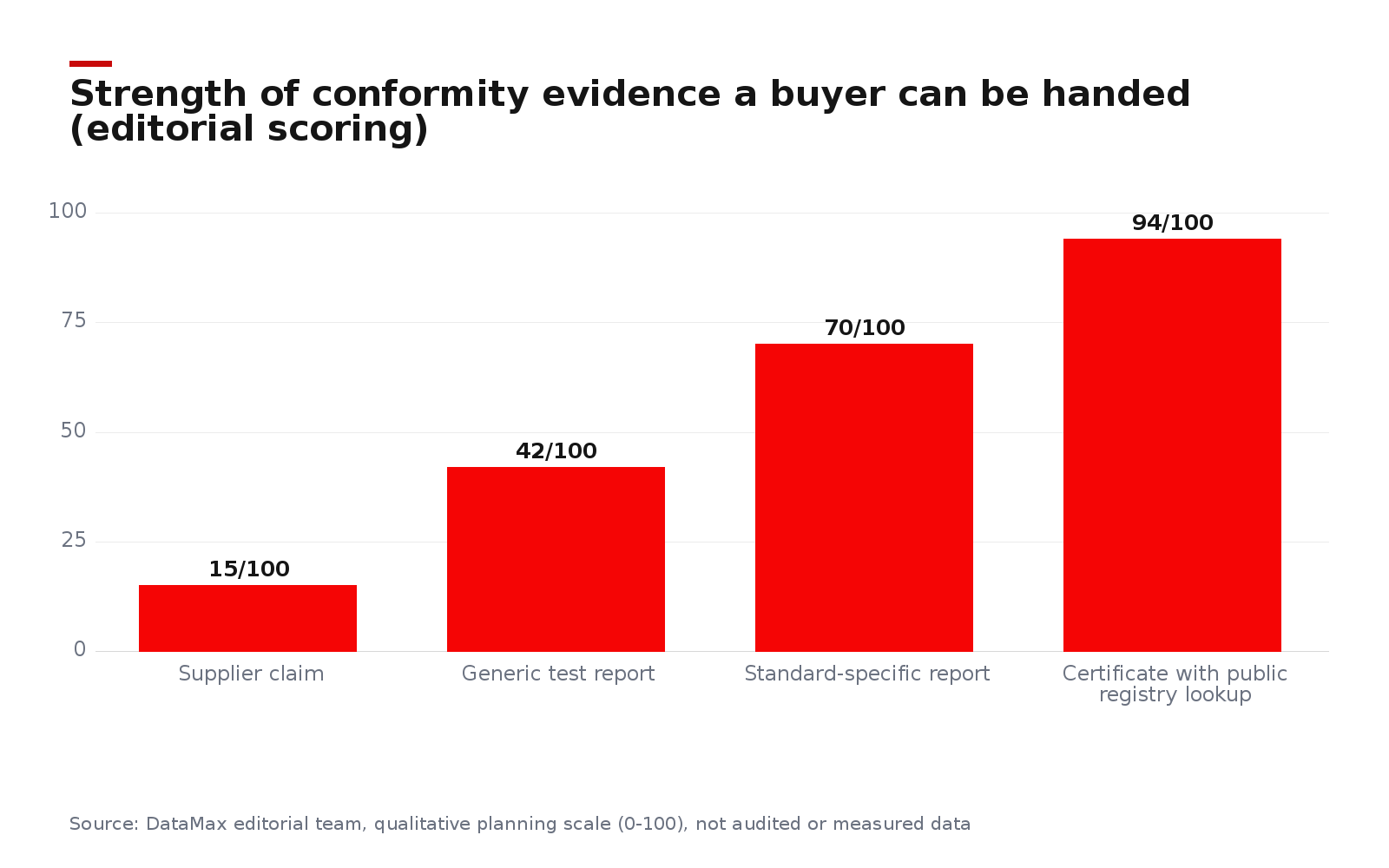
The same figures, in searchable form:
| Evidence option | Editorial score |
|---|---|
| Supplier claim | 15/100 |
| Generic test report | 42/100 |
| Standard-specific report | 70/100 |
| Certificate with public registry lookup | 94/100 |
The chart ranks evidence formats, not platforms. It is an editorial qualitative planning scale, not audited or measured performance. A certificate with a public registry lookup offers stronger independent traceability than a catalogue claim, but it still does not prove that the buyer’s exact firmware, device identity, and content workflow were tested. The Widevine L1 certification guide helps define the distinction before it enters commercial evaluation.
A useful side-by-side gate compares acceptance work, not just headline hardware. Under the continuation tier, the buyer retains one approved middleware procedure and compares the second unit against one golden configuration. Under the commitment tier, the buyer maintains two images, two provisioning records, two interface baselines, and one common protected-playback acceptance result. The commitment tier creates architectural diversity, but each divergence adds another item to regression testing.
Price should not be used as the sole selector, and the final commercial comparison should remain on the buyer’s own quotation basis. Use a consistent unit definition across responses: memory option, HDMI path, Ethernet option, operator software, packaging, test content, documentation, and approval conditions. If one response includes those items and another treats them as optional, the apparent difference is scope rather than product performance.
Definitions a buyer cannot outsource
Widevine is Google’s DRM platform. Its architecture distinguishes device security levels and separates device-level provisioning from content-service licensing. The buyer must still control configuration and acceptance; a factory cannot outsource that responsibility by displaying “L1” on a datasheet.
Under the published architecture, Security Level 1 means all content processing, cryptography, and control occur within the Trusted Execution Environment. Security Level 3 has no TEE on the device; protection remains in the host operating system, while a hardware crypto engine improves performance only, not security. The broader Widevine architecture defines a multi-tenant DRM framework, a device-specific identity and key pair, secure boot, and a licence-based content path.
Source: Google / Widevine, Widevine DRM Architecture Overview
A typical protected-playback path has 4 linked stages:
- Device identity The device receives or stores the identity material required for its DRM implementation.
- Secure boot and firmware The approved platform starts through the device’s security controls.
- Licence request The application exchanges device and service credentials with the content licence server.
- Protected output Decryption and content protection follow the applicable output and display rules, including HDCP where required.
This distinction explains why Widevine L1 and HDCP are separate RFQ fields. Widevine addresses the device DRM security level; HDCP governs protected audiovisual output over interfaces such as HDMI. A platform can therefore list Widevine L1 while leaving HDCP 2.2 optional. If the service requires protected 4K output, both fields need explicit acceptance criteria.
The AOSP baseline is equally important. AOSP is the open-source foundation, while Google Android TV, operator middleware, and application packages add separate layers. The buyer must identify who owns the image, bootloader settings, device provisioning, update channel, and middleware integration. For broader context, compare AOSP and Google Android TV before locking the software wording.
A device-specific identity is not a substitute for fleet management. It links a unit to its DRM implementation, but operators still need a controlled process for assigning identities, recording assignment, recovering failed provisioning, and revoking or replacing units. The acceptance test should therefore include identity import or activation, an application-level licence request, successful protected playback, and behaviour after reboot. It should not stop at a device-information screen.
Secure boot and firmware control define another boundary. A DRM security level can be implemented correctly while the surrounding image, bootloader state, update policy, or root-access posture introduces operational risk. The buyer should ask whether the shipped image is signed, whether updates are controlled, whether engineering builds can reach production, and whether a rollback mechanism could restore an unapproved configuration. The answer must be connected to the actual release process, not merely to a platform capability statement.
Playback acceptance should also specify the display environment. Resolution, frame rate, codec profile, and output interface form a chain: decode capability does not prove display output; display output does not prove a protected licence path; and a successful protected path does not prove service compatibility. A repeatable test record should capture those states separately.
Finally, terminology such as “certified” needs an owner and an artefact. The buyer should identify the certifying party, the exact subject device, the applicable standard, the issue or renewal process, and whether a registry record can be independently located. This is a due-diligence action, not a reason to infer that any listed product has current certification.
Real DataMax platforms, field by field
The relevant DataMax choice is not determined by a single DRM label. It starts with the product fit, then the SoC, operating-system baseline, memory configuration, decode path, and interface set. Confirm every orderable combination against the production datasheet.
| Model | Fit | SoC | OS | RAM/ROM | DRM | Ports and connectivity |
|---|---|---|---|---|---|---|
| DM21P | 4K IPTV / operator middleware set-top box | Amlogic S905Y4, quad Cortex-A35 | AOSP Android 11 | 2GB / 8GB (4GB; 16/32/64GB optional) | Widevine L1 / PlayReady / HDCP 2.2 optional | HDMI 2.0b out x1, USB2.0 x2, TF, S/PDIF, 3.5mm AV, RJ45 100M, Wi-Fi6 2x2 + BT5.4, DC 5V/2A |
| DM21S | 4K Android TV box for IPTV/OTT white-label | Amlogic S905Y5, quad Cortex-A55 | AOSP Android 14 | 2GB / 16GB (2/4/8GB; 16/32/64GB optional) | Widevine L1 / PlayReady optional; Dolby Vision/DTS | HDMI 2.0b out, S/PDIF, AV, USB2.0 x2, TF, RJ45 100M (1G optional), Wi-Fi6 2x2 + BT5.4 |
| DM21T | Premium UHD / cloud-gaming box | Amlogic S905X5, quad Cortex-A510 (ARMv9) | AOSP Android 14 | 4GB / 64GB (family options) | Widevine L1 / PlayReady optional | HDMI 2.0b out (no HDMI in), USB2.0 x1 + USB3.0 x1, TF, S/PDIF, AV, RJ45 100M (1G opt), Wi-Fi6 + BT5.4 |
| DM22Q | Gaming-oriented Android TV box | Amlogic S905X5M, quad Cortex-A55 up to 2.5GHz | AOSP Android 14 | 4GB / 64GB (2/4/8GB; 16/32/64GB optional) | Widevine L1 / PlayReady optional; Dolby Vision/DTS | HDMI 2.0b out, USB2.0 x2, TF, S/PDIF, AV, RJ45 100M (1G opt), Wi-Fi6 2x2 + BT5.4 |
DM21P is the operator-middleware-oriented choice, while DM21S is positioned for IPTV/OTT white-label programmes. DM21T and DM22Q serve premium UHD/cloud-gaming and gaming-oriented use respectively. These fit labels are starting points, not proof that two configurations are interchangeable. The Android baseline, optional interfaces, and memory options remain controlled fields.
For playback planning, DM21P lists AV1 [email protected], VP9/H.265 4K@60, and H.264 4K@30. DM21S lists AV1 / H.265 [email protected] 4K@60. DM21T lists H.266/VVC [email protected] 4K@120, AV1/VP9/H.265 4K@120, AVS3 4K@120, H.264 4K@60, and inline AI-SR. DM22Q lists AV1/H.265 L5.1 4K@60 and inline AI-SR. Do not infer an output resolution beyond these production facts.
The table also exposes where a second-source decision needs an exact model and option set. DM21P carries a DC 5V/2A field and a 3.5mm AV interface; DM21S offers an optional 1G Ethernet configuration; DM21T has no HDMI input and one USB2.0 plus one USB3.0 port; DM22Q has two USB2.0 ports. These fields affect installation, power logistics, peripheral expectations, and continuity planning as much as the DRM wording.
For a platform based on DM21P, the RFQ should preserve the Amlogic S905Y4 and quad Cortex-A35 description, AOSP Android 11 baseline, and selected RAM/ROM line. For DM21S, the baseline changes to AOSP Android 14 on Amlogic S905Y5 with quad Cortex-A55. A buyer must not present these as interchangeable in a continuity schedule merely because both are positioned for 4K IPTV or OTT use.
DM21T and DM22Q offer higher stated memory baselines and newer Android 14 configurations, but their product fits also differ from the operator set-top-box use case. Their wider stated decode lists should be turned into service-specific tests rather than treated as proof of every commercial-service entitlement. The applicable codec, profile, resolution, frame rate, output path, and service licence conditions remain acceptance fields.
The evidence chart in this section ranks documentation strength, not platform performance. A score of 94/100 for a certificate with public registry lookup still does not replace a production BOM, firmware identifier, device-identity procedure, or lot-linked test result. Use the highest available evidence type and then demand configuration-level records from the supplier.
For a sample request, ask DataMax to identify which model and which optional fields are included, provide the current production datasheet, and state which evidence accompanies the units. Treat the table as a review aid. Any ordering decision must use the production configuration confirmed for that shipment.
The android tv box manufacturer should also identify whether the sample uses the same board revision and option set intended for volume production. If the sample is a different hardware revision, the buyer must treat it as feasibility evidence and request the production-linked qualification record before fleet release. This distinction prevents an engineering result from being mistaken for a factory process result.
Buyer situations, ranked by what they punish
Different buyers fail in different ways. An operator with live IPTV services punishes device-identity and provisioning errors because a failed unit can become a truck-roll and support incident. A distributor managing several accounts punishes uncontrolled configuration drift because two units with the same catalogue name may trigger different integration work. An AV integrator punishes missing interfaces and output mismatches because installation labour rises quickly. A gaming-oriented brand punishes claims that exceed the verified playback path.
| Situation | What the deployment punishes | Requirement emphasis | Model direction |
|---|---|---|---|
| IPTV operator with live middleware | Provisioning, identity, and fleet inconsistency | AOSP baseline, operator middleware, repeatable device identity, lot traceability | DM21P or DM21S, subject to exact qualification |
| OTT distributor with white-label programme | Configuration drift across orders and customers | Fixed BOM, firmware ownership, controlled options, clear evidence pack | DM21S |
| Premium UHD or cloud-gaming brand | Decode-path mismatch and unsupported resolution claims | Explicit codec, frame-rate, output, and playback acceptance criteria | DM21T |
| Gaming-oriented brand | Headline claims exceeding the 4K playback specification | SoC-accurate performance qualification and verified decode limits | DM22Q |
| AV integrator deploying commercial displays | Interface omissions, HDMI negotiation, and installation variability | Port-level fit checklist, EDID/output test, field acceptance | Select by confirmed ports rather than DRM tier alone |
| Enterprise continuity programme | Evidence that cannot be traced to shipped units | Lot linkage, change notices, golden-sample control, retest procedure | Any platform after configuration and evidence review |
| Hotel or hospitality operator | Room-level recovery, remote support, and interface variation | Stable image, recoverable identity, Ethernet and AV fit, installation test | Select by confirmed deployment interfaces |
| Retail digital-signage programme | Long-running playback and unattended restart | Output qualification, update control, stability evidence, lot consistency | Choose after workload-specific testing |
| Regional ISP with mixed firmware teams | Platform fragmentation and duplicated support procedures | Configuration freeze, firmware ownership, operator middleware, change notices | DM21P or DM21S after team review |
| Brand owner protecting launch claims | Unsupported marketing specifications | Codec-by-codec acceptance, exact output limits, datasheet control | DM21T or DM22Q according to product fit |
The ranking is by consequence, not market volume. Operators need continuity at service level; integrators need installation repeatability; distributors need commercial configuration discipline; gaming brands need technically accurate performance claims. For broad manufacturer selection criteria, use the canonical guide to choosing an android tv box manufacturer, then apply this second-source evidence discipline.
A final procurement step should convert the selected direction into a controlled sample request. The first message sent to the sample-order team must specify the exact model, required Widevine L1 requirement, Android baseline, fixed RAM/ROM option, required playback path, evidence expected with the samples, and any interfaces that must not change. DataMax should then return the production-aligned configuration for confirmation before fleet approval.
The deployment matrix also determines the acceptance emphasis. An operator should test identity recovery after a failed provisioning attempt. A hotel deployment should verify restart, Ethernet behaviour, and the installed AV path. A signage programme should combine the protected-playback test with its operating schedule. A brand owner should validate each claimed codec and output mode independently so that one successful playback path does not become evidence for every stated capability.
Continuity planning should include two fleets, not one. The incumbent and alternate source need common acceptance rules, separate configuration baselines, and a clear statement of which differences are intentional. If the second unit fails, the buyer should know whether to roll back to the incumbent, quarantine one lot, or execute a firmware or provisioning correction. That recovery decision belongs in the sample phase, before fleet deployment.
The practical penalty model should guide the release gate. For an operator, one failed activation can affect a live subscriber account, so identity recovery leads the test. For a signage venue, an output or restart defect can interrupt an entire location, so interface and recovery testing lead. For a distributor, configuration drift creates recurring support cost across many orders, so BOM and firmware evidence lead. These are different acceptance emphases even when all three require Widevine L1.
A useful final review asks each stakeholder to sign one field: engineering signs the SoC, BOM, image, and boot state; the service owner signs the licence and playback path; operations signs provisioning and recovery; manufacturing signs lot traceability; the android tv box manufacturer confirms how every signed condition will be held in production. Fleet approval then means that the same field set has passed across samples and the release process can reproduce it.
Further reading
- Guide android tv box manufacturer
- Telecom and pay-TV operator solutions
- Certifications and test evidence
- Amlogic Android TV boxes
- Google TV devices
- DataMax DM21P specifications and fit
- DataMax DM21S specifications and fit
FAQ
Does Widevine L1 guarantee 4K protected playback?
No. Widevine L1 specifies where protected content processing, cryptography, and control occur; it does not by itself specify resolution, frame rate, codec, service licence compatibility, or HDMI output protection. Name the complete playback chain in the RFQ, including codec, resolution, frame rate, HDCP state, service workflow, and pass/fail criteria.
Can two Android TV boxes with Widevine L1 be treated as identical?
Not automatically. SoC, RAM/ROM, firmware image, boot mode, device identity, middleware, output path, and test conditions can differ. The second source must be compared against an approved configuration and accepted through the same protected-playback workflow, with changes controlled in writing.
What evidence should an Android TV box supplier provide?
Request an approved bill of materials, firmware build identifier, device provisioning method, test procedure, report, lot or serial traceability, deviation records, and change-notification process. For an android tv box manufacturer under second-source review, evidence must connect the tested configuration to the shipped configuration rather than merely repeat a catalogue claim.
Is HDCP part of the Widevine L1 requirement?
They are related but separate procurement fields. Widevine L1 concerns the DRM security implementation and its protected content-processing environment. HDCP concerns protected audiovisual output through interfaces such as HDMI. If the content path requires protected high-resolution output, specify the required HDCP state and test it explicitly.
Should the second source use the same model or a different platform?
Use the same model when operational similarity, qualification cost, and fleet consistency dominate. Qualify a different platform when supply-chain resilience or a deliberate roadmap change outweigh the extra middleware, validation, and support work. Either route requires a fixed configuration and documented acceptance method.
What is the safest first step in a second-source programme?
Request a production-aligned sample and define the evidence pack before approving a fleet order. The initial android tv box manufacturer message should name the model direction, Widevine requirement, Android baseline, memory configuration, playback path, interfaces, traceability requirement, and approval process for substitutions.


