
The procurement answer in one screen
Widevine L1 certification should be treated as a per-SKU compliance gate, not a catalogue-page feature. The decisive evidence is a certificate or authorization record tied to the exact hardware, Android build, firmware, and application package that will ship. A supplier statement that a chipset or design family supports Widevine L1 is only a technical lead, not proof of commercial qualification.
For DataMax, the stated DRM status provides the starting matrix: DM21P lists Widevine L1, with PlayReady and HDCP 2.2 optional; DM21S lists Widevine L1, with PlayReady optional; DM21T lists Widevine L1, with PlayReady optional; and DM22Q lists Widevine L1, with PlayReady optional. Those entries identify design capability, while the ordered configuration still requires evidence validation. For a procurement file, request the actual certificate details, licensed-device authorization process, device identifier rules, build identification, and any operator-specific content-playback acceptance criteria.
The platform direction is also distinct. DM21P targets a 4K IPTV or operator-middleware set-top box, DM21S targets a 4K Android TV box for IPTV/OTT white-label work, while DM21T and DM22Q target premium UHD or gaming-oriented boxes. Their decode ceilings and network configurations differ, so L1 support cannot substitute for a full video, DRM, and operator integration review. Request samples with the first message identifying the target operator or app, required playback resolution, output interface, RAM/ROM configuration, and the evidence package expected.
A practical screen should show four separate checks. First, identify whether the ordered model has a stated Widevine L1 capability. Second, map that model to its production SoC and RAM/ROM option. Third, request the certificate or authorization identifier and the build coverage. Fourth, require an application-specific playback record using the operator’s protected streams. This prevents a supporting product statement from being mistaken for launch approval.
For widevine l1 certification evidence, require the model, configuration, firmware, package identifier, test date, result, and lookup path in one review record. If any field is missing, the gate remains open regardless of the DRM entry in the datasheet. The catalogue remains useful for narrowing the hardware choice; the compliance file determines whether that hardware can launch.
How the requirement actually works
Widevine is Google’s DRM system for protected media playback. Its security levels describe where protected processing, cryptography, and control occur; they are not interchangeable marketing labels. Google’s architecture overview defines Security Level 1 as performing all content processing, cryptography, and control within the Trusted Execution Environment. It defines Security Level 3 as having no TEE on the device, using host-OS protection, with a hardware crypto engine improving performance only rather than security.
That distinction changes what a buyer must verify. A Widevine L1 claim implies the production device has an appropriate protected execution and software implementation. It does not establish that the final application will request the intended licence, that a particular service has authorized the device, that a specific bitstream will play, or that the operator has completed its own acceptance process. A procurement file therefore needs four distinct records: the Google device/security-level qualification, the application’s DRM integration status, the service-provider authorization, and acceptance evidence for the finished user experience.
The playback path adds further gates. The application requests a licence, the client obtains the required cryptographic capability from the device implementation, the content service applies its policy, and the media pipeline decodes protected content under the resulting licence. Widevine compatibility coexists with codec support but does not prove that a codec, resolution, frame rate, dynamic-range format, and HDMI output path work together. For example, the product facts list AV1 and H.265 [email protected] 4K@60 for DM21S, while DM21T lists AV1, VP9, H.265, AVS3, and H.264 decode paths extending to 4K@120 with H.266/VVC [email protected] support. Those are device capability statements, not a completed stream-partner certification matrix.
The difference between L1 and L3 is architectural, not merely a higher numeric label. A buyer asking for widevine l1 certification is specifying a protected-execution path in which content processing, cryptography, and control operate inside the TEE. This definition alone does not identify the certificate, the production image, or the content provider’s authorization. A supplier should be able to explain which part of the device implements the relevant security functions and how that implementation maps to the evidence supplied.
- Do not substitute a chipset claim for the certified configuration.
- Updates and firmware changes require controlled review.
A second layer is the media contract. The DRM security level does not replace codec-profile checks, output validation, or service policy. Consider an AV1 stream submitted at 4K@60. The device must decode the required profile, the application must negotiate the protected rendition, the licence must be issued, and the display path must present the stream correctly. A successful L1 implementation can still fail because an account lacks entitlement or the installed application has not completed the service’s integration process.
Google’s document is the reference for the security-level architecture. For the broader launch sequence and date-oriented qualification gate, use the canonical page on the Widevine L1 certification launch gate with a date; this article concentrates on the support matrix and evidence distinction.
Source: Google / Widevine, Widevine DRM Architecture Overview
The platform shortlist with datasheet values
The DataMax shortlist separates operator-oriented IPTV deployment from white-label OTT and premium or gaming-oriented Android TV products. Every row below reproduces only the supplied product facts. “Optional” remains optional; it is not silently converted into a standard configuration.
| Model | Positioning | SoC and OS | RAM / ROM | DRM | Decode | Connectivity and output |
|---|---|---|---|---|---|---|
| DM21P | 4K IPTV / operator middleware set-top box | Amlogic S905Y4, quad Cortex-A35; AOSP Android 11 | 2GB / 8GB; 4GB; 16/32/64GB optional | Widevine L1 / PlayReady / HDCP 2.2 optional | AV1 [email protected], VP9/H.265 4K@60, H.264 4K@30 | HDMI 2.0b out x1; USB2.0 x2; TF; S/PDIF; 3.5mm AV; RJ45 100M; Wi-Fi6 2x2 + BT5.4; DC 5V/2A |
| DM21S | 4K Android TV box for IPTV/OTT white-label work | Amlogic S905Y5, quad Cortex-A55; AOSP Android 14 | 2GB / 16GB; 2/4/8GB; 16/32/64GB optional | Widevine L1 / PlayReady optional; Dolby Vision/DTS | AV1 / H.265 [email protected] 4K@60 | HDMI 2.0b out; S/PDIF; AV; USB2.0 x2; TF; RJ45 100M, 1G optional; Wi-Fi6 2x2 + BT5.4 |
| DM21T | Premium UHD / cloud-gaming box | Amlogic S905X5, quad Cortex-A510, ARMv9; AOSP Android 14 | 4GB / 64GB family options | Widevine L1 / PlayReady optional | H.266/VVC [email protected] 4K@120; AV1/VP9/H.265 4K@120; AVS3 4K@120; H.264 4K@60; inline AI-SR | HDMI 2.0b out, no HDMI in; USB2.0 x1 + USB3.0 x1; TF; S/PDIF; AV; RJ45 100M, 1G opt; Wi-Fi6 + BT5.4 |
| DM22Q | Gaming-oriented Android TV box | Amlogic S905X5M, quad Cortex-A55 up to 2.5GHz; AOSP Android 14 | 4GB / 64GB; 2/4/8GB; 16/32/64GB optional | Widevine L1 / PlayReady optional; Dolby Vision/DTS | AV1/H.265 L5.1 4K@60; inline AI-SR, no NPU TOPS stated | HDMI 2.0b out; USB2.0 x2; TF; S/PDIF; AV; RJ45 100M, 1G opt; Wi-Fi6 2x2 + BT5.4 |
The supplied facts do not include certificate numbers, certification dates, application identifiers, approved storage configurations, or service-provider authorization records. Those omissions are procurement gaps, not evidence of non-compliance. Ask DataMax to confirm the production evidence against the ordered SKU. The certifications and compliance pages provide the appropriate route, but certificates and DRM/security provisions must be confirmed per ordered SKU rather than inferred from a catalogue page.
The product rows answer a capability question: which platforms have a stated Widevine L1 entry and which media or connectivity options accompany them. They do not answer the launch question: whether a particular ordered memory option, image, package, and operator application map to a valid authorization record. This distinction is especially relevant for models with optional storage or networking choices.
Do not compare a listed default with an unstated production configuration. DM21P’s listed 2GB / 8GB, DM21S’s listed 2GB / 16GB, DM21T’s 4GB / 64GB family options, and DM22Q’s listed 4GB / 64GB establish the supplied datasheet positions. They do not establish that every alternate memory combination shares the same widevine l1 certification scope. Request a variant-by-variant mapping.
The evidence hierarchy below is an editorial planning aid for comparing the handoff documents a buyer receives. It does not measure Google certification quality.
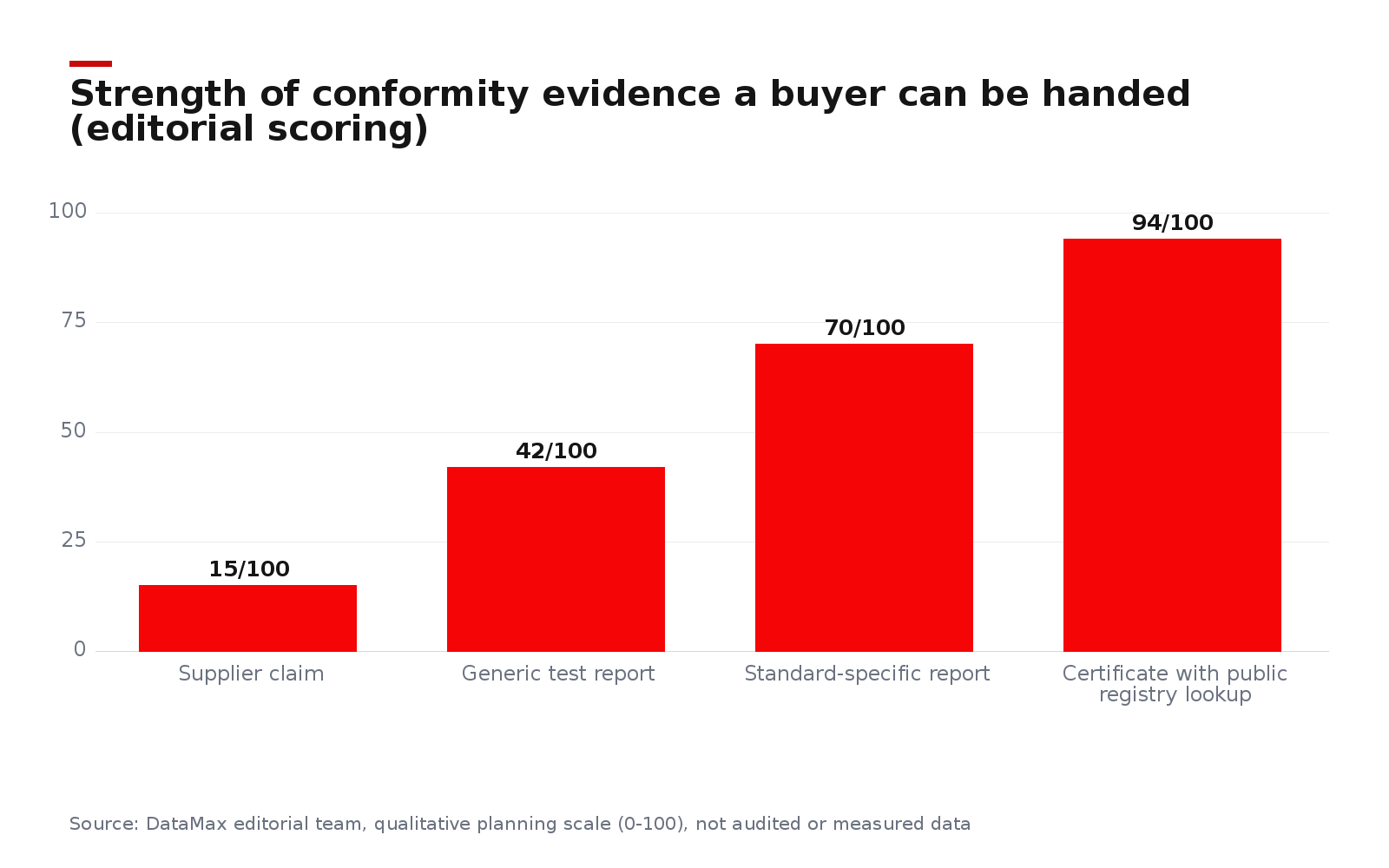
The same figures, in searchable form:
| Evidence option | Editorial score |
|---|---|
| Supplier claim | 15/100 |
| Generic test report | 42/100 |
| Standard-specific report | 70/100 |
| Certificate with public registry lookup | 94/100 |
Source: DataMax editorial team, qualitative planning scale (0-100), not audited or measured data.
Where this matters in a deployment
The operational risk changes with the deployment, although the evidence rule does not. An IPTV operator may be validating middleware, an electronic-program-guide workflow, entitlement behaviour, and a specific television service. An OTT integrator may need branded Android TV software and generic DRM playback. A commercial venue may require repeatable playback across many displays, with operational diagnostics and controlled firmware maintenance. A cloud-gaming programme may prioritize decode performance and input or output behaviour while still requiring protected-content playback.
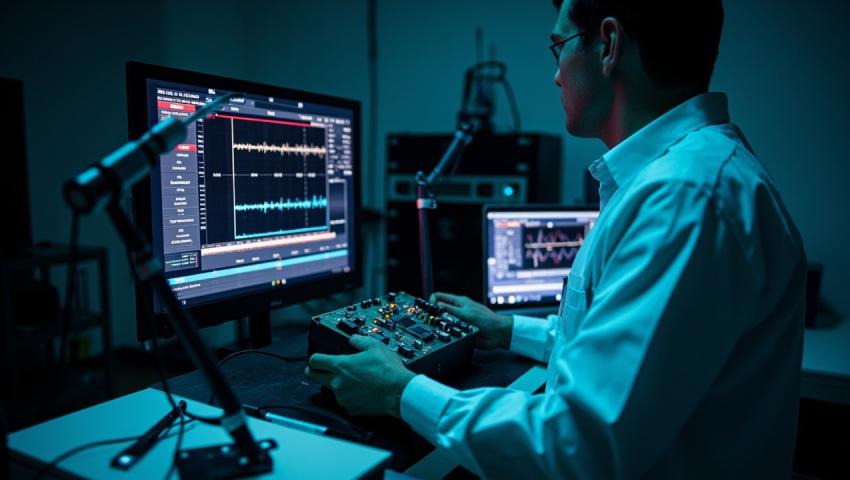
The scene matters because a laboratory certificate cannot substitute for site acceptance. Rows of set-top boxes, HDMI links, network infrastructure, and measurement equipment create a test environment in which firmware, network timing, HDCP negotiation, display capabilities, and account policy can be observed together. The launch-gate method can then set milestones around qualification, authorization, and deployment evidence.
| Situation | Primary requirement | Model direction | Evidence emphasis |
|---|---|---|---|
| Operator-controlled IPTV middleware | Widevine L1 device compliance, middleware integration, network stability, controlled software release | Start with DM21P | Per-SKU certificate detail, application test report, operator acceptance report |
| IPTV/OTT white-label programme | Android TV application signing, brand customization, Widevine L1 and optional PlayReady support | Evaluate DM21S | Package and build identity, service authorization, update-control record |
| Premium UHD or cloud-gaming use case | Widevine L1 plus higher listed decode capability and performance validation | Assess DM21T | 4K stream profile, output validation, application acceptance, load testing |
| Gaming-oriented Android TV deployment | Widevine L1, AV1/H.265 playback, operator or service acceptance | Consider DM22Q | Exact ROM configuration, certificate mapping, service authorization, soak test |
| Operator hospitality room with varied displays | Stable protected playback across display and HDMI configurations | Evaluate DM21P or DM21S | Display-mode matrix, reboot test, network recovery log |
| Digital-signage installation with scheduled media | Protected-content playback plus controlled updates and fault recovery | Evaluate DM21S | Package identity, entitlement procedure, recovery evidence |
For fleet deployment, define the unit under test before testing begins. Lock the SoC, RAM/ROM, operating-system image, firmware, application package, signing key, display mode, network profile, and account conditions. A failure may originate outside DRM: an unsupported codec profile, wrong HDMI mode, expired licence, account entitlement issue, or an application defect can resemble a device-certification problem. Controlled variables preserve diagnostic value.
For commercial venues, where displays and HDMI chains vary, record the display model, resolution, refresh rate, HDR/Dolby Vision configuration, and switching equipment used in acceptance. The DataMax facts list Dolby Vision/DTS for DM21S and DM22Q, but these entries do not establish that every panel, source, and application combination is qualified. Conversely, the absence of a Dolby Vision listing for another model is not proof of failure in a non-Dolby-Vision deployment; it is simply a boundary on what the supplied datasheet establishes.
For operator IPTV, the critical integration point may be middleware rather than a consumer storefront. Record whether the operator application obtains a licence before presenting a channel, how entitlement failures are surfaced, and whether a reboot preserves account state. For an OTT integrator, package signing and build identity can decide whether a service accepts the device even when the hardware DRM claim is correct. For a cloud-gaming programme, verify whether protected assets and the game client share the display path without assuming that general codec support guarantees service playback.
The AV1 qualification context adds another deployment variable. Netflix reported that “88% of large-screen devices (TVs, set-top boxes, streaming sticks) submitted for Netflix certification 2021-2025 supported AV1; nearly all submitted since 2023, vast majority full 4K@60fps.” The population is submitted devices, not every device shipped.

The same figures, in searchable form:
| Submission result | Share |
|---|---|
| Supported AV1 | 88% |
| No AV1 support | 12% |
Source: Netflix Technology Blog, AV1 — Now Powering 30% of Netflix Streaming (2025-12-01)
This service-level evidence is separate from a device’s stated AV1 decoder. A submitted-device statistic can inform platform planning, while the buyer’s application still needs the exact rendition, resolution, frame rate, display mode, and authorization path tested. For widevine l1 certification, the two layers should be recorded side by side: device compliance and service acceptance.
Turning the question into a spec line
A useful RFQ converts “Does it support Widevine L1?” into a set of auditable requirements. First identify the service and application, then define the device and build, then require evidence, and finally define acceptance and change control. This sequence prevents a broad product claim from becoming an assumed launch dependency.
- Define the content service State the operator, OTT provider, gaming service, or content owner; identify the application package and account or entitlement model.
- Define the ordered hardware Specify model, SoC, RAM/ROM, storage option, connectivity, output configuration, and accessory or operator middleware requirements.
- Define the software baseline Record AOSP version, production firmware build, application version, signing identity, and any required security configuration.
- Define the evidence obligation Require Widevine L1 certification or authorization details for the exact production device, plus an application-specific test report where available.
- Define acceptance criteria List the protected stream, codec, resolution, frame rate, audio format, output path, and the required pass/fail behavior.
- Define update control State which firmware, package, key, configuration, or certificate changes require prior notice, retesting, or approval.
- Define the delivery record Require the document identifiers, test dates, build identifiers, test environment, result, and supplier contact so the evidence can be archived with the purchase order.
A pasteable specification line can read: “The delivered SKU shall provide Widevine L1 security-level compliance evidence traceable to the ordered model, production SoC, RAM/ROM configuration, Android build, firmware image, and DRM application package; evidence shall include the certificate or authorization identifier, validity status, build coverage, and an application-specific playback test against the streams and display modes stated in this order. Any change to the certified configuration shall be notified before shipment and accompanied by an updated evidence package.”
Attach a second line for the media contract: “Protected playback acceptance shall cover each listed codec and profile at the specified resolution and frame rate, including HDMI output negotiation, audio passthrough, licence acquisition, entitlement response, error recovery, and reboot persistence.” Avoid saying simply “4K certified” because resolution alone omits codec profile, frame rate, colour or dynamic-range requirements, and display conditions.
The RFQ should also distinguish catalogue capability from order-level evidence. For example, DM21S is listed with 2GB / 16GB and optional RAM/ROM choices; DM21P is listed with 2GB / 8GB and additional optional storage. Do not assume every storage configuration has identical certificate or application coverage. Send the RFQ with the first message containing the target model, operator or app, stream profile, display mode, requested storage configuration, required evidence types, pilot quantity, and target shipment stage; any quantities should be handled through the supplier’s quotation process.
Add an evidence-format line. “Supplier confirmation” is not enough for a controlled programme. Request the certificate or authorization identifier, the lookup instructions, the covered model and hardware configuration, the tested firmware and package version, and the date and result of application playback testing. If an identifier is unavailable, require a documented exception with the exact reason, owner, closure condition, and approval authority.
Add a variant clause. For any optional RAM/ROM, Ethernet, PlayReady, HDCP 2.2, Dolby Vision, or DTS selection, state whether the order requires that option and require evidence mapped to the selected configuration. A quotation should separate the standard product row from the compliance additions caused by the operator’s service, middleware, and display environment.
Finally, define acceptance as a controlled state, not a binary capability label. State that the gate is open until the document set, build mapping, application test, and change-control commitment have been reviewed by the buyer’s designated compliance owner. This line keeps widevine l1 certification evidence from being silently transferred from a development unit to a production shipment.
Where quotations quietly diverge
The most expensive quotation ambiguity is usually semantic. Two suppliers may use “L1 supported” for different evidentiary states: one may refer to a chipset capability, another to a production-device certificate, and a third to successful playback in a particular application. These are not interchangeable claims. The buyer must ask what object the statement attaches to and how the object maps to the shipment.
Field trap
A “Widevine L1” entry on a model table does not identify the certificate, device record, authorized build, or service-provider status for a specific order. Accepting it as final proof can create a launch delay after tooling, packaging, or field deployment. Require the identifier and build mapping before treating the gate as closed.
A second trap is over-reading the DRM and decode fields. Widevine L1 can be accompanied by optional PlayReady and, on DM21P, optional HDCP 2.2. “Optional” means the ordered configuration must establish the requirement; it does not mean every unit includes it. Likewise, AV1 decode does not establish AV1 service certification, 4K support, the desired frame rate, or successful protected playback. The model’s listed capability must be checked against the actual content contract.
Field trap
Do not turn a model-level decode claim into a blanket service approval. A protected-service acceptance record can depend on the application, account policy, firmware, display, and stream profile. Keep “device DRM level,” “codec capability,” “application integration,” and “service authorization” as four separate evidence lines.
Other divergences arise from unresolved configuration variables. A quotation may omit whether the certificate covers the requested storage variant, whether the test used the production Android image, whether the application was signed with the shipping key, or whether the operator middleware altered security-relevant components. It may also omit how HDMI capture is performed, what display mode is selected, and whether network failures were included in the test.
Currency, exact certificate status, and expiry handling should be checked at quote review and again before shipment. If the supplier cannot produce a registry lookup or a document whose identifiers can be checked, the buyer should record the evidence gap rather than infer closure from the model name. The factory-quality route can support requests for configuration traceability, while certification proof remains a separate approval item.
A third divergence is the meaning of “same model.” A quotation may name DM21S and show the standard 2GB / 16GB row while the purchase order later changes RAM, ROM, Android image, middleware, or application signing. The name may remain stable while the evidence mapping changes. Require the exact configuration to be printed in both the order and the compliance annex.
A fourth divergence is the test boundary. “Playback passed” may mean one protected stream in a supplier laboratory, while the operator requires AV1 4K@60, a specific audio format, a named display, a reboot after licence acquisition, and recovery from a network interruption. State the test matrix and let the acceptance record determine what passed.
A fifth divergence concerns scope of responsibility. The device manufacturer, middleware integrator, application developer, and service operator may each hold different evidence. A supplier that provides the DRM implementation may not control service authorization. Name the party responsible for each artifact and the party that must approve the final result. This allocation is particularly important when widevine l1 certification is a shared launch dependency rather than a standalone factory document.
Questions to put in the supplier review
The supplier review should test the process, not merely collect screenshots. Ask how the factory prevents an uncertified or mismatched configuration from entering the shipment stream. The answer should connect the ordered SKU to a controlled production record and show what was checked before release.
- Identity control “How is the production SoC and RAM/ROM combination tied to the Widevine L1 evidence supplied for this order?”
- Software control “How are the Android image, firmware build, application package, signing identity, and security configuration recorded?”
- Build verification “What automated checks confirm that the shipped build matches the build represented by the test evidence?”
- Playback verification “Which protected streams, codec profiles, resolutions, frame rates, audio paths, and display modes are included in the application test?”
- Network and recovery test “How are licence acquisition failures, entitlement rejection, reboot persistence, reconnection, and error recovery recorded?”
- Change control “Which changes trigger renewed testing or customer notification before shipment?”
- Evidence retention “Which document identifiers, test reports, images, and authorization records are delivered with the shipment?”
The photograph below illustrates the controlled bench environment needed for this review: multiple set-top boxes connected through HDMI and network paths while engineers observe display and RF-related conditions. The image is a scene illustration; the actual laboratory protocol must be confirmed against the production datasheet and supplier quality plan.

Evidence package requested per ordered SKU
Widevine L1 certificate or authorization identifier and lookup instructions; applicable model, hardware, and build mapping; application package and version; protected-stream test report; display, audio, and network conditions; failure criteria and results; approved changes; and a supplier attestation covering the exact delivery configuration. Do not accept a family-level or chipset-only statement as a substitute.
For manufacturing control, SMT inspection, AOI, burn-in, or aging can detect assembly and stability defects, but they do not create Widevine evidence by themselves. Likewise, a dark-room display check cannot establish DRM authorization. The useful chain connects production identity, software-build control, targeted playback testing, exception handling, and document release. If the supplier uses automated test tooling, ask which checks are automated, which outputs are retained, and how failures prevent release of the affected order.
Ask for the actual control mechanism. A useful answer identifies the work order, production serial or batch record, image checksum, application package, test station, protected asset, pass criterion, exception code, and release decision. For example, if the operator middleware replaces a system image, the supplier should be able to show which image was tested and whether the later order preserved it. A statement that “the same software” was used is insufficient if no identifier proves it.
Ask how sample validation relates to mass production. Identify whether the test unit has the same SoC, memory configuration, firmware image, package, and display path as the shipment. If the sample is a development board or uses a different image, require a bridge report showing which controlled properties are identical and which are not. This protects widevine l1 certification evidence from being applied to a materially different production unit.
Ask about failure disposition. A licence-acquisition failure, entitlement rejection, unsupported stream, black frame, reboot loop, or intermittent HDMI issue should generate a test exception tied to the build and configuration. The supplier should explain whether the affected batch is held, quarantined, retested, or released with an approved limitation. Screenshots alone do not show whether the failure path was reproducible.
The supplied DataMax facts support a hardware and OS shortlist but do not state the details of the factory’s Widevine certificate workflow, test chamber configuration, or per-model public registry identifiers. Request those details in the supplier review and confirm them against the production documentation. For custom development, firmware, middleware, and operator integration requirements must also be placed under the same evidence discipline.
The comparison buyers actually make
Buyers typically compare platform fit, configuration granularity, media capability, and evidence burden. They should not rank platforms by the presence of one DRM phrase. The meaningful entry-versus-commitment comparison is between a catalogue statement and an order-level evidence package, while model selection remains dependent on the deployment profile.
| Decision dimension | Catalogue-level reading | Order-level commitment | Procurement treatment |
|---|---|---|---|
| DRM statement | Model is listed as Widevine L1 | Identifier and build coverage shown for the ordered SKU | Do not close the gate from the catalogue entry |
| Hardware identity | SoC and default RAM/ROM are listed | Production SoC and ordered memory configuration are traceable | Map every variant to its evidence |
| Software identity | AOSP version is listed | Firmware image, package, version, and signing identity are recorded | Tie acceptance evidence to the shipping build |
| Media capability | Decode formats and ceilings are listed | Required protected streams pass at the specified display mode | Use an application-specific test matrix |
| Optional features | PlayReady, HDCP 2.2, Dolby Vision, DTS, or networking options may be listed as optional | The purchase order states the selected options | Confirm each option per ordered SKU |
| Change control | No change notice is specified | Certified-impact changes are disclosed and reviewed | Hold shipment if evidence no longer maps |
| Evidence custody | Supplier retains the document | Buyer receives and archives identifiers with the order | Make delivery of evidence a release condition |
| Failure handling | Test result is summarized | Exception, owner, corrective action, and disposition are recorded | Do not convert exceptions into silent acceptance |
| Display and audio scope | General output and decode claims appear | Named display, HDMI, audio, codec, resolution, and frame-rate matrix passes | Match the acceptance environment to deployment |
Among DataMax models, DM21P is the clearest operator-middleware direction, while DM21S aligns with IPTV/OTT white-label work. DM21T and DM22Q have higher or broader listed media capability and are directionally appropriate for premium UHD, cloud-gaming, or gaming-oriented programmes where those capabilities matter. Those fit statements still require application and content-service acceptance.
The evidence-strength chart’s editorial ranking is useful because it turns a vague request into a document hierarchy: supplier claim, generic test report, standard-specific report, and certificate with public registry lookup. A buyer can progress through those layers while retaining the model mapping and build identity. The scores are not audited or measured data and must not be represented as a Google rating.
A model-level comparison follows the same logic. Compare the deployment fit first: operator middleware for DM21P, white-label IPTV/OTT for DM21S, premium UHD or cloud gaming for DM21T, and gaming-oriented Android TV for DM22Q. Then compare listed decode and connectivity options against the content contract. Finally, place the same evidence obligation on every candidate so one weak response does not disappear inside the product specification.
The AV1 chart adds a service-side comparison point but not a substitute for certification. Netflix’s submitted-device population supports AV1 broadly, yet the deployment must still pass its own protected-stream test. The buyer should preserve the distinction between “the service accepts many submitted devices with AV1” and “this ordered box passes the operator’s exact rendition in the intended environment.”
The final decision should record 5 items in the purchase file: selected model, exact configuration, Widevine evidence identifier and status, application/service acceptance result, and the change-control commitment. Contact the DataMax team to validate those records against the production datasheet and the intended operator programme. For each proposed SKU, confirm the certificate and DRM/security provisions per ordered configuration rather than treating the catalogue row as final widevine l1 certification evidence.
Further reading
- widevine l1 certification as a Launch Gate With a Date
- Nigeria SONCAP compliance support
- Compliance support by market
- Allwinner Android TV boxes
- AOSP Android TV boxes
- DataMax DM21P specifications and fit
- DataMax DM21S specifications and fit
FAQ
Is a Widevine L1 entry in a model table sufficient for procurement?
No. It identifies a stated model capability, but procurement needs evidence tied to the ordered hardware, production software build, application package, and service authorization. The catalogue wording cannot replace a certificate identifier, registry lookup, or application-specific test report. Confirm the evidence package per SKU, especially when RAM, ROM, firmware, or application configuration varies.
Does Widevine L1 certify every codec and resolution listed for a box?
No. Widevine L1 describes the device DRM security level, not the complete playback matrix. Codec profile, resolution, frame rate, audio path, HDMI mode, application version, and service authorization require separate validation. A model that lists AV1 or H.265 still needs a protected-stream test at the required profile and display mode.
Which DataMax model should an IPTV operator evaluate first?
DM21P is the direct platform direction because its supplied fit is a 4K IPTV/operator-middleware set-top box. It lists Widevine L1, AOSP Android 11, Amlogic S905Y4, and 2GB / 8GB with optional storage alternatives. This is a platform recommendation, not a certification result; confirm the exact ordered SKU against the production datasheet.
What should the first RFQ message contain?
Identify the target model, operator or application, required codec and resolution, frame rate, display and audio configuration, requested RAM/ROM, network requirement, evidence types, pilot stage, and shipment timing. Include whether PlayReady, HDCP 2.2, Dolby Vision, DTS, or 1G Ethernet is required. Ask for the mapping between those requirements and the production certificate or authorization record.
Can a supplier use a chipset document as Widevine L1 evidence?
It can support technical investigation, but it does not establish that the finished set-top box has passed the required device and application path. The evidence must identify the production device, software build, and application context. Request the device-specific record and an application test result rather than relying on SoC support language.
Does Google Security Level 1 mean all processing occurs in a TEE?
According to Google’s Widevine architecture overview, Security Level 1 performs all content processing, cryptography, and control within the Trusted Execution Environment. Security Level 3 instead has no TEE, uses host-OS protection, and treats a hardware crypto engine as a performance improvement rather than a security mechanism. Buyers should use this architecture distinction when reviewing the supplier’s implementation description.