

Why installed commercial projects differ from home buying guides
A WiFi projector is not a separate optical category. It is a display system whose source connectivity, platform, controls, and installation requirements differ from a conventional projector. The procurement decision therefore cannot be reduced to wireless convenience. For an installed project, the governing variables are screen area, ambient light, mounting geometry, content security, network resilience, maintenance access, device management, and the service life of the deployment fleet.
Consumer guides commonly rank streaming access, phone mirroring, portability, and “4K” labels ahead of installation constraints. Those criteria can invert in a commercial program. A project that needs unattended operation for 14 hours per day, 300 days per year, cannot tolerate WiFi contention, uncontrolled app versions, recurring manual focus correction, or an inaccessible filter assembly. The buyer must specify the complete operating envelope rather than treating WiFi as the primary feature.
- Image plane: define the diagonal, width, height, screen gain, viewing angle, and permitted light level before comparing projector brightness.
- Electrical and thermal design: specify the outlet, cable route, service clearance, operating temperature, noise limit, and hours of daily use.
- Signal and control: separate the critical display path from wireless convenience, then reserve wired HDMI, LAN, USB, and audio paths for control and recovery.
- Platform governance: determine whether the device needs Google TV certification, Android application distribution, DRM, MDM enrollment, or an isolated AOSP image.
- Fleet economics: calculate replacement, spare, firmware, call-out, and downtime exposure over the intended service period.
| Decision area | Home-projector assumption | Installed commercial requirement | Procurement evidence |
|---|---|---|---|
| Source connection | WiFi mirroring is the primary experience | Critical playback uses a controlled network or wired fallback | WiFi test report, Ethernet behavior, HDMI fallback procedure |
| Placement | Tabletop and occasional repositioning | Fixed ceiling, wall, or rig installation | Mounting drawing, dimensions, weight, clearance, throw calculation |
| Operation | User-initiated session | Scheduled, unattended, or centrally controlled operation | OTA, MDM/API, scheduler, recovery, and telemetry evidence |
| Maintenance | User-accessible cleaning | Restricted service access or planned replacement | Dust-management design, service manual, spare strategy |
| Purchasing unit | Single consumer unit | Qualified production configuration and repeatable lot | Datasheet revision, ECN process, AQL, golden sample, PCN procedure |
Optical and measurement fundamentals for comparing projector classes
Brightness must be compared on the same measurement basis. ANSI lumens use a standardized nine-zone measurement of light output rather than a manufacturer-selected “LED brightness,” source lumens, or peak white value. For procurement, require the model-specific ANSI report and identify whether the number applies to a particular operating mode. Auto brightness, eco mode, HDR mode, and color settings can produce materially different results.
Two useful planning calculations are:
- Screen area: image width = diagonal × 0.871 for 16:9; image height = diagonal × 0.490.
- Projection distance: distance = throw ratio × image width. The result must then be checked against the product’s stated projection-distance range.
- Retained light: maintained lumens = initial ANSI lumens × retained-lumen factor. A manufacturer claim of 10,000–10,500 source lumens is not equivalent to ANSI output.
- Target illuminance: required lumens = target lux × screen area ÷ screen gain. This is a preliminary application model; validate with a photometric proposal and on-site sample.
| Metric | Procurement meaning | Acceptance method | Common trap |
|---|---|---|---|
| ANSI lumens | Normalized light output for room and screen comparison | Review third-party or accredited test report for the exact model and mode | Comparing “source lumens” with ANSI lumens |
| Native resolution | Physical pixel matrix; input resolution does not change it | Verify operating-system and signal-path limits, then inspect native test patterns | Calling 4K decoding or 4K input native 4K |
| Contrast ratio | Projector black-to-white capability under defined conditions | Review measurement method; validate with dark-scene content | Using native contrast as room ambient performance |
| Throw ratio | Distance relative to image width | Calculate required distance and lens focus from the final geometry | Using projection-distance range as a substitute for throw ratio |
| Keystone correction | Digital geometry correction | Measure edge geometry and pixel rendering at final placement | Assuming correction preserves native pixel density |
| Focus | Sharpness at the screen plane | Verify autofocus repeatability after warm-up and vibration | Assuming autofocus remains stable over time |
| Light-source life | Expected source operating envelope | Confirm rated mode, ambient temperature, and maintenance assumptions | Using LED hours as brightness-independent lifetime |

DataMax model comparison from supplied production data
The supplied records do not provide a uniform set of fields for every model. GP8, GP96-GTV, and GP94C have detailed parameter sets; the portable 230 ANSI model and the Android 13 WiFi projector are identified by titles but have no complete technical record. Missing or conflicting values must not be filled by inference. The current production datasheet and test report govern.
| Model | Optical and installation data | Platform and connectivity | Mechanical, electrical, and status |
|---|---|---|---|
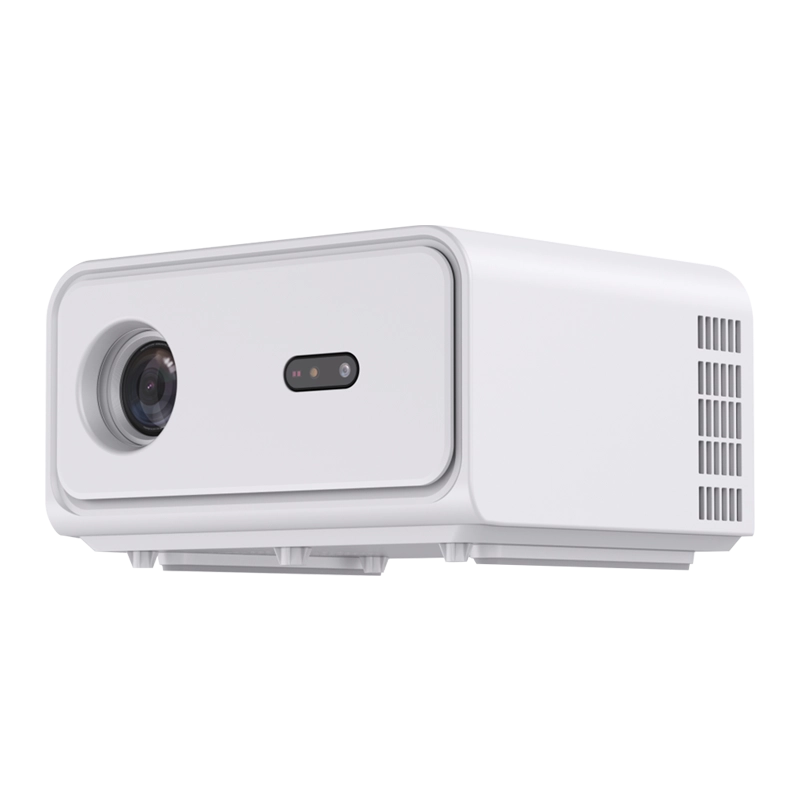
| GP8 | 450 ANSI lumens; native 1920×1080; 16:9; 0.24:1 throw; 30–200 in; 15–116 cm; contrast 1200:1; auto focus and auto keystone | Amlogic T972; Android 9; 2 GB RAM; 32 GB ROM; dual-band WiFi 6; Bluetooth 5.0; AirPlay/Miracast/Eshare; HDMI; 2×USB 2.0 | Front projection; LED; 89 W; 30 dB; 94×71×190 mm; 0.88 kg; title says “400 ANSI” but data says 450 ANSI: confirm against production datasheet |
| Portable 230 ANSI model | Title identifies 1080P, 230 ANSI lumens, WiFi, Bluetooth 5.2, and Android 13 | Android 13 and wireless connectivity are identified; complete interface and wireless details are absent | No supplied dimensions, weight, noise, power, throw, focus, or I/O data: confirm against production datasheet |
| Android 13 WiFi projector | Title identifies 1080P, WiFi, autofocus, and keystone correction | Android 13 identified; complete SoC, memory, DRM, MDM, interface, and network data are absent | No supplied brightness, contrast, throw, image size, power, noise, dimensions, or weight: confirm against production datasheet |
| GP96-GTV | 1000 ANSI lumens; native 1920×1080; 1.2:1 throw; 80–120 in; 1.26–3.5 m; contrast 1600:1; auto focus, keystone, screen alignment, obstacle avoidance; LED source listed as 10,000–10,500 lumens | Main unit uses Allwinner H137 with XuanTie C906 RISC-V CPU; Google TV dongle lists Android 11 or 14, S805X2/RTD1332, 1 GB DDR4, 8 GB eMMC, dual-band WiFi, Bluetooth 5.0, HDR formats, Dolby, and specified codecs | Front/rear/hang projection; 130 W; 32 dB; 256×203×140 mm; 2.95 kg; one HDMI; one USB; dust-free design claim; OS and dongle configuration: confirm against production datasheet |
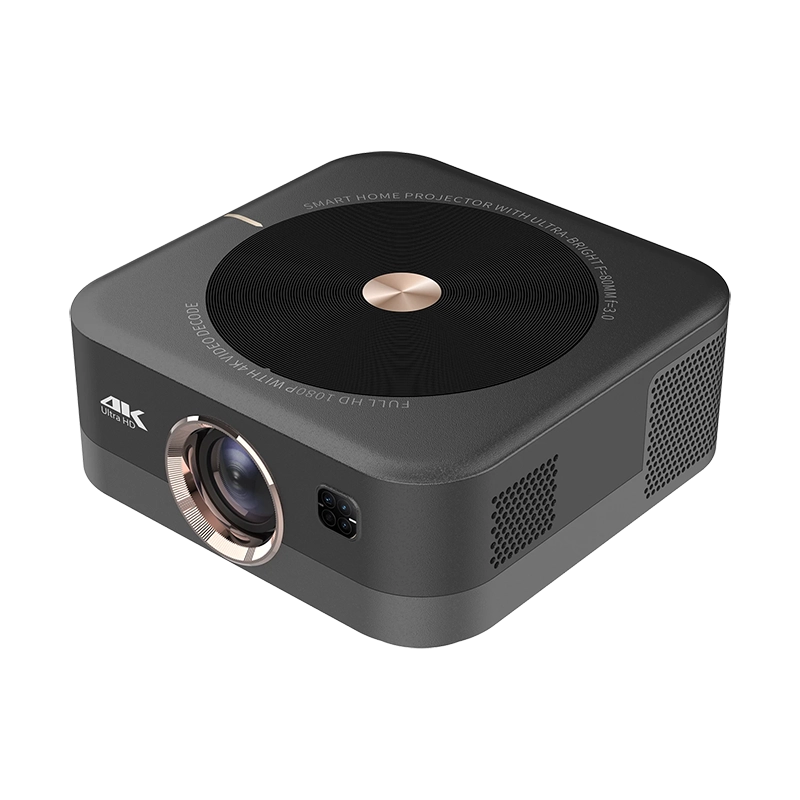
| GP94C | 500 ANSI lumens; native 1920×1080; 1.35:1 throw; 29–150 in; 1.15–6 m; contrast 1500:1; auto focus, keystone, screen alignment, obstacle avoidance | MTK9269; Android 9; 1 GB RAM; 32 GB ROM; dual-band WiFi 6; Bluetooth 5.1; mirroring; HDMI; 100M Ethernet; one USB; mini-jack audio; IR remote | Front/rear/hang projection; 86 W; 32 dB; 315×305×155 mm; 2.42 kg; LED source listed as 10,000–10,500 lumens; hospitality control and DRM status: confirm against production datasheet |

Quantitative selection method and worked sizing example
Start with the screen, not the projector SKU. The following example assumes a 120-inch 16:9 screen, 1.2 screen gain, and a maintained target of 160 lux. It is an illustrative engineering calculation, not a guarantee of visible performance. Room reflectance, lamp or LED age, color mode, ambient light, and screen uniformity remain validation items.
- Step 1: calculate image area: width = 120 × 0.871 = 104.5 in = 2.655 m; height = 120 × 0.490 = 58.8 in = 1.494 m; area = 3.967 m².
- Step 2: calculate required maintained output: 160 lux × 3.967 m² ÷ 1.2 gain = 529 lumens.
- Step 3: apply an illustrative retained-lumen factor of 0.80 for lifecycle planning: initial required lumens = 529 ÷ 0.80 = 661 ANSI lumens.
- Step 4: screen the portfolio: 1000 ANSI lumens provides 339 lumens of design headroom before the illustrative 20% depreciation factor, while 500 ANSI lumens does not meet the calculated 661-lumen initial requirement.
- Step 5: validate geometry. A 1.2:1 GP96-GTV requires 2.655 × 1.2 = 3.19 m lens-to-screen distance, within its stated 1.26–3.5 m range. The GP94C at 1.35:1 requires 3.58 m, outside its stated 1.15–6 m best range? No: 3.58 m is within that range, but its light output is the limiting factor for this example.
| Size matrix | Target maintained lux | Screen gain | Required maintained lumens | Required initial lumens at 0.80 retention | Portfolio implication |
|---|---|---|---|---|---|
| 80 in, 16:9 | 120 | 1.2 | 284 | 355 | GP94C nominally clears the calculation; GP8 requires site validation |
| 100 in, 16:9 | 140 | 1.2 | 402 | 503 | GP94C is marginal under the illustrative factor |
| 120 in, 16:9 | 160 | 1.2 | 529 | 661 | GP96-GTV clears; GP94C does not |
| 150 in, 16:9 | 160 | 1.2 | 825 | 1,031 | GP96-GTV is marginal; validate with photometry |
Throw distance alone does not establish suitability. For an ultra-short-throw design such as GP8, the 0.24:1 ratio yields a nominal distance of about 0.64 m for a 104.5-inch-wide image, but wall flatness, obstacle avoidance, image height, ceiling integration, and screen alignment remain critical. Auto geometry can simplify commissioning, but it does not remove the need for a surveyed mounting position.
Deployment profiles by application, environment, and risk
| Profile | Conditions and mounting | Connectivity and management | Primary risks |
|---|---|---|---|
| Hotel and hospitality | Typical guest-room or hospitality deployment; confirm whether the unit is ceiling, furniture-top, front, rear, or hang mounted. Maintain access to power and controls. | Use 100M Ethernet where GP94C is specified, and define PMS or front-desk integration. IR, serial, API, or network-control methods are not confirmed and require datasheet confirmation. | Guest-network isolation, account leakage, audible noise, heat in furniture cavities, remote pairing, and centralized recovery |
| Corporate | Fixed ceiling or rear projection for meeting rooms; survey screen gain, room reflectance, and 1.35 m minimum clearances. | Retain HDMI and wired network paths; deploy scheduled playback, MDM, or platform controls only if supported by the exact image. | Concurrent-source failures, WiFi contention, unmanaged app changes, and unauthorized casting |
| Education | Ceiling mounting in classrooms with anti-tamper attachments and controlled wall power. High-ambient use requires a higher photometric target. | Separate teacher-control and student-cast networks; define VDI, wireless presentation, and DRM content routes. | Rough use, blocked vents, unauthorized applications, inappropriate content, and service access by untrained staff |
| Retail and signage | Long-duration scheduled operation; use a fixed mount with rear or hang projection where supported. Validate portrait, 4:3, or 16:9 layout needs against the exact chassis. | Require central content management, restart recovery, and remote diagnostics; USB operation must not be mistaken for enterprise fleet management. | |
| Content drift, player failure, burned-in static images, thermal cycling, and unmanaged USB infection | |||
| High-ambient | Daylit rooms require photometric simulation and often direct-view alternatives. If projection remains selected, specify measured maintained illuminance rather than nominal brightness. | Use wired playback and disable unnecessary wireless radios if platform policy permits. Wall power and thermal management must support long duty cycles. | Low contrast, washed-out color, glare, heat, and operating-cost escalation from sustained maximum output |
Platform, content, network, and mechanical integration
Google TV and AOSP serve different procurement requirements. Google TV provides a certified commercial platform with a defined application and device experience, but certification, operator acceptance, Widevine security level, HDCP requirements, and the exact Google TV edition must be verified for the production configuration. AOSP provides greater control for bespoke firmware and enterprise device management, but the integrator owns application distribution, security policy, certification, and lifecycle support.
DRM is not equivalent to WiFi. A content operator may require Widevine L1 hardware-backed DRM, HDCP 2.2 or 2.3 protected output, secure boot, device attestation, and key rotation. The supplied records do not establish Widevine level, HDCP version, Netflix certification, EDLA status, or GMS compliance for any model. Confirm against the production datasheet and certification reports. For architecture guidance, see Widevine L1 versus L3 and business impact.
| Layer | Architecture decision | Evidence required | Failure mode |
|---|---|---|---|
| Display platform | Select Google TV for managed consumer-facing apps or AOSP for a controlled custom image | Exact OS build, app permissions, EDLA/GMS scope, license terms, and image-signing process | Feature mismatch between sales specification and shipped unit |
| Content security | Define DRM, HDCP, output protection, and key delivery separately | Certificate, level, supported codec, protected-output test, and contractual rights | Protected content refuses playback or leaks through an unprotected path |
| OTA and MDM | Choose signed OTA, Android Management API, or an equivalent device owner; AOSP without management is not fleet-ready | Rollout policy, rollback, staging ring, device enrollment, logs, and RMA recovery | Failed update bricks part of the estate |
| Network | Separate corporate, guest, IoT, and AV VLANs; use DHCP reservation, NTP, DNS, and QoS | Wireless survey, RF coexistence plan, wired failover, firewall matrix, and packet-loss test | Intermittent mirror, latency, or loss of control |
| Hospitality control | Define PMS/RMS integration, power-on behavior, volume, source, and service-room actions | Supported protocol, API version, authentication, command set, and recovery state | Guest cannot restore room state or front desk loses control |
| Mechanical and thermal | Validate enclosure, intake/exhaust, service clearances, weight, acoustics, and mounting load | CAD drawing, noise measurement, thermal test, safety certificate, and mounting kit | Overheating, fan noise, vibration, or focus drift |
The GP96-GTV record contains a possible architecture distinction between the projector main parameters and the Google TV dongle specification. Treat the CPU, memory, storage, OS, wireless capability, and codec behavior as configuration-dependent until the production datasheet identifies whether these are internal modules, board variants, or legacy entries. Do not design an MDM or security policy around the ambiguous fields.

Compliance evidence, optical maintenance, depreciation, and TCO
Regulatory compliance is market-specific. A buyer should require the exact model’s applicable electrical safety, EMC, environmental, RoHS, and radio documentation. For EU programs, assess applicable CE-related conformity evidence and the current EU Radio Equipment Directive regime; for the US, verify FCC equipment authorization and the intended transmitter configuration; for other markets, map the applicable national requirements before shipment. Marking, instructions, declarations, test reports, and certificates must match the production model, radio module, power supply, and firmware where relevant.
- Request the certificate number, issuing laboratory, model variant, test standard, issue date, and expiry or validity basis.
- Match the serial-number label, enclosure, power rating, antenna, and radio configuration to the approval evidence.
- For Google TV, request the applicable certification and operator documentation rather than inferring approval from the Android version.
- For optical engines, request dust-ingress or sealed-engine evidence. The GP96-GTV description says “dust-free design,” but the method and rating are not supplied; confirm against the production datasheet.
- Record cleaning intervals by environment. A sealed engine does not eliminate filter, vent, lens-surface, and thermal inspection requirements.
| Cost element | Calculation method | Data required | Control |
|---|---|---|---|
| Capital fleet | Units required × unit cost | Installed quantity plus 2–5% illustrative spare ratio | Separate model, mount, cables, surge protection, and signage |
| Installation | Labor hours × approved rate + travel + certification | Site drawings and access constraints | Use standardized bracket, cable, and commissioning work packages |
| Energy | Average watts × operating hours × local tariff | Measured operating watts and duty cycle | Use auto/scheduled power states and sleep modes where supported |
| Maintenance | Cleaning visits + replacement parts + field labor | Failure history and service response data | Preventive maintenance based on dust and operating hours |
| Depreciation and replacement | Scheduled replacement cost divided by service years | Expected brightness, source life, and use profile | Maintain a measured lumen-depreciation model |
| Downtime | Unavailable devices × hours × service cost | Criticality and local spare stock | Reserve 2–5% spares illustratively and define swap procedure |
The stated 10,000–10,500 LED “lumens” for GP94C and GP96-GTV is a source-life metric in the supplied layout, not ANSI brightness. Do not use it for screen sizing. Obtain a lumen-maintenance curve, rated operating mode, ambient-temperature condition, and service policy. The 450 versus 400 ANSI discrepancy for GP8 and the Android 11 or 14 ambiguity for GP96-GTV are procurement blockers until reconciled in the production datasheet.
OEM/ODM process, customization, AQL, PCN, spares, and warranty
A commercial projector program requires a controlled product definition rather than a catalogue order. The contract should identify the exact production model, SoC, memory, OS build, Google TV or AOSP status, brightness mode, lens and throw geometry, power supply, regional radio module, I/O, packaging, accessories, firmware, and approved golden sample. Any change to those elements can change certification, performance, test duration, and lifecycle risk.
- Define the specification: issue a numbered product requirements document covering optical, electrical, mechanical, platform, security, packaging, and service requirements.
- Lock the golden sample: approve a serialized production unit with measured output, thermal map, interface inventory, remote behavior, boot sequence, and accessory set.
- Run pre-production validation: execute DVT, certification, compatibility, OTA, MDM, DRM, and site-pilot tests; do not infer results from the engineering-sample configuration.
- Control production: define AQL sampling by critical, major, and minor defect classes, with 100% checks for specified safety, identity, firmware, and accessories.
- Manage changes: require advance PCN or ECN approval for SoC, panel, light source, lens, power supply, firmware baseline, radio, supplier, and packaging changes.
- Prepare service stock: identify units, remotes, mounts, power supplies, and interchangeable boards or modules based on actual failure data, not generic similarity.
- Execute warranty governance: define RMA authorization, turnaround target, defect-code taxonomy, evidence retention, root-cause reporting, and field-firmware correction rights.
| Deliverable | Minimum content | Approval gate |
|---|---|---|
| Production datasheet | Final model, configuration, tested modes, interfaces, dimensions, certifications | Procurement, engineering, and quality sign-off |
| Golden-sample record | Serial number, firmware hash, measured samples, accessories, packing list | Before pilot production |
| Inspection plan | AQL, defect classification, sampling sequence, 100% checks, records | Before shipment release |
| PCN procedure | Change trigger, notice period, regression scope, certificate impact, stock disposition | Before any approved change |
| Service package | Spares, RMA workflow, firmware, labels, warranty exclusions, reporting cadence | Before commercial deployment |
For broader process context, use projector OEM and ODM process. Customization may include branding, packaging, preinstalled applications, regional remote control, or firmware behavior, but it must not silently alter chipset, radio, optical, thermal, or certification scope.

Weighted RFP scoring and ordered selection process
| Criterion | Weight | Scoring guide | Mandatory gate |
|---|---|---|---|
| Optical and geometric performance | 20% | ANSI evidence, native resolution, contrast, focus, keystone, throw fit | Meets calculated maintained-light target |
| Platform and content security | 18% | Google TV/AOSP scope, DRM, HDCP, application policy, protected output | Exact certification and rights available |
| Management and OTA | 14% | Signed updates, rollback, MDM, telemetry, recovery | Fleet administration demonstrable |
| Connectivity and control | 12% | LAN, WiFi, HDMI, API, PMS, CEC, audio, IR | Required control path supported |
| Reliability and thermal design | 12% | Duty-cycle test, temperature, dust management, noise, endurance | Passes stated operating envelope |
| Mechanical and acoustic integration | 8% | Dimensions, weight, mount, clearance, vibration, sound | Fit and access approved |
| Compliance and documentation | 8% | Model-matched safety, EMC, radio, environmental and marking evidence | Market-specific evidence complete |
| Commercial and service framework | 8% | Warranty, RMA, spares, PCN, traceability, AQL | Operational governance accepted |
- Set the non-negotiable gates: reject any proposal that fails photometric sizing, protected-content requirements, network/control interface, physical fit, or market compliance.
- Normalize the evidence: score only the exact production configuration; mark an unverified claim as zero rather than accepting a comparison from an earlier model.
- Calculate weighted score: multiply each criterion score from 1–5 by its stated weight and sum the products; the maximum is 500.
- Apply risk adjustment: record contradictions as deductions and require written closure; do not average away a missing critical document.
- Run the site pilot: test the highest-scoring two configurations under real ambient light, network load, mount geometry, and representative content.
- Award by configuration: select the model and frozen configuration, not a family or “equivalent” platform.
Acceptance testing and field troubleshooting
| Acceptance test | Procedure | Pass criterion | Record |
|---|---|---|---|
| Identity and configuration | Compare label, serial number, hardware revision, SoC, memory, OS, radio, and accessories with the frozen BOM | 100% match | Digital inspection record |
| Brightness | Measure ANSI output in the specified production mode after stabilization | Meets purchase specification and model report | Instrument, ambient conditions, and reading |
| Geometry and focus | Display native grid, edge, text, and focus patterns at final mount | Geometry within drawing; focus remains sharp after warm-up | Photo, distance, and test pattern |
| Signal resilience | Run HDMI and network playback concurrently with WiFi transfer and measured packet loss | No interruption beyond project threshold | Capture logs and switch timestamps |
| Platform | Verify build, sign-in, app launch, casting, protected content, restart, OTA, rollback, and MDM enrollment | All required functions pass | Version, certificates, and operator IDs |
| Thermal and acoustic | Operate for at least the agreed 8-hour representative duty cycle | No thermal shutdown; noise at defined distance meets specification | Temperature curve and sound reading |
| Recovery and service | Power-cycle, disconnect network, simulate update failure, and execute RMA swap | Documented recovery within target; spare restores service | Timing and incident ticket |
| Symptom | First checks | Likely isolation | Corrective action |
|---|---|---|---|
| WiFi casting drops | Channel congestion, driver power state, RSSI, DHCP, AP roaming | Wireless path or client compatibility | Use supported band/channel, move AP, update signed image, or use wired source |
| Image smaller than expected | Throw ratio, lens shift, screen size, auto correction, input aspect ratio | Geometry configuration | Recalculate distance, correct projection mode, and set the correct aspect ratio |
| Keystone distorts text | Screen flatness, projector squareness, autofocus state, correction setting | Mechanical alignment rather than source resolution | Level mount, use surveyed position, and limit digital correction |
| Protected app fails | DRM level, HDCP path, display mode, account entitlement, time synchronization | Content-security chain | Correct output mode, verify entitlement and certificates, and use the certified configuration |
| Overheating or fan noise | Intake obstruction, ambient temperature, fan condition, duty cycle, mounting orientation | Thermal design or installation | Restore clearance, clean as approved, reduce duty cycle, or replace the unit |
| Focus changes after startup | Warm-up, vibration, autofocus target, temperature, repeated power cycle | Focus algorithm or mechanical stability | Disable unsuitable auto behavior if supported, improve mount rigidity, and log repeatability |
| Central control command fails | Authentication, API version, VLAN, PMS state, IR code, device state | Control integration | Align API and command set, review firewall policy, and test state synchronization |
| OTA update fails | Power stability, storage, firmware signature, staged rollout, rollback partition | Update service | Keep stable power, retry from staging, use signed package, and execute rollback procedure |

Expert FAQ: WiFi projector and regular projector procurement
Is a WiFi projector optically different from a regular projector?
No. WiFi describes source connectivity, not the light engine, resolution, throw geometry, or light output. A WiFi model can use the same optical architecture as a wired model. Procurement should compare ANSI lumens, native resolution, contrast, throw ratio, focus, source life, and tested operating mode before considering wireless features.
Does WiFi eliminate the need for HDMI and Ethernet?
Not in a critical commercial installation. HDMI remains the most predictable high-bandwidth local source path, while Ethernet supports device control, management, and stable delivery where the product supports it. The supplied GP94C record includes HDMI and 100M Ethernet. A resilient design can use WiFi for convenience while retaining a wired fallback.
Does “4K” mean the projector has a native 4K panel?
No. Native resolution and input or decoding capability are separate specifications. The supplied GP8, GP96-GTV, and GP94C records state native 1920×1080. GP94C is described as supporting 4K video decoding, which does not create native 4K pixels. Require the physical panel or light-engine resolution separately from input support.
How should ANSI lumens be used in a site design?
Calculate required maintained lumens from target illuminance, screen area, and screen gain, then validate the result with a photometric proposal. For the illustrative 120-inch example, 160 lux and 1.2 gain produced 529 maintained lumens, or 661 initial lumens using a 0.80 retention factor. Ambient light and screen performance still require site validation.
Should a commercial project use Google TV or AOSP?
Google TV is appropriate when certified applications, operator-managed services, and a defined consumer experience are required. AOSP supports a more controlled custom image but transfers application, security, update, and certification responsibility to the integrator or OEM. Neither label alone proves DRM readiness, fleet management, or production certification.
Do WiFi and streaming require Widevine L1 and HDCP 2.2 or 2.3?
The requirement depends on the content owner, application, output path, and service contract. A commercial buyer should specify Widevine security level and HDCP version rather than ask whether the projector supports “streaming.” Confirm the exact model’s protection capabilities and certification evidence; the supplied DataMax records do not state them.
Can automatic focus and keystone eliminate commissioning?
No. Automatic focus and keystone improve usability, but they do not correct a non-square mount, uneven wall, unstable bracket, unsuitable projection distance, or vibration. Commissioning still requires a surveyed geometry, final-focus test, image-size calculation, and written acceptance record.
What makes a projector fleet-manageable?
A fleet requires signed OTA, staged rollout, rollback, device identity, MDM or equivalent ownership, inventory mapping, remote diagnostics, and a documented recovery process. An Android device with WiFi and Bluetooth is not automatically fleet-manageable. The exact platform and management path must be demonstrated on the production configuration.
How should procurement compare lifecycle cost rather than unit specifications?
Evaluate installed cost, energy, cleaning, spare units, failure response, firmware administration, expected brightness depreciation, and replacement timing over the operating period. A higher-output model may reduce image-area risk but increase power and thermal load. Use measured duty cycles and site-specific maintenance assumptions rather than generic life claims.
Engineering consultation and RFQ pathway
For a defensible WiFi projector versus regular projector comparison, provide the screen dimensions, room ambient-light survey, projection distance, mounting orientation, content-protection requirements, network topology, management policy, operating hours, target service period, and site acceptance thresholds. An engineering review can then convert those inputs into a photometric proposal, integration architecture, frozen DataMax configuration, test plan, and weighted RFP package without relying on unsupported product assumptions.




