

What the answer hinges on
Before approving android tv box wholesale terms, confirm 6 linked items: the operating model, exact hardware configuration, licensed software, customization depth, factory evidence, and acceptance responsibility. Attach each item to the quotation or purchase order; verbal assurances become ambiguous after shipment. This page covers terms distributors commonly blur, including “operator grade,” “customized,” “certified,” and “same as sample.”
Verification starts with an RFQ that freezes the model and configuration identifiers, followed by documentary evidence for each claimed capability. A sample establishes appearance and basic behavior, but cannot independently validate the production BOM, firmware branch, software licensing, or repeatable manufacturing controls. The contract must also define ownership of the bootloader, applications, content-protection keys, firmware updates, regulatory documents, and defect triage.
For android tv box wholesale, the decisive distinction is between buying an off-the-shelf platform and commissioning a committed program involving branding, middleware, device management, bespoke hardware, or ongoing OTA operations. The first can suit a conventional IPTV/OTT channel. The second requires engineering governance, a controlled baseline, and staged acceptance gates.
This article addresses terminology and verification rather than the generic buying model. For the broader commercial framework, compare the procurement stages in the canonical wholesale Android TV box guide. DataMax can support a specification-led request through its inquiry channel; the first message should identify the target segment, model candidate, firmware level, customization scope, forecast band, destination markets, and required test evidence.
The checklist matters because each omission has a different owner. Model identity without a revision permits substitution. Codec language without display testing permits an output mismatch. A DRM name without license ownership permits a playback dispute. A branding label without an approval artifact permits firmware drift. Evidence without serial linkage cannot prove which unit passed. Responsibility without escalation turns a field incident into a routing exercise.
Sign-off should therefore be a configuration decision, not a price comparison. A buyer can accept a catalog model with fewer documents or authorize a committed program with a deeper evidence package. The unacceptable outcome is a term whose meaning changes between the sample, purchase order, production line, and installed fleet.
Entry tier versus commitment tier
Distributor terms become clearer when classified by commitment rather than by the number of listed features. An entry arrangement buys an existing platform with limited presentation changes. A commitment arrangement reserves engineering, supply, and operational work against a defined program.
| Decision field | Entry tier | Commitment tier |
|---|---|---|
| Configuration control | Existing model and listed RAM/ROM option | Frozen SKU, BOM, firmware baseline, and change mechanism |
| Branding | Packaging or limited logo application | Boot animation, launcher, settings, UI, and controlled firmware branch |
| Software responsibility | Buyer deploys and updates applications | Defined ownership for integration, signing, release, and OTA |
| Quality evidence | Functional sample and basic production inspection | Approved golden sample plus traceable SMT, AOI, aging, and audit records |
| Change control | Factory catalog updates | Written change request, impact review, retest, and approval gate |
| Acceptance | Delivery specification | Pre-agreed functional, performance, and documentation criteria |
| Lifecycle support | Best-effort support subject to quotation | Agreed support window, escalation path, and firmware maintenance scope |
An entry-tier quotation does not automatically produce a lower total program cost. The buyer may inherit application signing, storefront policy, middleware integration, device enrollment, field updates, and troubleshooting. Conversely, a commitment-tier quotation lacking a baseline and acceptance plan adds coordination work. Compare the complete responsibility map before interpreting the proposal.
The operating model also changes technical acceptance. A distributor supplying a standard SKU should demonstrate the declared HDMI, Ethernet, wireless, decoding, and DRM configuration on the production model. A committed ODM program must add traceability for substitutions, firmware branches, packaging revisions, and approved deviations. “Same as sample” is inadequate unless the sample has a serial-linked configuration record.
Consider an OTT proposal listing an Android 14 box, 2GB / 16GB, Widevine L1, and a branded launcher. Under the entry tier, these may describe a standard configuration that the buyer configures after receipt. Under the commitment tier, the same list could imply a maintained private firmware branch with licensed applications, an approved boot image, and factory-installed middleware. Only the written scope can determine which interpretation applies.
The entry tier needs a clear fallback rule. If the listed storage option is unavailable, should the supplier quote another memory option, offer a date-controlled alternative, or decline? A commitment tier needs a change mechanism: deviation notice, impact assessment, retest scope, approval authority, and effective revision. These controls prevent a shortage from silently altering the accepted product.
The post-delivery boundary must also be explicit. A catalog purchase may leave the buyer responsible for application distribution and OTA. A committed program may assign image maintenance to the manufacturer while the buyer retains commercial application signing. State those tasks separately. Hardware supply does not automatically transfer middleware ownership, and device supply does not automatically transfer fleet-recovery responsibility.
This ranking is not a performance score or a quotation. A branded boot screen does not prove operator-middleware readiness, while a joint ODM engagement still requires written acceptance criteria. Use it to expose the scope being priced, then attach each selected level to a deliverable.
For android tv box wholesale, give every negotiation row an owner and artifact. “Branding” should reference artwork, boot asset, launcher build, and approval record. “DRM” should reference the selected license configuration and test report. “Support” should reference the escalation path, firmware-maintenance scope, and defect-severity rules. Rows without those links describe expectations rather than enforceable commitments.
The mechanism behind the spec
Distributor claims often collapse several technical domains into one label. The contract should separate hardware platform, Android configuration, content protection, connectivity, custom firmware, and operational support. That division exposes mismatched terms before the purchase order is issued.
“Android TV” can describe a product category, an application form factor, or an AOSP-derived build. AOSP Android 11 or Android 14 in the DataMax model baseline is a verifiable OS fact, but it does not automatically establish Google Play certification, Widevine device certification, operator-middleware licensing, or Google services integration. Each service must be named separately. Buyers can review the distinctions in AOSP versus Google Android TV.
Similarly, “4K” requires output format and decode limits to be separated. HDMI 2.0b output, AV1 or VP9 decoding, and H.265 4K@60 are distinct capabilities. Widevine L1, PlayReady, HDCP 2.2, Dolby Vision, and DTS describe different licensing or output paths. The presence of one does not prove another. State the selected licensed configuration and identify any option versus standard build.
Networking terms require equivalent precision. RJ45 100M, optional 1G, Wi-Fi6 2x2, and BT5.4 are not interchangeable. The SKU must identify interface speed, radio configuration, and regional regulatory obligations. “Network ready” has little engineering value unless acceptance covers Ethernet behavior, wireless performance, DHCP/DNS use, and the intended management path.
Customization operates through defined layers. Packaging art is print control. Boot animation and launcher changes require assets and firmware integration. A feature branch needs source ownership, version baseline, review rights, signing procedures, and release responsibility. Joint hardware/software ODM extends control into schematic design, component selection, validation, and lifecycle change control.
This chain prevents “HD,” “operator ready,” and “customized” from becoming orphaned adjectives. Each label should point to a measurable condition, verification method, and accountable owner. If the distributor cannot identify the license holder, test method, or change process, the commercial scope remains undefined.
The hardware-to-software sequence follows the same logic. The SoC establishes the processing baseline; the board revision determines ports and component placement; firmware exposes boot, codec, network, and update behavior; the signed application set determines the user-facing service; deployment configuration assigns network and management services. A change at one layer can invalidate acceptance above it. Replacing a wireless module alters the radio configuration; changing the bootloader alters an otherwise identical application build.
Codec claims must be tested as chains rather than components. The decoder may support a format, but the source may carry another profile, the display may negotiate another mode, and the application may request an unavailable output. Record source codec, profile, resolution, frame rate, display mode, negotiated output, and observed result. Do not collapse “H.265 4K@60” into a generic 4K promise.
Content protection has another chain: device certification, license provisioning, application integration, output path, and playback behavior. The distributor must identify which elements it supplies and which remain buyer-controlled. If the requirement includes Widevine L1, PlayReady, HDCP 2.2, Dolby Vision, or DTS, attach the selected configuration and define source, display, and failure criteria.
For android tv box wholesale, decompose “operator grade.” It might mean controlled hardware revisions, remote recovery, middleware support, enrollment, or manufacturing traceability. Ask for one testable meaning per requirement. The objective is not a larger document set; it is to prevent the same feature from being assumed simultaneously by the distributor, integrator, and operator.
Which DataMax models actually sit here
The correct DataMax platform depends on the operator segment, codec path, interface needs, and software baseline—not a distributor’s generic tier label. The table confines every model claim to the supplied production facts. Other configurations must be confirmed against the production datasheet.
| Model | SoC and OS | Memory | Decode and DRM | Interfaces |
|---|---|---|---|---|
| DM21P | Amlogic S905Y4, quad Cortex-A35; AOSP Android 11 | 2GB / 8GB; 4GB; 16/32/64GB optional | AV1 [email protected], VP9/H.265 4K@60, H.264 4K@30; Widevine L1 / PlayReady / HDCP 2.2 optional | HDMI 2.0b out x1, USB2.0 x2, TF, S/PDIF, 3.5mm AV, RJ45 100M, Wi-Fi6 2x2 + BT5.4, DC 5V/2A |
| DM21S | Amlogic S905Y5, quad Cortex-A55; AOSP Android 14 | 2GB / 16GB; 2/4/8GB; 16/32/64GB optional | AV1 / H.265 [email protected] 4K@60; Widevine L1 / PlayReady optional; Dolby Vision/DTS | HDMI 2.0b out, S/PDIF, AV, USB2.0 x2, TF, RJ45 100M (1G optional), Wi-Fi6 2x2 + BT5.4 |
| DM21T | Amlogic S905X5, quad Cortex-A510 (ARMv9); AOSP Android 14 | 4GB / 64GB; family options | H.266/VVC [email protected] 4K@120, AV1/VP9/H.265 4K@120, AVS3 4K@120, H.264 4K@60; inline AI-SR; Widevine L1 / PlayReady optional | HDMI 2.0b out (no HDMI in), USB2.0 x1 + USB3.0 x1, TF, S/PDIF, AV, RJ45 100M (1G opt), Wi-Fi6 + BT5.4 |
| DM22Q | Amlogic S905X5M, quad Cortex-A55 up to 2.5GHz; AOSP Android 14 | 4GB / 64GB; 2/4/8GB; 16/32/64GB optional | AV1/H.265 L5.1 4K@60; inline AI-SR (no NPU TOPS stated); Widevine L1 / PlayReady optional; Dolby Vision/DTS | HDMI 2.0b out, USB2.0 x2, TF, S/PDIF, AV, RJ45 100M (1G opt), Wi-Fi6 2x2 + BT5.4 |
The platform direction is clear, but each order still needs a written configuration. For a 4K IPTV or operator-middleware proposition, DM21P is the direct fit in the supplied line. DM21S addresses a 4K Android TV box for IPTV/OTT white-label work and presents Dolby Vision/DTS in its stated feature set. DM21T targets a premium UHD or cloud-gaming box, while DM22Q is positioned as a gaming-oriented Android TV box. These fit labels indicate direction; they do not replace an approved configuration sheet.
The editorial engagement chart separates another dimension: how deeply the program changes the supplied product.
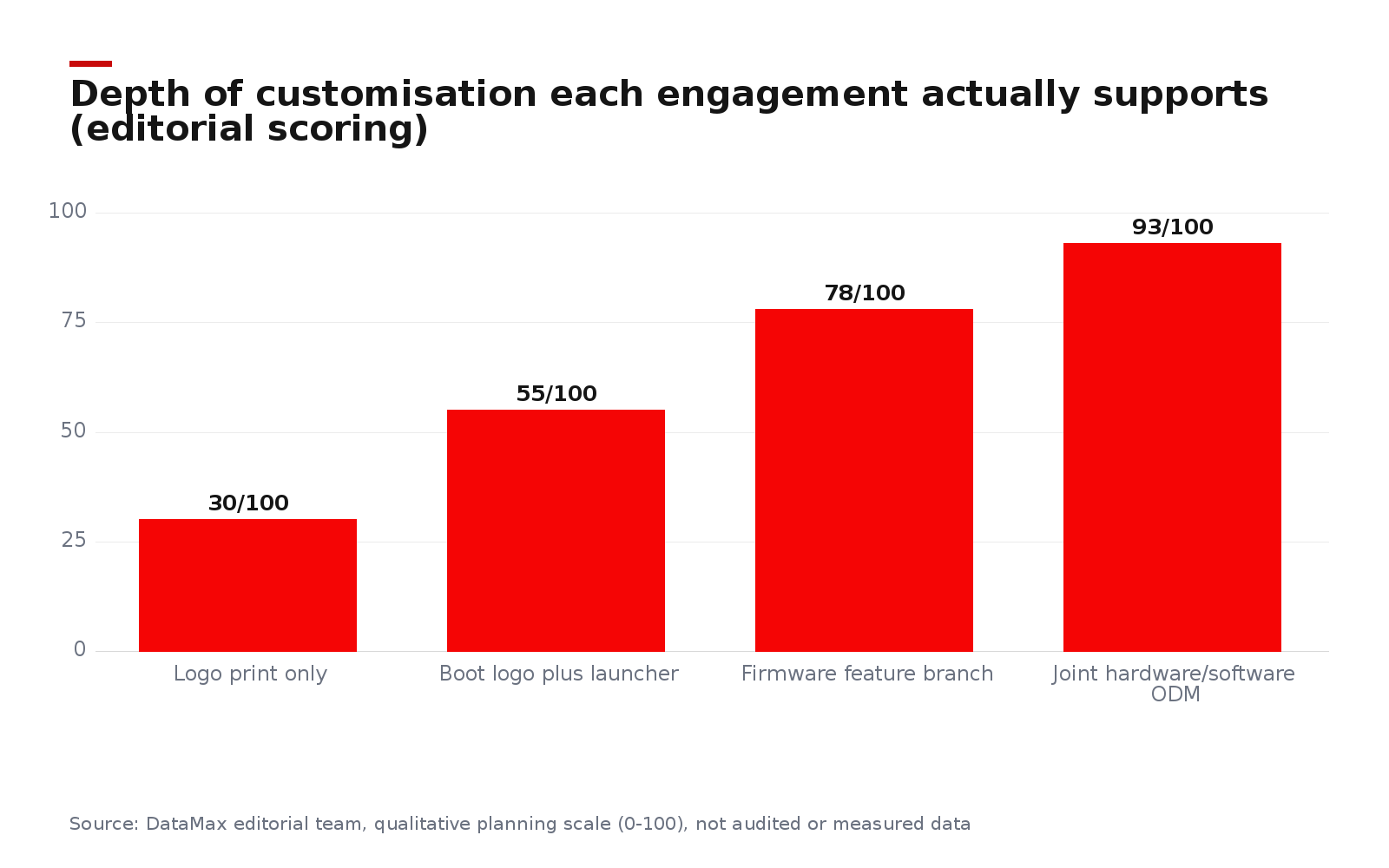
The same figures, in searchable form:
| Engagement option | Editorial score |
|---|---|
| Logo print only | 30/100 |
| Boot logo plus launcher | 55/100 |
| Firmware feature branch | 78/100 |
| Joint hardware/software ODM | 93/100 |
Source: DataMax editorial team, qualitative planning scale (0-100), not audited or measured data.
Options also require written selection. 1G Ethernet is optional on DM21S, DM21T, and DM22Q, while DM21P lists RJ45 100M. Optional DRM arrangements must be quoted as selected, not inferred. Any combination not shown in the production datasheet must be confirmed against the production datasheet before contractual use.
Model fit is not configuration approval. DM21P fits an operator-middleware requirement, but its storage, optional HDCP 2.2 arrangement, and RJ45 100M interface still need to match the deployment. DM21T lists a USB3.0 port and higher-frame-rate 4K decode paths, but its HDMI output and lack of HDMI input must be reflected in the installation design.
For android tv box wholesale, use the model name as an identifier, not a complete specification. Add the selected memory option, OS baseline, optional interface, DRM arrangement, firmware build, and packaging revision. If a distributor combines model families, alters an SoC, or proposes a memory combination outside the supplied facts, require written confirmation against the production datasheet before acceptance.
Attach a configuration snapshot to the golden sample. Record model, serial number, hardware revision, SoC, RAM/ROM, OS build, firmware image, enabled ports, selected options, and artwork revision. A photograph cannot prove the first five items, and a verbal description cannot prove firmware identity. A signed sample record anchors both technical review and production reconciliation.
Where this matters in a deployment
The same distributor phrase can be valid in one deployment and inadequate in another. Map the buyer situation to its controlling requirement, then use the model direction only as a starting point. Acceptance must match the selected production configuration.
| Situation | Controlling requirement | Model direction | Evidence to request |
|---|---|---|---|
| • IPTV operator middleware rollout | • Controlled middleware image; stable Ethernet path; licensed playback | • DM21P for 4K IPTV/operator middleware | • Golden-sample image hash; interface configuration; decode and DRM test report |
| • OTT white-label channel | • Android 14 baseline, launcher and brand presentation, application signing | • DM21S for 4K IPTV/OTT white-label | • Branding approval; update procedure; playback and interface acceptance record |
| • Cloud-gaming or premium UHD | • Higher-motion 4K codec path; one USB3.0 port; no HDMI input requirement | • DM21T for premium UHD/cloud-gaming | • 4K@120 format and display compatibility tests; port and thermal evidence |
| • Gaming-focused retail or hospitality offer | • Gaming positioning, AV1/H.265 playback, Android 14 baseline | • DM22Q for gaming-oriented Android TV | • Configuration record; decode test; sustained-load behavior |
| • Hotel-room operator box | • Compact installation, stable LAN service, remote recovery | • Confirm fit against DM21P or DM21S after room-system review | • Device-management workflow; restart and recovery test; installation drawing |
| • Multi-site digital signage | • Managed deployment, reproducible update process, defined hardware revision | • Confirm capacity across the selected DataMax family | • OTA policy; device enrollment evidence; serialized production record |
For an operator, “middleware” identifies an integration responsibility but not who signs the image, provisions licenses, handles updates, or supports field recovery. For an AV integrator, HDMI 2.0b, optical audio, AV, USB, and Ethernet determine installation compatibility. A distributor’s phrase “complete media box” does neither job.
A modern hotel room at dusk illustrates the physical side of the specification: the television may show a clean image while the compact operator box remains hidden behind the display. That scene says nothing about Ethernet stability, remote recovery, thermal behavior, or device enrollment.

Venue deployments expose ownership gaps. The buyer may own the guest-network account, while the box vendor supplies the device and another party controls the middleware. The agreement must state who assigns the network, who operates the device-management service, and who responds when a TV input, handshake, or service activation fails.
Operator deployments also need staged environment checks. A laboratory test can establish that the selected box decodes a source and renders an image. A central IPTV deployment adds multicast, DHCP, DNS, authentication, provisioning, and device-management interactions. Distinguish platform acceptance from network integration. A supplier need not own the operator network, yet the interface between device and network requires an owner and test procedure.
An AV integrator faces a different risk set. The selected HDMI output, audio path, network mode, remote-control method, and physical placement must be checked against the room system. A box may pass playback and still fail because the display negotiates an unexpected mode, the optical-audio path is disabled, or the installer cannot reach the device. For signage, the repeated-update and restart cycle matters more than a showroom demonstration.
For android tv box wholesale, deployment language should identify the environment and responsible system. “For hotel rooms” is a market description. “For managed operator boxes behind guest displays, connected through the specified Ethernet method and enrolled through the named device-management service” is an acceptance boundary. The latter gives the distributor, integrator, and operator a common object to test.
Use the operator-tier Android TV box solution to structure the operator requirement. For the standards background, consult the 4K 60fps Android TV box guide. Neither resource replaces a configuration-specific acceptance record.
The selection sequence that removes rework
Move from operating need to frozen configuration, then from supplier evidence to acceptance. Do not begin with cosmetic branding or an unverified chipset headline. A pasted RFQ prevents the distributor from answering a different program.
- Define the deployment State operator, IPTV, OTT, gaming, or signage use; destinations; source resolution and frame-rate target; wired or wireless network; installed environment; and device-management operator.
- Select the platform direction Use the model matrix to form a shortlist, but keep optional Ethernet, DRM, and storage configurations outside the RFQ until verified against the production datasheet.
- Freeze the commercial scope Attach the exact model, SoC, OS, memory, port list, codec list, DRM selection, packaging, branding depth, software responsibilities, documentation, and acceptance tests.
- Identify the evidence owner Map each claim to a test report, sample record, production document, license statement, or contractual responsibility. Mark unmapped claims unverified.
- Approve a configuration golden sample Record serial number, hardware revision, firmware build, application versions, packaging revision, and accessories. State whether the sample is retained for audit.
- Run pre-production verification Validate the intended display, source, decode format, network, remote control, update path, recovery behavior, and regulatory documentation before production release.
- Set a shipment acceptance gate Define sampling, defect categories, evidence submission, corrective-action timing, and the disposition when the delivered build differs from the approved baseline.
A procurement-ready RFQ line should read: “Quote the selected DataMax model, exact SoC, AOSP version, approved RAM/ROM combination, enabled interfaces, selected codec profile, and selected optional DRM configuration. State any deviation from the attached production datasheet and identify it as an exception requiring written approval.”
The next line should define the customization boundary. Specify packaging artwork, boot animation, launcher, settings screens, middleware build, preinstalled applications, store account, signing authority, update mechanism, and owner of each element. Distinguish an existing production build from a fork because their maintenance and validation obligations differ.
The final line should request the evidence set: sample configuration record, functional test report, SMT and AOI records, aging record, packaging inspection, serial traceability, applicable compliance documents, and a change-control contact. Send this through the inquiry channel. The first message for this topic should contain the deployment type, model candidate, exact configuration requirements, customization depth, destination market, forecast band, required evidence, and response deadline.
Begin with a requirement sentence: “The unit must render the named 4K source format to the buyer’s named display model, connect through the selected Ethernet configuration, join the operator’s device-management system, and recover after the agreed restart event.” Only then name a model. This order keeps the model accountable to the deployment.
Include a document-precedence rule. State whether the signed purchase order, configuration sheet, approved sample record, firmware acceptance report, or production datasheet controls when documents differ. An explicitly approved deviation should control only its named field; every other field remains at the frozen baseline. Without that rule, an email approving one storage option can alter the order’s interpretation.
The sample stage should identify production-identical elements. Housing artwork, packaging, remote-control accessories, and power adapters may differ in relevance, but the SoC, memory configuration, board revision, enabled interfaces, and firmware build need explicit records. If the sample is opened, flashed, or consumed by aging, retain a second serialized sample for comparison.
Pre-production verification should exercise the intended path rather than a generic demonstration. Use the actual display, source, network service, remote control, middleware account, update policy, and recovery method. Record expected results and failure definitions. If a capability cannot be tested in the available environment, classify it as pending rather than accepted.
The shipment gate must define what happens after an exception: hold, rework, replacement, concession with documented deviation, or refusal. State the evidence deadline, responsible party, and release authority. Without a disposition rule, “subject to final inspection” can move an unresolved configuration issue into the buyer’s warehouse.
For android tv box wholesale, this sequence distinguishes a catalog transaction from a repeatable program. It converts distributor vocabulary into numbered requirements, maps each requirement to evidence, and defines the decision when production deviates from the approved baseline.
Failure modes that reach the field
Quotations diverge because they describe the same term at different levels of precision. A model name without its configuration is not a frozen order line. A branding claim without an approval artifact is not a completed custom build. A test result without method, sample identity, and revision is not acceptance evidence.
Field trap: interchangeable channel terms
A distributor may quote “AV1-ready,” “Dolby Vision,” or “HDCP” while the selected build lacks the corresponding license, configuration, display path, or output negotiation. Confirm the selected configuration, test display and source, and define failure criteria. If the quotation cannot distinguish decoding from output or content protection from licensing, protected playback may fail at acceptance.
The second trap is treating a sample as the production specification. Hardware substitutions, different memory suppliers, altered wireless modules, package changes, or unapproved firmware branches can pass visual comparison while altering behavior. Require a serialized golden sample, revision control, and written approval for every deviation. “Same as sample” without linkage is operationally unsafe.
Field trap: distributed ownership
The distributor builds the image, the operator signs the applications, the integrator provisions the network, and a platform team updates devices, yet no agreement names the release owner. A bad build can circulate through every layer without one accountable decision-maker. Assign release authority, rollback authority, recovery access, incident ownership, and evidence retention in the purchase order.
Interface naming creates further failures. “USB 3.0,” “1G Ethernet,” “Dolby Vision,” and “AI scaling” are insufficient. State port count, optional status, negotiated speed, display format, and whether the selected SKU includes the feature. A fixed Ethernet port may be preferable to an optional faster variant in a managed hotel deployment because the production configuration remains stable.
Performance language also needs a test method. Frame-rate support does not guarantee the complete chain: decoding, display mode, HDMI negotiation, application output, thermal state, and sustained behavior participate. Validate the intended source and target display rather than inferring acceptance from a codec list.
Another failure mode appears when a distributor catalogue becomes a regulatory register. A document may exist for one model revision while the shipment contains another board, radio configuration, power supply, or enclosure. The cost can include quarantine, relabeling, destination-market review, and missed rollout windows. Require the exact document identifier and model coverage for every regulatory claim, then reconcile that coverage against the packed configuration.
A related error is allowing “latest firmware” to act as a release rule. The word moves over time and provides no reproducible rollback point. Require a firmware build identifier, release notes, compatibility statement, approval record, and rollback image. If the distributor distributes OTA updates after shipment, update authority and customer notification need contractual treatment.
Incomplete recovery definitions cause additional failures. Restart behavior, application relaunch, network reconnection, account expiry, and factory reset are separate procedures. “Remote recovery supported” must identify the trigger, authorized operator, expected result, and data effect. A workflow requiring physical access is not equivalent to restoration from an operations console.
Document-level review is also essential. A declaration name does not establish every destination-market requirement, and a certification does not prove that the shipped model is the certified configuration. Ask for the applicable document, model coverage, laboratory or issuer identification, validity status, and production linkage through certifications and compliance.
For android tv box wholesale, these failures share one corrective action: replace the adjective with an observable state. The state must be assigned, testable, recorded, and linked to the delivered configuration. A quotation is ready for signature when its terms survive a factory audit, incoming inspection, and field incident without relying on memory.
The evidence trail from SMT to shipment
Factory evidence should trace one delivered unit back to the processes that produced it. The purpose is not a large evidence bundle; it is a coherent chain from component placement and inspection through firmware loading, aging, final test, packaging, and shipment release.
- SMT placement Record the approved line, production date, work order, board revision, component list, and line identification. Log substitutions against the approved BOM rather than hiding them as “equivalent.”
- AOI inspection Retain the inspection result for the work order and board revision. Define whether the acceptance threshold includes the supplier’s inspection method or buyer-witnessed controls.
- Assembly and firmware loading Link the hardware revision and approved image or build identifier to the unit serial record. Record application versions, configuration flags, and bootloader or update state where applicable.
- Functional and dark-room verification Test defined ports, display output, source decoding, network behavior, audio path, remote functions, and protected-content flow. The dark-room record must identify the sample set and criterion.
- Aging and stress evidence Define duration, workload, ambient conditions, and failure criterion for the agreed program. Do not turn a generic factory activity into an unmeasured performance guarantee.
- Final inspection and packaging Reconcile the serial record with SKU, memory configuration, packaging artwork, accessories, labels, and destination-market documents.
- Shipment release Compile the approved configuration list, inspection summary, exception record, serial traceability, and document index. Accept the shipment before closing the evidence trail.
Evidence package: work-order reference; board and product revision; approved BOM and substitution log; SMT record; AOI result; firmware build identifier; functional test summary; dark-room result; aging record; packaging inspection; serial-to-shipment reconciliation; applicable compliance-document index.
Set the evidence expectation before production begins. For a standard catalog order, sampling and inspection boundaries can follow the agreed supplier procedure. For a committed program, the golden-sample identity and acceptance tests become the fixed reference. The more the software, hardware, packaging, and documentation are customized, the tighter the revision linkage must be.
The chain should permit a targeted query. An inspector should take one serial number and identify its board revision, loaded firmware build, functional-test result, aging result, and packing record. If those records exist only as undated spreadsheets without revision identifiers, the chain is incomplete. A buyer should not have to infer which production week and image belong to the carton.
SMT and AOI evidence must connect to the approved BOM. An inspection record proves a board passed a process; it does not establish that the correct approved components were placed. The substitution log should identify the original item, proposed item, technical rationale, approval, affected work orders, and required retest. Supplier approval without production-order linkage is insufficient.
Firmware loading is a factory operation with a software result. Record the image identifier, application package versions, configuration flags, signing state, and installation outcome against the serial record. For a catalog product, this may be a controlled stock image; for a private-label program, it may be a customer-specific image. Distinguish the two in the evidence wording.
Dark-room and aging evidence must state what was tested, on which sample set, under what conditions, and against which criterion. Dark-room testing can cover display output, source formats, ports, network behavior, audio, remote functions, and protected-content flow. Aging must state duration, workload, ambient conditions, and failure definition. “100% aging passed” does not describe a controlled acceptance test.
Final reconciliation closes the loop. Match the packed SKU, memory configuration, artwork, accessories, labels, documentation, and serial list against the shipment record. Record every exception and approved disposition. This prevents the evidence system from proving a technically correct unit while the carton carries the wrong branding or accessory set.
DataMax can support this review through the factory-quality workflow or manufacturer information. Invite a video factory audit and request SMT/AOI/aging evidence for the proposed SKU, production revision, and firmware baseline. A generic factory tour is less useful than an evidence review tied to the order.
Before releasing the android tv box wholesale program, check that the production record matches the accepted sample and contractual specification. If the supplier cannot connect the quotation term to an owner, a test, and a serial-linked record, the term remains a claim rather than a controlled deliverable.
Further reading
- Guide wholesale android tv box
- Edge computing boxes
- 4K 60fps Android TV box guide
- Rockchip Android TV box guide
- Dolby Vision Android TV box guide
- DataMax DM21P specifications and fit
- DataMax DM21S specifications and fit
FAQ
Which distributor terms should appear in an Android TV box purchase order?
The purchase order should identify the exact model, approved hardware revision, RAM/ROM configuration, OS baseline, enabled interfaces, codec requirements, selected DRM configuration, firmware build, packaging revision, and customization scope. It should also assign software signing, update, recovery, and defect responsibilities. Generic terms such as “operator grade” or “latest version” are weak controls because they do not identify the delivered configuration or required evidence.
Is a golden sample sufficient for acceptance?
A golden sample identifies the approved configuration but is insufficient by itself for full acceptance. It can establish appearance, interface layout, application behavior, and selected functional expectations. Production acceptance may still require build identification, component-substitution control, factory test records, aging evidence, and reconciliation between sample, shipment, and serial records. The purchase order should define which evidence supplements the sample.
Does AOSP Android 14 mean the box has Google Play?
No. AOSP Android 14 identifies the supplied Android baseline; it does not by itself prove Google Play, Google services, certified Android TV integration, or an application-distribution arrangement. These are separate commercial and technical scopes. A buyer requiring a storefront, Google services, or a particular device-management service should request that capability explicitly and define the responsible party, account model, update process, and acceptance test.
How should DRM and 4K claims be tested before shipment?
Require the quotation to distinguish decoding, output, display support, and licensing. A claim involving Widevine L1, PlayReady, HDCP, Dolby Vision, or DTS should identify the selected configuration, and the acceptance test should state source format, display mode, negotiated output, protected-content flow, and failure criterion. Codec support alone does not prove that the intended source, display, application, and license combination works in the deployed environment.
Who should request factory evidence for a private-label program?
The buyer or program owner should request it before shipment release, with evidence linked to the proposed model, board revision, firmware build, work order, and serial records. The release owner should also confirm that the installed production image matches the approved build. If ownership is unclear, request an order-sample discussion and document the evidence chain before authorizing the production configuration.
What happens if the delivered model differs from the sample?
Stop at the configured disposition step: hold the shipment, replace it, rework it, accept it as a documented deviation, or reject it. Base the decision on the named deviation, affected requirement, retest needs, and authority granted in the purchase order. Do not let visual similarity or an informal “equivalent” label close the gap between the approved sample and delivered configuration.


