

Before the terminology: the warranty decision
The belief that a long warranty automatically means better manufacturing is wrong. Warranty duration is only a liability allocation; manufacturing reliability, replacement logistics, traceability, and claim turnaround determine the operational outcome. For an android tv box program, the defensible decision is to define the failure, the covered remedy, the evidence burden, and the escalation path before selecting a platform or accepting a clause.
Warranty wording should separate 4 distinct concepts that quotations often merge. First, coverage identifies defective units, dead-on-arrival events, specified interface failures, and other conditions for which the supplier accepts responsibility. Second, duration defines the measurement point and the clock’s starting event. Third, remedy defines repair, replacement, firmware recovery, refund, or another action. Fourth, exclusions define physical damage, unauthorized modification, consumable wear, third-party service interventions, and operating conditions outside the agreed specification.
A clause such as “one year warranty” is therefore incomplete. It omits whether the period begins at shipment, invoice, activation, or customer acceptance; whether a replacement resets the clock; who pays return freight; what evidence is required; and whether the remedy is limited. The quotation, purchase order, warranty policy, and production datasheet must agree on those points.
DataMax can support an OEM sourcing discussion through its platform and factory evidence, but the buyer must still approve the final commercial and operational terms. For broader platform selection, use the canonical Android TV box for ISPs guide to decide the product role before negotiating warranty scope.
A practical buyer should therefore treat warranty as an acceptance-control system. Freeze the SKU, build, accessories, test method, and claim route before approving a duration. If a supplier cannot identify the production revision covered by the clause, the clause is not ready for purchase-order release. If the buyer cannot retrieve a serial number and lot record after deployment, the claim process will depend on memory rather than evidence. The decision is therefore operational: determine which failures qualify, how the unit is identified, who carries logistics, and what happens when the remedy fails.
The cost of an ambiguous clause is not limited to the defective unit. It includes distributor triage, retailer escalation, field replacement, freight, firmware regression checks, and credit or replacement decisions that may be taken twice. A precise clause does not eliminate manufacturing failures; it prevents each failure from becoming an argument about scope. That is the correct frame for selecting an android tv box and negotiating the warranty that surrounds it.
Verification you can ask for on paper
Factory control does not create warranty coverage by itself. It creates evidence that the supplier can use to distinguish a production defect from an installation, network, content, firmware-policy, or handling issue. For a volume android tv box order, request an evidence trail covering production and return inspection.
Evidence packet
Ask for the applicable build revision, production lot, serial range, inspection results, failure-analysis record, and disposition trace. Each record should connect the shipped unit to the inspection checkpoint without exposing unrelated customer data.
- Define serial and lot traceability Map the serial-number range to the build revision and production date. Confirm that packaging, carton, and service records use the same identifier.
- Review SMT and AOI evidence Request the inspection method, inspection boundary, acceptance criteria, and exception-disposition records for the applicable board revision.
- Review aging and burn-in evidence Confirm the tested interval, load pattern, environmental conditions, sample basis, and whether the production program covers every unit or a defined sample.
- Validate dark-room or screen evidence Obtain the procedure, visual acceptance criteria, instrument or reference method, and record linkage used to detect display anomalies.
- Audit the change trail Require notice and approval rules for component substitutions, Android security patch changes, firmware branches, and assembly-site transfers.
- Reconcile RMA records Trace a sample claim from receipt through triage, repair or replacement, return shipment, root-cause code, and production corrective action.
The key distinction is between inspection evidence and warranty acceptance. A passed AOI record supports the assertion that board assembly met the inspected criteria; it does not, by itself, define the commercial remedy. Likewise, a burn-in sample supports process control but cannot establish that every end-market installation completed successfully.
Require records that are representative of the current production build, not generic factory certificates. A certificate from a different model, firmware branch, supplier, or site may not establish control of the ordered configuration. Ask DataMax for the applicable SMT/AOI, aging, or audit evidence through the factory quality and manufacturer pages, then map each requested record to a clause in the purchase order.
The request should identify the evidence owner, review date, permitted redactions, and acceptance authority. A procurement team may redact distributor pricing or customer identifiers while preserving inspection criteria, serial mapping, exception counts, and disposition. Do not accept a file titled “quality report” without its revision and scope. State whether the report covers the mainboard, power adapter, RF module, display output, remote control, packaging, or the complete assembly. State whether the test was conducted before packaging, after firmware loading, or after final electrical test.
For warranty administration, request 3 report classes. First, a release report showing that the current build was inspected under stated criteria. Second, an exception report identifying rejected units, rework, or concession decisions. Third, an RMA sample showing how a returned unit was connected to production history. This structure prevents a factory process report from being mistaken for a commercial promise and a warranty claim from being mistaken for proof of a systemic defect.
A good evidence packet answers 5 operational questions: which units were covered, what condition was measured, what threshold was applied, who dispositioned exceptions, and how the result reaches an RMA decision. If the supplier cannot answer all 5 for the current build, the buyer should not infer coverage from the presence of inspection activity. Keep the evidence request tied to the exact android tv box model, hardware revision, firmware branch, and factory site named in the order.
Entry tier versus commitment tier
The central commercial choice is not simply “basic warranty” versus “extended warranty.” It is whether the supplier offers a low-commitment entry arrangement or assumes a measurable volume obligation. The following comparison separates common term structures; final inclusions, exclusions, and time limits must be approved in writing.
| Decision line | Entry tier | Commitment tier |
|---|---|---|
| Coverage basis | Defective product against the agreed specification | Defective product plus explicitly listed service failures |
| Evidence | Serial, invoice, installation date, and fault description | Serial, lot, diagnostic logs, photos, and RMA evidence package |
| Primary remedy | Repair, replacement, or another remedy defined in the order | Defined service-level remedy with escalation and reporting |
| Field replacement | Buyer arranges or funds replacement logistics | Allocation stated for return freight, replacement stock, and dead-on-arrival handling |
| Program governance | Case-by-case claim handling | Batch review, failure-code trend review, and corrective-action reporting |
| Change control | Commercial acknowledgement of specification changes | Advance notice, approval gates, and revision traceability |
| Duration clock | Start event and replacement treatment explicitly stated | Start event, extension rule, and claim-window handling stated |
The bars are an editorial planning aid, not a performance statistic. Their procurement significance is the control sequence: a verbal commitment creates little traceability; a contract clause establishes intent; a golden sample freezes what “conforming” means; and a pilot gate connects the sample to a repeatable production and acceptance process.
In cost-of-ownership terms, the entry tier may be appropriate for a controlled pilot where the buyer retains all field logistics. The commitment tier becomes more relevant when operator distribution, retail channel exposure, or many installations make repeat failure analysis expensive. The correct threshold is the expected handling burden and disruption per confirmed defect, not an arbitrary warranty duration.
Add 5 operational comparisons to the quotation matrix. Compare the number of supported claim categories, not just the number of months. Compare the evidence accepted when logs are unavailable. Compare whether a replacement is stocked locally or returned to the factory. Compare who owns a unit that fails during customer installation. Compare whether failure-code reporting is provided by batch, SKU, and build revision.
The entry tier often preserves flexibility for a small pilot, but flexibility becomes ambiguity if the buyer cannot state who pays freight or what constitutes a complete claim. The commitment tier adds process, yet it can still fail if service targets are not connected to accepted evidence and escalation. For example, a replacement promise without a serial-to-RMA rule leaves inventory unattributed. A reporting promise without a failure-code dictionary produces unusable trends.
A buyer should also compare the remedy hierarchy. If the first option is firmware recovery, define who executes it, how the result is recorded, and how the unit proceeds to physical replacement. If the first option is repair, define the return location, maximum repair cycle, test procedure, and warranty treatment after repair. If replacement is the standard remedy, define whether the replacement uses the same approved configuration and whether its clock continues or restarts.
This tiering concerns contractual depth, not product quality. The same platform can sit in either tier, and the entry arrangement can still be suitable for a controlled evaluation. The important result is a visible allocation of responsibility: evidence, logistics, decision authority, remedy execution, and escalation. If those elements remain unquoted, a nominal commitment tier adds little operational control.
The mechanism behind the specification
A warranty clause is an architecture of obligations. It needs a trigger, an evidence path, a decision authority, a remedy, and a closure record. Omitting one layer creates disputes even when both parties intend to resolve the claim efficiently.
The trigger should identify the failure condition and reference the agreed product specification. “Malfunction” is weak; “failure to produce an image over HDMI 2.0b output within the test sequence defined in document X” is auditable. However, the test document must distinguish product faults from missing signal, unsupported resolution, incorrect display configuration, and content-source problems.
The evidence path should use the unit’s serial number, production lot, hardware revision, firmware build, and customer installation record. A dated photograph can establish visible damage, but it cannot prove an intermittent board fault. Diagnostic logs may help, yet log availability depends on the operating system, middleware, boot path, and privacy settings. Logs must therefore be defined as “where available,” with alternative evidence specified.
- Defines coverage, exclusions, remedies, clock, and claim process
- References the production datasheet and acceptance specification
- Defines the accepted configuration and test procedures
- Distinguishes hardware, software, network, and content faults
- Links shipment, build revision, inspection result, and RMA record
- Supports change notification and corrective-action analysis
- Records repair, replacement, firmware action, or rejection
- Updates the operational failure trend and closure evidence
Protocol and codec language must also be precise. Widevine L1 and PlayReady identify DRM integration levels, not device reliability. HDCP 2.2 affects protected-content path requirements, not the duration of a warranty. Android CDD or CTS validation addresses platform behavior and compatibility; neither is a substitute for an agreed product acceptance test. Similarly, an Android Management API policy or operator middleware configuration can remove features or alter boot behavior without implying a hardware defect.
The architecture works when the commercial document references the right technical baseline. If the quotation promises a configuration that the production datasheet does not support, warranty attribution becomes ambiguous. Freeze the BOM, Android build, firmware branch, accessories, regional power supply, packaging, and approved change process in the order.
Use a 5-part acceptance record. It should identify the test equipment or method, environmental and power conditions, the input signal or content source, the expected result, and the evidence captured. A codec test without a defined source can fail because of content encoding rather than the SoC. An HDMI test without display capability can fail because the display does not support the requested format. A DRM test without the required provisioning and account state can fail outside the device defect boundary.
For networked deployments, separate local failure from service failure. Ethernet, Wi-Fi, DHCP, DNS, multicast, portal authentication, and backend access may be tested in separate sections with separate owners. The android tv box hardware can pass a local decode test and still fail an operator service test because the middleware configuration blocks the stream. A warranty clause becomes useful only when the acceptance specification states where responsibility changes.
The closure record should complete the loop. Every accepted claim needs a disposition code, remedy, replacement or repaired-unit identity, root-cause category, and production corrective action where applicable. The buyer can then compare failures against the correct build rather than aggregate every symptom under the model name. That is the mechanism that turns a liability clause into a reliability program.
The platform shortlist with datasheet values
The warranty discussion should begin with the actual platform, not a generic tier label. The table below reproduces the supplied DataMax facts verbatim and only links each model to its product page. Options marked “optional” remain optional until the production datasheet and purchase order confirm the selected configuration.
| Model | SoC and OS | RAM / ROM | Decode and DRM | Ports and connectivity |
|---|---|---|---|---|
| DM21P | Amlogic S905Y4, quad Cortex-A35; AOSP Android 11 | 2GB / 8GB (4GB; 16/32/64GB optional) | AV1 [email protected], VP9/H.265 4K@60, H.264 4K@30; Widevine L1 / PlayReady / HDCP 2.2 optional | HDMI 2.0b out x1, USB2.0 x2, TF, S/PDIF, 3.5mm AV, RJ45 100M, Wi-Fi6 2x2 + BT5.4, DC 5V/2A |
| DM21S | Amlogic S905Y5, quad Cortex-A55; AOSP Android 14 | 2GB / 16GB (2/4/8GB; 16/32/64GB optional) | AV1 / H.265 [email protected] 4K@60; Widevine L1 / PlayReady optional; Dolby Vision/DTS | HDMI 2.0b out, S/PDIF, AV, USB2.0 x2, TF, RJ45 100M (1G optional), Wi-Fi6 2x2 + BT5.4 |
| DM21T | Amlogic S905X5, quad Cortex-A510 (ARMv9); AOSP Android 14 | 4GB / 64GB (family options) | H.266/VVC [email protected] 4K@120, AV1/VP9/H.265 4K@120, AVS3 4K@120, H.264 4K@60; inline AI-SR; Widevine L1 / PlayReady optional | HDMI 2.0b out (no HDMI in), USB2.0 x1 + USB3.0 x1, TF, S/PDIF, AV, RJ45 100M (1G opt), Wi-Fi6 + BT5.4 |
| DM22Q | Amlogic S905X5M, quad Cortex-A55 up to 2.5GHz; AOSP Android 14 | 4GB / 64GB (2/4/8GB; 16/32/64GB optional) | AV1/H.265 L5.1 4K@60; inline AI-SR (no NPU TOPS stated); Widevine L1 / PlayReady optional; Dolby Vision/DTS | HDMI 2.0b out, USB2.0 x2, TF, S/PDIF, AV, RJ45 100M (1G opt), Wi-Fi6 2x2 + BT5.4 |
The model selection changes what the warranty must reference. DM21P is positioned for 4K IPTV and operator middleware set-top-box use, while DM21S addresses 4K IPTV/OTT white-label deployments. DM21T targets premium UHD and cloud-gaming use, and DM22Q targets gaming-oriented Android TV deployments. These are fit statements, not claims about performance beyond the supplied facts.
Do not convert marketing labels into warranty promises. In particular, the DM21T and DM22Q production facts cap output or decoding at 4K, so an 8K claim must not enter an RFQ, quotation, acceptance specification, or warranty clause. For broader codec decisions, the AV1 Android TV box guide helps determine which video-format requirement belongs in the technical specification.
Confirm every uncommitted option against the production datasheet: ROM capacity, Ethernet speed, DRM package, Dolby Vision/DTS inclusion, accessories, and packaging. The warranty baseline should name the exact ordered SKU rather than merely the model family.
For a DM21P order, the baseline can identify AOSP Android 11, 2GB / 8GB, and the selected interface set, with every listed optional storage or HDCP 2.2 choice resolved before release. For DM21S, distinguish the base 2GB / 16GB from the listed RAM and ROM alternatives, and confirm whether 1G Ethernet and DRM or Dolby Vision/DTS are ordered. The warranty text should not assume an option merely because the family supports it.
For DM21T, identify the exact 4K@120 decode baseline and the absence of HDMI input in the accepted configuration. For DM22Q, identify the exact Android 14 build, RAM/ROM selection, optional Ethernet speed, and inclusion of Dolby Vision/DTS. These are not clerical details: each becomes a reference point when a field unit is compared with the production record.
The editorial risk-control comparison below ranks contractual controls on a qualitative 0–100 planning scale. It does not measure model reliability or field performance; it shows why a platform decision and a warranty decision should be connected through a golden sample and pilot gate.
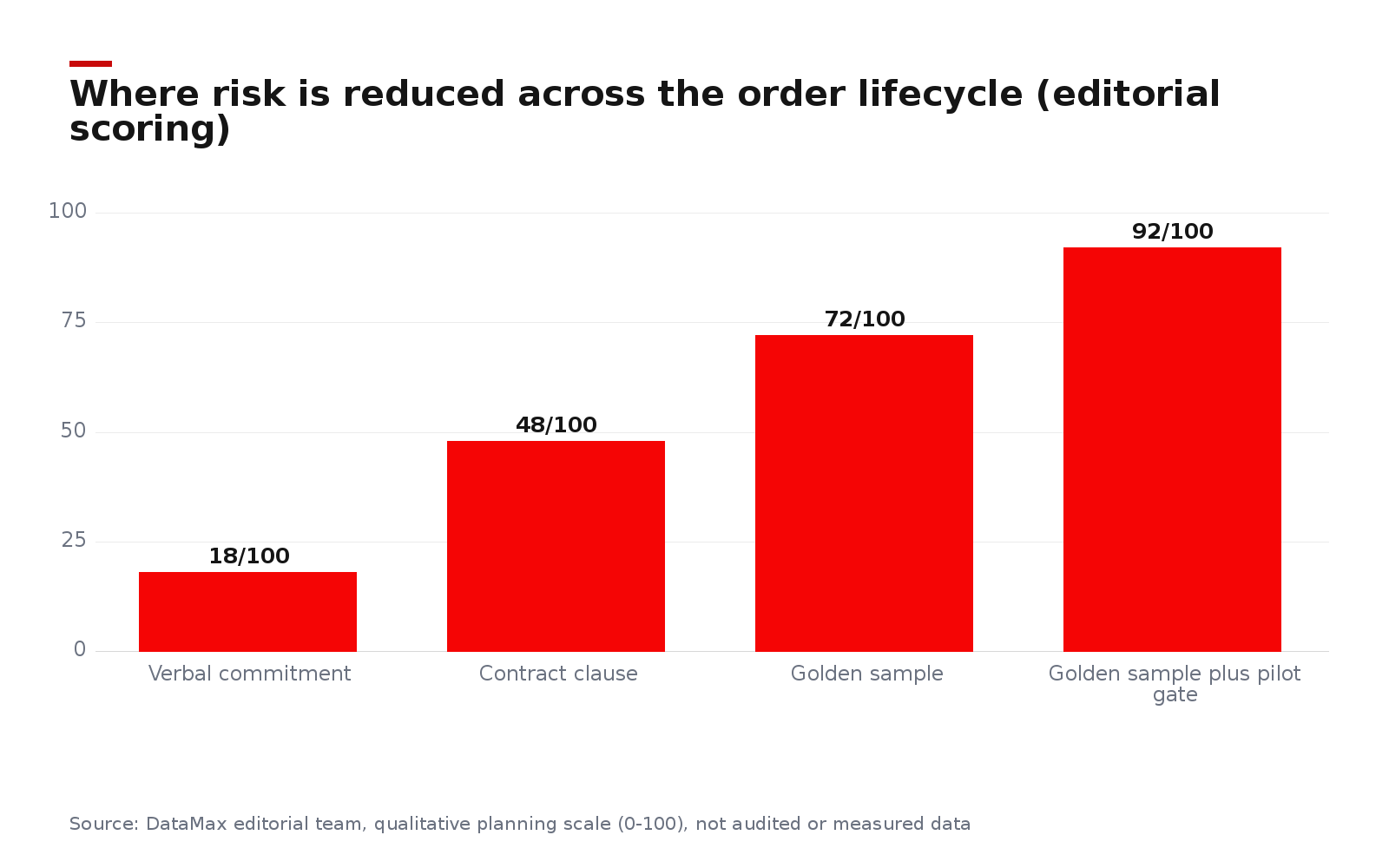
The same figures, in searchable form:
| Control point | Editorial score |
|---|---|
| Verbal commitment | 18/100 |
| Contract clause | 48/100 |
| Golden sample | 72/100 |
| Golden sample plus pilot gate | 92/100 |
Source: DataMax editorial team, qualitative planning scale (0-100), not audited or measured data.
Where this matters in a deployment
The same warranty clause can fail across operator, integrator, and venue contexts because the installation owner and failure-reporter differ. Procurement should map the deployment situation to the evidence holder, likely failure mechanism, and correct model direction before commercial terms are drafted.
A procurement desk for an operator rollout must reconcile supplier terms with customer-facing service commitments. The photographs are visual direction only: a procurement desk with 3 printed quotation sheets, a tablet showing a spec comparison table, a pen, and a coffee cup in clean natural light. The documents contain abstract lines, no readable text, and no logos.

| Situation | Primary requirement | Model direction |
|---|---|---|
| • Operator IPTV rollout | • Operator middleware acceptance; serial and lot trace; controlled batch claim review | • DM21P for 4K IPTV / operator middleware set-top-box fit |
| • IPTV or OTT white label | • Approved ROM and firmware baseline; regional accessory scope; change notification | • DM21S for 4K IPTV/OTT white-label fit |
| • Premium UHD service | • 4K@120 decode requirement in the accepted configuration; output limitation stated | • DM21T for premium UHD / cloud-gaming fit |
| • Gaming-oriented service | • Exact Android build and codec acceptance; no unverified 8K entitlement | • DM22Q for gaming-oriented fit |
| • AV/IT integrator | • Physical-damage exclusions balanced with documented ESD or handling responsibilities | • Select by confirmed ports and installation environment, not warranty headline |
| • Venue digital-signage deployment | • Continuous-duty acceptance and remote recovery procedure; 24-hour operation claim must be evidenced | • Confirm the production duty profile against the datasheet |
For an operator, the key risk is a chain of responsibility: the operator reports a field issue to the distributor, the distributor sends it to DataMax, and the final evidence package lacks the serial number or installation context. An integrator may classify connector damage as a product defect, while the factory sees physical damage outside the agreed handling procedure. A venue may interpret “installed and operating” as a 24-hour reliability statement when the datasheet does not establish that duty profile.
The model direction is not a warranty tier. It identifies which platform facts should be frozen before the clause is written. In every row, the quotation, datasheet, acceptance procedure, and claim form must use the same SKU, firmware identity, and accessory list. The operator-tier Android TV box solution can help structure the broader platform decision before warranty language is finalized.
An operator deployment should assign claims to the party holding the serial record and installation history. The distributor should not forward a symptom without the unit identity, build, customer site, and initial diagnosis. DataMax should receive a consistent RMA package, while the operator retains the customer-facing escalation record. This separation prevents the absence of one data field from stopping the entire chain.
For an AV/IT integrator, the clause should identify handling controls and site conditions. Define whether installation includes HDMI cable insertion, power-adapter substitution, cleaning, or physical relocation. These activities can create damage outside the production boundary, but only a documented procedure supports a physical-damage exclusion. The model direction follows the confirmed port set, display environment, network method, and accessory list.
For a venue deployment, continuous operation must be treated as an acceptance condition only after the supplier confirms the applicable duty profile. The buyer should define restart behavior, recovery method, monitoring responsibility, and the boundary between player failure and content-platform failure. If the platform is not committed for 24-hour operation, the quotation must not imply that condition. The warranty therefore attaches to the documented operating envelope rather than the installation site’s informal expectation.
The selection sequence that removes rework
A controlled sequence prevents warranty work from being appended after model selection. Use the following flow to turn the commercial question into RFQ lines. Replace bracketed fields with approved values; leave no field to oral interpretation.
- State the deployment role Paste: “The device will be used as [operator set-top box / IPTV/OTT white-label / premium UHD / cloud-gaming / gaming-oriented / digital-signage player]. Coverage assumes the approved installation environment described in specification [ID].”
- Freeze the ordered configuration Paste: “Model [DM21P / DM21S / DM21T / DM22Q], hardware revision [revision], Android build [build], firmware [branch], RAM/ROM [values], DRM [package], accessories [list], and power supply [rating] define the warranty baseline.”
- Define the covered failure Paste: “A covered failure is a reproducible deviation from the accepted specification during the test sequence [ID], excluding causes expressly listed in the exclusions clause.”
- Set the clock and evidence Paste: “Coverage runs for [period] from [shipment / invoice / activation / acceptance]. Claims require serial number, proof of installation date, symptom description, and [diagnostic files/photos] where applicable.”
- Define the remedy and logistics Paste: “The approved remedy is [repair/replace/other]; return-freight responsibility is [party]; replacement units carry [clock treatment]; escalation occurs after [time/event].”
- Connect the pilot to production Paste: “Golden sample [ID] approves appearance, ports, boot, UI, network, DRM, decoding, and accessory fit. Pilot findings must be closed before the production release gate.”
- Govern changes and records Paste: “Component, Android build, firmware, packaging, and manufacturing-site changes require [notice period/approval]. Records shall remain available for [period] and link serial, lot, failure code, and corrective action.”
Sample approval is a control point, not a disclaimer. It creates a reference against which visual, functional, and configuration variation can be judged. The pilot then tests whether that reference survives the real installation chain.
Before issuing the RFQ, confirm whether the selected model’s optional fields have been committed. Request a written production datasheet, approved sample record, and clause matrix. DataMax’s sample order process can support the configuration freeze, while an inquiry can be structured around the exact warranty lines above.
Make the sequence visible in approval documents. Attach the deployment role to specification [ID], the frozen configuration to the golden-sample record, and the pilot results to the purchase-order release. Give each document a revision number and approval owner. A change to the Android build, firmware branch, memory configuration, codec package, DRM package, Ethernet option, power supply, remote, packaging, or manufacturing site should trigger review of both acceptance and warranty baselines.
The RFQ should also request the supplier’s own proposed field. Ask what evidence the supplier needs to approve a claim and what remedy it proposes for each covered category. This reveals mismatches before volume release. For example, the supplier may require complete diagnostic files even though the agreed product configuration cannot export them in every boot state. The buyer may expect replacement stock, while the supplier defines replacement as return-first repair. Both positions can be reasonable; ambiguity is not.
Make the claim route executable with 6 handoffs: field reporter, distributor or integrator, buyer warranty owner, DataMax RMA intake, engineering triage, and final disposition owner. Identify what each handoff must carry and what stops progression. This turns a warranty clause into a process map and reduces the chance that a valid claim becomes a stock dispute.
Failure modes that reach the field
Most warranty disputes originate from ambiguity rather than from a novel failure mechanism. The quotation may promise a 12-month period while the purchase order uses a different start event. A replacement may reset the clock, or it may not. “Factory warranty” may exclude the distributor’s installation work without naming which activities the buyer must perform.
Field trap 1
The clock starts at shipment but the field failure occurs before activation. If the clause does not define delivery risk, installation, and pre-activation claims, the parties can disagree about who owns the transit and commissioning window. The cost is replacement handling, delayed deployment, and avoidable channel escalation.
Field trap 2
The quotation names a “4K Android TV platform,” while the accepted configuration or marketing label implies unsupported resolution or capability. A customer can then treat the discrepancy as a nonconforming product even if the supplied datasheet specifies a lower output or decode ceiling. The cost is rework across packaging, listings, firmware, and claims training.
Other failure modes include missing serial evidence, undocumented firmware changes, mixed power-supply or accessory configurations, unsupported third-party applications, and physical-damage exclusions without a handling procedure. A repair-only remedy may also fail when the buyer has no spare-stock route and the device is already installed at a customer site.
Commercial leakage can occur when the supplier’s standard policy is imported without adapting the start event, claimant identity, freight allocation, or service escalation to the actual channel. Conversely, a bespoke clause that ignores the supplier’s RMA process can slow valid claims. The remedy must be operationally executable for both sides.
Mitigation is documentary. Attach 5 controlled documents to the order: the production datasheet, approved golden-sample record, acceptance procedure, warranty clause, and change-control schedule. Give each a revision identifier. Require the warranty clause to state exclusions, remedies, evidence, timing, escalation, and record retention without relying on a salesperson’s email. For factory evidence, request an audit video or build-specific SMT/AOI, aging, and dark-room documentation through DataMax’s compliance or contact channels.
A further trap is the optional feature named only in a brochure. If Ethernet speed, HDCP 2.2, Dolby Vision/DTS, or a storage option is not confirmed in the production datasheet and order, the field unit may not match the promised baseline. The remedy is to identify the exact ordered SKU and confirm each optional field before the golden sample. Another trap is the unapproved software update: a security patch or firmware branch can change boot behavior, logs, middleware compatibility, or feature availability. Require notice and approval rules rather than accepting silent production changes.
Record claim outcomes by failure category, model, build revision, lot, and disposition. A rising count for one SKU can justify a pilot investigation; isolated cases can require local diagnosis. Do not convert a trend into a warranty exclusion without evidence, and do not extend a broad exclusion to an unrelated hardware defect. For an android tv box program, this disciplined separation of product, configuration, environment, and logistics is the final control before the purchase order is released.
Further reading
- Guide android tv box for isps
- About DataMax
- RFQ checklist for device procurement
- Procurement glossary
- Amlogic Android TV boxes
- DataMax DM21P specifications and fit
- DataMax DM21S specifications and fit
FAQ
What does a 12-month Android TV box warranty normally cover?
It normally addresses defects in the agreed product configuration, but the exact meaning depends on the contract. Coverage should identify included faults, the clock’s start event, permitted remedies, evidence requirements, exclusions, freight allocation, and escalation. A duration stated alone does not establish that network faults, content issues, physical damage, unauthorized firmware changes, or third-party services are covered.
Should a replacement reset the warranty period?
The contract must say whether the original period continues, is extended by the replacement time, or restarts for the replacement unit. Specify whether the replacement carries the original serial reference, a new serial, a linked RMA record, and the same approved configuration. Without these rules, channel inventory, serial records, and customer eligibility can diverge.
What evidence should an OEM buyer request from the factory?
Request build-specific SMT/AOI results, aging or burn-in records, dark-room or screen-inspection evidence where applicable, serial-to-lot traceability, approved-sample records, change notifications, and a sample RMA trace. Each record should identify the production revision and acceptance criteria. A generic certificate for another model or build does not demonstrate control of the ordered configuration.
Does Widevine L1 certification determine warranty coverage?
No. Widevine L1 identifies the DRM integration level, not product reliability or the commercial remedy. Warranty terms should separately reference the approved DRM configuration and explain how DRM, network, account, content, and playback failures are triaged. HDCP, codec support, Android builds, and middleware behavior require the same separation between technical acceptance and contractual coverage.
Can the warranty cover failures caused by operator middleware?
Only if the contract includes that configuration and defines responsibility boundaries. Supplier warranty can address defects in the agreed product, while middleware defects, configuration errors, service interruptions, and incompatible integrations may need separate operator or software-provider procedures. Attach the middleware build, configuration baseline, test sequence, and escalation ownership to the order.
What should be written into an OEM warranty RFQ?
Specify the exact model and configuration, covered-failure definition, exclusions, clock start, claim window, evidence package, remedy hierarchy, replacement treatment, freight responsibility, escalation process, change control, record linkage, and approved sample. Freeze the datasheet revision. Any blank term should remain explicitly “to be agreed” rather than being resolved by the supplier’s general policy or a verbal assurance.
What should happen when a failure code has no agreed definition?
The claim should remain open rather than being rejected under an invented category. Add the missing code to a controlled failure-code dictionary with its symptom, evidence requirements, responsible owner, and disposition rule. Update the dictionary through formal approval, preserve prior claim classifications, and use the approved code in trend reporting. This prevents each party from interpreting the same RMA outcome differently.
How often should the buyer review warranty claims during production?
Review them at the pilot gate, first production release, and whenever failure codes, build revisions, or remedies change materially. Segment the review by exact SKU, hardware revision, firmware branch, production lot, and deployment context. A mixed-model total can conceal one platform’s repeated issue, while a single-case count can miss a configuration-wide pattern. The review should decide whether to proceed, modify the acceptance test, open a corrective action, or revise the clause.


