

What the answer hinges on
A widespread procurement error is treating a catalogue claim as proof of compliance. For a streaming stick entering a government project, the decisive evidence is not a marketing line such as “certified,” “secure,” or “Widevine L1.” It is a traceable package tied to the ordered SKU, production revision, and application: test reports, applicable declarations, certificate records, factory-control records, and a defined route for evidence handover.
The correct frame is evidence continuity. A buyer should be able to connect the device model and configuration to the production line, identify the procedures that controlled assembly and testing, verify the results, and receive documents whose scope matches the shipment. A generic report that names neither the exact SKU nor the relevant standard is weak evidence. A standard-specific report with an identifiable test item is stronger. A certificate whose validity and holder can be checked through a public registry is strongest, but even then its scope must be reconciled with the hardware and firmware actually delivered.
For government use, also separate product compliance from project acceptance. EMC, RF, safety, environmental and market-access requirements depend on the destination, power supply, radio configuration and intended use. Content security, DRM, account controls and data handling depend on the deployment architecture. Neither is demonstrated by another. The D03E broadcast operations specification check covers the operational angle; this article addresses only the evidence chain a buyer can hand to an auditor.
Streaming stick selection should therefore start with the required evidence package, not the lowest catalogue configuration. Confirm certificates and DRM/security provisions against the production datasheet for each ordered SKU. A compliance claim without a controlled document trail is an unresolved risk.
Evidence hierarchy in procurement terms
| Evidence object | What it proves | What must be reconciled |
|---|---|---|
| Supplier statement | Declared intent or capability | SKU, revision, test method and validity |
| Generic test report | Testing occurred within a stated scope | Model, configuration, sample identity and result |
| Standard-specific report | Performance against a named requirement | Port, radio, firmware, model and production equivalence |
| Verifiable certificate | Formal certification tied to a defined scope | Holder, covered model, expiry, public lookup and production match |
The practical output is a handover index. It should identify the device, document, issuer, issue or revision date where applicable, applicable standard or regulation, result, and the relationship between the tested sample and the delivered configuration.
A buyer can test this framework with a simple pilot: select one proposed streaming stick configuration, request every available document, and assign each item an owner and verification action. Items with no model match should remain open rather than being classified as passed. This pilot usually exposes whether the supplier has a controlled evidence process or only a collection of PDFs.
Questions to put in the supplier review
A supplier review should test the production system, not just request a document repository. For a streaming stick program, ask who controls which process, where evidence is retained, and how a serial number or configuration can be tied back to inspection and test results.
The first line of review is identity. Require the supplier to identify the orderable SKU, hardware revision, Android build, memory configuration, regional radio configuration, power supply and packaging. Ask how substitutions are prevented or approved. A report for one radio variant does not establish conformity for another, and a certificate may cover a family rather than every orderable configuration.
The second line is manufacturing control. SMT, AOI and aging evidence should connect to the actual process flow. Inspection records establish that components and soldering were inspected; functional test establishes that the assembled unit passed defined checks; aging exposes early-life instability. A supplier may also use ICT, firmware flashing, RF calibration, burn-in or operator verification. Do not assume the existence of an unstated test. Name the process, sample coverage, acceptance criteria, record owner and retention period in the RFQ.
Evidence request
Request a redacted package showing one document’s full identity chain: applicable standard or regulation, exact tested model and configuration, laboratory or test location, sample identifiers, result, issue date, and the supplier’s production-equivalence statement.
- Lock identity Freeze the ordered model, revision, OS build, memory, radio option, power supply and destination market before accepting evidence.
- Trace the process Map SMT, AOI, programming, functional test, aging and final inspection to work instructions, acceptance limits and retained records.
- Sample the evidence Verify a production or recent build record and confirm that the tested configuration matches the proposed SKU.
- Check formal documents Confirm scope, holder, model coverage, status and any public registry details for certificates.
- Test change control Require advance approval for SoC, PCB, radio, firmware, supplier or manufacturing-site changes that could invalidate the evidence.
- Define handover State which documents accompany delivery, who owns updates, and how supersession is communicated.
For a government program, ask for a video factory audit or a request for SMT/AOI/aging evidence specific to this topic through DataMax factory quality. The audit should follow material movement from incoming inspection to programming, functional test and packing. Screens may show operators, traceability identifiers and controlled work instructions; claims without visible process relationships are not substitutes for records.
A practical audit sample should cross at least three units from different build dates. For each streaming stick, compare the serial identifier, board revision, memory option, firmware image and final test result. If the supplier cannot connect those fields, the evidence package describes a sample rather than the production population. Ask separately how failed or rework units are segregated, because a mixed board revision is a common source of inconclusive test evidence.
Evidence questions that expose weak quotations
Ask: “Does this document cover the exact ordered configuration or only a representative sample?” Then ask: “What production change invalidates it?” A mature answer names a change-control boundary. A weak answer treats every document as permanent and universal.
Also request the evidence-delivery schedule. If documents are available only after a certificate is issued, identify the lawful interim controls. Missing final paperwork is a contractual and schedule issue, not something to resolve retrospectively after shipment.
The comparison buyers actually make
Buyers usually compare quotations by feature count, unit cost and delivery schedule. For a government streaming stick, a better comparison separates the entry tier from the commitment tier: a catalogue-ready configuration versus a configuration supported by a production-specific evidence package and contractual handover obligations.
The entry tier can be suitable when the buyer accepts representative reports, self-validates limited requirements and handles downstream conformity assessment. The commitment tier is stronger when a tender requires traceable certificates, configuration-controlled production evidence, factory-audit access, change notification and a defined document index. Neither tier is inherently “approved”; the tender and destination requirements determine what is acceptable.
| Comparison line | Entry-tier quotation | Commitment-tier quotation | Buyer check |
|---|---|---|---|
| Configuration control | Model named in quotation | Model, revision, build and options frozen | Does the order reference the production configuration? |
| Test evidence | Generic report or PDF | Standard-specific package linked to the build | Can sample identity be reconciled? |
| Factory evidence | Process description | SMT, AOI, aging and traceability records | Are acceptance criteria visible? |
| Certificate handover | Availability after delivery | Scheduled index and update process | Who owns missing or expired records? |
| Engineering changes | Notification after the fact | Prior approval for specified changes | Which changes affect conformity? |
| Audit rights | Document review only | Video or on-site factory review | Can the actual flow be inspected? |
| Project handover | Device and carton only | Device plus evidence index and traceability | Will tender files be complete on acceptance? |
| Record retention | Supplier discretion | Defined period and retrieval procedure | Can records support a later review? |
| Nonconformance handling | Internal process | Buyer-visible disposition and corrective action | How are deviations communicated? |
| Accessory control | Listed without revision | Adapter, cable and remote linked to the order | Does the power arrangement match the evidence? |
| Software release | Latest available image | Approved build identifier and update rule | Is the shipped image reproducible? |
| Document ownership | Supplier issues without transfer | Named owner, issue and supersession dates | Who responds to an auditor’s request? |
The editorial scoring below ranks the handover value of four evidence types. It is not measured data and must not be represented as an audit score. For procurement planning, the main distinction is the ability to connect formal evidence to the ordered production configuration.
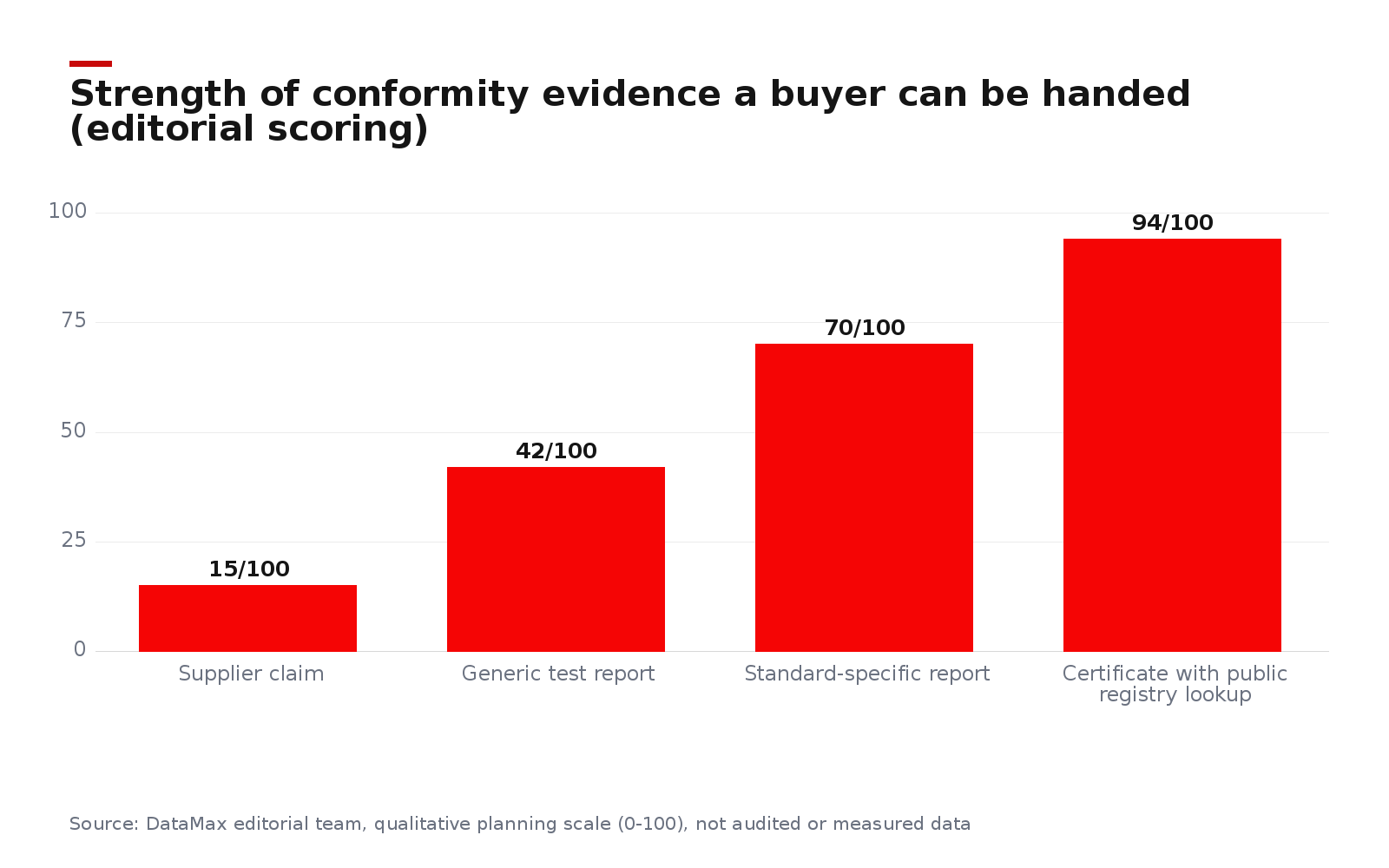
The same figures, in searchable form:
| Evidence option | Editorial score |
|---|---|
| Supplier claim | 15/100 |
| Generic test report | 42/100 |
| Standard-specific report | 70/100 |
| Certificate with public registry lookup | 94/100 |
Quotation trap
A low quotation can conceal a second cost when the evidence package is incomplete. The buyer may need repeat testing, a project-specific report, factory travel, document replacement or delayed acceptance. Price the evidence obligation, not only the hardware.
The comparison should also be expressed as a delivery obligation. Entry-tier documentation can leave the buyer to reconstruct evidence after tender submission. Commitment-tier documentation assigns dates: configuration frozen at order, production evidence available before shipment, formal records supplied at the contractual handover point, and updates issued when status changes. That schedule converts an ambiguous compliance promise into a measurable procurement condition.
Where the terminology comes from
“Compliance” is an umbrella, not a single certificate. A streaming stick may be evaluated against regional safety, electromagnetic compatibility, radio-frequency, environmental and cybersecurity requirements. The exact obligations depend on the destination market and how the product is supplied. A buyer should name the target market and the conformity route before asking whether a device is “compliant.”
Evidence objects also follow different logic. A test report records a result against a named method or standard for identified samples. A certificate records formal assessment against a defined certification scheme, but its validity depends on the holder, covered product, scope, status and dates where applicable. A declaration places responsibility on a defined party. A factory record shows that a process was performed during manufacture. None substitutes automatically for another.
For connected television devices, content-path protection is a separate architecture. DRM licences authorize protected playback, while HDCP governs the protected link between source and display. Widevine L1 means a supported hardware-backed path for Widevine-protected content; PlayReady is a different DRM system. Dolby pass-through indicates support for forwarding a compatible Dolby signal, not proof that every application, service or source supports it. These features must be checked against the application, account, service tier, display chain and shipping firmware.
Radio terminology also needs discipline. Wi-Fi 6 describes a wireless-generation capability, not regulatory approval. A radio specification also does not establish that the product’s final antenna, configuration, firmware and destination-market labeling are compliant. The evidence must cover the relevant radio and final configuration.
- Test report Method, sample and result
- Certificate Scheme, scope and status
- Declaration Responsible party and legal basis
- Incoming inspection Component and lot control
- SMT and AOI Assembly and solder inspection
- Programming and functional test Software loading and acceptance criteria
- Aging and final inspection Early-life stability and packing checks
- Power Supplied adapter and cable conditions
- Network Service, authentication and access controls
- Content path DRM, HDCP, application and display chain
The correct terminology for a requirement is therefore specific: “a test report covering model X against identified standard Y,” not “a certificate.” If the tender uses broad language, ask the issuing authority to define the document type, validity period, sample rules and acceptable issuer. For platform-specific DRM and security requirements, DataMax’s DRM and compliance solution briefing can provide a structured starting point, subject to per-SKU confirmation.
Architecture determines which evidence can satisfy which clause. A public-network streaming stick with Wi-Fi and optional cellular hardware may require radio-scope evidence in addition to electrical-safety and EMC records. A set-top box delivered for operator middleware adds software build, provisioning, storage and network-interface acceptance. A government deployment may also specify secure boot, update control, credential handling or application permissions, but those must be stated as technical requirements; they cannot be inferred from an Android version or chipset name.
Real DataMax platforms, field by field
The product choice must follow the deployment architecture and evidence scope. The table below reproduces only the supplied DataMax production facts. Every model name links to its product page. No certificate, regulatory approval, Bluetooth version or security capability is inferred from these specifications.
| Model | SoC and OS | Memory | Decode and content path | Interfaces and dimensions |
|---|---|---|---|---|
| D03E | Allwinner H313, quad Cortex-A53; AOSP Android 10 | 2GB / 16GB; 4GB/32GB optional | H.265 4K@60; Widevine L1 / HDCP 2.2 optional; Dolby pass-through | HDMI 2.0b out; USB2.0 x1; TF; IR extender; Type-C 5V/1.5A; no RJ45; Wi-Fi6 2T2R; 94x31x12mm |
| DM33H | Allwinner H618, quad Cortex-A53; AOSP Android 14 | 2GB / 16GB; 4GB/32GB optional | H.265 up to 8K@24 source; H.264/VP9/AVS2 4K@30; H.265 Main10 4K@60; no Widevine row on datasheet | HDMI 2.0b out; 2x Type-C, one 5V/2A power and one data; SIM x1, 4G Quectel EG915N, 5G optional; Wi-Fi6 2T2R; no RJ45; 70x70x17mm |
| DM21P | Amlogic S905Y4, quad Cortex-A35; AOSP Android 11 | 2GB / 8GB; 4GB; 16/32/64GB optional | AV1 [email protected]; VP9/H.265 4K@60; H.264 4K@30; Widevine L1 / PlayReady / HDCP 2.2 optional | HDMI 2.0b out x1; USB2.0 x2; TF; S/PDIF; 3.5mm AV; RJ45 100M; Wi-Fi6 2x2 + BT5.4; DC 5V/2A |
| DM21S | Amlogic S905Y5, quad Cortex-A55; AOSP Android 14 | 2GB / 16GB; 2/4/8GB; 16/32/64GB optional | AV1 / H.265 [email protected] 4K@60; Widevine L1 / PlayReady optional; Dolby Vision/DTS | HDMI 2.0b out; S/PDIF; AV; USB2.0 x2; TF; RJ45 100M, 1G optional; Wi-Fi6 2x2 + BT5.4 |
For the D03E, the declared fit is a cost-down white-label 4K stick. Its widevine and HDCP entries are optional, so they cannot be assumed for every order. The supplied facts do not provide a Bluetooth version for D03E, and that field must not be inferred from another platform.
For DM33H, the cellular path differentiates it for RV, hospitality and no-Wi-Fi signage use. The 4G module is Quectel EG915N, while 5G is optional. No Widevine row appears on the datasheet. Consequently, a project requiring Widevine should not choose this model on an assumed capability; request the production evidence for the ordered configuration.
DM21P and DM21S are set-top-box directions rather than stick-form factors. DM21P supports operator-oriented IPTV with wired RJ45 100M and a specified decoding set. DM21S targets Android TV IPTV/OTT white-label use, with Android 14 and optional 1G networking. These differences affect the conformity dossier because radios, ports, enclosures, power arrangements and software builds may differ.
The evidence task follows the product selection. Ask DataMax to confirm each certificate and DRM/security provision per ordered SKU, not per catalogue page. The DataMax certifications and compliance inquiry routes are the appropriate checkpoints for document scope, validity and handover.
When comparing these platforms for a government streaming stick tender, keep two columns: capability and evidence. The capability column records what the production facts state; the evidence column remains blank until the buyer receives the applicable document or record. This prevents a decoded-video capability from being mistaken for a regulatory finding and prevents an optional DRM entry from being treated as a committed configuration.
Buyer situations, ranked by what they punish
Different deployments punish different failures. A national operator may reject a device whose controlled software build cannot be reproduced. A system integrator may fail acceptance because peripheral support or network integration is undocumented. A venue operator may need remote fleet control and local connectivity rather than a laboratory certificate. Compliance evidence must fit the actual use.
| Buyer situation | Primary requirement | Model direction | Evidence emphasis |
|---|---|---|---|
| Pay-TV or IPTV operator | Reproducible firmware, middleware integration and managed content delivery | DM21P or DM21S | Build identity, software test, provisioning workflow, network and DRM scope |
| AV or IT integrator | HDMI, USB, AV, audio, networking and peripheral compatibility | DM21P or DM21S; D03E where the form factor and limited interfaces are accepted | Interface acceptance, supplied accessories, firmware behavior and configuration control |
| RV or hospitality deployment | Independent wide-area connectivity without dependence on venue Wi-Fi | DM33H | 4G configuration, 5G option status, antenna and cellular-network operational evidence |
| White-label 4K compact device | Cost-controlled form factor with defined content playback | D03E | Optional Widevine and HDCP configuration, OS build, storage option and production traceability |
| Government tender with fixed acceptance index | Document scope, certificate status and production equivalence | Select after requirement mapping | Evidence index, issuer identity, dates, model match, change control and handover schedule |
| Public display at a controlled venue | Stable playback and repeatable installation | Select by interface and network fit | Display-chain test, storage option, power configuration and approved firmware |
| Remote-managed signage estate | Recovery, update and centralized observability | Direction depends on network and form factor | Update procedure, serviceability evidence and device-to-build traceability |
A compact streaming stick is not automatically a weaker governance decision. The D03E can fit a controlled white-label program if its optional capabilities are ordered and documented. Likewise, a cellular dongle is not automatically suitable where content licensing requires a specific DRM path. The procurement failure is choosing by form factor before mapping evidence.
Before the technical review, visualize the real project boundary. The review should include the hardware prototype, production configuration, network service, display chain, content application and evidence files. Engineers can point to the relevant PCB feature, interface or manufacturing step while the project owner maps each item to the tender clause.

Rank the scenarios by the evidence they punish. Operator programs punish unrepeatable software. Integrator programs punish undocumented interface behavior. Cellular programs punish an unconfirmed radio configuration. Government tenders punish a document mismatch. Use those failure modes to order the technical questions, rather than beginning with cosmetic industrial design.
For a multi-site program, add a serial-range question before the audit. Identify which build batch entered each location, who performed the installation, which firmware image was activated and where the evidence record for that unit is retained. A nationwide streaming stick rollout can produce the same hardware model while masking a regional radio, power-supply or software variation. Site acceptance records close that gap.
A decision path for the RFQ
The RFQ should turn compliance into verifiable clauses. Start with the destination and use case, then freeze the device configuration, request the evidence package, audit the production route, and contract the handover. The sequence prevents a low-feature quotation from becoming a compliance dependency.
- State the conformity target Specify destination market, product category, intended use, content requirements and required document type. Avoid the unsupported phrase “all certifications.”
- Freeze the commercial object Name the DataMax model, memory option, OS release, connectivity option, power supply, accessories, firmware level and packaging.
- Define evidence acceptance State that reports must identify the tested model and configuration, and certificates must state holder, scope, status and applicable model coverage.
- Define production equivalence Require a written statement describing how the tested sample relates to the production line, including any difference in board, radio, firmware or supply chain.
- Define factory evidence Request the applicable SMT, AOI, programming, functional-test, aging and final-inspection records, with acceptance criteria and traceability references.
- Define change control Require prior notice and buyer approval for changes that invalidate a report, certificate, production-equivalence argument or agreed configuration.
- Define delivery Attach an evidence index to the order, assign document ownership, state the handover date and define how revised or superseded documents are communicated.
Concrete RFQ lines can be pasted directly into the document schedule:
- “The supplied streaming stick shall be identified by exact model, hardware revision, Android build, memory, connectivity configuration, power supply and accessory configuration.”
- “Each conformity document shall identify the tested sample and explain its equivalence to the ordered production configuration.”
- “The supplier shall provide applicable SMT, AOI, functional-test and aging evidence, or explicitly state the controlled alternative and its acceptance criteria.”
- “Certificate scope, holder, status and product coverage shall be confirmed against the ordered SKU before shipment.”
- “No SoC, PCB, radio, firmware, manufacturing-site or key-component substitution shall occur without documented approval and evidence revalidation.”
- “The shipment shall include a version-controlled evidence index and all documents required for project acceptance.”
These clauses create acceptance criteria without inventing a standard that the tender has not named. They also distinguish a supplier’s promise to provide evidence from evidence already demonstrated for that product.
Add two operational lines to the RFQ schedule. First, require a document-gap response stating “not applicable,” “not available” or “applicable and supplied,” with a reason and owner. Silence must not count as compliance. Second, require an exception process for failed units, substitutions and revised test samples, including approval authority and the date by which the corrected file will be delivered. For each streaming stick candidate, the same evidence table should be completed; otherwise quotations cannot be compared on a common basis.
Invite DataMax to review the complete requirement set through custom development or the inquiry route. A video factory audit or targeted request for SMT/AOI/aging evidence is more useful than a broad catalogue review because it tests the mechanism behind each promised document.
The traps in this category
The first trap is certificate transference. A document may be valid for one holder, one model family, one radio variant or one assessed configuration. Copying it into another bid without checking scope creates a formal evidence gap. The buyer must reconcile the certificate’s named product and holder with the ordered device and manufacturing arrangement.
The second trap is sample-to-production drift. A representative sample can differ from production in PCB revision, memory option, radio, antenna, firmware, power supply or accessory. The document may remain technically valid for what was tested, yet inadequate for the shipped configuration. Require a production-equivalence statement and a change-control process.
Field trap 1
Do not treat “Widevine L1,” “HDCP 2.2,” “Wi-Fi 6” or “5G optional” as a compliance dossier. These are product-feature statements with different scopes. A government project needs documents that establish how the feature and final configuration relate to the applicable requirement.
Field trap 2
Do not let a quotation omit the evidence schedule. The cost of discovering an unmatched report after tooling, shipment or tender review includes repeat testing, project delay, replacement logistics and acceptance risk. Put document type, scope, timing and update duties in the purchase order.
A third trap is confusing factory testing with formal certification. A functional test can show that a unit passed defined checks; it does not automatically create regulatory standing. A certificate can show conformity within a scheme; it does not prove the assembly process remains controlled. Keep the two evidence chains linked, but do not merge their meanings.
A fourth trap is accepting unspecified options as ordered facts. On the D03E, Widevine L1 and HDCP 2.2 are optional. On the DM33H, 5G is optional and the datasheet has no Widevine row. On the DM21P and DM21S, several DRM and memory choices are optional. Every quotation and evidence index should state the selected configuration explicitly.
A fifth trap is the “latest firmware” release line. It defeats configuration freezing because the image can change after the test evidence is issued. Name an approved build identifier, define who may update it and require an equivalence statement for the final shipping image. This control is particularly relevant when the streaming stick carries operator middleware, DRM provisioning or venue-specific network settings.
Finally, manage document currency. An expired, superseded or inaccessible record can invalidate a handover even when the original document was sound. Define who monitors validity, who receives updates, and how changed status affects in-field inventory. For project review, start with DataMax contact and request certificate and DRM/security confirmation for the exact ordered SKU.
Further reading
- DataMax D03E for Broadcast Operations: Confidence Monitor
- Order samples and pilot units
- Contact DataMax
- TV box vendor selection checklist
- Industry solutions
- DataMax D03E specifications and fit
- DataMax DM33H specifications and fit
FAQ
What compliance evidence should a government buyer request for a streaming stick?
Request documents tied to the exact ordered model, revision, firmware and relevant options. The package should identify the applicable standard or regulation, tested sample, result, issuer and production-equivalence basis. For certificates, verify holder, scope and status. The catalogue description alone is not an evidence package.
Is a generic test report sufficient for a government tender?
It may support preliminary qualification, but the buyer must check whether it identifies the tested model and configuration. A tender may require standard-specific reports, verifiable certificates or declarations. Define the acceptable document type, issuer, validity and sample rules before issuing the RFQ.
How should a buyer verify that a certificate covers the ordered device?
Compare the certificate’s holder, covered model, radio or configuration scope, status and dates with the purchase specification. Confirm the public registry entry where applicable. Then reconcile any hardware, firmware or manufacturing differences through a written production-equivalence statement.
Does a factory SMT or AOI record prove regulatory compliance?
No. SMT, AOI, functional-test and aging records demonstrate controlled production activities and can help establish product equivalence. Regulatory or certification status comes from the applicable test reports, certificates, declarations and scheme rules. Both chains are needed for a defensible government handover.
Which DataMax platform fits a cellular no-Wi-Fi deployment?
The DM33H is positioned for cellular 4G/5G use in RV, hospitality and no-Wi-Fi signage. Its listed 4G module is Quectel EG915N, while 5G is optional. Confirm the selected radio configuration and associated evidence against the production datasheet.
Can DRM capabilities be assumed from the product page?
No. DRM, HDCP and optional connectivity features must be confirmed for the ordered SKU and relevant firmware. The D03E, for example, lists Widevine L1 and HDCP 2.2 as optional. Use the certification inquiry route to establish the final evidence scope.
What should happen when the supplier lacks a requested document?
Record the gap as unresolved rather than treating a catalogue claim as a substitute. Require the supplier to state whether the document is not applicable, unavailable, pending or covered by an equivalent controlled record. Assign an owner and delivery date, define any interim control and specify the commercial remedy if the acceptance condition is not met.
How should a buyer handle an engineering change after evidence review?
Do not assume the original evidence still covers the device. Identify whether the SoC, PCB, radio, firmware, power arrangement or manufacturing site changed, then request a revised scope or production-equivalence statement. Pause affected shipments when the change invalidates the governing record and record the buyer’s approval before release.




