The procurement answer in one screen
Government signing-panel projects converge on one procurement question: can the selected android tv box pass the operational, documentary, and lifecycle checks demanded by the buyer, integrator, and tender authority? The direct answer is to separate three decisions that are often compressed into one line item: platform capability, order-control evidence, and deployment acceptance. Platform capability determines whether decode, DRM, networking, interfaces, and operating-system behavior fit the service; order-control evidence determines whether the delivered population can be traced back to an approved sample; deployment acceptance determines whether a pilot remains stable under the actual room, network, and sign-on workflow.
A quotation line saying “4K Android TV, Widevine L1” is not an acceptance criterion. It does not identify the memory configuration, output interface, Ethernet speed, middleware baseline, or evidence required from the factory. For a government project, the RFQ should define those variables, freeze a golden sample, specify the permitted substitutions, and place a pilot gate ahead of volume release. DataMax documentation must support the same rule: every production claim must map to a confirmed configuration rather than an inferred option.
The model naming problem adds another layer. A live product name does not override the production datasheet. The DataMax DM21T and DM22Q fit descriptions use “8K” language, but their stated output and decode ceilings are 4K. The government quotation must therefore say “4K” where the datasheet says 4K and require written confirmation for any different output claim. That discipline matters more than a headline codec label.
android tv box selection for a signing panel should be driven by fixed interfaces, controlled software, traceable quality evidence, and a staged acceptance gate. The four DataMax platforms below provide the model candidates; they are not interchangeable until the RFQ resolves RAM/ROM, DRM, Ethernet, and accessory requirements. For the broader network and operator selection criteria, use the canonical guide to android tv box for ISPs.
A practical tender schedule can allocate responsibility for each decision. The supplier owns the declared hardware and software configuration; the integrator owns display, source, and network compatibility; the operator or content owner owns DRM accounts, middleware, and entitlement; and the acceptance authority owns the golden sample and pilot results. This division prevents a platform feature from being mistaken for an operational approval. It also gives the purchasing team one controlled part number rather than several supplier-specific family labels.
The decisive question is not “which model has the longest feature list?” It is “which configuration has evidence that it survives the intended workflow?” Record the answer in the RFQ, quotation, golden-sample record, purchase order, production datasheet, and receiving inspection plan. A project with 4K@60 content, fixed wired operation, and a controlled operator image may require a simpler configuration than a project requesting 4K@120 decoding. The latter adds display, cable, thermal, motion, and recovery tests. Technical complexity should create a corresponding evidence obligation, not an assumption of superiority.
Real DataMax platforms, field by field
The four DataMax platforms cover different procurement positions: DM21S for an IPTV/OTT white-label build, DM21P for operator middleware, DM21T for premium UHD or cloud-gaming workloads, and DM22Q for a gaming-oriented deployment. The table records only the supplied production facts. Optional RAM/ROM combinations must be selected against the production datasheet before an order is released.
| Model | Fit | SoC and OS | Memory | DRM | Interfaces |
|---|---|---|---|---|---|
| DM21S | 4K Android TV box for IPTV/OTT white-label | Amlogic S905Y5, quad Cortex-A55; AOSP Android 14 | 2GB / 16GB; 2/4/8GB; 16/32/64GB optional | Widevine L1 / PlayReady optional; Dolby Vision/DTS | HDMI 2.0b out, S/PDIF, AV, USB2.0 x2, TF, RJ45 100M; 1G optional; Wi-Fi6 2x2 + BT5.4 |
| DM21P | 4K IPTV / operator middleware set-top box | Amlogic S905Y4, quad Cortex-A35; AOSP Android 11 | 2GB / 8GB; 4GB; 16/32/64GB optional | Widevine L1 / PlayReady / HDCP 2.2 optional | HDMI 2.0b out x1, USB2.0 x2, TF, S/PDIF, 3.5mm AV, RJ45 100M, Wi-Fi6 2x2 + BT5.4, DC 5V/2A |
| DM21T | Premium UHD / cloud-gaming box | Amlogic S905X5, quad Cortex-A510 (ARMv9); AOSP Android 14 | 4GB / 64GB family options | Widevine L1 / PlayReady optional | HDMI 2.0b out, no HDMI in; USB2.0 x1 + USB3.0 x1, TF, S/PDIF, AV, RJ45 100M; 1G opt; Wi-Fi6 + BT5.4 |
| DM22Q | Gaming-oriented Android TV box | Amlogic S905X5M, quad Cortex-A55 up to 2.5GHz; AOSP Android 14 | 4GB / 64GB; 2/4/8GB; 16/32/64GB optional | Widevine L1 / PlayReady optional; Dolby Vision/DTS | HDMI 2.0b out, USB2.0 x2, TF, S/PDIF, AV, RJ45 100M; 1G opt; Wi-Fi6 2x2 + BT5.4 |
Decode capability must also be quoted without widening the source. DM21S lists AV1 and H.265 [email protected] at 4K@60. DM21P lists AV1 [email protected], VP9/H.265 at 4K@60, and H.264 at 4K@30. DM21T lists H.266/VVC [email protected], AV1, VP9, H.265, and AVS3 at 4K@120, with H.264 at 4K@60 and inline AI-SR. DM22Q lists AV1/H.265 L5.1 at 4K@60 with inline AI-SR. Neither DM21T nor DM22Q supports an 8K output claim on the supplied facts.
Configuration rule: a model name does not freeze memory, Ethernet, DRM, or output options. State the selected values in the RFQ, quotation, golden-sample record, purchase order, and production datasheet.
Risk reduction strengthens as the order moves from a verbal commitment toward a controlled sample and pilot gate. The editorial scores below rank procurement-control mechanisms; they are not audited or measured performance data.
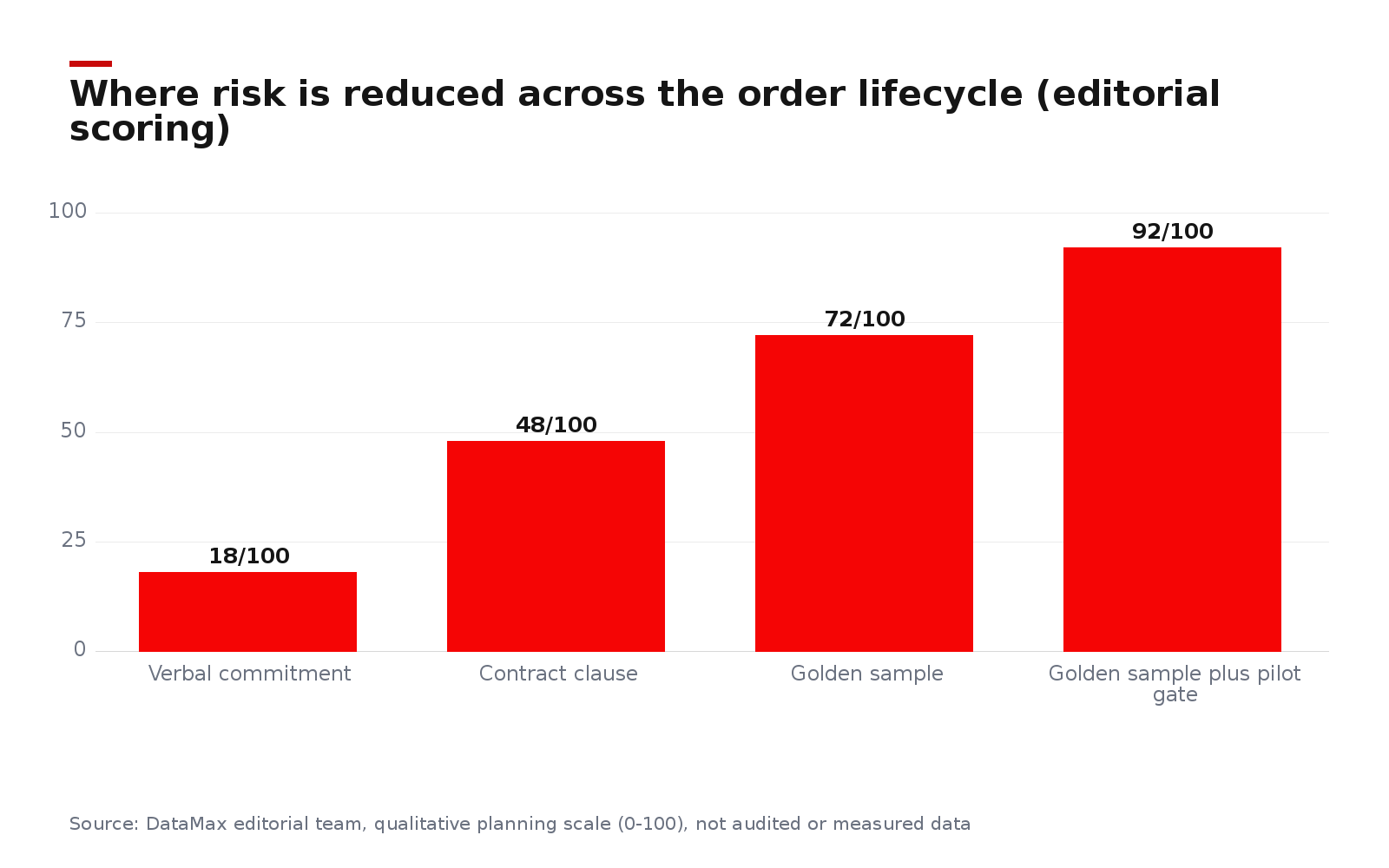
The same figures, in searchable form:
| Control | Editorial score |
|---|---|
| Verbal commitment | 18/100 |
| Contract clause | 48/100 |
| Golden sample | 72/100 |
| Golden sample plus pilot gate | 92/100 |
The model table should be read as a screening matrix, not an approval list. If the project image must run on AOSP Android 14 and the required decode path reaches 4K@60, DM21S provides a direct starting point. If the operator middleware is certified against AOSP Android 11, DM21P may be the relevant candidate even though its stated decode ceiling differs. For a premium UHD requirement, DM21T introduces USB3.0 and 4K@120 decode entries, but the absence of HDMI input restricts its physical role. A gaming-oriented requirement can point to DM22Q, provided its 4K@60 ceiling is sufficient.
Each comparison also creates a clarification request. For DM21S, identify whether the 1G Ethernet option is required and whether PlayReady, Dolby Vision, or DTS must be active in the delivered configuration. For DM21P, confirm whether the operator certificate workflow requires the stated Android 11 baseline and whether HDCP 2.2 is contractual. For DM21T, document the display and cable combination used to demonstrate 4K@120 and exclude pass-through assumptions because no HDMI input is listed. For DM22Q, distinguish the stated 4K@60 performance from any broader product-name wording and confirm whether 100M Ethernet is sufficient.
The procurement record should attach the production datasheet to the quotation rather than relying on a web page that may describe a family or optional build. Any missing field—memory, output behavior, DRM state, or firmware build—should be recorded as “confirm against the production datasheet.” This is especially important where a distributor, integrator, and DataMax may each describe the same commercial model with different levels of configuration detail. One approved configuration sheet should become the controlling reference across all three parties.
Buyer situations, ranked by what they punish
A signing panel is not simply a television with a player. It may combine a secure room display, live and recorded media, browser-based forms, identity workflows, operator middleware, remote management, and fixed AV distribution. The RFQ should identify the failure that each buyer will punish most strongly. A wrong DRM license path may stall content commissioning; an undersized Ethernet interface may complicate control traffic; an unapproved image may break certification; and an unstable serial-to-unit trace may delay acceptance.
| Buyer situation | Requirement that must be evidenced | Model direction |
|---|---|---|
| IPTV or OTT white-label operator | 4K decode, selected DRM, AOSP Android 14 baseline, 1G Ethernet option, and operator image |
|
| Operator middleware integrator | Fixed AV interface set, 100M RJ45, Android 11 compatibility, and middleware-managed lifecycle |
|
| Premium UHD or cloud-gaming venue | 4K@120 decode paths, 4GB / 64GB, USB3.0 availability, and controlled high-motion output |
|
| AV integrator delivering a gaming-oriented installation | 4K@60 AV1/H.265 capability, Wi-Fi6 2x2, fixed Ethernet decision, and room-level input compatibility |
|
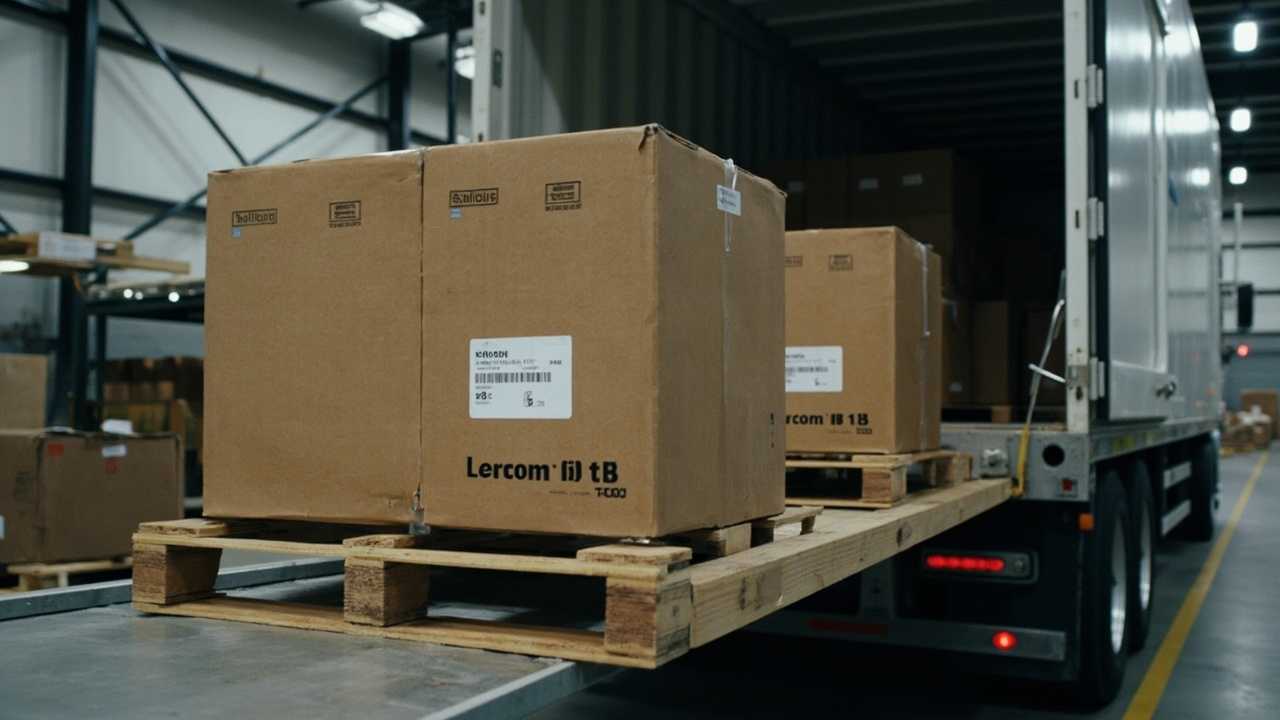
The shipping dock is where configuration divergence becomes physical: brown cartons on pallets can contain several approved SKUs, accessory types, or firmware revisions. A project label must therefore connect model, memory, OS build, DRM option, Ethernet option, cable set, and destination.
An operator commissioning a live event room will punish an unstable boot, delayed license acquisition, or update interruption. Its RFQ should therefore require repeated cold starts, a valid operator sign-on, licensed playback at the specified resolution, and a documented recovery path. The integrator will punish a physical mismatch: a missing S/PDIF output, wrong USB count, unsupported cable, or an Ethernet speed assumption. Its acceptance plan should test the assembled unit with the actual display, switcher, network, remote, and mounting arrangement.
A venue owner may prioritize device management and unattended recovery rather than a specific SoC generation. The requirement should still be measurable: specify the update channel, expected restart behavior, local configuration retention, and the evidence required to identify a nonconforming unit. If the room uses wired operation, Wi-Fi6 capability cannot substitute for an RJ45 decision. If video is delivered locally from USB or TF, the access workflow must be included in the test matrix rather than assumed from the interface list.
The buying authority has a different failure mode: undocumented substitution. A sample may pass, but a production shipment may change memory, Ethernet hardware, firmware, cable, or packaging. Its RFQ should identify the controlling specification, the approval authority, the notification process for changes, and the evidence that links a lot to the approved sample. This is particularly important when a project has multiple sites or staggered delivery. A site-specific accessory pack must remain distinguishable from the standard product configuration.
For an RFQ that covers this deployment angle, the first message to DataMax inquiry team should identify the room count, source applications, display and HDMI topology, Ethernet requirement, required DRM, memory configuration, target OS, and any operator middleware. A request for samples should include the exact acceptance test matrix so the sample is evaluated against the intended production configuration.
A decision path for the RFQ
The procurement sequence should turn ambiguous commercial language into testable specification lines. Start with the workflow, not the model. Identify the video path, protected-content path, control path, network path, and physical I/O path. Then map each path to a mandatory RFQ clause and an observable acceptance result.
- Freeze the application profile Record 4K frame-rate targets, codec requirements, DRM services, middleware, sign-on method, update method, and the display model.
- Select the platform baseline Choose one DataMax model and state the exact SoC, OS, RAM/ROM, DRM, and Ethernet configuration; prohibit silent substitutions.
- Translate requirements into interfaces State HDMI output, USB count and generation, S/PDIF, AV, TF, RJ45 speed, Wi-Fi generation, and Bluetooth version where relevant.
- Define the image and content acceptance Name the build fingerprint, licensed playback test, codec frame-rate test, middleware workflow, update behavior, and recovery procedure.
- Approve a golden sample Record serial number, hardware revision, software build, configuration, accessories, approved images, and measured acceptance results.
- Run the pilot gate Complete endurance, network, boot, recovery, thermal, and room-operation checks before authorizing volume release.
A buyer can paste the following structure into the RFQ: “The device shall be [DataMax model], [exact RAM/ROM], [AOSP OS version], with [DRM state], [RJ45 speed], and [specified ports]. The maximum decoded/output format shall not exceed the production datasheet. Each production unit shall match golden sample [identifier] and build [identifier]. Warranty handling, substitutions, and firmware changes require written approval.” The last clause is operationally important because a hardware change can alter the production datasheet even when the enclosure and model name remain unchanged.
The RFQ should also require the supplier to state which requirements are standard, which are optional, and which depend on the operator image. That avoids a common scope conflict: the distributor may quote the base model while the operator expects an approved middleware build and its certificate workflow. Ask for the exact android tv box part number, not only a family name, and require the response to identify any configuration that is unavailable for the project.
Each workflow path should have one accountable owner and one acceptance artifact. The video path can terminate in a codec-and-display test report. The protected-content path can terminate in a license and entitlement record. The control path can terminate in a management enrollment log. The network path can terminate in a wired or wireless connectivity report. The physical path can terminate in an approved connection diagram and accessory list. This structure turns the RFQ from a device description into a project-control document.
The sequence also protects the factory from ambiguous delivery demands. Instead of receiving “the same DM21S as the sample,” the supplier receives a configuration sheet, build fingerprint, cable code, and approved accessory references. If a field changes, the change request identifies whether it affects hardware, firmware, packing, or the acceptance matrix. The buyer can then decide whether to requalify the sample or amend the purchase order. A controlled change path is faster than discovering the difference during receiving inspection.
For a multi-site rollout, add a release lot concept even if the supplier does not use that term. Each release lot should reference the same controlling configuration but carry its own serial or lot range, packing list, factory test summary, and authorization status. The pilot authorizes one configuration and process; it does not automatically authorize every later production run without continued records. The purchaser should define whether additional golden-sample reconciliation is required after a process or component change.
What goes wrong after the PO
The most expensive divergence often appears after commercial agreement, when the ordered population no longer matches the tested sample or when the buyer’s acceptance test differs from the supplier’s test. Four failure modes deserve explicit contract treatment.
Field trap
A quotation may state 4K without defining frame rate, codec, color format, or output ceiling. “8K” language in marketing for the DM21T and DM22Q also conflicts with their supplied 4K datasheet limits. Accepting either without a written configuration can create an acceptance dispute at receiving inspection.
Field trap
An optional Ethernet speed or DRM state can be treated by the buyer as committed while remaining unconfirmed in the supplier’s quotation. Require a signed configuration sheet and tie it to the golden sample and purchase order; “optional” must not survive into a production shipment as an assumed feature.
The second failure is firmware drift. AOSP Android 14 identifies the platform baseline, not the final project image. A bootloader version, middleware release, certificate package, update policy, and build fingerprint can still diverge. The contract should define which party owns image integration, how security updates are delivered, and what happens if a production unit carries an unapproved build.
The third failure is accessory ambiguity. HDMI cable length, Ethernet category, remote-control type, power adapter, wall bracket, and signage enclosure are part of the room result even when they are not printed on the android tv box datasheet. Keep accessories on the BOM, identify approved equivalents, and test the complete installed assembly.
The fourth failure is weak traceability. If a carton contains mixed RAM/ROM or Ethernet variants, a receiving team may sort by packaging rather than configuration. Each carton should carry a project SKU, hardware revision, software-build range, and serial or lot identifier. The purchasing record must point to the factory order and the approved golden sample.
A fifth failure is a testing-boundary mismatch. The supplier may test codec decoding in isolation, while the buyer tests the room workflow with licensed content, browser forms, remote control, updates, and power recovery. The parties can then disagree about whether a failure is hardware, software, network, content, or installation related. Define the test topology, include the actual image, use a named content set, and require the report to classify each failed step rather than record only a final pass or fail.
A sixth failure is an omitted change trigger. Component substitutions, enclosure-label revisions, packaging changes, or middleware releases may individually appear harmless. Collectively, they can break a serialized acceptance record. The purchase order should identify which changes require notice, which require written approval, and which require a new sample comparison. The factory should not have to infer that a project-specific configuration is immutable merely because the product name has not changed.
For dispute prevention, define the inspection boundary in advance: what is sampled, which defects count, how software is identified, who performs the pilot, and what evidence authorizes the next batch. Otherwise the buyer and supplier can test different things after the units have already crossed the shipping dock.
Verification you can ask for on paper
Factory verification should follow the physical and software build, not merely a supplier declaration. Ask DataMax for a project-specific evidence package that links inspection, aging, firmware configuration, packing, and shipment records to the approved sample.
- Incoming-material and SMT verification Request line records, component substitutions, stencil and placement records, and inspection results for the production lot.
- Automated optical inspection Obtain AOI records for the relevant assembly stage, including defect coding, disposition, and rework traceability.
- Electrical and functional test Ask for a test matrix covering power, boot, interfaces, network, storage, audio/video output, remote functions, and configured options.
- Aging and stress evidence Request the defined burn-in or aging window, environmental conditions, failure criteria, and retest records without accepting untested duration claims.
- Dark-room and visual verification Obtain the inspection scope, sample method, display procedure, and defect dispositions for screen, enclosure, labels, and packaging.
- Build audit and trace Match serial or lot identifiers, firmware fingerprint, hardware revision, configuration sheet, and carton labels.
- Golden-sample and pilot reconciliation Compare shipped units with the approved sample and retain the signed acceptance record before volume release.
Evidence index: require one document index keyed by lot, model, hardware revision, software build, test date, and record owner. A list of generic factory photographs is not an evidence trail because it cannot establish which lot or configuration was inspected.
The project should define which documents are pre-production gates, which are retained for audit, and which require buyer approval. For example, a golden-sample comparison may require DataMax to confirm the exact RAM/ROM, Ethernet speed, OS build, DRM option, and port set before pilot shipment. The pilot report should then show test method, result, observed failure, retest, and final disposition.
A stronger evidence package describes relationships rather than merely attaching documents. The AOI record identifies the assembly lot; the functional test identifies the firmware fingerprint; the configuration sheet identifies the RAM/ROM and network option; the carton label identifies the shipped SKU; and the shipment record identifies the destination. A reviewer can then follow one unit or lot through the chain without relying on narrative assurances.
The request should also state the sampling and acceptance criteria for each process step. “AOI passed” is incomplete without the inspected stage, defect classification, disposition, and rework reference. “Aging completed” is incomplete without the test window, conditions, failure criteria, and retest outcome. “Dark-room checked” is incomplete without the display procedure and defect dispositions. This wording protects both parties: the factory can demonstrate compliance, while the buyer can audit the method.
Requesting evidence through the DataMax factory-quality process is more useful than requesting a generic “quality certificate.” If the project also requires formal market-access documentation, define that separately through the certifications and compliance routes. A certification document does not prove the delivered unit matches the proposed configuration, and a factory test does not substitute for required regulatory evidence.
Entry tier versus commitment tier
The model set should be evaluated as a difference in contractual commitment, not as a simple good/better ladder. DM21S and DM21P cover conventional white-label and operator-middleware deployments. DM21T and DM22Q bring higher stated decode ceilings or gaming-oriented positioning, but the procurement commitment still depends on selected memory, DRM, Ethernet, display behavior, and acceptance tests.
| Decision field | Entry orientation: DM21S / DM21P | Higher-commitment orientation: DM21T / DM22Q |
|---|---|---|
| OS baseline | DM21S: AOSP Android 14; DM21P: AOSP Android 11 | DM21T and DM22Q: AOSP Android 14 |
| SoC | DM21S: Amlogic S905Y5, quad Cortex-A55; DM21P: Amlogic S905Y4, quad Cortex-A35 | DM21T: Amlogic S905X5, quad Cortex-A510 (ARMv9); DM22Q: Amlogic S905X5M, quad Cortex-A55 up to 2.5GHz |
| Stated 4K ceiling | DM21S: AV1 / H.265 [email protected] 4K@60; DM21P includes AV1, VP9/H.265 4K@60 and H.264 4K@30 | DM21T: several codecs at 4K@120; DM22Q: AV1/H.265 L5.1 4K@60 |
| Memory posture | DM21S: 2GB / 16GB with listed optional combinations; DM21P: 2GB / 8GB with listed optional combinations | DM21T: 4GB / 64GB family options; DM22Q: 4GB / 64GB with listed optional combinations |
| Interface emphasis | DM21S has 1G optional; DM21P includes 3.5mm AV and DC 5V/2A | DM21T includes USB3.0 x1 and states no HDMI in; DM22Q provides USB2.0 x2 |
| Contract commitment | Fixed basic output, DRM, OS, and networking options accepted through golden sample | Higher decode demand accepted through display-specific, frame-rate-specific pilot evidence |
A lower entry model can be the lower-risk choice when the service requires 4K@60, the room display is fixed, and the media path does not justify a 4K@120 test burden. A higher-commitment model can become the higher-risk choice if the integrator has not qualified 4K@120 behavior with the actual display, cable, and room configuration. The relevant distinction is fit plus evidence, not codec marketing.
The DM21T configuration also needs interface discipline. Its datasheet states HDMI 2.0b output and no HDMI input, so it cannot be treated as a conventional pass-through source box. The DM22Q supplies HDMI 2.0b output, 1G Ethernet as an option, Wi-Fi6 2x2, and BT5.4. For an installation where wired operation is mandatory, confirm 100M versus 1G rather than allowing the integrator to infer the higher-speed option.
The entry tier also differs in evidence burden. A DM21S white-label build may center on one selected memory configuration, a fixed image, 4K@60 acceptance, and the required network option. A DM21T deployment may require frame-rate-specific playback tests, USB3.0 device checks, sustained motion, thermal observation, and qualification of the display path. The higher decode ceiling is useful only if the content, display, installation, and acceptance procedure justify that added work.
A worked comparison illustrates the trade-off. Suppose a signing room displays AV1 and H.265 content at 4K@60 through a fixed HDMI display. The DM21S entry orientation may align with that requirement, provided its exact RAM/ROM, Ethernet, and DRM configuration are confirmed. Suppose the same venue demonstrates high-motion 4K@120 material and uses a USB3.0 workflow. DM21T becomes the relevant candidate, but its output must still be tested with the display and cable; no 8K output statement is permissible from the supplied facts. Neither conclusion can be made from product position alone.
Warranty language and support processes should also be compared at the same level as hardware, but no duration is assumed here. The buyer should state the required service process, evidence return path, replacement authority, and escalation route, then require them in the quotation. This avoids treating a generic support promise as part of the model’s technical tier. For government delivery, a clear RMA and configuration-trace process may be more valuable than an unverified feature advantage.
On the DataMax program, request a sample, configuration sheet, and pilot matrix through sample ordering. The first message should state the target model, exact memory, OS baseline, DRM, Ethernet, required decode formats, cable set, and proposed golden-sample and pilot criteria. That converts the tier decision into a controlled commitment rather than a feature-list preference.
The mechanism behind the spec
The signing-panel requirement resolves into a chain: the display consumes an HDMI signal; the operating system runs the project image and middleware; the SoC decodes compressed media; DRM governs protected-content entitlement; the network carries control and content traffic; and the project build determines how all those functions behave. Procurement language works only when it names the relevant mechanism and acceptance result.
HDMI 2.0b specifies the physical output interface, but it does not remove the need to qualify the source, display, cable, resolution, frame rate, and content path. The decode list establishes the platform’s stated codec ceiling. For DM21T, the stated 4K@120 support still requires a room-level demonstration because the display and installation path determine the usable result.
DRM is a licensing and service mechanism, not a cosmetic label. Widevine L1, PlayReady, and HDCP 2.2 are separate entries in the supplied facts, with optional states varying by model. Acceptance should verify that the chosen service recognizes the unit and that the complete content path behaves as required. Hardware capability alone does not prove that the project account, certificate, token, and server entitlement have been configured correctly.
RJ45 100M or optional 1G changes the network requirement. Wi-Fi6 2x2 and BT5.4 describe wireless and Bluetooth capabilities, but fixed government or commercial rooms often rely on wired control and update traffic. The android tv box must therefore be selected around the actual transport policy, not the broadest list of labels.
AOSP identifies the Android baseline from which the product build is derived. It does not by itself certify operator middleware compatibility, update behavior, security patch cadence, device-management enrollment, or application signature handling. Those functions belong in the project specification and pilot.
The architecture is straightforward when each layer has an owner:
- Hardware platform SoC, RAM/ROM, interfaces, network, output configuration
- Project software AOSP baseline, operator image, middleware, applications, certificates
- Service path Content delivery, DRM licensing, control, management, updates
- Physical installation Display, source, cables, power, mounting, network, remote
- Evidence chain Golden sample, production records, pilot results, acceptance authorization
The mechanism clarifies why a single “4K Android TV” label cannot govern procurement. The SoC establishes a decode ceiling; the image establishes application and middleware behavior; the DRM service establishes entitlement conditions; the interface establishes the physical signal path; and the network establishes control and content transport. An acceptance test at the final room boundary examines the combined result, while the RFQ assigns each contributing mechanism to a specific configuration value.
The same principle applies to operational control. AOSP Android 14 is the baseline for DM21S, DM21T, and DM22Q, but a project may add a specific operator image, application package, update policy, and device identifier. AOSP Android 11 on DM21P may align with middleware built for that baseline. The mechanism-based request names the build fingerprint and workflow rather than asking whether the device is simply “Android.” That gives the software owner a testable deliverable and the factory a reproducible input.
The android tv box is therefore the physical endpoint of a larger control chain, not the whole mechanism. The buyer should preserve that distinction in contract language: hardware fields identify the platform, software fields identify the build, service fields identify the entitlement and control paths, installation fields identify the room, and evidence fields identify the acceptance decision. Each link must point to the next one. If a link lacks an owner or an artifact, the corresponding procurement claim remains unverified.
Further reading
- Guide android tv box for isps
- OEM services
- Custom hardware and software development
- Certifications and test evidence
- Send a procurement inquiry
- DataMax DM21S specifications and fit
- DataMax DM21P specifications and fit
FAQ
Which DataMax model fits a government signing panel?
Choose by workflow rather than project title. DM21S fits a 4K IPTV/OTT white-label build on AOSP Android 14; DM21P fits operator middleware on AOSP Android 11; DM21T targets premium UHD or cloud-gaming use; and DM22Q targets gaming-oriented use. Freeze RAM/ROM, DRM, Ethernet, and the tested image in the RFQ.
Can DM21T or DM22Q be quoted as an 8K product?
No. The supplied production facts cap their output and decode capability at 4K: DM21T lists several codecs at 4K@120, while DM22Q lists AV1/H.265 L5.1 at 4K@60. The quotation must use 4K and cite the production datasheet. Any different display or output requirement needs written confirmation rather than reliance on marketing naming.
What evidence should accompany the purchase order?
Request a configuration sheet, golden-sample identifier, factory test records, AOI and aging evidence, firmware-build record, packing trace, and pilot acceptance procedure. These records should connect the specific model, memory, Ethernet option, DRM state, and software build to the shipped lot. Generic quality statements do not establish configuration conformity.
Should the project include 1G Ethernet by default?
Do not assume it. DM21S, DM21T, and DM22Q list 1G as optional, while DM21P lists RJ45 100M. Write the required speed into the RFQ and golden-sample record. If the project uses fixed wired operation, test that configuration with the actual network rather than accepting a family-level specification.
What should the first RFQ message contain?
Include room count, application profile, display and HDMI topology, required codecs and frame rates, DRM services, middleware, memory, Ethernet, USB and audio needs, remote-control requirements, and the proposed sample and pilot tests. Send that information to the DataMax inquiry team so quotations and samples use the same controlled configuration.
When should a new golden sample be required?
Require a new comparison after an approved hardware or software change, an unresolved pilot failure, a firmware-build change that alters project behavior, or a packaging or accessory revision that changes the installed result. The RFQ should identify which changes require written approval and which require a new sample review. This prevents a previously accepted model name from concealing an unverified project configuration.