

The short answer: retail-chain fit starts with the quotation boundary
“Android TV box” is used as though it describes one deployable device. In retail-chain procurement, it is only a software-and-form-factor label. The purchasable object is a production configuration: a named hardware platform, an AOSP release, a fixed memory and storage build, an enabled DRM option, a defined interface set, a certification package, and a repeatable firmware image. Two quotations carrying the same phrase can therefore create different qualification workloads.
For a retail chain, the direct answer is to qualify a model against the actual storefront or merchandising role, then freeze every field that changes certification, firmware, networking, or installation. The DataMax DM21S is the relevant starting point for a 4K IPTV/OTT white-label deployment, but the other production SKUs may be better aligned with operator middleware, premium UHD, cloud-gaming, or gaming-oriented use.
An android tv box should be specified at least to this boundary:
| Quotation field | What the buyer must fix | Why it changes later work |
|---|---|---|
| Model and SoC | DM21S and Amlogic S905Y5 | Controls the platform baseline and firmware qualification scope. |
| Software | AOSP Android 14 | Defines the OS release under test and the certification baseline. |
| Memory | 2GB RAM / 16GB storage | Fixes application headroom, cached content, and image size. |
| DRM | Widevine L1, with PlayReady optional | Determines service availability and licence-flow testing. |
| Interfaces | HDMI 2.0b, 100M RJ45, Wi-Fi6 2x2, USB, TF, audio | Drives store-network and peripheral compatibility decisions. |
| Evidence | Certification, SMT/AOI, aging, audit, and image records | Provides traceability beyond a model name and catalogue row. |
This answer does not treat a catalogue description as final acceptance. Production quantities, memory options, licences, firmware features, and regional homologation still require confirmation against the production datasheet. The useful procurement artifact is a specification lock, not the phrase “android tv box” by itself.
A retail-chain buyer should also decide who owns each acceptance layer before issuing the RFQ. The service owner can approve protected-content playback, but the venue owner must accept the display, power, cabling, and recovery route. An integrator may promise a repeatable installation process, yet it cannot approve a firmware change or optional DRM configuration. Dividing those responsibilities prevents a device-level pass from being mistaken for a site-level pass.
For a broad platform assessment, the canonical guide to an android tv box for ISPs helps separate service requirements from device features. That comparison should precede the store-chain specification, because IPTV traffic, identity, middleware, and licence handling can change the selected platform before physical testing begins.
The selection sequence that removes rework
A retail-chain programme normally combines at least four workstreams: store display, service access, operator middleware, physical installation, and evidence collection. Start with the operational outcome, then identify the platform, then freeze the evidence boundary.
- Name the scene Record whether the unit is for IPTV, OTT, signage, operator middleware, premium UHD, cloud gaming, or a general gaming-oriented deployment. Do not use one requirement sheet for all six roles.
- Select the production platform Map the role to a DataMax SKU, then verify the exact SoC, OS, memory, DRM, decode capability, and physical interfaces against the production datasheet.
- Freeze the commercial build Specify RAM and storage, enabled DRM, firmware branch, app installation method, remote-control behaviour, network interface, and regional power supply.
- Define the evidence package List required certifications, BOM revisions, firmware hashes, test reports, audit records, packaging evidence, and approved sample references.
- Stage validation Separate application certification, device certification, site pilot, and production release so a failure has a defined owner and disposition.
- Lock change control Require advance approval for SoC substitution, Android revision, memory change, radio module change, interface reduction, and licence-path changes.
The resulting RFQ line should read as a testable object, not a preference. For example:
Device: DataMax DM21S. Processor: Amlogic S905Y5, quad Cortex-A55. OS: AOSP Android 14. Memory build: 2GB RAM / 16GB storage. Video: AV1 / H.265 [email protected] 4K@60. DRM: Widevine L1; PlayReady only if explicitly enabled. Interfaces: HDMI 2.0b output, S/PDIF, AV, USB2.0 x2, TF, RJ45 100M, Wi-Fi6 2x2 and BT5.4. Submission must identify firmware revision, certification status, proposed production memory build, test reports, and change-control process.
That line exposes omissions before samples arrive. A supplier can still propose an alternative, but the buyer can compare it on the same fields. Add columns for firmware identity, regional power configuration, approved peripherals, service identity, and required certification evidence. A second example for an operator-managed deployment would name the middleware image, HDCP requirement, recovery method, remote-control protocol, and store-network contract.
Do not leave key fields as “latest,” “standard version,” or “as required.” Translate them into an inspectable response: give the exact release, state whether the option is enabled, identify the report that proves it, and name the person authorized to approve a deviation. This is particularly important when the procurement team and the certification team use the same term for different levels of commitment.
Each arrow needs an acceptance record. The model selection must map to a use case, the frozen build must map to the quotation, the evidence package must map to the build, and the pilot must map to the approved evidence. A gap at one arrow invalidates the next claim. This sequence removes rework because the buyer changes a specification before samples are painted, packaged, and distributed to stores.
Failure modes that reach the field
Most field failures originate from an ambiguous quotation, not from an isolated hardware defect. The supplier and buyer may both believe that a feature is enabled because it appears somewhere in a brochure. The production image, certification record, or connected equipment then reveals a different configuration.
Field trap
A quoted “optional” DRM or interface is not a deliverable. If PlayReady, 1G RJ45, or another optional build can change after approval, the application test, certification record, cable plan, and spare-parts configuration can diverge from the shipped unit.
The following divergences deserve explicit closure:
- Platform ambiguity: A model family may contain several memory and storage combinations. A catalogue entry without a selected build cannot support image reproducibility, application sizing, or spare-parts continuity.
- Display-path ambiguity: Output interfaces, codec support, and DRM are separate controls. A 4K claim does not prove that the required codec, HDCP path, app profile, and television compatibility have been tested together.
- Network ambiguity: RJ45 at 100M and Wi-Fi6 are different deployment paths. The quotation must state whether the retail installation depends on wired service, wireless association, captive-portal behaviour, or a fallback arrangement.
- Certification ambiguity: “Android TV” may appear in sales language without corresponding Android TV certification, GMS/EDLA status, operator middleware qualification, or regional regulatory evidence. None should be inferred from the model name.
- Version ambiguity: An AOSP release does not specify the image revision, security patch, application versions, service packages, or production update policy.
Field trap
Do not accept “8K” as an RFQ acceptance criterion for DM21T or DM22Q. The supplied production facts cap their relevant video paths at 4K; output and decode claims must come from the controlled datasheet, not marketing shorthand.
Another recurring failure is the mismatch between the approved sample and the production lot. Procurement may approve a sample with a particular storage option, radio module, remote, power supply, package, or firmware branch, while production uses a functionally close substitute. The inquiry should require a “golden sample” identifier, a dated comparison record, and written approval for every difference. The same rule applies after a firmware update: a repaired service fault can become a fleet-wide regression if the updated image bypasses application certification.
A second failure appears when a retail display is treated as a universal target. A successful H.265 or AV1 decode at 4K@60 does not establish that the store display accepts the selected colour mode, frame rate, HDCP path, audio format, or HDMI feature set. Record the display model, firmware state, input configuration, and EDID interpretation in the pilot. If stores differ, create separate compatibility classes rather than averaging the results into one claim.
Thermal stability is another operational dependency. A short demonstration can pass while a continuously running installation fails after sustained load. The acceptance procedure should define an operating duration, ambient condition, playback or application load, network state, and observation method. Any early restart, interface loss, or image failure should retain the device identifier and logs for disposition rather than being removed informally from the pilot.
The commercial cost of these gaps appears in multiple places: re-certification, delayed store rollout, returned stock, duplicated spare units, replacement firmware images, and site visits whose cause cannot be reconstructed. Each acceptance test should therefore point to a serializable evidence record. For factory-side verification, request a video factory audit or evidence package focused on SMT, AOI, aging, and the selected production configuration.
The evidence trail from SMT to shipment
Factory control is a chain, not a single certificate. The chain begins with the approved component and configuration set, passes through board assembly and inspection, enters firmware and ageing validation, and ends with a traceable packed unit. A buyer should be able to name the evidence associated with each stage.
- Input control Match the incoming BOM, approved vendor parts, SoC, memory, radio module, and interfaces to the locked product specification.
- SMT verification Review stencil, solder-paste, placement, reflow, AOI, and inspection records for the production line.
- Board test Correlate serial or batch records with power, boot, USB, HDMI, audio, Ethernet, and wireless checks.
- Firmware binding Record the image identifier and install the exact intended software build rather than a generic AOSP release label.
- Soak and functional ageing Validate boot stability, network association, output, storage, peripherals, and application behaviour over the agreed test cycle.
- Audit and release Compare the physical sample, packaging, firmware, labels, certifications, and approved bill of materials.
- Shipment traceability Link packed units to the production batch, inspection result, firmware revision, and delivery record.
Minimum evidence index: approved specification, BOM revision, board and firmware identifiers, SMT/AOI record, ageing result, functional test record, certification report, packaging approval, shipment batch, and approved-sample reference. The buyer should specify document names, owners, and submission dates rather than request “quality documents” generically.
A dark-room or display test adds value only when the acceptance condition is documented. Specify the display target, signal path, application, duration, image population, and disposition rule. For RF and regulatory work, request the exact reports applicable to the shipped radio and power configuration. Product certification status should be checked through the certification evidence, while compliance scope should be tied to the destination market rather than copied from another regional programme.
The evidence trail also needs an exception path. A failed test must record the serial or batch, failure code, observation, root-cause owner, corrective action, retest result, and approval. Without that sequence, an apparently complete folder may still lack proof that the corrective action reached the shipped lot.
Define the acceptance regime before judging the records. A retail programme can use a sample-based line audit, serial-based functional checks, or a hybrid in which critical board tests are automated while application and ageing checks are performed on selected units. The RFQ should name the regime, sampling rule, defect classes, disposition authority, and retest requirement. It should also state whether a failure blocks the batch, the shipment, or only the affected unit.
Hardware and software evidence should meet at the serial level. A board-test record proves that a circuit passed under defined conditions; it does not prove that the final image, licence service, network identity, or display path was validated on that unit. Conversely, a successful application demonstration does not prove correct soldering across every production board. The traceable unit is the intersection of those records.
For an android tv box qualification, request release evidence in a format that can be sampled by the buyer’s quality team. At minimum, the supplier should show the approved BOM revision, firmware identifier, test date, line or batch identifier, operator or station reference, result, and nonconformance status. Redacted records may be acceptable where commercial data must remain confidential, provided the approver can still correlate the configuration, revision, date, and result.
The evidence trail should also cover packaging because a retail rollout is not only an electronics programme. Carton labels, accessory count, remote-control pairing instructions, power documentation, regulatory markings, and serial placement must be tied to the approved pack-out. A shipment carton with the right board and the wrong remote creates a store-level installation exception that hardware testing will not detect.

Photograph direction: Electronics factory shipping dock with neutral brown cartons on pallets being loaded into a container truck, warehouse interior, overcast daylight, photorealistic industrial photography, no readable text, no brand logos.
The comparison buyers actually make
Retail-chain buyers rarely compare two devices on a single headline. They compare the cost of qualification, the completeness of the shipped configuration, and the operational consequences of an exception. The following editorial scale ranks quotation comparability as the specification becomes more controlled; it is not measured production performance.
A product-name-only comparison leaves nearly every consequential decision open. Adding chip and memory narrows software and performance assumptions. Adding DRM and radio specifications exposes service and network dependencies. A full field-by-field specification gives procurement, engineering, certification, logistics, and the supplier a shared acceptance baseline.
The figure should guide the RFQ, not replace it. A score of 93 does not certify a device or prove compatibility. It indicates that two suppliers are more likely to be discussing the same physical and software object. For retail chains, that distinction matters because qualification failures become more expensive after packaging, store fixtures, and launch schedules are committed.
Lead-in: The same quotation controls can be represented as an editorial comparison before they become the production specification.
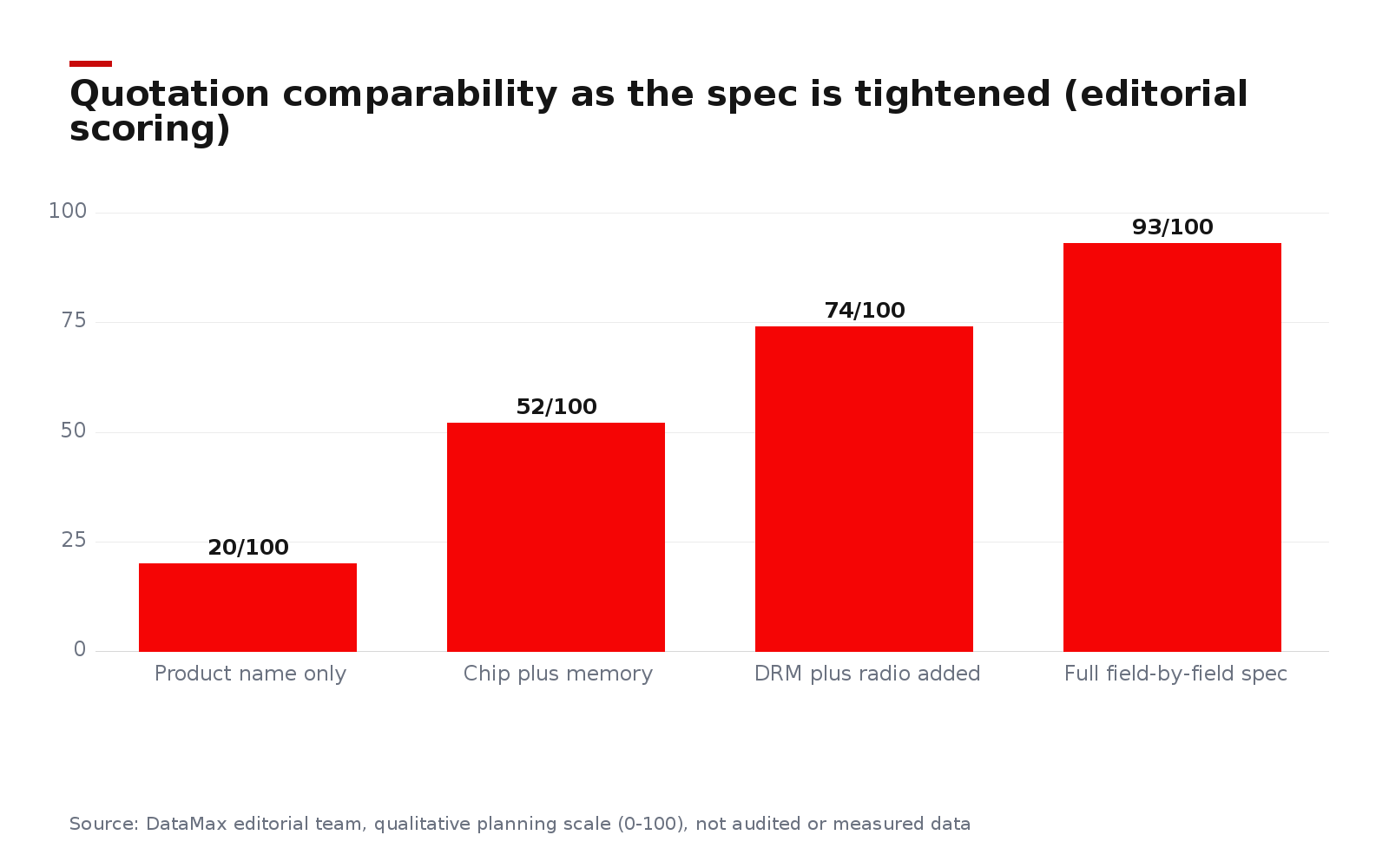
The same figures, in searchable form:
| Specification boundary | Editorial score |
|---|---|
| Product name only | 20 |
| Chip plus memory | 52 |
| DRM plus radio added | 74 |
| Full field-by-field spec | 93 |
The practical comparison has three columns: what is fixed, what remains optional, and what evidence is required before approval. The buyer should also record a fourth field: the commercial consequence of each optional element. A firmware change is not equivalent to a cable change, but both create programme risk if they are absent from the quotation.
A second comparison sheet should test programme effort rather than feature totals. It can score the number of open options, the number of separate approval owners, the availability of certification records, the clarity of the firmware build, the completeness of interface evidence, and the effort needed to recover a failed unit. These are workflow measures, not product-performance measurements. They help a buyer determine whether a technically plausible option is administratively ready for a chain-wide rollout.
Do not combine “capability present” and “capability accepted” in one cell. An AV1 path can be present in the SoC specification, enabled in firmware, certified for a particular service, and accepted on the display used by the store. Those are four separate statements with four evidence owners. A comparison table that collapses them produces a false equivalence between a promising prototype and a release candidate.
Where the terminology comes from
The category combines several distinct technical systems. Understanding the boundaries prevents an application certification requirement from being confused with a hardware feature or a regulatory approval.
AOSP is the open-source basis for Android. “AOSP Android 14” identifies the OS release, but not the OEM image, Google Mobile Services, Android TV certification, application permissions, update mechanism, or production build. For an android tv box programme, these downstream layers must be requested separately.
Widevine L1 and PlayReady are DRM systems with separate licence-service and device-level requirements. A row listing both does not prove that both are enabled, licensed, and operational in the production image. The acceptance test must identify the service, content, token flow, output path, and failure handling.
HDMI 2.0b describes an interface version, while AV1, H.265, H.264, VP9, AVS3, and H.266/VVC describe video coding capabilities. Decode support and output resolution must not be collapsed into one claim. The supplied DM21T facts explicitly state HDMI 2.0b output, no HDMI input, and 4K video paths; those boundaries belong in the RFQ.
Wi-Fi6 2x2 and BT5.4 describe radio capability. They do not establish the regulatory variant, antenna configuration, coexistence behaviour, access-point credentials, country restrictions, or the certification package for the destination market.
GMS and EDLA are separate commercial and device-certification tracks. GMS concerns licensed Google services and the applicable compatibility process; EDLA certification concerns qualifying Android TV devices. Neither status should be inferred merely from AOSP, Widevine, or a product label. Likewise, HDCP 2.2 and HDCP 2.3 are content-protection requirements for specific paths and devices, not interchangeable marketing adjectives.
The architecture behind retail deployment may extend beyond the box:
- Device layer SoC, RAM, storage, display, audio, network, radios, ports, and cooling
- Software layer AOSP image, drivers, middleware, applications, DRM integration, provisioning, and update policy
- Service layer Identity, catalogue, licence, telemetry, conditional access, and content delivery
- Site layer Displays, power, structured cabling, Wi-Fi coverage, store operations, and asset tracking
- Governance layer Certification, regional compliance, acceptance evidence, change control, and end-of-life planning
This is why a generic “TV box” label is inadequate for engineering. It says little about the application contract, the compliance boundary, or the operational owner.
The same distinction applies to operating-system update mechanisms. An AOSP build may use manual local updates, over-the-air update, managed-device policy, or a retail-specific service path, but the product facts supplied here do not identify the update method. The buyer should ask the supplier to state it rather than infer it from Android 11 or Android 14. If fleet updates are required, define the update authority, staging method, failure recovery, rollback condition, and release evidence.
The term “middleware” is similarly broad. Operator middleware may include provisioning, conditional access, entitlement, device identity, remote management, and UI policy. A box that supports an application is not necessarily qualified for a managed operator service. The qualification record should identify the middleware version, the supported device profile, identity method, and recovery behaviour. This separation is essential for an android tv box programme where the service team and hardware supplier may otherwise use “operator ready” for different requirements.
For certification, maintain a matrix rather than a single badge field. List the standard or programme, product configuration, destination market, certificate or declaration identifier, issuing body, status, issue date, model coverage, and evidence owner. A change to the Android release, radio variant, power supply, or storage build may affect what must be reviewed; the exact consequence depends on the applicable regime and should be confirmed against the production datasheet and certification evidence.
Four production SKUs compared
The CROSS family covers distinct retail-chain roles. The table below uses the supplied production facts verbatim; optional configurations remain explicitly optional and must be confirmed against the production datasheet.
| Model | SoC and OS | RAM / ROM | Decode and DRM | Ports and connectivity |
|---|---|---|---|---|
| DM21S | Amlogic S905Y5, quad Cortex-A55; AOSP Android 14 | 2GB / 16GB (2/4/8GB; 16/32/64GB optional) | AV1 / H.265 [email protected] 4K@60; Widevine L1 / PlayReady optional; Dolby Vision/DTS | HDMI 2.0b out, S/PDIF, AV, USB2.0 x2, TF, RJ45 100M (1G optional), Wi-Fi6 2x2 + BT5.4 |
| DM21P | Amlogic S905Y4, quad Cortex-A35; AOSP Android 11 | 2GB / 8GB (4GB; 16/32/64GB optional) | AV1 [email protected], VP9/H.265 4K@60, H.264 4K@30; Widevine L1 / PlayReady / HDCP 2.2 optional | HDMI 2.0b out x1, USB2.0 x2, TF, S/PDIF, 3.5mm AV, RJ45 100M, Wi-Fi6 2x2 + BT5.4, DC 5V/2A |
| DM21T | Amlogic S905X5, quad Cortex-A510 (ARMv9); AOSP Android 14 | 4GB / 64GB (family options) | H.266/VVC [email protected] 4K@120, AV1/VP9/H.265 4K@120, AVS3 4K@120, H.264 4K@60; inline AI-SR; Widevine L1 / PlayReady optional | HDMI 2.0b out (no HDMI in), USB2.0 x1 + USB3.0 x1, TF, S/PDIF, AV, RJ45 100M (1G opt), Wi-Fi6 + BT5.4 |
| DM22Q | Amlogic S905X5M, quad Cortex-A55 up to 2.5GHz; AOSP Android 14 | 4GB / 64GB (2/4/8GB; 16/32/64GB optional) | AV1/H.265 L5.1 4K@60; inline AI-SR (no NPU TOPS stated); Widevine L1 / PlayReady optional; Dolby Vision/DTS | HDMI 2.0b out, USB2.0 x2, TF, S/PDIF, AV, RJ45 100M (1G opt), Wi-Fi6 2x2 + BT5.4 |
Only four named production SKUs are supplied here, despite the planning basis referencing five. No fifth model has been invented or substituted. The correct procurement response is to confirm the intended additional platform and its production datasheet rather than infer one from the family label.
Several decisions are visible without extrapolation. DM21S and DM21P use different SoCs and Android releases. DM21T adds H.266/VVC, AVS3, USB3.0, and 4K@120 decode paths, while its HDMI output remains 2.0b and it has no HDMI input. DM21P includes HDCP 2.2 as an optional DRM-related item. DM22Q and DM21T share the Amlogic S905X5-family naming but differ in the exact SoC, CPU, memory options, decode list, interfaces, and wireless notation; they are not interchangeable in an RFQ.
A field-by-field evaluation should begin with the work the device must perform. DM21S is the stated direction for a 4K Android TV box for IPTV/OTT white-label use, while DM21P is positioned for a 4K IPTV/operator middleware set-top box. DM21T serves a premium UHD/cloud-gaming direction, and DM22Q serves a gaming-oriented Android TV box direction. Those fit statements are the correct starting point, but they do not replace acceptance against the actual application, display, network, remote, and store-operating model.
Build the comparison around decision rows, not feature totals. Ask whether the required codec is listed; whether the required frame rate is listed; whether the required memory build is selected; whether the DRM option is enabled; whether HDMI output is adequate; whether Ethernet is required; whether USB3.0 is required; and whether the Android release fits the operator image. A model with more listed features can still be the wrong selection if one required field remains open.
The exact phrases in the table matter. “1G optional,” “PlayReady optional,” “HDCP 2.2 optional,” and “family options” are not permission to assume those items are present. A quotation should state the proposed build and identify any option as excluded. For production confirmation, request the controlled datasheet, approved sample, firmware record, and certification scope against that exact build.
The comparison should also preserve negative constraints. DM21T has no HDMI input; that may be suitable for an output-only retail installation and unsuitable for a pass-through or capture workflow. Its 4K@120 decode entries do not authorize an 8K output claim. DM22Q’s inline AI-SR entry does not supply a stated NPU TOPS figure. Such boundaries are valuable procurement controls because they prevent a later supplier proposal from quietly changing the test basis.
For a retail chain, the correct starting direction is operational. A DataMax team can prepare the controlled quotation and evidence index through the inquiry process, while sample planning can proceed through sample ordering. The sample should carry the proposed memory build, enabled options, exact firmware branch, regional power configuration, peripherals, and packaging under review.
The operator, the integrator and the venue
Retail deployment decisions cross three ownership boundaries. The operator defines the service and device behaviour. The integrator owns installation and site integration. The venue operator owns the physical store, display estate, network path, and rollout window. A mismatch between these owners is a frequent cause of late change.
| Situation | Primary requirement | Model direction | Acceptance focus |
|---|---|---|---|
| Retailer launches a white-label IPTV/OTT service | 4K service path, DRM, operator application, controlled branding | DM21S direction | Frozen memory build, enabled DRM, application certification, firmware and identity records |
| Operator deploys middleware to managed retail rooms | Operator middleware qualification, 4K IPTV path, HDCP where required | DM21P direction | Middleware image, network behaviour, HDCP 2.2 option if enabled, remote and recovery tests |
| Premium demonstration area uses high-frame-rate 4K content | 4K@120 decode paths, high-bandwidth peripherals, premium display path | DM21T direction | Per-codec 4K@120 tests, output constraints, USB3.0 and thermal validation |
| Interactive gaming-oriented installation | 4K@60 AV1/H.265 path, responsiveness, controller and network integration | DM22Q direction | Latency procedure, controller enumeration, network stability, image and output validation |
| Integrator rolls out across many stores | RJ45 or Wi-Fi installation standard, recovery method, asset identification | Select the platform only after site survey | Boot recovery, provisioning, serial or asset mapping, store pilot, packaging and spare-unit procedure |
| Venue owns displays, power and connectivity | HDMI, audio, power, cable, and service-window compatibility | Confirm against venue infrastructure | Peripheral matrix, sustained ageing, site acceptance, labelled power and network drawings |
An operator’s acceptance test may prove that a stream starts and a protected asset plays. It does not prove that a retail display accepts the mode, that an integrator’s switch preserves traffic, or that a venue can recover a failed unit after store opening. Each layer needs its own test record.
A useful sequence begins with a representative store pilot: validate the display and network path, install the approved image, register the device with the service, exercise DRM and applications, perform reboot and recovery tests, then measure the operational handover. Scale-up should proceed only after the failure procedure and evidence naming convention are accepted.
For an operator-led deployment, the acceptance sequence usually begins with identity, catalogue access, entitlement, DRM, playback, and service recovery. For an integrator-led rollout, it begins with power, cabling, network association, display mode, mounting, peripheral pairing, and asset labelling. For a venue-owned installation, it begins with access windows, display inventories, store operating hours, cleaning or security procedures, and the route used to swap a failed unit. The android tv box remains the same hardware class, but the evidence package changes with the accountable owner.
Pilot selection should deliberately cover risk rather than convenience. Include the slowest acceptable network path, the largest declared display, the application set that consumes the most memory, the required protected content, the preferred remote method, and the recovery procedure used after opening hours. Record each site’s configuration so a successful flagship store cannot be used as proof for every smaller location.
The handover needs a common vocabulary. The service operator should define service identifiers and acceptable playback outcomes; the integrator should define installation states and physical completion; the venue should define access, safety, and asset acceptance. A handover record should close with the installed image, serial or asset identifier, site configuration, observed defects, accepted exceptions, and escalation route. This creates evidence that survives staff changes and store refurbishments.
The retail-chain owner should also separate stock movements from technical substitutions. If a memory option or interface changes after pilot approval, engineering must assess the impact and the vendor must identify the affected records. The DataMax manufacturing route is suited to reviewing those controls, and the compliance evidence process should be tied to the exact market and shipped configuration. A retail deployment solution can help align platform, application, and site acceptance without replacing the model-specific datasheet check.
Before ordering production units, ask the supplier for the proposed model, exact configuration, firmware and application build, certification status, evidence index, packaging revision, and change-control route in one controlled response. A video factory audit can focus on SMT/AOI records, ageing, firmware binding, and shipment traceability. Procurement can then compare the android tv box alternatives against the same acceptance baseline rather than a catalogue headline.
Further reading
- Guide android tv box for isps
- TV box vendor selection checklist
- Industry solutions
- Allwinner Android TV boxes
- AOSP Android TV boxes
- DataMax DM21S specifications and fit
- DataMax DM21P specifications and fit
FAQ
What makes an Android TV box suitable for a retail chain?
The decisive factors are the frozen production configuration, display and network compatibility, DRM and application behaviour, recovery procedure, and traceability. A model name alone is insufficient. For example, a 2GB / 16GB build, Android release, interface set, and enabled DRM must be fixed in the quotation so store testing applies to the same object that will be shipped.
Should every retail installation use Ethernet?
No. The decision depends on site infrastructure, network ownership, application traffic, provisioning, and recovery standards. RJ45 100M is listed on the supplied DataMax platforms, while 1G is optional on selected models. The buyer should select the wired or wireless operating path after a site survey and freeze that choice in the deployment specification.
Does Widevine L1 guarantee protected-content playback?
No. Widevine L1 is a DRM level within a larger service arrangement. The device, production firmware, service token, content rights, output path, and application integration must work together. PlayReady and HDCP options also require explicit enablement and qualification. Accept the device through the intended service and display scenario, not through the DRM label alone.
Which DataMax model should a white-label IPTV pilot use?
The DM21S is the relevant direction because its stated fit is a 4K Android TV box for IPTV/OTT white-label. It pairs the Amlogic S905Y5 with AOSP Android 14 and a 2GB / 16GB base configuration. The pilot must still lock the optional features, memory build, firmware, application, certification status, and store test conditions.
What evidence should be requested before shipment?
Request the approved specification, BOM revision, SMT and AOI records, board-test evidence, ageing results, functional test results, firmware identifiers, applicable certification records, packaging approval, approved-sample comparison, and shipment-batch traceability. The evidence index should identify document names, owners, and dates. A generic quality-document request does not establish that the shipped configuration was tested.
How should a change to the production build be controlled?
Treat SoC, Android revision, memory, storage, radio, interface, DRM, firmware, and application changes as controlled items. Require advance notice, impact analysis, revised test evidence where necessary, and buyer approval before release. A model-family code or generic Android label is insufficient to determine whether two shipments contain equivalent hardware and software.
Can a successful store pilot approve every location?
No. A pilot validates the tested displays, network paths, application versions, and operating procedures, not every unvisited store. Scale each location against a controlled compatibility profile and repeat site acceptance when display, network, firmware, application, accessory, or physical configuration changes. The release record should identify the accepted site class and the evidence that placed each unit in that class.
How should retail buyers compare optional configuration risk?
Treat each optional item as a separate decision with an owner, selected state, evidence requirement, and consequence of omission. For example, PlayReady, 1G RJ45, HDCP 2.2, and storage alternatives may affect service qualification, cabling, test effort, or spare-unit continuity. A controlled quotation should say “enabled,” “excluded,” or “pending approval,” then require a revision before the affected build is released.




