

Before the terminology: the decision
DM21T is the right broadcast-operations candidate when the requirement set includes VVC Main10 Level 5.2 at 4K/120, Android 14, and a premium UHD or cloud-gaming profile. Its production datasheet identifies an Amlogic S905X5 with quad Cortex-A510 processors and AOSP Android 14. That combination distinguishes it from the other CROSS models in this comparison: DM21P is positioned for 4K IPTV and operator middleware, DM21S for 4K IPTV/OTT white-label programs, and DM22Q for gaming-oriented deployments. The procurement decision should therefore be based on an exact decode contract, not a broad “4K box” label.
For broadcast operations, the critical check is straightforward: verify the source format, codec profile, resolution, frame rate, display output path, middleware build, DRM configuration, and production evidence as separate RFQ lines. The DataMax DM21T is not automatically a universal broadcast appliance. It is the closest DataMax platform to this VVC decision because its stated decode capability reaches H.266/VVC [email protected] 4K@120. The same product fact sheet caps output and decode at 4K, so any quotation describing 8K output requires correction before approval.
Treat the selection as a two-stage decision. First choose the hardware class against the actual media chain; then require the OEM or ODM to produce evidence for the exact production configuration. For an android tv box sourcing program, this prevents a codec-led sample from hiding unresolved firmware, certification, connectivity, or audit requirements. DataMax can support the product transition from commercial specification through manufacturing evidence and shipment release.
A procurement example clarifies the decision. If the incoming feed is a VVC Main10 Level 5.2 master and the operator needs 4K/120 playback on an Android 14 device, the DM21T specification is the relevant starting point. The RFQ should name the source profile, the accepted decode ceiling, and the output test mode. If the actual service uses HEVC or AV1 at 4K/60, with operator middleware as the dominant requirement, DM21P may be the closer operational fit. The product decision is therefore driven by the media contract and service architecture, not by the phrase broadcast operations.
The mechanism behind the spec
A broadcast-operation requirement is a chain, not a single headline. The acquisition stage determines the encoded representation; the decoder stage must support the relevant coding standard and profile; the operating system carries the media framework, middleware and service configuration; HDMI carries the rendered output; and the display must accept the resulting signal. A procurement specification must close every link in that chain.
VVC, also designated H.266, uses coding tools that are distinct from H.265/HEVC, H.264, AV1 and VP9. The DM21T fact sheet specifically states “H.266/VVC [email protected] 4K@120.” That wording should be copied into the RFQ rather than generalized as “VVC capable.” Main10 matters for 10-bit content workflows, Level 5.2 identifies the stated conformance level, and 4K@120 defines the stated decode ceiling. These are different dimensions, and a supplier may meet one while leaving another ambiguous.
The chipset path is Amlogic S905X5 with quad Cortex-A510 (ARMv9). The OS is AOSP Android 14, so an operator deployment still requires application packaging, device provisioning, middleware integration, account activation, network configuration and an update policy. AOSP is not a substitute for a completed operator image. Likewise, Widevine L1 / PlayReady optional means the DRM package must be ordered and verified for the target service; it is not evidence that every commercial licence will be issued.
The output path is HDMI 2.0b out with no HDMI input. A loop-through workflow, therefore, cannot be inferred from the product name or from its decoding capability. The model includes USB2.0 x1, USB3.0 x1, TF, S/PDIF, AV, RJ45 100M with 1G optional, and Wi-Fi6 with BT5.4. Each supported path should be tied to the deployment requirement: USB peripherals, optical or analogue audio, wired access, storage, or wireless connectivity.
A useful RFQ distinguishes signal input, decode and display output. State the maximum input resolution and frame rate separately, the required codec and profile, then the output mode. Confirm against the production datasheet and the approved sample. For broader category context, use the canonical guide to an android tv box for ISPs; this article addresses only the broadcast-operations specification angle.
For a broadcast engineer, the most useful acceptance test is a traceable content path. Use a controlled file or stream that exercises the exact VVC profile, connect through the intended output, and capture the negotiated display mode, audio route and playback result. Record the source hash, device serial number, firmware build, display model and test date. That record turns a feature claim into a reproducible observation and exposes a mismatch between source delivery, decoder behavior and display acceptance.
The same discipline applies to the software path. Ask whether the VVC test is running on a generic AOSP image, the operator image or a white-label build. For example, a live sports monitoring workflow may require rapid recovery after reboot, while an IPTV distribution programme may prioritize licence acquisition, entitlement delivery and deterministic startup. These are separate acceptance criteria, even when both use the same hardware family.
Which DataMax models actually sit here
The CROSS range spans operator, white-label, premium UHD and gaming profiles. Model fit follows the stated SoC, OS, memory family, decode ceiling, DRM package and physical interfaces. Confirm against the production datasheet before converting any comparison row into a purchase order.
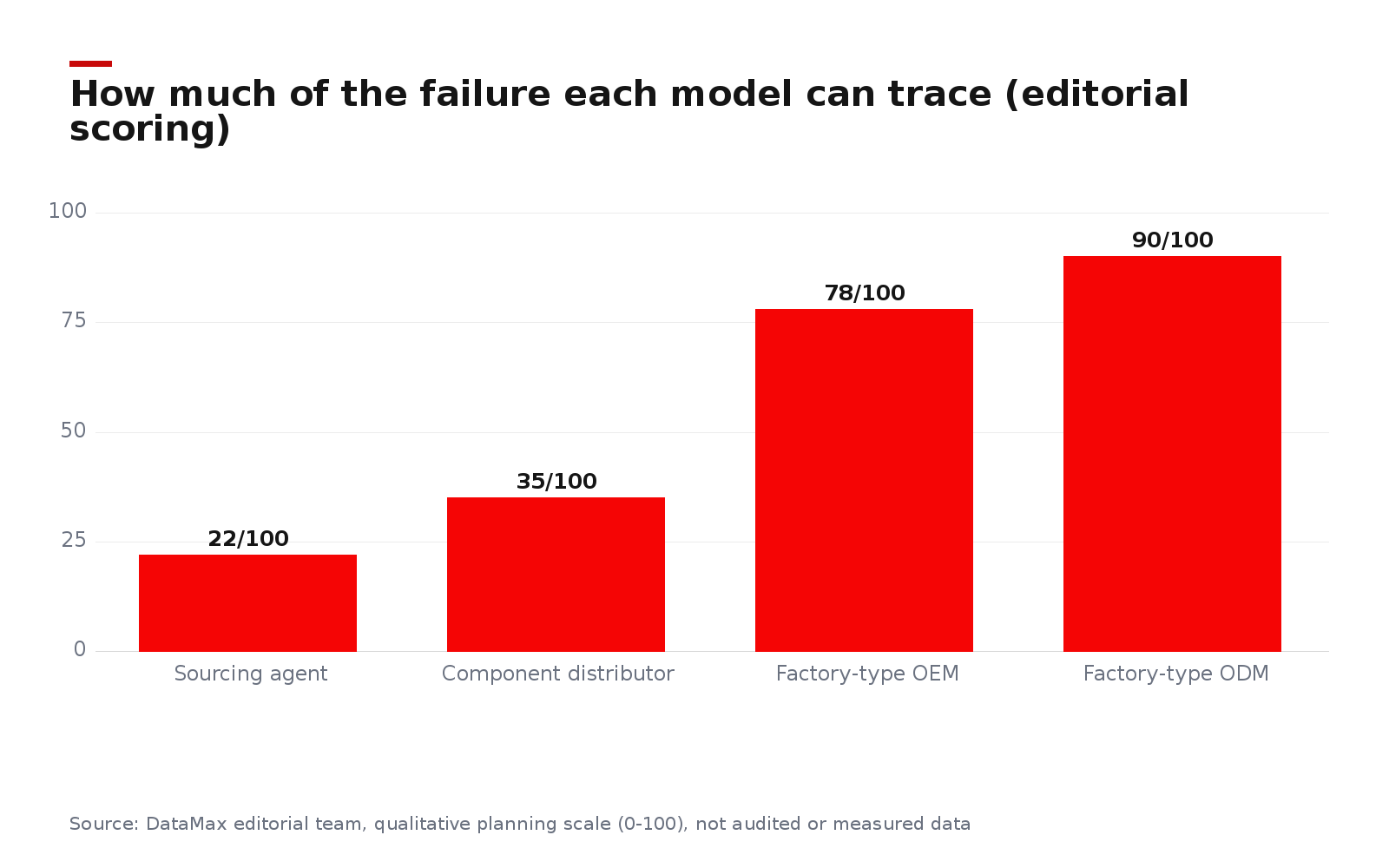
The same figures, in searchable form:
| Supply model | Editorial score | Value suffix |
|---|---|---|
| Sourcing agent | 22 | /100 |
| Component distributor | 35 | /100 |
| Factory-type OEM | 78 | /100 |
| Factory-type ODM | 90 | /100 |
| Model and fit | SoC and OS | Memory | Decode | DRM | Ports |
|---|---|---|---|---|---|
| DM21T — Premium UHD / cloud-gaming box | Amlogic S905X5, quad Cortex-A510 (ARMv9); AOSP Android 14 | 4GB / 64GB (family options) | H.266/VVC [email protected] 4K@120; AV1/VP9/H.265 4K@120; AVS3 4K@120; H.264 4K@60; inline AI-SR | Widevine L1 / PlayReady optional | HDMI 2.0b out (no HDMI in); USB2.0 x1 + USB3.0 x1; TF; S/PDIF; AV; RJ45 100M (1G opt); Wi-Fi6 + BT5.4 |
| DM21P — 4K IPTV / operator middleware set-top box | Amlogic S905Y4, quad Cortex-A35; AOSP Android 11 | 2GB / 8GB (4GB; 16/32/64GB optional) | AV1 [email protected]; VP9/H.265 4K@60; H.264 4K@30 | Widevine L1 / PlayReady / HDCP 2.2 optional | HDMI 2.0b out x1; USB2.0x2; TF; S/PDIF; 3.5mm AV; RJ45 100M; Wi-Fi6 2x2 + BT5.4; DC 5V/2A |
| DM21S — 4K Android TV box for IPTV/OTT white-label | Amlogic S905Y5, quad Cortex-A55; AOSP Android 14 | 2GB / 16GB (2/4/8GB; 16/32/64GB optional) | AV1 / H.265 [email protected] 4K@60 | Widevine L1 / PlayReady optional; Dolby Vision/DTS | HDMI 2.0b out; S/PDIF; AV; USB2.0x2; TF; RJ45 100M (1G optional); Wi-Fi6 2x2 + BT5.4 |
| DM22Q — Gaming-oriented Android TV box | Amlogic S905X5M, quad Cortex-A55 up to 2.5GHz; AOSP Android 14 | 4GB / 64GB (2/4/8GB; 16/32/64GB optional) | AV1/H.265 L5.1 4K@60; inline AI-SR (no NPU TOPS stated) | Widevine L1 / PlayReady optional; Dolby Vision/DTS | HDMI 2.0b out; USB2.0x2; TF; S/PDIF; AV; RJ45 100M (1G opt); Wi-Fi6 2x2 + BT5.4 |
The model distinction is operationally meaningful. Only the DM21T facts include stated H.266/VVC [email protected] decoding and 4K@120 output. DM21P and DM21S are centered on 4K@60-class decode configurations, while DM22Q is explicitly gaming-oriented. No VVC capability is stated for DM21P, DM21S or DM22Q, so they should not be presented as substitutes for the DM21T in a VVC workflow.
Memory is another configuration control. The DM21T fact set states 4GB / 64GB within family options. The other rows list broader memory options, but a quotation should still identify the exact production variant rather than treating a family range as a fixed build. For example, a white-label IPTV image may need different storage and memory allocation from a gaming profile with a larger local content library.
The comparison also prevents a common source-category error. A component distributor may sell a device whose model name resembles a factory program, while a factory-type ODM may control the board, image, test and shipment records. The hardware specification is only one layer. The audit-traceability chart is an editorial planning aid, not measured performance, and it indicates where deeper documentary verification is likely to be required.
Deployment scenarios and the spec each needs
The deployment context determines the acceptance test. An IPTV operator focused on middleware and AVC/HEVC delivery may choose the DM21P. A white-label OTT programme requiring Android 14 and a 4K IPTV/OTT profile may examine DM21S. A gaming-oriented programme may examine DM22Q. A premium UHD or cloud-gaming programme with VVC and high-frame-rate requirements should start with DM21T.
| Situation | Primary requirement | Model direction | Acceptance evidence |
|---|---|---|---|
| IPTV operator middleware | Operator image, 4K service profile, controlled provisioning | DM21P direction | Middleware build, provisioning record, service playback report |
| IPTV/OTT white-label brand | Android 14, branded image, 4K IPTV/OTT use | DM21S direction | Brand build, update procedure, applicable certification evidence |
| Gaming-oriented service | Android 14, 4K@60 class decode, gaming interface | DM22Q direction | Game-service playback, input and response test plan |
| Premium UHD / cloud-gaming with VVC | H.266/VVC [email protected] at 4K@120 | DM21T direction | VVC conformance sample, output measurement and production configuration record |
Broadcast integration teams should define display, network and peripheral requirements before firmware approval. For example, an operator may require wired Ethernet, while an integrator may need USB 3.0, S/PDIF or analogue AV. The DM21T has USB3.0 x1 and RJ45 100M with 1G optional; both 1G Ethernet and selected optional DRM packages need written confirmation rather than assumption.
At a venue, screen capability, playback duration and content encoding may matter more than headline resolution. A signage deployment should test the complete file set, including audio routing, reboot recovery and network reconnection. A live-broadcast contribution role may require different interfaces and must not be inferred from decode capability. The term “broadcast operations” in an RFQ should identify the actual role: monitoring, playout, decode, signage, contribution or operator distribution.

The factory dock is the final physical stage of that chain. For the RFQ, send the first message with the target model, source codec/profile, resolution and frame rate, output interface, network requirement, OS image, middleware, DRM package, quantity forecast and the evidence package required. A sample request through DataMax sample ordering should include the exact acceptance media and display mode, not just a generic review unit.
The matrix should be used as a routing rule, not as a final model approval. An IPTV operator selecting the DM21P direction might still require a DRM package, a specific memory variant and a particular middleware image. The component table then supplies the verified fields. The model name narrows the search; the exact configuration closes the procurement scope.
A venue integrator can use the same method with different evidence. For a digital-signage player, require scheduled playback, power recovery, network reconnection and the actual signage display in the test. For a broadcast monitor, require the intended video and audio paths, frame-rate interpretation and recovery behavior. For operator distribution, require entitlement, provisioning and update workflows. These examples explain why “broadcast” must be narrowed before a model can be approved.
The selection sequence that removes rework
Use a seven-line specification sequence before asking for a quotation. It converts an ambiguous product discussion into a configuration that engineering, certification and operations can assess against the same baseline.
- Define the media contract State source codec, profile, resolution, frame rate and colour requirements. For the DM21T, quote “H.266/VVC [email protected] 4K@120” only as the stated decode capability.
- Define the output contract State HDMI mode, display resolution, refresh rate and audio route. Record that DM21T has HDMI 2.0b out and no HDMI input.
- Define the software baseline State AOSP Android 14, operator or white-label image, middleware version, application package and over-the-air update policy.
- Define the connectivity baseline State Ethernet speed, Wi-Fi requirements, USB count and type, storage and peripheral interfaces. Mark 1G Ethernet as optional pending production confirmation.
- Define the content-security baseline State Widevine L1, PlayReady and any HDCP requirement. Treat optional DRM packages as configuration lines, not standard inclusions.
- Define the compliance baseline List required regional, operator and platform certifications without assuming that a chipset or model designation supplies them.
- Define the evidence baseline Request the approved sample configuration, test report, firmware hash, serial traceability and factory audit records.
A pasteable RFQ line for the principal model is: “Quote DM21T for AOSP Android 14 with the required operator firmware, VVC decode and output acceptance based on H.266/VVC [email protected] 4K@120, HDMI 2.0b output, specified Ethernet/USB/Wi-Fi configuration, specified DRM options, and documented production traceability. Do not include 8K output claims.” Confirm any unstated configuration against the production datasheet.
The sequence also protects against a sample mismatch. A representative unit may carry a different ROM, firmware, DRM build, network option or supplier lot from the shipment build. Record the exact configuration of the approval sample and require the production order to match that controlled configuration.
Send this first message to DataMax inquiry. If the objective is to validate manufacturing control rather than product selection, request the factory evidence package separately. This ordering prevents a hardware decision from being approved before the quotation exposes configuration gaps.
Each sequence stage should have an accountable owner. Media engineering can approve the codec and output test; the operator product team can approve middleware and provisioning; compliance can approve the certification scope; and manufacturing can approve the evidence index. The procurement lead should then freeze those inputs in the quotation. This prevents a late request from a deployment team from changing the model or firmware after commercial approval.
The RFQ should also define what is not required. If the deployment does not need HDMI input, state that no loop-through is in scope. If the service does not use PlayReady, do not leave it as an assumed option. If 100M Ethernet is sufficient, avoid paying for an unnecessary option or designing the network around an unconfirmed 1G path. Precise exclusions reduce the chance that a supplier substitutes a feature the buyer did not evaluate.
Failure modes that reach the field
The most damaging failure is a codec-name mismatch. “VVC supported” can conceal a different profile, level, bit depth or frame-rate limit. Require the exact stated DM21T decode string and test the delivery media. Do not allow an 8K output claim to enter the specification because the production facts cap output and decode at 4K.
Field trap
A quotation may pair “VVC” with a different refresh-rate ceiling. The commercial cost of accepting that ambiguity is late test-cycle rejection: replacement units, retested firmware, operator integration delay and a new approval decision. Resolve codec, profile, level, frame rate and output mode before sample approval.
A second failure is treating AOSP Android 14 as a finished service platform. The base OS does not establish the operator image, middleware, account system, network management, update mechanism or application compatibility. For an android tv box rollout, acceptance must include a clean boot, account enrolment, service playback, restart recovery and update execution on the controlled image.
Connectivity omissions create their own field issues. RJ45 100M is stated, while 1G Ethernet is optional on DM21T. “Fast Ethernet” and “Gigabit Ethernet” are not interchangeable for network design. Likewise, the absence of HDMI input prevents a specification from assuming loop-through. An integrator requiring capture, pass-through or signal redistribution needs a different device architecture.
Optional DRM creates entitlement ambiguity. “Widevine L1 / PlayReady optional” does not mean both services are active in every unit. Name the required package, device-security configuration, service-test media and licence flow. HDCP requirements, where applicable, should be stated separately from DRM support.
Field trap
An interface marked “AV” does not itself resolve analogue audio routing, resolution support or connector format. S/PDIF, 3.5mm AV and HDMI audio also create different installation paths. Require photographs, connector drawings and an acceptance test for the exact production unit; confirm against the production datasheet.
Finally, a supplier may quote a platform and substitute a different SoC, Android release or memory configuration without changing the commercial code. Lock the approved configuration by model, specification revision, firmware hash and sample serial. The factory evidence trail should close that substitution risk before shipment.
A less visible failure occurs when the accepted sample is tested on one display and the deployed estate uses another. HDMI mode negotiation, refresh-rate support and audio behaviour can vary across the installation. The acceptance record should identify the display model and cable path where practical, and the production sample should use the same output configuration as the field unit.
A related failure is a stale firmware comparison. A representative unit received before image freeze may not contain the final operator middleware, security patch, launcher or provisioning logic. Keep the sample in the approval loop, identify its serial number and firmware hash, and require a documented delta process before any image change is accepted.
Thermal or prolonged-playback failure is also avoidable at the specification stage. Establish the expected display mode, ambient condition and operating duration for the programme, then ask whether the factory’s aging and functional records cover that use condition. The request should describe the workload rather than merely request a generic burn-in statement.
The evidence trail from SMT to shipment
Factory control is a sequence of records, not a single “passed QC” statement. The useful evidence begins with the approved configuration and follows the hardware through surface-mount assembly, inspection, software loading, testing, aging and release. DataMax can provide the relevant factory evidence for this topic through factory-quality documentation or manufacturing capability, including a video factory audit request or targeted SMT/AOI/aging evidence.
- Configuration baseline Match the purchase order and build sheet to the approved model, SoC, memory, OS, interfaces and optional packages.
- SMT and AOI evidence Request inspection records tied to the production lot and line, including the controlled inspection criteria used for the board assembly.
- Program and firmware loading Record the firmware or image identifier, application build and configuration checksum used on the line.
- Electrical and functional test Map the test items to USB, HDMI, Ethernet, Wi-Fi, Bluetooth, audio, storage, decode and remote-control requirements.
- Dark-room and display validation Require evidence for the accepted output mode and leakage checks relevant to the programme. The test report should identify the actual display and signal used.
- Aging and burn-in Request the defined duration, workload and lot coverage for the production order, together with the recorded result and disposition of failed units.
- Audit and shipment release Review traceability between serial number, hardware revision, firmware identity, test result, carton and pallet before container release.
Request evidence as a batch-indexed package: production order, model and BOM revision, firmware hash, SMT/AOI record, line test log, aging log, dark-room record, audit record, serial list and carton-to-container manifest. Indexing is what turns test results into traceable evidence.
The documentary request should align with the actual acceptance scenario. For DM21T, include a VVC Main10 Level 5.2 4K@120 clip, the required output mode and the applicable physical-port checks. Do not request a generic “4K passed” statement because it does not demonstrate the required codec and frame-rate combination.
A video factory audit is useful for confirming line sequence, operator instruction, test-station status, firmware-loading control and material traceability. It complements, rather than replaces, documentary records from the shipped lot. For a high-volume programme, request one approved-lot example before signing a repeatable quality plan.
The operational distinction is clear: a factory can manufacture the right board but load the wrong software; it can assemble the right software but omit a defined test; or it can test the right unit but lose serial traceability during packing. The evidence package must connect all four events.
A practical evidence review follows the physical unit. Start with the carton and pallet identification, then reconcile the serial list against the line test log and firmware identity. Next, inspect the functional-test record against the approved media, port and output requirements. Review the aging and dark-room evidence for the specified lot coverage, and finish with the release record. Any missing link should remain an open action rather than being treated as implied by the previous document.
The same method applies to optional components. If 1G Ethernet or an optional DRM package is ordered, the evidence index should identify where that option was checked. If the production build uses the standard RJ45 100M configuration instead, the quotation and test plan should state that substitution explicitly. Optional does not mean interchangeable for the bill of differences.
Options placed side by side
The model comparison is not a contest between four interchangeable boxes. It is a mapping between workload and production evidence. The primary choice depends on the stated decode profile, OS baseline, operator function and approved connectivity.
| Decision axis | DM21T | DM21P | DM21S | DM22Q |
|---|---|---|---|---|
| Stated fit | Premium UHD / cloud-gaming box | 4K IPTV / operator middleware set-top box | 4K Android TV box for IPTV/OTT white-label | Gaming-oriented Android TV box |
| Stated OS | AOSP Android 14 | AOSP Android 11 | AOSP Android 14 | AOSP Android 14 |
| Stated decode differentiator | H.266/VVC [email protected] 4K@120 | AV1 [email protected]; VP9/H.265 4K@60; H.264 4K@30 | AV1 / H.265 [email protected] 4K@60 | AV1/H.265 L5.1 4K@60 |
| USB arrangement | USB2.0 x1 + USB3.0 x1 | USB2.0 x2 | USB2.0 x2 | USB2.0 x2 |
| Ethernet statement | RJ45 100M (1G opt) | RJ45 100M | RJ45 100M (1G optional) | RJ45 100M (1G opt) |
| Best selection direction | When VVC [email protected] 4K@120 is explicitly required | When operator middleware is the primary fit | When Android 14 white-label IPTV/OTT is the primary fit | When gaming orientation is the primary fit |
The commercial commitment tier is not defined by product capability alone. It is defined by evidence: controlled BOM and firmware, approved sample, reproducible line tests, aging records and serial traceability. A factory-type ODM or OEM that can provide that chain may justify a more complex qualification than a distributor assembling products from multiple upstream sources.
Use an android tv box RFQ as a configuration contract rather than a catalogue request. For DM21T, the decisive line remains the VVC [email protected] 4K@120 decode requirement, supported by an HDMI output specification and no invented 8K claim. For other models, use only their stated decode and fit. Then ask DataMax to close the evidence gap before shipment approval.
The bill of differences also includes integration effort. A buyer selecting DM21P for operator middleware accepts AOSP Android 11 as the stated baseline. A buyer selecting DM21S or DM22Q can work from AOSP Android 14. The DM21T and DM22Q include inline AI-SR in their stated feature set, while DM21P and DM21S do not have that line in the provided facts. None of these distinctions should be converted into a performance promise without testing in the intended image.
The final commitment gate should be a signed configuration record, not a verbal selection. It should name the model, SoC, memory, OS baseline, decode obligation, output path, interfaces, optional packages, middleware build, test media, evidence index and approval sample. A change to any of those elements should trigger an engineering review before the order proceeds. This protects the procurement team from a technically attractive platform drifting into an unverified programme.
Further reading
- Guide android tv box for isps
- Dolby Vision Android TV box guide
- RFQ checklist for device procurement
- OEM/ODM service overview
- Private-label device programs
- DataMax DM21T specifications and fit
- DataMax DM21P specifications and fit
FAQ
Does the DM21T support 8K output?
No. The provided production facts cap output and decode at 4K, despite marketing references to 8K. The stated advanced decode capability is H.266/VVC [email protected] at 4K@120. Require the production datasheet and an output-mode test before approval; do not accept 8K output as a quotation assumption.
Is DM21T the right choice for an IPTV operator?
It is the leading candidate when the brief explicitly requires VVC [email protected] 4K@120 or a premium UHD/cloud-gaming profile. For a conventional operator middleware position aligned to 4K IPTV, DM21P may have the closer stated fit. The final choice depends on the actual media contract, middleware baseline and connectivity requirements.
What evidence should accompany the first quotation?
Request the exact model and configuration revision, BOM status, firmware identity, VVC acceptance media, output mode, available test reports, SMT/AOI records, aging evidence and serial traceability. The first inquiry should identify the target model, codec, profile, resolution, frame rate, OS, network, DRM, interfaces and required evidence package.
Does Widevine L1 mean the DRM configuration is complete?
No. Widevine L1 / PlayReady is stated as optional on DM21T. Specify the required package, service-level test content, device configuration and licence flow. Treat PlayReady as conditional until confirmed in the production configuration, and state any HDCP requirement separately.
Can DM21T provide HDMI loop-through?
No HDMI input is stated, while HDMI 2.0b output is specified. Do not design a loop-through workflow around this model. Operators requiring pass-through or signal redistribution need a product with the appropriate input and output architecture, confirmed against its production datasheet.
When should a factory audit be requested?
Request a video factory audit when the programme depends on repeatable SMT/AOI, firmware loading, functional testing, dark-room validation, aging and serial-to-carton traceability. It is especially useful when the approved sample and the production lot must be reconciled. Request SMT/AOI/aging evidence specific to the DM21T configuration, then verify those records against the shipment lot.


