

What the answer hinges on: a DOA rate definition before a number
“DOA rate” is a reliability label, not a universal measurement. A buyer asking for the DOA rate of a digital signage player must first establish the denominator, failure boundary, observation window, and reporting owner. Is DOA limited to units that fail before shipment, or does it include units that leave the factory, reach installation, and then fail? Is a blank screen caused by application configuration a hardware DOA, an operational incident, or a content fault? Without those definitions, two quotations can report radically different rates while both appearing precise.
The decision-grade answer is to avoid purchasing an unsupported percentage. Convert the request into a controlled field metric, require evidence from SMT inspection, AOI, functional testing, aging, burn-in, and shipment records, and write escalation rules into the purchase order or quality agreement. A quoted figure should identify the SKU, hardware revision, batch, test standard, observation period, and denominator. It should also state who pays for diagnosis, root-cause analysis, replacement, return freight, and corrective action.
Field trap
A supplier that writes only “low DOA” or “less than 1%” has supplied a claim without a measurable population. Reject it until the metric is attached to a defined stage: factory DOA, arrival DOA, 30-day installation DOA, or 90-day field DOA.
This matters most in broadcast operations, where a failed unit can interrupt scheduled programming, on-air presentation, retail promotion, or wayfinding. The operational burden depends on access, spares, recovery time, and remote monitoring—not only on component quality. For the broader device definition, see what a digital signage player is. For deployment selection, the retail digital signage guide helps separate screen-format, connectivity, and management requirements before reliability terms are negotiated.
The answer hinges on whether the supplier can produce a traceable rate, not on whether it can repeat a favorable headline. A defensible metric connects the test population to the shipped population and the shipped population to field returns. If that chain breaks at incoming inspection, functional test, exception approval, shipment release, or installation reconciliation, the supplier cannot explain why the rate changed. The same principle applies to every digital signage player proposed for a broadcast operation.
Turning the question into a spec line
Treat the DOA request as an evidence chain rather than a conversation about reputation. The RFQ must define what the factory measures, while the quality agreement must define what happens when field failures exceed the agreed response.
- Define the population State model, hardware revision, firmware baseline, production batch, order quantity, serial-number range, destination, and whether evaluation units are excluded.
- Define DOA Specify the failure boundary: no boot, no video output, unstable playback, missing storage, network failure, touch failure, or another approved condition.
- Define the denominator Identify whether the rate is calculated against units tested, units shipped, units received, installed units, or active units in the observation window.
- Define the window Set factory, arrival, 30-day, 90-day, and longer-term reporting periods separately; do not blend them into one figure.
- Define evidence Require serial-level test records, AOI results, functional-test results, burn-in hours, aging records, exception approvals, and field-return records.
- Define remedies Specify investigation times, root-cause reports, credit or replacement authority, field-engineering support, and corrective-action closure.
- Define escalation Attach notification thresholds and response procedures to lot-level quality events rather than relying on an annual scorecard.
A pasteable RFQ line can read: “Provide the factory DOA rate for SKU and hardware revision as inspected units failing the agreed boot/video/network test divided by all inspected units in the stated serial range. Separately report arrival and 30-day installation DOA. Submit serial-level evidence and root-cause disposition.”
A pasteable quality clause can read: “No shipment or batch shall be accepted until electrical safety, functional I/O, display, network, storage, and burn-in records are complete. Nonconforming units require an exception record. Field failures shall be reconciled against production serial numbers and classified as hardware, software, configuration, logistics, or content related.”
Do not ask for a generic “reliability percentage.” Ask for numerator, denominator, exclusions, sample size, time window, and data owner in the same sentence. A percentage without those seven fields is not decision-grade information. Add the firmware baseline and approved content application because a firmware or playlist change can alter observed behavior even when the display hardware remains unchanged.
For a broadcast installation, the RFQ should identify the operating mode: continuous playback, scheduled reboot, standby-triggered playback, remote monitoring, or manually operated kiosk use. Specify the accepted display mode, refresh behavior, network dependency, and recovery requirement. If a unit reboots at a scheduled time, that event must appear in the test record rather than being treated as an unexplained field failure.
The supplier should state how test fixtures map to the customer environment. A factory test using a laboratory display does not prove behavior with a particular panel, HDMI source, USB drive, network switch, or content workflow. Require the digital signage player test to cover the approved golden sample, production firmware, intended power arrangement, and representative media. A buyer can accept a defined pass criterion without accepting an unsupported percentage.
A practical RFQ should also name the required records and their owner. The factory may own inspection and aging records; logistics may own receipt reconciliation; the integrator may own installation records; and operations may own playback incidents. If no one owns reconciliation, the denominator changes at each handoff. A missing receipt timestamp, serial transcription error, or omitted replacement unit can turn a valid field metric into an unusable claim.
For broadcast programming, include a change log in the acceptance package. Record the firmware image, application version, playlist, network configuration, and test media used for the sample. A later software update should trigger a defined recheck, especially when it changes decoding, display output, wake timing, network reconnection, or peripheral discovery. The RFQ should not treat a software change as a hardware revision, but it should prevent stale test evidence from being reused without review.
Where quotations quietly diverge
Most divergent quotations are not dishonest; they measure different populations under different rules. One factory may count a unit that cannot boot after delivery, while another counts only units dead on arrival before departure. One operator may count a scheduled screen interruption, while another excludes a misconfigured playlist. The same installation can therefore produce different field rates from the same hardware.
| Quotation language | What it may conceal | RFQ correction |
|---|---|---|
| “DOA below 1%” | Undefined denominator or pre-shipment-only boundary | Name the stage, serial range, exclusions, and reporting window |
| “No observed DOA” | Small inspected batch or untested units | State population size, test completion, and exception handling |
| “One-year reliability” | Field failures may be mixed with logistics damage | Separate factory, arrival, installation, and operational failures |
| “Passed 48-hour aging” | Aging may not replicate video, network, or touch load | List the exact workload, peripherals, and pass criteria |
| “Same platform as flagship model” | SoC, memory, display, thermal, and power configurations may differ | Freeze the full SKU and component configuration |
Field trap
Do not infer that a product-family DOA applies to every display size, power configuration, storage option, or regional hardware revision. The commercial dispute usually becomes a configuration dispute because the quotation never froze the SKU.
Three cost errors recur. First, counting all field incidents as hardware DOA makes the factory responsible for operator configuration errors. Second, excluding every field failure as “environmental” hides thermal, power, or storage weaknesses. Third, accepting a blended annual rate prevents trend detection: a stable average can conceal one defective production lot followed by several clean lots.
The corrective action is a failure taxonomy with one owner for each code. Codes should cover manufacturing defect, component aging, firmware, application, configuration, content, network, power, installation, impact, logistics, and no-fault-found. Each code needs a disposition and corrective-action route. Reconciliation must use serial numbers, because model-level averages cannot reveal a recurring batch pattern.
A second field trap appears when the supplier reports only the numerator. “Three units failed” can sound severe, but it may be less severe than one failure across a small batch; the same count can also conceal an untested population. Require numerator and denominator together, plus the count of units tested, passed, failed, reworked, scrapped, and released by exception. Those fields expose whether the rate is a screening result or complete production result.
A third divergence concerns replacement units. If a returned unit is replaced and the replacement passes, the original incident still belongs in the cohort. Counting only the final deployment can suppress the original failure. Preserve both failed and replacement serial numbers, while reporting cohort failure and replacement performance separately.
A fourth divergence is the definition of “tested.” A unit may have received visual inspection without complete boot, display, network, storage, touch, and peripheral tests. Ask which steps were mandatory, which were conditional, and which could be skipped after an earlier failure. Identify whether partial testing can pass a unit into shipment and how that unit enters the denominator.
A fifth divergence is the treatment of pre-shipment replacements. If a failed unit is reworked before shipment, the order can look clean while the original failure disappears from the final report. For process improvement, retain the original exception, repair action, retest result, and disposition. For acceptance accounting, state whether the metric measures units as shipped or all units entering production. Both views answer different questions.
A sixth divergence is interrupted testing. Aging interrupted by a facility event, power event, or missing fixture should not be recorded as a pass merely because the unit later powered on. Define minimum continuous workload, interruption treatment, restart procedure, and evidence required before release. Network reconnection, scheduled reboot, and touch testing need named pass criteria rather than a general statement that the device was “stable.”
Questions to put in the supplier review
A factory audit should trace one serial number from incoming inspection to shipment and then into field-return reconciliation. This is more useful than a tour of clean work areas. Ask to see the inspection instruction, test record, exception list, release decision, and person accountable for each transition.
- SMT evidence Review stencil, solder-paste, placement, reflow, SPI, AOI, X-ray or other applicable records, plus deviation approvals. Confirm how inspected and approved lots remain linked to production boards.
- Functional coverage Inspect boot, storage, Ethernet or Wi-Fi, HDMI or display output, USB, TF, audio, touch, camera, and power tests according to the exact SKU configuration.
- Aging and burn-in Request temperature, duration, power state, video workload, network activity, and recovery criteria. A duration alone is not evidence of coverage.
- Golden-sample control Establish which approved unit represents the production specification and what happens when a process or component changes.
- Traceability Follow serial number, hardware revision, firmware, component lot, work station, test time, operator, result, and exception code.
- Field closure Review returns by failure code, root-cause category, corrective action, verification method, and whether the corrective action reached later production.
Audit evidence should answer 5 operational questions: what was tested, how it was tested, which units were excluded, who approved exceptions, and how returned units were reconciled to production. Request the records behind a claim rather than accepting a summary slide without a traceable sample.

In a live review, buyers in a marked walkway should be able to observe SMT equipment, test stations, and operators handling documentation without interfering with production. Request a video factory audit or an evidence pack covering SMT, AOI, aging, exception handling, and golden-sample governance through DataMax factory quality. The purpose is not to infer a DOA percentage from visual cleanliness; it is to determine whether production can produce and defend a stable metric.
Ask for a sample packet before the visit: one approved inspection instruction, one SPI record, one AOI exception, one functional-test record, one aging record, one shipment-release record, and one corrective-action record. Redact confidential pricing if necessary, but do not redact serial linkage, revision identifiers, pass criteria, or exception dispositions. These records let the technical buyer test whether the factory process and commercial promise describe the same process.
For broadcast operations, request the test sequence used with actual media. Confirm whether decoding, display output, network reconnection, scheduled reboot, and peripheral re-enumeration are tested individually or only as a combined scenario. A combined test can pass while one isolated function remains unprotected. The digital signage player acceptance procedure should contain named test steps, expected results, actual results, and a disposition for every exception.
Inspect the release workflow. Determine whether a failed unit can be reworked and returned to the line, whether a second failure triggers escalation, and whether the corrected process reaches a fresh golden sample. A corrective action that changes only one station should be checked against the affected serial range. This prevents a fix from being recorded while unchanged units continue through the same process.
For a multi-site broadcast rollout, ask how the factory distinguishes a local site defect from a systemic hardware issue. The evidence package should show failures coded by symptom, board, component lot, firmware branch, and test stage. If the supplier cannot connect a field return to a production serial number, treat the rate as an operational count rather than a controlled DOA measure.
Options placed side by side: commitment strength, not percentages
There is no acceptable “entry tier” versus “commitment tier” based only on a claimed DOA number. The useful comparison is the strength of the control mechanism behind the rate. A verbal assurance cannot support lot investigation or corrective action. A contract clause creates an enforceable definition. A golden sample creates a technical reference. A golden sample plus pilot gate links that reference to an installation environment before volume release.
The practical sequence is staged commitment. Start with a written metric definition and pilot units. Validate the golden sample against the actual panel, power source, network, content, peripherals, and operating schedule. Release volume only after the pilot passes defined tests and the factory demonstrates serial-level traceability. Then maintain rolling field reconciliation with escalation rules.
| Control | Definition quality | Traceability | Dispute position | Best use |
|---|---|---|---|---|
| Verbal commitment | Usually incomplete | Low | Weak | Initial technical discussion |
| Contract clause | High when population and window are explicit | Defined by evidence schedule | Enforceable | Production procurement |
| Golden sample | Concrete configuration reference | Applies to approved units | Technical benchmark | Engineering validation |
| Golden sample plus pilot gate | Combines specification and environment | Links factory output to field use | Strongest before volume release | Multi-site or operationally sensitive deployment |
The trade-off is administrative effort. Pilot gates consume time and engineering attention, while a clause without operational evidence creates a paper remedy. Procurement should buy both: a clear contractual metric and a technically controlled production process.
Add a fourth dimension: change control. A golden sample is useful only when the supplier identifies which changes require reapproval. Ask whether a SoC substitution, memory change, panel vendor change, power-design change, firmware branch, enclosure revision, or port configuration change requires a new sample or pilot. The same digital signage player model name can conceal a change that invalidates earlier test evidence.
Commercial terms should match the control tier. A factory DOA commitment belongs to the batch and inspection population; an arrival DOA commitment belongs to the delivered population; an installation or 30-day field commitment depends on accurate receipt and installation data. Keep remedies aligned to the responsible stage. Otherwise, a supplier may reject a field claim as outside factory control, or an operator may reject a factory claim because evidence was never supplied with the shipment.
The control ladder also changes escalation options. A verbal commitment offers no consistent evidence set when a batch is questioned. A contract clause allows records to be requested but still requires a defined evidence schedule. A golden sample identifies “approved configuration” but does not prove behavior after installation. The pilot gate closes that gap by testing actual content, peripherals, power, network, and schedule.
For procurement, the best entry point is not a model with the strongest advertised percentage. It is the option that can produce a repeatable evidence package for the exact SKU. The commercial discussion should identify which data the supplier already maintains, which records it can export, and who signs the release decision. This separates process capability from unsupported claims and gives the buyer a route to reconcile factory, shipment, and field data.
Definitions a buyer cannot outsource
A DOA metric is a statistical expression, but its usefulness depends on failure semantics. Factory DOA uses inspected or shipped units as the denominator. Arrival DOA uses received units. Installation DOA uses units installed and powered in the intended environment. Field failure describes any failure after acceptance; it is not automatically DOA.
The numerator must map to testable failure modes. For a display-oriented device, these can include failure to boot, absent output, incorrect touch response, unstable storage, network-interface failure, or power faults. For a content player, decoding or playback capability may matter more than general desktop-style workload testing. The requirement must reflect deployment: continuous playback, scheduled reboot, remote management, long operating hours, peripheral attachment, and environmental conditions.
- Population: model, revision, batch, serial range
- Numerator: agreed failure definition
- Denominator: tested, shipped, received, or installed units
- Window: factory, arrival, 30-day, or 90-day
- SPI and AOI exception records
- Functional test by serial number
- Aging workload and recovery result
- Golden-sample configuration
- Installation record
- Failure code and evidence
- Root-cause classification
- Corrective-action verification
The buyer must distinguish certification from a product claim. EDLA, GMS, Widevine, and HDCP involve different ecosystems and verification scopes. A badge in a catalogue is not a substitute for a certificate or SDK-level feature declaration. Widevine L1 and HDCP2.2 may be listed as optional for one DataMax configuration, but they should be fixed to the ordered SKU and supported by licensing or certification evidence before deployment.
Architecture also affects the test. An AOSP Android device combines application, firmware, content, network, and display behavior. A unit can boot correctly and still fail a playlist because of an application setting. That is an operational failure, but excluding it without analysis can conceal a poor update process. The correct mechanism is logging, classification, reproduction, and corrective action—not automatic exclusion.
Procurement owns the metric definition, operations owns field classification, engineering owns reproduction, and the supplier owns manufacturing evidence. Assigning these roles prevents the definition from being negotiated away. The receiving site must record serial number, firmware baseline, installation timestamp, application version, content package, network state, and first observed symptom. Without that installation record, field reconciliation becomes a dispute over denominators.
For managed deployments, the remote-management layer should expose device identity, health state, last contact, application state, and update status where supported by the chosen platform. Monitoring does not automatically prove a favorable DOA outcome, because an offline unit can still fail during a scheduled boot or after a power interruption. Use monitoring to shorten discovery time and correlate incidents, then reconcile the result against the agreed physical and functional test.
AOSP Android versions should be treated as configuration facts, not interchangeable labels. Android 9, Android 11, and Android 11 or above create different software baselines for acceptance testing. Require the exact build, patch level, application package, and update policy. The platform name alone does not define whether a codec, peripheral, display path, or security feature behaves as expected.
The media path should also be defined by format, not resolution alone. Record codec, profile, bitrate, frame rate, color profile, audio routing, container, and playback duration for representative content. A unit may pass a short local sample and fail a scheduled playlist containing mixed media. The digital signage player test should combine media coverage with the operational schedule, including reboot and reconnection behavior where relevant.
Real DataMax platforms, field by field
The table below reproduces only the supplied DataMax product facts. It is not a universal CROSS catalogue: confirm the exact SKU, component configuration, power option, and production datasheet before ordering. Do not merge catalogue variants with the listed PDP configurations.
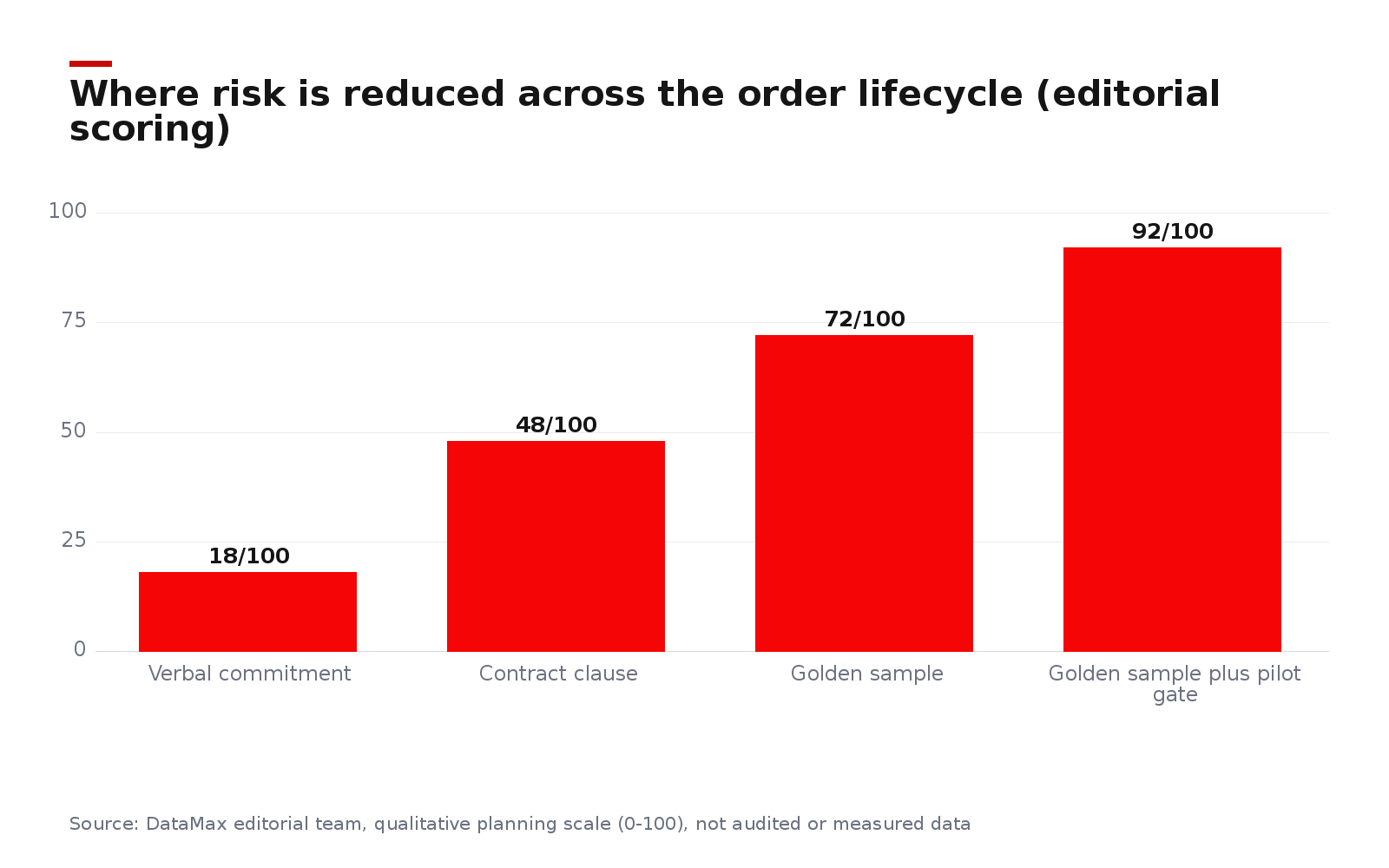
The same figures, in searchable form:
| Risk-control option | Editorial score |
|---|---|
| Verbal commitment | 18 |
| Contract clause | 48 |
| Golden sample | 72 |
| Golden sample plus pilot gate | 92 |
| Model | System and memory | Display or decoding | Interfaces | Operational note |
|---|---|---|---|---|
| DS43H | HiSilicon Hi3751 quad 32-bit A53, Mali-450; AOSP Android 9; 1GB / 8GB | 43-inch TFT LED, 1920x1080, 300 cd/sqm, 1500:1, 6ms, 89deg; 1080P@60 + VP9 10-bit decode | HDMI in, LVDS in, USB2.0 x4, RJ45 100M, DC12V/2A | 989x578.5x60.3mm; backlight 50,000h; 0-50C; confirm power option |
| DP810U | Rockchip RK3562 quad A53 up to 1.2GHz, Mali-G52 1-Core-1EE; AOSP Android 11; 2GB / 16GB, 4GB optional | 8-inch / 10.1-inch capacitive touch; 1280x800 or 1920x1200; H.265 4K@60, H.264/VP9 1080P@60 decode | HDMI out, USB2.0 x2, TF x2 up to 128GB, 3.5mm, RJ45 100M, DC12V/2A, Wi-Fi + BT5.0 | 1x3W; bank, government, and hotel desktop kiosk direction |
| DP104R | Rockchip RK3566 quad A55, Mali-G52 1-Core-2EE; AOSP Android 11 or above; 2GB / 16GB, 4GB optional | 10.1-inch IPS capacitive touch, portrait 800x1280 or 1200x1920; H.265/H.264/VP9 4K@60 decode, 1080P encode, 8M ISP | HDMI out, USB2.0 x2, TF x2, 3.5mm, RJ45 100M, DC12V/2A, Wi-Fi + BT5.0 | 5MP camera optional; retail, hospitality, and portrait L-shaped desk direction |
| DP02L | Rockchip RK3399 dual A72 + quad A53, Mali-T860 MP4; AOSP Android 11; 4GB / 32GB, 8GB / 64GB optional | 21.5-inch capacitive touch, 1920x1080, 16:9 or 16:10; H.265 10-bit 4K@60, H.264 4K@30 decode | USB2.0 x1, USB3.0 x2, RJ45 1000M with PoE optional, Wi-Fi + BT5.0, DC12V/3A | 16h/7d, 8MP camera, 2x3W plus microphone, 2x headset; Widevine L1/HDCP2.2 optional |
DS43H uses the listed HDMI and LVDS inputs for its wall-signage configuration, so input-path testing belongs in the golden sample. DP810U and DP104R are compact touch products with optional memory variants; the test record must identify the selected memory configuration. DP02L adds camera, microphone, headset, Ethernet, and optional PoE, each creating a separate test point. The editorial control scores show why a pilot gate adds risk control before field exposure; they do not measure any model’s DOA rate.
Field mapping prevents false substitution. A 43-inch wall display with input interfaces is not automatically interchangeable with a compact touch kiosk because display construction, interaction method, and interface lists differ. Likewise, an 8-inch / 10.1-inch compact product and a 10.1-inch portrait product require separate golden samples even where memory options overlap. For every digital signage player, freeze model name, panel option, memory option, power arrangement, firmware baseline, and intended peripherals before approving the acceptance plan.
Decode capability also affects the media test. DS43H is listed for 1080P@60 and VP9 10-bit, with no 4K or AV1. DP810U is listed for H.265 4K@60 and H.264/VP9 1080P@60. DP104R is listed for H.265/H.264/VP9 4K@60 decode and 1080P encode. DP02L is listed for H.265 10-bit 4K@60 and H.264 4K@30. A broadcast test should use intended codec, resolution, bitrate, color profile, and audio path.
Use the product table to generate configuration-specific test rows. DS43H receives panel, backlight, viewing-angle, input, and thermal checks. DP810U receives touch, TF, Wi-Fi, Bluetooth, and compact-kiosk workload checks. DP104R receives portrait-orientation, camera-option, encode, and kiosk-recovery checks. DP02L receives camera, microphone, headset, PoE-option, Ethernet, audio, and optional DRM checks. A field result belongs to the tested configuration, not merely the model family.
Use the DataMax manufacturing discussion to request the factory evidence package before fixing the acceptance plan. The key document set includes approved inspection instructions, line records, test fixture configuration, exception approvals, and golden-sample release notes. Any optional variant should become an explicit order line or be recorded as “confirm against the production datasheet”; it should not be treated as an assumed production configuration.
Buyer situations, ranked by what they punish
Different scenes punish failure differently. A broadcast operation may punish schedule interruption and slow diagnosis. A branch integrator may punish configuration variation across sites. A hospital may punish mixed-purpose endpoints and unsafe bedside deployment. The highest-risk use is not automatically the device with the most ports; it is the scene where replacement is slow, diagnosis is remote, or a fault becomes visible to an audience.
| Situation | Primary requirement | Model direction | Control emphasis |
|---|---|---|---|
| Broadcast operation with scheduled playback | Stable output, controlled configuration, fast replacement | DS43H for wall signage or DP104R for portrait presentation, subject to site format | Golden sample plus pilot gate; test content, input, and recovery workflow |
| Retail branch network | Portrait display, familiar content workflow, distributed fleet management | DP104R | Freeze panel orientation, resolution, memory, and management workflow per SKU |
| Bank, government, or hotel self-service | Touch kiosk form factor and compact integration | DP810U | Validate touch, TF configuration, connectivity, and long-run interaction |
| Hospital bedside infotainment | Audio, camera, headset, connectivity, and caregiver workflow | DP02L | Test peripherals and optional features independently; confirm software scope |
| High-visibility public display | Brightness, viewing angle, thermal environment, and input integration | DS43H | Confirm panel configuration, power option, operating environment, and 24-hour content workload |
The ranking is operational. Broadcast operations place schedule continuity first. Integrators place fleet consistency and installation repeatability first. Venue teams place physical interface, environmental fit, and audience impact first. Hospitals place workflow and peripheral reliability first because bedside use combines patient-facing content and operational interaction.
For volume release, ask DataMax to map the selected model to the exact pilot environment and provide a serial-level evidence plan. A video factory audit should cover SMT, AOI, aging, golden-sample control, and exception release. Then run a pilot that captures real content, peripherals, power, and network behavior. The sample request process can establish the technical reference before a production order, while the engineering inquiry can freeze the SKU and acceptance fields. The commercial target should be not a self-declared percentage but a repeatable process that produces defensible evidence.
Rank situations by recovery constraints as well as audience visibility. A studio-adjacent wall display may require rapid swap-in, while a distributed retail branch may depend on centralized monitoring and remote diagnosis. A hospital bedside terminal may combine touch, camera, audio, and connectivity, so one symptom can belong to several subsystems. The acceptance plan for each digital signage player should test the failure mode the scene punishes rather than relying on a generic burn-in duration.
The highest-control scenario combines an audience-facing schedule, a constrained replacement window, and no immediate on-site technical access. That combination benefits most from a golden sample plus pilot gate. Less critical internal evaluation units may need less ceremony, but they still need a written denominator, serial traceability, and exception ownership. The hotel meeting-room signage guide helps a venue buyer decide which screens, mounting positions, and operating workflows should enter pilot scope.
A useful site scorecard has 4 fields: recovery access, audience visibility, configuration variance, and diagnostic evidence. A venue with frequent on-site technicians but many model variants may prioritize configuration control. A remote broadcast site with no spare stock may prioritize swap-in workflow and pilot coverage. A hospital team may prioritize peripheral testing and workflow interruption. The scorecard identifies the control mechanism; it does not select hardware by itself.
Model direction remains conditional. Use supplied DataMax platform facts to define the starting point, then confirm the ordered configuration against the production datasheet. Do not infer an unlisted chipset, power arrangement, certification, or operating capability from a family name. The compliance evidence should support security or DRM requirements, while the pilot establishes whether the selected configuration behaves correctly in its intended environment.
Further reading
- Digital Signage Player: What It Is and What It Is Not
- OEM/ODM service overview
- Private-label device programs
- Factory and quality control evidence
- Order samples and pilot units
- 43-inch hospital digital signage
- Compact kiosk display
FAQ
What is a DOA rate for a digital signage player?
A DOA rate is the proportion of units classified as dead on arrival within a defined population and period. It must specify whether the denominator covers inspected, shipped, received, or installed units, and whether classification includes only no-boot failures or other hardware faults. Without the failure definition, observation window, serial range, and test evidence, the percentage cannot be compared reliably between suppliers or deployments.
Which failures should not count as hardware DOA?
Configuration errors, content faults, unavailable network services, and documented application misuse should generally be classified separately from manufacturing DOA. Excluding them requires evidence and should not provide a loophole for hiding hardware instability. Every field failure should receive a serial-linked failure code, root-cause disposition, and corrective-action decision so that hardware, software, logistics, and operational categories remain auditable.
How many pilot units are needed for a broadcast deployment?
The pilot count depends on SKU configuration, model mix, site variability, and the number of hardware revisions being evaluated. Rather than accept a universal count, require the supplier to justify the sample against production configuration and expected variants. The pilot must exercise the approved golden sample with representative content, peripherals, network, power, and operating schedule before volume release.
What evidence should accompany a factory DOA rate?
Request the denominator, numerator definition, serial range, hardware revision, test method, exception records, and reporting period. Supporting evidence should include SPI and AOI results where applicable, functional-test records, aging and burn-in conditions, golden-sample approvals, serial traceability, and field-return reconciliation. Summary percentages alone do not show whether the process is stable or whether excluded units concealed unresolved exceptions.
Can the same reliability evidence cover several DataMax models?
Only when the models are identical for the tested attributes. Screen size, touch function, SoC, memory, power, storage, camera, audio, connectivity, and input path can each change the failure mechanism and required test. Treat each ordered configuration as a separate control domain, confirm it against the production datasheet, and use the certification and compliance evidence relevant to the deployment rather than extending one model’s result to another.


