
Before the terminology: the decision
A DVB-C tuner and an Android TV platform answer different questions. DVB-C describes the RF and receiver path for cable television: antenna or coax input, channel tuning, MPEG-2 transport-stream handling and, where required, descrambling under a conditional-access system. Android TV describes the software platform and application environment running above the device hardware. A set-top box can therefore include a DVB-C tuner and still run Android TV; conversely, an Android TV box with IP connectivity does not automatically receive DVB-C.
For an android tv box comparison, the decisive specification is therefore not a marketing label but the signal path and control plane. Operators need the tuner model, frequency range, symbol-rate limits, CA interface and entitlement architecture. IPTV teams need the application middleware, streaming protocol, network behavior and update mechanism. Retail or OTT programs need the approved Android environment, DRM terms, content certification and remote-control experience. These requirements can coexist, but they create different bills of materials and test obligations.
The phrase android tv box comparison is useful only when each column describes one testable feature. “DVB-C ready” is not a procurement value. “DVB-C tuner with cable input, conditional access, and the named channel plan” is. “4K” is not a procurement value. “4K output at 60 frames per second through HDMI 2.0b” is. “DRM supported” is not a procurement value. The named implementation, security level and required certification are.
This distinction also prevents false equivalences. A product label such as TV box, IPTV box, OTT box or operator middleware box may describe a commercial fit rather than a technical layer. The DataMax range illustrates that split: DM21P targets operator middleware and 4K IPTV, DM21S targets white-label IPTV/OTT, while DM21T and DM22Q serve more demanding premium UHD and gaming-oriented briefs. None of the supplied facts establishes a DVB-C tuner, so DVB-C suitability must be confirmed against the production datasheet rather than inferred from the category.
A practical decision follows immediately. If the subscriber enters through coax and the operator manages a channel line-up, evaluate the DVB-C route first. If the subscriber enters through IP unicast or multicast and the commercial product is controlled by an application layer, evaluate the Android-centered route. If both paths are required, specify the tuner, software integration, entitlement and acceptance procedure as one engineering deliverable rather than combining two partial quotations.
For broader purchasing definitions, the canonical Android TV box for sale explained for buyers page covers the wider hardware-selection context. This article isolates the DVB-C-versus-Android terminology and the evidence required to make the comparison defensible.
How to choose, step by step
Start from the content-delivery boundary, then work inward to the silicon and software. The sequence prevents the common mistake of selecting a decoder first and discovering that the product cannot receive the intended transport stream or integrate with the operator system.
- Define the source Specify whether the device receives cable RF, IP unicast, IP multicast or locally installed applications. Record the access network, codec profile, resolution and target channel count.
- Define the operator layer State whether middleware is licensed, customized or absent. Name the provisioning, entitlement, activation, analytics and remote-management expectations.
- Define the content-security layer Record the required DRM implementations, security levels, HDCP version and studio certification path. Separate a silicon capability from a completed device certification.
- Define the interface layer Specify HDMI, Ethernet, Wi-Fi, Bluetooth, USB, optical audio, analog AV, storage and any tuner or CI/CAM requirement. Include physical connector count, not merely “ports included”.
- Define the lifecycle Set the target OS baseline, update channel, recovery method, audit evidence and acceptance testing. Treat a declared AOSP build as a starting point, not proof of operator readiness.
Turn that sequence into RFQ lines. For a cable-oriented program, the line should request the tuner vendor and model, supported frequency bands, input impedance, maximum symbol rate, demodulation standard, CA path and evidence of channel-scan stability. For an IPTV or OTT program, it should request unicast and multicast behavior, IPv4/IPv6 expectations, Wi-Fi and Ethernet configuration, middleware version, application deployment method and OTA rollback procedure.
The next line should freeze media claims: output resolution, frame rate, codec support, HDMI version and whether decode or output is the limiting factor. The following line should freeze content-security requirements: Widevine or PlayReady level, HDCP version, optional Dolby Vision or DTS status, and which approvals must be production variants rather than engineering samples. The final line should define evidence: golden samples, firmware revision, test report, burn-in duration, packaging criteria and the document revision attached to the order.
An RFQ comparison sheet should also distinguish mandatory, conditional and excluded fields. Make Ethernet 1G mandatory when the access network requires it; make 1G optional only where 100M meets the measured service profile; leave DVB-C excluded when the launch is IP-only; and list a tuner as conditional only if the supplier is to quote its exact part number and certification path. This structure reduces ambiguity without forcing unnecessary features into every unit.
For example, an operator pilot requiring IP multicast, 4K@60 AV1, Widevine L1, HDMI 2.0b and 1G Ethernet should not accept a response based only on “Android 11 4K box”. The quotation should identify the Android baseline, AV1 profile, security configuration, Ethernet state, HDMI output limit, firmware identifier and sample test result. A white-label OTT product without a DVB-C requirement can then be evaluated against the same matrix without carrying irrelevant tuner assumptions.
A buyer can use the AOSP versus Google Android TV guide to separate the operating-system baseline from the application and certification layer. The AV1 Android TV box guide can then refine media acceptance. For the final request, the first message to DataMax inquiry should contain the source type, DVB-C presence or absence, required codec/DRM/HDCP levels, connector list, OS baseline, volume context and the exact document revision requested.
What goes wrong after the PO
The first failure mode is a category-led quotation. Two lines both labelled “4K IPTV box” may differ in tuner, middleware, RAM, storage, wired-network speed, DRM certification, remote-control protocol and OTA recovery. Without a field-level specification, the lower-cost interpretation becomes the contractual baseline, even if neither party intended that outcome.
A second failure mode is the separation of platform capability from deployment readiness. Widevine L1 on a component bill of materials does not prove that a production device has passed the required integration and certification work. Likewise, an AOSP Android build does not establish that a specific operator middleware has been integrated, signed, provisioned and tested. The quotation must identify which state applies: chipset support, firmware feature, application integration or certified production configuration.
Field trap
A quotation that says “DVB-C” without identifying the tuner, band plan, CA approach and channel-scan procedure cannot be compared with an IP-only line. The operational cost is not only component substitution: firmware, certification, installation and field-service procedures may all change.
Interface drift creates another post-PO dispute. “Wi-Fi 6” does not identify spatial configuration or supported bands; “Ethernet” does not identify the nominal speed; and “AV output” does not resolve connector format. The supplied DataMax facts show why precision matters: several models list RJ45 100M with 1G optional, while others list specific Wi-Fi 6 2x2 arrangements. Those entries must remain explicit in the purchase specification.
Field trap
Do not accept “optional” as the final state. Mark the ordered configuration as base, included option or excluded feature, and identify the SKU, BOM revision and test method. Otherwise, the production line may legitimately supply a variant that fails the operator’s bandwidth, certification or installation requirement.
The fourth risk is accepting a headline decode claim without its output constraint. A processor may decode a codec profile that the selected HDMI mode, display path or firmware configuration does not expose at the advertised resolution and frame rate. The acceptance document should name the input file or stream, codec profile, resolution, frame rate, output connector and measured result. A video output limitation must remain visible in any subsequent comparison.
The fifth failure is a change-control gap. A supplier may substitute the Ethernet PHY, Wi-Fi module, tuner, storage supplier or DRM path after the quotation because the original part is unavailable, without changing the model label. Contractual protection comes from a controlled BOM revision, advance-change notice, permitted substitute list and a requirement to resubmit affected compliance or acceptance evidence. For a product with an optional 1G Ethernet configuration, the SKU and test result should travel with every production delivery.
The sixth failure is a mismatch between the accepted sample and production volume. A sample can carry a later application, firmware or option set than the equipment used for qualification. Record the sample serial number, hardware revision, bootloader, firmware image, middleware version and configuration checksum. Require that the qualified combination remains the default or that the supplier obtains written approval for any change.
For an android tv box comparison, the final stage is not simply choosing the better quotation. It is checking whether both quotations answer the same requirement. One may price the base 100M Ethernet while the other includes 1G; one may include Widevine L1 while the other includes an optional implementation; one may be IP-only while the other includes an unquoted tuner. Normalize these differences before commercial review.
Verification you can ask for on paper
Verification should follow the physical assembly and software configuration. A certificate without a traceable production unit, or a test report without the firmware identifier, cannot close a procurement file.
- Incoming inspection Link component lot or reel records to the work order, production date and finished-unit serial range.
- SMT and AOI evidence Retain stencil, placement, reflow or AOI records appropriate to the process, plus approved first-article results and deviation approvals.
- Assembly verification Record continuity or functional checks for power, interfaces, RF path and programmed storage according to the approved work instruction.
- Software build control Identify the image, bootloader, security patch baseline, application middleware and configuration bundle for each sample or lot.
- Functional and media test Exercise required source types, outputs, codecs, DRM flows, networking, peripherals and operator workflows on the final hardware configuration.
- Stress and dark-room test Define the burn-in duration, operating modes and failure criteria in the quality plan rather than accepting an undefined “aging” statement.
- Audit traceability Link the final inspection result, test report, firmware revision, serial numbers and shipment lot to the purchase order.
Ask for a sample evidence packet indexed by device serial number and firmware revision. It should identify which checks were performed on the supplied configuration, which results came from line inspection, and which evidence belongs to the finished unit rather than a component or pre-compliance campaign.
The paper request should include the inspection standard, approved vendor list, test fixture revision, sampling plan, failure disposition, corrective-action process and restart condition after a line stop. For DVB-C, add channel-plan coverage, signal-range sweeps, tuner lock time, BER or equivalent quality evidence, CA-module tests and thermal or long-duration channel-retention checks. For Android, add cold boot, application restoration, account or entitlement flows, OTA success and rollback, network reconnection and peripheral mapping.
Make the evidence hierarchy explicit. A supplier declaration is useful for commercial screening, but a configuration-controlled test record is stronger evidence for acceptance. A certificate issued for a reference design may establish a relationship to a component or platform, but it does not show that the ordered model contains the corresponding option. A first-article report establishes conformity for one defined build; serial-linked production records establish conformity across a shipment lot.
A practical review sheet should contain at least 12 fields: model and hardware revision; SoC and OS baseline; memory configuration; display and codec matrix; DRM state; HDCP state; Ethernet configuration; radio configuration; connector list; middleware version; test-method revision; and packaging and traceability record. Add tuner, band plan, symbol-rate range and CA architecture when DVB-C is in scope.
The supplier should explain what happens when a test fails. Identify the quarantine boundary, whether potentially affected units already in inventory are held, the root-cause record, the corrective action, the affected serial range and the retest authority. This matters for RF-related faults, thermal stability and network-sensitive behavior because a single channel-retention or Ethernet throughput failure may not be visible in a basic boot check.
Request DataMax factory-quality documentation for the applicable evidence model, then compare it with the buyer’s acceptance plan. A process map showing SMT, AOI, aging, test and audit is useful only when it states the record generated at each stage and the defect containment rule. Otherwise, it remains a process illustration rather than proof that the ordered configuration passed.
An android tv box comparison should score evidence quality as well as features. A model with a complete field-by-field configuration and serial-linked test records can be compared more reliably than a model with a broader headline specification but no configuration traceability. This makes the verification packet part of the technical selection, not paperwork added after supplier nomination.
Two routes, one bill of differences
The practical choice is between a cable-focused hardware route and an Android-centered IP or OTT route. These are not clean product categories because an integrated product can combine them, but they expose different cost and risk centers.
| Decision field | DVB-C-focused route | Android-centered IP/OTT route |
|---|---|---|
| Primary input | Cable RF or coax path, plus tuner and channel plan | Ethernet or Wi-Fi delivery, with application and streaming layer |
| Core control | Channel scan, conditional access and operator entitlement | Application UI, account state, middleware and OTA |
| Content security | CA/DRM relationship, output protection and studio requirements | DRM level, HDCP, application certification and account security |
| Commissioning risk | RF installation, signal margin, tuner tuning and field retention | Provisioning, connectivity, middleware compatibility and update recovery |
| Evidence needed | Band plan, symbol-rate coverage, CA test, scan stability and signal sweeps | Protocol behavior, middleware test, DRM flow, OTA and rollback evidence |
| Quotation trap | “DVB-C” without a named tuner and conditional-access architecture | “Android TV box” without OS baseline, DRM and application scope |
| Hardware change control | Tuner, RF front end, connector and channel-plan impacts | Application, middleware, DRM and connectivity impacts |
| Field-service objective | Signal margin, tuning accuracy and entitlement recovery | Account recovery, update recovery and application restoration |
| Acceptance sample | Final tuner, CA arrangement, channel plan and firmware | Final middleware, DRM state, network option and application build |
A DVB-C-led design should treat the tuner as a named subsystem with a development path. A software-led design should treat the application, device management and content-security lifecycle as first-class scope. Combining both means resolving ownership across RF, hardware acceleration, middleware, entitlement, certification and service tooling. It should be priced as an integrated engineering program, not as an option label.
For example, an operator replacing legacy cable receivers may prioritize a stable channel scan and conditional-access module even when the model has no Android TV interface. A separate OTT product team may prioritize Android 14, application deployment and Widevine L1 but have no tuner requirement. If both are issued in one tender, separate base platforms and common parts prevent the cable engineering scope from obscuring the Android application scope.
The bill of differences also includes obligations that do not appear on a bill of materials. DVB-C may require channel-plan engineering, RF calibration, installation documentation, CA provisioning and retuning procedures. An Android-centered route may require application signing, account integration, OTA infrastructure, privacy controls and device-management services. These work packages belong in the comparison even when the hardware models are electrically similar.
For a shorter comparison, rank the depth of specification needed to make quotations comparable.
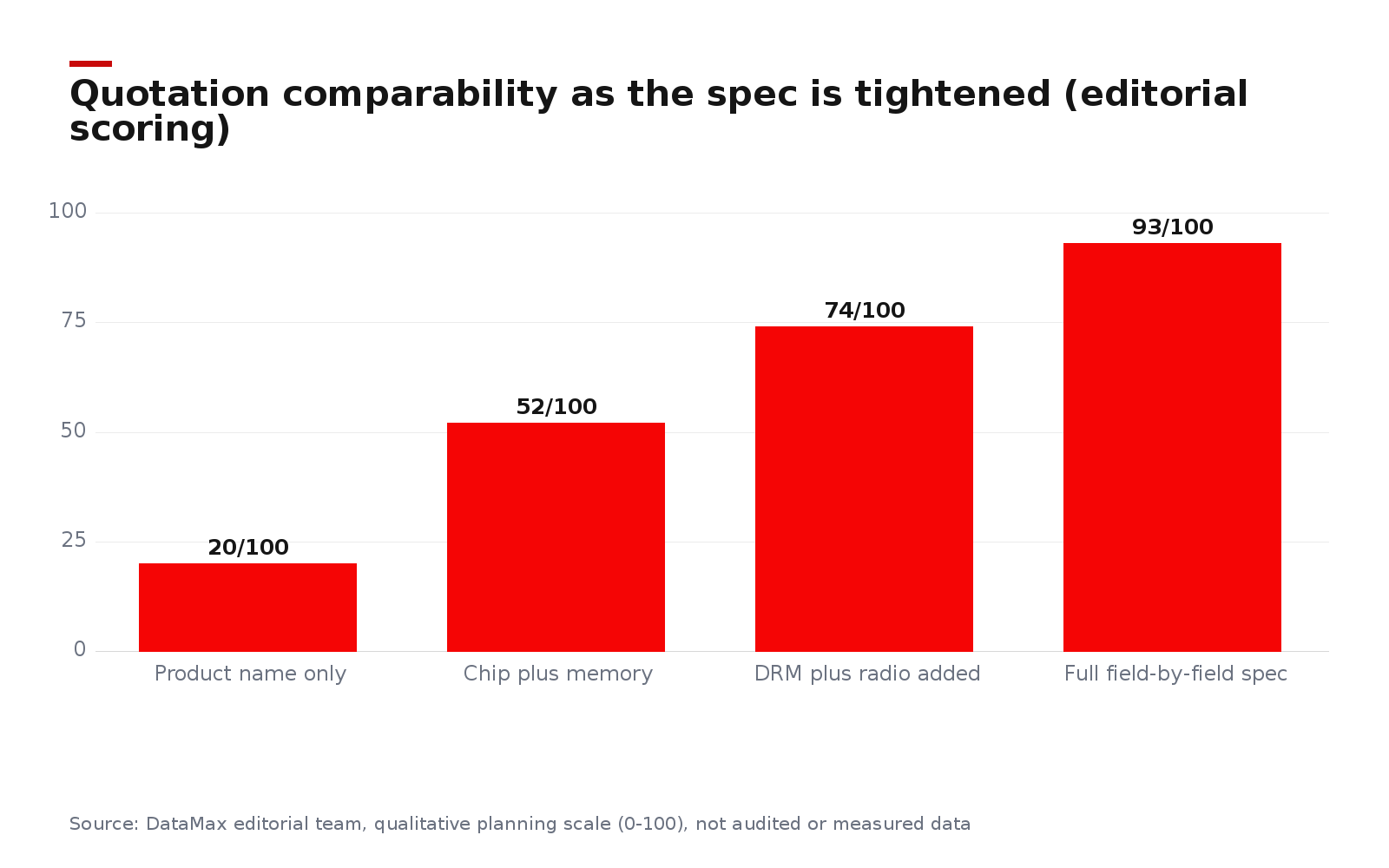
The same figures, in searchable form:
| Specification depth | Editorial score |
|---|---|
| Product name only | 20/100 |
| Chip plus memory | 52/100 |
| DRM plus radio added | 74/100 |
| Full field-by-field spec | 93/100 |
Source: DataMax editorial team, qualitative planning scale (0-100), not audited or measured data.
How the requirement actually works
A DVB-C receiver chain begins with a coax connection and an RF front end. The tuner selects a channel or frequency segment, demodulates the cable signal and produces transport streams. The service operator defines the channel plan, bandwidth, modulation parameters and conditional-access or DRM policy. A DVB-C set-top box must therefore connect the physical tuner to the demultiplexer, decoder, output path and entitlement system.
Conditional access may use a CAM/CI interface, an embedded secure module or another operator-controlled mechanism, but the supplied DataMax facts do not identify a DVB-C tuner, CAM/CI arrangement or CA system for any listed model. Confirm against the production datasheet. It would be incorrect to infer DVB-C capability from the IPTV, OTT or Android TV fit.
Android TV is an application and device experience platform with Google-defined behavior for television interfaces, search, recommendations, input handling and application compatibility. AOSP Android is the open-source base from which an Android TV product can be built. A production device may require the relevant Google Android TV certification, but a stated AOSP OS version alone does not prove that certification.
The pipeline for an IPTV or OTT application usually crosses several layers: network delivery, demultiplexing or stream selection, codec decode, DRM license acquisition, secure rendering and output protection. Widevine and PlayReady are distinct DRM ecosystems. An optional implementation means the production quotation must identify whether the feature is fitted and certified. HDCP protects the AV output path and must also be considered alongside output resolution and refresh rate.
| Layer | DVB-C emphasis | Android TV emphasis | RFQ evidence |
|---|---|---|---|
| Input | Tuner, RF band, channel plan, symbol rate | Ethernet/Wi-Fi, stream source, multicast/unicast | Connector configuration and test limits |
| Platform | Receiver firmware, demux, CA integration | AOSP baseline, Android TV application layer, middleware | Firmware and middleware revision |
| Media | Decode and output profile | Decode, display mode and application rendering | Media matrix on final hardware |
| Security | CA, content protection and entitlement | DRM level, HDCP and account security | Certification and license-flow evidence |
| Lifecycle | Channel retune and field recovery | OTA, rollback and application recovery | Serial-linked test records |
| Diagnosis | Signal margin, BER, lock and CA status | Network state, app logs, entitlement and update state | Named diagnostic fields and export method |
| Ownership | RF, tuner and conditional-access teams | Platform, application and service teams | Named owner for each failure domain |
Decode capability is narrower than delivered picture performance. The media path includes demuxing, codec decode, color and format conversion, rendering, HDMI mode selection and the connected display. Therefore, a codec matrix should record both the accepted stream and the observed output. Frame rate, resolution and chroma format should be written without relying on a general “4K” label.
DRM has a second dependency chain. The application requests a license, the DRM module processes the request, the protected content is decoded through the permitted path and the output is protected. A Widevine L1 entry establishes one stated security level; it does not establish every codec, resolution, frame rate or application policy. The same distinction applies to PlayReady and HDCP.
For a DVB-C operator, entitlement can intersect the receiver path through conditional access, while DRM may still protect output or selected services. Buyers should state whether the requirement is CA, DRM, both or neither. Confusing them produces a design that authenticates the subscriber but cannot play protected content, or plays a protected stream without delivering the operator’s entitlement workflow.
A comparison should also separate hardware support from configuration. Android 14 does not by itself prove a particular application compatibility level. Wi-Fi 6 does not prove the final antenna or regulatory configuration. A 1G Ethernet option does not prove that the ordered SKU includes it. This is why the specification, the production BOM and the test record must use the same revision identifiers.
The mechanism behind a useful android tv box comparison is therefore traceability from requirement to evidence: source to tuner or network; control to middleware or CA; content to codec and DRM; output to HDMI and HDCP; operation to firmware and OTA. Each arrow needs a named owner and a test result.
The platform shortlist with datasheet values
No supplied model establishes a DVB-C tuner. The shortlist therefore helps buyers allocate an IPTV, OTT or premium Android TV requirement, while DVB-C remains a separate line to confirm against the production datasheet.
| Model | SoC and OS | RAM / ROM | Decode and DRM | Ports |
|---|---|---|---|---|
| DM21P | Amlogic S905Y4, quad Cortex-A35; AOSP Android 11 | 2GB / 8GB (4GB; 16/32/64GB optional) | AV1 [email protected], VP9/H.265 4K@60, H.264 4K@30; Widevine L1 / PlayReady / HDCP 2.2 optional | HDMI 2.0b out x1, USB2.0 x2, TF, S/PDIF, 3.5mm AV, RJ45 100M, Wi-Fi6 2x2 + BT5.4, DC 5V/2A |
| DM21S | Amlogic S905Y5, quad Cortex-A55; AOSP Android 14 | 2GB / 16GB (2/4/8GB; 16/32/64GB optional) | AV1 / H.265 [email protected] 4K@60; Widevine L1 / PlayReady optional; Dolby Vision/DTS | HDMI 2.0b out, S/PDIF, AV, USB2.0 x2, TF, RJ45 100M (1G optional), Wi-Fi6 2x2 + BT5.4 |
| DM21T | Amlogic S905X5, quad Cortex-A510 (ARMv9); AOSP Android 14 | 4GB / 64GB (family options) | H.266/VVC [email protected] 4K@120, AV1/VP9/H.265 4K@120, AVS3 4K@120, H.264 4K@60; inline AI-SR; Widevine L1 / PlayReady optional | HDMI 2.0b out (no HDMI in), USB2.0 x1 + USB3.0 x1, TF, S/PDIF, AV, RJ45 100M (1G opt), Wi-Fi6 + BT5.4 |
| DM22Q | Amlogic S905X5M, quad Cortex-A55 up to 2.5GHz; AOSP Android 14 | 4GB / 64GB (2/4/8GB; 16/32/64GB optional) | AV1/H.265 L5.1 4K@60; inline AI-SR (no NPU TOPS stated); Widevine L1 / PlayReady optional; Dolby Vision/DTS | HDMI 2.0b out, USB2.0 x2, TF, S/PDIF, AV, RJ45 100M (1G opt), Wi-Fi6 2x2 + BT5.4 |
DM21P is the operator-middleware and 4K IPTV direction, but its AOSP Android 11 baseline may require OS-version justification. It includes the most explicit distinction between HDMI 2.0b output and USB2.0 count in the supplied facts, while Widevine L1, PlayReady and HDCP 2.2 are optional. An RFQ should therefore identify whether that security configuration is part of the ordered SKU.
DM21S offers a newer AOSP Android 14 baseline and an IPTV/OTT white-label fit. Its supplied facts list AV1 and H.265 [email protected] at 4K@60, optional Widevine L1 and PlayReady, and Dolby Vision/DTS. The RJ45 entry is 100M with 1G optional, so a network-dependent program must settle that option before sample approval.
DM21T adds 120-frame-per-second 4K decode paths and a USB3.0 port, making its direction relevant to premium UHD and cloud-gaming briefs. Its facts list H.266/VVC [email protected] 4K@120, AV1/VP9/H.265 4K@120, AVS3 4K@120 and H.264 4K@60. Its output ceiling remains a datasheet-controlled 4K claim; confirm the target display, source and mode on samples.
DM22Q targets gaming-oriented use with a 4K@60 decode profile, 4GB / 64GB base entry and RJ45 100M with 1G opt. Its inline AI-SR entry does not include a stated NPU TOPS figure, so the procurement record should not convert that feature into an unsupported compute claim.
An android tv box comparison built from this table should preserve the option language rather than silently promoting optional configurations to standard content. It should also avoid treating the decode profile as proof of output capability. These distinctions keep a shortlist commercially useful without turning product-fit language into contractual hardware facts.
For a deployment review, use the model’s stated fit only as a starting direction. A DVB-C requirement remains unsupported by these facts for every row. An Android-centered brief can move to engineering validation once the selected memory, radio, Ethernet, DRM, display and OS fields are frozen against the production datasheet.
Where this matters in a deployment
The deployment scene determines which lines deserve priority. An operator may value receiver integration and managed middleware; an integrator may prioritize interfaces and installation workflows; a venue may optimize for display mode and device control. No scene removes the need to freeze the source, security configuration and acceptance evidence.
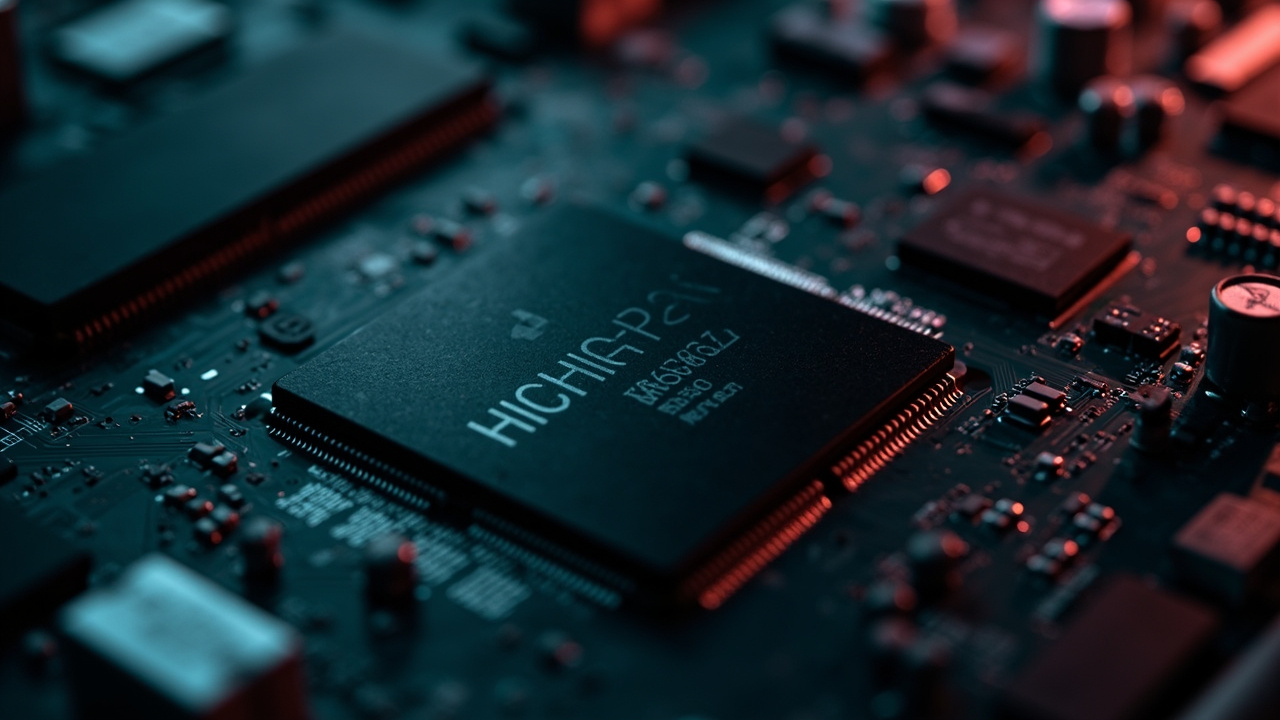
Real-world inspection begins below the enclosure: an extreme macro view of a black system-on-chip package on a television mainboard isolates why the silicon and memory configuration must be checked as part of an android tv box comparison, not treated as decorative product-page data.
| Situation | Priority requirement | Model direction | Decision condition |
|---|---|---|---|
| Operator IPTV program | Middleware integration, managed lifecycle, 4K IPTV direction | DM21P | Validate middleware, networking and production configuration |
| IPTV/OTT white-label launch | Android 14 baseline, branding, application deployment | DM21S | Confirm the application and certification scope |
| Premium UHD presentation | 4K@120 decode, stable display output, premium media path | DM21T | Validate display, source and output limits on the target panel |
| Gaming-oriented hospitality deployment | 4K@60 media, inline AI-SR, USB and network options | DM22Q | Confirm latency strategy separately from decode capability |
| Cable network extension | DVB-C tuner, channel plan and conditional access | No direction supported by supplied facts | Confirm against the production datasheet |
| Corporate IPTV deployment | Managed Ethernet, application restore and fleet recovery | Direction depends on operator middleware | Validate 100M or 1G state and OTA rollback |
| Hotel-room entertainment | Display compatibility, remote-control workflow and recovery | Direction depends on room-system interface | Test final panel, IR or network control and restore path |
| Retail digital-signage network | Stable application startup and controlled reboot | Direction depends on signage middleware | Confirm application signing, update control and storage |
For an operator, the risk is fragmentation between subscriber management, middleware and hardware revision control. For an AV integrator, the risk is a display-mode mismatch despite a nominally correct 4K device. For a venue, remote management, recovery after power loss and controlled replacement can outweigh peak decode capability. A network installer must also distinguish Wi-Fi coverage requirements from Ethernet service performance; a nominally wireless product still needs an RF survey, roaming policy and a wired fallback decision.
The 4K at 60 frames per second Android TV box guide helps define the display and media acceptance line. The Dolby Atmos Android TV box guide helps separate audio-format requirements from hardware claims. Before a purchase order is released, send DataMax sample request a first message containing the exact model, target source, selected memory configuration, mandatory DRM and HDCP state, required ports, operating-system baseline, DVB-C requirement and the tests each sample must pass.
For broader Android TV purchasing context, see Android TV box for sale explained for buyers. The final engineering step should be a golden-sample sign-off that records the accepted display mode, application flow, network behavior, recovery procedure and document revisions. That signed configuration becomes the reference for the production android tv box comparison, rather than a collection of unreconciled catalog fields.
Further reading
- Android TV Box For Sale: Catalogue Versus Commissioned
- DRM compliance solutions
- Telecom solutions
- Amlogic Android TV boxes
- Google TV devices
- DataMax DM21P specifications and fit
- DataMax DM21S specifications and fit
FAQ
Is a DVB-C box the same as an Android TV box?
No. DVB-C identifies a cable-reception function involving a tuner, RF signal processing, channel management and often conditional access. Android TV identifies the television software platform and application experience. A product can provide both, but the two descriptions alone do not establish the same feature set. Confirm the tuner, platform and integration requirements separately.
Which fields matter most in an android tv box comparison?
Start with signal source, operating-system baseline, memory configuration, decode and output limits, DRM level, HDCP version and physical interfaces. Add Ethernet speed, Wi-Fi configuration, middleware, OTA recovery and certification evidence for operator programs. A product name or chipset alone leaves major cost and compatibility variables unresolved.
Can an AOSP Android TV product receive DVB-C?
Potentially, but AOSP does not itself prove DVB-C reception. The hardware must include a suitable tuner and the firmware must integrate tuning, demultiplexing, channel data and entitlement handling. None of the supplied DataMax model facts identifies a DVB-C tuner, so confirm against the production datasheet.
Does Widevine L1 mean every content service is supported?
No. Widevine L1 describes a DRM security level, while service compatibility also depends on codec profile, resolution, frame rate, output protection, device certification and the service operator’s application policy. PlayReady, HDCP and any Dolby Vision or DTS requirement are separate fields that must appear in the procurement specification.
Which DataMax model fits a premium 4K brief?
DM21T lists decode paths up to 4K@120 and is directed toward premium UHD and cloud-gaming use. DM22Q lists 4K@60 decoding and a gaming-oriented fit. Neither model’s supplied facts establishes DVB-C. Validate the actual source, display, output mode and optional security configuration on final samples.
What should the first RFQ message contain?
Include the source type, DVB-C presence or absence, required codec and resolution limits, DRM level, HDCP version, connector list, OS baseline, memory configuration, middleware scope, lifecycle expectations and requested test evidence. Naming the required document revision prevents the quotation from resolving ambiguities through unstated assumptions.
How should two quotations with different optional features be normalized?
Create a configuration line for every mandatory, conditional and excluded feature. Show the base SKU, any selected option, the resulting port or security state, the firmware revision and the evidence supplied. Do not compare a quoted 1G Ethernet configuration with a base 100M configuration as if both were the same delivery state.
When is a DVB-C requirement confirmed?
Only when the production datasheet or controlled specification identifies the tuner, supported signal plan, demodulation limits, conditional-access approach, output integration and test method. An IPTV label, Android TV operating system, coax connector or tuner-capable chipset does not by itself confirm a complete DVB-C receiver configuration.


