

The short answer first
GMS certification is evidence that a shipped android tv box configuration aligns with a defined Google Mobile Services requirement, but it does not replace model-level SKU approval, DRM licensing, content-service certification, or production-quality evidence. The decisive procurement question is whether the quotation’s exact Android release, firmware, service package, regional SKU, and hardware revision can be matched to valid certification documentation. A catalogue label alone cannot establish that match.
| Decision point | What evidence to require | Acceptance rule |
|---|---|---|
| Google services | SKU-specific GMS documentation | Model, hardware revision and software build must correspond |
| Android platform | Production OS version and release notes | AOSP versus Google TV must be stated explicitly |
| Protected content | DRM implementation and service-level test record | Widevine level, HDCP path and content workflow must match the channel |
| Hardware stability | Production and factory evidence | Acceptance covers the ordered configuration, not the product family |
| Fleet operations | Provisioning, update, recovery and telemetry procedure | Validate the representative production image under the intended management system |
| Variant control | Memory, Ethernet, radio, accessory and packaging records | Any option affecting certification or service approval is explicitly ordered |
For an operator explicitly requiring a Google-certified, non-Google-TV device, the DM21RTD is the relevant DataMax starting point because its supplied facts specify Realtek RTD1325 and GMS-certified AOSP. For other IPTV or OTT requirements, AOSP does not itself mean GMS approval. The platform and product-selection background is covered in the canonical guide to android tv box for ISPs; this page narrows the discussion to terminology, evidence, and supplier scrutiny.
A procurement team should distinguish “certified product family,” “certified ordered SKU,” and “certified production batch.” These are different evidence scopes. The first describes a supplier’s platform statement, the second links an approval to a purchasable configuration, and the third proves that delivered units remain inside that approved scope. None should be inferred from another.
The evidence ladder is equally important. A supplier statement supports an initial commercial discussion, but it does not replace a standard-specific report, a certificate, or a verifiable public-registry record. The stronger the evidence, the more precisely the buyer can connect an approval to the hardware revision, firmware build, regional package set, and shipment configuration. This is the central distinction for an android tv box procurement: certification is a controlled configuration claim, not a decorative product attribute.
The platform shortlist with datasheet values
The shortlist separates the stated GMS-certified non-Google-TV SKU from the broader AOSP set-top-box range. Every value below comes from the supplied production facts; unstated dimensions, certifications, and variants remain subject to confirmation against the production datasheet.
| Model | SoC and platform | Memory options | Decode and DRM | Specified fit |
|---|---|---|---|---|
| DM21RTD | Realtek RTD1325; GMS-certified AOSP | Confirm against the production datasheet | AV1 capable | Operators/retail that require a Google-certified non-Google-TV (AOSP+GMS) SKU |
| DM21P | Amlogic S905Y4, quad Cortex-A35; AOSP Android 11 | 2GB / 8GB (4GB; 16/32/64GB optional) | AV1 [email protected], VP9/H.265 4K@60, H.264 4K@30; Widevine L1 / PlayReady / HDCP 2.2 optional | 4K IPTV / operator middleware set-top box |
| DM21S | Amlogic S905Y5, quad Cortex-A55; AOSP Android 14 | 2GB / 16GB (2/4/8GB; 16/32/64GB optional) | AV1 / H.265 [email protected] 4K@60; Widevine L1 / PlayReady optional; Dolby Vision/DTS | 4K Android TV box for IPTV/OTT white-label |
| DM21T | Amlogic S905X5, quad Cortex-A510 (ARMv9); AOSP Android 14 | 4GB / 64GB (family options) | H.266/VVC [email protected] 4K@120, AV1/VP9/H.265 4K@120, AVS3 4K@120, H.264 4K@60; inline AI-SR; Widevine L1 / PlayReady optional | Premium UHD / cloud-gaming box |
Port configuration affects integration rather than certification. The DM21P specifies HDMI 2.0b out x1, USB2.0 x2, TF, S/PDIF, 3.5mm AV, RJ45 100M, Wi-Fi6 2x2 + BT5.4, and DC 5V/2A. The DM21S specifies HDMI 2.0b out, S/PDIF, AV, USB2.0 x2, TF, RJ45 100M with 1G optional, and Wi-Fi6 2x2 + BT5.4. The DM21T specifies HDMI 2.0b output with no HDMI input, USB2.0 x1, USB3.0 x1, TF, S/PDIF, AV, RJ45 100M with 1G optional, and Wi-Fi6 + BT5.4.
Do not infer HDMI input, 8K output, display capabilities, dimensions, or regional radio compliance from these declarations. A buyer comparing a unit against a retail appliance should put the display mode, output format, HDCP path, remote-control arrangement, and wall-mount requirements in the RFQ rather than relying on a platform description. The DataMax model table is a starting point, not a substitute for the production datasheet and approved configuration record.
A second procurement view is the difference between a platform baseline and a release candidate. Android 11 on DM21P, Android 14 on DM21S and DM21T, and GMS-certified AOSP on DM21RTD describe distinct starting points. The production image, regional firmware, application build, boot logo, preinstalled services, security patch state, and update mechanism should be identified by immutable version identifiers in the order. A family-level chipset statement is useful for architecture planning, but it does not close the release gate.
A third view is optional content-security functionality. On DM21P, the supplied combination is “Widevine L1 / PlayReady / HDCP 2.2 optional.” On DM21S, “Widevine L1 / PlayReady optional; Dolby Vision/DTS” is listed. On DM21T, “Widevine L1 / PlayReady optional” is listed. Those entries define choices available for procurement, not automatic population. Each optional DRM implementation, Ethernet speed, memory configuration, and codec entitlement needs a separate line item and acceptance method.

The same figures, in searchable form:
| Evidence option | Editorial score |
|---|---|
| Supplier claim | 15/100 |
| Generic test report | 42/100 |
| Standard-specific report | 70/100 |
| Certificate with public registry lookup | 94/100 |
Source: DataMax editorial team, qualitative planning scale (0-100), not audited or measured data.
How the requirement actually works
“GMS-certified” describes approval within Google Mobile Services, while “Android TV” identifies a form-factor and application category associated with the television user experience. “AOSP Android TV box” can refer to a device carrying the Android TV operating-system baseline without Google Play services. These are different axes, so a procurement specification should name both the platform and the service state.
The compliance architecture has 5 layers:
- Hardware revision SoC, board, display interfaces, radios, and security components form the physical basis.
- Model-family approval does not automatically validate every memory or connectivity option.
- A radio, storage, display, or security-component change may alter the tested configuration.
- Android build The production firmware release, build identifier, and system-image provenance determine what is being tested.
- For Android 11 or Android 14, retain the exact release in the contract record.
- The boot image, application image, and update policy may be separate controlled artefacts.
- Google Mobile Services Package versions, service configuration, and device registration determine the GMS side of the requirement.
- AOSP plus GMS is not the same package as a Google TV build.
- Preinstalled-service and regional configuration requirements should be explicit.
- Content security Widevine, PlayReady, and HDCP operate along the service-to-display path.
- DRM support alone does not prove that a particular channel, model, or region will pass the content owner’s process.
- The source service, licence policy, display, cable, and sink must be tested as a chain.
- Operational acceptance Provisioning, middleware, updates, telemetry, recovery, and service-level testing govern the deployed fleet.
- The evidence packet must identify the production image, not only a demonstration unit.
- Fleet-scale recovery and update behavior belong in the release criteria.
DRM terminology must be precise. Widevine L1 generally denotes a protected hardware-backed path; Widevine L3 denotes a software-based protected path with different security characteristics. PlayReady is a separate DRM system. HDCP 2.2 applies to the protected AV output path and must be reconciled with the source service, display, cable, and sink capabilities. For the DM21P, the supplied facts list Widevine L1 / PlayReady / HDCP 2.2 as optional, so the quotation must identify whether those options are populated. For DM21S and DM21T, Widevine L1 / PlayReady are likewise optional.
The distinction extends to service tiers. A device may expose an application capable of protected playback while the account, territory, subscription, output mode, or device registration remains unsuitable. Procurement should name the protected-content workflow: sign-in, licence retrieval, stream start, resolution selection, output route, restart, and recovery. For an operator IPTV programme, the middleware certificate, device registration, channel entitlement, and DRM path may each be controlled by a different organization.
AV1, AV1 [email protected], and “AV1 capable” are not interchangeable certification labels. MP-10 identifies a codec profile and level, while L5.1 indicates a level constraint. Likewise, Dolby Vision, DTS, and inline AI-SR are feature labels, not evidence of a successful application-service certification. For procurement, require the service owner’s approval process to be completed against the production configuration.
The AV1 decision can also affect content efficiency and device qualification. Netflix reports that AV1 powers approximately 30% of all Netflix viewing and is the second most-used codec. It also reports about one-third less bandwidth than AVC and HEVC and 45% fewer buffering interruptions. These are content-delivery metrics, not GMS acceptance criteria, so they belong in codec planning rather than the compliance matrix. The service owner’s current device requirements remain the governing gate.
The same source reports that 88% of large-screen devices submitted for Netflix certification supported AV1 during 2021–2025. The denominator matters: these are devices submitted for certification, not all devices shipped to viewers.
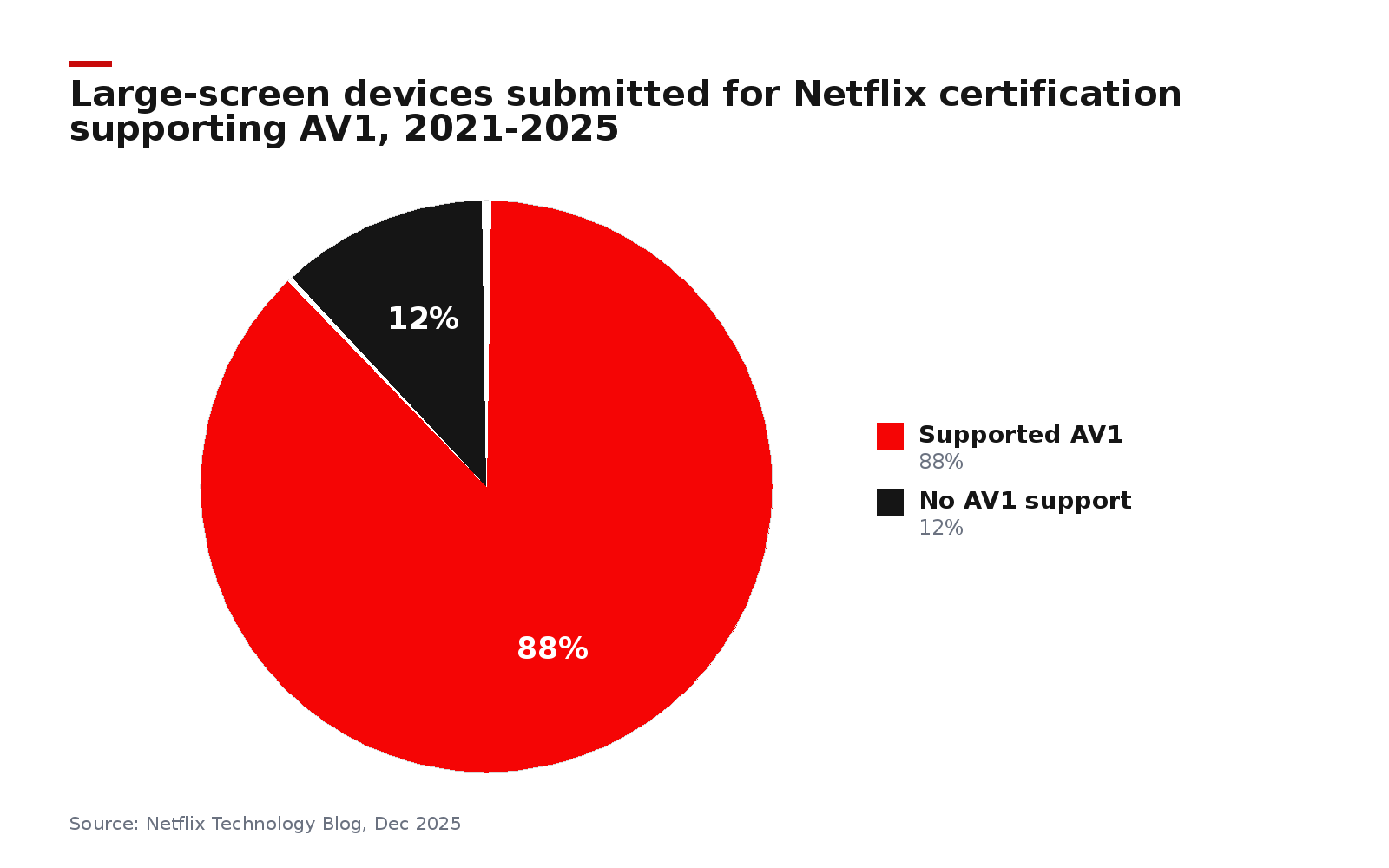
The same figures, in searchable form:
| AV1 support among submitted devices | Share |
|---|---|
| Supported AV1 | 88% |
| No AV1 support | 12% |
Source: Netflix Technology Blog, AV1 — Now Powering 30% of Netflix Streaming (2025-12-01). Population is devices submitted for certification, not all devices shipped.
Two routes, one bill of differences
The two procurement routes are not “certified” versus “uncertified.” The meaningful split is between a requirement tied specifically to Google-certified GMS and one governed by the IPTV/OTT application, middleware, DRM, and device-management stack. A route that omits GMS may still require rigorous device approval, content-security validation, and factory acceptance.
| Dimension | AOSP-led route | GMS-committed route |
|---|---|---|
| OS declaration | AOSP Android 11 or Android 14 for supplied DataMax models | GMS-certified AOSP for DM21RTD |
| Google service evidence | Specify any required services explicitly | Require SKU-specific GMS evidence and validity dates |
| Content services | Operator middleware, IPTV, or OTT application approval | Same application approval, plus GMS-specific production alignment |
| DRM | Specify required implementation and output path | Specify required implementation and output path; optional entries must be ordered explicitly |
| Operational control | Android Management, MDM, or operator provisioning as applicable | Same fleet-control path, including update and recovery obligations |
| Release risk | Service-image dependency and integration variations | Additional dependency on Google package alignment and certification scope |
| Evidence owner | Operator, application vendor, brand, or integrator | Supplier plus Google approval scope and application owner |
| Change trigger | Application, middleware, device-management, and firmware changes | Those changes plus GMS package, service, and platform changes |
The DM21P and DM21S illustrate the AOSP-led route: the former is positioned for 4K IPTV and operator middleware, while the latter addresses 4K IPTV/OTT white-label use. The DM21T targets premium UHD and cloud gaming with higher specified 4K@120 decode classes and family memory options. The DM21RTD addresses the distinct need for a Google-certified, non-Google-TV SKU.
A quotation should contain a compliance matrix rather than one “certified” checkbox. One column should identify the GMS or application requirement, another the exact model and ordered options, a third the evidence document, and the final columns the issuer, identifier, issue date, expiry or validity condition, and production-match statement. Where the supplier cannot provide a public registry lookup, that limitation belongs in the exception register rather than being silently replaced by a logo, certificate scan, or distributor assurance.
The bill of differences also includes engineering effort. The GMS-committed route usually requires tighter coordination among the hardware revision, Android build, Google service packages, preinstallation, regional configuration, and release documentation. The AOSP-led route may appear simpler at the OS label but can shift effort into middleware signing, application packaging, device enrollment, account systems, telemetry, DRM licensing, and fleet operations. A lower GMS burden is not automatically a lower total integration burden.
For example, a managed IPTV order using DM21P might specify AOSP Android 11, 2GB / 8GB, Widevine L1, PlayReady, HDCP 2.2, RJ45 100M, and the required operator middleware. A retail programme using DM21RTD would instead need the GMS-certified AOSP build tied to the ordered hardware. These are different acceptance packets even if both devices connect to the same television.
Commercial control should follow the evidence. A buyer may require documentary delivery, pilot approval, production audit, and written deviation closure as separate conditions. A supplier that cannot identify the responsible legal entity, covered model, identifier, and production-build correspondence should not be allowed to replace those fields with a generic GMS statement. For an android tv box tender, the comparison should therefore include evidence deliverables beside unit features, because the route determines both release time and ownership of mismatch resolution.
Deployment scenarios and the spec each needs
The correct specification depends on who owns the application, who approves the device, and how the product reaches the viewer. An operator managing a managed IPTV fleet has different release gates from a white-label brand or a venue integrator installing devices behind its own management platform.
| Situation | Primary requirement | DRM and network | Model direction | Acceptance evidence |
|---|---|---|---|---|
| ● IPTV operator with managed middleware | Stable AOSP baseline, provisioning, and recovery | Widevine/HDCP path and Ethernet fit | DM21P or DM21S | Middleware acceptance and production firmware record |
| ● Retail or operator requiring Google-certified non-Google-TV | GMS-certified AOSP SKU | Confirm ordered DRM and connectivity options | DM21RTD | SKU-specific GMS documentation and model match |
| ● OTT white-label programme | AOSP Android 14 direction and brand control | AV1/HEVC capability, optional DRM, Ethernet option | DM21S | Application certification and image provenance |
| ● Premium UHD or cloud-gaming venue | 4K@120 decode class, storage, and peripheral fit | HDMI 2.0b output; no HDMI input; USB mix | DM21T | Media pipeline test and connected-device acceptance |
| ● Integrator managing venue displays | Device-management, recovery, and installed-system test | HDMI, Ethernet, and audio routing as deployed | Select after connectivity validation | Site pilot, burn-in record, and update procedure |
| ● Operator distributing a GMS retail variant | Google-certified non-Google-TV identity | Confirm connectivity, regional radio, DRM, and service options | DM21RTD | SKU record, registry lookup, and production-image match |
| ● Brand requiring codec-rich white-label device | Android 14, AV1/H.265 4K@60, branding, and OTA control | Widevine/PlayReady, Ethernet, Wi-Fi, and update path | DM21S | Application approval, signage check, and fleet recovery test |
A telecom engineering lab bench with rows of small black Android set-top boxes connected by HDMI and network cables can expose integration defects that a single-unit demonstration misses. Test monitors, RF measurement equipment, and engineer adjustments are useful in a controlled laboratory scene; they are not substitutes for certification records.

For a managed operator fleet, write the acceptance sequence as hardware continuity, signed-in boot, network association, middleware launch, channel zapping, protected playback, restart, recovery, update, and fleet reporting. For a venue deployment, include the actual display, audio path, network switch, remote-control procedure, and power-distribution arrangement. For an OTT brand, include the storefront, sign-in, playback, playback finish/resume, update, and telemetry paths. These procedures distinguish a functioning appliance from a compliant production system.
The number of devices in the pilot should be representative of production variants rather than a single presentation unit. Include the ordered memory and Ethernet configuration, the expected remote control, and the actual firmware release. For an operator programme, test under network congestion and force an interrupted update. For a venue programme, test repeated HDMI handshake, channel changes, and recovery after power interruption. For a retail GMS programme, test account sign-in, preinstalled-service behavior, regional settings, and the application path used by the customer.
Site acceptance should also separate faults caused by the local display, switch, optical converter, or network from faults in the set-top box. Capture device identity, input format, resolution, frame rate, audio route, network type, and application build alongside each failed result. Without those variables, a failed playback test can trigger an unnecessary shipment return even when the local sink is outside the device’s supported input path.
The deployment owner also determines the evidence burden. An operator’s central technical team can maintain one production image across thousands of managed units; a retail programme may need a customer-facing update and recovery policy; a venue integrator may need a fixed-image lock-down process. For an android tv box programme, the model should therefore be chosen against the operating process as well as the screen specification, and the pilot must exercise the same route used after installation.
What goes wrong after the PO
The most expensive failure is usually not a wrong chipset. It is an approval artefact that does not represent the goods delivered. Model-family evidence may omit the selected memory variant, radio option, regional configuration, or production firmware. A GMS claim can therefore be valid for one build while unusable for procurement if the quoted SKU cannot be tied to it.
Field trap
A catalogue label is not an approval record. Require the certificate identifier, named legal entity, covered model or module, hardware revision, software status, issue or validity information, and a supplier declaration that the shipped build matches the approved configuration. Confirm certificates and DRM/security provisions per ordered SKU, not per catalogue page.
A second trap is equating media decode with service acceptance. AV1 support does not establish Netflix or another content service’s approval; it establishes only a stated capability in the supplied facts. Widevine L1 does not guarantee that a particular application will issue licences under the intended account, region, service tier, and display path. A quotation using “DRM ready,” “HDCP supported,” or “Netflix ready” without naming the underlying implementation and acceptance record is technically incomplete.
Field trap
Optional is not included. The DM21P, DM21S, and DM21T facts identify DRM configurations as optional. If the order record omits “Widevine L1,” “PlayReady,” “HDCP 2.2,” “1G,” or another option, procurement cannot infer population. Put every populated option in the line items and acceptance schedule.
Other post-PO failures arise from untested production changes. A different SoC vendor, PCB revision, firmware image, Wi-Fi module, or ROM configuration can invalidate an application approval or produce field symptoms that look like certification failure. The supplier must therefore operate change notification, traceability, and regression testing; the buyer must reserve the right to identify the actual delivered configuration and run an incoming audit.
Memory configuration creates a second comparison trap. The supplied DM21P and DM21S families include multiple RAM and ROM combinations, while DM21T lists 4GB / 64GB with family options. A quoted “8GB storage” does not identify whether the device also has the specified RAM capacity, and storage size alone does not establish performance. The quotation should use the complete configuration string, such as “2GB / 8GB,” and record any optional variant that was actually populated.
Codec language can create a third trap. “AV1 capable,” “AV1 [email protected],” and “AV1/VP9/H.265 4K@60” support different levels of detail. A buyer should request the actual profile, level, resolution, frame rate, and display path required by the application. The DM21T’s specified 4K@120 decode capability does not establish that a deployed television, cable, switch, or conversion path accepts 4K@120, and its HDMI 2.0b output and no-HDMI-input constraints must be tested in the intended system.
Commercial divergence often appears at the last document stage. One quotation includes certification evidence, another treats it as a future activity, and a third assumes that certificate transfer follows the hardware. The purchase order should state whether evidence is a prerequisite to sample approval, pilot approval, or shipment release. It should also name the responsible party for resolving a mismatch and prohibit substitution of an equivalent model without written technical approval.
A final trap is the acceptance sample itself. If the pilot uses a development board, an optional configuration, or a special engineering image, passing that unit says little about the production android tv box. Require the sample serial number, hardware revision, memory string, DRM population, and firmware identifier to be recorded in the purchase order. Any later divergence should reopen approval rather than be treated as an equivalent substitution.
How to choose, step by step
Start with the service obligation, not the product category. Identify whether Google Mobile Services is contractual, merely desired, or unnecessary. Then separate application certification, DRM, display security, and factory acceptance into distinct gates. This sequence prevents a GMS requirement from being confused with an IPTV middleware requirement.
- Write the service obligation State “GMS-certified AOSP” or “AOSP Android 11/14,” then name the IPTV, OTT, retail, or gaming workflow.
- Fix the model family Use DM21RTD for the stated Google-certified non-Google-TV requirement; compare DM21P, DM21S, and DM21T for AOSP-led operator, white-label, and premium workflows.
- Lock the exact options Record memory, Ethernet speed, DRM implementation, HDCP path, codec requirement, ports, and power supply in the order line.
- Map every approval to a SKU Attach GMS, application, DRM, and content-owner records with effective dates and identifiers.
- Define the pilot Include login, channels, protected playback, display, audio, network, restart, recovery, update, and remote operations.
- Attach production assurance Require traceability, SMT/AOI evidence, aging records, and notice of engineering changes before shipment approval.
- Set deviation control Name the evidence owner, permitted substitutions, response route, and closure condition for every open compliance item.
The resulting RFQ should contain copy-ready specification lines rather than marketing adjectives. Example: “GMS-certified AOSP software build corresponding to the ordered DM21RTD hardware revision; submit certificate identifier, covered model, and validity evidence before shipment approval.” Another line: “For the ordered DM21S configuration, state the populated DRM implementation, Ethernet speed, and production OS build; do not include optional features unless listed as ordered.” A third should name the decode requirement, display output, physical ports, and recovery test instead of asking for a “4K certified box.”
The same discipline applies to sample orders. A sample request should identify the production-equivalent hardware revision, RAM/ROM combination, Ethernet option, DRM population, firmware build, and intended application. Ask for the configuration record shipped with the sample so the buyer can compare it with the later production order. A photograph of a hardware label is useful, but it does not reveal the complete software and option configuration.
The review should also include a negative test: temporarily substitute an unapproved memory or Ethernet option in the quotation and determine whether the compliance matrix flags it. A useful compliance register will identify scope differences automatically. If the process relies on a salesperson’s memory, the same variation may pass from sample to bulk order.
Engineering and procurement can request the factory evidence pack from DataMax factory quality or review the broader manufacturer capability. For a component-level request, the inquiry route should identify the exact model, target application, and documentary deliverable before samples or a pilot are proposed.
Questions to put in the supplier review
The supplier review should test whether conformity is controlled as a production variable or merely described in marketing. Ask for evidence tied to the quoted SKU, manufacturing lot, and firmware image. A broad factory presentation without unit-level traceability is not sufficient.
- Identity and scope Which legal entity holds the GMS or application approval, and which exact model, hardware revision, and software build does it cover?
- SMT and AOI How are inspection results linked to the production board and lot identifier, including exceptions and disposition?
- Functional and aging records What burn-in or aging criteria are applied to network, HDMI, audio, storage, recovery, and power behaviour?
- Dark-room and display checks Which display, playback, and interface checks are performed, and how are results retained against serial number?
- Audit trail Can a sample serial number be traced to firmware, components, test results, rework, and shipment records?
- Change control What notice period applies to SoC, PCB, radio, memory, supplier, or firmware changes that might affect conformity?
- Approval reconciliation How often are active certificates and application approvals reconciled with the production bill of materials?
- Nonconformance handling What evidence is required before rework or shipment resumes after an SMT, AOI, aging, or functional-test failure?
Review outcome: accept only when the evidence chain links model, hardware revision, ordered options, production image, test record, and shipment identity. Place exceptions in a signed deviation list with an owner and closure date; do not let an exception disappear inside a general compliance statement.
Also ask for the date and scope of the most recent factory or video audit, the process for reconciling certificates against active production, and the support boundary for a failed application approval. Verify that a “Google-certified” statement refers to the actual ordered device rather than a development board, reference platform, or unrelated product. Confirm whether certification, certificates, and DRM/security provisions are validated for each ordered SKU.
The documentary and process review should use a sample, not only a presentation. Select one serial number and one purchase order, then trace them in both directions: from the order to the approved configuration, and from the shipped unit to its board, firmware, tests, and release authorization. Missing links identify exactly where a future audit could fail. A missing AOI record may expose process weakness; a missing firmware link may invalidate service approval; an absent certificate identifier may prevent public verification.
Dark-room work should be relevant to the programme rather than treated as a generic ritual. For a broadcast or operator appliance, verify display output, interface behavior, boot, and application navigation under controlled conditions. For a retail unit, check the customer-facing flow and preinstalled services. For a white-label device, inspect branding, regional settings, network setup, and recovery. The test record should identify the actual image and hardware revision so the result can be reused only within its valid scope.
A practical release rule is to withhold final shipment approval until the compliance matrix, model-mapping record, and production evidence pack agree on all 3 levels: commercial configuration, technical configuration, and documentary evidence. Invite a video factory audit or request SMT/AOI and aging evidence specific to the intended programme. This turns “certified” from an adjective into a traceable acceptance condition.
The documentary route is available through certifications and compliance. Confirm certificates and DRM/security provisions per ordered SKU, not per catalogue page. The factory route is available through factory quality and manufacturer; a buyer can request SMT/AOI, aging, dark-room, and audit evidence linked to the proposed production build.
Further reading
- Guide android tv box for isps
- DRM compliance solutions
- Telecom solutions
- United States compliance notes
- Android TV boxes
- DataMax DM21RTD specifications and fit
- DataMax DM21P specifications and fit
FAQ
Does GMS certification mean a device is Google TV?
No. GMS certification and Google TV are separate classifications. The DM21RTD is specified as GMS-certified AOSP for a non-Google-TV use case. A buyer should state the platform and service requirement separately rather than treating the labels as interchangeable.
Can an AOSP Android TV box be sold without GMS?
Yes, when GMS is not a contractual requirement and the application, device-management, and content-security obligations are satisfied. For operator IPTV, OTT, or white-label programmes, document the chosen platform, middleware or application approval, DRM path, and production image in the order specification.
Does AV1 support prove Netflix certification?
No. AV1 is a decode capability, not a content-service approval. Netflix separately specifies device certification. The 88% figure concerns large-screen devices submitted for certification during 2021–2025, not all shipped devices.
What evidence should accompany a GMS-certified model?
Request the certificate or approval record, issuer or responsible legal entity, covered model and hardware revision, software status, identifier, validity information, and a production-match declaration. Generic test reports or supplier statements provide weaker traceability than a certificate with a verifiable registry lookup.
Are optional DRM features included by default?
The product facts for DM21P, DM21S, and DM21T identify DRM configurations as optional. Populated options must be written into the purchase order and acceptance schedule. Confirm the exact implementation, including Widevine L1, PlayReady, or HDCP 2.2 where applicable, against the production datasheet.
Does a factory audit replace certification evidence?
No. A factory audit can verify process controls, traceability, and test records, but it does not replace SKU-specific GMS or content-service approval. Use the audit to test whether the supplier can connect the ordered unit to its evidence and production records.


