
What the answer hinges on: the approval boundary
Before approving an android tv box manufacturer, confirm 6 boundaries: the exact SKU, the Google TV or AOSP software owner, the chipset and codec ceiling, DRM and HDCP obligations, the physical and network interfaces, and the production evidence required at shipment. Each item needs a named artifact or test record; a catalogue description establishes only a starting point.
The central distinction is between product approval and manufacturing responsibility. Google TV certification, Android compatibility, codec licensing, DRM integration, operator middleware, display output, and factory quality can sit with different parties. A buyer should not infer that an ODM producing the hardware also owns Google certification, operator acceptance, or content-security approval. It may manage those activities, but accountability must be assigned in the purchase specification.
The short answer is to approve a factory only after the proposed configuration has been mapped to its evidence trail. For Android TV and operator programs, also review the broader question of which party answers for the software. DataMax can be evaluated as a factory or ODM for the models covered by its production records, while software, certification, and content obligations remain explicitly scoped.
Use one approval matrix per ordered SKU. It should list every required certificate, protected-content feature, port configuration, operator image, test method, and responsible party.
A practical approval sheet has 4 columns: requirement, evidence, owner, and release status. For example, “HDMI 2.0b output” should point to the released port drawing and golden-sample test; “Widevine L1” should point to the ordered configuration and protected-content test; “Android 14” should point to the exact software build; and “operator middleware” should point to the signed image and acceptance procedure. This structure prevents a general factory capability from being mistaken for approval of one shipping configuration.
The sign-off authority also needs definition. Hardware engineering may accept ports and decode performance; software may accept the image; regulatory may accept market documentation; operations may accept provisioning and recovery. A single buyer representative should nevertheless maintain the consolidated matrix so that no department closes its gate while another remains open. The evidence date, software revision, hardware revision, and serial-number scope should appear beside each approval.
For an android tv box manufacturer review, the minimum sign-off record is: released hardware revision, exact software identifier, ordered option matrix, certificate scope, protected-content result, operator acceptance, factory test evidence, and change-control trigger. A verbal assurance or catalogue image is not a substitute.
Entry tier versus commitment tier: compare the bill of differences
A sourcing agent or component distributor can reduce initial coordination, but the approval boundary moves downstream. A factory-type OEM typically controls more of the hardware and production chain than a sourcing agent; a factory-type ODM adds product design, firmware integration, and manufacturing accountability. The more layers that remain between buyer and factory, the more explicitly the contract must assign inspection, corrective-action, certification, and change-control duties.
| Participant | Primary contribution | Approval evidence | Buyer control point |
|---|---|---|---|
| Sourcing agent | Commercial coordination and component sourcing | Supplier identity, quotations, selected documents | Audit the actual factory and define change notice |
| Component distributor | Component availability and supply routing | Traceability and batch records | Verify substitutions and production equivalence |
| Factory-type OEM | Hardware manufacture against an agreed design | Work instructions, inspection data, build records | Define permitted substitutions and approval gates |
| Factory-type ODM | Product design, software integration, and manufacture | Design record, test results, certification evidence, shipment audit | Assign certification, middleware, DRM, and escalation duties |
The commitment tier also changes where a defect becomes visible. A distributor may resolve a logistics issue before assembly. An OEM may expose the issue at line inspection. An ODM can connect it to firmware, thermal design, RF calibration, or operator middleware. Procurement should therefore compare not only unit capability but also the chain of responsibility for a failed update, a counterfeit component, a nonconforming output mode, or an operator rejection.
For a procurement team preparing an RFQ, specify the required decision level: catalogue sourcing, build-to-print manufacture, or integrated design and manufacturing. Also identify which activities the supplier may subcontract. The RFQ should state the proposed SKU, software stack, target quantity band without a prohibited commercial minimum, interface list, protected-content requirements, operator middleware, destination markets, and required factory evidence.
The contract should also distinguish “coordination” from “control.” An agent may collect a certificate, but the buyer needs to know whether it can verify the issuing body, the covered model, and the software revision. An OEM may own SMT and final assembly, but the buyer should retain authority to reject a changed component or unreleased firmware. An ODM may own integration, but field escalation must return to one accountable organization with access to the build records.
Three commercial lines commonly create ambiguity: “certified,” “operator-ready,” and “customized.” Each should be rewritten as a deliverable. “Certified” becomes the named program, model scope, software build, document identifier, holder, and validity date. “Operator-ready” becomes the image version, middleware test, device provisioning method, entitlement flow, recovery procedure, and acceptance owner. “Customized” becomes the revisioned hardware schematic, BSP or ROM baseline, application package, boot and update policy, and golden sample.
| Quotation wording | Required clarification | Release consequence |
|---|---|---|
| “Factory certified” | Name the certificate, scope, holder, software build, and document revision | Do not treat it as a platform-wide approval |
| “Google TV supported” | State whether the buyer, ODM, or software partner owns the program submission | Hold release until ownership is documented |
| “IPTV ready” | Identify middleware, network mode, entitlement, management, and recovery tests | Run an operator-specific pilot |
| “Customization included” | Attach revisioned design, software, and acceptance deliverables | Exclude vague scope from baseline acceptance |
A decision record should capture which tier was selected, which activities were retained by the buyer, and which were delegated. That prevents a low-commitment catalogue purchase from being evaluated as a custom program, while ensuring a factory-type ODM does not leave certification or middleware ownership implicit. For this boundary question, the role of the android tv box manufacturer is only one element of the accountability chain.
The mechanism behind the spec: how approval actually works
Product approval depends on a chain of technical gates. A Google TV device must satisfy Google’s device and program requirements applicable to the release, while Android device compatibility involves CTS/VTS or CDD obligations associated with the Android version and device classification. AOSP Android 14 or Android 11 does not, by itself, establish Google TV certification. The buyer must identify the exact software release, device type, certification scope, and responsible certificate holder.
Hardware capability is a second gate. The SoC and display pipeline define supported output, decode formats, and practical resolution ceilings. HDMI 2.0b output does not imply HDMI input, and a decode claim does not prove that the OEM image exposes the codec in a commercially usable service. Widevine L1, PlayReady, HDCP 2.2, Dolby Vision, or DTS may also be optional by SKU and dependent on licence, hardware, and deployment configuration. The approved golden sample is more useful than a consolidated platform matrix.
Network and device operations form a third gate. Android Management API, device-owner enrollment, EMM/MDM policy, secure boot, verified boot, key provisioning, application signing, and OTA update control must be allocated between platform vendor, operator, middleware supplier, and factory. TR-069 or an equivalent remote-management path may be needed for IPTV fleet operations, but its agent, server, certificates, and command scope must be named.
Then comes production equivalence. BOM substitutions, Android revisions, driver changes, packaging changes, and supplier changes can alter test outcomes. A robust approval mechanism uses engineering change notices, revisioned test fixtures, traceability from component lot to serial number, and a sample-based or lot-based audit plan.
A quotation line such as “Google TV certified” is insufficient unless it identifies the certificate or declaration, model family, software build, validity status, and responsible party. For the broader software allocation, use the canonical analysis on Android TV box OEM responsibility for software.
The decode path needs particular precision. Source format, codec profile, level, color format, resolution, frame rate, display mode, application, and output configuration form one test chain. A hardware decoder statement addresses only one link. A box may decode a supported source but fail to expose it through the selected application, negotiate an unsuitable display mode, or lack the required protected-content path.
Software approval follows a different chain. BSP or ROM integration must produce a known Android build; the application or middleware must be signed with the intended key; services must have declared permissions and update policies; device identity and entitlement must bind to the correct operator account. The buyer should record the build identifier and package hash so that a test result can be connected to the exact image later.
Certification also has a temporal and product boundary. The document applies to a named model or family, a defined software revision, and a validity period. A later chipset substitution, Android update, enclosure change, or market-specific radio configuration can trigger renewed review. A factory-type android tv box manufacturer may control change notification, but the program owner must decide whether the change invalidates an approval.
Remote management introduces a separate operational gate. An operator may need device inventory, reboot scheduling, log retrieval, network diagnostics, application deployment, and recovery after interrupted updates. The acceptance test should exercise those functions under the intended network conditions rather than verify only that an agent is installed.
Finally, production equivalence links all gates to the physical unit. The golden sample should be tied to a hardware revision, BOM revision, firmware identifier, and test fixture revision. A first article proves only that configuration. Later lots require traceability and change control if the supplier expects to reuse the approval.
Which DataMax models actually sit here: a field-by-field platform map
The model choice determines the technical evidence that must be reviewed. The table below reproduces only the supplied production facts; any feature marked optional or requiring an ordered configuration must be confirmed against the production datasheet before approval.
| Model | SoC and OS | RAM / storage | Decode | DRM | Interfaces |
|---|---|---|---|---|---|
| DM21P | Amlogic S905Y4, quad Cortex-A35; AOSP Android 11 | 2GB / 8GB; 4GB; 16/32/64GB optional | AV1 [email protected], VP9/H.265 4K@60, H.264 4K@30 | Widevine L1 / PlayReady / HDCP 2.2 optional | HDMI 2.0b out x1, USB2.0 x2, TF, S/PDIF, 3.5mm AV, RJ45 100M, Wi-Fi6 2x2 + BT5.4, DC 5V/2A |
| DM21S | Amlogic S905Y5, quad Cortex-A55; AOSP Android 14 | 2GB / 16GB; 2/4/8GB; 16/32/64GB optional | AV1 / H.265 [email protected] 4K@60 | Widevine L1 / PlayReady optional; Dolby Vision/DTS | HDMI 2.0b out, S/PDIF, AV, USB2.0 x2, TF, RJ45 100M; 1G optional; Wi-Fi6 2x2 + BT5.4 |
| DM21T | Amlogic S905X5, quad Cortex-A510 (ARMv9); AOSP Android 14 | 4GB / 64GB; family options | H.266/VVC [email protected] 4K@120, AV1/VP9/H.265 4K@120, AVS3 4K@120, H.264 4K@60; inline AI-SR | Widevine L1 / PlayReady optional | HDMI 2.0b out; no HDMI in; USB2.0 x1 + USB3.0 x1, TF, S/PDIF, AV, RJ45 100M; 1G opt; Wi-Fi6 + BT5.4 |
| DM22Q | Amlogic S905X5M, quad Cortex-A55 up to 2.5GHz; AOSP Android 14 | 4GB / 64GB; 2/4/8GB; 16/32/64GB optional | AV1/H.265 L5.1 4K@60; inline AI-SR; no NPU TOPS stated | Widevine L1 / PlayReady optional; Dolby Vision/DTS | HDMI 2.0b out, USB2.0 x2, TF, S/PDIF, AV, RJ45 100M; 1G opt; Wi-Fi6 2x2 + BT5.4 |
The fit statements are directional: DM21P for 4K IPTV and operator middleware, DM21S for 4K Android TV IPTV/OTT white-label work, DM21T for premium UHD and cloud-gaming use, and DM22Q for gaming-oriented Android TV use. AOSP does not establish a Google TV build, so each project still requires a software and certification decision. Similarly, optional DRM and interface choices must be tied to the production datasheet and approved sample.
Model selection should begin with the workload rather than the headline codec. DM21P’s listed AV1, VP9, H.265, and H.264 decoding supports an IPTV-oriented evaluation at 4K within the stated rates. DM21S offers a newer AOSP Android 14 base and optional 1G Ethernet, making it a direction for white-label IPTV/OTT work when those exact options are required. Neither statement means that a Google TV build, operator acceptance, or playback licence path is already present.
DM21T requires a different acceptance approach. The supplied facts list 4K@120 decode paths, including H.266/VVC main10, AV1, VP9, H.265, and AVS3, plus inline AI-SR. The validation must exercise the actual display, application, source, and output path together; a decoder benchmark alone does not prove the program’s user experience. Its 4GB/64GB family baseline and AOSP Android 14 base should be matched to the project’s storage and software assumptions.
DM22Q is directed toward gaming-oriented Android TV use. The supplied facts state 4GB/64GB, AOSP Android 14, AV1/H.265 L5.1 4K@60, inline AI-SR, and no NPU TOPS stated. A buyer should not infer an AI performance figure. Latency, sustained workload, controller behavior, thermal stability, and recovery need project-specific tests. Optional Dolby Vision/DTS and 1G Ethernet remain configuration questions rather than universal facts.
The editorial planning score below compares how much failure traceability each business model can support. It is not measured performance and must not be used as a supplier capability metric.
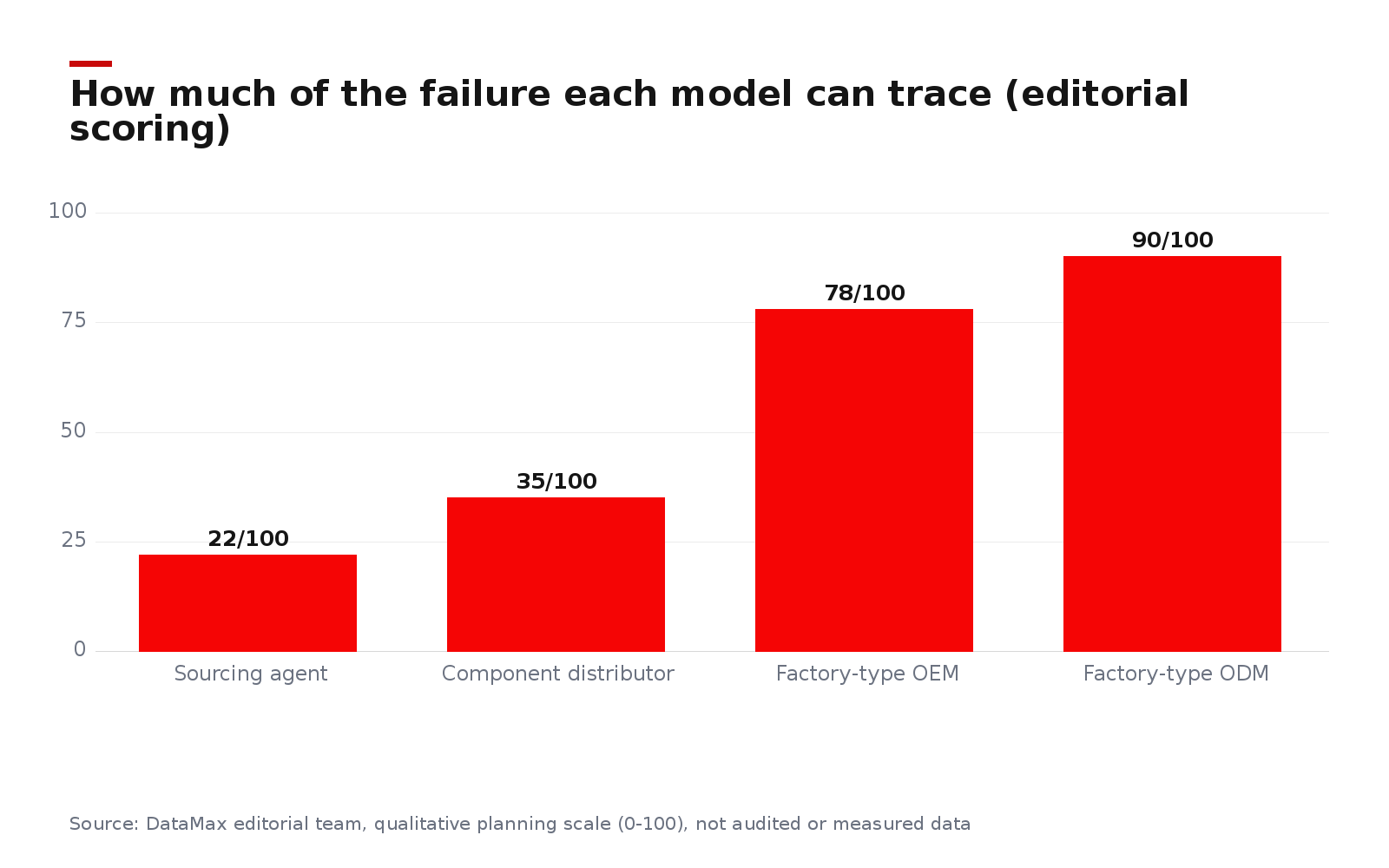
The same figures, in searchable form:
| Model type | Editorial score |
|---|---|
| Sourcing agent | 22/100 |
| Component distributor | 35/100 |
| Factory-type OEM | 78/100 |
| Factory-type ODM | 90/100 |
These scores are comparative editorial judgments on a 0-100 planning scale, not audited results. A score of 90/100 for the factory-type ODM reflects the editorial expectation that design, software, and manufacturing records can be connected more directly; it is not a warranty, performance guarantee, or substitute for an audit. The 22/100 and 35/100 entries indicate greater traceability distance, not evidence of poor intent or inevitable defects.
Where this matters in a deployment: map situation to requirement
The same hardware can face different approval gates depending on who operates it. An IPTV operator needs middleware integration, entitlement workflows, multicast or unicast delivery, remote management, and predictable updates. A consumer OTT deployment may prioritize storefront compatibility, signed applications, account isolation, and protected playback. An integrator may need fixed interfaces, display reliability, and controlled recovery rather than broad retail certification.
| Situation | Controlling requirement | Model direction | Approval evidence |
|---|---|---|---|
| IPTV operator | Operator middleware, fleet management, video pipeline | DM21P or DM21S | Middleware image test, network test, update and recovery procedure |
| OTT white-label launch | Android application signing, storefront deployment, playback licensing | DM21S | Software build record, certificate scope, protected-content test |
| Premium UHD/cloud gaming | High-frame-rate decode and sustained performance validation | DM21T | Codec matrix, thermal run test, 4K@120 output validation |
| Gaming-oriented Android TV | Latency, controller path, sustained workload | DM22Q | Input-latency method, workload stability, thermal and output test |
| Hotel or venue display | Recovery after power loss, fixed interfaces, remote update | Direction depends on operator middleware and I/O mix | Pilot burn-in, recovery test, remote-management trial |
A real deployment also tests the boundary between approval and support. Before rollout, conduct a pilot that exercises account login, entitlement, streaming restart, network reconnection, OTA failure recovery, HDMI re-negotiation, remote support, and rollback. For operator projects, verify whether device identity and secure keys are injected during manufacture, at the warehouse, or by the operator’s provisioning system.

The production line is only one part of field readiness. A clean SMT line can produce a mechanically sound unit that still fails because the operator image, signing keys, output profile, or content licence was not approved. Deployment owners should retain the golden sample, factory test record, software build identifier, and shipment serial mapping in the same evidence package.
An IPTV operator deployment adds protocol and fleet questions. The test environment should reproduce the intended content-delivery path, including the selected multicast or unicast behavior, channel changes, entitlement renewal, stream restart, and sustained network loss. A hardware box can decode the stream and still fail at account binding, middleware lifecycle management, or update rollback. The approval owner should therefore include network operations and the middleware supplier, not only the android tv box manufacturer.
A white-label OTT program adds brand and distribution dependencies. The launcher, wallpaper, package signing, privacy disclosures, storefront deployment, account separation, and regional service configuration must match the release. A model with AOSP Android 14 may be a suitable hardware baseline, but the exact image, application bundles, and distribution route need separate approval. This is why a white-label review should capture the complete software artifact set rather than a branded screenshot.
A hotel or venue deployment often values recovery over catalogue breadth. Fixed HDMI and network paths, remote updates, power-loss recovery, kiosk mode, peripheral support, and stable display behavior become central. The model direction depends on the operator middleware and I/O mix, so the matrix deliberately does not force a platform. A pilot should include repeated power cycling, network interruption, screen rotation where relevant, and remote recovery from a managed location.
Premium UHD and cloud-gaming validation shifts toward sustained performance. The project should specify the display’s supported mode, the source’s codec and level, the application path, sustained run duration, thermal condition, network state, and expected recovery. “4K@120” is a test condition, not a complete acceptance criterion. The buyer must define whether the commercial service actually delivers that combination and whether the selected model’s stated path supports it.
The selection sequence that removes rework: from RFQ to approval
The procurement sequence should make each decision auditable before the next one starts.
- Define the operating scope State operator or OTT use, country or territory, network type, account model, middleware, update policy, display equipment, and required peripherals.
- Shortlist by supplied platform facts Use the DataMax model table to select candidates from the stated SoC, Android version, memory, storage, decode, DRM, and port options. Resolve every optional item against the production datasheet.
- Assign ownership Name the party responsible for hardware design, BSP or ROM integration, Google or Android documentation, DRM, operator middleware, certificates, provisioning, OTA, and field escalation.
- Lock the software baseline Record the Android build, firmware revision, application signing method, device-owner policy, regional service configuration, and update/rollback procedure.
- Approve a golden sample Test video modes, codecs, ports, network recovery, protected playback, performance, thermal behaviour, remote management, and user-facing workflow against the written acceptance criteria.
- Audit production equivalence Review BOM revision, component traceability, SMT and test records, firmware flashing, aging, dark-room checks, and change-control records.
- Release conditionally Define the permitted shipment window, audit frequency, defect threshold, corrective-action process, and evidence required for every production lot.
A usable RFQ should contain paste-ready specification lines rather than general quality language. Examples include: “AOSP Android 14, exact build and security patch level to be stated”; “Widevine L1, PlayReady, and HDCP obligations to be stated per ordered SKU”; “HDMI 2.0b output, no HDMI input”; “RJ45 100M as standard, 1G optional pending datasheet confirmation”; and “each serial number traceable to hardware revision, firmware image, test result, and packing record.”
The first message sent through sample ordering should include the target model, required RAM/storage and port options, software and middleware assumptions, destination market, expected codec use, protected-content needs, the proposed test protocol, and the evidence package required before approval.
The RFQ should separate baseline hardware from variable software. A stable line might specify Amlogic S905X5M, quad Cortex-A55 up to 2.5GHz, AOSP Android 14, and 4GB/64GB for a DM22Q direction. A variable line should identify optional storage, optional 1G Ethernet, and any optional protected-content features as confirmation items. This structure lets the supplier quote a defined configuration while avoiding a false assumption that every family option is present in every SKU.
Each acceptance criterion needs an objective method. “Video works” becomes source format, resolution, frame rate, application, display mode, and expected result. “Stable network” becomes reconnect interval, packet-loss condition, stream restart behavior, and recovery target defined by the project. “Protected playback” becomes the applicable DRM path, content source, output path, and pass condition. The android tv box manufacturer can then demonstrate the method without substituting an internal default test.
A second RFQ table should identify proposed substitutions and prohibited changes. For each part, it should list the approved manufacturer and part number, the reason for substitution, equivalence evidence, firmware or driver impact, validation plan, and approval authority. The rule should be simple: no substitution enters production until engineering and the program owner accept the revised configuration.
The order of gates matters. Selecting a model before defining the software can produce an incompatible platform. Locking software before confirming the port and decode path can produce an untestable build. Approving a golden sample before defining shipment evidence can make the factory unable to demonstrate equivalence. The sequence closes those loops in that order.
Failure modes that reach the field: identify where quotations diverge
Field trap
A quotation that combines “Android TV,” AOSP, Google TV, and operator certification as interchangeable labels leaves the approval boundary undefined. The buyer may receive a functional box but receive no valid certificate, unsupported operator image, or missing playback licence path.
The first failure mode is configuration drift. A quotation may list Widevine L1 while the ordered SKU omits the required licence or certificate arrangement. Another may show 1G Ethernet even though the standard configuration is 100M. Optional Dolby Vision/DTS wording can similarly be mistaken for universal availability. The corrective action is to freeze a SKU matrix after sample approval and require the production datasheet, approved sample, and shipment record to use matching identifiers.
Configuration drift also affects storage and memory. DM21P is listed as 2GB/8GB with 4GB and 16/32/64GB options; DM21S and DM22Q have broader family options; DM21T has a 4GB/64GB family baseline. A purchase order that says only the model name leaves the supplier to choose a variant. The buyer should write the selected RAM/storage pair into the SKU code, golden-sample record, packing label, and factory test record.
The second failure mode is output overstatement. A marketing name can imply a resolution ceiling that the actual output and decode path does not support. For DM21T and DM22Q, approval should use the supplied 4K decode limits; no 8K output claim should be accepted. Test the selected source format, display mode, application path, and output configuration as one chain.
A related interface mismatch can make the video test fail for an unrelated reason. DM21T has HDMI 2.0b output and no HDMI input. The several models list RJ45 100M, with 1G described as optional for DM21S, DM21T, and DM22Q. An RFQ that assumes 1G or input functionality changes the approved electrical and software baseline. Exact port options must be confirmed against the production datasheet.
The third failure mode is a disconnected software owner. Factory firmware may pass a basic user-interface review while key injection, entitlement binding, background recovery, or OTA rollback fails. The buyer needs a named software owner, defect severity definitions, reproduction steps, and escalation timing.
Field trap
A pre-shipment inspection that checks only boot, display, and remote-control response can miss DRM integration, operator account recovery, update interruption, and network failover. Expanding the visual check without expanding functional coverage leaves the field risk unchanged.
A fourth divergence concerns evidence age. Certificates, software declarations, factory processes, and test fixtures can all change. The approval file needs issue dates, revision numbers, and review triggers. For each deployment phase—engineering sample, pilot, first production lot, and repeat order—reconcile the configuration again.
A fifth field risk is incomplete lot traceability. A test record showing a pass is useful only if the reviewer can connect the tested unit or fixture to the production lot, hardware revision, firmware image, component lots, and serial range. If the association is missing, the buyer cannot determine whether an exception was isolated, corrected, or carried into later units.
The sixth risk is an unowned certificate or licence renewal. A device may ship correctly and fail later when a document expires, a key changes, or a software revision alters protected-content behavior. The programme owner should define review intervals and an exception process for certificates, DRM provisioning, security settings, and certificate-holder changes. This keeps the android tv box manufacturer from becoming the default owner of obligations that were never assigned contractually.
The evidence trail from SMT to shipment: control every variable
The factory must connect line output to the same approval baseline used by the buyer. The evidence trail begins before SMT with a released BOM, schematic and layout revision, firmware package, firmware version, and approved configuration record. Component lots need traceability to the assembly record and finished serial number.
- Incoming control Verify approved part identity, lot documentation, storage conditions, and substitutions before components enter the line.
- SMT and AOI Record line setup, feeder or placement verification, AOI results, defect disposition, and first-piece approval against the released package.
- Assembly and firmware Capture board revision, image identifier, provisioning results, serial-number association, and rework records.
- Functional and aging Apply the agreed checklist for ports, video, network, input, remote control, stability, and the agreed burn-in or aging procedure.
- Dark-room and visual inspection Document display, enclosure, labelling, accessories, and approved cosmetic criteria under the defined lighting condition.
- Final audit and shipment Compare the lot against the golden sample, reconcile test exceptions, close nonconformities, and archive the packing and serial-number records.
The shipment evidence package should contain the lot traceability map, AOI and functional-test summary, aging record, dark-room inspection report, firmware identification, approved configuration, exception disposition, and packing list. The audit should verify records against physical samples, not merely accept spreadsheets.
Use DataMax factory-quality evidence to define the review scope before sampling. For certificates, DRM, and security provisions, confirm the documents and obligations for each ordered SKU through certification review or compliance review; a catalogue page is not proof that a specific production configuration carries the same approval. The final sign-off should connect the selected DataMax model, software owner, certificate scope, test plan, and serial-level shipment record in one review package.
The incoming-control record should carry more than a received-part count. It should identify the manufacturer, part number, lot or batch, inspection result, storage condition where relevant, and approved substitution status. The release file must show which BOM revision the line is configured to run. A mismatch between the approved engineering package and the line BOM is a stop condition because visual similarity between components does not establish electrical, firmware, or RF equivalence.
SMT and AOI evidence closes the mechanical side of the baseline. Line setup, placement or feeder verification, first-piece approval, AOI results, and defect disposition should use the released revision. Repairs require authorization, rework record, reinspection, and a statement of whether the affected unit remained within the approved configuration. Reworked units should not disappear into an undifferentiated pass count.
Firmware flashing and provisioning need equal control. The evidence should identify the board revision, image package, flashing result, provisioning result, and serial number. For operator deployments, the device identifier and secure-key path must match the agreed architecture. If a unit was flashed more than once, the final image and failed intermediate step should both remain traceable.
Functional and aging records convert the written test plan into evidence. The plan should cover ports, supported video modes, network recovery, inputs, remote control, stability, and the agreed burn-in or aging procedure. The exact duration and sample plan must come from the project acceptance criteria; a generic factory burn-in statement does not establish suitability for a particular workload.
Dark-room and visual inspection provides the final enclosure, display, labelling, accessory, and cosmetic comparison against the approved criteria. It does not replace functional testing. A correctly packaged unit can still carry the wrong firmware or a mismatched option. The buyer should retain the approved golden sample, current fixture, and image identifier so that the visual audit uses the same reference baseline.
The final lot review should reconcile physical units, records, and the packing list. Open exceptions need disposition, retest evidence, and authorization; unresolved exceptions should not disappear through a blanket release. For repeat orders, the same trail should establish whether the factory or ODM remains production-equivalent to the approved model. That continuous chain is what lets an android tv box manufacturer demonstrate control rather than merely possession of a quality certificate.
Further reading
- Android TV Box OEM: What Procurement Should Ask First
- Telecom solutions
- United States compliance notes
- Android TV boxes
- Rockchip Android TV boxes
- DataMax DM21P specifications and fit
- DataMax DM21S specifications and fit
FAQ
What should a buyer confirm before approving an Android TV Box manufacturer?
Confirm the exact ordered SKU, design responsibility, Android or Google TV software owner, certification scope, DRM and HDCP obligations, port configuration, operator middleware, production-equivalence controls, and shipment evidence. Require revisioned documents and a golden sample rather than relying on family-level marketing. The approval should also assign responsibility for OTA, secure keys, defect escalation, and substitutions.
Does AOSP Android 14 mean the box is Google TV certified?
No. AOSP Android 14 identifies the software base, not the Google TV program approval. Ask for the exact product and software revision covered by the relevant Google or Android documentation, plus the responsible certificate holder. Certification, Android compatibility, operator acceptance, and protected-content requirements may be separate approval activities with separate evidence.
Which DataMax model fits a 4K IPTV project?
DM21P is positioned for 4K IPTV and operator middleware set-top boxes, while DM21S fits 4K Android TV IPTV/OTT white-label work. The supplied facts show AOSP Android 11 for DM21P and AOSP Android 14 for DM21S. Confirm the exact middleware image, Google TV decision, optional DRAM features, and final production datasheet before approval.
What evidence should be reviewed before shipment approval?
Review the released configuration, component traceability, SMT and AOI records, firmware identification, functional test results, agreed aging evidence, dark-room report, exception disposition, and serial-number-to-packing reconciliation. Also compare retained samples with the approved golden sample. A first-article sample validates one unit; the shipment review establishes whether production remains equivalent.
Can one quotation cover every DataMax model as Google TV approved?
No. The supplied DataMax facts specify AOSP Android versions, not Google TV certification, and DRM or interface features can be optional. Request model-specific and SKU-specific evidence, including the exact software build and certificate scope. For programme decisions, use custom development planning and the AOSP versus Google Android TV guide alongside direct programme clarification.
Who owns a failure between the factory, software partner, and operator?
Ownership follows the approval matrix rather than the physical location of the factory. The party that controls the failed element must investigate it, while the programme owner coordinates containment, retest, corrective action, and release status. For example, an image provisioning failure belongs to the software or provisioning owner, while a missing component belongs to production control. The first RFQ message should state the model, ordered options, software baseline, middleware, protected-content requirements, destination market, test method, and required evidence.


